SUBSCRIBE TO OUR FREE NEWSLETTER
Daily news & progressive opinion—funded by the people, not the corporations—delivered straight to your inbox.
5
#000000
#FFFFFF
To donate by check, phone, or other method, see our More Ways to Give page.
Daily news & progressive opinion—funded by the people, not the corporations—delivered straight to your inbox.
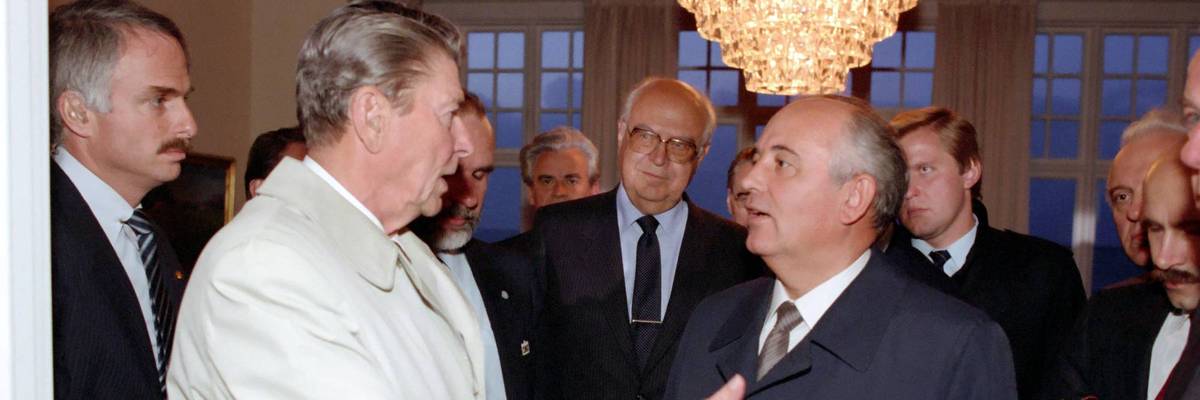
Ronald Reagan and Mikhail Gorbachev greet each other in Höfði in Reykjavík, Iceland.
Four decades ago, US and Russian leaders came closer than ever to eliminating all nuclear weapons. How can we keep that vision alive today?
Forty years ago this week President Ronald Reagan and Secretary General Mikhail Gorbachev met from October 11-12 in Reykjavík, Iceland in a hastily organized summit that came closer to the complete elimination of all nuclear weapons than at any point in our nuclear age. This was a time at the peak of the Cold War, when there were roughly 70,000 nuclear weapons in the global arsenals and the Bulletin of Atomic Scientists Doomsday Clock was set at three minutes till midnight.
Meeting in Geneva in November 1985, the year before, the two leaders made their joint declaration that “a nuclear war cannot be won and must never be fought.” The two Cold Warriors shared an understanding of the horror of nuclear weapons.
The Icelandic summit between the two leaders came together quickly after Reagan gave a speech to the United Nations General Assembly in September 1986 calling for a nuclear arms reduction accord. This was followed closely by Secretary General Gorbachev extending an offer to meet in October culminating in the Icelandic Summit.
Nuclear war is a real and present danger. It is not a future that must be. But it is the future that will be if we do not act.
At Reykjavík, Gorbachev argued for a 50% reduction in strategic nuclear weapons and total elimination of all intermediate range missiles deployed in Europe. Back-and-forth discussions continued throughout the summit, and in the final hours, Reagan proposed the complete elimination of ALL nuclear arms. The caveat was his unwavering commitment to the flawed Strategic Defense Initiative or so-called “Star Wars,” a protective shield over the planet to protect from nuclear attack. He wanted testing and development to be allowed in space.
In the final hours, Gorbachev insisted that testing be limited to the labs and not in space. And thus the talks collapsed and humanity lost its greatest chance to date to eliminate these weapons.
This summit paved the way for continued dialogue and, in the years to follow, serious, though far less magnanimous, arms control agreements were reached. These included the Intermediate Nuclear Force Treaty, INF, which eliminated an entire class of nuclear weapons, and the 1991 START Treaty dramatically removing approximately 80% of the world's strategic nuclear weapons.
Fast forward 40 years to October 2026. While there have been dramatic reductions in global nuclear arsenals to 12,187 weapons we find ourselves much closer to nuclear war than at any time throughout the entire 81-year nuclear age.
We have the leaders of the two largest nuclear powers reminding the world of their nuclear arsenals and threatening to use them, whether in Russia’s war on Ukraine or Trump‘s repeated threats throughout his terms, both in terms of nuclear button size envy and threats to bring fire and fury on adversaries. His lack of leadership in arms control has allowed treaties to expire on his watch. His careless media bravado in April, posting “a whole civilization will die tonight never to be brought back again,” does little to resolve crises of his own making. Just last month, speaking to world leaders at the 81st opening sessions of the United Nations General Assembly, he asked, “Would there be a deal that let Iran rebuild a greater country than it ever was before?“ After which he considered whether to “annihilate the Islamic Republic” and “drive them into hell with no chance of survival and hope of future greatness or generations?“
Analogous to “Star Wars,“ Trump‘s obsession with being top dog has resulted in his own “Golden Dome,” a proposal to provide an impenetrable shield from a nuclear attack. At a projected cost of $1.2 trillion, the program with a projected success rate of 80% would be better named the “golden sieve.”
Taking into account these nuclear realities, the Bulletin of Atomic Scientists this year moved their Doomsday Clock minute hand to 85 seconds to midnight, which is the closest it has ever been since its inception.
In making their decision they have considered:
Nuclear war is a real and present danger. It is not a future that must be. But it is the future that will be if we do not act. If we do nothing then it is not a matter of “if” nuclear weapons will be used, it is a question of “when.” There are no “right hands” when it comes to controlling the nuclear button, but it is obvious that Trump’s hand must be removed from that possibility. As citizens, we must demand the United States move Back From the Brink of nuclear war, and lead a global effort to abolish these weapons once and for all.
Dear Common Dreams reader, It’s been nearly 30 years since I co-founded Common Dreams with my late wife, Lina Newhouser. We had the radical notion that journalism should serve the public good, not corporate profits. It was clear to us from the outset what it would take to build such a project. No paid advertisements. No corporate sponsors. No millionaire publisher telling us what to think or do. Many people said we wouldn't last a year, but we proved those doubters wrong. Together with a tremendous team of journalists and dedicated staff, we built an independent media outlet free from the constraints of profits and corporate control. Our mission has always been simple: To inform. To inspire. To ignite change for the common good. Building Common Dreams was not easy. Our survival was never guaranteed. When you take on the most powerful forces—Wall Street greed, fossil fuel industry destruction, Big Tech lobbyists, and uber-rich oligarchs who have spent billions upon billions rigging the economy and democracy in their favor—the only bulwark you have is supporters who believe in your work. But here’s the urgent message from me today. It's never been this bad out there. And it's never been this hard to keep us going. At the very moment Common Dreams is most needed, the threats we face are intensifying. We need your support now more than ever. We don't accept corporate advertising and never will. We don't have a paywall because we don't think people should be blocked from critical news based on their ability to pay. Everything we do is funded by the donations of readers like you. When everyone does the little they can afford, we are strong. But if that support retreats or dries up, so do we. Will you donate now to make sure Common Dreams not only survives but thrives? —Craig Brown, Co-founder |
Forty years ago this week President Ronald Reagan and Secretary General Mikhail Gorbachev met from October 11-12 in Reykjavík, Iceland in a hastily organized summit that came closer to the complete elimination of all nuclear weapons than at any point in our nuclear age. This was a time at the peak of the Cold War, when there were roughly 70,000 nuclear weapons in the global arsenals and the Bulletin of Atomic Scientists Doomsday Clock was set at three minutes till midnight.
Meeting in Geneva in November 1985, the year before, the two leaders made their joint declaration that “a nuclear war cannot be won and must never be fought.” The two Cold Warriors shared an understanding of the horror of nuclear weapons.
The Icelandic summit between the two leaders came together quickly after Reagan gave a speech to the United Nations General Assembly in September 1986 calling for a nuclear arms reduction accord. This was followed closely by Secretary General Gorbachev extending an offer to meet in October culminating in the Icelandic Summit.
Nuclear war is a real and present danger. It is not a future that must be. But it is the future that will be if we do not act.
At Reykjavík, Gorbachev argued for a 50% reduction in strategic nuclear weapons and total elimination of all intermediate range missiles deployed in Europe. Back-and-forth discussions continued throughout the summit, and in the final hours, Reagan proposed the complete elimination of ALL nuclear arms. The caveat was his unwavering commitment to the flawed Strategic Defense Initiative or so-called “Star Wars,” a protective shield over the planet to protect from nuclear attack. He wanted testing and development to be allowed in space.
In the final hours, Gorbachev insisted that testing be limited to the labs and not in space. And thus the talks collapsed and humanity lost its greatest chance to date to eliminate these weapons.
This summit paved the way for continued dialogue and, in the years to follow, serious, though far less magnanimous, arms control agreements were reached. These included the Intermediate Nuclear Force Treaty, INF, which eliminated an entire class of nuclear weapons, and the 1991 START Treaty dramatically removing approximately 80% of the world's strategic nuclear weapons.
Fast forward 40 years to October 2026. While there have been dramatic reductions in global nuclear arsenals to 12,187 weapons we find ourselves much closer to nuclear war than at any time throughout the entire 81-year nuclear age.
We have the leaders of the two largest nuclear powers reminding the world of their nuclear arsenals and threatening to use them, whether in Russia’s war on Ukraine or Trump‘s repeated threats throughout his terms, both in terms of nuclear button size envy and threats to bring fire and fury on adversaries. His lack of leadership in arms control has allowed treaties to expire on his watch. His careless media bravado in April, posting “a whole civilization will die tonight never to be brought back again,” does little to resolve crises of his own making. Just last month, speaking to world leaders at the 81st opening sessions of the United Nations General Assembly, he asked, “Would there be a deal that let Iran rebuild a greater country than it ever was before?“ After which he considered whether to “annihilate the Islamic Republic” and “drive them into hell with no chance of survival and hope of future greatness or generations?“
Analogous to “Star Wars,“ Trump‘s obsession with being top dog has resulted in his own “Golden Dome,” a proposal to provide an impenetrable shield from a nuclear attack. At a projected cost of $1.2 trillion, the program with a projected success rate of 80% would be better named the “golden sieve.”
Taking into account these nuclear realities, the Bulletin of Atomic Scientists this year moved their Doomsday Clock minute hand to 85 seconds to midnight, which is the closest it has ever been since its inception.
In making their decision they have considered:
Nuclear war is a real and present danger. It is not a future that must be. But it is the future that will be if we do not act. If we do nothing then it is not a matter of “if” nuclear weapons will be used, it is a question of “when.” There are no “right hands” when it comes to controlling the nuclear button, but it is obvious that Trump’s hand must be removed from that possibility. As citizens, we must demand the United States move Back From the Brink of nuclear war, and lead a global effort to abolish these weapons once and for all.
Forty years ago this week President Ronald Reagan and Secretary General Mikhail Gorbachev met from October 11-12 in Reykjavík, Iceland in a hastily organized summit that came closer to the complete elimination of all nuclear weapons than at any point in our nuclear age. This was a time at the peak of the Cold War, when there were roughly 70,000 nuclear weapons in the global arsenals and the Bulletin of Atomic Scientists Doomsday Clock was set at three minutes till midnight.
Meeting in Geneva in November 1985, the year before, the two leaders made their joint declaration that “a nuclear war cannot be won and must never be fought.” The two Cold Warriors shared an understanding of the horror of nuclear weapons.
The Icelandic summit between the two leaders came together quickly after Reagan gave a speech to the United Nations General Assembly in September 1986 calling for a nuclear arms reduction accord. This was followed closely by Secretary General Gorbachev extending an offer to meet in October culminating in the Icelandic Summit.
Nuclear war is a real and present danger. It is not a future that must be. But it is the future that will be if we do not act.
At Reykjavík, Gorbachev argued for a 50% reduction in strategic nuclear weapons and total elimination of all intermediate range missiles deployed in Europe. Back-and-forth discussions continued throughout the summit, and in the final hours, Reagan proposed the complete elimination of ALL nuclear arms. The caveat was his unwavering commitment to the flawed Strategic Defense Initiative or so-called “Star Wars,” a protective shield over the planet to protect from nuclear attack. He wanted testing and development to be allowed in space.
In the final hours, Gorbachev insisted that testing be limited to the labs and not in space. And thus the talks collapsed and humanity lost its greatest chance to date to eliminate these weapons.
This summit paved the way for continued dialogue and, in the years to follow, serious, though far less magnanimous, arms control agreements were reached. These included the Intermediate Nuclear Force Treaty, INF, which eliminated an entire class of nuclear weapons, and the 1991 START Treaty dramatically removing approximately 80% of the world's strategic nuclear weapons.
Fast forward 40 years to October 2026. While there have been dramatic reductions in global nuclear arsenals to 12,187 weapons we find ourselves much closer to nuclear war than at any time throughout the entire 81-year nuclear age.
We have the leaders of the two largest nuclear powers reminding the world of their nuclear arsenals and threatening to use them, whether in Russia’s war on Ukraine or Trump‘s repeated threats throughout his terms, both in terms of nuclear button size envy and threats to bring fire and fury on adversaries. His lack of leadership in arms control has allowed treaties to expire on his watch. His careless media bravado in April, posting “a whole civilization will die tonight never to be brought back again,” does little to resolve crises of his own making. Just last month, speaking to world leaders at the 81st opening sessions of the United Nations General Assembly, he asked, “Would there be a deal that let Iran rebuild a greater country than it ever was before?“ After which he considered whether to “annihilate the Islamic Republic” and “drive them into hell with no chance of survival and hope of future greatness or generations?“
Analogous to “Star Wars,“ Trump‘s obsession with being top dog has resulted in his own “Golden Dome,” a proposal to provide an impenetrable shield from a nuclear attack. At a projected cost of $1.2 trillion, the program with a projected success rate of 80% would be better named the “golden sieve.”
Taking into account these nuclear realities, the Bulletin of Atomic Scientists this year moved their Doomsday Clock minute hand to 85 seconds to midnight, which is the closest it has ever been since its inception.
In making their decision they have considered:
Nuclear war is a real and present danger. It is not a future that must be. But it is the future that will be if we do not act. If we do nothing then it is not a matter of “if” nuclear weapons will be used, it is a question of “when.” There are no “right hands” when it comes to controlling the nuclear button, but it is obvious that Trump’s hand must be removed from that possibility. As citizens, we must demand the United States move Back From the Brink of nuclear war, and lead a global effort to abolish these weapons once and for all.