SUBSCRIBE TO OUR FREE NEWSLETTER
Daily news & progressive opinion—funded by the people, not the corporations—delivered straight to your inbox.
5
#000000
#FFFFFF
To donate by check, phone, or other method, see our More Ways to Give page.
Daily news & progressive opinion—funded by the people, not the corporations—delivered straight to your inbox.
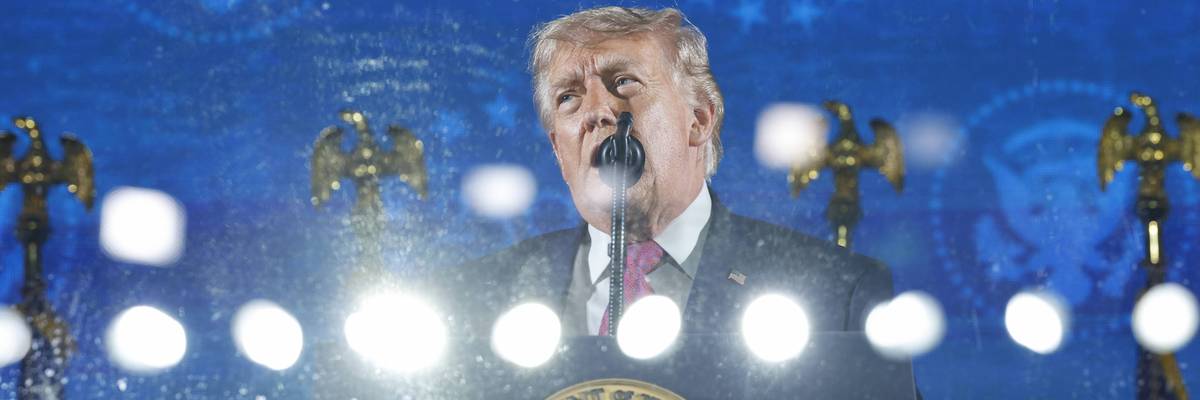
US President Donald Trump speaks during a rally at Mount Rushmore National Memorial on July 3, 2026 in Keystone, South Dakota.
President Donald Trump has reenergized the Red Scare by labeling Democrats as communists, but this is ironic as today’s real threat is Trump’s authoritarianism and his dictatorial goals.
In his 1951 treatise, The True Believer, Eric Hoffer saw the fanatical leaders of communist and fascist states—Joseph Stalin and Adolf Hitler specifically—as fundamentally products of the same cloth, cloth different from, he quoted, the “Social-Democrat and the trade-union boss.” Stalin may have been a communist and Hitler a fascist, but similarly each a dictator.
Stalin forged a centralized, and brutal, control of the national economy under the guise of continuing the proletarian class struggle earlier led by Vladimir Lenin. Hitler led a racial struggle murdering millions of Jews and others with the goal of establishing a nation for the so-called Aryan race.
Today, with the midterm elections in November, President Donald Trump frames Democrats as the embodiment of communism, as the authoritarian threat America faces. This while Trump has also praised the communist leader, Xi Jinping, in China; Vladimir Putin in Russia; and the right-wing leadership of Viktor Orbán in Hungary, among similar leaders.
the hypocrisy is clear in Trump saying if Democrats win in the midterm elections they would threaten individual liberty as a caucus of communists.
And what is the leadership style shared by Orbán, Jinping, and Putin? Authoritarianism is the correct answer. Leaders, in Hoffer’s treatise, of the same cloth. Cloth Trump appears to want to dress himself in.
Since the defeat of Hitler, with the advent of the Cold War after World War II, communism has been seen as the major threat to the American way of life. Concern with the global spread of communism, after all, framed the context leading the US into the Vietnam War.
Richard Nixon, when the vice president, wrote on the threat of communism opening his essay in 1960 stating that, I quote, the “major problem confronting the people of the United States and free peoples everywhere in the last half of the 20th century is the threat to peace and freedom presented by the militant aggressiveness of international communism.”
Nixon’s warning followed the Red Scare that gripped America after World War II, often referred to as McCarthyism for the Wisconsin senator, Joseph McCarthy. McCarthy’s singular claim to fame, and eventual disgrace, was his anti-communism agenda in the 1950s as the chair of the Senate Permanent Investigation Subcommittee with his allegations of communist infiltration in the US government, the Army and, notoriously, Hollywood.
President Trump in his speech on July 4, during this year’s celebration of the 250th anniversary of the United States on the National Mall, hailed the triumph over both fascism and communism saying that “after we vanquished fascism [in World War II], Americans stood against the evil of communism in the Cold War.”
Ever since, as far as I am aware, he hasn’t mentioned any war against fascism. He targeted only communism in the reminder of his speech on July 4, telling the audience: “America will never be a communist country. Won’t happen... It’s like a cancer. You have to cut it out and you got to cut it out fast.”
Trump has polished his aim as the midterm elections in November have grown closer, alluding to the Democratic Party becoming the seat of communism in America. At the Republican midterm convention in Texas on September 9, Trump said that (his words) “the Democrat establishment has been overthrown and replaced by crazed lunatics and radicals. They call themselves Democrat socialists, but actually they’re communists.” Then he added that if “they win the greatest legislative body in history will for the first time ever be controlled by a communist caucus.”
In labeling Democratic candidates as communist, Trump diverts attention from failures in his policies and his growing and sustained disapproval.
The backdrop to Trump’s painting votes for Democrats as a vote for a communist takeover of the United States has been the emergence of a small minority of Democratic candidates with membership in the Democratic Socialists of America (DSA), following the success of Zohran Mamdani, New York City’s DSA-member mayor.
With that backdrop fueling Trump’s anti-communism rhetoric, other Democratic candidates in the midterm elections unaffiliated with DSA, like Michigan’s Democratic Senate candidate Abdul El-Sayed, have even had to emphasize they are not socialists and embrace capitalism.
The terms “socialism” and “communism” seem for many to represent the same entity, though in practice meaningful distinctions exist. In any case, polls have focused on opinions of socialism.
The subtitle to a research report in 2022 from Pew Research Center on views of socialism among Americans reads: “Many Democrats say socialism meets people’s basic needs; Republicans say it restricts individual freedoms.”
Among Democrats and those Democrat leaning in 2019, 65% reported viewing socialism positively, with 57% so viewing in 2022. Only 15% of Republican and Republican-leaning voters held a positive view of socialism in 2019, with 14% doing so in 2022.
In a more recent survey by Gallup in 2026, 65% of Democrats had an overall positive view of socialism compared with 45% among Independents and 14% of Republicans.
Regarding Authoritarianism. In her 2016 article at Vox, Amanda Taub chronicled research on how the rise of American authoritarianism, especially in the Republican Party, preceded and fertilized Trump’s rise to power. She highlighted the work of social scientists like Stanley Feldman, who saw authoritarianism more as a personality trait than simply a political preference. A trait highly valuing hierarchy, order, and conformity over other attributes. A trait Feldman measured by four questions on child-rearing goals, such as, “Please tell me which one you think is more important for a child to have: obedience or self-reliance?”
Vox commissioned a study in 2016 on the relationship between authoritarianism and perceived threats to one’s way of life. Summarizing some of the findings, Taub wrote:
…that 44% of white respondents nationwide scored as "high" or "very high" authoritarians, [and that] people in this 44% only vote or otherwise act as authoritarians once triggered by some perceived threat, physical or social. But that latency is part of how, over the past few decades, authoritarians have quietly become a powerful political constituency without anyone realizing it.
Over 65% of those scoring highest on Feldman’s authoritarianism scale were Republican voters. Whereas individuals whose scores were the most non-authoritarian, by always selecting the non-authoritarian parenting answers, were almost 75% Democrats.
These results, Taub emphasized, didn’t mean authoritarian-leaning folks were inherently Republicans. Rather, changes in the Republican Party’s platform attracted more authoritarians. Becoming the party promising “to stave off social change and, if necessary, to impose order happened to speak powerfully to voters with authoritarian inclinations,” Taub wrote. On the other hand, Taub wrote, “Democrats, by contrast, have positioned themselves as the party of civil rights, equality, and social progress—in other words, as the party of social change, a position that not only fails to attract but actively repels change-averse authoritarians.”
A more recent study in 2024 by the Public Religion Research Institute had related findings using a different measure of authoritarianism, the Right-Wing Authoritarian Scale. Among Republicans, 67% scored high on this authoritarianism scale, compared with only 35% among independents and 28% of Democrats.
A Perplexing Phenomenon. Those with more authoritarian inclinations, that is Republicans, are also more likely to view socialism as an authoritarian menace threatening their freedoms.
Perhaps the answer to this riddle is that the scope of concern over freedom among those with ingrained authoritarian traits may be more limited to concerns over their freedoms only, not freedoms among other groups; a hypothesis worthy of further study.
Whatever the case, the hypocrisy is clear in Trump saying if Democrats win in the midterm elections they would threaten individual liberty as a caucus of communists.
The Republican Party remains today a major seat of authoritarianism in the United States, and the supportive arm of Trump’s would-be dictatorial rule threatening individual freedoms.
Dear Common Dreams reader, It’s been nearly 30 years since I co-founded Common Dreams with my late wife, Lina Newhouser. We had the radical notion that journalism should serve the public good, not corporate profits. It was clear to us from the outset what it would take to build such a project. No paid advertisements. No corporate sponsors. No millionaire publisher telling us what to think or do. Many people said we wouldn't last a year, but we proved those doubters wrong. Together with a tremendous team of journalists and dedicated staff, we built an independent media outlet free from the constraints of profits and corporate control. Our mission has always been simple: To inform. To inspire. To ignite change for the common good. Building Common Dreams was not easy. Our survival was never guaranteed. When you take on the most powerful forces—Wall Street greed, fossil fuel industry destruction, Big Tech lobbyists, and uber-rich oligarchs who have spent billions upon billions rigging the economy and democracy in their favor—the only bulwark you have is supporters who believe in your work. But here’s the urgent message from me today. It's never been this bad out there. And it's never been this hard to keep us going. At the very moment Common Dreams is most needed, the threats we face are intensifying. We need your support now more than ever. We don't accept corporate advertising and never will. We don't have a paywall because we don't think people should be blocked from critical news based on their ability to pay. Everything we do is funded by the donations of readers like you. When everyone does the little they can afford, we are strong. But if that support retreats or dries up, so do we. Will you donate now to make sure Common Dreams not only survives but thrives? —Craig Brown, Co-founder |
In his 1951 treatise, The True Believer, Eric Hoffer saw the fanatical leaders of communist and fascist states—Joseph Stalin and Adolf Hitler specifically—as fundamentally products of the same cloth, cloth different from, he quoted, the “Social-Democrat and the trade-union boss.” Stalin may have been a communist and Hitler a fascist, but similarly each a dictator.
Stalin forged a centralized, and brutal, control of the national economy under the guise of continuing the proletarian class struggle earlier led by Vladimir Lenin. Hitler led a racial struggle murdering millions of Jews and others with the goal of establishing a nation for the so-called Aryan race.
Today, with the midterm elections in November, President Donald Trump frames Democrats as the embodiment of communism, as the authoritarian threat America faces. This while Trump has also praised the communist leader, Xi Jinping, in China; Vladimir Putin in Russia; and the right-wing leadership of Viktor Orbán in Hungary, among similar leaders.
the hypocrisy is clear in Trump saying if Democrats win in the midterm elections they would threaten individual liberty as a caucus of communists.
And what is the leadership style shared by Orbán, Jinping, and Putin? Authoritarianism is the correct answer. Leaders, in Hoffer’s treatise, of the same cloth. Cloth Trump appears to want to dress himself in.
Since the defeat of Hitler, with the advent of the Cold War after World War II, communism has been seen as the major threat to the American way of life. Concern with the global spread of communism, after all, framed the context leading the US into the Vietnam War.
Richard Nixon, when the vice president, wrote on the threat of communism opening his essay in 1960 stating that, I quote, the “major problem confronting the people of the United States and free peoples everywhere in the last half of the 20th century is the threat to peace and freedom presented by the militant aggressiveness of international communism.”
Nixon’s warning followed the Red Scare that gripped America after World War II, often referred to as McCarthyism for the Wisconsin senator, Joseph McCarthy. McCarthy’s singular claim to fame, and eventual disgrace, was his anti-communism agenda in the 1950s as the chair of the Senate Permanent Investigation Subcommittee with his allegations of communist infiltration in the US government, the Army and, notoriously, Hollywood.
President Trump in his speech on July 4, during this year’s celebration of the 250th anniversary of the United States on the National Mall, hailed the triumph over both fascism and communism saying that “after we vanquished fascism [in World War II], Americans stood against the evil of communism in the Cold War.”
Ever since, as far as I am aware, he hasn’t mentioned any war against fascism. He targeted only communism in the reminder of his speech on July 4, telling the audience: “America will never be a communist country. Won’t happen... It’s like a cancer. You have to cut it out and you got to cut it out fast.”
Trump has polished his aim as the midterm elections in November have grown closer, alluding to the Democratic Party becoming the seat of communism in America. At the Republican midterm convention in Texas on September 9, Trump said that (his words) “the Democrat establishment has been overthrown and replaced by crazed lunatics and radicals. They call themselves Democrat socialists, but actually they’re communists.” Then he added that if “they win the greatest legislative body in history will for the first time ever be controlled by a communist caucus.”
In labeling Democratic candidates as communist, Trump diverts attention from failures in his policies and his growing and sustained disapproval.
The backdrop to Trump’s painting votes for Democrats as a vote for a communist takeover of the United States has been the emergence of a small minority of Democratic candidates with membership in the Democratic Socialists of America (DSA), following the success of Zohran Mamdani, New York City’s DSA-member mayor.
With that backdrop fueling Trump’s anti-communism rhetoric, other Democratic candidates in the midterm elections unaffiliated with DSA, like Michigan’s Democratic Senate candidate Abdul El-Sayed, have even had to emphasize they are not socialists and embrace capitalism.
The terms “socialism” and “communism” seem for many to represent the same entity, though in practice meaningful distinctions exist. In any case, polls have focused on opinions of socialism.
The subtitle to a research report in 2022 from Pew Research Center on views of socialism among Americans reads: “Many Democrats say socialism meets people’s basic needs; Republicans say it restricts individual freedoms.”
Among Democrats and those Democrat leaning in 2019, 65% reported viewing socialism positively, with 57% so viewing in 2022. Only 15% of Republican and Republican-leaning voters held a positive view of socialism in 2019, with 14% doing so in 2022.
In a more recent survey by Gallup in 2026, 65% of Democrats had an overall positive view of socialism compared with 45% among Independents and 14% of Republicans.
Regarding Authoritarianism. In her 2016 article at Vox, Amanda Taub chronicled research on how the rise of American authoritarianism, especially in the Republican Party, preceded and fertilized Trump’s rise to power. She highlighted the work of social scientists like Stanley Feldman, who saw authoritarianism more as a personality trait than simply a political preference. A trait highly valuing hierarchy, order, and conformity over other attributes. A trait Feldman measured by four questions on child-rearing goals, such as, “Please tell me which one you think is more important for a child to have: obedience or self-reliance?”
Vox commissioned a study in 2016 on the relationship between authoritarianism and perceived threats to one’s way of life. Summarizing some of the findings, Taub wrote:
…that 44% of white respondents nationwide scored as "high" or "very high" authoritarians, [and that] people in this 44% only vote or otherwise act as authoritarians once triggered by some perceived threat, physical or social. But that latency is part of how, over the past few decades, authoritarians have quietly become a powerful political constituency without anyone realizing it.
Over 65% of those scoring highest on Feldman’s authoritarianism scale were Republican voters. Whereas individuals whose scores were the most non-authoritarian, by always selecting the non-authoritarian parenting answers, were almost 75% Democrats.
These results, Taub emphasized, didn’t mean authoritarian-leaning folks were inherently Republicans. Rather, changes in the Republican Party’s platform attracted more authoritarians. Becoming the party promising “to stave off social change and, if necessary, to impose order happened to speak powerfully to voters with authoritarian inclinations,” Taub wrote. On the other hand, Taub wrote, “Democrats, by contrast, have positioned themselves as the party of civil rights, equality, and social progress—in other words, as the party of social change, a position that not only fails to attract but actively repels change-averse authoritarians.”
A more recent study in 2024 by the Public Religion Research Institute had related findings using a different measure of authoritarianism, the Right-Wing Authoritarian Scale. Among Republicans, 67% scored high on this authoritarianism scale, compared with only 35% among independents and 28% of Democrats.
A Perplexing Phenomenon. Those with more authoritarian inclinations, that is Republicans, are also more likely to view socialism as an authoritarian menace threatening their freedoms.
Perhaps the answer to this riddle is that the scope of concern over freedom among those with ingrained authoritarian traits may be more limited to concerns over their freedoms only, not freedoms among other groups; a hypothesis worthy of further study.
Whatever the case, the hypocrisy is clear in Trump saying if Democrats win in the midterm elections they would threaten individual liberty as a caucus of communists.
The Republican Party remains today a major seat of authoritarianism in the United States, and the supportive arm of Trump’s would-be dictatorial rule threatening individual freedoms.
In his 1951 treatise, The True Believer, Eric Hoffer saw the fanatical leaders of communist and fascist states—Joseph Stalin and Adolf Hitler specifically—as fundamentally products of the same cloth, cloth different from, he quoted, the “Social-Democrat and the trade-union boss.” Stalin may have been a communist and Hitler a fascist, but similarly each a dictator.
Stalin forged a centralized, and brutal, control of the national economy under the guise of continuing the proletarian class struggle earlier led by Vladimir Lenin. Hitler led a racial struggle murdering millions of Jews and others with the goal of establishing a nation for the so-called Aryan race.
Today, with the midterm elections in November, President Donald Trump frames Democrats as the embodiment of communism, as the authoritarian threat America faces. This while Trump has also praised the communist leader, Xi Jinping, in China; Vladimir Putin in Russia; and the right-wing leadership of Viktor Orbán in Hungary, among similar leaders.
the hypocrisy is clear in Trump saying if Democrats win in the midterm elections they would threaten individual liberty as a caucus of communists.
And what is the leadership style shared by Orbán, Jinping, and Putin? Authoritarianism is the correct answer. Leaders, in Hoffer’s treatise, of the same cloth. Cloth Trump appears to want to dress himself in.
Since the defeat of Hitler, with the advent of the Cold War after World War II, communism has been seen as the major threat to the American way of life. Concern with the global spread of communism, after all, framed the context leading the US into the Vietnam War.
Richard Nixon, when the vice president, wrote on the threat of communism opening his essay in 1960 stating that, I quote, the “major problem confronting the people of the United States and free peoples everywhere in the last half of the 20th century is the threat to peace and freedom presented by the militant aggressiveness of international communism.”
Nixon’s warning followed the Red Scare that gripped America after World War II, often referred to as McCarthyism for the Wisconsin senator, Joseph McCarthy. McCarthy’s singular claim to fame, and eventual disgrace, was his anti-communism agenda in the 1950s as the chair of the Senate Permanent Investigation Subcommittee with his allegations of communist infiltration in the US government, the Army and, notoriously, Hollywood.
President Trump in his speech on July 4, during this year’s celebration of the 250th anniversary of the United States on the National Mall, hailed the triumph over both fascism and communism saying that “after we vanquished fascism [in World War II], Americans stood against the evil of communism in the Cold War.”
Ever since, as far as I am aware, he hasn’t mentioned any war against fascism. He targeted only communism in the reminder of his speech on July 4, telling the audience: “America will never be a communist country. Won’t happen... It’s like a cancer. You have to cut it out and you got to cut it out fast.”
Trump has polished his aim as the midterm elections in November have grown closer, alluding to the Democratic Party becoming the seat of communism in America. At the Republican midterm convention in Texas on September 9, Trump said that (his words) “the Democrat establishment has been overthrown and replaced by crazed lunatics and radicals. They call themselves Democrat socialists, but actually they’re communists.” Then he added that if “they win the greatest legislative body in history will for the first time ever be controlled by a communist caucus.”
In labeling Democratic candidates as communist, Trump diverts attention from failures in his policies and his growing and sustained disapproval.
The backdrop to Trump’s painting votes for Democrats as a vote for a communist takeover of the United States has been the emergence of a small minority of Democratic candidates with membership in the Democratic Socialists of America (DSA), following the success of Zohran Mamdani, New York City’s DSA-member mayor.
With that backdrop fueling Trump’s anti-communism rhetoric, other Democratic candidates in the midterm elections unaffiliated with DSA, like Michigan’s Democratic Senate candidate Abdul El-Sayed, have even had to emphasize they are not socialists and embrace capitalism.
The terms “socialism” and “communism” seem for many to represent the same entity, though in practice meaningful distinctions exist. In any case, polls have focused on opinions of socialism.
The subtitle to a research report in 2022 from Pew Research Center on views of socialism among Americans reads: “Many Democrats say socialism meets people’s basic needs; Republicans say it restricts individual freedoms.”
Among Democrats and those Democrat leaning in 2019, 65% reported viewing socialism positively, with 57% so viewing in 2022. Only 15% of Republican and Republican-leaning voters held a positive view of socialism in 2019, with 14% doing so in 2022.
In a more recent survey by Gallup in 2026, 65% of Democrats had an overall positive view of socialism compared with 45% among Independents and 14% of Republicans.
Regarding Authoritarianism. In her 2016 article at Vox, Amanda Taub chronicled research on how the rise of American authoritarianism, especially in the Republican Party, preceded and fertilized Trump’s rise to power. She highlighted the work of social scientists like Stanley Feldman, who saw authoritarianism more as a personality trait than simply a political preference. A trait highly valuing hierarchy, order, and conformity over other attributes. A trait Feldman measured by four questions on child-rearing goals, such as, “Please tell me which one you think is more important for a child to have: obedience or self-reliance?”
Vox commissioned a study in 2016 on the relationship between authoritarianism and perceived threats to one’s way of life. Summarizing some of the findings, Taub wrote:
…that 44% of white respondents nationwide scored as "high" or "very high" authoritarians, [and that] people in this 44% only vote or otherwise act as authoritarians once triggered by some perceived threat, physical or social. But that latency is part of how, over the past few decades, authoritarians have quietly become a powerful political constituency without anyone realizing it.
Over 65% of those scoring highest on Feldman’s authoritarianism scale were Republican voters. Whereas individuals whose scores were the most non-authoritarian, by always selecting the non-authoritarian parenting answers, were almost 75% Democrats.
These results, Taub emphasized, didn’t mean authoritarian-leaning folks were inherently Republicans. Rather, changes in the Republican Party’s platform attracted more authoritarians. Becoming the party promising “to stave off social change and, if necessary, to impose order happened to speak powerfully to voters with authoritarian inclinations,” Taub wrote. On the other hand, Taub wrote, “Democrats, by contrast, have positioned themselves as the party of civil rights, equality, and social progress—in other words, as the party of social change, a position that not only fails to attract but actively repels change-averse authoritarians.”
A more recent study in 2024 by the Public Religion Research Institute had related findings using a different measure of authoritarianism, the Right-Wing Authoritarian Scale. Among Republicans, 67% scored high on this authoritarianism scale, compared with only 35% among independents and 28% of Democrats.
A Perplexing Phenomenon. Those with more authoritarian inclinations, that is Republicans, are also more likely to view socialism as an authoritarian menace threatening their freedoms.
Perhaps the answer to this riddle is that the scope of concern over freedom among those with ingrained authoritarian traits may be more limited to concerns over their freedoms only, not freedoms among other groups; a hypothesis worthy of further study.
Whatever the case, the hypocrisy is clear in Trump saying if Democrats win in the midterm elections they would threaten individual liberty as a caucus of communists.
The Republican Party remains today a major seat of authoritarianism in the United States, and the supportive arm of Trump’s would-be dictatorial rule threatening individual freedoms.