

SUBSCRIBE TO OUR FREE NEWSLETTER
Daily news & progressive opinion—funded by the people, not the corporations—delivered straight to your inbox.
5
#000000
#FFFFFF
To donate by check, phone, or other method, see our More Ways to Give page.
Daily news & progressive opinion—funded by the people, not the corporations—delivered straight to your inbox.
A couple of weeks ago, shortly before the beginning of the 4th World Conference of Screenwriters in Berlin, several of us involved in its organizing were told that toward the end of the second and final day there would be a lot of additional security.
And so there was. Suddenly, at the appointed hour, several unfamiliar faces arrived, casually dressed but strategically placed around the auditorium and clearly ready to take action if anything bad seemed about to happen.
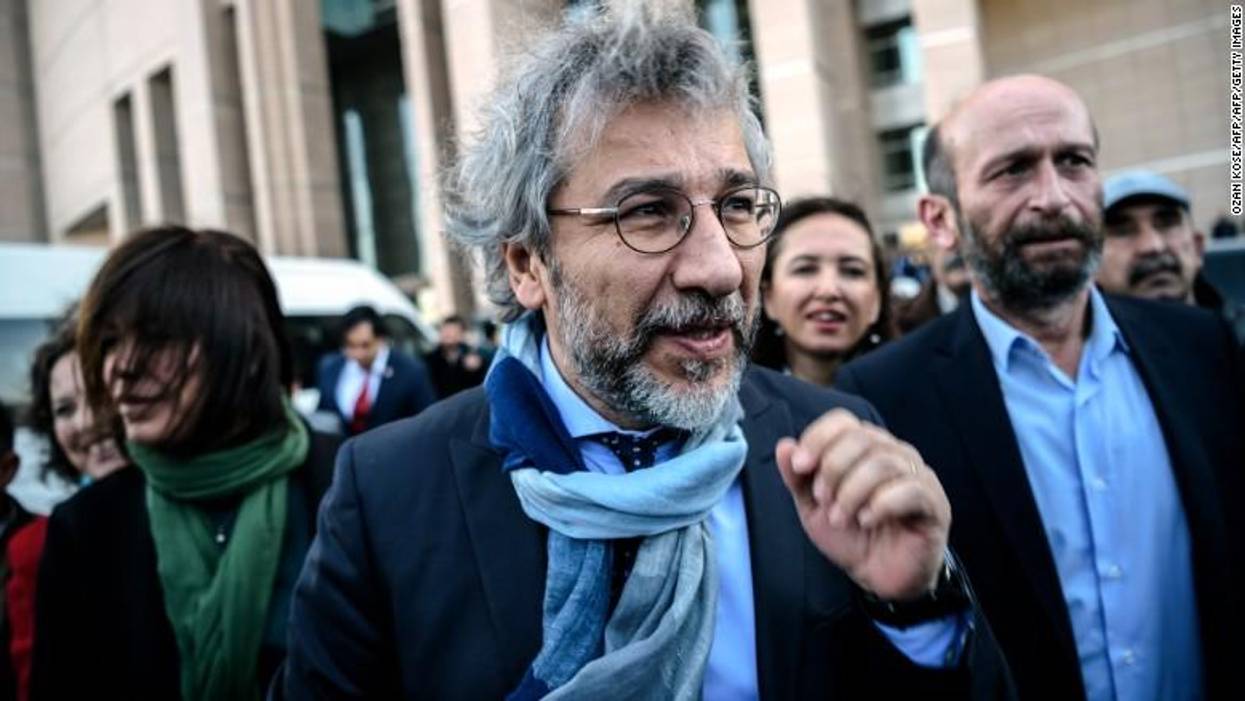
They were there to protect the Turkish journalist Can Dundar. For the last year and a half he has been hiding in exile in Berlin - a Salman Rushdie without the fatwa, but nonetheless in danger. A noted author, screenwriter and TV personality as well as a newsman, he was arrested by the Erdogan government in November 2015 on terrorism and espionage charges, but freed pending trial after 92 days in prison.
"There's a great big eye wandering over our heads. That eye belongs to a figure known to us all from literature: Big Brother is now in Turkey." --Can Dundar, Turkish journalist living in exile
The following spring, Dundar was sentenced by a Turkish judge to five years and ten months. Leaving the courthouse, he was the target of a failed assassination attempt. He fled to Germany. Should he return home, an outstanding arrest warrant, incarceration and possible death await.
His crimes? In general, enraging the Turkish government with his acute analysis and investigative reporting. More specifically, as editor-in-chief of the Cumhuriyet newspaper, he oversaw an expose that Turkey surreptitiously was sending arms to Syrian rebels, a story headlined, "Here are the weapons that Erdogan says do not exist."
Erdogan, who claimed Dundar's paper was spreading lies in support of Fethullah Gulen, the cleric living in America that the Turkish president accuses of plotting the failed 2016 coup against him, vowed that Dundar would "pay a heavy price." He was accused of leaking official secrets and betraying the state.
But now here he was with us in Berlin, in sports coat, tie and khakis, smiling, bearded and diminutive as his security guards towered over him.
"Imagine you rule as a one party government for a decade and a half," he began. "You've crushed all your opposition and taken over the media... You've commissioned films glorifying your ideology and no one goes to watch them. You've removed 'sinful' sculptures from public spaces but no one turns to look at the fountains you erected in their place. You've had 'immoral' TV series axed but no one watches their replacements."
There is, he continued, a "battle for cultural rule in Turkey," a struggle for freedom of speech and creativity. "Will we work and draw the government's fury or yield to the censor and lose?" he asked.
"When they hear the word culture, they reach for their gun. But fate plays them cruel tricks. They've got nothing else to read but the books that we write, nothing else to watch but the series we produce, and nothing else to sing but our songs. In any contest with oppression, culture always has the last laugh."
Nonetheless, he said, "There's a great big eye wandering over our heads. That eye belongs to a figure known to us all from literature: Big Brother is now in Turkey."
According to the Turkish press freedom website P24, as of mid-October, "There are at least 176 journalists and media workers in prison in Turkey either in pretrial detention or serving a sentence."
The organization Reporters without Borders notes that since the 2016 coup attempt, "A state of emergency has allowed the authorities to eliminate dozens of media outlets with the stroke of a pen, reducing pluralism to a handful of low-circulated and targeted publications. Turkey is again the world's biggest prison for professional journalists, with members of the press spending more than a year in prison before trial and long jail sentences becoming the new norm -- in some cases, journalists are sentenced to life imprisonment without the possibility of a pardon."
All of which makes it richly ironic, even in the face of tragedy, to see Erdogan in such high dudgeon over the death and alleged dismemberment of dissident and Washington Post columnist Jamal Khashoggi, murdered at the Saudi Arabian consulate in Istanbul. While he demands a complete and transparent investigation into the killing of Khashoggi, Erdogan keeps reporters and editors - and thousands of dissidents and opponents - incarcerated in his own country. (Not to mention Erdogan's own predilection for rendition, kidnapping Turkish nationals from other countries.)
But as Can Dundar finished his remarks in Berlin, there was another big surprise, another reason for the heightened security. Two members of the Russian dissident group Pussy Riot had arrived and rose to speak.
Pyotr Verzilov and Nika Nikulshina are two of the four protesters who on July 15 ran out onto the field at the World Cup final in Moscow, in front of Vladimir Putin, France's Emmanuel Macron and other heads of state. They spent fifteen days in jail.
Weeks later, after Nikulshina had been held in detention again and Verzilov had waited in a courthouse for her release, he fell ill. "Nika and I returned to our home and it was the anniversary of our relationship," he told us. "I went out to get some flowers and as I was going to the flower shop I looked at my phone and I realized that suddenly I wasn't able to focus closely on what was written on my phone and couldn't really concentrate... I went to sleep for a couple of hours and when I woke up I realized that I was slowly losing my consciousness and my ability to communicate with the outside world.
Nikulshina called an ambulance. "I think if we hadn't found him he would have died," she said. Two weeks and two Moscow hospitals later, "People started to suspect I was poisoned by a military grade agent, some poisonous gas that no one ever knew what it was," Verzilov said. "So we immediately began to become quite suspicious with Russian hospitals because they were not sharing with our lawyer their analysis.
"You can understand that if you're the boss of a huge hospital in central Moscow, and you view your job as very political, obviously you can't give a patient his analysis before checking with some people at the [Russian security agency] FSB."
Pyotr was moved to a Berlin hospital, where he was successfully treated and seems fully recovered: "Gladly, I'm much better now than the last weeks that I just spent in my own magical world so now we are trying to understand what has happened and piece this all into one puzzle, but essentially what happened was the price that you have to pay in Russia if you're going to be political and willing to stand up against Putin."
Why did this happen? Pyotr Verzilov did not say, but at The New Yorker, Masha Gessen recently observed, "[O]ne of Russia's many quasi-anonymous, semi-underground online publications on the publishing and messaging platform Telegram--the contemporary version of samizdat--reported that Verzilov had been working on an investigative story about the deaths of... three Russian journalists, Alexander Rastorguev, Orkhan Dzhemal, and Kirill Radchenko. The three had been in the Central African Republic reporting on a mercenary force linked to a close associate of President Vladimir Putin."
Verzilov was supposed to be on that trip to Africa but had committed instead to the World Cup protest. He had just raised money to investigate the three deaths and was supposed to receive documents relevant to the probe on the day he fell ill.
We know about the other Russian newsmen and women who have died since Putin's rise to power. And worldwide, so far this year, the International Federation of Journalists has recorded the deaths of 72 journalists and media workers. Our conference began just days after Khashoggi's disappearance and shortly after news had come of the rape and murder of Bulgarian reporter Victoria Marinova, the fourth high-profile journalist to be killed in Europe since the beginning of last year.
Many of these are murders perpetrated by those who fight against the freedom of expression, who would shout fake news in the face of honest investigative reporting that seeks the truth, no matter where the facts may lead.
"When everything our president says is a lie, when our country turn its back on the truth, when we do not speak out and use our strength and position to defend a human right as fundamental as speech, unless we push back hard, we're done for."
And they are deaths further exacerbated by America forfeiting its place in the global community, led by a man who mocks and bullies the press - just days after Khashoggi's disappearance praising the Montana congressman Greg Gianforte for bodyslamming journalist Ben Jacobs.
He refuses to take a moral stand on anything, much less defending the right of expression or of taking an opposing position, and has embraced in a bear hug the nationalism, bigotry and populism of the far right. He has declared America First and rejected globalism and international cooperation.
In so doing, the United States now gives carte blanche to those in the world -- Putin, Erdogan, Saudi crown prince Mohammad bin Salman and the rest -- who choose to crush dissent and honest reporting with the gun, the sword, the noose and the bone saw.
When everything our president says is a lie, when our country turn its back on the truth, when we do not speak out and use our strength and position to defend a human right as fundamental as speech, unless we push back hard, we're done for. End of story.
On Wednesday October 17, activists from British environmentalist group Extinction Rebellion (XR) held a sit-in at none other than the UK headquarters of Greenpeace--you know, the worldwide environmentalist org so radical that they've been shot at by the Russians and had their boat blown up by the French. According to XR, however, the renowned non-profit isn't radical enough, given the dire situation painted by the latest report from the Intergovernmental Panel on Climate Change (IPCC).
XR is a decentralized organization born out of activist group Risingup!. As Risingup!'s largest project to date, XR hopes to spur a massive, non-violent uprising via widespread acts of civil disobedience, which the group sees as the only possible method of averting total climate catastrophe. Beginning with a "Declaration of Rebellion" event on October 31st and followed by a "Rebellion Day" on November 17, anyone who acts according to the principles and values of XR can perform civil disobedience under the banner of the organization.
It's sort of like a Pussy Riot for the end of the world, as caused by a failure of democracy and ecological destruction. In an email, Nils Agger, a coordinator of XR's media and messaging working group, explained that XR's members believe the range of acceptable discussion around climate change and ecological crisis is not broad enough and should "include aspects such as the possibility of human extinction and societal collapse."
"[We are] working on building a rebellion against our broken democracy which is complicit in the ecological crisis we are facing and which is now a real emergency," Agger said. He added, "[The crisis is] a systemic problem rather than something which can be treated through changes in individual consumption."
So, where does Greenpeace fit into this? According to Agger, "NGOs like Greenpeace are part of the problem... since their messaging is a lot more narrow and doesn't tell the truth of the extent of the upcoming ecological crisis. We need a rebellion to tackle the problem we find ourselves in and Greenpeace, with their connections, could have a critical impact on the success of the uprising if they would choose to support it."
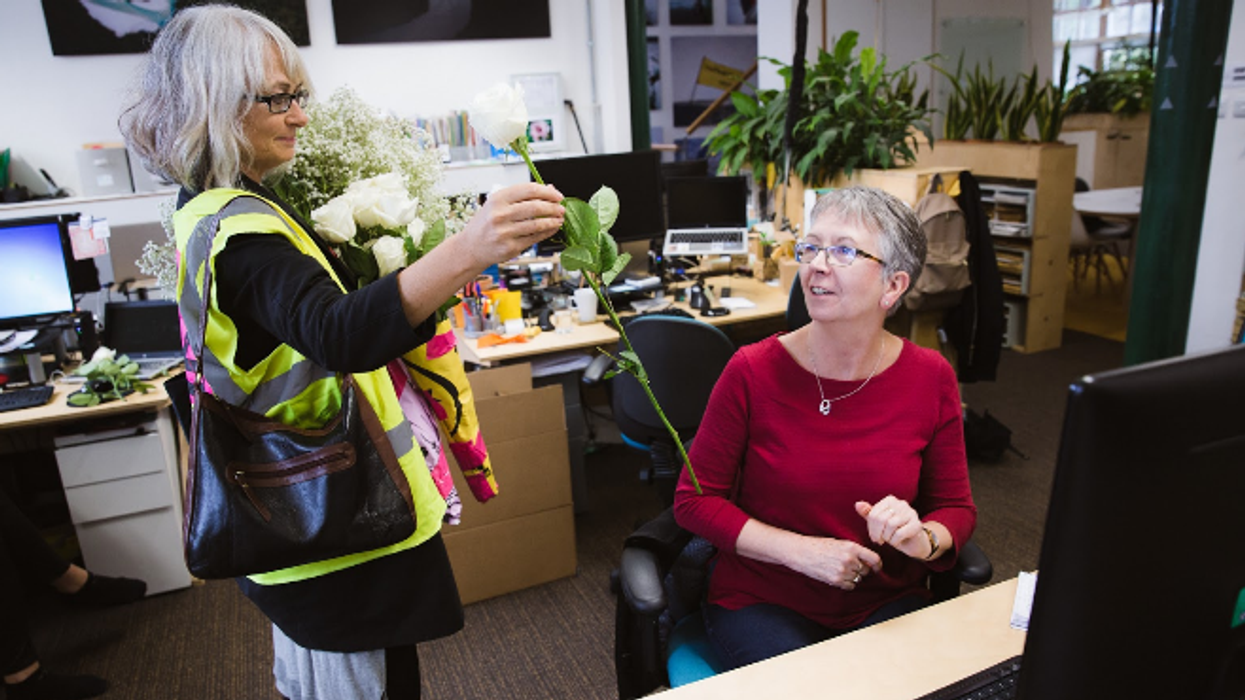
To get the non-profit to support such a rebellion, the group delivered cake and flowers to the NGO's employees and occupied the office space for two hours, as part of an action planned autonomously by XR members "who have been having conversations with the organisation for a while," Agger said. It wasn't until Greenpeace management agreed to consider the possibility of more direct action protests that the XR activists agreed to part, according to one Twitter user.
Specifically, XR asked Greenpeace "to encourage their members to participate in mass civil disobedience as the only remaining alternative to avert the worst of the catastrophe," Agger explained. As of 2017, Greenpeace has 2,555 permanent staff, 47,000 volunteers and 13 million petition signatures, but petitions aren't enough, according to Agger. "We are so very nearly out of time and campaigning as usual wont do the job. Greenpeace has a responsibility as an established organisation with resources and contacts to do what is necessary to avert as much as possible of the climate breakdown we are now facing," he said.
Agger hinted that, on October 31st, XR will perform a disruptive act that "will have a strong ceremonial aspect to it" and that "will be dramatic and spectacular". More details about the actions on that day will be released as it approaches. As of right now, we know that The Guardian's resident ecological conscience, George Monbiot, will be speaking at the UK event, but, if more activists participate under the banner of XR, it's possible that we will see actions performed on other parts of the globe.
When asked what XR hopes it can achieve with its civil disruption, Agger said that the group aims to highlight our climate emergency through "telling the truth and acting accordingly", ultimately spurring the sort of rapid societal adaptation that was seen during World War Two.
"If you are in a building which is catching fire and you try to let everyone else know about it who are also in the building, but then go on to act like business as usual then no one is going to believe you," Agger concluded. "The only appropriate response to a government which is complicit in the killing of millions of people is rebellion so that is what we are setting our aims on."
Without any evidence whatsoever, the New York Times published a "special report" tying the operations of WikiLeaks to Russian leader Vladimir Putin. Times reporters strongly suggested, "whether by conviction, convenience, or coincidence," WikiLeaks' document releases, along with statements by its editor-in-chief Julian Assange, have "often benefited Russia at the expense of the West."
Without any evidence whatsoever, the New York Times published a "special report" tying the operations of WikiLeaks to Russian leader Vladimir Putin. Times reporters strongly suggested, "whether by conviction, convenience, or coincidence," WikiLeaks' document releases, along with statements by its editor-in-chief Julian Assange, have "often benefited Russia at the expense of the West."
This kind of journalism has historically been labeled yellow journalism. It is a crude exaggeration and distorting of reality aimed at sensationalism. Times reporters fuel a manufactured idea that somehow WikiLeaks is a Russian pawn of Prime Minister Vladimir Putin in the country's new Cold War against the United States.
In fact, decades ago, the CIA spread anti-communist propaganda and disinformation, which had a way of making it into American newspapers. Perhaps, during that era this type of story would have been planted by the CIA in the Times, however, nowadays the CIA does not need to plant news stories. Journalists willingly adopt their agenda and ideology and publish stories like this one, which have the same effect.
Jo Becker, Steven Erlanger, and Eric Schmitt report, "Among United States officials, the emerging consensus is that Mr. Assange and WikiLeaks probably have no direct ties to Russian intelligence services."
If that is the case, the reporters have no story. Assange and WikiLeaks are probably not conducting operations to serve the interests of Russia. They have no proof, not even a specific nugget from U.S. officials whispering in their ear that they can claim as a scoop.
But the reporters add, "[Officials] say that, at least in the case of the Democrats' emails, Moscow knew it had a sympathetic outlet in WikiLeaks, where intermediaries could drop pilfered documents in the group's anonymized digital inbox."
The Times reporters ask, "Has WikiLeaks become a laundering machine for compromising material gathered by Russian spies?" They ascribe a lot of significance to the fact that Assange sometimes engages in actions when criticizing the United States that "dovetail" with statements made by Putin. Yet, at no point do the reporters recognize that this does not constitute proof of being in cahoots.
Putin recognizes the adversarial position the U.S. government takes toward Russia. Assange recognizes the adversarial position the U.S. government takes toward WikiLeaks. Naturally, this leads to provocative statements from both about the nature of U.S. power that have similarities.
Former collaborators and supporters are granted anonymity to speak, and one former collaborator tells the Times that Assange "views everything through the prism of how he's treated. America and Hillary Clinton have caused him trouble, and Russia never has."
This could easily be the frame for a story about Assange. Although journalists in U.S. media see it more as a vendetta, Assange and WikiLeaks has been targeted by U.S. intelligence agencies and government officials. Is it not unjust and objectionable for a country that holds itself out as the leader of the free world to undermine freedom of the press and target a media organization?
New York Times editors would never green light that story. It would not sell newspapers. What sells is mashing quotes from transparency advocates, who have qualms about how Assange runs WikiLeaks, with insinuations from anonymous officials to bolster the idea that Assange is unwittingly or wittingly serving Putin as he publishes material on Clinton and the Democratic Party.
WikiLeaks itself put out a statement refuting much of the report. It claims Russia never issued a visa for Assange, although that appears in the story. It points out Assange published an anthology of essays based on U.S. diplomatic cables, including one essay on Russia which specifically examined corruption in the country. It highlights the multiple meetings Assange has had with members of the punk rock group, Pussy Riot, who were once political prisoners in Russia.
To undermine the suggestion from the Times that Assange has tried to serve Putin by laying off criticism of Syria, the statement indicates emails from Assad's government, which the organization published, exposed the workings of the Assad regime, and documents on Syrian government spying on Syrian activists were published as well.
In the newspaper's desperation to make the case that Assange is some agent of Moscow, it questions the timing of Twitter postings. For example, in September 2014, "Mr. Assange wrote on Twitter about what he called the 'corrupt deal' that Turkey engineered to force the suppression of a pro-Kurdish television station in Denmark in return for allowing that country's prime minister, Anders Fogh Rasmussen, to take the helm of NATO."
"The timing of his Twitter post was curious on two fronts. It relied on a diplomatic cable that had garnered headlines when WikiLeaks released it four years earlier. And it followed a months-long tit for tat between Mr. Rasmussen and Mr. Putin, with the Russian president taking the NATO chief to task for secretly recording their private conversation, and Mr. Rasmussen accusing Mr. Putin of playing a 'double game' in Ukraine by issuing conciliatory statements while massing troops on the border and shipping weapons to the separatists," the Times contends.
It could be WikiLeaks re-shares and promotes older documents as they are topical, like when Rasmussen and Putin have a "tit for tat." This would obviously help bolster the organization's reputation and show the world the value of the documents.
Indeed, the media organization declares, "WikiLeaks has responded to news hooks--as all news outlets do, to draw attention to its archives or to support its anti-censorship or source protection mission."
One could imagine the Times doing something similar, like pointing to a series published some time ago if reforms were proposed to correct an injustice. There isn't anything particularly nefarious about this practice. It is part of running a media organization that runs on a small budget.
Even more ridiculous is how the Times reporters appear to invent metrics to castigate the work of WikiLeaks. The report asserts Russia "has been the most vocal opponent" of the Trans-Pacific Partnership and the Trade In Services agreement, "with Mr. Putin portraying them as an effort to give the United States an unfair leg up in the global economy." (WikiLeaks published drafts of these agreements.)
The Times reporters never include any context that would answer the question: compared to who or compared to what country?
Most Americans probably oppose these trade agreements because they heard Democratic presidential candidate, Senator Bernie Sanders, blast the agreements during his campaign, or they have heard Republican presidential nominee Donald Trump criticize them. In other words, what Putin says, and how Assange reinforces those statements, has no bearing on the fact that the agreements supported by President Barack Obama are politically unpopular.
The "special report" is a window into the state-identified mindset of the New York Times as a media institution. Recall, the Times was a leader in selling the Iraq War to the public. At the request of President George W. Bush, it chose not to publish a story that would have exposed warrantless NSA wiretapping before the 2004 election.
The Times hid the existence of a base in Saudi Arabia used by the CIA to launch drone strikes. It helped the U.S. government conceal the real identity of Raymond Davis, who shot and killed two men in Pakistan and was working for the CIA.
Dean Baquet, who is currently the executive editor for the Times, has a record of avoiding journalism that could be upsetting to the U.S. government. He did not think it was significant that NSA data was shared with Israeli intelligence, so reporters at the publication never pursued further details after The Guardian's story in 2013. He saw no reason to prepare anything substantial to mark the tenth anniversary of the Iraq War and advocated for a "low-key approach," even though the paper played a key role in the war and occupation that killed a million Iraqis and thousands of U.S. soldiers.
Incredibly, Baquet has pointed to the publication of disclosures from WikiLeaks to argue the Times is willing to "push back against the government." It now ham-handedly tries to link Assange to Putin, and one must ask: did publishing WikiLeaks disclosures ever unwittingly help Putin and how will the Times atone for its disloyal sins?
To use the words of Times reporters, whether by conviction, convenience, or coincidence, the "special report" dovetails with the interests of Hillary Clinton's presidential campaign. It dovetails with the agenda of national security agencies--just as propaganda published in the press about NSA whistleblower Edward Snowden being a Russian spy served the agenda of U.S. intelligence.
Has the New York Times become a laundering machine for McCarthyist political and security state gossip? And more broadly, what precisely is the relationship between Baquet and Clinton?
Since this is what the Times considers to be journalism, let's ask the questions. Because the Times endorsed Clinton, Clinton and allies have used rhetoric similar to this report to attack WikiLeaks, and so it is important to figure out where the presidential campaign of Clinton ends and the journalism of the Times begins.
RIKERS ISLAND, N.Y.--Cecily McMillan, the Occupy activist who on Monday morning will appear before a criminal court in New York City to be sentenced to up to seven years on a charge of assaulting a police officer, sat in a plastic chair wearing a baggy, oversized gray jumpsuit, cheap brown plastic sandals and horn-rim glasses.
RIKERS ISLAND, N.Y.--Cecily McMillan, the Occupy activist who on Monday morning will appear before a criminal court in New York City to be sentenced to up to seven years on a charge of assaulting a police officer, sat in a plastic chair wearing a baggy, oversized gray jumpsuit, cheap brown plastic sandals and horn-rim glasses. Other women, also dressed in prison-issued gray jumpsuits, sat nearby in the narrow, concrete-walled visitation room clutching their children, tears streaming down their faces. The children, bewildered, had their arms wrapped tightly around their mothers' necks. It looked like the disaster scene it was.
"It's all out in the open here," said the 25-year-old student, who was to have graduated May 22 with a master's degree from The New School of Social Research in New York City. "The cruelty of power can't hide like it does on the outside. You get America, everything America has become, especially for poor people of color in prison. My lawyers think I will get two years. But two years is nothing compared to what these women, who never went to trial, never had the possibility of a trial with adequate legal representation, face. There are women in my dorm who, because they have such a poor command of English, do not even understand their charges. I spent a lot of time trying to explain the charges to them."
McMillan says Grantley Bovell, who was in plainclothes and did not identify himself as a police officer, grabbed her from behind during a March 17, 2012, gathering of several hundred Occupy activists in Manhattan's Zuccotti Park. In a video of the incident she appears to have instinctively elbowed him in the face, but she says she has no memory of what happened. Video and photographs--mostly not permitted by the trial judge to be shown in the courtroom--buttressed her version of events. There is no dispute that she was severely beaten by police and taken from the park to a hospital where she was handcuffed to a bed. On May 5 she was found guilty after a three-week trial of a felony assault in the second degree. She can receive anything from probation to seven years in prison.
"I am prepared mentally for a long sentence," she told me this past weekend when I interviewed her at the Rikers Island prison in the Bronx. "I watched the trial. I watched the judge. This was never about justice. Just as it is not about justice for these other women. One mother was put in here for shoplifting after she lost her job and her house and needed to feed her children. There is another prisoner, a preschool teacher with a 1-year-old son she was breastfeeding, who let her cousin stay with her after her cousin was evicted. It turns out the cousin sold drugs. The cops found money, not drugs, that the cousin kept in the house and took the mother. They told her to leave her child with the neighbors. There is story after story in here like this. It wakes you up."
McMillan's case is emblematic of the nationwide judicial persecution of activists, a persecution familiar to poor people of color. Her case stands in contrast with the blanket impunity given to the criminals of Wall Street. Some 8,000 nonviolent Occupy protesters have been arrested. Not one banker or investor has gone to jail for causing the 2008 financial meltdown. The disparity of justice mirrors the disparity in incomes and the disparity in power.
Occupy activists across the country have been pressured to "plea out" on felony charges in exchange for sentences of years of probation, which not only carry numerous restrictions, including being unable to attend law school or serve on a jury, but make it difficult for them to engage in further activism for fear of arrest and violating their probation. McMillan was offered the same plea deal but refused it. She was one of the few who went to trial.
"I am deeply committed to nonviolence, especially in the face of all the violence around me inside and outside this prison," she said in the interview. "I could not accept this deal. I had to fight back. That is why I am an activist. Being branded as someone who was violent was intolerable."
McMillan's case is as much about our right to nonviolent protest as it is about McMillan. It is about our right to carry out such protest without being subjected to police violence intended to crush peaceful and lawful dissent. It is about our right to engage in political organization without our groups being monitored and infiltrated by the security and surveillance state. It is about our right of free speech and free assembly, guaranteed under the Constitution but effectively stripped from us in a series of judicial rulings and through municipal ordinances that make it impossible to protest in many U.S. cities.
Judge Ronald A. Zweibel was caustic and hostile to McMillan and her defense team during the trial. He barred video evidence that would have helped her case. He issued a gag order that forbade the defense lawyers, Martin Stolar and Rebecca Heinegg, to communicate with the press. And, astonishingly, he denied McMillan bail.
The judge also assiduously protected Bovell against challenges to his credibility. He refused to allow the jurors to hear about or see the excessive police violence that was used to clear the park the night McMillan was arrested--violence many activists say was the most indiscriminate and abusive ever inflicted during the Occupy movement. He hid Bovell's history of misconduct as a police officer from the jury. Bovell has been investigated at least twice by the internal affairs section of the New York City Police Department, the Guardian newspaper reported. Bovell and his police partner, in one of the cases, were sued for allegedly using an unmarked police car to strike a 17-year-old fleeing on a dirt bike. The teenager said his nose was broken, two teeth were knocked out and his forehead was lacerated. The case was settled out of court for a significant amount of money. There is also a video that appears to show Bovell relentlessly kicking a suspect on the floor of a Bronx grocery. In addition, Bovell was involved in a ticket-fixing scandal in his Bronx precinct. And Austin Guest, 33, a Harvard University graduate who was arrested at Zuccotti Park on the night McMillan was assaulted, is suing Bovell and the NYPD because the officer allegedly intentionally banged his head on the internal stairs and seats of a bus that took him and other activists in for processing. The judge barred the running down of the teenager on the dirt bike and Bovell's alleged abuse of Guest from being discussed in front of the jury.
The case has galvanized many activists, who see in McMillan's persecution the persecution of movements across the globe struggling for nonviolent democratic change. McMillan was visited in Rikers by Russia human rights campaigners of the group Pussy Riot. Hundreds of people, including nine of the 12 jurors and some New York City Council members, have urged Judge Zweibel to be lenient. Some 160,000 people have signed an online petition calling on Mayor Bill de Blasio and Gov. Andrew Cuomo to intervene on her behalf. But so far pleas like these have failed to mollify the corporate state's determination to use the McMillan case as a tool to prevent any new mass movements.
"I am very conscious of how privileged I am, especially in here," McMillan said. "When you are in prison white privilege works against you. You tend to react when you come out of white privilege by saying 'you can't do that' when prison authorities force you to do something arbitrary and meaningless. But the poor understand the system. They know it is absurd, capricious and senseless, that it is all about being forced to pay deference to power. If you react out of white privilege it sets you apart. I have learned to respond as a collective, to speak to authority in a unified voice. And this has been good for me. I needed this."
"We can talk about movement theory all we want," she went on. "We can read Michel Foucault or Pierre Bourdieu, but at a certain point it becomes a game. You have to get out and live it. You have to actually build a movement. And if we don't get to work to build a movement now there will be no one studying movement theory in a decade because there will be no movements. I can do this in prison. I can do this out of prison. It is all one struggle."
McMillan has been held in Rikers' Rose M. Singer Center, Dorm 2 East B, with about 40 other women. They sleep in rows of cots. Nearly all the women are poor mothers of color, most of them black, Hispanic or Chinese. McMillan is giving lessons in English in exchange for lessons in Spanish.
McMillan has bonded with an African-American woman known as "Fat Baby" who ogled her and told her she had nice legs. Fat Baby threw out a couple of lame pickup lines that, McMillan said, "sounded as if she was a construction worker. I told her I would teach her some pickup lines that were a little more subtle."
McMillan, who is required to have a prison activity, participates in the drug rehabilitation program although she did not use drugs. She is critical of the instructor's feeding of "positive" and Christian thinking to the inmates, some of whom are Muslims. "It is all about the power of positive thinking, about how they made mistakes and bad choices in life and now they can correct those mistakes by taking another road, a Christian road, to a new life," she said. "This focus on happy thoughts pervades the prison. There is little analysis of the structural causes for poverty and oppression. It is as if it was all about decisions we made, not that were made for us. And this is how those in power want it. This kind of thinking induces passivity."
McMillan was receiving 30 to 40 letters daily at Rikers but during the week before the interview was told every day that she had none. She suspects the prison has cut off the flow of mail to her.
Because my pens and paper were confiscated during the two-hour process it took to enter the prison, after the visit I had to reconstruct the notes from our conversation, which lasted an hour and a half. The entry process is normal for visitors, who on weekends stand in long lines in metal chutes outside the prison. My body was searched and my clothing was minutely inspected for contraband, and I had to go through two metal detectors.
During the interview a guard asked McMillan to roll down her sleeves and admonished her once for crossing her legs. "You scratch a hole in the crotch," McMillan said, running a fingernail up and down the crotch seam of her jumpsuit. "You make a small hole. And when the visitor slips you a cigarette you push up your vagina. I am learning a lot in prison. I have gotten very good at hiding books on my way to medical and stealing food to bring back to the dorm."
"It is hard to read, it is hard to write," she went on. "There is constant movement and constant noise."
She was working Sunday on the statement she would read in court Monday. She said it draws heavily from Leo Tolstoy's "The Kingdom of God Is Within You."
McMillan had just finished writing a message to supporters who planned to rally in her support Sunday afternoon in New York City. She told them:
I came to New York the summer of 2011 to go to school--Rikers Island was definitely not on my list of intended experiences. Though I did call myself "a radical" that title stretched only as far to include plans to start a socialist student chapter and study welfare policy with aims of improving it. Within 1 week, these plans were railroaded by the Occupy Wall Street Movement--and for the following 3 months, I did little else.
Like many, the eviction of Zuccotti left me lost, searching for that infectious energy that bound so many together in efforts to transform the world. Like many, I've spent the time since trying to understand what we had & striving to get back to it.
Like many I point to a lack of militancy in our movement--a commitment of one's entire being--personally, politically, emotionally & physically--to the greater good. But I examined what action those beautiful words entailed, I exchanged "militancy" for the concept of "love ethic"--a distinction born of the belief that fights between "usses and thems" run counter to the collective "we". "We" being human society with each person as an integral part--that must be seen, heard, felt & loved--in order to transform the whole.
Like many, I found my beliefs easy to come by but difficult to act on. I always strived, but often struggled, to see, hear, feel, to love--even as I expected as much in return. I began to question, "If it is such a struggle to solidify amongst a few, how can we hope to strengthen love ethic across the many?"
Unlike most, when my trial began: friends formed a support structure, comrades came to court, journalists reported injustices. When the verdict was read, cries of outrage were heard, the news spread, & sympathy was shared from around the world.
Unlike most, during my weakest hour, I had never felt more supported. Though I had never ever felt more oppressed, I had never felt so loved. I stand resolved to keep fighting, because your love ethic props me up and allows me to do so.
Unlike most, I am blessed with the support of so many. And though I am thankful, I am also thoughtful of the many forced to face such oppression alone. I know you have already done so much, but I'm going to ask for one thing more:
If you feel safe enough to share, please raise your hand if you have suffered police violence? If you have suffered sexual violence? If you have suffered the violence of the justice system? If you have suffered the violence of the prison system?
Oppression is rampant. Take a moment to try & really see, hear, feel the suffering of the many around you. Now imagine the power of your collective love ethic to stand against it.
Only through the pervasive spread of such a love ethic by the many for the many--not just the privileged few--will we finally have ourselves a movement.
McMillan takes comfort from her supporters and her family and from those of her heroes who endured prison for a just cause. She reads and rereads the speech Eugene V. Debs made to a federal court in Cleveland before he went to prison for opposing the draft in World War I. His words, she said, have become her own.
"Your honor, years ago I recognized my kinship with all living beings, and I made up my mind that I was not one bit better than the meanest on earth," Debs said. "I said it then, as I say it now, that while there is a lower class, I am in it, and while there is a criminal element I am of it, and while there is a soul in prison, I am not free."
Update: Activists earlier detained by Russian police in Sochi have been released, without charges, after being questioned and held for several hours.
According to AP:
Police said they were questioned in connection with a theft at the hotel where they were staying. No charges were filed.
Tolokonnikova said the detention followed three days of police harassment. She also said the two band members were detained for several hours the previous two days.
"We members of Pussy Riot have been here since late Sunday and we were constantly detained since then," Tolokonnikova said after her release. "We are constantly surrounded by people, not you journalists, but people who are shadowing us, following our every move and looking for any excuse to detain us."
Earlier:
Nadezhda Tolokonnikova and Maria Alekhina, two prominent yet former members of the punk rock activist band Pussy Riot, were arrested in the city of Sochi on Tuesday along with other activists who had traveled to the site of the Olympic Games.
Authorities have said they are being held on accusations of theft, but Tolokonnikova told a journalist by phone from the jail that, "Of course there has been no theft."
"We were just walking around Sochi when they grabbed us," she said, though indicated the group may have been planning a political action.
As CNN reports:
Tolokonnikova and Alyokhina, who are highly critical of President Vladimir Putin, went to Sochi to protest against the lack freedom of speech in Russia.
The former band members were thrown in jail for nearly two years after they were convicted of "hooliganism" and inciting religious hatred for performing a riotous punk song slamming Putin in a Moscow Cathedral -- and posting a video of it online.
And the Guardian adds:
Semyon Simonov, a local human rights activist who was also detained along with the group, said that they had been accosted by police while walking along the street, and roughly bundled into a police van.
"They told us that we were suspected of a theft," said Simonov from the police station where he was waiting to be questioned. He said no official charges had been made, but that the police told them the hotel where the Pussy Riot women are staying had reported them for theft.
Simonov said ten people had been arrested, including David Khakim, who was on Monday sentenced to 30 hours of community service by a Sochi court for holding a one-man protest in support of Evgeny Vitishko, a jailed environmentalist.
Vitishko has been sentenced to three years in prison for vandalising a fence, in a case that activists say is linked to his criticism of environmental violations during Olympic construction.
The Olympic games in Sochi have been the site of various protests, many of which have targeted the repressive anti-gay laws enacted by the Putin government and a broader call to end Russia's restrictive and authoritarian legal system.
Though Tolokonnikova and Alyokhina have in many ways become the international face of Pussy Riot, the other members of the underground band have made it clear in recent weeks that though they support their former bandmates and fellow activists, the two should no longer be considered active members of the group.
___________________________
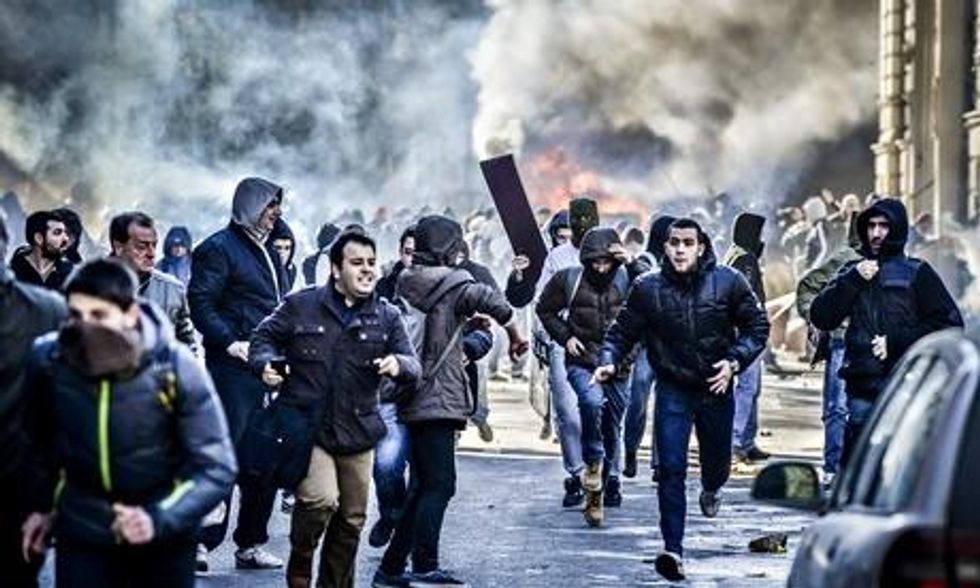
The events gave rise to conspiracy theories (for example, that the Serb government had organised the protests to topple the Bosnian leadership), but one should safely ignore them since it is clear that, whatever lurks behind, the protesters' despair is authentic. One is tempted to paraphrase Mao Zedong's famous phrase here: there is chaos in Bosnia, the situation is excellent!
"What Max Horkheimer said about fascism and capitalism back in the 1930s (that those who do not want to talk critically about capitalism should also keep quiet about fascism) should be applied to today's fundamentalism: those who do not want to talk critically about liberal democracy should also keep quiet about religious fundamentalism."
Why? Because the protesters' demands were as simple as they can be - jobs, a chance of decent life, an end to corruption - but they mobilised people in Bosnia, a country which, in the last decades, has become synonymous with ferocious ethnic cleansing.
Before now, the only mass protests in Bosnia and other post-Yugoslav states were about ethnic or religious passions. In the middle of 2013, two public protests were organised in Croatia, a country in deep economic crisis, with high unemployment and a deep sense of despair: trade unions tried to organise a rally in support of workers' rights, while rightwing nationalists started a protest movement against the use of cyrillic letters on public buildings in cities with a Serb minority. The first initiative brought a couple of hundred people to a square in Zagreb; the second mobilised hundreds of thousands, as had an earlier fundamentalist movement against gay marriages.
Croatia is far from being an exception: from the Balkans to Scandinavia, from the US to Israel, from central Africa to India, a new Dark Age is looming, with ethnic and religious passions exploding and Enlightenment values receding. These passions were lurking in the background all the time, but what is new is the outright shamelessness of their display.
So what are we to do? Mainstream liberals are telling us that when basic democratic values are under threat by ethnic or religious fundamentalists, we must all unite behind the liberal-democratic agenda of cultural tolerance, save what can be saved and put aside dreams of a more radical social transformation. Our task, we are told, is clear: we must choose between liberal freedom and fundamentalist oppression.
However, when we are triumphantly asked a (purely rhetorical) question such as "Do you want women to be excluded from public life?" or "Do you want every critic of religion to be punished by death?", what should make us suspicious is the very self-evidence of the answer. The problem is that such a simplistic liberal universalism long ago lost its innocence. The conflict between liberal permissiveness and fundamentalism is ultimately a false conflict - a vicious cycle of the two poles generating and presupposing each other.
What Max Horkheimer said about fascism and capitalism back in the 1930s (that those who do not want to talk critically about capitalism should also keep quiet about fascism) should be applied to today's fundamentalism: those who do not want to talk critically about liberal democracy should also keep quiet about religious fundamentalism.
Reacting to the characterisation of Marxism as "the Islam of the 20th century", Jean-Pierre Taguieff wrote that Islam was turning out to be "the Marxism of the 21st century" prolonging, after the decline of Communism, its violent anti-capitalism.
However, the recent vicissitudes of Muslim fundamentalism can be said to confirm Walter Benjamin's old insight that "every rise of fascism bears witness to a failed revolution". The rise of fascism is, in other words, both the left's failure, and simultaneously proof that there was a revolutionary potential, a dissatisfaction, which the left was not able to mobilise. And does the same not hold for today's so-called "Islamo-fascism"? Is the rise of radical Islamism not exactly correlative to the disappearance of the secular left in Muslim countries?
When Afghanistan is portrayed as the utmost Islamic fundamentalist country, who still remembers that 40 years ago it was a country with strong secular tradition, including a powerful Communist party which took power there independently of the Soviet Union?
It is against this background that one should understand the latest events in Bosnia. In one of the photos from the protests, we see the demonstrators waving three flags side by side: Bosnian, Serb, Croat, expressing the will to ignore ethnic differences. In short, we are dealing with a rebellion against nationalist elites: the people of Bosnia have finally understood who their true enemy is: not other ethnic groups, but their own leaders who pretend to protect them from others. It is as if the old and much-abused Titoist motto of the "brotherhood and unity" of Yugoslav nations acquired new actuality.
One of the protesters' targets was the EU administration which oversees the Bosnian state, enforcing peace between the three nations and providing significant financial help to enable the state to function. This may seem surprising, since the goals of the protesters are nominally the same as the goals of Brussels: prosperity and the end of both ethnic tensions and corruption. However, the way the EU effectively governs Bosnia entrenches partitions: it deals with nationalist elites as their privileged partners, mediating within them.
What the Bosnian outburst confirms is that one cannot genuinely overcome ethnic passions by imposing a liberal agenda: what brought the protesters together is a radical demand for justice. The next and most difficult step would have been to organise the protests into a new social movement that ignores ethnic divisions, and to organise further protests - can one imagine a scene of enraged Bosnians and Serbs demonstrating together in Sarajevo?
Even if the protests gradually lose their power, they will remain a brief spark of hope, something like the enemy soldiers fraternising across the trenches in the first world war. Authentic emancipatory events always involve such ignoring of particular identities.
And the same holds for the recent visit of the two Pussy Riot members to New York: in a big gala show, they were introduced by Madonna in the presence of Bob Geldof, Richard Gere, etc: the usual human rights gang. What they should have done there was to express their solidarity with Edward Snowden, to assert that Pussy Riot and Snowden are part of the same global movement. Without such gestures which bring together what, in our ordinary ideological experience, appears incompatible (Muslims, Serbs and Croats in Bosnia; Turkish secularists and anti-capitalist Muslims in Turkey, etc), protest movements will be always manipulated by one superpower in its struggle against another.
We, the anonymous members of Pussy Riot, would like to say many thanks to all the people who have supported us all this time, those who demanded the release of our members, those who sympathized with us and sympathized with our ideology.
Our joint efforts were not in vain: Putin had to bend under the pressure of the international community and let Nadia and Masha free.
Thus, December 23rd was a real celebration for us--the Liberation Day of prisoners of conscience and the real victory of the liberation of the entire Pussy Riot.
But the amnesty is certainly not the end of our dreams. We demand real justice: the complete abolition of the verdict and the recognition of the entire criminal case against Pussy Riot as illegitimate.
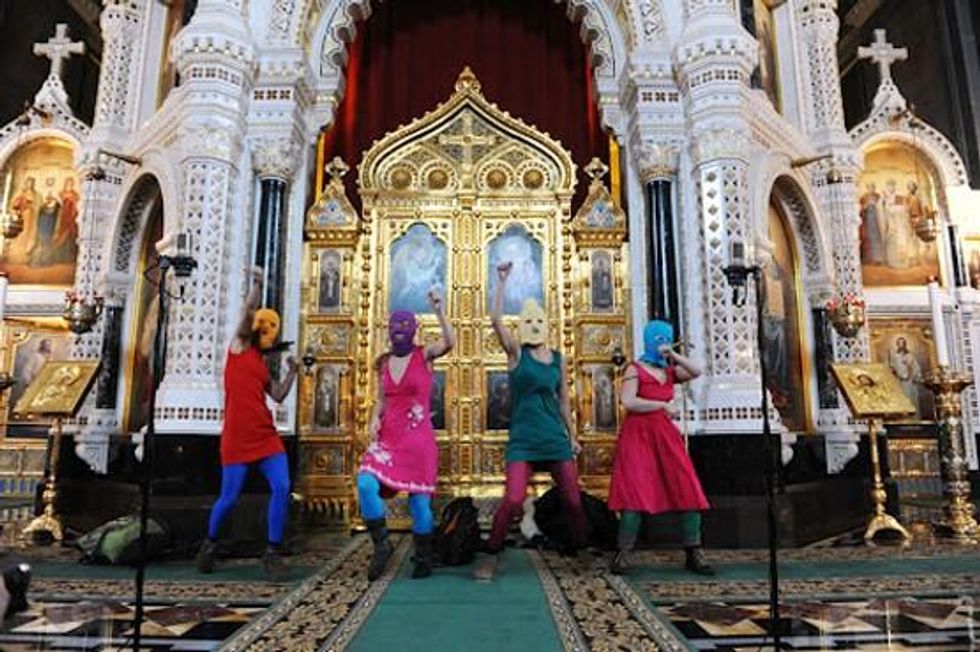
We do hope that the justice will be restored on February 21 - the anniversary of our teasing performance in the Christ the Savior Cathedral, with the song "Mother of God, Put Putin Away!"
We are very pleased with Masha's and Nadia's release. We are proud of their resistance against harsh trials that fell to their lot, and their determination by all means to continue the struggle that they had started during their stay in the colonies.
Unfortunately for us, they are being so carried away with the problems in Russian prisons, that they completely forgot about the aspirations and ideals of our group - feminism, separatist resistance, fight against authoritarianism and personality cult, all of which, as a matter of fact, were the cause for their unjust punishment.
Now it is no secret that Masha and Nadia are no longer members of the group, and they will no longer take part in radical activism. Now they are engaged in a new project. Now they are institutionalized advocates of prisoners' rights.
And as you know, such advocacy is hardly compatible with radical political statements and provocative works of art that raise controversial topics in modern society. Just as gender-conformity is not compatible with radical feminism.
Institutionalized advocacy can hardly afford the critique of fundamental norms and rules that underline the very mechanics of modern patriarchal society. Being an institutional part of this society, such advocacy, can hardly go beyond the rules set forth by this society.
Yes, we lost two friends, two ideological fellow member, but the world has acquired two brave, interesting, controversial human rights defenders - fighters for the rights of the Russian prisoners.
Unfortunately, we can not congratulate them on this in person, because they refuse to have any contact with us. But we appreciate their choice and sincerely wish them well in their new career.
At the moment, we are witnessing an outrageous collision.
While Nadia and Masha are being the focus of media and the international community, they gather crowds of journalists and people heed to their every word, so far no one hears them.
In almost every interview they repeat what they left the group, that they are no longer Pussy Riot, that they act in their own names, that they will no longer engage in radical art activities. However, the headlines are still full of the group's name, all their public appearances are declared as performances of Pussy Riot, and their personal withdrawal from Pussy Riot is treated as termination of the entire collective, thus ignoring the fact that at the pulpit of the Christ the Savior Church, there were not two, but five women in balaclavas and the Red Square performance had eight participants.
The apotheosis of this misunderstanding was the public announcement by Amensty International of Masha's and Nadia's speech at a concert in Barclays Center in New York, as the first legal performance of Pussy Riot.
Moreover, instead of the names of Nadia and Masha, the poster of the event showed a man in a balaclava with electric guitar, under the name of Pussy Riot, while the organizers called for people to buy expensive tickets.
All this is an extreme contradiction to the very principles of Pussy Riot collective.
We are all-female separatist collective - no man can represent us either on a poster or in reality.
We belong to leftist anti-capitalist ideology - we charge no fees for viewing our art-work, all our videos are distributed freely on the web, the spectators to our performances are always spontaneous passers by, and we never sell tickets to our "shows".
Our performances are always 'illegal', staged only in unpredictable locations and public places not designed for traditional entertainment. The distribution of our clips is always through free and unrestricted media channels.
We are anonymous, because we act against any personality cult, against hierarchies implied by appearance, age and other visible social attributes. We cover our heads, because we oppose the very idea of using female face as a trademark for promoting any sort of goods or services.
The mixing of the rebel feminist punk image with the image of institutionalized defenders of prisoners' rights, is harmful for us as a collective, as well as it is harmful for the new role that Nadia and Masha have taken on.
Hear them finally!
Since it happened that Nadia and Masha chose not to be with us, please, respect their choice. Remember, we are no longer Nadia and Masha. They are no longer Pussy Riot.
The campaign "Free Pussy Riot" is over. We, as art collective, have an ethical right to preserve our art practice, our name and our visual identity, distinct from other organizations.
Anonymous members of Pussy Riot:
Garadja , Fara, Shaiba, Cat, Seraphima and Schumacher
After reading Thursday's NYT report which revealed that the Foreign Intelligence Surveillance Court legitimized NSA metadata collection for more than seven years without providing a legal rationale I thought of: The Emperor's New Clothes; The torture memos from Bush 43's Office of Legal Counsel; Putin's release of his high profile foes from prison; and light vs.
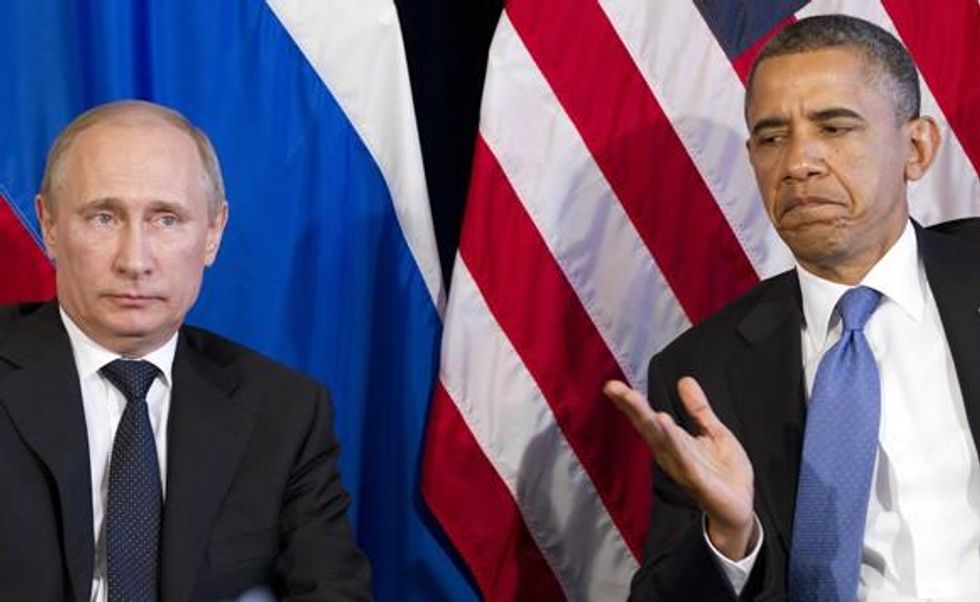
The releases of Putin's high profile foes underscored the arbitrariness of the Russian justice system. The rule of law requires an engaged civil society with the breathing space to demand accountability of those in power, which in turn requires independent institutions serving the people. That Putin could so rapidly get Parliament to pass an Amnesty law and the Judiciary to order the release of prisoners exposes the travesty of Russian justice. As a Pussy Riot musician said, "They put me in, they let me out," noting that the timing was "ridiculous" coming so close to the end of her sentence. Both released musicians said they asked to be allowed to finish their sentence, but were forced to leave prison as part of Putin's PR campaign for the upcoming Sochi Olympics.
With Obama's Jan. 17 speech on NSA Spy-Gate failing to quell civil unrest, the Privacy and Civil Liberties Oversight Board today released its findings that NSA metadata collection is unlawful and should stop. Most revealing was Charlie Savage's reporting that from May 2006 to August 2013 the FISC authorized Patriot Act Sec. 215 overriding the Electronic Communications Privacy Act without any legal opinion to support the clear violations of the ECPA, let alone the Fourth Amendment. Yes, secret law is an oxymoron - meaning lawlessness.
The torture memos by John Yoo, Jay Bybee, and Steven Bradbury were written because CIA criminality was exposed by leaks, so the Bush cabal felt they needed legal cover. Had Jane Mayer and Dana Priest not used leaked information to write about the outsourcing of torture and secret CIA-run prisons in Europe, no such twisted law, logic and morality as evinced by those memos would be needed. Likewise, but for Ed Snowden and Glenn Greenwald, the FISC would still be the secret handmaiden of the national security state.
Belief in the "trust us" rationale for secret law-making requires belief that the world is black and white, with clear good guys vs. bad guys. Thanks to transparency abetted by technology, we see that all powerful states are dirty. And so, when the Emperor claims that he is well-robed in his language of democracy and rule of law, we clearly see him naked.
Judge Claire Egan's August 29, 2013 opinion endorsing the legality of NSA metadata surveillance is an abdication of the duties of an independent judiciary. She calls the issue a political question, not a legal one: "a matter for the political branches to decide." The statutory analysis in the opinion is flawed. Indeed, it is for the courts to decide when an act is unconstitutional. Three co-equal branches, right? And, the power of judicial review is the final constitutional check against abuse. Yet for more than seven years, the law was completely silent as the national security state accreted ever- greater illegitimate power. Her lame legal justification for NSA metadata collection was compelled by public protest.
It is indeed a ripe time for the people of the world to raise their voices. For we, are the ultimate check against tyranny. The evidence is clear that we are needed. Law demands accountability. Secrecy affords impunity. While big brother is zooming you, zoom on him and tell the world what you see. Let the sun shine in. From Sochi to your home state raise your voice at this travesty of justice, while you still can.
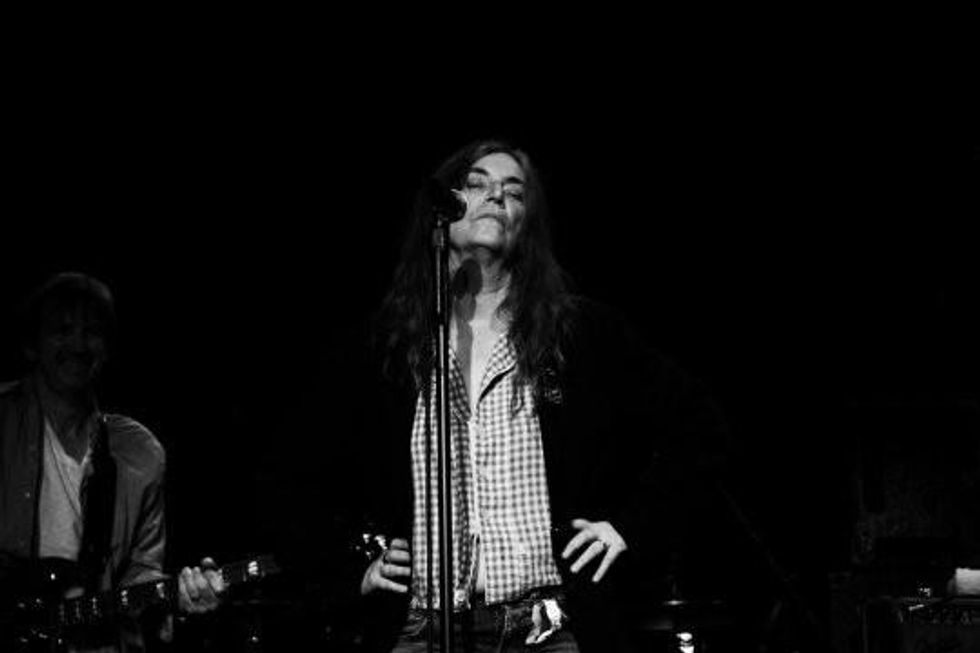
Ringing in her 67th birthday at New York's Webster Hall Monday night, "Godmother of Punk" Patti Smith praised Edward Snowden and the members of Pussy Riot for "speak[ing] for all of us."
"All of our phone numbers, all of our personal business, the business of our government, Edward let it snow, Edward let it snow," Smith sang before the crowd, Buzzfeed reports.
Buzzfeed continues:
Smith said that she was so happy that the anti-Putin group [...] would "continue to use their voice, because it's very dangerous for them to do so." The singer implored the audience to "not underestimate the danger those girls face by speaking their mind."
"Edward Snowden, Pussy Riot, these people speak for us all," she continued, "all of us who are no longer numb, all of us who are no longer dumb."
Smith also performed the "Edward Snowden" song, which she wrote shortly after the initial leak of classified NSA surveillance information, while touring Europe this summer.
"What our world needs is you and truth. They tread so secretly. But Edward, there's no secrets between you and me," she sings. "What will happen, I don't know. Will they take you away? I don't know. But Edward, let it snow, let it snow. We want to know."
In previous appearances, Smith has also spoken passionately on behalf of the members of Pussy Riot, who earlier this month were released after being held for 9 months in Russian prisons on charges of "hooliganism" for speaking out against the Putin-led government.
"These girls have been such an inspiration," Smith said in June speaking before the premiere to the documentary Pussy Riot: A Punk Prayer. "They are our daughters, our sisters.[...] There is not a time when I don't go on stage and I don't think about them, or feel the freedom to speak out and say the things that upset or anger me about my own country."
Below is a video of Smith's July performance of the "Edward Snowden" song at Tradgardsforeningen park in Gothenburg, Sweden.
Patti Smith - Edward Snowden tribute @ Trädgårdsföreningen 2013A newly written song was performed at Trädgårdsföreningen park, Gothenburg 13th July 2013.
But the taste of freedom didn't strip either woman of their harsh critique of Putin or the repressive Russian establishment he represents.
Upon her release, Alyokhina immediately slammed the president and called the amnesty bill nothing but a public relations ploy by the Putin government.
"I do not think it is a humanitarian act, I think it is a PR stunt," the twenty-five year-old artist and political activists said by telephone to the Russian Internet and TV channel Dozhd. "My attitude to the president has not changed."
Going further, Alyokhina told reporters that if she could have resisted the order, she would have. "If I had a chance to turn it down, I would have done it, no doubt about that," she told Dozhd. "This is not an amnesty. This is a hoax and a PR move."
Released separately later in the day, Tolokonnikova was also defiant, shouting "Russia without Putin" as she emerged from a detention facility in Siberia.
The Guardian adds:
Three band members were jailed after being found guilty of hooliganism motivated by religious hatred and sentenced to two years in prison for a performance at Moscow's main cathedral in March 2012.
One, Yekaterina Samutsevich, was released on a suspended sentence in October 2012.
Alyokhina was released early on Monday morning by prison officials who drove her from the prison colony outside Nizhny Novgorod, and left her outside the city's railway station, still dressed in a prison overcoat with her name written on her chest.
She told the Guardian she was not allowed to pack her belongings or even say goodbye to fellow inmates.
"This is typical behaviour in our penitentiary system, which is as closed and conservative as jail itself - [prison officials'] methods are all about secrecy, no information and zero transparency," she said.
__________________________________