

SUBSCRIBE TO OUR FREE NEWSLETTER
Daily news & progressive opinion—funded by the people, not the corporations—delivered straight to your inbox.
5
#000000
#FFFFFF
To donate by check, phone, or other method, see our More Ways to Give page.
Daily news & progressive opinion—funded by the people, not the corporations—delivered straight to your inbox.
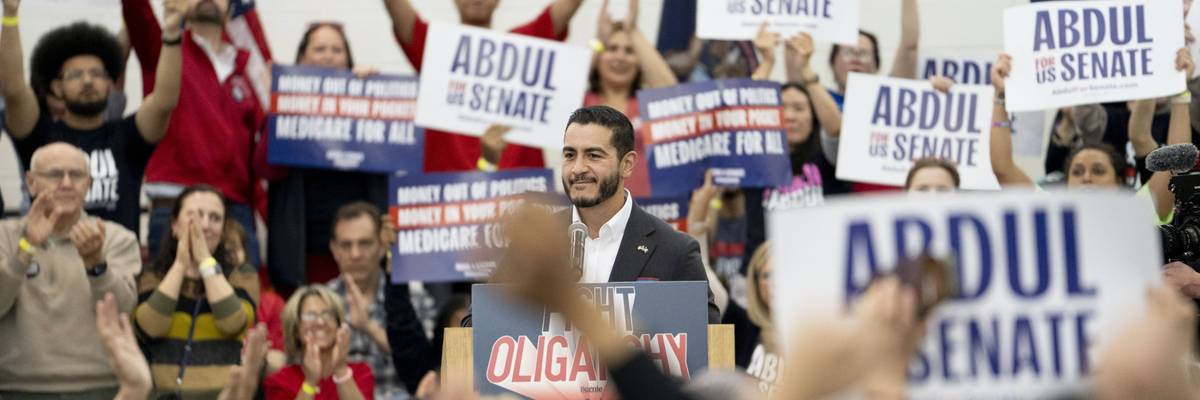
Abdul El-Sayed, candidate for US Senate in Michigan, speaks at Mumford High School on May 3, 2026 in Detroit.
The former public health official has centered the government-run healthcare proposal in his campaign.
In his first TV ad of the US Senate primary race in Michigan on Tuesday, former Detroit health official Abdul El-Sayed emphasized his top three priorities as he vies to represent working people across the state.
"This campaign will take on the powerful with three simple ideas," he said in the ad. "Money out of politics, money in your pocket, and Medicare for All."
The ad, featuring longtime Medicare for All advocate and early El-Sayed supporter Sen. Bernie Sanders (I-Vt.), marked only the latest time the candidate placed front and center the proposal to improve and expand the existing Medicare program to the entire US population, providing a government-run healthcare system that resembles those in other wealthy countries.
Today, we're going up on TV with our new ad, "Chorus."
This movement is powered by Michiganders and pro-worker champions. And our momentum is undeniable.
Michigan, we're going to get money out of politics, put money in pockets, and pass Medicare for All.
WATCH: pic.twitter.com/SM9eGH3Pm1
— Dr. Abdul El-Sayed (@AbdulElSayed) June 16, 2026
El-Sayed made the case for the program—supported by more than 100 members of the Democratic caucus in Congress as well as 78% of Democratic voters—in a video he posted on social media Monday, asking Michigan voters to imagine being diagnosed with cancer—only to realize they'll have to drive three hours to get the nearest cancer center, like many residents who don't live near one of Michigan's two nationally designated, comprehensive cancer treatment facilities.
"That's the reality for too many people who live in rural communities across our state," said El-Sayed, who wrote a book called Medicare for All: A Citizen's Guide in 2021. "Distance becomes an access issue, above and beyond all of the challenges with health insurance... And to make matters worse, with Medicaid cuts and [Affordable Care Act] cuts, all the reimbursements that should go into keeping those hospitals and clinics open, well, they're dwindling away."
Medicare for All, he said, would be "a lifeline" for people who are "traveling way too long to get the care they need."
A single-payer healthcare system that expanded the existing program, he said, would mean that everyone "reimburses at the same level, meaning it doesn't matter who you are, when you walk into a healthcare center, you're going to bring the full freight of Medicare payments to that hospital. It means that those hospitals that otherwise would have shut down get to stay open."
Imagine you’re diagnosed with cancer. And then you find out the cancer center is 3 hours away. And it’s the middle of winter.
Distance quickly becomes an access issue.
The solution? Medicare for All. pic.twitter.com/9MiJz5aKXh
— Dr. Abdul El-Sayed (@AbdulElSayed) June 15, 2026
El-Sayed also shared an exchange he had at a campaign event with a woman who said she had lost her daughter to cancer and had lost her income due to her need to become her child's full-time caregiver because in Michigan's Upper Peninsula, she had limited access to cancer care.
"Part of the reason that communities like this don't have healthcare is because you guys have two twin challenges," said El-Sayed. "One is the brokenness of our multiclass healthcare system. And one of them is distance."
"A lot of people ask me, 'Why are you so passionate about Medicare for All?'" he said. "Well part of it is, I want people to have healthcare when they need it. But part of is also for you, healthcare access isn't just health insurance. It's having a place to get the healthcare when you need it."
This is one of hundreds of stories I’ve heard from Michiganders about what can happen when someone simply gets sick in a country where healthcare is not guaranteed.
Pass Medicare for All. pic.twitter.com/g63BiKRVHT
— Dr. Abdul El-Sayed (@AbdulElSayed) June 12, 2026
El-Sayed is one of several progressive candidates pushing to bring Medicare for All to the center of US politics, six years after Sanders debated Democrats including former Vice President Kamala Harris and former President Joe Biden on the proposal on debate stages during the 2020 election.
At the time, Biden, who ultimately won the nomination and the presidency, dismissed Medicare for All as "unrealistic" and too expensive—despite studies that have shown it would save an estimated $650 billion per year. One organizer told Common Dreams in 2024 that during the Biden administration, the movement for Medicare for All became "quiet."
As Common Dreams reported last week, more than 325 organizations signed an open letter arguing that—as working families across the US struggle to keep up with rising costs of housing, groceries, gas, and other essentials while also facing the Republican Party's cuts to Affordable Care Act (ACA) subsidies and Medicaid—right now "is the time to organize" for Medicare for All.
The ACA was passed more than 16 years ago, and many Democratic candidates continue to run on promises to "protect" the program from Republican attacks.
But the GOP's efforts to gut the program have contributed to an ongoing healthcare crisis, with premiums, the uninsured rate, and the number of people relying on high-deductible "catastrophic" insurance rising this year.
In Michigan last week, the director of the United Auto Workers Region 1A in southeast Michigan told The Detroit News that El-Sayed's stance on healthcare helped him emerge as "the clear winner" as the influential union was weighing whom it would endorse in the three-way Democratic primary race.
El-Sayed is facing state Sen. Mallory McMorrow (D-8)—who recently claimed that public support "isn't there yet" for a government-run healthcare program—and US Rep. Haley Stevens (D-Mich.), who has expressed support for a "public option" but has not introduced legislation for such a system. El-Sayed noted at a recent debate that both of his opponents have taken donations from the for-profit health insurance industry.
At town halls, on his "We Can Do Better" listening tour, and on his social media accounts, El-Sayed has centered the demand for Medicare for All, denouncing opponents of the proposal who have claimed it would be unaffordable for the US—despite the fact that Republicans in Congress last week advanced a proposed Pentagon budget that exceeds $1 trillion.
"It's a funny thing, nobody ever asks the general who's drawing up war plans in Iran, 'General, how are you gonna pay for that?'" said El-Sayed at a recent event. "I happen to believe that rather than sending our money over there, or fighting foreign wars over there... I would rather end this dumb-ass war in Iran, abolish [Immigration and Customs Enforcement], and spend our money on healthcare here at home."
Dear Common Dreams reader, It’s been nearly 30 years since I co-founded Common Dreams with my late wife, Lina Newhouser. We had the radical notion that journalism should serve the public good, not corporate profits. It was clear to us from the outset what it would take to build such a project. No paid advertisements. No corporate sponsors. No millionaire publisher telling us what to think or do. Many people said we wouldn't last a year, but we proved those doubters wrong. Together with a tremendous team of journalists and dedicated staff, we built an independent media outlet free from the constraints of profits and corporate control. Our mission has always been simple: To inform. To inspire. To ignite change for the common good. Building Common Dreams was not easy. Our survival was never guaranteed. When you take on the most powerful forces—Wall Street greed, fossil fuel industry destruction, Big Tech lobbyists, and uber-rich oligarchs who have spent billions upon billions rigging the economy and democracy in their favor—the only bulwark you have is supporters who believe in your work. But here’s the urgent message from me today. It's never been this bad out there. And it's never been this hard to keep us going. At the very moment Common Dreams is most needed, the threats we face are intensifying. We need your support now more than ever. We don't accept corporate advertising and never will. We don't have a paywall because we don't think people should be blocked from critical news based on their ability to pay. Everything we do is funded by the donations of readers like you. When everyone does the little they can afford, we are strong. But if that support retreats or dries up, so do we. Will you donate now to make sure Common Dreams not only survives but thrives? —Craig Brown, Co-founder |
In his first TV ad of the US Senate primary race in Michigan on Tuesday, former Detroit health official Abdul El-Sayed emphasized his top three priorities as he vies to represent working people across the state.
"This campaign will take on the powerful with three simple ideas," he said in the ad. "Money out of politics, money in your pocket, and Medicare for All."
The ad, featuring longtime Medicare for All advocate and early El-Sayed supporter Sen. Bernie Sanders (I-Vt.), marked only the latest time the candidate placed front and center the proposal to improve and expand the existing Medicare program to the entire US population, providing a government-run healthcare system that resembles those in other wealthy countries.
Today, we're going up on TV with our new ad, "Chorus."
This movement is powered by Michiganders and pro-worker champions. And our momentum is undeniable.
Michigan, we're going to get money out of politics, put money in pockets, and pass Medicare for All.
WATCH: pic.twitter.com/SM9eGH3Pm1
— Dr. Abdul El-Sayed (@AbdulElSayed) June 16, 2026
El-Sayed made the case for the program—supported by more than 100 members of the Democratic caucus in Congress as well as 78% of Democratic voters—in a video he posted on social media Monday, asking Michigan voters to imagine being diagnosed with cancer—only to realize they'll have to drive three hours to get the nearest cancer center, like many residents who don't live near one of Michigan's two nationally designated, comprehensive cancer treatment facilities.
"That's the reality for too many people who live in rural communities across our state," said El-Sayed, who wrote a book called Medicare for All: A Citizen's Guide in 2021. "Distance becomes an access issue, above and beyond all of the challenges with health insurance... And to make matters worse, with Medicaid cuts and [Affordable Care Act] cuts, all the reimbursements that should go into keeping those hospitals and clinics open, well, they're dwindling away."
Medicare for All, he said, would be "a lifeline" for people who are "traveling way too long to get the care they need."
A single-payer healthcare system that expanded the existing program, he said, would mean that everyone "reimburses at the same level, meaning it doesn't matter who you are, when you walk into a healthcare center, you're going to bring the full freight of Medicare payments to that hospital. It means that those hospitals that otherwise would have shut down get to stay open."
Imagine you’re diagnosed with cancer. And then you find out the cancer center is 3 hours away. And it’s the middle of winter.
Distance quickly becomes an access issue.
The solution? Medicare for All. pic.twitter.com/9MiJz5aKXh
— Dr. Abdul El-Sayed (@AbdulElSayed) June 15, 2026
El-Sayed also shared an exchange he had at a campaign event with a woman who said she had lost her daughter to cancer and had lost her income due to her need to become her child's full-time caregiver because in Michigan's Upper Peninsula, she had limited access to cancer care.
"Part of the reason that communities like this don't have healthcare is because you guys have two twin challenges," said El-Sayed. "One is the brokenness of our multiclass healthcare system. And one of them is distance."
"A lot of people ask me, 'Why are you so passionate about Medicare for All?'" he said. "Well part of it is, I want people to have healthcare when they need it. But part of is also for you, healthcare access isn't just health insurance. It's having a place to get the healthcare when you need it."
This is one of hundreds of stories I’ve heard from Michiganders about what can happen when someone simply gets sick in a country where healthcare is not guaranteed.
Pass Medicare for All. pic.twitter.com/g63BiKRVHT
— Dr. Abdul El-Sayed (@AbdulElSayed) June 12, 2026
El-Sayed is one of several progressive candidates pushing to bring Medicare for All to the center of US politics, six years after Sanders debated Democrats including former Vice President Kamala Harris and former President Joe Biden on the proposal on debate stages during the 2020 election.
At the time, Biden, who ultimately won the nomination and the presidency, dismissed Medicare for All as "unrealistic" and too expensive—despite studies that have shown it would save an estimated $650 billion per year. One organizer told Common Dreams in 2024 that during the Biden administration, the movement for Medicare for All became "quiet."
As Common Dreams reported last week, more than 325 organizations signed an open letter arguing that—as working families across the US struggle to keep up with rising costs of housing, groceries, gas, and other essentials while also facing the Republican Party's cuts to Affordable Care Act (ACA) subsidies and Medicaid—right now "is the time to organize" for Medicare for All.
The ACA was passed more than 16 years ago, and many Democratic candidates continue to run on promises to "protect" the program from Republican attacks.
But the GOP's efforts to gut the program have contributed to an ongoing healthcare crisis, with premiums, the uninsured rate, and the number of people relying on high-deductible "catastrophic" insurance rising this year.
In Michigan last week, the director of the United Auto Workers Region 1A in southeast Michigan told The Detroit News that El-Sayed's stance on healthcare helped him emerge as "the clear winner" as the influential union was weighing whom it would endorse in the three-way Democratic primary race.
El-Sayed is facing state Sen. Mallory McMorrow (D-8)—who recently claimed that public support "isn't there yet" for a government-run healthcare program—and US Rep. Haley Stevens (D-Mich.), who has expressed support for a "public option" but has not introduced legislation for such a system. El-Sayed noted at a recent debate that both of his opponents have taken donations from the for-profit health insurance industry.
At town halls, on his "We Can Do Better" listening tour, and on his social media accounts, El-Sayed has centered the demand for Medicare for All, denouncing opponents of the proposal who have claimed it would be unaffordable for the US—despite the fact that Republicans in Congress last week advanced a proposed Pentagon budget that exceeds $1 trillion.
"It's a funny thing, nobody ever asks the general who's drawing up war plans in Iran, 'General, how are you gonna pay for that?'" said El-Sayed at a recent event. "I happen to believe that rather than sending our money over there, or fighting foreign wars over there... I would rather end this dumb-ass war in Iran, abolish [Immigration and Customs Enforcement], and spend our money on healthcare here at home."
In his first TV ad of the US Senate primary race in Michigan on Tuesday, former Detroit health official Abdul El-Sayed emphasized his top three priorities as he vies to represent working people across the state.
"This campaign will take on the powerful with three simple ideas," he said in the ad. "Money out of politics, money in your pocket, and Medicare for All."
The ad, featuring longtime Medicare for All advocate and early El-Sayed supporter Sen. Bernie Sanders (I-Vt.), marked only the latest time the candidate placed front and center the proposal to improve and expand the existing Medicare program to the entire US population, providing a government-run healthcare system that resembles those in other wealthy countries.
Today, we're going up on TV with our new ad, "Chorus."
This movement is powered by Michiganders and pro-worker champions. And our momentum is undeniable.
Michigan, we're going to get money out of politics, put money in pockets, and pass Medicare for All.
WATCH: pic.twitter.com/SM9eGH3Pm1
— Dr. Abdul El-Sayed (@AbdulElSayed) June 16, 2026
El-Sayed made the case for the program—supported by more than 100 members of the Democratic caucus in Congress as well as 78% of Democratic voters—in a video he posted on social media Monday, asking Michigan voters to imagine being diagnosed with cancer—only to realize they'll have to drive three hours to get the nearest cancer center, like many residents who don't live near one of Michigan's two nationally designated, comprehensive cancer treatment facilities.
"That's the reality for too many people who live in rural communities across our state," said El-Sayed, who wrote a book called Medicare for All: A Citizen's Guide in 2021. "Distance becomes an access issue, above and beyond all of the challenges with health insurance... And to make matters worse, with Medicaid cuts and [Affordable Care Act] cuts, all the reimbursements that should go into keeping those hospitals and clinics open, well, they're dwindling away."
Medicare for All, he said, would be "a lifeline" for people who are "traveling way too long to get the care they need."
A single-payer healthcare system that expanded the existing program, he said, would mean that everyone "reimburses at the same level, meaning it doesn't matter who you are, when you walk into a healthcare center, you're going to bring the full freight of Medicare payments to that hospital. It means that those hospitals that otherwise would have shut down get to stay open."
Imagine you’re diagnosed with cancer. And then you find out the cancer center is 3 hours away. And it’s the middle of winter.
Distance quickly becomes an access issue.
The solution? Medicare for All. pic.twitter.com/9MiJz5aKXh
— Dr. Abdul El-Sayed (@AbdulElSayed) June 15, 2026
El-Sayed also shared an exchange he had at a campaign event with a woman who said she had lost her daughter to cancer and had lost her income due to her need to become her child's full-time caregiver because in Michigan's Upper Peninsula, she had limited access to cancer care.
"Part of the reason that communities like this don't have healthcare is because you guys have two twin challenges," said El-Sayed. "One is the brokenness of our multiclass healthcare system. And one of them is distance."
"A lot of people ask me, 'Why are you so passionate about Medicare for All?'" he said. "Well part of it is, I want people to have healthcare when they need it. But part of is also for you, healthcare access isn't just health insurance. It's having a place to get the healthcare when you need it."
This is one of hundreds of stories I’ve heard from Michiganders about what can happen when someone simply gets sick in a country where healthcare is not guaranteed.
Pass Medicare for All. pic.twitter.com/g63BiKRVHT
— Dr. Abdul El-Sayed (@AbdulElSayed) June 12, 2026
El-Sayed is one of several progressive candidates pushing to bring Medicare for All to the center of US politics, six years after Sanders debated Democrats including former Vice President Kamala Harris and former President Joe Biden on the proposal on debate stages during the 2020 election.
At the time, Biden, who ultimately won the nomination and the presidency, dismissed Medicare for All as "unrealistic" and too expensive—despite studies that have shown it would save an estimated $650 billion per year. One organizer told Common Dreams in 2024 that during the Biden administration, the movement for Medicare for All became "quiet."
As Common Dreams reported last week, more than 325 organizations signed an open letter arguing that—as working families across the US struggle to keep up with rising costs of housing, groceries, gas, and other essentials while also facing the Republican Party's cuts to Affordable Care Act (ACA) subsidies and Medicaid—right now "is the time to organize" for Medicare for All.
The ACA was passed more than 16 years ago, and many Democratic candidates continue to run on promises to "protect" the program from Republican attacks.
But the GOP's efforts to gut the program have contributed to an ongoing healthcare crisis, with premiums, the uninsured rate, and the number of people relying on high-deductible "catastrophic" insurance rising this year.
In Michigan last week, the director of the United Auto Workers Region 1A in southeast Michigan told The Detroit News that El-Sayed's stance on healthcare helped him emerge as "the clear winner" as the influential union was weighing whom it would endorse in the three-way Democratic primary race.
El-Sayed is facing state Sen. Mallory McMorrow (D-8)—who recently claimed that public support "isn't there yet" for a government-run healthcare program—and US Rep. Haley Stevens (D-Mich.), who has expressed support for a "public option" but has not introduced legislation for such a system. El-Sayed noted at a recent debate that both of his opponents have taken donations from the for-profit health insurance industry.
At town halls, on his "We Can Do Better" listening tour, and on his social media accounts, El-Sayed has centered the demand for Medicare for All, denouncing opponents of the proposal who have claimed it would be unaffordable for the US—despite the fact that Republicans in Congress last week advanced a proposed Pentagon budget that exceeds $1 trillion.
"It's a funny thing, nobody ever asks the general who's drawing up war plans in Iran, 'General, how are you gonna pay for that?'" said El-Sayed at a recent event. "I happen to believe that rather than sending our money over there, or fighting foreign wars over there... I would rather end this dumb-ass war in Iran, abolish [Immigration and Customs Enforcement], and spend our money on healthcare here at home."

