SUBSCRIBE TO OUR FREE NEWSLETTER
Daily news & progressive opinion—funded by the people, not the corporations—delivered straight to your inbox.
5
#000000
#FFFFFF
To donate by check, phone, or other method, see our More Ways to Give page.
Daily news & progressive opinion—funded by the people, not the corporations—delivered straight to your inbox.
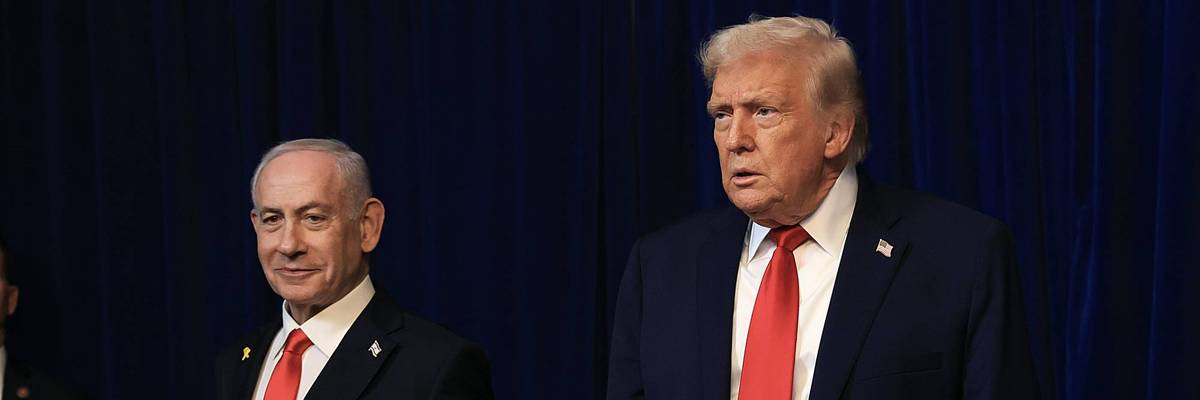
US President Donald Trump holds a press conference with Israeli Prime Minister Benjamin Netanyahu at his Mar-a-Lago club on December 29, 2025, in Palm Beach, Florida.
"Trump again says the quiet part out loud—America entered the Iran war to support a genocidal ethno-state and brutal absolute autocracies, all of whom are his political and commercial financiers."
During his campaign for reelection, one of President Donald Trump's central pitches was that the US needed to stay out of foreign wars in order to prioritize "America first."
But his decision to join Israel and launch a massive war with Iran, which has caused turmoil across the American economy, has left many voters rather skeptical of these motivations, believing the war benefits other nations—particularly Israel—more than the US.
That perception has not been assuaged by statements from officials like Secretary of State Marco Rubio, who acknowledged in the early days of the war that a so-called "imminent threat" to the US only existed because Israel had planned to attack, or by the president's recent comment that he doesn't "think about Americans' financial situation" regarding the war.
In an interview with Sean Hannity on Fox News on Thursday, Trump appeared to further affirm that the Iran invasion's impact on his own country is far from top-of-mind.
Trump was asked by Hannity about his weekslong effort to reopen the Strait of Hormuz, which Iran closed in response to the war's launch, causing a spike in global oil prices that has hit the US. Reopening the strait has become one of Trump's main demands as he pushes for a deal with Iran, even though it was open before the war began.
But Trump said on Thursday that other countries "need the strait more than we need it open." He cited his administration's aggressive expansion of oil drilling, which he has claimed would make the US more resilient to the oil shock, although it hasn't been enough to stop gas prices from soaring above $4.50/gallon on average.
"We don't need it at all," Trump said, to which Hannity responded incredulously, "We don't need it at all?"
"We don't need it at all," Trump reiterated. “I mean, you could make the case, you know, like why are we even, we’re doing it to help Israel, and to help Saudi Arabia, and to help Qatar and [the United Arab Emirates] and, you know, Kuwait and other countries, Bahrain—”
Hannity interjected: "It also helps China."
Speaking of his summit this week with Chinese leaders, including President Xi Jinping, Trump said: "Actually, I told him today, I said, 'You know, we're helping you, and we're helping you in another way,' because I don't think they want, I don't think China wants Iran to have a nuclear weapon either.'"
Trump's director of national intelligence, Tulsi Gabbard, testified in a written statement to Congress in March that Iran had not tried to rebuild its nuclear enrichment capability after earlier US and Israeli attacks last June, which undercut one of the administration's primary rationales for war.
Trump's former National Counterterrorism Center director, Joe Kent, said last week that the US intelligence community agreed in the days leading up to the war that "Iran wasn’t developing a nuclear weapon,” but said that these assessments were undermined by persuasion from "a foreign government—Israel," which "won the argument and forced us into this war."
Many of the US's Persian Gulf allies have publicly tried to distance themselves from the war, especially in the face of retaliation from Iran. But The Associated Press has reported that countries like the UAE, Saudi Arabia, Kuwait, and Bahrain have pushed Trump behind the scenes to continue escalating the war in an effort to weaken Iran militarily and force more permanent changes to the regime.
Some have noted the Trump family’s close personal ties to the Gulf regimes—from his family’s cryptocurrency venture which is buoyed by a $500 million investment from a powerful member of Abu Dhabi’s ruling family; to his son in law Jared Kushner’s private equity firm, which has received $2 billion from Saudi Arabia’s public investment fund; to his real estate empire which has lucrative Trump-branded properties popping up across the region.
Independent journalist Borzou Daragahi said that with his latest comments, "Trump again says the quiet part out loud—America entered the Iran war to support a genocidal ethno-state and brutal absolute autocracies, all of whom are his political and commercial financiers."
Dear Common Dreams reader, It’s been nearly 30 years since I co-founded Common Dreams with my late wife, Lina Newhouser. We had the radical notion that journalism should serve the public good, not corporate profits. It was clear to us from the outset what it would take to build such a project. No paid advertisements. No corporate sponsors. No millionaire publisher telling us what to think or do. Many people said we wouldn't last a year, but we proved those doubters wrong. Together with a tremendous team of journalists and dedicated staff, we built an independent media outlet free from the constraints of profits and corporate control. Our mission has always been simple: To inform. To inspire. To ignite change for the common good. Building Common Dreams was not easy. Our survival was never guaranteed. When you take on the most powerful forces—Wall Street greed, fossil fuel industry destruction, Big Tech lobbyists, and uber-rich oligarchs who have spent billions upon billions rigging the economy and democracy in their favor—the only bulwark you have is supporters who believe in your work. But here’s the urgent message from me today. It's never been this bad out there. And it's never been this hard to keep us going. At the very moment Common Dreams is most needed, the threats we face are intensifying. We need your support now more than ever. We don't accept corporate advertising and never will. We don't have a paywall because we don't think people should be blocked from critical news based on their ability to pay. Everything we do is funded by the donations of readers like you. When everyone does the little they can afford, we are strong. But if that support retreats or dries up, so do we. Will you donate now to make sure Common Dreams not only survives but thrives? —Craig Brown, Co-founder |
During his campaign for reelection, one of President Donald Trump's central pitches was that the US needed to stay out of foreign wars in order to prioritize "America first."
But his decision to join Israel and launch a massive war with Iran, which has caused turmoil across the American economy, has left many voters rather skeptical of these motivations, believing the war benefits other nations—particularly Israel—more than the US.
That perception has not been assuaged by statements from officials like Secretary of State Marco Rubio, who acknowledged in the early days of the war that a so-called "imminent threat" to the US only existed because Israel had planned to attack, or by the president's recent comment that he doesn't "think about Americans' financial situation" regarding the war.
In an interview with Sean Hannity on Fox News on Thursday, Trump appeared to further affirm that the Iran invasion's impact on his own country is far from top-of-mind.
Trump was asked by Hannity about his weekslong effort to reopen the Strait of Hormuz, which Iran closed in response to the war's launch, causing a spike in global oil prices that has hit the US. Reopening the strait has become one of Trump's main demands as he pushes for a deal with Iran, even though it was open before the war began.
But Trump said on Thursday that other countries "need the strait more than we need it open." He cited his administration's aggressive expansion of oil drilling, which he has claimed would make the US more resilient to the oil shock, although it hasn't been enough to stop gas prices from soaring above $4.50/gallon on average.
"We don't need it at all," Trump said, to which Hannity responded incredulously, "We don't need it at all?"
"We don't need it at all," Trump reiterated. “I mean, you could make the case, you know, like why are we even, we’re doing it to help Israel, and to help Saudi Arabia, and to help Qatar and [the United Arab Emirates] and, you know, Kuwait and other countries, Bahrain—”
Hannity interjected: "It also helps China."
Speaking of his summit this week with Chinese leaders, including President Xi Jinping, Trump said: "Actually, I told him today, I said, 'You know, we're helping you, and we're helping you in another way,' because I don't think they want, I don't think China wants Iran to have a nuclear weapon either.'"
Trump's director of national intelligence, Tulsi Gabbard, testified in a written statement to Congress in March that Iran had not tried to rebuild its nuclear enrichment capability after earlier US and Israeli attacks last June, which undercut one of the administration's primary rationales for war.
Trump's former National Counterterrorism Center director, Joe Kent, said last week that the US intelligence community agreed in the days leading up to the war that "Iran wasn’t developing a nuclear weapon,” but said that these assessments were undermined by persuasion from "a foreign government—Israel," which "won the argument and forced us into this war."
Many of the US's Persian Gulf allies have publicly tried to distance themselves from the war, especially in the face of retaliation from Iran. But The Associated Press has reported that countries like the UAE, Saudi Arabia, Kuwait, and Bahrain have pushed Trump behind the scenes to continue escalating the war in an effort to weaken Iran militarily and force more permanent changes to the regime.
Some have noted the Trump family’s close personal ties to the Gulf regimes—from his family’s cryptocurrency venture which is buoyed by a $500 million investment from a powerful member of Abu Dhabi’s ruling family; to his son in law Jared Kushner’s private equity firm, which has received $2 billion from Saudi Arabia’s public investment fund; to his real estate empire which has lucrative Trump-branded properties popping up across the region.
Independent journalist Borzou Daragahi said that with his latest comments, "Trump again says the quiet part out loud—America entered the Iran war to support a genocidal ethno-state and brutal absolute autocracies, all of whom are his political and commercial financiers."
During his campaign for reelection, one of President Donald Trump's central pitches was that the US needed to stay out of foreign wars in order to prioritize "America first."
But his decision to join Israel and launch a massive war with Iran, which has caused turmoil across the American economy, has left many voters rather skeptical of these motivations, believing the war benefits other nations—particularly Israel—more than the US.
That perception has not been assuaged by statements from officials like Secretary of State Marco Rubio, who acknowledged in the early days of the war that a so-called "imminent threat" to the US only existed because Israel had planned to attack, or by the president's recent comment that he doesn't "think about Americans' financial situation" regarding the war.
In an interview with Sean Hannity on Fox News on Thursday, Trump appeared to further affirm that the Iran invasion's impact on his own country is far from top-of-mind.
Trump was asked by Hannity about his weekslong effort to reopen the Strait of Hormuz, which Iran closed in response to the war's launch, causing a spike in global oil prices that has hit the US. Reopening the strait has become one of Trump's main demands as he pushes for a deal with Iran, even though it was open before the war began.
But Trump said on Thursday that other countries "need the strait more than we need it open." He cited his administration's aggressive expansion of oil drilling, which he has claimed would make the US more resilient to the oil shock, although it hasn't been enough to stop gas prices from soaring above $4.50/gallon on average.
"We don't need it at all," Trump said, to which Hannity responded incredulously, "We don't need it at all?"
"We don't need it at all," Trump reiterated. “I mean, you could make the case, you know, like why are we even, we’re doing it to help Israel, and to help Saudi Arabia, and to help Qatar and [the United Arab Emirates] and, you know, Kuwait and other countries, Bahrain—”
Hannity interjected: "It also helps China."
Speaking of his summit this week with Chinese leaders, including President Xi Jinping, Trump said: "Actually, I told him today, I said, 'You know, we're helping you, and we're helping you in another way,' because I don't think they want, I don't think China wants Iran to have a nuclear weapon either.'"
Trump's director of national intelligence, Tulsi Gabbard, testified in a written statement to Congress in March that Iran had not tried to rebuild its nuclear enrichment capability after earlier US and Israeli attacks last June, which undercut one of the administration's primary rationales for war.
Trump's former National Counterterrorism Center director, Joe Kent, said last week that the US intelligence community agreed in the days leading up to the war that "Iran wasn’t developing a nuclear weapon,” but said that these assessments were undermined by persuasion from "a foreign government—Israel," which "won the argument and forced us into this war."
Many of the US's Persian Gulf allies have publicly tried to distance themselves from the war, especially in the face of retaliation from Iran. But The Associated Press has reported that countries like the UAE, Saudi Arabia, Kuwait, and Bahrain have pushed Trump behind the scenes to continue escalating the war in an effort to weaken Iran militarily and force more permanent changes to the regime.
Some have noted the Trump family’s close personal ties to the Gulf regimes—from his family’s cryptocurrency venture which is buoyed by a $500 million investment from a powerful member of Abu Dhabi’s ruling family; to his son in law Jared Kushner’s private equity firm, which has received $2 billion from Saudi Arabia’s public investment fund; to his real estate empire which has lucrative Trump-branded properties popping up across the region.
Independent journalist Borzou Daragahi said that with his latest comments, "Trump again says the quiet part out loud—America entered the Iran war to support a genocidal ethno-state and brutal absolute autocracies, all of whom are his political and commercial financiers."