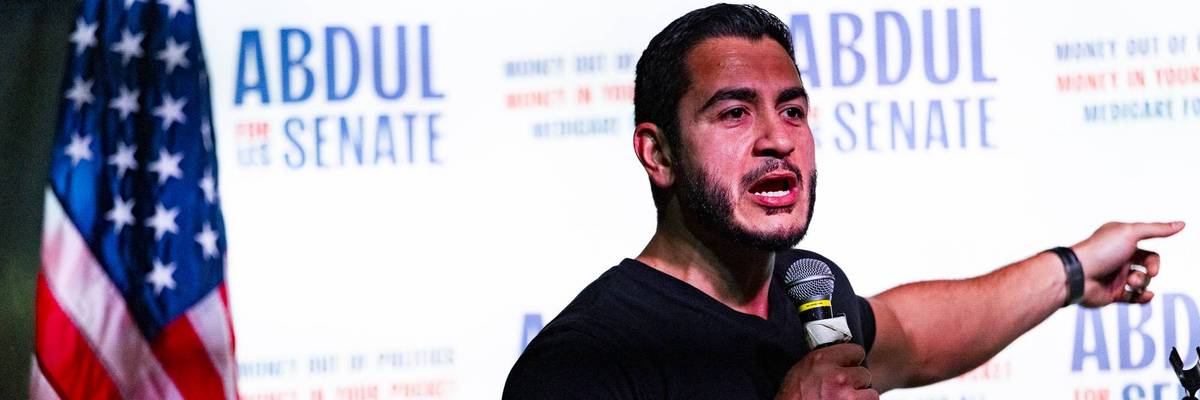
Democratic US Senate candidate Abdul El-Sayed speaks during a campaign event at the Loving Touch on July 25, 2026, in Ferndale, Michigan.
$60 Million 'Crutch' From Super PACs Is Proof That Stevens Isn't Actually 'Electable,' Says El-Sayed
In the final debate before Michigan's pivotal Democratic Senate primary, Abdul El-Sayed continued to hammer on the idea that his opponent, Rep. Haley Stevens, is "bought off" by AIPAC and corporate-funded super PACs.
Progressive US Senate hopeful Dr. Abdul El-Sayed spent Monday night's final Democratic primary debate in Michigan continuing to hammer on his centrist opponent Rep. Haley Stevens' backing from big money donors.
With just a week before Michiganders head to the polls, Stevens has emphasized her supposed electability against presumptive Republican nominee former Rep. Mike Rogers for the seat, which could decide the balance of power in the Senate.
While El-Sayed has consistently dominated in fundraising from individual contributors, particularly small-dollar donors, he is still dramatically outgunned by Stevens in terms of overall financial support.
Six aligned super PACs have reserved roughly $60 million to run ads boosting her—more than half of which comes from the American Israel Public Affairs Committee (AIPAC)-affiliated super political action committee (PAC) the United Democracy Project.
This tidal wave of outside funding has appeared to help Stevens remain competitive with El-Sayed after initially trailing him. But on the debate stage Monday, former Detroit public health official El-Sayed—who has made removing big money from politics a central campaign plank—argued that the spending cuts against Stevens' claim that she is more "electable" than him.
Along with the Senate filibuster, which he said would allow Republicans to stymy ambitious agenda items like Medicare for All and labor protection bills like the PRO Act, El-Sayed argued that "money in politics" was among the biggest "risks to our democracy."
He pointed to the super PAC-funded "attack ads that you've seen, probably in the last commercial break itself" that "change our political system." He then called out Stevens directly.
"When you ask $60 million to come into a race for you, and then say that somehow you're electable, I think you don't quite understand what electability means," El-Sayed said. "If you need a $60 million crutch, you probably can't be elected on your own terms."
Both El-Sayed and Stevens are shown to be slightly ahead of Rogers in polls for a hypothetical November matchup.
While Stevens has claimed that Rogers views El-Sayed as an easier opponent, one aggregate of four recent polls by 270ToWin shows El-Sayed leading the Republican by about 2.5 percentage points on average compared to Stevens, who leads by about 1.3 points on average.
El-Sayed, who has made a point of swearing off corporate backers, hit on the idea that Stevens was "bought off" repeatedly throughout the night.
He noted the $45,000 in direct support her campaigns had received since 2019 from the increasingly loathed Michigan energy monopoly DTE, as well as her support from super PACs backed by donors in the health insurance and tech industries.
Responding to Stevens’ message about the need to lower prices for ordinary people, El-Sayed said, “I don’t take money from the corporations who are jacking up your prices in the first place.”
He also pointed to her vote last week to preserve $3.3 billion in military aid for Israel while more than half of her Democratic colleagues voted for an amendment that would have cut off the support.
El-Sayed said it showed that AIPAC, which has grown overwhelmingly unpopular with Democratic voters disgusted by Israel's actions, had dumped at least $30 million behind Stevens because “they know she’ll be a reliable vote."
Stevens largely sidestepped questions about her super PAC support, instead hitting back at El-Sayed for campaigning with "senators who’ve come in here from the coast," like Bernie Sanders (I-Vt.), Elizabeth Warren (D-Mass.) and Chris Van Hollen (D-Md.), who she said lack an understanding of "what makes our state tick."
She emphasized her "experience" over El-Sayed as a four-term congresswoman and as “Michigan’s manufacturing geek” who'd bring a "unique understanding" of the state's issues to Congress.
"I don't think there's much difference between super PACs going in for Abdul or super PACs going in for me," Stevens said, ignoring that outside spending to back Stevens throughout the primary outpaces the amount supporting El-Sayed by about 18-to-1, according to the latest totals from AdImpact.
While polling for next Tuesday's primary has been all over the map, showing leads for both El-Sayed and Stevens in recent weeks, an unscientific online poll from Fox 2 Detroit indicated that El-Sayed was viewed overwhelmingly as the winner of Monday's debate.
We are at a crossroads
This country and this world are at a monumental crossroads. In a few short weeks, US voters will have an opportunity to beat back the forces of fascism and confront the billionaires who are rigging the economy, our media system, and our democracy, making it increasingly impossible for ordinary people to get by. We’re not just talking about the election. We’re talking about what must be done once these fascist elements are vanquished from power. We need a bolder set of solutions than what either major party has so far been willing to offer and a working-class movement ready to fight like hell for it. Trump didn't emerge from nowhere. The conditions that fueled MAGA authoritarianism were created by decades of radical neoliberal economic policies and a corrupt political system dominated by corporate interests. They slashed taxes on the super-rich, promising that the benefits would trickle down. They said giveaways to the corporate titans would make life more affordable for the rest of us. It was all bullshit. And when a bitter, betrayed populace searches for someone to blame, right-wing demagogues have little trouble finding scapegoats. People know when they're being lied to, but you won't hear any of this from the corporate media. Only independent journalism—powered and funded by people who believe in building a better world—can deliver truly trustworthy daily news. Our Fall Campaign is underway, and we need your help. To power our newsroom through the rest of the year, we need to raise $125,000 by midnight on October 31. So if you share our vision, please contribute whatever you can to sustain our work. |
Progressive US Senate hopeful Dr. Abdul El-Sayed spent Monday night's final Democratic primary debate in Michigan continuing to hammer on his centrist opponent Rep. Haley Stevens' backing from big money donors.
With just a week before Michiganders head to the polls, Stevens has emphasized her supposed electability against presumptive Republican nominee former Rep. Mike Rogers for the seat, which could decide the balance of power in the Senate.
While El-Sayed has consistently dominated in fundraising from individual contributors, particularly small-dollar donors, he is still dramatically outgunned by Stevens in terms of overall financial support.
Six aligned super PACs have reserved roughly $60 million to run ads boosting her—more than half of which comes from the American Israel Public Affairs Committee (AIPAC)-affiliated super political action committee (PAC) the United Democracy Project.
This tidal wave of outside funding has appeared to help Stevens remain competitive with El-Sayed after initially trailing him. But on the debate stage Monday, former Detroit public health official El-Sayed—who has made removing big money from politics a central campaign plank—argued that the spending cuts against Stevens' claim that she is more "electable" than him.
Along with the Senate filibuster, which he said would allow Republicans to stymy ambitious agenda items like Medicare for All and labor protection bills like the PRO Act, El-Sayed argued that "money in politics" was among the biggest "risks to our democracy."
He pointed to the super PAC-funded "attack ads that you've seen, probably in the last commercial break itself" that "change our political system." He then called out Stevens directly.
"When you ask $60 million to come into a race for you, and then say that somehow you're electable, I think you don't quite understand what electability means," El-Sayed said. "If you need a $60 million crutch, you probably can't be elected on your own terms."
Both El-Sayed and Stevens are shown to be slightly ahead of Rogers in polls for a hypothetical November matchup.
While Stevens has claimed that Rogers views El-Sayed as an easier opponent, one aggregate of four recent polls by 270ToWin shows El-Sayed leading the Republican by about 2.5 percentage points on average compared to Stevens, who leads by about 1.3 points on average.
El-Sayed, who has made a point of swearing off corporate backers, hit on the idea that Stevens was "bought off" repeatedly throughout the night.
He noted the $45,000 in direct support her campaigns had received since 2019 from the increasingly loathed Michigan energy monopoly DTE, as well as her support from super PACs backed by donors in the health insurance and tech industries.
Responding to Stevens’ message about the need to lower prices for ordinary people, El-Sayed said, “I don’t take money from the corporations who are jacking up your prices in the first place.”
He also pointed to her vote last week to preserve $3.3 billion in military aid for Israel while more than half of her Democratic colleagues voted for an amendment that would have cut off the support.
El-Sayed said it showed that AIPAC, which has grown overwhelmingly unpopular with Democratic voters disgusted by Israel's actions, had dumped at least $30 million behind Stevens because “they know she’ll be a reliable vote."
Stevens largely sidestepped questions about her super PAC support, instead hitting back at El-Sayed for campaigning with "senators who’ve come in here from the coast," like Bernie Sanders (I-Vt.), Elizabeth Warren (D-Mass.) and Chris Van Hollen (D-Md.), who she said lack an understanding of "what makes our state tick."
She emphasized her "experience" over El-Sayed as a four-term congresswoman and as “Michigan’s manufacturing geek” who'd bring a "unique understanding" of the state's issues to Congress.
"I don't think there's much difference between super PACs going in for Abdul or super PACs going in for me," Stevens said, ignoring that outside spending to back Stevens throughout the primary outpaces the amount supporting El-Sayed by about 18-to-1, according to the latest totals from AdImpact.
While polling for next Tuesday's primary has been all over the map, showing leads for both El-Sayed and Stevens in recent weeks, an unscientific online poll from Fox 2 Detroit indicated that El-Sayed was viewed overwhelmingly as the winner of Monday's debate.
- In Senate Race, Michigan's El-Sayed Hammers Message on Medicare for All ›
- 'Underhanded' Stevens Sends Out Fake El-Sayed Press Release Claiming He’s Endorsed by Their GOP Opponent ›
- 'Contrast Could Not Be Clearer' as Medicare for All Advocate El-Sayed Faces AIPAC-Backed Stevens in Michigan ›
- El-Sayed Takes Aim at Opponents’ AIPAC, For-Profit Insurance Donations in Michigan Senate Debate ›
- AIPAC, 'Murky' Donors Spend $50 Million to Help Stevens Beat El-Sayed in Michigan ›
- 'We Don’t Need to Be Unkind to Be Honest': El-Sayed Asks Supporters to Criticize Haley Stevens on 'the Issues' ›
- Dem Establishment Intensifies Attacks on El-Sayed as New Poll Shows Him Leading by Double Digits | Common Dreams ›
- Progressives Aim to Defeat AIPAC Cash, Dem Establishment in Michigan and Missouri Primaries | Common Dreams ›
- As El-Sayed Champions Medicare for All, Michiganders Can't Afford Basic Needs Due to Health Insurance Costs | Common Dreams ›
Progressive US Senate hopeful Dr. Abdul El-Sayed spent Monday night's final Democratic primary debate in Michigan continuing to hammer on his centrist opponent Rep. Haley Stevens' backing from big money donors.
With just a week before Michiganders head to the polls, Stevens has emphasized her supposed electability against presumptive Republican nominee former Rep. Mike Rogers for the seat, which could decide the balance of power in the Senate.
While El-Sayed has consistently dominated in fundraising from individual contributors, particularly small-dollar donors, he is still dramatically outgunned by Stevens in terms of overall financial support.
Six aligned super PACs have reserved roughly $60 million to run ads boosting her—more than half of which comes from the American Israel Public Affairs Committee (AIPAC)-affiliated super political action committee (PAC) the United Democracy Project.
This tidal wave of outside funding has appeared to help Stevens remain competitive with El-Sayed after initially trailing him. But on the debate stage Monday, former Detroit public health official El-Sayed—who has made removing big money from politics a central campaign plank—argued that the spending cuts against Stevens' claim that she is more "electable" than him.
Along with the Senate filibuster, which he said would allow Republicans to stymy ambitious agenda items like Medicare for All and labor protection bills like the PRO Act, El-Sayed argued that "money in politics" was among the biggest "risks to our democracy."
He pointed to the super PAC-funded "attack ads that you've seen, probably in the last commercial break itself" that "change our political system." He then called out Stevens directly.
"When you ask $60 million to come into a race for you, and then say that somehow you're electable, I think you don't quite understand what electability means," El-Sayed said. "If you need a $60 million crutch, you probably can't be elected on your own terms."
Both El-Sayed and Stevens are shown to be slightly ahead of Rogers in polls for a hypothetical November matchup.
While Stevens has claimed that Rogers views El-Sayed as an easier opponent, one aggregate of four recent polls by 270ToWin shows El-Sayed leading the Republican by about 2.5 percentage points on average compared to Stevens, who leads by about 1.3 points on average.
El-Sayed, who has made a point of swearing off corporate backers, hit on the idea that Stevens was "bought off" repeatedly throughout the night.
He noted the $45,000 in direct support her campaigns had received since 2019 from the increasingly loathed Michigan energy monopoly DTE, as well as her support from super PACs backed by donors in the health insurance and tech industries.
Responding to Stevens’ message about the need to lower prices for ordinary people, El-Sayed said, “I don’t take money from the corporations who are jacking up your prices in the first place.”
He also pointed to her vote last week to preserve $3.3 billion in military aid for Israel while more than half of her Democratic colleagues voted for an amendment that would have cut off the support.
El-Sayed said it showed that AIPAC, which has grown overwhelmingly unpopular with Democratic voters disgusted by Israel's actions, had dumped at least $30 million behind Stevens because “they know she’ll be a reliable vote."
Stevens largely sidestepped questions about her super PAC support, instead hitting back at El-Sayed for campaigning with "senators who’ve come in here from the coast," like Bernie Sanders (I-Vt.), Elizabeth Warren (D-Mass.) and Chris Van Hollen (D-Md.), who she said lack an understanding of "what makes our state tick."
She emphasized her "experience" over El-Sayed as a four-term congresswoman and as “Michigan’s manufacturing geek” who'd bring a "unique understanding" of the state's issues to Congress.
"I don't think there's much difference between super PACs going in for Abdul or super PACs going in for me," Stevens said, ignoring that outside spending to back Stevens throughout the primary outpaces the amount supporting El-Sayed by about 18-to-1, according to the latest totals from AdImpact.
While polling for next Tuesday's primary has been all over the map, showing leads for both El-Sayed and Stevens in recent weeks, an unscientific online poll from Fox 2 Detroit indicated that El-Sayed was viewed overwhelmingly as the winner of Monday's debate.
- In Senate Race, Michigan's El-Sayed Hammers Message on Medicare for All ›
- 'Underhanded' Stevens Sends Out Fake El-Sayed Press Release Claiming He’s Endorsed by Their GOP Opponent ›
- 'Contrast Could Not Be Clearer' as Medicare for All Advocate El-Sayed Faces AIPAC-Backed Stevens in Michigan ›
- El-Sayed Takes Aim at Opponents’ AIPAC, For-Profit Insurance Donations in Michigan Senate Debate ›
- AIPAC, 'Murky' Donors Spend $50 Million to Help Stevens Beat El-Sayed in Michigan ›
- 'We Don’t Need to Be Unkind to Be Honest': El-Sayed Asks Supporters to Criticize Haley Stevens on 'the Issues' ›
- Dem Establishment Intensifies Attacks on El-Sayed as New Poll Shows Him Leading by Double Digits | Common Dreams ›
- Progressives Aim to Defeat AIPAC Cash, Dem Establishment in Michigan and Missouri Primaries | Common Dreams ›
- As El-Sayed Champions Medicare for All, Michiganders Can't Afford Basic Needs Due to Health Insurance Costs | Common Dreams ›