

SUBSCRIBE TO OUR FREE NEWSLETTER
Daily news & progressive opinion—funded by the people, not the corporations—delivered straight to your inbox.
5
#000000
#FFFFFF
To donate by check, phone, or other method, see our More Ways to Give page.
Daily news & progressive opinion—funded by the people, not the corporations—delivered straight to your inbox.
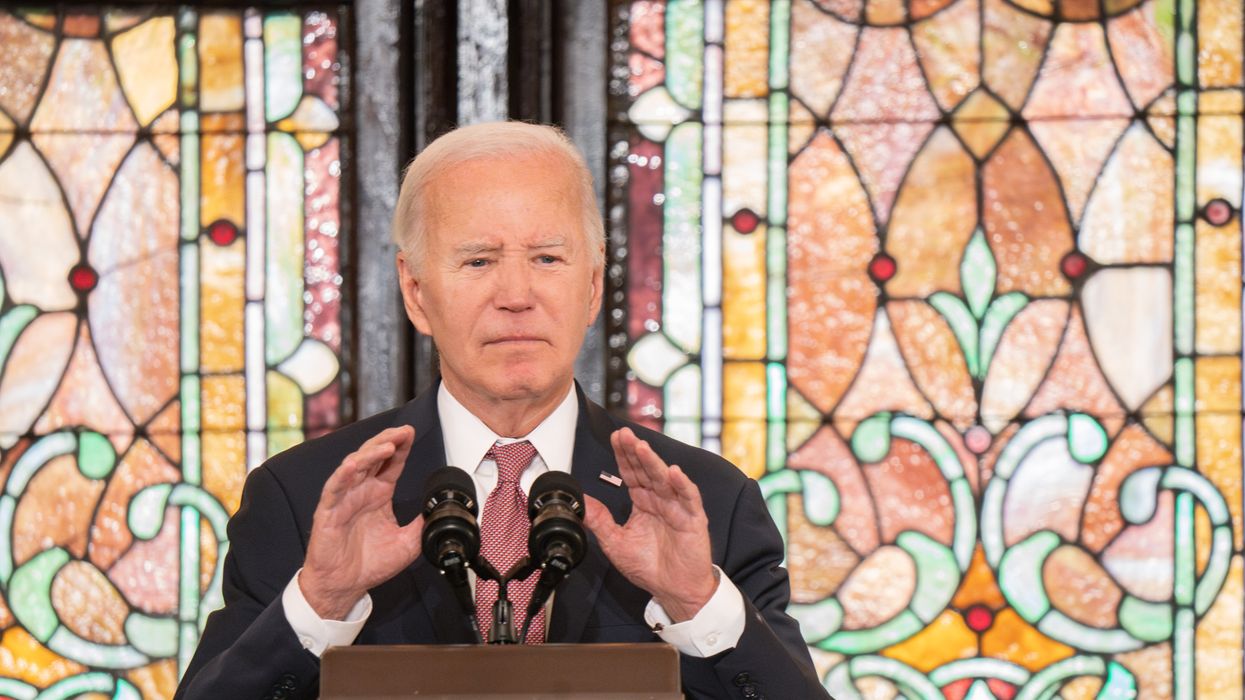
"Biden and every American politician who continues to support arming Israel as it kills more and more Palestinians in Gaza every day do not deserve a moment of peace in their public lives," said one critic.
Demonstrators demanding a cease-fire in the U.S.-backed Israeli war on the Gaza Strip were drowned out by supporters of President Joe Biden chanting "four more years" in Charleston, South Carolina on Monday.
A few audience members disrupted Biden—who is seeking reelection this year—as he addressed a crowd at Mother Emanuel AME Church, where a white supremacist gunman killed nine Black worshippers in 2015.
"If you really care about the lives lost here, then you should honor the lives lost and call for a cease-fire in Palestine," shouted one protester, who was then joined by others in chanting, "Cease-fire now!"
As the cease-fire supporters were escorted out of the church, much louder chants of "four more years" broke out.
Biden has affirmed his "unwavering" support as Israel has waged war on Gaza since the Hamas-led attack of October 7. He asked Congress for a $14.3 billion package on top of the $3.8 billion in military aid that the U.S. gives Israel annually and his administration twice bypassed congressional oversight to approve recent arms sales to the country.
Appearing caught off-guard by Monday's disruption, Biden eventually quieted the crowd with raised hands and repeated "thank you’s.
"Look folks," the president said, "I understand their passion, and I've been quietly working with the Israeli government to get them to reduce and significantly get out of Gaza, using all that I can to do that. But I understand the passion."
In response to footage of the event, IfNotNow, an American Jewish group organizing to end U.S. support for Israel's apartheid system, said: "Biden was shaken. He's starting to understand the reality: His war on Gaza is horrifically unpopular, and people are fed up."
Noting that the disruption in South Carolina came after New York City demonstrators on Monday morning shut down the Holland Tunnel and three major Manhattan bridges, IfNotNow added: "Young people are furious. We will not allow Biden and the U.S. to continue to support the starvation and slaughter of Gaza."
Also welcoming the protest in Charleston, Naftali Ehrenkranz of Justice Democrats said: "Hell yeah. Biden and every American politician who continues to support arming Israel as it kills more and more Palestinians in Gaza every day do not deserve a moment of peace in their public lives. Cease-fire now."
Some Biden backers criticized the protesters for "targeting" the president on "hallowed ground," provoking responses that highlighted recent actions by Israeli forces in Gaza—from killing thousands of kids to bombing places of worship—as well as the history of this church, which was co-founded by Denmark Vesey, who was executed for planning a slave revolt.
"To dilute the history of Black churches as if they aren't the epicenter of civil rights organizing is more than a little harmful. It's downright disingenuous," argued writer and audio producer B.A. Parker. "And if young folk are protesting in a church as a call to action, then maybe they should be heard instead of 'collected.'"
Writer Todd Dillard declared on social media, "I need Democrats to understand that when a protestor shouts '20,000 dead Palestinians; their blood is on your hands' responding with 'FOUR MORE YEARS FOUR MORE YEARS FOUR MORE YEARS' is the grimmest, darkest thing imaginable."
As of Monday, Israeli bombings and raids in Gaza have killed over 23,000 Palestinians and injured nearly 59,000 more. A growing number of legal scholars and world leaders have accused Israel of genocide, including at the International Court of Justice.
"The Democrats rushing to Biden's defense should realize that chanting 'four more years' in response to a protest objecting to the U.S. government's support of a genocide in Gaza is not doing anything to improve the president's standing as his poll numbers continue to drop," said In These Times senior editor Miles Kampf-Lassin.
As The New York Times reported Monday:
Voters broadly disapprove of Mr. Biden's handling of the war, and it has become a major political vulnerability for him.
The protest on Monday, though brief, was a stark reminder that Mr. Biden will not be able to escape the subject as he seeks reelection. Protesters calling for a cease-fire interrupted at least two of his speeches late last year, one in Minnesota and one in Illinois. More than 500 appointees and employees in the federal government signed a letter calling for a cease-fire in November, staff members held a vigil outside the White House in December, and two officials have resigned in protest of his policies on Israel and Gaza.
"I imagine there will be even larger protests like this at Biden's campaign events in swing states like Michigan and Georgia," predicted Democratic strategist Waleed Shahid.
Palestinian American political analyst Yousef Munayyer agreed, saying that this is "probably gonna be the norm for every public event on the campaign trail."
Biden is under mounting pressure from not only the public but also progressives in Congress, with Rep. Ro Khanna (D-Calif.) warning in a Friday interview with Common Dreams that calling for a cease-fire in Gaza "is going to be a dividing issue for the Democratic Party for the future, like the Iraq War was... And I think the window is rapidly closing to be on the right side of history."
Referring to Israeli Prime Minister Benjamin Netanyahu, the Center for International Policy's Matt Duss told MSNBC's Chris Hayes that "Biden has essentially outsourced decision-making for an extremely consequential war... to one of the most dangerous, right-wing authoritarian leaders in the world—and I do use that term advisedly."
"The outrage at President Biden's handling of this war and his continuing unconditional support for this massacre that we've been seeing over the past three months is really off the charts," Duss added, warning that the issue could impact the November presidential election.
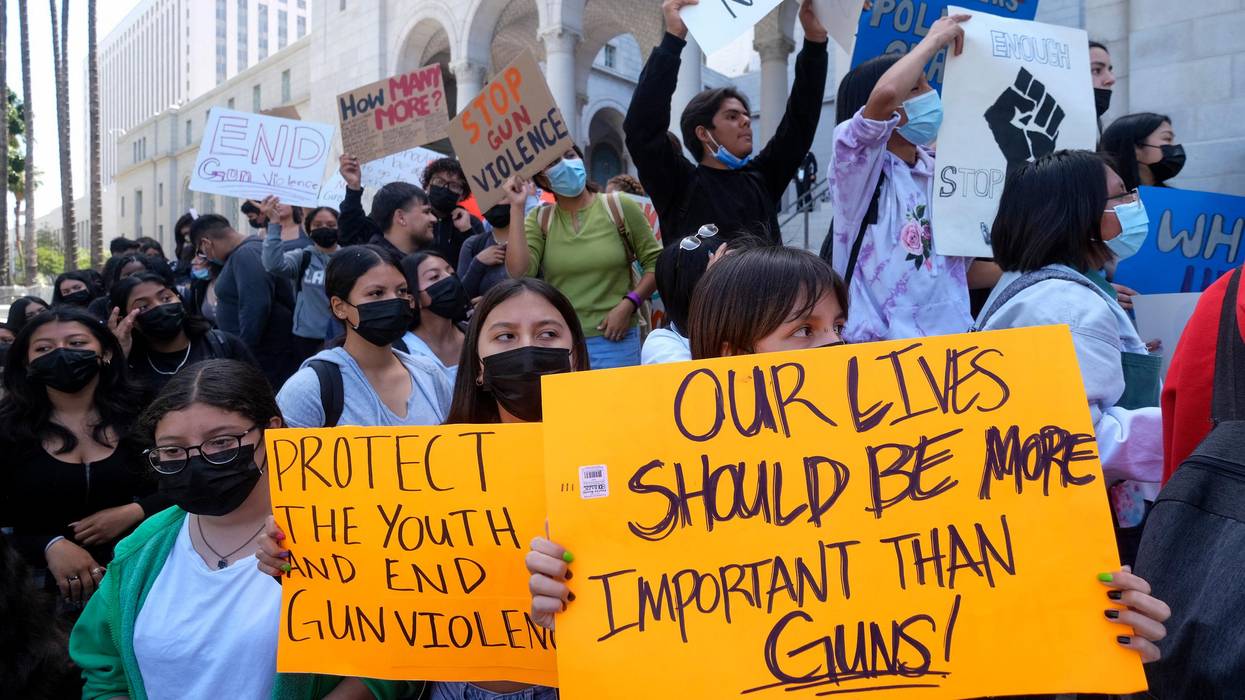
Legal experts said Friday that a federal judge's ruling in West Virginia illustrates the danger posed by the U.S. Supreme Court's right wing majority, which ruled this year in New York State Rifle & Pistol Association v. Bruen that restrictions on firearms must fall within the so-called "historical tradition" of gun laws.
U.S. District Judge Joseph Goodwin, who was appointed to the Southern District of West Virginia by former Democratic President Bill Clinton, ruled against a federal law prohibiting people from possessing firearms with serial numbers that have been "altered, obliterated, or removed."
"Serial numbers were largely unknown to the Framers, Goodwin wrote. And so the Second Amendment confers a right to remove them from modern weapons."
Serial numbers have been required for guns since the passage of the Gun Control Act of 1968 and are intended to prevent the illegal sale of guns and to allowing law enforcement to trace firearms.
But basing his ruling on the majority Supreme Court opinion written by Justice Clarence Thomas in June, Goodwin said Wednesday that requiring serial numbers is not part of the "historical tradition of firearm regulation" and therefore runs afoul of the Second Amendment.
In his majority opinion in Bruen, which overturned New York's state law restricting the concealed carry of firearms in public, Thomas wrote that for a gun control law to stand, the federal, state, or local government "must affirmatively prove that its firearm regulation is part of the historical tradition that delimits the outer bounds of the right to keep and bear arms."
Goodwin's opinion, said Demand Justice, which advocates for Supreme Court reform, demonstrates the far-reaching impact the Bruen ruling could have on gun laws across the country.
"That radical ruling is impacting measures as basic as a requirement that guns have serial numbers," said the group.
The case heard by Goodwin originated with a traffic stop in Charleston, West Virginia during which police found a gun with the serial number removed. The driver, Randy Price, had also been convicted of a felony.
Price argued in court that he had a constitutional right to have the firearm, while lawyers for the federal government said the law regarding serial numbers was a "commercial regulation" that did not violate the Second Amendment.
On Thursday, Slate journalist Mark Joseph Stern wrote that while Goodwin's ruling "might sound bizarre... his analysis closely follows Thomas' test" that requires the government to prove a gun regulation had a historical "analogue" in 1791, when the Second Amendment was ratified, or 1868, when it was imposed throughout the U.S.:
The only remaining question is whether the government could find an analogous regulation from 1791 or 1868 that restricted the possession of guns with an altered serial number. It could not, for a fairly obvious reason: Serial numbers only became common following the mass production of firearms, which took off in the decades after the Civil War.
[...]
Serial numbers were largely unknown to the Framers, Goodwin wrote. And so the Second Amendment confers a right to remove them from modern weapons.
When Bruen was handed down in June, Stern called the ruling "a revolution in Second Amendment law" which would ultimately go "so, so far beyond concealed carry."
Goodwin noted in his opinion on Wednesday that firearms that can't be traced using a serial number "are likely to be used in violent crime and therefore a prohibition on their possession is desirable," but said that argument "is the exact type of means-end reasoning the Supreme Court has forbidden me from considering."
Stern suggested that parts of Goodwin's opinion read "as if the judge is desperate to show readers just how dangerous and radical [the Bruen] ruling is."
According to the Supreme Court, Stern wrote, "all that counts is that serial number laws arose over the last century, so they are too modern to comport with the Second Amendment. Goodwin made this point over and over again; it almost sounded like he was quietly protesting the extreme and dangerous results demanded by the Bruen test."
"His decision thus doubled as a warning," he added. "The Supreme Court's Second Amendment jurisprudence has grown so radical that it now shields criminals trying to conceal their involvement in a violent crime."
We live on. Whether you believe in an afterlife or not, we live on. We live on in the memories of those we leave behind. We live on in words, in gestures, in glances, in anything that changes the heart of another person forever. We live on in loved ones and in strangers, in the people we've touched and the people they touch in turn. Each passes a tiny piece of us down the ancient chain of human life.
Sometimes we live on without even knowing it.
We live on. Whether you believe in an afterlife or not, we live on. We live on in the memories of those we leave behind. We live on in words, in gestures, in glances, in anything that changes the heart of another person forever. We live on in loved ones and in strangers, in the people we've touched and the people they touch in turn. Each passes a tiny piece of us down the ancient chain of human life.
Sometimes, we live on without even knowing it.
So let's start by remembering each of them by name, the nine kind souls who welcomed a stranger into their midst on June 17, 2015 at Emanuel African Methodist Episcopal Church in Charleston, S.C.:
* Cynthia Marie Graham Hurd did Bible study and was a manager for the Charleston County Public Library system.
* Susie Jackson did Bible study and sang in the choir.
* Ethel Lee Lance was the church sexton.
* Depayne Middleton-Doctor was a pastor. He was also an administrator and admissions coordinator at Southern Wesleyan University.
* Clementa C. Pinckney was the church's pastor and a state senator.
* Tywanza Sanders did Bible study.
* Daniel Simmons was a pastor, there at "Mother Emanuel" and at Greater Zion AME Church in Awendaw, S.C.
* Sharonda Coleman-Singleton was a pastor, a speech therapist and a track coach.
* Myra Thompson taught Bible study.
I won't name the young man who killed them. I won't name him because I support the "no notoriety" campaign, and because he was nothing more than the instrument of larger forces. "Like a dog on a chain," says the Bob Dylan song about Medgar Evers' killer, "he ain't got no name."
This week we mourn another gun tragedy, the worst mass shooting in recent American history. It happened at a club called Pulse in Orlando, Fla. There, too, the killer was driven by fanaticism and hatred, this time against LGBT people.
After Newtown, after Charleston, after Orlando, our politicians still haven't summoned the courage to ban assault weapons or to regulate guns the way we regulate cars. So Americans keep killing and dying in numbers that are unheard of in other countries.
You left us too soon, you nine souls of Charleston, so you probably didn't see this coming: Donald Trump is the Republican candidate for president of the United States.
Trump delivered a speech this week that should chill all reasonable people to the bone. He's prepared to punish all of our nation's Muslims for the actions of one deluded killer. New Jersey Governor and Trump supporter Chris Christie upped the ante, threatening to bomb a foreign country for the crime of one sick individual born in Queens, N.Y.
Hate can't conquer hate. Even a fool knows that. But then, some people don't want to know.
The Orlando murderer used his religion the same way the Charleston murderer used his whiteness: as a mask for bloodlust. They're all the same inside, these killers. They may ascribe their deeds to religion, or race, or a totalitarian social ideal. But their real creed is narcissistic hate. They sacrifice strangers on the altar of their own reflections.
If I could talk to the nine sweet souls of Charleston, here's what I'd tell them: We've had some serious talks since you've been gone. We've been talking about the black lives lost, about slow deaths from inequality and sudden deaths from an officer's gun. We've been talking about old folks in need and children gone too soon.
We haven't always agreed. One of our politicians said this to a Black Lives Matter activist: "I don't believe you change hearts. I believe you change laws, you change allocation of resources, you change the way systems operate."
I disagree. I still think the deepest change begins in the heart. But at least we're talking. The young people did that.
If I could talk to the nine sweet souls of Charleston, here's what I'd tell them: We may not have worked it all out yet, but we've learned a little since you left us. We've learned that economic justice and social justice must go hand in hand, or there's no justice at all.
You were studying when you died, so I thought you'd be glad to hear we've learned something.
I was standing by an abandoned church in my hometown—it's a dying manufacturing town—a while back, and for some reason, the old hymn came to me: "Before this time another year, I may be gone."
You didn't know the moment of your passing. None of us do. Each heartbeat could be our last. The rhythm of those beats is our lifeline, our pulse. When it ends, we end. Everything we've done, for good or bad, is what lives on. I hope Trump and Christie understand that. I believe that you did.
A year has passed. If I could talk to you I'd tell you we haven't forgotten you. "Though lovers be lost," wrote Dylan Thomas, "love shall not."
Cynthia Hurd. Susie Jackson. Ethel Lee Lance. Depayne Middle-Doctor. Clementa Pinckney. Tywanza Sanders. Daniel Simmons. Sharonda Singleton. Myra Thompson.
Remember them by name. They live on.
On Friday, June 24, I turned on my television to watch the funeral for Reverend Clementa Pinckney, one of the nine people shot dead at the Emanuel AME church in Charleston, South Carolina.
President Obama sang "Amazing Grace" at a time when many in the nation are mourning not only for the lost lives of the Emanuel 9 but the loss of black life that is stitched into the fabric of this country.
But then Bree Newsome allowed me to breathe.
I have heard "Amazing Grace" many times in my life. Black Americans singing, in moments of deep despair, is too familiar. I did not need to hear those sounds at this moment in our history.I needed something, but that was not it.
I switched to C-SPAN and, instead of seeing the funeral, I saw the news instead and learned that the U.S. Supreme Court had legalized same-sex marriage in all 50 states. I felt a surge of joy because I am truly invested in human rights for all in this country.
Yet I wondered if the many who were celebrating the Supreme Court ruling were feeling the death of the Emanuel 9 with the same depth as they felt this victory. As a black American, it is becoming increasingly difficult to maintain a sense of joy. These days, I am afraid to look at my social media feeds because, inevitably, I will see news of another murdered, unarmed, black person. It takes everything I have to not get crushed under the weight of the deep sorrow that many black people and our allies are feeling in this moment.
So I was not sure how to feel, how to be joyful for this forward movement in the country.
Fortunately, social media exploded with another story. On Saturday, June 27, I turned to my social media feeds and there, like a beam of light, was Bree Newsome taking down the Confederate flag from the Capitol building in Columbia, South Carolina.
"We removed the flag today because we can't wait any longer," Newsome said in a statement she sent out by email.
A graduate of New York University who has directed films and played in a funk band called Powerhouse, Newsome's action has already garnered more than $115,000 on an Indiegogo campaign.
(Update: Newsome released a detailed and passionate statement about the event on June 29.)
The singing of "Amazing Grace" felt like a familiar trope.
Until Newsome's action, I had been imploding with rage at the fact that South Carolina did not have the decency to take down that flag as the body of Clementa Pinckney--who was a South Carolina state senator as well as a preacher--was brought to the state house. There was a lump in my throat, in my heart. The presence of that flag, with every wave, laid salt in the wound of the tragedy.
But then Bree Newsome allowed me to breathe. The anger and hurt disappeared, for a moment, because she let us know we are still powerful. She showed us that we liberate ourselves through our actions. She reminded us, in the midst of deep sorrow, that we, who want to see a better America, must keep living, fighting, breathing, doing.
Her act spoke to me in a way that the president's singing did not. The singing of "Amazing Grace" felt like a familiar trope in the narrative of black America: We suffer, we sing, we forgive. Newsome's actions were different and more inspired. They addressed white supremacy directly. When many were arguing that the Confederate flag could not be removed because of legal reasons, Newsome removed it. In that act, she reminded us that Americans who want to see change, can write a bolder narrative.
We must maintain a sense of love, joy, hope, and movement as we grieve. But that is hard to do when black America and our allies are suffering through a constant stream of murdered black Americans, together with symbols of our oppression like the Confederate flag.
Newsome demonstrated that it is possible to hold two conflicting emotions in balance. Out of her grief came an action that challenged racism and brought joy to me and to thousands of others. Joy is essential to struggle. Within the joy, planning, strategizing, hand-holding, falling in love, and caring for one another, we extend the legacy of the murdered. I do not let them go when I am caught up in a moment of folly. I do not let them go when I am at the botanical gardens, talking with a friend about our suffering. They are walking with me, in my life, with every step. I remind myself of that. I remind myself that I am here to keep their memory alive and to work so that others do not suffer a similar fate. I still feel the ache of their loss, even as I celebrate the victories.
I am trying to balance sorrow and joy. These days, I seem to experience the former more than the latter. I need something to be done about white violence, and I mean something substantial, on the order of the Supreme Court ruling on same-sex marriage. The president singing "Amazing Grace" was not that thing.
Bree Newsome reminded me there is a legacy in black America that joins singing and spirituality and action. She reminded me that what I really need to see is the Confederate flag--and everything it represents--taken down.
Three more victims of the attack on Charleston, South Carolina's Emanuel A.M.E. Church will be laid to rest on Saturday, as mourners from around the country gather to pay their respects to the nine black men and women shot dead during a Bible study more than a week ago.
The first funeral procession for Cynthia Graham Hurd, 54, will occur in the morning. Hurd was the regional manager at St. Andrews Regional Library, which was named in her honor last week. "Cynthia was a tireless servant of the community who spent her life helping residents, making sure they had every opportunity for an education and personal growth," the library said in a statement after the shooting. "Her loss is incomprehensible and we ask for prayers for her family, her co-workers, her church and this entire community as we come together to face this tragic loss."
Hurd's brother, Malcolm Graham, a former North Carolina state senator, said of his sister last week, "It is unimaginable that she would walk into church and not return. But that's who she was--a woman of faith."
In the afternoon, a joint service will be held for Tywanza Sanders, 26, and his aunt, Susie Jackson, 87. Survivors said that as the gunman opened fire, Sanders tried to talk him out of his attack--then jumped in front of Jackson to shield her from the bullets with his body.
Sanders had recently graduated from Allen University in Columbia, South Carolina.
Jackson will be remembered as a caretaker and a source of strength for her family. The Post and Courier wrote in Jackson's obituary, "At one time, almost every house on Jackson's block was owned by a relative. But her home, a classic Charleston single, was the center of family gatherings. 'You come from out of town, this is where you come,' her nephew Robert Sanders said. 'She opened her arms to us.'"
On Friday, funeral services were held for pastor Rev. Clementa Pinckney, 41. His eulogy was delivered by President Barack Obama, who described the pastor as "a man who believed in things not seen, a man who believed there were better days ahead."
The Post and Courier wrote:
Noting Pinckney's smile and "reassuring baritone," Obama described Pinckney's remarkable career. "He was in the pulpit by 13, pastor by 18, public servant by 23," and how as a state senator for Allendale, Beaufort, Charleston, Colleton, Hampton and Jasper counties, he "represented a sprawling swath of Lowcountry, a place that has long been one of the most neglected in America, a place still racked by poverty and inadequate schools, a place where children can still go hungry and the sick can go without treatment -- a place that needed someone like Clem.
Pinckney, he added, "embodied a politics that was neither mean nor small. He conducted himself quietly and kindly and diligently."
Funeral processions will continue at Emanuel A.M.E. Church on Sunday for DePayne Middleton-Doctor and on Monday for Myra Thompson. The final funeral will be held Tuesday at St. Luke A.M.E. Church, also in Charleston, for Daniel Simmons.
This week, The Guardian reported that the leader of a right-wing group which apparently influenced Dylan Roof's extremist views on race before the Charleston church shootings had donated tens of thousands of dollars to leading Republicans.
Earl Holt, president of the Council of Conservative Citizens who once stated that African Americans were "the laziest, stupidest and most criminally-inclined race in the history of the world," has spent $65,000 backing GOP candidates including presidential hopefuls Ted Cruz, Rand Paul and Rick Santorum. In a manifesto attributed to Roof, the accused Charleston shooter credited the CCC with informing his views about race and African Americans in particular.
The Washington Post further reported that Holt, who is based in Longview, Texas, has also contributed to numerous other campaigns, including the 2014 Senate bids of Tom Cotton in Arkansas and Thom Tillis in North Carolina. Once the contributions were made public, many of the candidates announced they will be returning the funds. As Sen. Cotton said in a statement:
We have initiated a refund of Mr. Holt's contribution. I do not agree with his hateful beliefs and language and believe they are hurtful to our country.
This isn't the first time a donor tied to white nationalist and white supremacist groups has drawn attention for supporting conservative politicians. In recent years, there have been several instances of individuals linked to fringe groups making political contributions, especially in support of candidates popular in the Tea Party movement. In many -- but not all -- of the cases, candidates have returned donations and distanced themselves from known extremists once the contributions have been brought to light.
MICHAEL PEROUTKA
A Maryland-based lawyer, Peroutka identifies as a Christian Reconstructionist who believes there is "no such thing as a civil right." For years Peroutka was closely involved with the League of the South, a neo-Confederate group that favors secession and has defended the Council of Conservative Citizens in the wake of the Charleston massacre. Peroutka was a member of the League's board and was a featured speaker at their 2013 conference, "Southern Independence: Antidote to Tyranny." (Peroutka quit the League when news about his ties to the group surfaced during his 2014 campaign for Anne Arundel County Council.)
Peroutka and his law firm have been generous political donors for conservative candidates. According to election spending data compiled by the National Institute on Money in State Politics' FollowTheMoney.org database, Peroutka has contributed more than $300,000 over the last 12 years, including $2,500 for Sen. Ron Paul as a write-in candidate for president in 2012. He also contributed to at least two U.S. House candidates: former Rep. Steve Stockman (R-TX) and current Rep. Andy Harris (R-MD). In addition, FollowTheMoney.org shows more than $200,000 in contributions from Peroutka's law firm since 2000, including to the campaigns of Rep. Harris and Rep. Alex Mooney (R-WV).
By far the biggest beneficiary of Peroutka's political giving has been judge Roy Moore, chief justice of the Alabama Supreme Court. All told, records show Peroutka and his firm funneling $180,000 to benefit Moore and his organizations between 2006 and 2012. In February, Judge Moore earned national attention when he ordered judges and state employees to ignore a federal court ruling legalizing same-sex marriage in Alabama.
In this video from Right Wing Watch, Peroutka addresses a 2012 League of the South conference during which he led the crowd in singing "Dixie," the de facto anthem of the Confederacy, which he called the "national anthem."
CARL FORD
A bankruptcy lawyer in Laurel, Mississippi, Ford is the former lawyer for Sam Bower, the imperial wizard of the White Knights of the Ku Klux Klan who died in prison after being convicted of the murder of civil rights activist Vernon Dahmer. Ford is also active in the League of the South and was active in the Mississippi Klan in the 1960s.
In 2014, news surfaced that U.S. Sen. Chris McDaniel, a Tea Party favorite from Mississippi, received an $800 donation from Ford, who said he especially appreciated McDaniel's position against "so-called immigration reform." Federal campaign finance records show the McDaniel campaign ultimately returning $1,800 worth of donations from Ford.
As reported in The Daily Beast, campaign finance records also show Ford donating to former Rep. Ron Paul (R-TX), Sen. Rand Paul (R-KY), Rep. Alan Nunnelee (R-MS) and the 2006 campaign of Sen. Jim Webb (D-VA).
RON WILSON
A businessman and politician in Anderson County, South Carolina, Wilson for many years was an active member of the League of the South and Council of Conservative Citizens, where he was a columnist for the group's publication "Citizen Informer" from 1989 to 1993. He also was part of an extremist wing that gained control of the Sons of Confederate Veterans, rising to the level of commander-in-chief from 2002 to 2004.
Wilson was also a leader or spokesman for three groups in South Carolina dedicated to defending the Confederate flag: the South Carolina Heritage Coalition, which he directed; the Palmetto League; and Americans for the Preservation of American Culture, a political committee he founded in the early 2000s.
As reported in the Independent Mail, Americans for the Preservation of American Culture raised $22,900 between 2002 and 2008, the year it got involved in national elections:
During the 2008 Republican primary, the group produced radio ads and YouTube videos that attacked both U.S. Sen. John McCain and former Mass. Gov. Mitt Romney for failing to support the Confederate flag, while getting behind former Ark. Gov. Mike Huckabee for supporting Southerners' rights to determine whether to fly the flag.
Eighty percent of the PAC's money came from Wilson and his family.
In 2012, Wilson was sentenced to a 20-year prison term for operating a Ponzi scheme that federal investigators determined had defrauded investors of more than $59 million.
There has been an important hashtag -- #knowtheirnames -- circulating through social media recently that encourages us all to say out loud and remember the names of those murdered by a white supremacist in Charleston on June 17, 2015.
There has been an important hashtag -- #knowtheirnames -- circulating through social media recently that encourages us all to say out loud and remember the names of those murdered by a white supremacist in Charleston on June 17, 2015. Just a few months ago, the Guardian launched an interactive project, "The Counted," that names all of the victims of police violence in the United States in 2015, with a running toll in the left-hand corner (the toll was at 528 as I sat down to write these words). Saying the names of people who have lost their lives to white supremacy is something we need to remind ourselves to do, while at the same time large segments of the population generally have no problem with swimming in a lake named after proponents of slavery and Native American genocide, entering buildings named after Ku Klux Klan leaders to earn our college degrees, or spending and earning money with the faces of slave owners on them. The names of the people responsible for the deaths and oppression of large numbers of Americans are often on our lips and at our fingertips in the United States.
Popular arguments in the South, where I live now, are that buildings named after former Klan leaders and Confederates reflect the history of the South and re-naming them would "erase" or "sanitize" the past. As a scholar who studies and teaches history, I often hear students (as well as fellow academics) write off these contested names, excusing the benefactor because "everyone was racist then," "everyone owned slaves then," or, in the context of 20th-century Europe "everyone was anti-Semitic." Of course, this is categorically untrue once you take into account the enslaved, the Jewish targets of 20th-century Fascism, and the many allies who fought for the abolition of slavery and for the National Socialists in Germany to be stopped. History has the power to establish the status quo, but it also the duty of historians to expose the cracks in the monotonous facade.
While a lot of media attention has focused on South Carolina and the reckoning with the confederate flag in the past few days, the controversy over re-naming has made it to the "great white North". Recently, in my home state of Minnesota, there has been a call to rename Lake Calhoun, one of the chain of lakes that is at the center of some of the most expensive property in Minneapolis, as well as a public space that attracts thousands of visitors to its beaches and running trails. Before white colonialists settled the land, the Dakota people called this body of water Mde Maka Ska, or White Earth Lake. In the early 19th century, it was re-named for John Caldwell Calhoun (1782-1850), a man who promoted slavery, owned slaves, and was as U.S. Congressman from South Carolina, Secretary of War, as well as the seventh Vice-President of the United States, under Presidents John Quincy Adams and Andrew Jackson. Calhoun supported the 1850 Fugitive Slave Act, and was himself a slave owner. As Jon Schwarz of the Intercept has pointed out, the names and voices of the many slaves Calhoun owned, abused, and profited from have remained "voiceless" in the history of the United States, while Calhoun is remembered throughout the country, from this lake in Minneapolis, to a statue in Marion Square in Charleston, S.C., not far from the Emmanuel AME Church that was attacked. Following the massacre, the Calhoun was spray painted with the slogan "Black Lives Matter."
The terrorist act in Charleston that left Sharonda Coleman-Singleton, Rev. Clementa Pinckney, Cynthia Hurd, Tywanza Sanders, Myra Thompson, Ethel Lee Lance, Rev. Daniel L. Simmons, Rev. Depayne Middleton-Doctor, and Susie Jackson dead, opened the eyes of many Minnesotans for the first time to who John C. Calhoun was - leaving many confused as to why there was a Lake Calhoun in Minneapolis. In the wake of Charleston, a petition was started by Minneapolis resident Mike Spangenberg to rename Lake Calhoun: according to the Minneapolis Star-Tribune, the petition had over 2500 signatures by the end of the day on June 23rd.
People in the Northern United States tend to view racism and racial segregation as a Southern problem. There is a certain air of moral superiority that comes with the cold air in Minnesota - a state that has a history of progressive politics, and a pride in being well north of the Mason-Dixon. As I've followed the comments on social media around the Lake Calhoun naming question, I've noticed a lot of Minnesotans - white, middle-class, educated Minnesotans - urging caution on the question of re-naming. Some people think it doesn't really matter who John C. Calhoun was, and are loathe to change something that is familiar. To these individuals, it is immoral to "erase history" by re-naming. "Why not keep the name and use it to educate?" some have asked. They argue that re-naming is not that significant; that energy could be better spent other places. Others still note that it is a "slippery slope," and ask, "What is next - renaming Fort Snelling?"
Just as large swaths of Minnesotans had never stopped to think about who John C. Calhoun was while enjoying the lake, many of these same people have been oblivious to a struggle not just to re-name but also to raze Fort Snelling and mark it solely as a site of genocide. Dakota activists, scholars, and their allies have occupied Fort Snelling, led marches to Fort Snelling in protest of its imperialist history, and published editorials calling for its removal. The indigenous people involved in this struggle are no stranger to John C. Calhoun -- Calhoun was not only a promoter of slavery in the South, he also founded Fort Snelling, the site of U.S. military occupation used to control the Dakota people who lived in the Upper Mississippi River Valley, using it as an internment camp during the US-Dakota War of 1862.
The truth is, as indigenous scholars and activists have been telling us for at least a century, that the majority of streets, towns, lakes, forests, schools, and other government institutions are named after white men (and sometimes women) who achieved fame for colonizing the land, establishing a system of white supremacy, and annihilating indigenous people, culture, and language. The indigenous peoples of the United States have never been allowed the opportunity to decolonize, which stems from an inability of a great number of Americans to recognize they are part of a colonizing class. As many important indigenous and African-American thinkers have reminded us, communities of color are still under occupation in the United States today.
Language and naming are important tools of colonial control. In colonial India, for example, British administrators controlled the population by naming everything in English - from encouraging local people to give their children proper English names to insisting that English education was modern while learning in Sanskrit was outdated (as for the hundreds of regional and vernacular languages, those weren't even worth thinking about, except to control local populations). Buildings, streets, and schools were named after the heroes of colonial conquest. After a long struggle for independence from British rule that ended in 1947, there was a massive movement to change the names of these institutions that had once born the names of the masters. Part of the decolonial process meant that street names lost their British character, giving way to a multitude of streets named after the heroes of independence, such as M.K. Gandhi and Jawaharlal Nehru. These name changes all have, however, a particular history and politics that tell us about both the current political moment and the historical past. The changed street names are often printed above or on top of the old names - traces of the colonial past are all around the subcontinent, and have certainly not been forgotten.
India is not the only post-colonial country to engage in massive renaming campaigns. After the fall of the USSR, statues of Communist leaders were toppled all over Russia, Eastern Europe, and Central Asia, and thousands of streets named for Stalin and Lenin were either restored to their original names or given new ones. Countries throughout Latin America and Africa have also moved away from colonial names.
In contrast to the many countries once ruled by European imperial power, the United States has never had a decolonial reckoning as a nation, despite calls from movements such as the American Indian Movement and Idle No More, amongst others. Today there are numerous indigenous, African-American, and Latin@ activists and groups working to dismantle colonial language, but are held up not only by conservative groups who actively promote maintaining white supremacy, but also by mainstream and even left-of-center Liberals nostalgic for the past who are certain they can improve the conditions of the "wretched of the earth" while maintaining the status quo.
People not involved in social movements led by people of color often ask, should we really rename every one of these streets and lakes? Isn't that just asking too much? To this I reply - of course we should! Will this dismantle white supremacy? Of course not, but it will create an important note in the historical record that at this point in time a significant number of people in the United States came to understand that the history of this country is not in the official names we see on government signs, but is in what is buried underneath. The year 2015 could be remembered because Wal-Mart banned the sale of confederate flag items, South Carolina removed the confederate flag from flying in front of the state house, activists at the University of North Carolina - Chapel Hill fought successfully for the name change of Saunders Hall to Carolina Hall (though their proposed name was Hurston Hall, Carolina Hall the choice of the Board of Trustees), and all across the United States, people removed the name "Calhoun" from monuments, lakes, streets, buildings, and schools.
Calls for re-naming are happening all over the United States right now - it's not a Northern issue, a Southern issue, or a Western issue. The United States, as a nation, is past due for a conversation about what decolonization will look like. Re-naming never erases history; it only makes the historical record richer. Many involved in the petition to rename Lake Calhoun have suggested changing the name but including a historical marker that explains the legacy of the name and the movement that arose amongst the people of Minnesota to change it. That is, in my opinion, one excellent way to make history.
A fire that damaged a predominantly black church in Georgia on Tuesday has been ruled as arson by investigators.
It was one of two instances this week that saw historically black churches set ablaze in the South, with the other in North Carolina on Wednesday, also suspected to be arson. The fires follow last week's terrorist attack on Emanuel A.M.E. Church in Charleston, South Carolina, which saw nine black men and women killed and is being investigated as a hate crime.
As the Telegraph reported on Thursday, Macon-Bibb County Fire Sgt. Ben Gleason does not suspect the fire that damaged Macon's God's Power Church of Christ to be a hate crime. Officials also said that electronics and other equipment had been stolen from the church in two burglaries.
But, as Emma Green writes for the Atlantic, the historical context of arson targeting black churches must not be overlooked. Green says:
These fires join the murder of nine people at Charleston's Emanuel African Methodist Episcopal Church as major acts of violence perpetrated against predominantly black churches in the last fortnight. Churches are burning again in the United States, and the symbolism of that is powerful. Even though many instances of arson have happened at white churches, the crime is often association with racial violence: a highly visible attack on a core institution of the black community, often done at night, and often motivated by hate.
In North Carolina, Charlotte Fire Department senior fire investigator David Williams told the Charlotte Observer on Wednesday that officials are still trying to determine if the arson in Briar Creek Road Baptist Church was a hate crime.
Marty Ahrens, a staffer at the National Fire Protection Association, told the Atlantic that new reporting standards have made it difficult to determine the motivation behind an arson. "To know that something is motivated by hate, you either have to know who did it or they have to leave you a message in some way that makes it very obvious," she said.
Green concludes:
The investigations in North Carolina and Georgia are still ongoing, and they may end up in that broad category of fires of suspicious, but ultimately unknowable, origin that Ahrens described. But no matter why they happened, these fires are a troubling reminder of the vulnerability of our sacred institutions in the days following one of the most violent attacks on a church in recent memory.
A deeper meaning of forgiveness in the Christian nonviolent tradition reveals a critique that knows when the perpetrator has been caught but the killer is still at large.
There is a scripture that says we wrestle not against flesh and blood but against the powers and rulers of the darkness. Within the nonviolent faith tradition, it has always been clear that hate cannot drive out hate and evil cannot drive out evil. And so the Christians at the Charleston Emanuel African Methodist Episcopal Church who were able to forgive the murder of nine of their fellow worshipers 48 hours after losing their loved ones are consistent with their faith. Jesus said as he was being murdered by the state, "Father, forgive them, for they know not what they do."
But this forgiveness should not be misinterpreted as a dismissing of the greater evil. The forgiveness in Charleston is also an act of resistance to the attempts to lay the blame for this horror at the feet of one man. If America is serious about this moment, we cannot just cry ceremonial tears while at the same time refusing to support the martyred Reverend Pinckney and his parishioners' stalwart fight against the racism that gave birth to the crime.
The perpetrator has been caught, but the killer is still at large: the deep well of American racism and white supremacy that Dylann Roof drank from. These families are challenging the schizophrenia of American morality, which allows political leaders to condemn the crime but embrace the policies that are its genesis.
Many South Carolina politicians and others around the nation are decrying the killings but steadfastly refusing to quell their divisive race-implying rhetoric. They have condemned the violence but have not ceased their push for policies that promote race-based voter suppression; adversity toward fixing the Voting Rights Act; cutting public education in ways that foster resegregation; denying workers living wages; refusing Medicaid expansion; allowing the proliferation of guns; and flying the Confederate flag, a symbol of slavery, racism, and terrorism against African-Americans, at the state Capitol.
Some even use racial code words to criticize the president, all in the name of taking their country back and preventing its destruction. And they refuse to admit that there is a history of racialized political rhetoric and policies spawning the pathology of terroristic murder and violent resistance.
When they were murdered, Reverend Pinckney and his parishioners were advocating for a better life for people of all races. They were standing with fast-food workers demanding a living wage. They were calling for the Confederate flag to come down. They were fighting against voter suppression and for funding public education, expanding Medicaid to allow the poor and near-poor of all races to have healthcare. They were mobilizing for police accountability and marching for justice in the recent killing of Walter Scott, an unarmed African-American man shot in the back by a police officer in North Charleston.
These brave family members are telling America that you cannot focus only on Dylann Roof and absolve the nation of its historic sickness. In a profound way, they are saying that giving the killer the death penalty is not going to fix what ails us. Arresting one disturbed young man will not bring "closure" or "healing" to a society that is still sick with the sins of racism and inequality, where too many perpetuate the slow violence of undermining the promise of equal protection under the law, which preachers like Denmark Vessey, Martin Luther King, and Clementa Pickney fought for.
These family members are asking us to forgive the sinner but hate the sin. They are issuing a clarion call born of their pain and loss to create a society that truly embraces justice and equality, that ends the policies of racism and poverty that guarantee there will be more Dylann Roofs and more acts of terror, because only then will we apprehend the real killers.
In light of this, I believe real healing would be writing and passing a bipartisan omnibus bill in the name of the nine Emanuel Martyrs that implements Medicaid expansion, raises public education funding, passes living-wage requirements and new gun-control laws, removes the Confederate flag from the South Carolina Statehouse, and restores the Voting Rights Act.
The very seat Reverend Pinckney held in the state Senate is in jeopardy as long as Section 5 of the VRA has been gutted. And even if it passed, the current reform bill in the US House would exempt Alabama, South Carolina, North Carolina, Virginia, and Tennessee from coverage. If we want closure, let us name a VRA restoration bill after the Emanuel Nine.
We have no choice. We must see transformative action, not temporary ceremonial displays. Until we deal with the issues of race, poverty, and violence that threaten to tear our nation asunder, it is not just America's soul that is at stake, but America itself.
The massacre of nine African-American worshippers at the Emanuel African Methodist Episcopal Church in Charleston, S.C., has sent shock waves through the nation and could well blow the roof off the Confederacy. Dylann Storm Roof is accused of methodically killing the congregants, reloading his Glock pistol at least twice. He let one victim live, according to a person who spoke with the survivor, so she could tell the world what happened. This brutal mass killing was blatantly racist, an overt act of terrorism.
Those murdered included the minister of the historic church, 41-year-old Rev. Clementa Pinckney, who also was an elected state senator in South Carolina and who was leading a Wednesday night Bible-study group. Roof actually sat in on the group for an hour before the massacre.
What little we know of Roof's motivation for his alleged crime comes from a website he is believed to have created. A manifesto posted on the site says: "I chose Charleston because it is most historic city in my state, and at one time had the highest ratio of blacks to Whites in the country. We have no skinheads, no real KKK, no one doing anything but talking on the internet. Well someone has to have the bravery to take it to the real world, and I guess that has to be me." A survivor of the shooting said that Roof told a victim begging for him to stop the killing: "I have to do it. You're raping our women and taking over the country. You have to go."
The website includes photos of Roof brandishing a gun, the .45-caliber Glock that is likely the murder weapon, and the Confederate flag, leading to renewed efforts to remove this symbol of racism and hate from flying on public property. For decades, the Confederate flag flew above the South Carolina Statehouse, along with the U.S. flag and the state flag of South Carolina. After the NAACP began a boycott of the state in the year 2000, a compromise was reached. The Confederate flag was removed from the state Capitol dome and placed on statehouse grounds, alongside a Confederate war memorial.
Among those who first stood up last week in favor of removing the flag was a white Republican serving in the South Carolina legislature, Doug Brannon. He told us on "Democracy Now!": "I woke up Thursday morning to the news of the death of these nine wonderful people. I knew something had to be done then. ... Clementa Pinckney deserves this. Those nine people deserve this. Our state Capitol needs to be free of the flag." When we asked him if he would consider a memorial to the victims of the Emanuel AME massacre, he said it was "a wonderful idea."
The Rev. Dr. William J. Barber III is the president of the North Carolina NAACP. He heard about the slaughter on Wednesday night while in jail. "About 10 of us had been arrested in the state House in North Carolina for challenging extremist politicians who have passed the worst voter-suppression law in the country," he said. Barber has led the "Moral Mondays" movement, with hundreds to thousands of people protesting weekly against the agenda being passed by North Carolina's Republican-controlled state government. He favors removal of the Confederate flag, which he calls "vulgar," but suggested that passing policy would be a more potent memorial to Clementa Pinckney and the other victims.
"Reverend Pinckney was not just opposed to the flag, he was opposed to the denial of Medicaid expansion," Barber continued. "He was opposed to those who have celebrated the ending of the Voting Rights Act. He was opposed to the lack of funding for public education. He wanted to see living wages raised." Addressing state Rep. Doug Brannon, Barber said: "Let's put together an omnibus bill in the name of the nine martyrs. And all of the things Reverend Pinckney was standing for, if we say we love him and his colleagues, let's put all of those things in a one big omnibus bill and pass that and bring it to the funeral on Friday."
Wal-Mart, Amazon and other major retailers have pulled Confederate paraphernalia from their shelves. Alabama has taken down the flag, and other states, including South Carolina, are following. The symbol of the Southern states' rebellion and secession, of waging war to protect slavery, will be less visible. But the fight for equality, waged 200 years ago by the very founders of Charleston's Emanuel AME church, continues. As the Rev. Barber says, systemic change is essential: "The perpetrator has been arrested, but the killer is still at large."
Denis Moynihan contributed research to this column.