SUBSCRIBE TO OUR FREE NEWSLETTER
Daily news & progressive opinion—funded by the people, not the corporations—delivered straight to your inbox.
5
#000000
#FFFFFF
To donate by check, phone, or other method, see our More Ways to Give page.
Daily news & progressive opinion—funded by the people, not the corporations—delivered straight to your inbox.
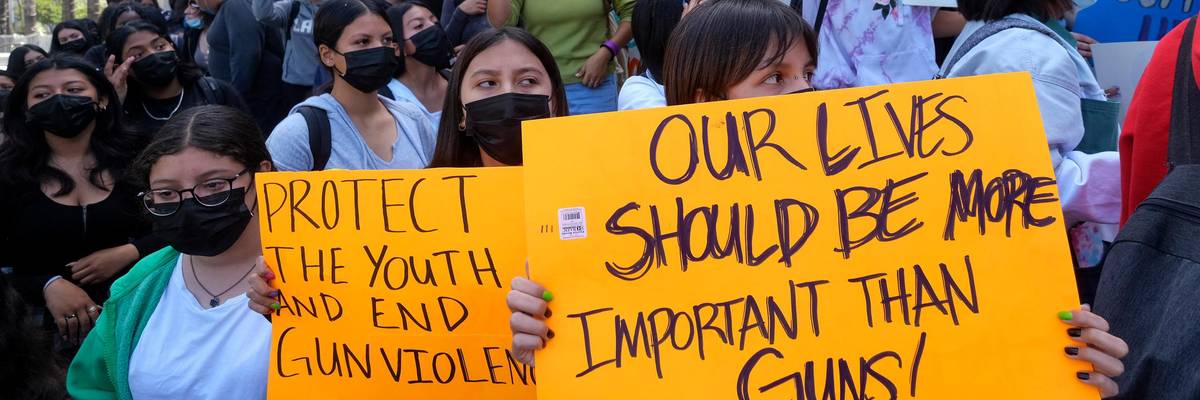
Students participate in a school walkout and protest in front of City Hall in Los Angeles to condemn gun violence on May 31, 2022.
Legal experts said Friday that a federal judge's ruling in West Virginia illustrates the danger posed by the U.S. Supreme Court's right wing majority, which ruled this year in New York State Rifle & Pistol Association v. Bruen that restrictions on firearms must fall within the so-called "historical tradition" of gun laws.
U.S. District Judge Joseph Goodwin, who was appointed to the Southern District of West Virginia by former Democratic President Bill Clinton, ruled against a federal law prohibiting people from possessing firearms with serial numbers that have been "altered, obliterated, or removed."
"Serial numbers were largely unknown to the Framers, Goodwin wrote. And so the Second Amendment confers a right to remove them from modern weapons."
Serial numbers have been required for guns since the passage of the Gun Control Act of 1968 and are intended to prevent the illegal sale of guns and to allowing law enforcement to trace firearms.
But basing his ruling on the majority Supreme Court opinion written by Justice Clarence Thomas in June, Goodwin said Wednesday that requiring serial numbers is not part of the "historical tradition of firearm regulation" and therefore runs afoul of the Second Amendment.
In his majority opinion in Bruen, which overturned New York's state law restricting the concealed carry of firearms in public, Thomas wrote that for a gun control law to stand, the federal, state, or local government "must affirmatively prove that its firearm regulation is part of the historical tradition that delimits the outer bounds of the right to keep and bear arms."
Goodwin's opinion, said Demand Justice, which advocates for Supreme Court reform, demonstrates the far-reaching impact the Bruen ruling could have on gun laws across the country.
"That radical ruling is impacting measures as basic as a requirement that guns have serial numbers," said the group.
The case heard by Goodwin originated with a traffic stop in Charleston, West Virginia during which police found a gun with the serial number removed. The driver, Randy Price, had also been convicted of a felony.
Price argued in court that he had a constitutional right to have the firearm, while lawyers for the federal government said the law regarding serial numbers was a "commercial regulation" that did not violate the Second Amendment.
On Thursday, Slate journalist Mark Joseph Stern wrote that while Goodwin's ruling "might sound bizarre... his analysis closely follows Thomas' test" that requires the government to prove a gun regulation had a historical "analogue" in 1791, when the Second Amendment was ratified, or 1868, when it was imposed throughout the U.S.:
The only remaining question is whether the government could find an analogous regulation from 1791 or 1868 that restricted the possession of guns with an altered serial number. It could not, for a fairly obvious reason: Serial numbers only became common following the mass production of firearms, which took off in the decades after the Civil War.
[...]
Serial numbers were largely unknown to the Framers, Goodwin wrote. And so the Second Amendment confers a right to remove them from modern weapons.
When Bruen was handed down in June, Stern called the ruling "a revolution in Second Amendment law" which would ultimately go "so, so far beyond concealed carry."
Goodwin noted in his opinion on Wednesday that firearms that can't be traced using a serial number "are likely to be used in violent crime and therefore a prohibition on their possession is desirable," but said that argument "is the exact type of means-end reasoning the Supreme Court has forbidden me from considering."
Stern suggested that parts of Goodwin's opinion read "as if the judge is desperate to show readers just how dangerous and radical [the Bruen] ruling is."
According to the Supreme Court, Stern wrote, "all that counts is that serial number laws arose over the last century, so they are too modern to comport with the Second Amendment. Goodwin made this point over and over again; it almost sounded like he was quietly protesting the extreme and dangerous results demanded by the Bruen test."
"His decision thus doubled as a warning," he added. "The Supreme Court's Second Amendment jurisprudence has grown so radical that it now shields criminals trying to conceal their involvement in a violent crime."
Dear Common Dreams reader, It’s been nearly 30 years since I co-founded Common Dreams with my late wife, Lina Newhouser. We had the radical notion that journalism should serve the public good, not corporate profits. It was clear to us from the outset what it would take to build such a project. No paid advertisements. No corporate sponsors. No millionaire publisher telling us what to think or do. Many people said we wouldn't last a year, but we proved those doubters wrong. Together with a tremendous team of journalists and dedicated staff, we built an independent media outlet free from the constraints of profits and corporate control. Our mission has always been simple: To inform. To inspire. To ignite change for the common good. Building Common Dreams was not easy. Our survival was never guaranteed. When you take on the most powerful forces—Wall Street greed, fossil fuel industry destruction, Big Tech lobbyists, and uber-rich oligarchs who have spent billions upon billions rigging the economy and democracy in their favor—the only bulwark you have is supporters who believe in your work. But here’s the urgent message from me today. It's never been this bad out there. And it's never been this hard to keep us going. At the very moment Common Dreams is most needed, the threats we face are intensifying. We need your support now more than ever. We don't accept corporate advertising and never will. We don't have a paywall because we don't think people should be blocked from critical news based on their ability to pay. Everything we do is funded by the donations of readers like you. When everyone does the little they can afford, we are strong. But if that support retreats or dries up, so do we. Will you donate now to make sure Common Dreams not only survives but thrives? —Craig Brown, Co-founder |
Legal experts said Friday that a federal judge's ruling in West Virginia illustrates the danger posed by the U.S. Supreme Court's right wing majority, which ruled this year in New York State Rifle & Pistol Association v. Bruen that restrictions on firearms must fall within the so-called "historical tradition" of gun laws.
U.S. District Judge Joseph Goodwin, who was appointed to the Southern District of West Virginia by former Democratic President Bill Clinton, ruled against a federal law prohibiting people from possessing firearms with serial numbers that have been "altered, obliterated, or removed."
"Serial numbers were largely unknown to the Framers, Goodwin wrote. And so the Second Amendment confers a right to remove them from modern weapons."
Serial numbers have been required for guns since the passage of the Gun Control Act of 1968 and are intended to prevent the illegal sale of guns and to allowing law enforcement to trace firearms.
But basing his ruling on the majority Supreme Court opinion written by Justice Clarence Thomas in June, Goodwin said Wednesday that requiring serial numbers is not part of the "historical tradition of firearm regulation" and therefore runs afoul of the Second Amendment.
In his majority opinion in Bruen, which overturned New York's state law restricting the concealed carry of firearms in public, Thomas wrote that for a gun control law to stand, the federal, state, or local government "must affirmatively prove that its firearm regulation is part of the historical tradition that delimits the outer bounds of the right to keep and bear arms."
Goodwin's opinion, said Demand Justice, which advocates for Supreme Court reform, demonstrates the far-reaching impact the Bruen ruling could have on gun laws across the country.
"That radical ruling is impacting measures as basic as a requirement that guns have serial numbers," said the group.
The case heard by Goodwin originated with a traffic stop in Charleston, West Virginia during which police found a gun with the serial number removed. The driver, Randy Price, had also been convicted of a felony.
Price argued in court that he had a constitutional right to have the firearm, while lawyers for the federal government said the law regarding serial numbers was a "commercial regulation" that did not violate the Second Amendment.
On Thursday, Slate journalist Mark Joseph Stern wrote that while Goodwin's ruling "might sound bizarre... his analysis closely follows Thomas' test" that requires the government to prove a gun regulation had a historical "analogue" in 1791, when the Second Amendment was ratified, or 1868, when it was imposed throughout the U.S.:
The only remaining question is whether the government could find an analogous regulation from 1791 or 1868 that restricted the possession of guns with an altered serial number. It could not, for a fairly obvious reason: Serial numbers only became common following the mass production of firearms, which took off in the decades after the Civil War.
[...]
Serial numbers were largely unknown to the Framers, Goodwin wrote. And so the Second Amendment confers a right to remove them from modern weapons.
When Bruen was handed down in June, Stern called the ruling "a revolution in Second Amendment law" which would ultimately go "so, so far beyond concealed carry."
Goodwin noted in his opinion on Wednesday that firearms that can't be traced using a serial number "are likely to be used in violent crime and therefore a prohibition on their possession is desirable," but said that argument "is the exact type of means-end reasoning the Supreme Court has forbidden me from considering."
Stern suggested that parts of Goodwin's opinion read "as if the judge is desperate to show readers just how dangerous and radical [the Bruen] ruling is."
According to the Supreme Court, Stern wrote, "all that counts is that serial number laws arose over the last century, so they are too modern to comport with the Second Amendment. Goodwin made this point over and over again; it almost sounded like he was quietly protesting the extreme and dangerous results demanded by the Bruen test."
"His decision thus doubled as a warning," he added. "The Supreme Court's Second Amendment jurisprudence has grown so radical that it now shields criminals trying to conceal their involvement in a violent crime."
Legal experts said Friday that a federal judge's ruling in West Virginia illustrates the danger posed by the U.S. Supreme Court's right wing majority, which ruled this year in New York State Rifle & Pistol Association v. Bruen that restrictions on firearms must fall within the so-called "historical tradition" of gun laws.
U.S. District Judge Joseph Goodwin, who was appointed to the Southern District of West Virginia by former Democratic President Bill Clinton, ruled against a federal law prohibiting people from possessing firearms with serial numbers that have been "altered, obliterated, or removed."
"Serial numbers were largely unknown to the Framers, Goodwin wrote. And so the Second Amendment confers a right to remove them from modern weapons."
Serial numbers have been required for guns since the passage of the Gun Control Act of 1968 and are intended to prevent the illegal sale of guns and to allowing law enforcement to trace firearms.
But basing his ruling on the majority Supreme Court opinion written by Justice Clarence Thomas in June, Goodwin said Wednesday that requiring serial numbers is not part of the "historical tradition of firearm regulation" and therefore runs afoul of the Second Amendment.
In his majority opinion in Bruen, which overturned New York's state law restricting the concealed carry of firearms in public, Thomas wrote that for a gun control law to stand, the federal, state, or local government "must affirmatively prove that its firearm regulation is part of the historical tradition that delimits the outer bounds of the right to keep and bear arms."
Goodwin's opinion, said Demand Justice, which advocates for Supreme Court reform, demonstrates the far-reaching impact the Bruen ruling could have on gun laws across the country.
"That radical ruling is impacting measures as basic as a requirement that guns have serial numbers," said the group.
The case heard by Goodwin originated with a traffic stop in Charleston, West Virginia during which police found a gun with the serial number removed. The driver, Randy Price, had also been convicted of a felony.
Price argued in court that he had a constitutional right to have the firearm, while lawyers for the federal government said the law regarding serial numbers was a "commercial regulation" that did not violate the Second Amendment.
On Thursday, Slate journalist Mark Joseph Stern wrote that while Goodwin's ruling "might sound bizarre... his analysis closely follows Thomas' test" that requires the government to prove a gun regulation had a historical "analogue" in 1791, when the Second Amendment was ratified, or 1868, when it was imposed throughout the U.S.:
The only remaining question is whether the government could find an analogous regulation from 1791 or 1868 that restricted the possession of guns with an altered serial number. It could not, for a fairly obvious reason: Serial numbers only became common following the mass production of firearms, which took off in the decades after the Civil War.
[...]
Serial numbers were largely unknown to the Framers, Goodwin wrote. And so the Second Amendment confers a right to remove them from modern weapons.
When Bruen was handed down in June, Stern called the ruling "a revolution in Second Amendment law" which would ultimately go "so, so far beyond concealed carry."
Goodwin noted in his opinion on Wednesday that firearms that can't be traced using a serial number "are likely to be used in violent crime and therefore a prohibition on their possession is desirable," but said that argument "is the exact type of means-end reasoning the Supreme Court has forbidden me from considering."
Stern suggested that parts of Goodwin's opinion read "as if the judge is desperate to show readers just how dangerous and radical [the Bruen] ruling is."
According to the Supreme Court, Stern wrote, "all that counts is that serial number laws arose over the last century, so they are too modern to comport with the Second Amendment. Goodwin made this point over and over again; it almost sounded like he was quietly protesting the extreme and dangerous results demanded by the Bruen test."
"His decision thus doubled as a warning," he added. "The Supreme Court's Second Amendment jurisprudence has grown so radical that it now shields criminals trying to conceal their involvement in a violent crime."