

SUBSCRIBE TO OUR FREE NEWSLETTER
Daily news & progressive opinion—funded by the people, not the corporations—delivered straight to your inbox.
5
#000000
#FFFFFF
To donate by check, phone, or other method, see our More Ways to Give page.
Daily news & progressive opinion—funded by the people, not the corporations—delivered straight to your inbox.
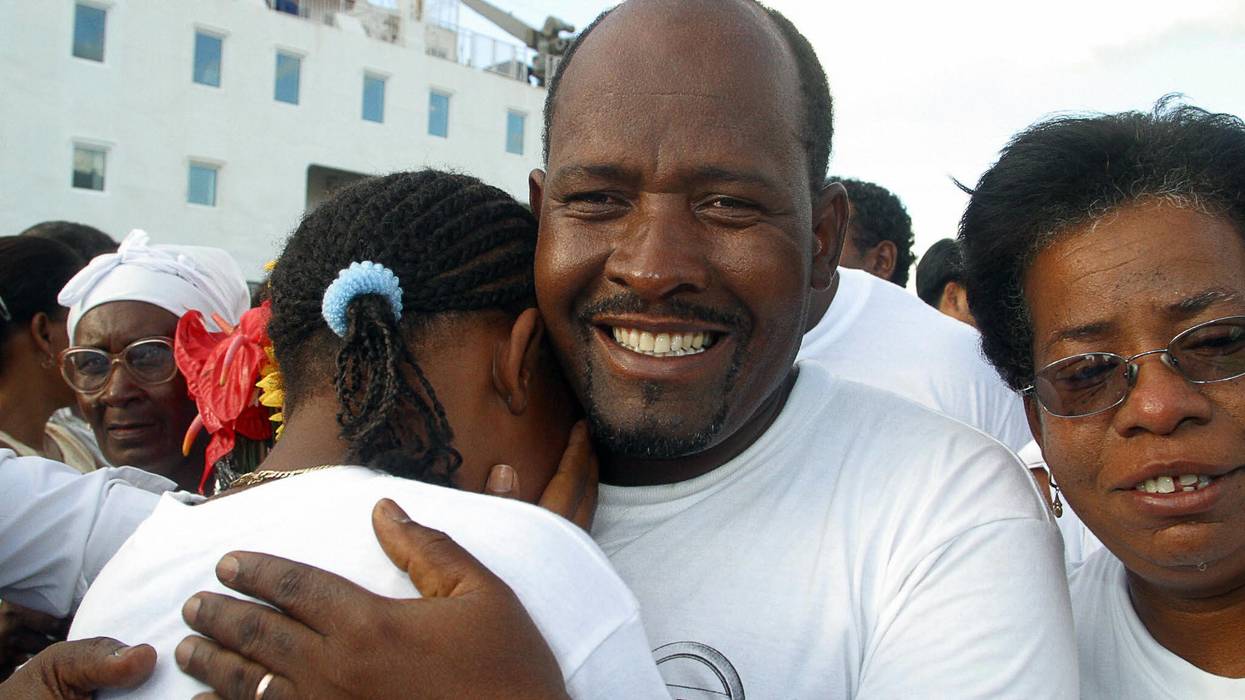
The Chagossians’ return to most of their homeland is a victory for resolving conflicts through diplomacy rather than force, as well as for decolonization and international law.
At a time when many may feel that good news has gone the way of the dodo, look no further than the homeland of that long-extinct bird—Mauritius—for a dose of encouragement. There, among the islands of the Indian Ocean, news can be found about the power of resistance and the ability of small groups of people to band together to overcome the powerful.
Amid ongoing slaughter from Gaza and Ukraine to Sudan and the Congo, the news also offers a victory for resolving conflicts through diplomacy rather than force. It’s a victory for decolonization and international law. And it’s a victory for Africa, the African diaspora, and Indigenous and other displaced peoples who simply want to go home. To the shock of many, President Donald Trump actually played a role in making such good news possible by bucking far-right allies in the United States and Britain.
While the victories the Chagossians, a group numbering less than 8,000, finally achieved last month are anything but perfect, they wouldn’t have happened without a more than half-century-long struggle for justice.
The news came in late May when the British government signed a historic treaty with Mauritius giving up Britain’s last African colony, the Chagos Islands, and allow the exiled Chagossian people to return home to all but one of them. The British also promised to pay an estimated £3.4 billion over 99 years in exchange for continuing control over one island, the largest, Diego Garcia. Though few in the U.S. even know that it exists, the Chagos Archipelago, located in the center of the Indian Ocean, is also home to a major U.S. military base on Diego Garcia that has played a key role in virtually every U.S. war and military operation in the Middle East since the 1970s.
Diego Garcia is one of the most powerful installations in a network of more than 750 U.S. military bases around the world that have helped control foreign lands in a largely unnoticed fashion since World War II. Far more secretive than the Guantánamo Bay naval base, Diego Garcia has been, with rare exceptions, off limits to anyone but U.S. and British military personnel since that base was created in 1971. Until recently, that ban also applied to the other Chagos Islands from which the Indigenous Chagossian people were exiled during the base’s creation in what Human Rights Watch has called a “crime against humanity.”
While the victories the Chagossians, a group numbering less than 8,000, finally achieved last month are anything but perfect, they wouldn’t have happened without a more than half-century-long struggle for justice. A real-life David and Goliath story, it demonstrates the ability of small but dedicated groups to overcome the most powerful governments on Earth.
The story begins around the time of the American Revolution when the ancestors of today’s Chagossians first began settling on Diego Garcia and the other uninhabited Chagos islands. Enslaved at the time, they were brought from Africa, along with indentured laborers from India, by French businessmen from Mauritius who used the workers to build coconut plantations there.
Over time, the population grew, gaining its emancipation, while a new society emerged. First known as the Ilois (the Islanders), they developed their own traditions, history, and Chagossian Kreol language. Although their islands were dominated by plantations, the Chagossians enjoyed a generally secure life, thanks in part to their often militant demands for better working conditions. Over time, they came to enjoy universal employment, free basichealthcare and education, regular vacations, housing, burial benefits, and a workday they could control, while living on gorgeous tropical islands.
“Life there paid little money, a very little,” one of the longtime leaders of the Chagossian struggle, Rita Bancoult, told me before her death in 2016, “but it was the sweet life.”
Chagos remained a little-known part of the British Empire from the early 19th century when Great Britain seized the archipelago from France until the 1950s when Washington grew interested in the islands as possible military bases.
Amidst Cold War competition with the Soviet Union and accelerating decolonization globally, U.S. officials worried about being evicted from bases in former European colonies then gaining their independence. Securing rights to build new military installations on strategically located islands became one solution to that perceived problem. Which is what led Stuart Barber, a U.S. Navy planner, to find what he called “that beautiful atoll of Diego Garcia, right in the middle of the ocean.” He and other officials loved Diego Garcia because it was within striking distance of a vast region, from southern Africa and the Middle East to South and Southeast Asia, while also possessing a protected lagoon capable of handling the largest naval vessels and a major air base.
In 1960, U.S. officials began secret negotiations with their British counterparts. By 1965, they had convinced the British to violate international law by separating the Chagos Islands from the rest of its colony of Mauritius to create the “British Indian Ocean Territory.” No matter that United Nations decolonization rules then prohibited colonial powers from chopping up colonies when, like Mauritius, they were gaining their independence. Britain’s last--created colony would have one purpose: hosting military bases. U.S. negotiators insisted Chagos come under their “exclusive control (without local inhabitants)”—an expulsion order embedded in a parenthetical phrase.
British officials and American sailors rounded up people’s pet dogs, lured them into sealed sheds, and gassed them with the exhaust from Navy vehicles before burning their carcasses.
U.S. and British officials sealed their deal with a 1966 agreement in which Washington would secretly transfer $14 million to the British government in exchange for basing rights on Diego Garcia. The British agreed to do the dirty work of getting rid of the Chagossians.
First, they prevented any Chagossians who had left on vacation or for medical treatment from returning home. Next, they cut off food and medical supplies to the islands. Finally, they deported the remaining Chagossians 1,200 miles to Mauritius and the Seychelles in the western Indian Ocean.
Both governments acknowledged that the expulsions were illegal. Both agreed to “maintain the fiction” that the Chagossians were “migrant laborers,” not a people whose ancestors had lived and died there for generations. In a secret cable, a British official called them “Tarzans” and, in a no less racist reference to Robinson Crusoe, “Man Fridays.”
In 1971, as the U.S. Navy started base construction on Diego Garcia, British officials and American sailors rounded up people’s pet dogs, lured them into sealed sheds, and gassed them with the exhaust from Navy vehicles before burning their carcasses. Chagossians watched in horror. Most were then deported in the holds of overcrowded cargo ships carrying dried coconut, horses, and guano (bird shit). Chagossians have compared the conditions to those found on slave ships.
In exile, they effectively received no resettlement assistance. When The Washington Post finally broke the story in 1975, a journalist found Chagossians living in “abject poverty” in the slums of Mauritius. By the 1980s, the base on Diego Garcia would be a multibillion-dollar installation. The U.S. military dubbed it the “Footprint of Freedom.”
The Chagossians have long demanded both the right to go home and compensation for the theft of their homeland. Led mostly by a group of fiercely committed women, they protested, petitioned, held hunger strikes, resisted riot police, went to jail, approached the U.N., filed lawsuits, and pursued nearly every strategy imaginable to convince the U.S. and British governments to let them return.
In the late 1970s and early 1980s, Chagossian protests in Mauritius won them small amounts of compensation from the British government (valued at around $6,000 per adult). Many used the money to pay off significant debts incurred since their arrival. Chagossians in the Seychelles, however, received nothing.
Still, their desire to return to the land of their ancestors remained, and hope was rekindled when the Chagos Refugees Group sued the British government in 1997, led by Rita Bancoult’s son, Olivier. To the surprise of many, they won. Over several tumultuous years, British judges ruled their expulsion illegal three times—only to have Britain’s highest court repeatedly rule in favor of the government by a single vote. Judges in the U.S. similarly rejected a suit, deferring to the president’s power to make foreign policy. The European Court of Human Rights also ruled against them.
Despite the painful defeats, Chagossian prospects brightened when the Chagos Refugees Group allied with the Mauritian government to take Britain to the International Court of Justice. Aided by Chagossian testimony about their expulsion, which an African Union representative called “the voice of Africa,” Mauritius won. In 2019, that court overwhelmingly ruled that Mauritius was the rightful sovereign in Chagos. It directed the U.K. to end its colonial rule “as rapidly as possible.” A subsequent U.N. General Assembly resolution ordered the British “to cooperate with Mauritius in facilitating the resettlement” of Chagossians.
Backed by the U.S., the British initially ignored the international consensus—until, in 2022, Prime Minister Liz Truss’ government suddenly began negotiations with the Mauritians. Two years later, a deal was reached with the support of the Biden administration. The deal recognized Mauritian sovereignty over Chagos but allowed Britain to retain control of Diego Garcia for at least 99 years, including the continued operation of the U.S. base. The Chagossians would be allowed to return to all their islands except, painfully, Diego Garcia and receive compensation.
The Chagos Refugees Group and other Chagossian organizations generally supported the deal, while continuing to demand the right to live on Diego Garcia. Some smaller Chagossian groups, especially in Britain (where many Chagossians have lived since winning full U.K. citizenship in 2002), opposed the agreement. Some still support British rule. Others seek Chagossian sovereignty.
Right-wing forces in Britain and the United States quickly tried to kill the deal. Former Prime Minister Boris Johnson, Brexit protagonist Nigel Farage, and then-Senator Marco Rubio campaigned for continued British colonial rule, often spouting bogus theories suggesting the agreement would benefit China.
Donald Trump’s election and the appointment of Rubio as secretary of state left many fearing they would kill the treaty. Instead, when Prime Minister Keir Starmer visited Washington, Trump indicated his support. A finalized treaty was in sight.
In the last hours, the deal was briefly blocked by a lawsuit that a judge later dismissed. “I’ve been betrayed by the British government,” Bernadette Dugasse, one of two Chagossians who brought the suit, said of the treaty. “I will have to keep on fighting the British government till they accept for me to settle” on Diego Garcia (where she was born).
Dugasse’s suit and plans for additional legal action are being funded by a shadowy “Great British PAC” that won’t disclose its donors. The group is led by right-wing political figures still trying, in their words, to “Save Chagos.” However, “saving Chagos” doesn’t mean saving Chagos for the Chagossians, but “saving” it from the end of British colonial control. In other words, right-wing figures are cynically using Chagossians to try to uphold the colonial status quo. (Even Dugasse fears she’s being used.)
On the other hand, the Chagos Refugees Group and many other Chagossians are celebrating, at least partially. For the first time in more than half a century of struggle they can go home to most of their islands, even if they, too, criticize the ban on returning to Diego Garcia and the shamefully small amount of compensation being offered: just £40 million earmarked for a Chagossian “trust fund” operated by the Mauritian government (with British consultation). Divided among the entire population, this could be as little as £5,000 per person for the theft of their homeland and more than half a century in exile. (People in car accidents get far more.)
Chagossians, backed by allies in Mauritius and beyond, are continuing their struggle for the right to return to Diego Garcia, for the reconstruction of Chagossian society in Chagos, and for full, proper compensation.
“I’m very happy after such a long fight,” Sabrina Jean, leader of the Chagos Refugees Group U.K. Branch, told me. “But I’m also upset about how the U.K. government continues to treat us for all the suffering it gave Chagossians,” she added. “£40 million is not enough.”
The Mauritian government should benefit more unambiguously than the Chagossians: The treaty formally ends decolonization from Britain, reuniting Mauritius and the Chagos Islands. Mauritius will receive an average of £101 million in rent per year for 99 years for Diego Garcia plus £1.125 billion in “development” funds paid over 25 years.
“The development fund will be used to resettle” Chagossians on the islands outside Diego Garcia, said Olivier Bancoult, now the president of the Chagos Refugees Group, about a commitment he’s received from the Mauritian government. “They have promised to rebuild Chagos.”
Bancoult and other Chagossians insist they also should receive some of the annual rent for Diego Garcia. “Parts of it needs to be used for Chagossians,” he told me by phone from Mauritius.
The continuing ban on Chagossians living on Diego Garcia clearly violates Chagossians’ human rights as well as the International Court’s ruling and that U.N. resolution of 2019. Human Rights Watch criticized the treaty for appearing to “entrench the policy that prevents Chagossians from returning to Diego Garcia” and failing to acknowledge U.S. and British responsibility for compensating the Chagossians and reconstructing infrastructure to enable their return.
“We will not give up concerning Diego,” Olivier Bancoult told me. For those born on Diego Garcia and those with ancestors buried there, it’s not enough to return to the other Chagos islands, at least 150 miles away. “We will continue to argue for our right to return to Diego Garcia,” he added.
While U.S. and British officials have long used “security” as an excuse to keep Chagossians off the island, they could, in truth, still live on the other half of Diego Garcia, miles from the base, just as civilians live near U.S. bases worldwide. Civilian laborers who are neither U.S. nor British citizens have lived and worked there for decades. (Chagossians will be eligible for such jobs, although historically they’ve faced discrimination getting hired.)
That the U.S. military has ended up a winner in the treaty could explain Donald Trump’s surprising support. The treaty secures base access for at least 99 years and possibly 40 more.
Which means the treaty is a setback for those Mauritians, Americans, and others who have campaigned to close a base that has cost U.S. taxpayers billions of dollars and has been a launchpad for catastrophic wars in the Middle East, which a certain president claimed to oppose.
While many Chagossians are privately critical of the base that caused their expulsion and occupies their land, most have prioritized going home over demanding its closure. The campaign to return has been hard enough.
Ultimately, I’m in no position to decide if the Chagos treaty is a victory or not. That’s for Chagossians and Mauritians to decide, not a citizen of the country that, along with Great Britain, is the primary author of that ongoing, shameful crime.
Let me note that victories are rarely, if ever, complete, especially when the power imbalance between parties is so vast. Chagossians, backed by allies in Mauritius and beyond, are continuing their struggle for the right to return to Diego Garcia, for the reconstruction of Chagossian society in Chagos, and for full, proper compensation. The Mauritian and British governments can correct the treaty’s flaws through a diplomatic “exchange of letters.”
“We are closer to the goal” of full victory, Olivier assured me. “We are very near.”
Having won the right to return to most of their islands after 50 years of struggle, Olivier has been thinking a lot about his mother, longtime leader Rita Bancoult. “I would like that my mom would be here, but I know if she would be here, she would be crying,” he said, “because she always believed in what I do, and she always encouraged me to go until the destination, the goal.”
For now, inspired by the memory of his mother and too many Chagossians who will never see a return to their homeland, Olivier told me, “lalit kontin.” The struggle continues.
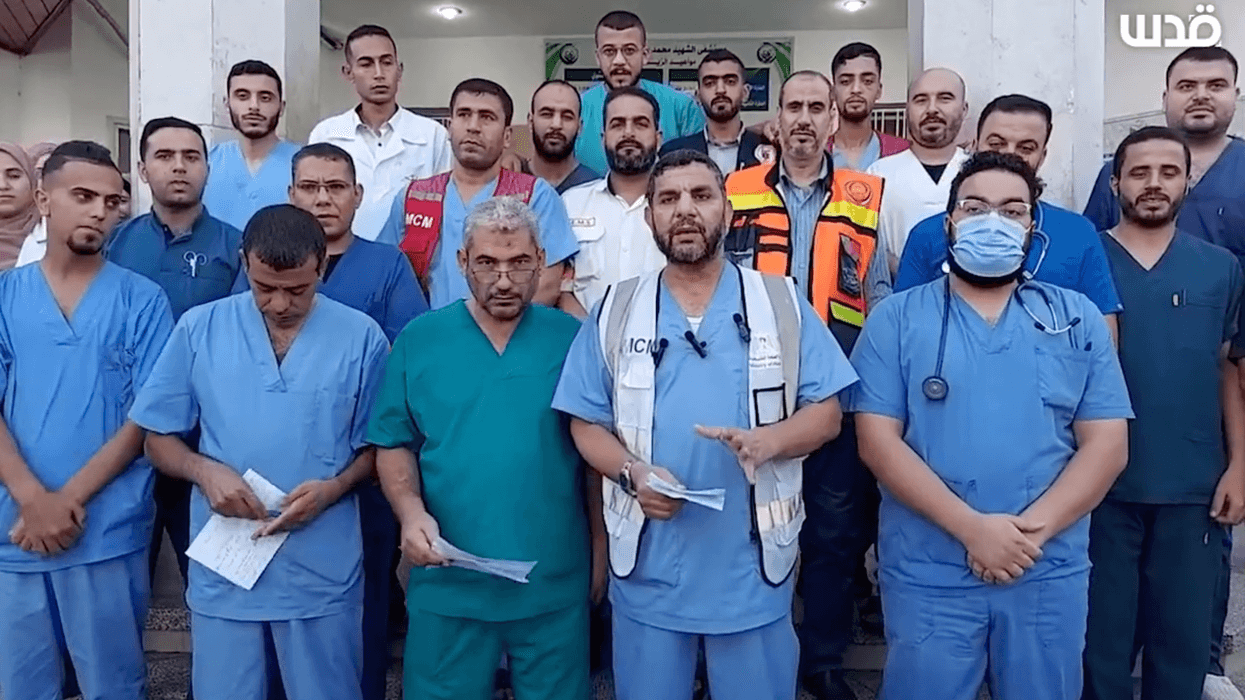
This transformative work requires reimagining medicine’s structures, moving people with racist beliefs out of positions of power, and creating systems for the most marginalized to lead.
Ignoring a genocide or pretending it is not happening is not a "difference of opinion." It is a racist ideology. This ideology does not belong in medicine. Decolonizing medicine requires understanding that we will not have health equity as long as racism is baked into the very structures of medicine. Decolonizing medicine is not about tweaking who is at the top of the pecking order or playing into liberal identitarianism, which, as Dr. King accurately diagnosed, “is more devoted to ‘order’ than to justice.” Decolonizing medicine requires reimagining the order altogether, because the one that exists was created in a time of subjugating women, queer, Indigenous, chronically ill, Black/brown, immigrant and other people deemed “deplorables” by European colonial standards.
The "Other" in medicine—whether between doctor and patient or doctor and structure—this phenomenon is about power, who has it and who is denied it. Power differentials create health inequities, and the differences that exist today were established in a time of colonial conquest. The United States and all of the Global South were colonized by militaries, missionaries, and medics. If we want health equity, we have to transform these outdated and harmful structures of power. We must compost them and create the conditions for something more healing to grow.
To do that we must understand the history and context of how these power structures evolved, who is occupying the seats of power today, and why. People in power in medicine today will tell you that we do not want to mix politics in medicine. But medicine is politics practiced on the human body. To pretend it is any other way is to ignore the actual realities that are causing harm on marginalized people in a system that was not built to serve us. Those in power prefer to distract us with superficial adjustments rather than structural ones. They tell us we are “unprofessional” when we push for change that will close the gaps on disparities. We can no longer play their game of delay.
Yesterday, my colleague Dr. Yipeng Ge suggested we change our oath, from the Hippocratic oath to an oath crafted by the doctors in Gaza, one that uplifts that level of commitment to serve the people.
History and context are critical to understand so we can stop having people who kill and justify killing inside medicine. Having a genocidal war criminal for a physician is bad for patient outcomes. We do not have to study it. We can just look at physician Howard Maibach, a devout Zionist who injected 2,600 imprisoned people (Black/brown) with pathogens and poisons without their informed consent, reminiscent of the Nazi medical experiments. Before I was slated to speak at the American Medical Association’s first Grand Rounds for Health Equity where we discussed Maibach’s medical racialized violence, Maibach’s lawyer—also “Israel’s lawyer”—Alan Dershowitz pressured my university to prevent me from talking. Dershowitz is now representing Israel in the International Criminal Court hearings calling for the arrest of Prime Minister Benjamin Netanyahu and former Minister of Defense Yoav Gallant.
Now while Maibach is not a war criminal, he harbors deep-seated racist ideologies. The harm he did and the fact that he remains employed by the University of California reveal the university’s power structure. Maibach’s family donates heavily to the Friends of the IDF, providing material support for the genocide in Gaza. This is a problem. We need doctors who are fully committed to healing and health for all, not killing some because it happens to be in alignment with their political agendas. And we require doctors who allow for discourse, not silencing because “it’s complicated” when people of European ancestry decide it is time to kill again for colonial conquest.
To decolonize medicine is to remove those obstructions to our voices so we can advocate for the health for all, as it is our moral and professional obligation. Since October 2023, medical students from around the country have texted me horrific, violent, and even murderous things that pro-Israeli professors have said about Palestinian patients in their presence. Once these students find their courage to speak up, the world is not ready for what they have to share. This is why there is such active repression of medical students and their voices, as Israeli doctors called for the destruction of the entire healthcare system in Gaza and the powers that be in Western medical institutions repress those of us who do speak up. The silence of healthcare workers across the West is a part of Israel’s genocide, and a recent submission to the United Nations documents exactly how.
In spite of the forces against us, I hope medical students will find their courage and recognize that building a medicine that will serve all will require that courage in order to compost a colonial system. This work requires the daylight of truth. In that daylight, there are incredible doctors ready to build a liberation medicine, one that will be able to address the needs of all the people we serve, not just an elite few—everyone.
I am grateful to medical students like Umaymah Mohammad, whose courage shines as she shares her horror that a professor at Emory went to serve a combat unit during the genocide and came back as if everything was perfectly normal. It is not. Genocide is the most intense expression of racism. Dr. Josh Winer at Emory University is not fit for teaching medical students in a pluralistic society, especially not ones whose family is currently being annihilated by Israel. Umaymah was suspended for speaking up about this violation of her safety and civil rights. Her stance is a moral one—and a missing one—in a colonial medical system that supports genocidal physicians and silences ones who speak up to stop a genocide. The agenda could not be clearer. Please support Umaymah here.
Physicians and other healthcare workers who have been repressed in the West are finding each other, and we are working to teach our colleagues how to cultivate their courage to embark on this transformative work together. We recently held a webinar to launch our peer to peer curriculum—Cultivating Courage—which is a six-week course to learn and unlearn together as we map out what is needed to build a liberation medicine.
As people across the West wake up and realize that physicians who supported, endorsed, and even participated in genocide continue on in their careers as those who stood to make noise about a genocide were defamed, suspended, and even fired, they will start to ask themselves questions about their personal safety in the hospital. Physicians who are deeply racist provide poor care to the people they hate. This has been shown over and over again. And the issue is not simply a healthcare issue. It is a matter of civil rights.
People of color have the right to be served by physicians who do not hate them. Arabs and Palestinians have a right to be served by physicians who do not want to see them annihilated. In a pluralistic society, holding deeply racist beliefs should be enough to show that a person does not have the basic competency required to be a physician. Changing one’s belief is not simply a matter of showing up for a DEI workshop or implicit bias training. This work cannot be led by liberals who opened the door to the right-wing exploitation of civil rights laws to silence people of color across the Global North as the West started its bloody campaign in Gaza. This transformative work requires reimagining medicine’s structures, moving people with racist beliefs out of positions of power. It requires creating systems for the most marginalized people who uplift the health of all in practice, not just in speech, to lead.
The decolonization of medicine is happening right now, led by the doctors in Gaza. With moral courage and leverage, they “absorb what is useful” from Western medicine and “discard what is not, add what is uniquely your own,” in the words of martial artist Bruce Lee. That is the path ahead for physicians of conscience. It is the future of medicine. Yesterday, my colleague Dr. Yipeng Ge suggested we change our oath, from the Hippocratic oath to an oath crafted by the doctors in Gaza, one that uplifts that level of commitment to serve the people. Because in the times that are upon us—social upheaval and climate collapse, fascism and food systems deterioration—we will need a different kind of physician and a different kind of medical system. The time to start laying those seeds is now.
This piece was originally published on Marya’s Substack Deep Medicine.
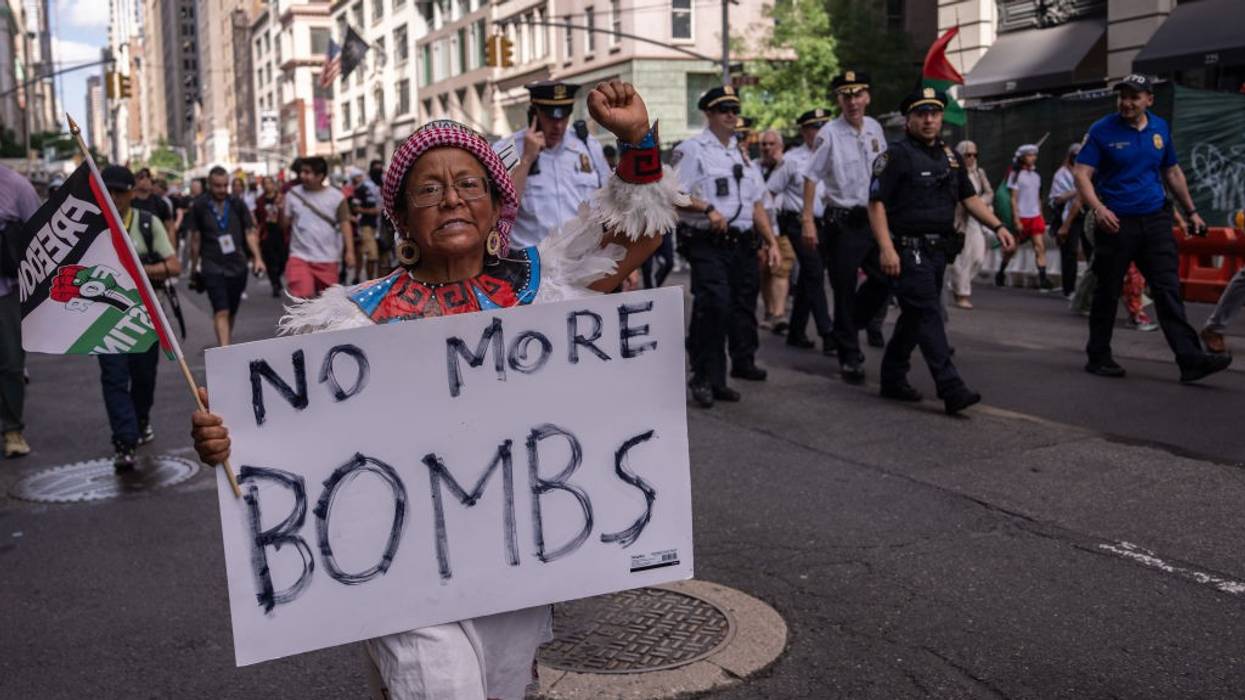
"Gotta love America—celebrating Indigenous Peoples Day today while arming, funding, and supporting the occupation, ethnic cleansing, and genocide of the Indigenous Palestinian people abroad," said one critic.
Human rights defenders on Monday underscored the links between the decolonization struggles of Native Americans and Palestinians—and the hypocrisy of celebrating Indigenous Peoples Day while the United States provides military aid and diplomatic support for Israel as it wages a war on Gaza for which it is on trial for genocide at the International Court of Justice.
"Several years ago Native activists successfully rallied their city councils to replace Columbus Day, the day that honors the Italian explorer who was a destroyer of Native worlds, with Indigenous Peoples Day, a holiday that celebrates the Natives who have resisted colonial oppression for over 500 years, since the arrival of Christopher Columbus," Jewish American scholar Benay Blend wrote for The Palestine Chronicle.
"It is also a good time to highlight Indigenous solidarity within the Americas as well as with other Indigenous people, including the Palestinians," Blend said. "Indeed, both people share a similar story of resistance to colonization, while the colonizers—the United States and Israel—share similar origin stories and tactics used to sever the Native people from their land."
Citing Steven Salaita—the Palestinian American professor of American Indian studies whose offer of a tenured position at the University of Illinois Champaign-Urbana was rescinded in 2014 over his criticism of Israeli bombing of Gaza—Blend noted that "both Israel and North America share similar rhetoric that justifies their origins."
"Infused with biblical references to 'salvation, redemption, and destiny,' settlers in both countries believed that they had reached the Promised Land, where God commanded them to eliminate the Indigenous populations to make way for more fertile land that had previously been 'underused and unappreciated by the natives,'" she added.
In a social media post that included video footage of Israel's bombing on Monday of a displaced people's encampment on the grounds of the al-Aqsa Martyrs Hospital in Deir al-Balah in central Gaza, Uahikea Maile—a Native Hawaiian professor of race, diaspora, and indigenity at the University of Chicago—said on social media that "Indigenous Peoples Day is about commemorating our survival and endurance despite settler colonialism—resisting annihilation as distinct people."
"If your celebration doesn't condemn Israel's wanton destruction of Palestinian life, then it recklessly shores up settler colonization," he added.
Samoan poet and educator Terisa Siagatonu stressed that "Palestinians are an Indigenous people" and "a free Palestine is an Indigenous struggle."
"I'm saying this over and over again as clear as I can because I don't believe people are contending with this enough, and you need to," she added.
Nick Estes, a Lakota community organizer and University of Minnesota historian, asserted that "the cynical 'celebration' of Indigenous Peoples Day by a settler state backing another settler state's genocide against Palestinians and Lebanese shows us nothing is sacred, not even our own survival, until we bury colonialism once and for all."
Responding to an Indigenous Peoples Day proclamation by U.S. President Joe Biden "respecting tribal sovereignty and self-determination," labor historian, author, and Empire State University professor Jeff Schuhrke took a swipe at those "commemorating Indigenous Peoples Day while simultaneously facilitating the real-time colonial extermination of Palestine's Indigenous people."
The U.S. direct action group Jewish Voice for Peace chose Indigenous Peoples Day to stage a protest at which more than 200 activists were arrested while demanding an end to U.S. military aid to Israel. Sumaya Awad, a Palestinian American spokesperson for the event and member of Adalah Justice Project, told The Indypendent that "the fact that the United States claims to stand with and honor Indigenous people... while they're actively funding and financially backing the ethnic cleansing of an Indigenous population in Palestine is contradictory to their statements."
Rick Tabenunaka, a member of the Comanche Nation and leftist organizer who hosts the "Decolonized Buffalo" podcast, said on social media, "I find it ironic that settlers will claim that Indigenous peoples on the North 'American' continent aren't doing enough to fight against settler colonialism."
"Yet," he lamented, "these same settlers spent a whole year watching their colonial government support genocide in Palestine and did nothing."
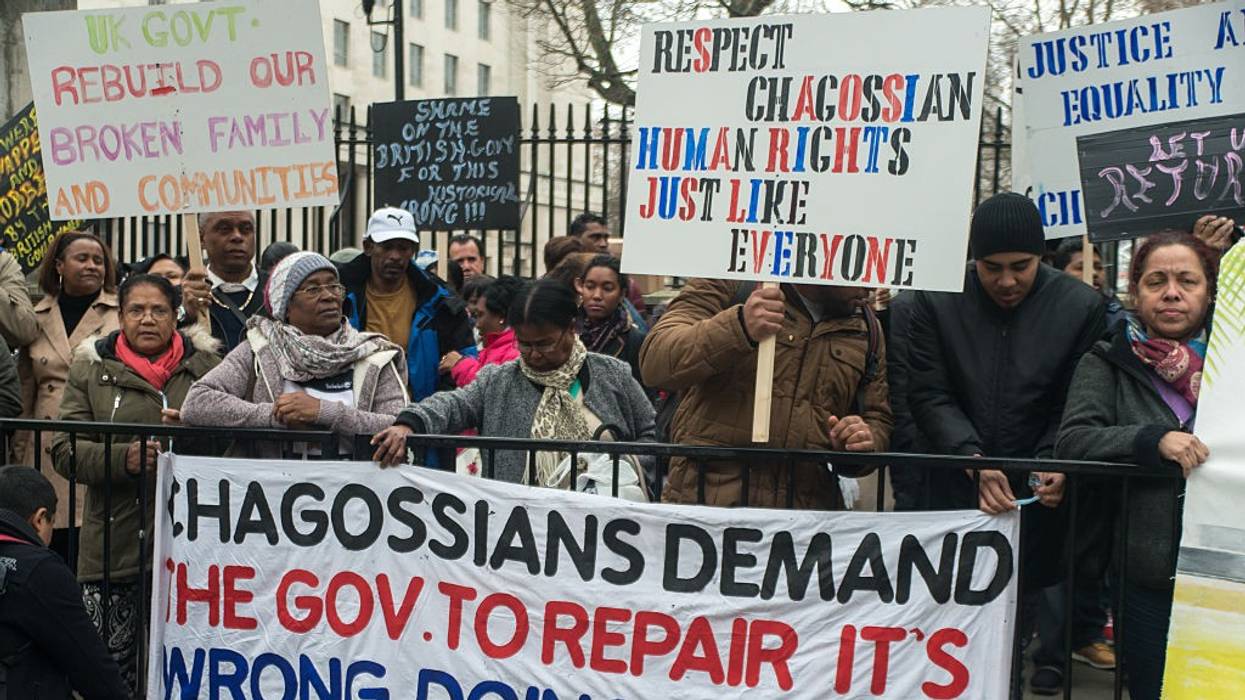
"We remain powerless and voiceless in determining our own future and the future of our homeland," one diaspora Chagossian said in response to the agreement.
Activists on Thursday decried a deal under which the United Kingdom will cede sovereignty of the Chagos Archipelago to Mauritius with the exception of Diego Garcia, an island from which the Indigenous Chagossian people were forcibly expelled over half a century ago to make way for one of the world's largest and most important U.S. military bases.
The agreement—which was announced Thursday by the U.K. and Mauritius governments—grants the latter full sovereignty over the remote Indian Ocean archipelago, while allowing the United States and Britain to keep the joint base on Diego Garcia for the next 99 years. Under the deal, Mauritius authorities will facilitate Chagossians' eventual resettlement of the archipelago, with the apparent glaring exception of Diego Garcia.
"Following two years of negotiation, this is a seminal moment in our relationship and a demonstration of our enduring commitment to the peaceful resolution of disputes and the rule of law," a joint statement published by the U.K. and Mauritius governments states. "Negotiations have been conducted in a constructive and respectful manner, as equal sovereign states, on the basis of international law, and with the intention of resolving all outstanding issues between the United Kingdom and Mauritius concerning the Chagos Archipelago, including those relating to its former inhabitants."
"The treaty will address wrongs of the past and demonstrate the commitment of both parties to support the welfare of Chagossians," the statement adds. "Mauritius will now be free to implement a program of resettlement on the islands of the Chagos Archipelago, other than Diego Garcia, and the U.K. will capitalize a new trust fund, as well as separately provide other support, for the benefit of Chagossians."
U.S. President Joe Biden welcomed what he called the "historic agreement," which he said represents a "clear demonstration that through diplomacy and partnership, countries can overcome long-standing historical challenges to reach peaceful and mutually beneficial outcomes."
Some Chagossians also welcomed the deal. Isabelle Charlot, chair of the Chagos Islanders Movement, told BBC Radio 4 that the agreement gave her hope that her family could return to "a place that we can call home, where we will be free."
Other Chagossians decried the deal. The advocacy group Chagossian Voices—which is based in Crawley in West Sussex, England—said in a statement:
Chagossian Voices deplore the exclusion of the Chagossian community from the negotiations which have produced this statement of intent concerning the sovereignty of our homeland. Chagossians have learned this outcome from the media and remain powerless and voiceless in determining our own future and the future of our homeland. The views of Chagossians, the Indigenous inhabitants of the islands, have been consistently and deliberately ignored and we demand full inclusion in the drafting of the treaty.
"We remain powerless and voiceless in determining our own future and the future of our homeland," Chagossian Voices founding member Frankie Bontemps told the BBC.
Diego Garcia was once home to around 1,500 Creole-speaking Chagossians and their beloved dogs. However, in the 1960s the U.S. convinced Britain to grant it full control there and subsequently began to "sweep" and "sanitize" the atoll of its Indigenous population, in the words of one American official.
"We must surely be very tough about this," one British official privately wrote, adding that "there will be no Indigenous population except seagulls."
Many Chagossians were tricked or terrorized into leaving. U.S. Marines told them they'd be bombed if they didn't evacuate, and Chagossians' dogs were gassed to death with fumes from military vehicles. The islanders were permitted to take just one suitcase with them. Most were shipped to Mauritius, where they were treated as second-class citizens and where many ended up living in poverty and heartbreak in the slums of the capital, Port Louis.
Meanwhile—and without any apparent sense of irony—the U.S. military dubbed the new Halliburton-built base on Diego Garcia Camp Justice. In addition to launching an unknown number of attacks on countries including Afghanistan, Pakistan, and Iraq from Diego Garcia during the ongoing so-called War on Terror, the U.S. military also dumped large amounts of human sewage into a protected coral lagoon on the atoll, belying British claims of commitment to ecological stewardship.
The forced displacement of the Chagossians was largely hidden from the U.S. and British public. However, the Chagossians never stopped fighting for justice. Britain's High Court of Justice twice ruled that their removal was illegal. In 2010, WikiLeaks published a secret U.S. diplomatic cable exposing nefarious intentions—denying Chagossians their right of return—behind the establishment of a marine reserve around the atoll.
In 2019, the International Court of Justice in The Hague issued an advisory opinion that the U.K. was exercising "illegal" sovereignty over Diego Garcia and urged the British government to "decolonize" the atoll by handing sovereignty to Mauritius, whose government long contended it was forced to cede control in order to secure its own independence from Britain.
Responding to the new agreement, Human Rights Watch (HRW) said Thursday that while the deal will "address the wrongs against the Chagossians of the past," it "looks like it will continue the crimes long into the future."
"It does not guarantee that the Chagossians will return to their homeland, appears to explicitly ban them from the largest island, Diego Garcia, for another century, and does not mention the reparations they are allowed to rebuild their future," HRW senior legal adviser Clive Baldwin said in a statement.
There has been an important hashtag -- #knowtheirnames -- circulating through social media recently that encourages us all to say out loud and remember the names of those murdered by a white supremacist in Charleston on June 17, 2015.
There has been an important hashtag -- #knowtheirnames -- circulating through social media recently that encourages us all to say out loud and remember the names of those murdered by a white supremacist in Charleston on June 17, 2015. Just a few months ago, the Guardian launched an interactive project, "The Counted," that names all of the victims of police violence in the United States in 2015, with a running toll in the left-hand corner (the toll was at 528 as I sat down to write these words). Saying the names of people who have lost their lives to white supremacy is something we need to remind ourselves to do, while at the same time large segments of the population generally have no problem with swimming in a lake named after proponents of slavery and Native American genocide, entering buildings named after Ku Klux Klan leaders to earn our college degrees, or spending and earning money with the faces of slave owners on them. The names of the people responsible for the deaths and oppression of large numbers of Americans are often on our lips and at our fingertips in the United States.
Popular arguments in the South, where I live now, are that buildings named after former Klan leaders and Confederates reflect the history of the South and re-naming them would "erase" or "sanitize" the past. As a scholar who studies and teaches history, I often hear students (as well as fellow academics) write off these contested names, excusing the benefactor because "everyone was racist then," "everyone owned slaves then," or, in the context of 20th-century Europe "everyone was anti-Semitic." Of course, this is categorically untrue once you take into account the enslaved, the Jewish targets of 20th-century Fascism, and the many allies who fought for the abolition of slavery and for the National Socialists in Germany to be stopped. History has the power to establish the status quo, but it also the duty of historians to expose the cracks in the monotonous facade.
While a lot of media attention has focused on South Carolina and the reckoning with the confederate flag in the past few days, the controversy over re-naming has made it to the "great white North". Recently, in my home state of Minnesota, there has been a call to rename Lake Calhoun, one of the chain of lakes that is at the center of some of the most expensive property in Minneapolis, as well as a public space that attracts thousands of visitors to its beaches and running trails. Before white colonialists settled the land, the Dakota people called this body of water Mde Maka Ska, or White Earth Lake. In the early 19th century, it was re-named for John Caldwell Calhoun (1782-1850), a man who promoted slavery, owned slaves, and was as U.S. Congressman from South Carolina, Secretary of War, as well as the seventh Vice-President of the United States, under Presidents John Quincy Adams and Andrew Jackson. Calhoun supported the 1850 Fugitive Slave Act, and was himself a slave owner. As Jon Schwarz of the Intercept has pointed out, the names and voices of the many slaves Calhoun owned, abused, and profited from have remained "voiceless" in the history of the United States, while Calhoun is remembered throughout the country, from this lake in Minneapolis, to a statue in Marion Square in Charleston, S.C., not far from the Emmanuel AME Church that was attacked. Following the massacre, the Calhoun was spray painted with the slogan "Black Lives Matter."
The terrorist act in Charleston that left Sharonda Coleman-Singleton, Rev. Clementa Pinckney, Cynthia Hurd, Tywanza Sanders, Myra Thompson, Ethel Lee Lance, Rev. Daniel L. Simmons, Rev. Depayne Middleton-Doctor, and Susie Jackson dead, opened the eyes of many Minnesotans for the first time to who John C. Calhoun was - leaving many confused as to why there was a Lake Calhoun in Minneapolis. In the wake of Charleston, a petition was started by Minneapolis resident Mike Spangenberg to rename Lake Calhoun: according to the Minneapolis Star-Tribune, the petition had over 2500 signatures by the end of the day on June 23rd.
People in the Northern United States tend to view racism and racial segregation as a Southern problem. There is a certain air of moral superiority that comes with the cold air in Minnesota - a state that has a history of progressive politics, and a pride in being well north of the Mason-Dixon. As I've followed the comments on social media around the Lake Calhoun naming question, I've noticed a lot of Minnesotans - white, middle-class, educated Minnesotans - urging caution on the question of re-naming. Some people think it doesn't really matter who John C. Calhoun was, and are loathe to change something that is familiar. To these individuals, it is immoral to "erase history" by re-naming. "Why not keep the name and use it to educate?" some have asked. They argue that re-naming is not that significant; that energy could be better spent other places. Others still note that it is a "slippery slope," and ask, "What is next - renaming Fort Snelling?"
Just as large swaths of Minnesotans had never stopped to think about who John C. Calhoun was while enjoying the lake, many of these same people have been oblivious to a struggle not just to re-name but also to raze Fort Snelling and mark it solely as a site of genocide. Dakota activists, scholars, and their allies have occupied Fort Snelling, led marches to Fort Snelling in protest of its imperialist history, and published editorials calling for its removal. The indigenous people involved in this struggle are no stranger to John C. Calhoun -- Calhoun was not only a promoter of slavery in the South, he also founded Fort Snelling, the site of U.S. military occupation used to control the Dakota people who lived in the Upper Mississippi River Valley, using it as an internment camp during the US-Dakota War of 1862.
The truth is, as indigenous scholars and activists have been telling us for at least a century, that the majority of streets, towns, lakes, forests, schools, and other government institutions are named after white men (and sometimes women) who achieved fame for colonizing the land, establishing a system of white supremacy, and annihilating indigenous people, culture, and language. The indigenous peoples of the United States have never been allowed the opportunity to decolonize, which stems from an inability of a great number of Americans to recognize they are part of a colonizing class. As many important indigenous and African-American thinkers have reminded us, communities of color are still under occupation in the United States today.
Language and naming are important tools of colonial control. In colonial India, for example, British administrators controlled the population by naming everything in English - from encouraging local people to give their children proper English names to insisting that English education was modern while learning in Sanskrit was outdated (as for the hundreds of regional and vernacular languages, those weren't even worth thinking about, except to control local populations). Buildings, streets, and schools were named after the heroes of colonial conquest. After a long struggle for independence from British rule that ended in 1947, there was a massive movement to change the names of these institutions that had once born the names of the masters. Part of the decolonial process meant that street names lost their British character, giving way to a multitude of streets named after the heroes of independence, such as M.K. Gandhi and Jawaharlal Nehru. These name changes all have, however, a particular history and politics that tell us about both the current political moment and the historical past. The changed street names are often printed above or on top of the old names - traces of the colonial past are all around the subcontinent, and have certainly not been forgotten.
India is not the only post-colonial country to engage in massive renaming campaigns. After the fall of the USSR, statues of Communist leaders were toppled all over Russia, Eastern Europe, and Central Asia, and thousands of streets named for Stalin and Lenin were either restored to their original names or given new ones. Countries throughout Latin America and Africa have also moved away from colonial names.
In contrast to the many countries once ruled by European imperial power, the United States has never had a decolonial reckoning as a nation, despite calls from movements such as the American Indian Movement and Idle No More, amongst others. Today there are numerous indigenous, African-American, and Latin@ activists and groups working to dismantle colonial language, but are held up not only by conservative groups who actively promote maintaining white supremacy, but also by mainstream and even left-of-center Liberals nostalgic for the past who are certain they can improve the conditions of the "wretched of the earth" while maintaining the status quo.
People not involved in social movements led by people of color often ask, should we really rename every one of these streets and lakes? Isn't that just asking too much? To this I reply - of course we should! Will this dismantle white supremacy? Of course not, but it will create an important note in the historical record that at this point in time a significant number of people in the United States came to understand that the history of this country is not in the official names we see on government signs, but is in what is buried underneath. The year 2015 could be remembered because Wal-Mart banned the sale of confederate flag items, South Carolina removed the confederate flag from flying in front of the state house, activists at the University of North Carolina - Chapel Hill fought successfully for the name change of Saunders Hall to Carolina Hall (though their proposed name was Hurston Hall, Carolina Hall the choice of the Board of Trustees), and all across the United States, people removed the name "Calhoun" from monuments, lakes, streets, buildings, and schools.
Calls for re-naming are happening all over the United States right now - it's not a Northern issue, a Southern issue, or a Western issue. The United States, as a nation, is past due for a conversation about what decolonization will look like. Re-naming never erases history; it only makes the historical record richer. Many involved in the petition to rename Lake Calhoun have suggested changing the name but including a historical marker that explains the legacy of the name and the movement that arose amongst the people of Minnesota to change it. That is, in my opinion, one excellent way to make history.
Dozens of social movement organizers recently gathered in Toronto at a meeting convened by the This Changes Everything team to envision a new economy centered on climate justice. With relentless extractions of labor and land harming all life on earth, cross-sectoral alliances are necessary.
But a number of predictable tensions bubbled up at the gathering, some related to land defence and workers' rights. How do we shift from a petro-economy to prevent catastrophic climate change while safeguarding workers whose livelihoods depend on the resource economy? Over the past few decades a green economy, which would ensure jobs and equity within a low-carbon economy, has been posited as a solution.
Extending from this and in the context of reconciliation, I want to envision emancipatory possibilities of solidarity between workers' movements for self-management and Indigenous struggles for self-determination.
Land defence as labor, blockades as pickets
Capitalism not only creates the conditions for the expropriation of labour, but also limits what can even be characterized as labor.
Our society primarily defines workers as those producing within the industrial, financial, service or technological economies. Labor outside of these economies is not only devalued, but also unrecognized as productive labor. This includes reproductive and affective labor, land stewardship, and care work. Single mothers, elders, peasants, women of color, and Indigenous communities, all of whom are deliberately impoverished and stigmatized as "uncontributing," overwhelmingly undertake this hard work that maintains life itself.
Blockades from Clayoquot to Caledonia have long been sites of conflict between workers in the resource sector and land defenders working to protect the land. Within the house of labor we can create a formidable precedent by respecting blockades as legitimate picket lines.
Furthermore, since land grabs are, to borrow from David Harvey, accumulation by dispossession, Indigenous land defence is an impediment to capital accumulation. Dene scholar Glen Coulthard notes that blockades "seek to negatively impact the economic infrastructure that is core to the colonial accumulation of capital in settler political economies like Canada's."
Strident working-class movements picket to hamper capital's exploitation of labour and strike for workers' collective control over the means of production. Similarly, Indigenous nations blockade to prevent state and capital's expropriation of natural resources by asserting Indigenous jurisdiction.
Green economy or Indigenous land-based economies?
Indigenous land defenders rarely describe their efforts as work, but rather say they are protecting a way of a life under attack by development projects. As Lianna Spence from Lax Kw'alaams, who recently voted to reject Pacific NorthWest LNG's project, states, "They're offering us benefits if we vote Yes. But we already have a lot of benefits around us - we have coho, spring and sockeye salmon. We have halibut, crab and eulachon."
We have normalized the idea of labor as a job that extracts time and energy from us for someone else's profit. But If we understand "work" and "way of life" as synonymous -- as generative rather than extractive processes -- it becomes evident that Indigenous nations are working to protect laws and relations stemming from their land-based economies.
Such economies are not only local and sustainable, but also offer a profound challenge to the logics of commodification and isolation inherent to capitalist markets. Author Leanne Betasamosake Simpson articulates, "If I look at how my ancestors even 200 years ago, they didn't spend a lot of time banking capital, they didn't rely on material wealth for their well-being and economic stability. They put energy into meaningful and authentic relationships. So their food security and economic security was based on how good and how resilient their relationships were."
With growing attacks against them since the 1980s, many North American unions retreated from anti-capitalist stances and took on more constrained slogans of "more jobs" or "fair working conditions." Fighting for dignified conditions of work is most potent when done alongside a systemic challenge to capitalist and state relations that subjugate the social and class positioning of workers (particularly racialized non-citizen women increasingly stratified into precarious work).
The bold leadership of unions that revive principles of social unionism ensures that unions are not simply advocating mobility within capitalism and state structures, but are primary allies in the struggle against capitalism and imperialism.
As Herman Rosenfeld, a former GM worker, writes, "Job security is key, but what kind of jobs? Is the job security strategy one that works against the interests of the rest of the working-class and First Nations peoples, or in partnership with them? Moving away from the narrow focus on the short-term sectoral interests of a relatively small group of workers, whose jobs are currently defined by their employers, is a critical way of building unions as fighters for the class as a whole, and for a different, sustainable, and hopefully anti-capitalist future."
Simply put, workers shouldn't have to extract toxic sludge. Workers want and need clean air, clean water, and a more equitable future.
Labour within settler-colonialism
While a reconceptualization of work strengthens alliances between workers and Indigenous movements, it is inadequate in contending with settler-colonialism and the context of labouring on Indigenous lands.
Since the inception of Canada, settler-colonialism has sought to forcibly displace Indigenous peoples from their territories, destroy self-determination within Indigenous governance, and assimilate Indigenous cultures and traditions. The Truth and Reconciliation Commission has painstakingly recounted how Canada clearly participated in "cultural genocide."
A pervasive myth is that the Canadian economy subsidizes Indigenous communities. The reality is the opposite. As one tangible act of reconciliation, unions can educate members on how industry's profits are not only generated by the labor of the working class. The wealth of Canadian society as a whole could not be built, as Dru Oja Jay argues, "without massive subsidies: of [Indigenous] land, resource wealth, and the incalculable cost of generations of suffering."
Or imagine if every union in Canada adopted the UN Declaration on the Rights of Indigenous Peoples and made free, prior and informed consent from Indigenous nations a necessary part of any collective bargaining it undertakes with government and industry.
The possibilities are endless and the power within such genuine acts of solidarity and reconciliation are transformative.
Given the scale of catastrophic climate change, state violence and capitalist crisis, we need to reimagine work as that which makes up the ecology and economy of everyday life through the generations. When it comes to the job of decolonization and protection of life, many aren't getting a paycheck at all.