

SUBSCRIBE TO OUR FREE NEWSLETTER
Daily news & progressive opinion—funded by the people, not the corporations—delivered straight to your inbox.
5
#000000
#FFFFFF
To donate by check, phone, or other method, see our More Ways to Give page.
Daily news & progressive opinion—funded by the people, not the corporations—delivered straight to your inbox.

The 2026 midterms are about more than congressional majorities; they are an opportunity for Americans to hold their representatives accountable and decide whether fear should remain an instrument of government.
The grandfather of the current president of the United States, Friedrich Trump, arrived penniless from Germany at the age of 16 in 1885. He worked as a barber in New York before heading west, eventually opening a restaurant in a mining town. Like so many immigrant stories, his is unremarkable in one sense, and quintessentially American in another. It reminds us that history often looks different when viewed from a distance.
Today, however, history is being written in real time. And the images now emerging from the United States tell a troubling story.
Across many American cities, armed and masked Immigration and Customs Enforcement (ICE) agents are conducting highly visible raids. Videos show people being detained in the streets, families disrupted, and communities thrown into fear. Other footage captures American citizens confronting federal agents in their own neighborhoods amid tear gas, pepper spray, and rubber bullets. These scenes dominated evening news broadcasts not only in the United States, but in Europe and elsewhere. Footage related to the fatal shootings in Minneapolis spread globally. Now, California’s Central Valley faces raids and accusations of voter intimidation ahead of Tuesday’s elections. They project an image of a nation in distress, one in which fear appears to be overtaking everything.
The nation’s greatness has always rested on the idea that people from every corner of the world came here to live under the same laws, to contribute, to succeed, and—eventually—to become citizens.
Some of these encounters raise serious constitutional questions. When force is used during immigration enforcement actions, concerns arise about the Fourth Amendment’s protections against unreasonable searches and seizures, the Fifth Amendment’s guarantee of due process, and the First Amendment rights of citizens who protest in public spaces. These are not abstract legal matters. They go to the heart of what it means to live under a constitutional democracy.
Why are so many people willing to stand in the streets to protect their neighbors? Because those neighbors are deeply woven into the fabric of American life. Undocumented immigrants often perform jobs that others are unwilling to take: picking apples, tending livestock, washing dishes, cleaning hospitals, and caring for the elderly. They work hard, pay taxes, and spend money in local economies. Economist Paul Krugman has noted that immigrants played a critical role in stabilizing the US economy after the pandemic, continuing essential work when much of the country shut down. Have we already forgotten that?
Most Americans either descended from immigrants who once lacked legal status or know family stories that began that way. This country has always been a mosaic of people who arrived with little, worked relentlessly, and eventually earned not only stability but admiration. They learned to love this land. Many still feel a surge of pride when they hear the national anthem or see the Stars and Stripes.
That is why what is happening now should concern all of us. Fear is spreading through immigrant neighborhoods—fear of going to work, going shopping, seeing a doctor, even answering the door. Parents worry about what will happen to their children. Communities are learning to live with the anxiety that a knock at dawn could change everything.
History teaches us that when societies normalize fear directed at a particular group, the consequences are rarely confined to that group alone. The United States has long defined itself by its rejection of such thinking. Dystopian novels were not written as instruction manuals, but as warnings to recognize the early signs of authoritarian drift and stop it.
As America celebrates the ongoing 250th anniversary year, it should be recommitting itself to the ideals articulated in 1776: liberty, dignity, and equal protection under the law. The nation’s greatness has always rested on the idea that people from every corner of the world came here to live under the same laws, to contribute, to succeed, and—eventually—to become citizens.
Thus, America must find the courage to honor its own history. That means recognizing the contributions of immigrants, including undocumented ones; rejecting policies that force people into hiding like thousands of Anne Franks; and pursuing reforms that help them obtain citizenship and integrate them into civic life. In doing so, the nation would not only honor its founding principles, but also the generations of immigrants—like Friedrich Trump—who believed in America enough to come here with nothing and help build it.
The 2026 midterms are about more than congressional majorities. They are an opportunity for Americans to hold their representatives accountable and decide whether fear should remain an instrument of government. They offer Americans an opportunity to remember those who made America their home but now live in constant fear.
After all, a president may wear many hats—or, in Trump’s case, many MAGA baseball caps—but no president should forget that his own family has an immigrant past. And that includes immigrant brides. How America treats immigrants ultimately reflects what kind of country it chooses to be. It is hubris to treat immigrants badly.

Our students deserve so much better than the chaos the legislature has thrown at our public schools. It’s vital that communities across New Hampshire vote no on the tax cap on November 3.
On Election Day, New Hampshire residents will face a ballot initiative that aims to place a tax cap on every public school district in the state. Similar proposals to cap property taxes or eliminate them for certain property owners are on the ballots this November in multiple states. But regardless of where the initiatives are being considered, if successful, the financial consequences will threaten school sports, extracurriculars, and even basic academic programming statewide. In the case of New Hampshire, the consequences will be especially negative to schools, families, and children.
At least since the Covid-19 pandemic, New Hampshire school districts have struggled to stay afloat. In September 2026, the town of Milton, New Hampshire was shocked by revelations of a $2.5 million hole in its school district’s budget. Nearby, the Farmington School District was forced to reduce teaching positions in the 2025-2026 school year due to a growing budget deficit. In the western part of the state, Claremont schools cut teaching positions and students washed cars to raise funds. At the same time, New Hampshire launched a universal voucher program to the tune of $102 million, sending a record amount of public money to private schools.
Historically, New Hampshire has largely left local communities to fund public schools on their own. In the 2024-2025 academic year, according to data from the National Education Association, New Hampshire ranked 50th in the share of state revenue contributed to public schools, at 28%. While some argue that New Hampshire has maintained level funding in real tax dollars, the state has simply not made budget increases on pace with rising costs, leaving local taxpayers holding the bill.
The new approach intrudes on that time-honored process of collective decision-making through deliberation. Instead, it places school funding into the hyper-partisan environment of the midterms.
In 2026, a superior court ruled the state had not been fulfilling its constitutional responsibility to provide adequate funding to public schools. New Hampshire Attorney General John Formella is appealing the case to the state’s supreme court, where he is also attempting to overturn the landmark 1993 case that established the state’s responsibility to provide fair funding to all public schools.
In this context, a local tax cap for schools would be detrimental for students and communities in general. While New Hampshire does not allow for statewide referendums on its ballots, legislators supporting the tax cap circumvented this with clever legislation. In 2025, Republican Gov. Kelly Ayotte signed HB 1300 into law, a measure that automatically places a tax cap question on the ballot of every municipality in the state in 2026 and in 2028.
The ballot measure was challenged on multiple fronts in court, including on the lack of clear constitutional standing and on account of being difficult to understand. The state supreme court, which has been plagued by scandals—including the chief justice’s resignation in September over an ethics violation—ultimately rejected these challenges.
The tax cap will require a three-fifths approval of local voters to go into effect. If enacted, it would limit local control of the schools with a tax cap that is linked to the Consumer Price Index (CPI), which, by nature of being tied to non-salary costs, is unpredictable on a year-to-year basis and can easily be outpaced by school costs, especially with rising fuel prices. It would also impose a limit on administrative spending as a proportion of the total school budget.
The effort to institute a tax cap defies New Hampshire’s long history of local control. It’s a tradition that brings residents of towns across the state together for town halls each spring, where school budgets are debated publicly. The process honors the citizens’ right to petition and write warrant articles that meet the specific needs of the locality, including placing limits on spending, if that is the collective will of the people. The new approach intrudes on that time-honored process of collective decision-making through deliberation. Instead, it places school funding into the hyper-partisan environment of the midterms.
Marianne Doane, who has taught in Milton for more than 40 years, is dedicated to its youth. As the president of the local teachers association, Doane has worked across differences to build support for her students and their education. She has organized babysitting services during town meetings to help provide childcare for parents who otherwise might not be able to participate. She has encouraged families to vote by sponsoring civic engagement programming for children outside of polling places. One year, she facilitated an activity for kids to design “I Voted” stickers and handed them out at the polls. In an interview, Doane shakes her head in disbelief about the tenuous position of the schools in her small town.
“Right now if the tax cap passes, the oil bill is $51,000 and the anticipated budget for special education is $500,000,” she says. “In order to come up with that amount, we are looking at losing 12 teachers. We only have 12 teachers at the elementary school. Who’s going to be left to teach?”
Down the road in Farmington, school administrator and veteran classroom teacher Kimberly McGlinchey is running for state representative. Her campaign is centered on defending public schools and addressing the school funding crisis. The district she seeks to represent is split between two towns as part of a legislative gerrymander.
Undeterred by the challenges of running a school and running for office, McGlinchey is clear-eyed about what the tax cap will mean for students.
“The problem with the school property tax cap is it does not consider local needs,” McGlinchey tells The Progressive. “The inflation rate of fuel, food, and materials has increased far more than the CPI. This means there will be a direct impact on programming and staffing that affects student learning and instruction, depleting the quality of New Hampshire students’ education. Limiting the funds without proper budgeting in relationship to needs will ultimately leave schools shortchanged.” McGlinchey has taken this message to the streets, most recently at the town center.
Some communities, like the town of Franklin, New Hampshire, have had tax caps in place for decades. Franklin teacher and union leader Jennifer Weaver says the town struggles to recruit and retain teachers, adding another burden to the long-term staff.
“We’ve been under a tax cap since the 1980s,” Weaver says. “Our [current] tax cap is strangling our community and school.”
Weaver’s warning about the harm of tax caps must be heeded before it’s too late. It’s all part of a multipronged attack against public schools over the last six years that includes the expansion of school voucher programs that funnel public money to private schools.
Our students deserve so much better than the chaos the legislature has thrown at our public schools. It’s vital that communities across New Hampshire vote no on the tax cap on November 3, and learn more about the systematic effort underway to erode public education.

When our government makes decisions about how we get power in our communities, they are also making decisions about whose health and wealth we protect; we should not have to pay the price while corporate polluters and data centers benefit.
$295 million; 200,000 kids with asthma.
That’s the cost of keeping a Michigan coal plant running after it was supposed to close. Now, customers across the Midwest are being forced to pick up the tab—in more ways than one.
Last year, the US Department of Energy (DOE) declared an emergency order to force a coal plant in West Olive to remain open past its scheduled closing. In September, a federal court ruled that this move was unlawful. By ordering the plant to stay open past its planned retirement, the Trump administration made Consumers Energy pay $295 million to keep it running—the equivalent of more than $615,000 per day passed on to consumer energy bills.
Let’s make sure we all fight for a Michigan where future generations can live, work, learn, pray, and play safely in clean air.
This is a story playing out across the country: Federal decisions are keeping power plants online and putting corporate profits over public health while driving up energy costs. Since May 2025, the Trump DOE has ordered seven fossil-fuel power plants in six states to remain open past their planned retirement.
When our government makes decisions about how we get power in our communities, they are also making decisions about whose health and wealth we protect. Our families should not have to pay the price while corporate polluters and data centers benefit. The Trump administration wants you to believe in fabricated emergencies in order to pay for rising energy costs—costs largely driven by the artificial intelligence data center buildout. But the real emergency is the cost we’re paying with our health, our wallets, and our future—the kind of cost that shows up on our utility bills and in countless doctor appointments, school absences, missed work days, and hospital visits.
Power plants are a major source of pollution, releasing dangerous greenhouse emissions and hazardous air pollutants like mercury, soot, and smog. Air pollution is a public health crisis in the United States that disproportionately affects people of color, and communities of color are more likely to live near power plants, and are most vulnerable to climate impacts. The US saw more deaths from air pollution in 2021 than any other high-income country.
That’s why we spend every day fighting for the right to clean air.
For decades, we have worked to connect environmental health protection with the values that guide our lives. Through the Green Door Initiative based in Detroit, statewide Michigan Green Muslims, and with the national Clean Air for the Long Haul coalition, we work with communities to put our values into practice—greening our schools, creating air monitoring and workforce development programs, and helping families understand the real costs and injustices of the energy systems around them.
This work begins with a simple understanding that caring for the environment is inseparable from caring for one another. The air we breathe does not stop at a neighborhood boundary, and pollution does not ask what we believe or what we look like before it enters our lungs. We all share the air around us, and we have a responsibility to protect it.
Decisions made in DC can feel removed, but their consequences reach our communities. Three days after the court ruled in Michigan, the US Environmental Protection Agency (EPA) finalized the repeal of most of its 2024 carbon standards for power plants and proposed to rescind all remaining regulations that curb power plant pollution. This is part of a larger effort by the federal government to roll back over 30 clean air and climate protections. Once again, the administration’s polluter-first agenda is prioritizing financial benefits for big business while intentionally ignoring public health harms.
Closer to home, DTE, Michigan’s largest utility, has proposed new gas plants as it plans for much higher electricity demand, and watchdogs say data centers are driving that need. Michigan customers could be left to pay for polluting power plants that leave them with blackouts to feed energy-hungry and water-thirsty data centers instead.
We must demand better. Urge the Michigan Public Service Commission to reject new gas plants and retire existing coal plants on schedule. Submit a letter on EPA’s proposal to roll back the power plant standards. Explain who you are, where you live, and why clean air is a human right for you and your family. Every story makes a difference.
Let’s make sure we all fight for a Michigan where future generations can live, work, learn, pray, and play safely in clean air. That’s something worth investing in.

The public option is a fantasy solution for real healthcare problems that only single payer can solve.
Americans are discouraged about the state of healthcare in the United States. The “Public Option” has again emerged as a possible solution to our healthcare woes.
There are several different proposals labelled as being “the public option” but, at its core, the public option is a health insurance plan that would be placed side-by-side and would also compete with commercial health insurance offerings, for example on the Obamacare exchanges. While the “public” in public option suggests a Medicare-type administration structure, the public option in some formulations would actually be administered by private insurers.
The public option stands in stark contrast to single-payer plans which cover everyone and eliminate private insurance plans entirely. Single-payer plans are often termed Medicare-for-All and, critically, are based on Medicare rather than on Medicare Advantage plans which tend to be run by private insurers.
Americans had already been dissatisfied with the affordability of health insurance and healthcare in recent years, but the passage of H.R. 1, the “One Big Beautiful Bill Act,” has brought additional pain to Americans. This is due, in part, to the failure of H.R. 1 to extend healthcare subsidies that had previously been in place for individuals and families in the Exchanges. The full toll of H.R. 1 is not yet visible, but marketplace enrollment has dropped in 41 states. For example, North Carolina and Ohio saw declines of 22% and 20%, respectively.
Washington state and Colorado have both created public option experiments, and these experiments have not been very successful in lowering premiums or enrolling significant numbers of people.
Democratic politicians (including Washington Sen. Patty Murray) have touted the public option. Presidential candidate Joe Biden, an opponent of single payer, floated the public option. There is a center created at Georgetown University in 2022 with the explicit option of assisting policy makers in exploring the public option. A number of conservative groups have urged Republican legislators to support the creation of the public option.
Reforms aimed at reversing the healthcare in the US can be judged by examining the extent to which plans fulfill the following criteria: Does the proposed solution
Based on the four criteria outlined above, the public option fails to provide meaningful reform.
Health insurance companies provide NO actual healthcare services on their own. The widely accepted theory is that these companies control healthcare costs by means of gatekeeping, but these companies actually add to healthcare costs by creating an expensive insurance workforce that Americans pay for with premiums. Private insurance also installs a costly workforce in hospitals and doctors’ offices that is dedicated to dealing with and defending against the challenges created by the health insurance companies. These costs are ultimately borne by patients.
Insurance companies are savvy and constantly alter their coverage rules and processes with an eye to maximizing their bottom lines. These companies also try to attract patients who won’t cost them too much and shed those who are expensive. This latter tendency can be expected to persist under a public option system and could doom the entire project (see above).
Because the public option would graft another insurance plan on to an already complicated and expensive coverage system, the public option will not heal and can worsen our healthcare landscape by delaying definitive solutions and by damping enthusiasm for genuine effective reform.
The obvious solution is to remove the health insurance companies from the mix and join the rest of the industrialized Western world in enacting a single-payer system. Returning to the criteria used (above) to measure the public option, a single-payer system would
In a nutshell, this is because a single-payer system refers to a common coverage system that covers everyone equally and whose administration is modelled on classic Medicare. This universal coverage would allow for real negotiating power.
The public option bobs to the surface again and again as a possible solution and a putative viable alternative to a single-payer program as it allows politicians to express concerns about healthcare in a way that does not threaten campaign contributions from insurance companies and Big Pharma.
In so doing, these various advocates have often portrayed single payer as “too radical” or “too impractical” to merit serious consideration
I can credibly be accused of being favorably disposed to single payer. The Mercatus Institute cannot. When this libertarian, Koch-funded, free-market-oriented organization set out to study the cost of a single-payer health system, their data did not discredit the economics of single payer but instead provided evidence that single-payer policies would lower healthcare costs.
In contrast to the views of politicians, ordinary Americans in increasing numbers are reporting that they are in favor of single-payer plans and are dissatisfied both with the cost of coverage and the barriers to care embodied in current health insurance coverage. Tellingly, when even Sarah Longwell of The Bulwark (an organization staffed by former Republicans) gives single payer consideration and predicts movement in the direction of single payer, one can argue that the current healthcare crisis may be creating an increased appetite for meaningful change.
The public option cannot fix our healthcare woes. Moreover, adopting this “solution” has the potential to cause further damage to our healthcare mess. A public option is highly likely to prove fiscally unworkable. The failure of this shiny object to address the very real pain Americans are experiencing will delay consideration of solutions that can work. And, critically, a failure of the public option has the potential to extinguish a collective will to do the hard work of creating a healthcare system that works for all of us.

What the midterms could reveal about civic power in this country.
Heading into Tuesday’s midterm elections, the ballot measure landscape reveals a struggle over whether government will respond to people’s needs—and whether communities will retain the power to act through direct democracy when it does not. Economic anxiety, contested rights, and efforts to restrict direct democracy are converging around questions that reach beyond any individual proposal: Who benefits from policy change? Whose priorities will guide government? And what happens when elected officials advance an agenda their constituents reject?
Recent elections suggest that voters are responding to more than a disconnect between their priorities and those of elected officials: they reveal a willingness to take power into their own hands when government fails to deliver. In Oklahoma, voters approved Medicaid expansion in 2020 after years of legislative inaction, using a citizen initiative to secure healthcare access that elected officials had resisted. In Missouri, voters approved Proposition A in 2024 to raise the minimum wage to $15 and establish paid sick leave, translating demands for economic security into a direct policy decision. Voters have also acted to defend their ability to make those decisions: in Ohio’s August 2023 special election, they rejected a legislative proposal to raise the constitutional amendment approval threshold to 60 percent and impose additional petition requirements.
These outcomes do not establish that every voter shared the same motivations, but they demonstrate how communities can pursue change and challenge institutional resistance through direct democracy. In the immediate term, ballot measures can turn that demand into policy. But in the long term, they help build constituencies around concrete solutions and establish priorities that responsive elected officials can carry into their governing agendas. Recent elections suggest that voters are willing to hold politicians accountable for inaction and eager for new leadership who challenge that disconnect. The success of candidates promising concrete economic improvements, the rejection of unpopular legislative proposals, and some incumbent defeats reflect a shared demand for more responsive government. These outcomes do not establish a uniform ideological shift, but they offer a useful lens for understanding Tuesday’s ballot: voters are looking for both economic relief and a greater say in the decisions shaping their lives.
Voters are looking for both economic relief and a greater say in the decisions shaping their lives.
Over the last decade, economic ballot measures have consistently revealed a persistent demand for the government to improve the material conditions of people’s lives. Through proposals to raise wages, expand access to healthcare, and secure paid leave, communities have used direct democracy to pursue economic relief when elected officials have failed to act. These efforts provide an important backdrop for understanding the appeal of campaigns like the one led by New York City Mayor Zohran Mamdani: affordability-centered candidacies reflect demands that voters have long been advancing through the People’s Tool.
Ballot measures are not tools for electing candidates, but they can help create the conditions for more responsive governing. They elevate community priorities, organize constituencies around concrete solutions, and demonstrate public support for policies that elected officials can advance and implement. The connection is not that economic ballot measures successfully elect candidates like Mamdani, but that both reflect a demand for leaders who listen to constituents and use their governing power to deliver tangible improvements. And if they don’t—voters will craft and pass those policies themselves, bypassing unresponsive legislators.
Missouri’s August 2026 election illustrates how similar concerns can produce a decisive “no.” Voters rejected Amendment 5’s proposed income tax overhaul by approximately 83%, amid concerns that eliminating income taxes would expose residents to substantially higher sales taxes. They also rejected Amendment 4, which would have required citizen-initiated constitutional amendments to win majority approval in every congressional district, by approximately 80%. Both defeats represented a sweeping repudiation of major legislative priorities.
Tuesday will test both the demand for policy change and the durability of earlier voter decisions. Reproductive freedom measures in Idaho, Nevada, and Virginia seek to establish or strengthen protections, while Missouri’s proposal would roll back rights voters approved in 2024 while also testing whether to relinquish rights at the expense of banning gender affirming care for minors. These contrasting measures demonstrate that the struggle continues after passage: voters may have to defend a decision they have already made. At the same time, proposals such as Utah’s 60% approval requirement for certain citizen-initiated tax changes would alter their capacity to pursue future solutions.
We must see the emerging connection is between economic security, public power, and democratic accountability. Ballot measures make the distance between legislative priorities and community needs visible. They can also provide a vehicle for closing that distance—especially for people historically excluded from policymaking. Recent results suggest that next Tuesday, voters may reward credible promises of improvement while resisting efforts to shift costs onto them or narrow their governing authority. Whether that resistance consistently produces consequences for elected officials remains an open question.

President Trump and his allies in Congress, across two presidential terms, have broken the federal corporate income tax.
They reduced the statutory tax rate to its lowest level since 1939 and lavishly exempted an enormous share of corporate income from taxation. The results?
Last year, the largest profitable corporations in the country paid the smallest share of their profits in federal income taxes since the Institute on Taxation and Economic Policy, the organization I head, began analyzing this over 40 years ago. Extraordinarily profitable companies paid very little and, shockingly, 114 corporations paid nothing at all.
It is likely that most of these corporate CEOs didn’t break any laws. They don’t have to. Their profligate campaign spending elects candidates who are beholden to them.
Who bears the cost of corporations paying such a pittance? The American people.
Our findings should alarm anyone who thinks enormous companies ought to contribute to the government of the country that enables them to profit so much. The report takes the Fortune 1000 and S&P 500 lists of the largest U.S. corporations and examines the 706 of them that reported profits and disclosed enough information to allow analysis of their 2025 federal income tax.
What stands out is not only the number of huge entities paying little or nothing, but the household names.
American Airlines, 3M, Citigroup, CVS, Doordash, Duke Energy, GoDaddy, H&R Block, Hasbro, Honeywell, Live Nation, Palantir, Southwest Airlines, Tesla, United Airlines, and Walt Disney are just some of the 114 companies that paid no federal income tax in 2025.
It wasn’t because they had a bad year. Tesla paid no tax on profits of $5.7 billion, giving Elon Musk his money’s worth from hundreds of millions in political spending. Citigroup paid no tax on profits of $4.4 billion. CVS paid nothing on $8 billion. It’s a nice deal if you can get it.
Along with no-tax corporations, there are plenty of low-tax ones: On top of the 114 zero tax companies, 144 more paid less than 7 percent on their income. Their average rate was 3.1 percent.
This list includes Amazon, AT&T, Coca-Cola, Delta Airlines, ExxonMobil, J.P. Morgan-Chase, Johnson & Johnson, Meta, Microsoft, News Corp., Uber, and many more. Again... profitable companies all.
On average, the 706 corporations in the ITEP report paid 10.4 percent of their profits in federal corporate income tax in 2025, the lowest level in at least 40 years. One reason is that the legal rate is lower than it’s been in over 80 years, down from 35 percent to 21 percent in President Trump’s first term. On top of that are tax subsidies, the breaks that exempt huge profits so corporations pay even less than 21 percent of their profits in taxes.
Every company in our study was profitable. The 706 corporations reported $1.88 trillion in domestic profits last year. At the pre-Trump rate of 35 percent, they would have paid $658 billion in taxes. Between the reduction in the rate and the subsidies, these corporations saved more than $460 billion.
The corporate tax slashing is happening even as federal spending cuts bludgeon our communities.
It is likely that most of these corporate CEOs didn’t break any laws. They don’t have to. Their profligate campaign spending elects candidates who are beholden to them. Their lobbying dictates what elected officials should do. And they profit from the laws that Congress and the President deliver.
The $460 billion in taxes saved by these 706 corporations could have been used to benefit the American people and tackle some of our biggest policy problems. It could have bought Medicaid coverage for more than 55 million people, Social Security for more than 18 million retired workers, or childcare for more than 34 million children.
The corporate tax slashing is happening even as federal spending cuts bludgeon our communities. While Trump’s 2025 tax law will cut $1 trillion in taxes for the richest 1 percent over the next decade, it will also chop $1 trillion from healthcare, forcing higher health insurance costs for Americans and eliminating insurance entirely for millions. Social Security will be insolvent by 2032 unless Congress allocates more resources. And childcare remains a cost-prohibitive essential for young working families.
Enough is enough. Inequality is soaring, prices are high, and instead of combatting the affordability crisis, this Congress and this president are passing laws that enrich the richest and abandon the rest of us.
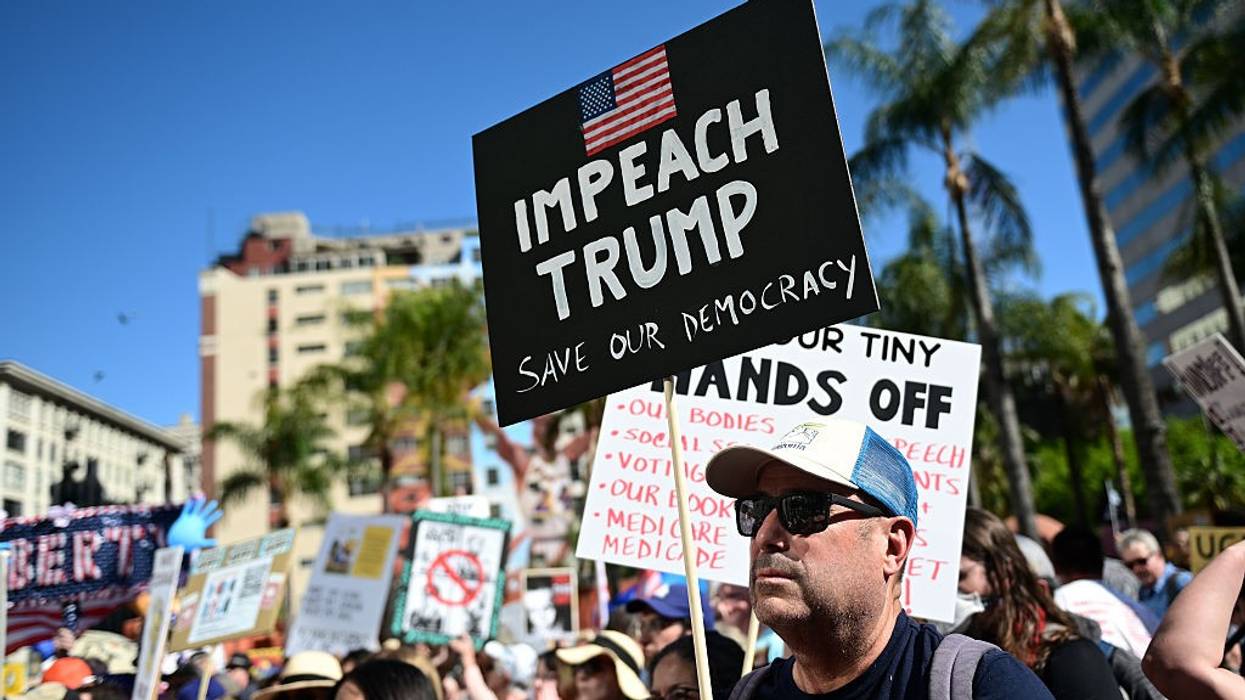
Of all the accountability tools that will be available should the Democrats prevail on November 3, impeachment and court reform stand out as the most powerful.
It’s not enough for the Democrats to win the midterms. Whether they take back one or both chambers of Congress, their overriding objective must be to cripple the remainder of Donald Trump’s presidency and dismantle the MAGA movement he leads. Holding Trump and his key enablers to account for their lawlessness and corruption will be the standard for success. Without accountability, there will be no justice and no end to the growing threat of fascism in America.
Of all the accountability tools that will be available should the Democrats prevail on November 3, impeachment and court reform stand out as the most powerful. Both are implicitly on the midterm ballot, and while neither is a magic bullet for checking Trumpism, they can and must be deployed far more aggressively and urgently than in the past.
The road ahead won’t be easy, but the party may never get another opportunity.
The Supreme Court’s 2024 decision on presidential immunity (Trump v. United States), penned by Chief Justice John Roberts, has made it all but impossible to hold Trump accountable through ordinary criminal prosecutions. As legal analyst Jeffrey Toobin has noted, Roberts’ opinion contains language that “suggests the president cannot even be investigated for his official actions,” much less indicted.
But the immunity ruling in no way undermines Congress’ impeachment powers. Even Trump’s lead lawyer in the case—D. John Sauer, now the administration’s solicitor general—acknowledged the broad scope of the impeachment power, contending that the Constitution’s Impeachment Judgment Clause (Article I, Section 3, Clause 7) requires that a president be impeached by the House and convicted in the Senate before being prosecuted criminally. Although the court rejected Sauer’s prerequisite argument, it recognized, consistent with the views of the Founders, that impeachment is a political process separate and apart from criminal prosecutions.
As Trump’s lawlessness and corruption have become more brazen and unrestrained, appeals for a third impeachment are mounting. In early October, the Philadelphia Inquirer published a series of editorials and op-eds calling on Congress to act in response to the president’s unconstitutional military operations in Iran and elsewhere; his attacks on judges, journalists, law firms, and political opponents; his threats to execute members of Congress; his reckless deployment of Immigration and Customs Enforcement agents; his inhumane mass deportations and detentions; his assault on birthright citizenship; and his use of the presidency for base self-enrichment, among myriad other “high crimes and misdemeanors.”
As Ralph Nader and Bruce Fein put it in their contribution to the Inquirer series, “Trump has turned the Constitution into a museum piece and claimed the infinite unchecked power of a dictator.” In their view, the “doubting Thomases who dismiss” a third impeachment are turning a blind eye to Trump’s “litany” of derelictions.
Even if conviction in the Senate is unlikely, the process itself has enormous value. Writing for LawFare in 2021 at the outset of Trump’s second impeachment trial, Princeton University political science professor Keith Whittington explained:
[R]emoval and disqualification are not the sole purposes of the impeachment clause. The impeachment process is a “grand inquest” in the sense that it is congressional oversight on steroids. The impeachment power gives the first, most democratic branch of the government the ability to scrutinize the actions of individuals in the other branches of government and call them to account for their actions… What’s more, the impeachment process serves as a warning to future officeholders.
There is also no reason for the Democrats to limit impeachment proceedings to the president. The vice president and all civil officers of the United States, including the justices of the Supreme Court, will all be fair game. Aware of his exposure, Defense Secretary Pete Hegseth is reportedly eyeing a Senate seat in Tennessee, hoping that if Marsha Blackburn becomes the state’s next governor, she will appoint him to fill her vacant seat, as senators are not considered civil officers of the US.
Many Trump aides are also reportedly seeking pardons to protect themselves from future federal criminal charges. Trump has expressed a willingness to comply, but the Constitution is very clear that the pardon power does not extend to cases of impeachment.
With the midterm elections behind them and an electoral base demanding action, we could see not one but multiple impeachment inquiries in the House—and, later, trials in the Senate—aimed at airing the facts of the Trump administration’s malfeasance for all the world to see, and serving as a catalyst for legislation to prevent another Trump-like tyrant from rising in the future.
John Roberts and his Republican confederates have issued a blistering succession of reactionary majority opinions, not only on presidential immunity, but also on voting rights, gerrymandering, union organizing, the death penalty, environmental protection, gun control, abortion, affirmative action, campaign finance, the use of dark money in politics, and equality for LGBTQ+ people, to cite just a few of the worst.
Reversing the tide and restoring our rights will require court reform. And while the most far-reaching reforms—such as more justices and term limits—will have to wait until the election of a Democratic president, a new Democratic Senate majority will be able to immediately block the confirmation of any pending or future Trump judicial nominees.
Clarence Thomas, 78, and Samuel Alito, 76, are the Supreme Court’s oldest members. Both are far beyond their salad days, and Alito has said that he is considering retirement before Trump leaves office. If either or both step aside while the Republicans hold the Senate, Trump will undoubtedly replace them with younger and possibly even more extreme jurists, such as James Ho of the 5th US Circuit Court of Appeals, or the obsequious Florida US District Court Judge Aileen Cannon, who killed the Mar-a-Lago documents case. If the Democrats retake the upper chamber, the two senior justices will likely hang on as long as they can, but neither will outlast the term of the next Democratic president, who can replace them with liberals.
The outlook for the lower federal courts, where the vast majority of cases are decided, is even more favorable. A Democratic Senate majority should mean the end to new Trump judges anywhere in the country.
Nothing is certain in politics, and it is entirely possible that the Democrats, once back in the majority, will try to mend fences with their MAGA adversaries in a futile attempt to restore the status quo ante Trump.
This is where we come in.
Voting is essential, but it cannot be the end of our political engagement. After the midterms, and throughout the run-up to 2028, we will need to keep the pressure on. We cannot allow the Democrats to chicken out, as they have so often in the past. There can be no more Biden nice guys, and no more Merrick Garlands. We have seen that movie before, and it isn’t worth a sequel.

Just because a woman is brown and Muslim, or just because the man being abused is Palestinian, does not mean their pain should be ignored by the mainstream feminists of today.
I came across a tweet recently that reads: "Reminder that rape is used a weapon of war on a regular basis because it is one of the most demoralizing, terrifying, and life-changingly traumatic things that can happen to a human being."
This post was in light of the gruesome sexual assault case coming out of Cornell University, and it really stuck with me. I've spent the past few years reading and talking about the experiences of Palestinians as they face every kind of abuse from Israeli soldiers and settlers. It is not lost on me that the vehicles used by the patriarchy to suppress women, like rape, are unfortunately present in every aspect of our society—the same society that has manufactured consent for a genocide in Palestine. From college campuses to Palestine, we are seeing sexual and gendered violence being intentionally used to strip human beings down to the barest parts of themselves.
It is this system of imperial patriarchy that cultivates a world in which two situations are allowed to occur simultaneously: A college girl can be drugged and sexually assaulted for seven hours, and women and men in Palestine can have their bodily autonomy ripped away from them as a tool of genocide. In both cases, the victims have been dehumanized by the outside world to such an extent that they are now an other.
Israel is committing one of the world's greatest acts against feminism right now: dehumanizing Palestinians, men and women both, to such an extreme degree that they are seen as disposable cattle to Israeli soldiers and settlers.
And in both cases, their perpetrators and assailants can leave the crime scene unscathed, with their hands clean.
This summer, the Palestinian Feminist Collective (PFC) released a report on the harrowing sexual and gendered violence Palestinians have faced during 70-plus years of occupation, and increasingly so in the past three years of accelerated genocide. Israel has always treated its military personnel and settlers with impunity, allowing them free rein to sexually torture Palestinians. With extensive evidence, the report concludes that Israel systemically uses sexual violence as a method of genocide.
The stories that are recounted in "A Predatory State," by both Palestinian men and women, are absolutely terrifying. When read all together, the pattern is plain and clear: Israeli soldiers and personnel operate within a dynamic of power where they believe they have complete authority over another human being. This results in gruesome and grotesque behaviors like sexual coercion, assault, harassment, and even enslavement. Palestinians are subjected to these abuses any time Israelis show up to steal their homes, massacre them, and round them up in mass-imprisonment campaigns.
I think of my family members who have lived in Palestine for generations. What have they experienced? What kind of trauma runs through my veins right now, as I am writing this? It is terrifying to know that as a woman in this world, the threat of sexual assault is always there. In Palestine, you can't really avoid it when the perpetrators are at every checkpoint, storming into your house at night, encroaching on your backyards with their illegal settlements, guarding the prisons, and just being everywhere all at once. It's not a matter of if but a matter of when. It also isn't a matter of man or woman, because in reality it happens to both. In a culture that holds modesty as a core value, I can only imagine the emotional and socioeconomic toll sexual violence takes on Palestinian people and their families.
Bell hooks defines feminism as "a movement to end sexism, sexist exploitation, and oppression.” I would think anyone would see this situation and resonate with it as a feminist issue. The ideology is not selective, nor is it performative; it's supposed to be something whole and intersectional. Feminism in practice should advocate for every person affected by the oppressive structures of patriarchy. That being said, you would be surprised at how many feminist and women's organizations act otherwise.
The Western feminist space has become one where optics are the only thing that matters. These "feminist" organizations operate as an institution for the institution, yet they brand themselves as global caregivers fighting for gender equality. In reality, they are the fruition of neoliberal co-optation of actual revolutionary ideas. That is why they deem Palestinians as nonhuman, consistently failing to speak up about the sexual and gendered violence they face in genocide. Palestine is too revolutionary for them.
Reading through PFC's report and then researching some of the most influential women's organizations—who have either never said a word about Palestine, despite their decades of existence, or issued a few measly statements here and there—was a painful process. The first target we had identified at CODEPINK was the Center for Reproductive Rights. This global legal organization upholds reproductive and sexual rights for women, not only in courts but also through consultations with other human rights organizations. They are active worldwide, fighting for reproductive and sexual health as a basic human right from the US to Africa to Asia—but somehow Palestine is missing from their picture.
In Palestine, women are facing a maternal health crisis with hardly any functioning hospitals, dangerous sanitation levels, and an overall stressful quality of life. A report was recently published highlighting the unprecedented rise of miscarriages in Gaza under Israel's blockade. In 2022, Gaza reported 57,000 births. In 2024, just one year after Israel's genocidal campaign began, the birth rate in Gaza dropped to a staggering 38,000. Then, from December 2025 to April 2026, in the span of just six months, birth rates in Gaza declined by 67%.
This seems like something the Center for Reproductive Rights should absolutely make noise about, but every single one of our attempts to speak to them has been blocked and ignored. When you look at their board and staff, the answer is pretty clear. When you have an organization run by a culmination of ex-CIA operatives, presidential campaign officials, and venture capitalists, Palestine seems to be the antithesis of the "values" they ascribe to, and the "feminism" they follow.
Israel is committing one of the world's greatest acts against feminism right now: dehumanizing Palestinians, men and women both, to such an extreme degree that they are seen as disposable cattle to Israeli soldiers and settlers. Yet, that does not concern the self-prescribed feminists who work for the state and war economy that is aiding and abetting this tragedy.
I leave Nawal El Saadawi's quote here as a reminder that liberal, white feminism does not seek true liberation for all those the patriarchy oppresses. Just because a woman is brown and Muslim, or just because the man being abused is Palestinian, does not mean their pain should be ignored by the mainstream feminists of today. Feminism is intersectional and whole, and it is beautiful that way. These organizations' hypocrisy in the face of injustice is a horrible stain on the feminist movement. I wish nothing more than for all of us to stand together as women subjected to struggle and scorn against the colonial powers of this world.
“Solidarity between women can be a powerful force of change, and can influence future development in ways favourable not only to women but also to men.”―Nawal El Saadawi, The Hidden Face of Eve: Women in the Arab World
The US National Domestic Violence Hotline can be reached at 1-800-799-SAFE (7233), by texting "START" to 88788, or through chat at thehotline.org. RAINN's National Sexual Assault Hotline can be reached at 1-800-656-HOPE (4673) or by texting "HOPE" to 64673. Both offer 24/7, free, and confidential support. DomesticShelters.org has a list of global and national resources.

In the coming months, Hakeem Jeffries and others like Rahm Emanuel and James Carville may discover a growing canyon between their direction for the party and a Democratic base increasingly friendly to democratic socialism and impassioned for Medicare for All.
The energy and votes unleashed this year by the insurgent new left of the Democratic Party would surely be welcomed by the Dems’ leadership after a long hangover from 2024 and setbacks at the hands of President Donald Trump, right?
Not exactly. These developments are viewed as anything but good news by many members of the party elite. Hakeen Jeffries (NY), in line to become Speaker of the House if Democrats prevail November 3, refused to endorse Zohran Mamdani last year even after he won the Democratic Party nomination in New York City. In Michigan, Jeffries had endorsed Senate candidate Haley Stevens, a big recipient of American Israel Political Action Committee (Jeffries himself has been a beneficiary of AIPAC), over the staunchly progressive Abdul El-Sayed, who won the primary. These choices were consistent with Jeffries’ history of hostility to progressives in the Democratic Party.
Over the last year, primary victories by progressives have given Jeffries much more to worry about. While there has been a general growing upsurge in support for Democratic candidates, much of the drive has been fueled by the left wing of the party. The Democrats have witnessed something of a rebirth charged by youthful, notably progressive momentum . While Democrats including moderates have gained ground in both special elections and primaries, the electoral strength of left-wing candidates has become a growing trend. From the election of New York Mayor Zohran Mamdani in 2025 to primary and special-election victories won by avowedly left-of center candidates this year, there is now a significant activated progressive core within the Democratic Party.
But Carville is correct on one point: Jeffries will encounter resistance from new House members wary that he will deeply alienate the electorate with tepid reforms that fail to produce tangible improvements in voters’ lives.
A number of the candidates are closely affiliated with the Democratic Socialists of America (DSA), others are independent progressives, and a much larger number are firmly committed to fighting for a Medicare for All healthcare plan. This trend reflects a broader, momentous shift to the left within the Democratic base. Democratic socialists make up only a minority, but they have earned a recognized place in the party. Recent polls from CBS News and The New York Times found that roughly 58-66% of Democrats view socialism positively, with that number rising to 70% in a ABC News/Washington Post/Ipsos poll conducted this month. CBS News polling revealed about 60% of Democrats favor a mix of socialism and capitalism.
But evidence of this relatively recent turn in the outlook of the Democratic base is only perceived as deeply disturbing by Jeffries and others like former Chicago Mayor Rahm Emanuel and James Carville, an influential Democratic strategist. Fittingly, Jeffries’ statement on democratic socialism and presumably DSA in particular projected no welcoming for an energetic, youthful element of the party: “There will never be a moment where I bend the knee to hard-left democratic socialism.” In this comment, Jeffries deploys a trope that DSA-backed candidates are somehow “hard-left” extremists fixed on espousing far-out symbolic views rather than winning substantial reforms at every level of government. In fact, the DSA-affiliated candidates and officeholders are pursuing broadly-shared progressive aims like taxing billionaires, sharply raising the minimum wage, providing universal childcare, and legislating a Medicare for All healthcare system.
On Medicare for All, Jeffries’ evident lack of support places him far outside the Democratic mainstream. At a 78% level of support, the base of the Democratic Party ardently backs a Medicare for All system that would largely replace large insurance corporations with a government-administered system as in Canada. A national Data for Progress survey found 65% of all voters support a Medicare for All system, including 71% of independents, and 49% of Republicans.
For the next Congress, Jeffries will be swimming against the tide on Medicare for All, as it is all but certain to become a pressing issue in the face of rising public concern over healthcare, which is already one of voters’ top affordability concerns and will become more sharply climbing as employers are aggressively thrusting rising insurance premiums back onto workers. Further, major cuts in Medicaid are already creating enormous stress for those otherwise lacking conventional insurance, and these reductions will intensify in 2027 when they come fully into effect.
At the same time, Medicare for All is gaining credibility as an alternative to the status quo. An important Yale study calculates that Medicare for All would save the US $1 trillion per year. Further, Medicare for All would save an estimated 114, 000 lives annually as the 27 million currently uninsured finally gain timely access to care.
Former Chicago mayor and diplomat Emanuel, a potential 2028 presidential contender, is another leading force who characterizes DSA and progressives as extreme and fiercely opposes Medicare for All. He told MS NOW that he believes that DSA simply has no place in the Democratic Party.
Emanuel, like Jeffries and several other figures in the Democratic establishment, caricatures DSA based on the most fanciful elements of DSA’s official long-term “agenda.” But that agenda is almost uniformly ignored by DSA officeholders, candidates, and local chapters alike. Still, Emanuel spotlights.impossible-to-achieve points on the agenda (e.g., abolishing the police and prisons) while ignoring the actual work of DSA conducted by officeholders like Mamdani, Rep. Alexandra Ocasio-Cortez (D-NY), and many others, and DSA chapters across the nation working on the minimum wage, taxation of billionaires, and well-funded public services—an agenda far different from Emanuel’s fixation on the much-derided sweeping privatization of services and sell-off of resources while mayor of Chicago.
Emanuel, who dismissed DSA on MSNOW TV as "an Ivy League seminar,” in reality seems less troubled by DSA’s meaningless long-term “agenda” than the more concrete programs that a new band of left-wing members will bring to the next session. Emanuel, for example, is singularly focused on repudiating the idea of Medicare for All legislation, which will gain a substantial influx of support if progressive candidates prevail in the midterms.
But the most ferocious voice excoriating the Democrats’ Left has been Carville, the long-time Democratic strategist. Carville describes DSA and the progressives as “over-educated little white turds,” conveniently ignoring the high-profile people of color within the progressive coalition, including, for example, Latina primary winners for the House from New York and a new House member from New Jersey. Carville has been unwilling to acknowledge the prominence of people of color in the democratic socialist camp, like Mamdani; Ocasio-Cortez; recently-elected US Rep. Analilia Mejia of New Jersey; and House candidates Melat Kiros of Colorado, Claire Valdez and Darializa Avila Chevalier in New York City, and Donavan McKinney in Michigan, the last two defeating entrenched incumbents in their primaries.
Escalating his attempts to alienate Blacks from DSA and the left wing of the party, Carville lashed out at DSA, claiming, “They think that Lenin was a more glorious human being than Martin Luther King or Frederick Douglass. That's what they really think.” Of course, Carville somehow manages to overlook the fact that King himself considered himself a democratic socialist, as did other key Black giants like A. Phillip Randolph.
But nothing tops Carville’s comment earlier this month in which he actually expresses more fear of DSA and the left than having far-right Speaker Mike Johnson (R-La.) continuing in his post. The searing hostility of Carville toward the Democrats’ left was evident in The Bulwark Takes podcast: "I would be disappointed if it [the midterms] comes in at 225 House seats. And that would almost be—I would rather the Republicans keep the House by five than the Democrats win by five because if that happens, they're hostage to the DSA," Carville said. "Like Hakeem cannot move. There's no place for him to go." Whether meant even partly in jest, Carville displayed the venom gathering against the left electoral successes.
But Carville is correct on one point: Jeffries will encounter resistance from new House members wary that he will deeply alienate the electorate with tepid reforms that fail to produce tangible improvements in voters’ lives. Media accounts report that Jeffries has no visible challengers to becoming speaker, but he will surely face battles both with increasingly progressive Democrats in Congress and the party base to which they are giving a new voice. “He [Jeffries] needs all of our votes to be speaker,” Chris Rabb, the DSA-backed Democratic nominee in Pennsylvania’s third congressional district, pointedly told The New York Times.
Jeffries has cloaked his conventional centrist politics as simply representing a majority of Democratic voters, while feeling free to lash out at progressives critical of “corporate” members of Congress whose policies align closely with their donors in corporate America: “The extreme left is obsessed with talking trash about mainstream Democrats on Twitter, when the majority of the electorate constitute mainstream Democrats at the polls."
But in the coming months, Jeffries and others like Emanuel and Carville may discover a growing canyon between their direction for the party and a Democratic base increasingly friendly to democratic socialism and impassioned for Medicare for All. Some in the establishment set may be preparing themselves for a battle with the marginal “white turds,” but not a significantly shifting “mainstream” of the party seeking the fighting spirit and visionary reforms offered by the party’s left.

When Trump's DOJ filed a potentially election-blocking lawsuit over the fact that there were two Dan Sullivans running as Alaska Republicans, the Times put its investigative efforts not into Trump’s threat to democracy, but into attempting to document that he might have a point.
We don’t know if there was a second gunman involved in the JFK assassination in Dallas. We do know that there is a second Dan Sullivan running for US Senate in Alaska.
Can you believe it? Two Dan Sullivans? In Alaska? The New York Times is on it.
Dan S. Sullivan is a Republican representing Alaska in the US Senate, facing a strong challenge from former Democratic Rep. Mary Peltola. Her viability in the race is worrying the GOP about the midterms generally—while also, as a pro-oil Democrat, encouraging those in her party who fear it’s moving too far to the left (Politico, 10/28/26).
People outside the snowy state learned about the existence of another Republican on the ballot named Daniel J. Sullivan, Jr.—the state has a multi-candidate ranked-choice system—when President Donald Trump ordered the Department of Justice, as ABC News (10/23/26) reported:
to preemptively file a lawsuit to try to block the certification of the crucial Alaska Senate race if Republican Sen. Dan Sullivan loses, citing name confusion among the candidates.
This struck many as a sign, as Time (10/28/26) put it, “that the midterm elections could face unprecedented interference by federal authorities.” The last time Trump won a major election, he instigated an insurrection to try to block certification of his opponent’s victory. His threat to annul the voting result in Alaska suggested that he was going to similarly reject the results of the 2026 midterms.
But The New York Times put its investigative efforts, not into Trump’s threat to democracy, but into attempting to document that he might have a point.
The New York Times produced an in-depth report (10/28/26) headlined “Inside Democrats’ Secret Effort to Stack Alaska’s Ballot.” The subhead: “Operatives aligned with Mary Peltola, the Democratic nominee for Senate, spent months recruiting candidates to peel votes from Senator Dan Sullivan, the Republican.”
The meat of the piece, by Times political reporter Kellen Browning, was this:
The Peltola campaign has repeatedly denied any involvement in [Daniel J. Sullivan’s] candidacy. But the Times has found, based on interviews and text messages, along with documents prepared for a potential lawsuit against the campaign, that not only did Ms. Peltola’s team work with people trying to recruit Mr. Sullivan to run for Senate, but the effort was much broader. The group worked to coax other would-be spoilers into the race, to dilute the incumbent’s support and help catapult the Democrat to victory.
Anyone who follows US elections closely knows that spoilers are a part of politics. Sometimes campaigns will quietly help third-party candidates from the opposite end of the political spectrum in hopes that they’ll siphon votes from their major rival (Fortune, 9/2/24). And other times they recruit candidates with a look-alike name in hopes that some voters will check the box next to the wrong candidate.
According to Ballotpedia, “28 states had at least one 2026 race between candidates that share the same last name.” In 1998, who did Georgia Republicans find to challenge civil rights hero and then-Democratic Rep. John Lewis? Another guy named John Lewis.
The Brookings Institution (10/28/26) recalled when John F. Kennedy first ran for Congress:
One of Kennedy’s opponents was an Italian-American Boston city councilor named Joe Russo. Kennedy’s father, Joe, set about to confuse voters by allegedly paying another Joe Russo, a janitor with no political experience, to run on the primary ballot as well—in hopes of splitting the Italian vote. As it turned out, it wasn’t necessary to get the other Joe Russo into the race—Kennedy won the primary by a large margin.
While not a particularly honorable campaign tactic, recruiting a candidate with a confusing name is not a crime. In fact, The New York Times admits:
Ballot-stacking tactics are common in politics and generally considered legal—and have been employed by both parties in Alaska. But this operation, which has not been reported before, reveals the lengths to which Democrats went to seek advantage in a Senate race that could determine control of the chamber.
So these tactics are “common,” and “legal,” but also reveal “the lengths” Democrats are willing to go to win a historic midterm election? Common, legal lengths?
The paper also said that “Alaska’s voting system makes it especially easy to add spoilers to the ballot,” which “allowed Mr. Sullivan of Petersburg, a longtime supporter of Ms. Peltola and other Democrats, to land a spot on” the ballot. It continued, “Republicans have also taken advantage of this system,” noting that when Peltola “ran for re-election to the House two years ago, the state Republican Party backed an effort to help a Democrat—an inmate who ran his campaign from a New York prison—stay on the ballot.”
While the article does lay out the drama of how Democrats seized an opportunity to make the election messier for the incumbent, the Times doesn’t ever make a case that Democrats broke the law.
You know what is a crime? Annulling an election so that the candidate who wins the most votes can’t take office. Though Trump administration officials had already announced an intent to commit that crime, The New York Times report seemed tailor-made to abet their efforts.
Predictably, Republicans seized on the Times investigation to lend legitimacy to Trump’s election-threatening efforts. Trump himself called for Peltola “to drop out of the race and be criminally prosecuted,” the New York Post (10/28/26) reported; it quoted the president, “They said they didn’t do it, and they did do it, and they got caught.” The tabloid explained:
Top aides of Peltola were behind the recruitment effort, The New York Times reported. She had originally denied any involvement, but Wednesday’s shock report revealed she was “definitely aware” of the scheme.
Wall Street Journal editorial board member Kimberley Strassel (10/28/26) explicitly cited the Times report as an after-the-fact justification for Trump’s election-nullification plan:
When the Justice Department sued Alaska over its manipulated Senate ballot, liberal shrieks could initially be heard up to the Arctic. They’re fading now, after The New York Times on Wednesday published evidence that Democrats rigged Alaska’s ranked-choice ballot with a decoy candidate who threatens to deny Republican Sen. Dan Sullivan re-election.
The National Review‘s Michael A. Fragoso (10/28/26) also relied on the “bombshell New York Times report” to bolster his argument that the recruiting a same-named candidate was “different from lawful trickery.” The second Sullivan, Fragoso argued, is “designed to take voters who intend to vote for the incumbent and trick them into not doing so even though they want to.”
Tell that to Florida Democratic voters who were deceived into voting for Pat Buchanan for president with maldesigned ballots in 2000, an incident that helped usher George W. Bush into the White House without a popular mandate (American Political Science Review, 12/01).
The New York Times investigation prompted state officials as well as the feds to target Peltola (AP, 10/29/26). Alaska Gov. Mike Dunleavy, a Republican, announced that he had ordered an investigation into whether Peltola should face civil or criminal penalties, saying that the Times report
reveals disturbing new evidence of an organized effort to manipulate Alaska’s elections by recruiting candidates—including one with the same name as an incumbent US senator—to deliberately confuse voters and misdirect their votes.
Times editors had to have known that this article would be a gift to an administration that claims Democratic wins are not legitimate, and that the very notion of Republican losses can only be explained by complicated election rigging rather than not getting enough votes (New York Times, 8/20/26, 10/17/26, 10/25/26, 10/27/26, 10/27/26).
If the Times had found potential wrongdoing by Alaska Democrats, that would have been a necessary story for readers. This, however, is a long-read about the usual shenanigans of US electoral politics. It doesn’t add to our understanding of politics, nor is it especially damning in the bigger context.
It is mildly entertaining, for sure, but the biggest impact this investigation will have is providing more justification for an authoritarian administration that already has plans in place to shut down democratic outcomes.

The ultimate betrayal will be if AI succeeds in making America vastly wealthier while leaving working Americans with less economic security, less political power, and with the bill for another generation of financial speculation wiping out our retirement accounts.
The AI bubble and it’s possible disintegration gives us some pretty grim insights into the question of what happens when the richest people in the world rebuild the economy in a way that it no longer needs working people, but still expects them to pay their bills.
Reuters reported this week that China’s AI and semiconductor stock boom has suffered a sudden and staggering reversal: Their STAR50 index of Beijing’s AI and chip champions (like our NASDAQ) has plunged 40% in less than four months, wiping out roughly $480 billion in market value.
Their robotics company Unitree's IPO just three months ago was oversubscribed 8,000 times by Chinese small investors and has lost half its value. Dong Baozhen, a Beijing fund manager, told Reuters:
And now we see the bubble bursting.
The same day (Monday) here in America Microsoft offered voluntary buyouts to 60,000 employees, about 27% of its global workforce, as it’s planning to replace them with AI. And when Anthropic (Claude) filed to go public, they disclosed an $80.7 billion net loss and some $657 billion in infrastructure deals with companies including Microsoft, Amazon, and SpaceX; fully $498 billion of that is noncancelable even if the company never uses the computing capacity it’s reserved.
Things got even weirder on Wednesday, when Microsoft and Alphabet reported some striking “earnings” numbers. Alphabet burned through $9.1 billion in free cash flow for the second straight quarter. NPR’s 1A tallied up Monday’s AI deals alone at roughly $235 billion, nearly 1% of American GDP, all in just one single day.
While Wall Street has been pouring massive sums into AI companies, data centers, chips, and power infrastructure, Economist Dean Baker reports at his weekly AI Bubble Monitor that CoreWeave’s debt (the company rents computing power to the AI giants) is now considered so deep in junk bond territory that they’re having to pay 16% interest on their long-term debt to get investors to bite.
In 1965, Intel co-founder Gordon Moore postulated that every two years the number of transistors in an integrated circuit would double. Not only was his “Moore’s Law” right, but as the power of digital hardware increases, costs also reliably drop by a similar factor.
Most of today’s frenzy of data center and power plant construction is based on the current state of the AI chip-and-software art, but Moore’s Law dictates that over time—and not a lot of time, probably just a matter of months or years at the most—the size and power needs of these AI data centers will decrease exponentially.
Already, entire buildings filled with computers are on the verge of being replaced by a single “wafer” disc that will carry the computing power of billions of today’s red-hot chips. The Wall Street Journal broke the news with an article titled and subtitled:
The Microchip Era Is About to End. The future is in wafers. Data centers will be the size of a box, not vast energy-hogging structures.
Author George Gilder noted we’re not just on the verge of the breakthrough; it’s nearly in production:
Cerebras of Palo Alto, Calif., used the concept in its WSE-3 wafer-scale engine. The WSE-3 boasts some four trillion transistors—14 times as many as Nvidia’s Blackwell chip—with 7,000 times the memory bandwidth. Cerebras inscribed the memory directly on to the wafer rather than relegating it to distant chips and chiplets in high-bandwidth memory mazes. The company stacked up its wafer-scale engines 16-fold, thereby reducing a data center to a small box with 64 trillion transistors.
A data center—a 700,000 square-foot building drawing gigawatts of electricity and chugging millions of gallons of water for cooling—replaced by “a small box” that could be powered by rooftop solar and a good battery bank.
Meanwhile, multiple companies have rolled out AI products that can run on a desktop PC, eliminating the need for data centers altogether. Perplexity introduced one just last month with the headline:
Perplexity Computer now runs fully local on Mac.
Ya think that may have an impact on our economy?
Places booming today as AI and other data facilities and the power plants and transmission lines to feed them are being built—if Moore’s Law applies to data centers as it has proven to apply to all things digital from computers to cell phones to TVs and satellites—will soon look like Flint, Michigan when Ronald Reagan’s free trade policies began to seriously bite in the 1990s.
It sure looks like we’re seeing a repeat of previous bubbles and bursts ranging from Dutch tulips to the 19th century railroads to this century’s dot-com and home mortgage collapses. And the people running the show seem just fine with creating a world where the rich get mindbogglingly richer while working people and 401k investors are out on the street.
JD Vance’s sugar daddy, Peter Thiel, wrote in a 2009 essay for the Cato Institute that “I no longer believe that freedom and democracy are compatible.” Marc Andreesen, the billionaire who helped Elon recruit young men for DOGE to take apart our government, complained on a podcast this year that government workers have both civil service protections and public-sector unions, giving them “two layers of insulation against ever getting fired.”
Unions, of course, are actual democracy in the workplace that generations of workers have literally fought and died for, but these guys don’t seem to appreciate or even understand that.
Meanwhile, OpenAI CEO Sam Altman wrote in a 2021 essay that as AI advances, “even more power will shift from labor to capital.” His warning points out how easily AI could dramatically increase the power of people who own businesses and tech while gutting the bargaining power of people who work for a living.
And, indeed, that’s already happening. Like Microsoft this week, Amazon has cut roughly 30,000 corporate jobs since last October, all after CEO Andy Jassy warned his employees that AI would “reduce our total corporate workforce.” One AI-related layoff tracker counts nearly 119,000 layoffs so far this year tied explicitly to AI automation, roughly four and a half times last year’s total.
And now the robotics business is exploding, with AI built into local machines that can assemble cars, sew clothing, clean streets, and drive you around town. It’s opened an entirely new industry: outfitting humans with sensors to track their movements to train robots to replace them.
So, if machines replace our workers, who’s going to have enough money to buy the goods and services the machines are putting out?
I grew up in a union family; my dad worked in a tool-and-die shop in Lansing, Michigan and was able to raise four boys with a three-bedroom home, a new car every few years, and had a decent retirement. Henry Ford increased his workers’ pay so they’d be able to buy the cars they were making.
This isn’t rocket science. Workers are also customers, taxpayers, homeowners, and parents; they’re the ultimate economic base of their communities. If AI destroys their purchasing power, we’re gnawing away at the foundation of America’s historic economic greatness.
We’ve seen versions of this before.
Reagan deregulated the Savings & Loan industry leading to predatory behavior that produced a massive crash; it cost taxpayers over $100 billion to clean up the mess (a trillion in today’s money). But Reagan also sent those banksters to prison: His regulators made more than 30,000 criminal referrals to the Justice Department, which won more than 1,000 felony convictions.
Since then, times have changed; it appears that the morbidly rich have acquired near-total immunity, no matter how badly they screw up things, because five corrupt Republicans on the Supreme Court legalized billionaires and corporations owning judges and politicians.
Congress and Bill Clinton deregulated our banks in the late 1990s and the bill came due in 2008 when it all fell apart and millions of Americans lost their homes, families watched retirement accounts evaporate, and workers who’d done absolutely nothing wrong lost their livelihoods.
Nepo-baby George W. Bush chose to hold nobody accountable, and even let the banksters keep their billion-dollar bonuses pulled out just before all the dominoes collapsed. He made zero criminal referrals against the big banks, in a crisis that was 70 times larger than Reagan’s S&L mess.
It appears that the AI gods tech bros think that’s the new normal and are betting on getting the same or better from the Trump regime. After all, in his first term he put “Foreclosure King” Steve Mnuchin, who’d thrown an estimated 36,000 Californians out of their homes during the 2008 crash, in charge of the entire economy as Treasury Secretary.
And this time the stakes are even larger than the banking system’s freeze-up; AI is now deeply entangled with America’s military, intelligence agencies, national security infrastructure, and the rivalry with China.
And in their arrogance, they’re saying the quiet part out loud: Last November, OpenAI’s chief financial officer, Sarah Friar, told a Wall Street Journal conference that her company wanted a federal “backstop” for the financing behind its data centers. When a reporter asked whether she meant a government guarantee, she answered, “Exactly.”
And pouring gasoline on this particular bonfire, President Donald Trump’s One Big Beautiful Billionaire’s Bill lets these companies write off the full cost of their data center hardware the year they buy it rather than the normal depreciation schedules every other industry in America has to stick to.
Perhaps that’s because the Trump family is so well-invested now in this, and he’s depending on tech bro billions to keep Republicans in office; Elon alone is spending almost a half-billion so far this year to that end.
Meanwhile, ordinary Americans are already paying. Residential electricity prices rose 6.9% last year, more than double the inflation rate, and Goldman Sachs’ analysts say they expect data centers to drive a massive 40% of electricity demand growth through the end of the decade.
The 13 mid-Atlantic and Midwest states have been hit with $23 billion in consumer electricity price increases through at least 2028, driven by AI data centers. A homeowner in Manassas, Virginia opened a $281 electric bill in January, up from about $100 the month before.
If today’s boom goes bust, who’s going to be left stuck with the bills for the half-built transmission lines, data centers, and power plants? Apparently it won’t be the morbidly rich tech bro masters of the universe, any more than it was Bush’s billionaire bankers.
None of this is to diminish the power and importance of AI. But the internet was real, too, and look what happened in the 1999-2002 period when that industry took down people’s retirement accounts while creating billionaires out of Zuck, Bezos, and Gates.
In 1983, Reagan instructed his Department of Justice, Federal Trade Commission, and Securities and Exchange Commision to stop enforcing the Sherman Anti-Trust and other anti-monopoly laws, leading to a decade of “Mergers & Acquisitions Mania” as was documented in Michael Douglas’ “greed is good” movie, Wall Street.
Add that to Reagan decriminalizing share buybacks and you have the perfect storm of perverse incentives that end up with doors falling off airplanes, workers and communities being screwed, and a new low standard of crappy customer service—all fed by a lack of competition. And we see that consolidation now happening in AI.
This is what happens when the people who own the machines accumulate more economic—and, thus, political—power than the people who depend on wages. It’s the old question: “Is the economy here to serve us, or are we here to serve the small number of mostly white men who control the economy?”
The AI revolution is going to force that debate back into the open.
The ultimate betrayal will be if AI succeeds in making America vastly wealthier while leaving working Americans with less economic security, less political power, and with the bill for another generation of financial speculation wiping out our retirement accounts.
If that happens, we need to be ready to force the issue of the concentration of wealth and power that grew up around it. We failed with the internet giants in 2000 and the banksters in 2008. We need to prepare—politically and economically—for the next cycle of boom and bust that’s increasingly seeming inevitable.