SUBSCRIBE TO OUR FREE NEWSLETTER
Daily news & progressive opinion—funded by the people, not the corporations—delivered straight to your inbox.
5
#000000
#FFFFFF
To donate by check, phone, or other method, see our More Ways to Give page.
Daily news & progressive opinion—funded by the people, not the corporations—delivered straight to your inbox.
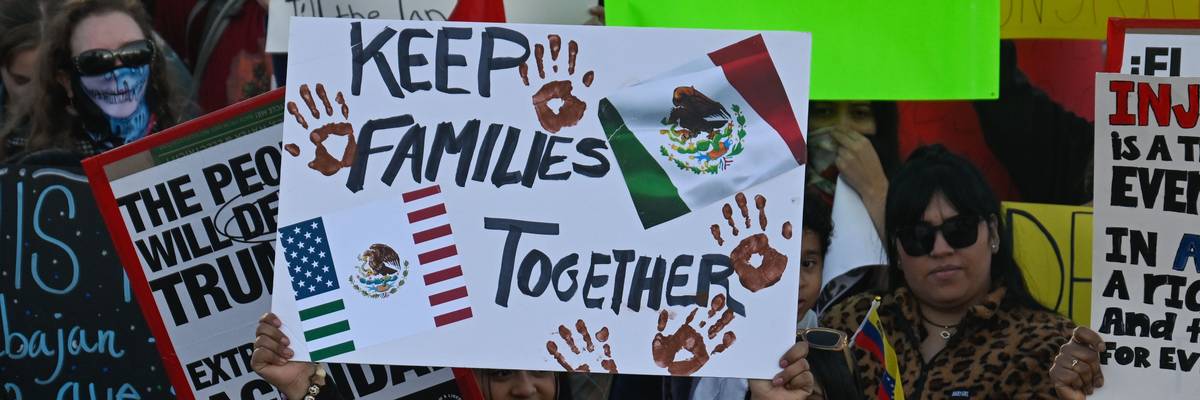
Hundreds of people carrying banners and flags gather to protest against US President Donald Trump's immigration policies and march for freedom to defend immigrant families in Charlotte, Carolina, United States on February 1, 2025.
The 2026 midterms are about more than congressional majorities; they are an opportunity for Americans to hold their representatives accountable and decide whether fear should remain an instrument of government.
The grandfather of the current president of the United States, Friedrich Trump, arrived penniless from Germany at the age of 16 in 1885. He worked as a barber in New York before heading west, eventually opening a restaurant in a mining town. Like so many immigrant stories, his is unremarkable in one sense, and quintessentially American in another. It reminds us that history often looks different when viewed from a distance.
Today, however, history is being written in real time. And the images now emerging from the United States tell a troubling story.
Across many American cities, armed and masked Immigration and Customs Enforcement (ICE) agents are conducting highly visible raids. Videos show people being detained in the streets, families disrupted, and communities thrown into fear. Other footage captures American citizens confronting federal agents in their own neighborhoods amid tear gas, pepper spray, and rubber bullets. These scenes dominated evening news broadcasts not only in the United States, but in Europe and elsewhere. Footage related to the fatal shootings in Minneapolis spread globally. Now, California’s Central Valley faces raids and accusations of voter intimidation ahead of Tuesday’s elections. They project an image of a nation in distress, one in which fear appears to be overtaking everything.
The nation’s greatness has always rested on the idea that people from every corner of the world came here to live under the same laws, to contribute, to succeed, and—eventually—to become citizens.
Some of these encounters raise serious constitutional questions. When force is used during immigration enforcement actions, concerns arise about the Fourth Amendment’s protections against unreasonable searches and seizures, the Fifth Amendment’s guarantee of due process, and the First Amendment rights of citizens who protest in public spaces. These are not abstract legal matters. They go to the heart of what it means to live under a constitutional democracy.
Why are so many people willing to stand in the streets to protect their neighbors? Because those neighbors are deeply woven into the fabric of American life. Undocumented immigrants often perform jobs that others are unwilling to take: picking apples, tending livestock, washing dishes, cleaning hospitals, and caring for the elderly. They work hard, pay taxes, and spend money in local economies. Economist Paul Krugman has noted that immigrants played a critical role in stabilizing the US economy after the pandemic, continuing essential work when much of the country shut down. Have we already forgotten that?
Most Americans either descended from immigrants who once lacked legal status or know family stories that began that way. This country has always been a mosaic of people who arrived with little, worked relentlessly, and eventually earned not only stability but admiration. They learned to love this land. Many still feel a surge of pride when they hear the national anthem or see the Stars and Stripes.
That is why what is happening now should concern all of us. Fear is spreading through immigrant neighborhoods—fear of going to work, going shopping, seeing a doctor, even answering the door. Parents worry about what will happen to their children. Communities are learning to live with the anxiety that a knock at dawn could change everything.
History teaches us that when societies normalize fear directed at a particular group, the consequences are rarely confined to that group alone. The United States has long defined itself by its rejection of such thinking. Dystopian novels were not written as instruction manuals, but as warnings to recognize the early signs of authoritarian drift and stop it.
As America celebrates the ongoing 250th anniversary year, it should be recommitting itself to the ideals articulated in 1776: liberty, dignity, and equal protection under the law. The nation’s greatness has always rested on the idea that people from every corner of the world came here to live under the same laws, to contribute, to succeed, and—eventually—to become citizens.
Thus, America must find the courage to honor its own history. That means recognizing the contributions of immigrants, including undocumented ones; rejecting policies that force people into hiding like thousands of Anne Franks; and pursuing reforms that help them obtain citizenship and integrate them into civic life. In doing so, the nation would not only honor its founding principles, but also the generations of immigrants—like Friedrich Trump—who believed in America enough to come here with nothing and help build it.
The 2026 midterms are about more than congressional majorities. They are an opportunity for Americans to hold their representatives accountable and decide whether fear should remain an instrument of government. They offer Americans an opportunity to remember those who made America their home but now live in constant fear.
After all, a president may wear many hats—or, in Trump’s case, many MAGA baseball caps—but no president should forget that his own family has an immigrant past. And that includes immigrant brides. How America treats immigrants ultimately reflects what kind of country it chooses to be. It is hubris to treat immigrants badly.
This country and this world are at a monumental crossroads. US voters have an opportunity to beat back the forces of fascism and confront the billionaires who are rigging the economy, our media system, and our democracy, making it increasingly impossible for ordinary people to get by. We’re not just talking about the election. We’re talking about what must be done once these fascist elements are vanquished from power. We need a bolder set of solutions than what either major party has so far been willing to offer and a working-class movement ready to fight like hell for it. Trump didn't emerge from nowhere. The conditions that fueled MAGA authoritarianism were created by decades of radical neoliberal economic policies and a corrupt political system dominated by corporate interests. They slashed taxes on the super-rich, promising that the benefits would trickle down. They said giveaways to the corporate titans would make life more affordable for the rest of us. It was all bullshit. And when a bitter, betrayed populace searches for someone to blame, right-wing demagogues have little trouble finding scapegoats. People know when they're being lied to, but you won't hear any of this from the corporate media. Only independent journalism—powered and funded by people who believe in building a better world—can deliver truly trustworthy daily news. If you share our vision, please contribute whatever you can to sustain our work. |
The grandfather of the current president of the United States, Friedrich Trump, arrived penniless from Germany at the age of 16 in 1885. He worked as a barber in New York before heading west, eventually opening a restaurant in a mining town. Like so many immigrant stories, his is unremarkable in one sense, and quintessentially American in another. It reminds us that history often looks different when viewed from a distance.
Today, however, history is being written in real time. And the images now emerging from the United States tell a troubling story.
Across many American cities, armed and masked Immigration and Customs Enforcement (ICE) agents are conducting highly visible raids. Videos show people being detained in the streets, families disrupted, and communities thrown into fear. Other footage captures American citizens confronting federal agents in their own neighborhoods amid tear gas, pepper spray, and rubber bullets. These scenes dominated evening news broadcasts not only in the United States, but in Europe and elsewhere. Footage related to the fatal shootings in Minneapolis spread globally. Now, California’s Central Valley faces raids and accusations of voter intimidation ahead of Tuesday’s elections. They project an image of a nation in distress, one in which fear appears to be overtaking everything.
The nation’s greatness has always rested on the idea that people from every corner of the world came here to live under the same laws, to contribute, to succeed, and—eventually—to become citizens.
Some of these encounters raise serious constitutional questions. When force is used during immigration enforcement actions, concerns arise about the Fourth Amendment’s protections against unreasonable searches and seizures, the Fifth Amendment’s guarantee of due process, and the First Amendment rights of citizens who protest in public spaces. These are not abstract legal matters. They go to the heart of what it means to live under a constitutional democracy.
Why are so many people willing to stand in the streets to protect their neighbors? Because those neighbors are deeply woven into the fabric of American life. Undocumented immigrants often perform jobs that others are unwilling to take: picking apples, tending livestock, washing dishes, cleaning hospitals, and caring for the elderly. They work hard, pay taxes, and spend money in local economies. Economist Paul Krugman has noted that immigrants played a critical role in stabilizing the US economy after the pandemic, continuing essential work when much of the country shut down. Have we already forgotten that?
Most Americans either descended from immigrants who once lacked legal status or know family stories that began that way. This country has always been a mosaic of people who arrived with little, worked relentlessly, and eventually earned not only stability but admiration. They learned to love this land. Many still feel a surge of pride when they hear the national anthem or see the Stars and Stripes.
That is why what is happening now should concern all of us. Fear is spreading through immigrant neighborhoods—fear of going to work, going shopping, seeing a doctor, even answering the door. Parents worry about what will happen to their children. Communities are learning to live with the anxiety that a knock at dawn could change everything.
History teaches us that when societies normalize fear directed at a particular group, the consequences are rarely confined to that group alone. The United States has long defined itself by its rejection of such thinking. Dystopian novels were not written as instruction manuals, but as warnings to recognize the early signs of authoritarian drift and stop it.
As America celebrates the ongoing 250th anniversary year, it should be recommitting itself to the ideals articulated in 1776: liberty, dignity, and equal protection under the law. The nation’s greatness has always rested on the idea that people from every corner of the world came here to live under the same laws, to contribute, to succeed, and—eventually—to become citizens.
Thus, America must find the courage to honor its own history. That means recognizing the contributions of immigrants, including undocumented ones; rejecting policies that force people into hiding like thousands of Anne Franks; and pursuing reforms that help them obtain citizenship and integrate them into civic life. In doing so, the nation would not only honor its founding principles, but also the generations of immigrants—like Friedrich Trump—who believed in America enough to come here with nothing and help build it.
The 2026 midterms are about more than congressional majorities. They are an opportunity for Americans to hold their representatives accountable and decide whether fear should remain an instrument of government. They offer Americans an opportunity to remember those who made America their home but now live in constant fear.
After all, a president may wear many hats—or, in Trump’s case, many MAGA baseball caps—but no president should forget that his own family has an immigrant past. And that includes immigrant brides. How America treats immigrants ultimately reflects what kind of country it chooses to be. It is hubris to treat immigrants badly.