SUBSCRIBE TO OUR FREE NEWSLETTER
Daily news & progressive opinion—funded by the people, not the corporations—delivered straight to your inbox.
5
#000000
#FFFFFF
To donate by check, phone, or other method, see our More Ways to Give page.
Daily news & progressive opinion—funded by the people, not the corporations—delivered straight to your inbox.
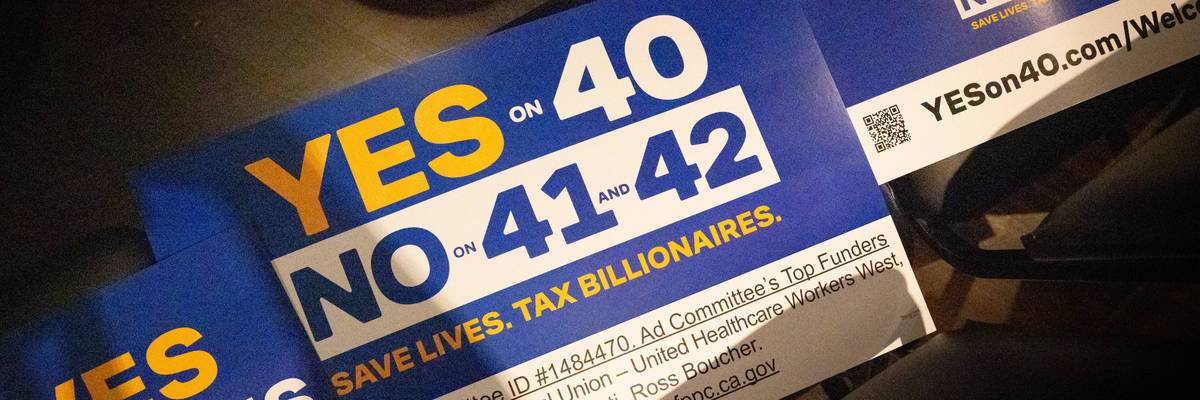
Yes on 40 signs sit on seats at the "Ballots Over Billionaires" rally on Monday, Oct. 5, 2026 in Los Angeles, CA.. Supporters of Prop. 40, which establishes a one-time wealth tax on billionaires, attend the "Ballots Over Billionaires" Rally.
What the midterms could reveal about civic power in this country.
Heading into Tuesday’s midterm elections, the ballot measure landscape reveals a struggle over whether government will respond to people’s needs—and whether communities will retain the power to act through direct democracy when it does not. Economic anxiety, contested rights, and efforts to restrict direct democracy are converging around questions that reach beyond any individual proposal: Who benefits from policy change? Whose priorities will guide government? And what happens when elected officials advance an agenda their constituents reject?
Recent elections suggest that voters are responding to more than a disconnect between their priorities and those of elected officials: they reveal a willingness to take power into their own hands when government fails to deliver. In Oklahoma, voters approved Medicaid expansion in 2020 after years of legislative inaction, using a citizen initiative to secure healthcare access that elected officials had resisted. In Missouri, voters approved Proposition A in 2024 to raise the minimum wage to $15 and establish paid sick leave, translating demands for economic security into a direct policy decision. Voters have also acted to defend their ability to make those decisions: in Ohio’s August 2023 special election, they rejected a legislative proposal to raise the constitutional amendment approval threshold to 60 percent and impose additional petition requirements.
These outcomes do not establish that every voter shared the same motivations, but they demonstrate how communities can pursue change and challenge institutional resistance through direct democracy. In the immediate term, ballot measures can turn that demand into policy. But in the long term, they help build constituencies around concrete solutions and establish priorities that responsive elected officials can carry into their governing agendas. Recent elections suggest that voters are willing to hold politicians accountable for inaction and eager for new leadership who challenge that disconnect. The success of candidates promising concrete economic improvements, the rejection of unpopular legislative proposals, and some incumbent defeats reflect a shared demand for more responsive government. These outcomes do not establish a uniform ideological shift, but they offer a useful lens for understanding Tuesday’s ballot: voters are looking for both economic relief and a greater say in the decisions shaping their lives.
Voters are looking for both economic relief and a greater say in the decisions shaping their lives.
Over the last decade, economic ballot measures have consistently revealed a persistent demand for the government to improve the material conditions of people’s lives. Through proposals to raise wages, expand access to healthcare, and secure paid leave, communities have used direct democracy to pursue economic relief when elected officials have failed to act. These efforts provide an important backdrop for understanding the appeal of campaigns like the one led by New York City Mayor Zohran Mamdani: affordability-centered candidacies reflect demands that voters have long been advancing through the People’s Tool.
Ballot measures are not tools for electing candidates, but they can help create the conditions for more responsive governing. They elevate community priorities, organize constituencies around concrete solutions, and demonstrate public support for policies that elected officials can advance and implement. The connection is not that economic ballot measures successfully elect candidates like Mamdani, but that both reflect a demand for leaders who listen to constituents and use their governing power to deliver tangible improvements. And if they don’t—voters will craft and pass those policies themselves, bypassing unresponsive legislators.
Missouri’s August 2026 election illustrates how similar concerns can produce a decisive “no.” Voters rejected Amendment 5’s proposed income tax overhaul by approximately 83%, amid concerns that eliminating income taxes would expose residents to substantially higher sales taxes. They also rejected Amendment 4, which would have required citizen-initiated constitutional amendments to win majority approval in every congressional district, by approximately 80%. Both defeats represented a sweeping repudiation of major legislative priorities.
Tuesday will test both the demand for policy change and the durability of earlier voter decisions. Reproductive freedom measures in Idaho, Nevada, and Virginia seek to establish or strengthen protections, while Missouri’s proposal would roll back rights voters approved in 2024 while also testing whether to relinquish rights at the expense of banning gender affirming care for minors. These contrasting measures demonstrate that the struggle continues after passage: voters may have to defend a decision they have already made. At the same time, proposals such as Utah’s 60% approval requirement for certain citizen-initiated tax changes would alter their capacity to pursue future solutions.
We must see the emerging connection is between economic security, public power, and democratic accountability. Ballot measures make the distance between legislative priorities and community needs visible. They can also provide a vehicle for closing that distance—especially for people historically excluded from policymaking. Recent results suggest that next Tuesday, voters may reward credible promises of improvement while resisting efforts to shift costs onto them or narrow their governing authority. Whether that resistance consistently produces consequences for elected officials remains an open question.
This country and this world are at a monumental crossroads. US voters have an opportunity to beat back the forces of fascism and confront the billionaires who are rigging the economy, our media system, and our democracy, making it increasingly impossible for ordinary people to get by. We’re not just talking about the election. We’re talking about what must be done once these fascist elements are vanquished from power. We need a bolder set of solutions than what either major party has so far been willing to offer and a working-class movement ready to fight like hell for it. Trump didn't emerge from nowhere. The conditions that fueled MAGA authoritarianism were created by decades of radical neoliberal economic policies and a corrupt political system dominated by corporate interests. They slashed taxes on the super-rich, promising that the benefits would trickle down. They said giveaways to the corporate titans would make life more affordable for the rest of us. It was all bullshit. And when a bitter, betrayed populace searches for someone to blame, right-wing demagogues have little trouble finding scapegoats. People know when they're being lied to, but you won't hear any of this from the corporate media. Only independent journalism—powered and funded by people who believe in building a better world—can deliver truly trustworthy daily news. If you share our vision, please contribute whatever you can to sustain our work. |
Heading into Tuesday’s midterm elections, the ballot measure landscape reveals a struggle over whether government will respond to people’s needs—and whether communities will retain the power to act through direct democracy when it does not. Economic anxiety, contested rights, and efforts to restrict direct democracy are converging around questions that reach beyond any individual proposal: Who benefits from policy change? Whose priorities will guide government? And what happens when elected officials advance an agenda their constituents reject?
Recent elections suggest that voters are responding to more than a disconnect between their priorities and those of elected officials: they reveal a willingness to take power into their own hands when government fails to deliver. In Oklahoma, voters approved Medicaid expansion in 2020 after years of legislative inaction, using a citizen initiative to secure healthcare access that elected officials had resisted. In Missouri, voters approved Proposition A in 2024 to raise the minimum wage to $15 and establish paid sick leave, translating demands for economic security into a direct policy decision. Voters have also acted to defend their ability to make those decisions: in Ohio’s August 2023 special election, they rejected a legislative proposal to raise the constitutional amendment approval threshold to 60 percent and impose additional petition requirements.
These outcomes do not establish that every voter shared the same motivations, but they demonstrate how communities can pursue change and challenge institutional resistance through direct democracy. In the immediate term, ballot measures can turn that demand into policy. But in the long term, they help build constituencies around concrete solutions and establish priorities that responsive elected officials can carry into their governing agendas. Recent elections suggest that voters are willing to hold politicians accountable for inaction and eager for new leadership who challenge that disconnect. The success of candidates promising concrete economic improvements, the rejection of unpopular legislative proposals, and some incumbent defeats reflect a shared demand for more responsive government. These outcomes do not establish a uniform ideological shift, but they offer a useful lens for understanding Tuesday’s ballot: voters are looking for both economic relief and a greater say in the decisions shaping their lives.
Voters are looking for both economic relief and a greater say in the decisions shaping their lives.
Over the last decade, economic ballot measures have consistently revealed a persistent demand for the government to improve the material conditions of people’s lives. Through proposals to raise wages, expand access to healthcare, and secure paid leave, communities have used direct democracy to pursue economic relief when elected officials have failed to act. These efforts provide an important backdrop for understanding the appeal of campaigns like the one led by New York City Mayor Zohran Mamdani: affordability-centered candidacies reflect demands that voters have long been advancing through the People’s Tool.
Ballot measures are not tools for electing candidates, but they can help create the conditions for more responsive governing. They elevate community priorities, organize constituencies around concrete solutions, and demonstrate public support for policies that elected officials can advance and implement. The connection is not that economic ballot measures successfully elect candidates like Mamdani, but that both reflect a demand for leaders who listen to constituents and use their governing power to deliver tangible improvements. And if they don’t—voters will craft and pass those policies themselves, bypassing unresponsive legislators.
Missouri’s August 2026 election illustrates how similar concerns can produce a decisive “no.” Voters rejected Amendment 5’s proposed income tax overhaul by approximately 83%, amid concerns that eliminating income taxes would expose residents to substantially higher sales taxes. They also rejected Amendment 4, which would have required citizen-initiated constitutional amendments to win majority approval in every congressional district, by approximately 80%. Both defeats represented a sweeping repudiation of major legislative priorities.
Tuesday will test both the demand for policy change and the durability of earlier voter decisions. Reproductive freedom measures in Idaho, Nevada, and Virginia seek to establish or strengthen protections, while Missouri’s proposal would roll back rights voters approved in 2024 while also testing whether to relinquish rights at the expense of banning gender affirming care for minors. These contrasting measures demonstrate that the struggle continues after passage: voters may have to defend a decision they have already made. At the same time, proposals such as Utah’s 60% approval requirement for certain citizen-initiated tax changes would alter their capacity to pursue future solutions.
We must see the emerging connection is between economic security, public power, and democratic accountability. Ballot measures make the distance between legislative priorities and community needs visible. They can also provide a vehicle for closing that distance—especially for people historically excluded from policymaking. Recent results suggest that next Tuesday, voters may reward credible promises of improvement while resisting efforts to shift costs onto them or narrow their governing authority. Whether that resistance consistently produces consequences for elected officials remains an open question.