SUBSCRIBE TO OUR FREE NEWSLETTER
Daily news & progressive opinion—funded by the people, not the corporations—delivered straight to your inbox.
5
#000000
#FFFFFF
To donate by check, phone, or other method, see our More Ways to Give page.
Daily news & progressive opinion—funded by the people, not the corporations—delivered straight to your inbox.
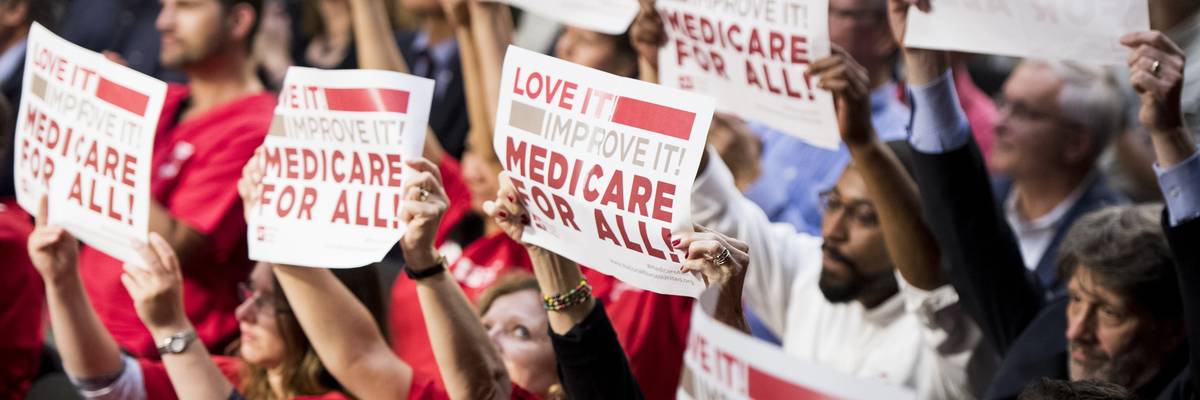
The audience waves signs as Sen. Bernie Sanders (I-Vt.) speaks during his event to introduce the Medicare for All Act of 2017 on Wednesday, September 13, 2017.
The public option is a fantasy solution for real healthcare problems that only single payer can solve.
Americans are discouraged about the state of healthcare in the United States. The “Public Option” has again emerged as a possible solution to our healthcare woes.
There are several different proposals labelled as being “the public option” but, at its core, the public option is a health insurance plan that would be placed side-by-side and would also compete with commercial health insurance offerings, for example on the Obamacare exchanges. While the “public” in public option suggests a Medicare-type administration structure, the public option in some formulations would actually be administered by private insurers.
The public option stands in stark contrast to single-payer plans which cover everyone and eliminate private insurance plans entirely. Single-payer plans are often termed Medicare-for-All and, critically, are based on Medicare rather than on Medicare Advantage plans which tend to be run by private insurers.
Americans had already been dissatisfied with the affordability of health insurance and healthcare in recent years, but the passage of H.R. 1, the “One Big Beautiful Bill Act,” has brought additional pain to Americans. This is due, in part, to the failure of H.R. 1 to extend healthcare subsidies that had previously been in place for individuals and families in the Exchanges. The full toll of H.R. 1 is not yet visible, but marketplace enrollment has dropped in 41 states. For example, North Carolina and Ohio saw declines of 22% and 20%, respectively.
Washington state and Colorado have both created public option experiments, and these experiments have not been very successful in lowering premiums or enrolling significant numbers of people.
Democratic politicians (including Washington Sen. Patty Murray) have touted the public option. Presidential candidate Joe Biden, an opponent of single payer, floated the public option. There is a center created at Georgetown University in 2022 with the explicit option of assisting policy makers in exploring the public option. A number of conservative groups have urged Republican legislators to support the creation of the public option.
Reforms aimed at reversing the healthcare in the US can be judged by examining the extent to which plans fulfill the following criteria: Does the proposed solution
Based on the four criteria outlined above, the public option fails to provide meaningful reform.
Health insurance companies provide NO actual healthcare services on their own. The widely accepted theory is that these companies control healthcare costs by means of gatekeeping, but these companies actually add to healthcare costs by creating an expensive insurance workforce that Americans pay for with premiums. Private insurance also installs a costly workforce in hospitals and doctors’ offices that is dedicated to dealing with and defending against the challenges created by the health insurance companies. These costs are ultimately borne by patients.
Insurance companies are savvy and constantly alter their coverage rules and processes with an eye to maximizing their bottom lines. These companies also try to attract patients who won’t cost them too much and shed those who are expensive. This latter tendency can be expected to persist under a public option system and could doom the entire project (see above).
Because the public option would graft another insurance plan on to an already complicated and expensive coverage system, the public option will not heal and can worsen our healthcare landscape by delaying definitive solutions and by damping enthusiasm for genuine effective reform.
The obvious solution is to remove the health insurance companies from the mix and join the rest of the industrialized Western world in enacting a single-payer system. Returning to the criteria used (above) to measure the public option, a single-payer system would
In a nutshell, this is because a single-payer system refers to a common coverage system that covers everyone equally and whose administration is modelled on classic Medicare. This universal coverage would allow for real negotiating power.
The public option bobs to the surface again and again as a possible solution and a putative viable alternative to a single-payer program as it allows politicians to express concerns about healthcare in a way that does not threaten campaign contributions from insurance companies and Big Pharma.
In so doing, these various advocates have often portrayed single payer as “too radical” or “too impractical” to merit serious consideration
I can credibly be accused of being favorably disposed to single payer. The Mercatus Institute cannot. When this libertarian, Koch-funded, free-market-oriented organization set out to study the cost of a single-payer health system, their data did not discredit the economics of single payer but instead provided evidence that single-payer policies would lower healthcare costs.
In contrast to the views of politicians, ordinary Americans in increasing numbers are reporting that they are in favor of single-payer plans and are dissatisfied both with the cost of coverage and the barriers to care embodied in current health insurance coverage. Tellingly, when even Sarah Longwell of The Bulwark (an organization staffed by former Republicans) gives single payer consideration and predicts movement in the direction of single payer, one can argue that the current healthcare crisis may be creating an increased appetite for meaningful change.
The public option cannot fix our healthcare woes. Moreover, adopting this “solution” has the potential to cause further damage to our healthcare mess. A public option is highly likely to prove fiscally unworkable. The failure of this shiny object to address the very real pain Americans are experiencing will delay consideration of solutions that can work. And, critically, a failure of the public option has the potential to extinguish a collective will to do the hard work of creating a healthcare system that works for all of us.
This country and this world are at a monumental crossroads. US voters have an opportunity to beat back the forces of fascism and confront the billionaires who are rigging the economy, our media system, and our democracy, making it increasingly impossible for ordinary people to get by. We’re not just talking about the election. We’re talking about what must be done once these fascist elements are vanquished from power. We need a bolder set of solutions than what either major party has so far been willing to offer and a working-class movement ready to fight like hell for it. Trump didn't emerge from nowhere. The conditions that fueled MAGA authoritarianism were created by decades of radical neoliberal economic policies and a corrupt political system dominated by corporate interests. They slashed taxes on the super-rich, promising that the benefits would trickle down. They said giveaways to the corporate titans would make life more affordable for the rest of us. It was all bullshit. And when a bitter, betrayed populace searches for someone to blame, right-wing demagogues have little trouble finding scapegoats. People know when they're being lied to, but you won't hear any of this from the corporate media. Only independent journalism—powered and funded by people who believe in building a better world—can deliver truly trustworthy daily news. If you share our vision, please contribute whatever you can to sustain our work. |
Americans are discouraged about the state of healthcare in the United States. The “Public Option” has again emerged as a possible solution to our healthcare woes.
There are several different proposals labelled as being “the public option” but, at its core, the public option is a health insurance plan that would be placed side-by-side and would also compete with commercial health insurance offerings, for example on the Obamacare exchanges. While the “public” in public option suggests a Medicare-type administration structure, the public option in some formulations would actually be administered by private insurers.
The public option stands in stark contrast to single-payer plans which cover everyone and eliminate private insurance plans entirely. Single-payer plans are often termed Medicare-for-All and, critically, are based on Medicare rather than on Medicare Advantage plans which tend to be run by private insurers.
Americans had already been dissatisfied with the affordability of health insurance and healthcare in recent years, but the passage of H.R. 1, the “One Big Beautiful Bill Act,” has brought additional pain to Americans. This is due, in part, to the failure of H.R. 1 to extend healthcare subsidies that had previously been in place for individuals and families in the Exchanges. The full toll of H.R. 1 is not yet visible, but marketplace enrollment has dropped in 41 states. For example, North Carolina and Ohio saw declines of 22% and 20%, respectively.
Washington state and Colorado have both created public option experiments, and these experiments have not been very successful in lowering premiums or enrolling significant numbers of people.
Democratic politicians (including Washington Sen. Patty Murray) have touted the public option. Presidential candidate Joe Biden, an opponent of single payer, floated the public option. There is a center created at Georgetown University in 2022 with the explicit option of assisting policy makers in exploring the public option. A number of conservative groups have urged Republican legislators to support the creation of the public option.
Reforms aimed at reversing the healthcare in the US can be judged by examining the extent to which plans fulfill the following criteria: Does the proposed solution
Based on the four criteria outlined above, the public option fails to provide meaningful reform.
Health insurance companies provide NO actual healthcare services on their own. The widely accepted theory is that these companies control healthcare costs by means of gatekeeping, but these companies actually add to healthcare costs by creating an expensive insurance workforce that Americans pay for with premiums. Private insurance also installs a costly workforce in hospitals and doctors’ offices that is dedicated to dealing with and defending against the challenges created by the health insurance companies. These costs are ultimately borne by patients.
Insurance companies are savvy and constantly alter their coverage rules and processes with an eye to maximizing their bottom lines. These companies also try to attract patients who won’t cost them too much and shed those who are expensive. This latter tendency can be expected to persist under a public option system and could doom the entire project (see above).
Because the public option would graft another insurance plan on to an already complicated and expensive coverage system, the public option will not heal and can worsen our healthcare landscape by delaying definitive solutions and by damping enthusiasm for genuine effective reform.
The obvious solution is to remove the health insurance companies from the mix and join the rest of the industrialized Western world in enacting a single-payer system. Returning to the criteria used (above) to measure the public option, a single-payer system would
In a nutshell, this is because a single-payer system refers to a common coverage system that covers everyone equally and whose administration is modelled on classic Medicare. This universal coverage would allow for real negotiating power.
The public option bobs to the surface again and again as a possible solution and a putative viable alternative to a single-payer program as it allows politicians to express concerns about healthcare in a way that does not threaten campaign contributions from insurance companies and Big Pharma.
In so doing, these various advocates have often portrayed single payer as “too radical” or “too impractical” to merit serious consideration
I can credibly be accused of being favorably disposed to single payer. The Mercatus Institute cannot. When this libertarian, Koch-funded, free-market-oriented organization set out to study the cost of a single-payer health system, their data did not discredit the economics of single payer but instead provided evidence that single-payer policies would lower healthcare costs.
In contrast to the views of politicians, ordinary Americans in increasing numbers are reporting that they are in favor of single-payer plans and are dissatisfied both with the cost of coverage and the barriers to care embodied in current health insurance coverage. Tellingly, when even Sarah Longwell of The Bulwark (an organization staffed by former Republicans) gives single payer consideration and predicts movement in the direction of single payer, one can argue that the current healthcare crisis may be creating an increased appetite for meaningful change.
The public option cannot fix our healthcare woes. Moreover, adopting this “solution” has the potential to cause further damage to our healthcare mess. A public option is highly likely to prove fiscally unworkable. The failure of this shiny object to address the very real pain Americans are experiencing will delay consideration of solutions that can work. And, critically, a failure of the public option has the potential to extinguish a collective will to do the hard work of creating a healthcare system that works for all of us.