'We Must Pull Out All the Stops': UN Emissions Report Confirms 1.5°C Target Is Dead
"The emissions gap is now a leadership gap, and the world is running out of time and excuses to close it," said the UN secretary-general.
Over a decade after world leaders adopted the Paris Agreement, United Nations experts warned Wednesday that the climate treaty's goal of limiting global temperature rise this century to 1.5°C above preindustrial levels is no longer achievable without an overshoot—though returning to that threshold remains possible with sweeping action to end the era of fossil fuels.
"The opportunity to bridge the 1.5°C emissions gap with 'no or limited' overshoot has been lost. Decades of insufficient mitigation action means that larger exceedance of 1.5°C above preindustrial levels based on multidecadal averages is now imminent and unavoidable," says "The Emissions Gap Report 2026: The Point of Return."
The United Nations Environment Program (UNEP) released its report with that "sobering" message in the wake of its "Limiting Overshoot" publication from last month, during a global biodiversity summit in Armenia, and in the lead-up to next month's climate conference in Türkiye.
Scientists have long stressed that surpassing the Paris target could cause "irreversible impacts" to the planet and its inhabitants. The new report points out that "every additional fraction of a degree and additional year of warming above 1.5°C raises the risk of irreversible changes including in ice sheets, permafrost carbon, ocean circulation, and coral systems, along with devastating human impacts."
"The task now, therefore, is not only to ensure that global warming stays well below 2°C," the document says, referring to another Paris target, "but to minimize the duration and magnitude of overshoot and establish a credible return path to 1.5°C by the end of the century."
As Inger Andersen, executive director of UNEP, put it: "We must pull out all the stops to minimize peak warming and return to 1.5°C by the end of the century. This is possible."
"We have a wealth of success stories showing that emissions can be cut quickly," she noted. "It is now up to nations to urgently put in place policies that spark fast, deep, and sustained emissions reductions, and put the world on track for a more stable climate and more stable economies and societies."
The 2026 UNEP Emissions Gap Report is out: The Point of Return. 🌍🌡️🔥It's sobering but actionable. Decades of inadequate climate action have closed off opportunities to limit warming, but ambitious action today can still prevent much greater harm.A thread of some of the highlights 🧵
[image or embed]
— Joeri Rogelj (@joerirogelj.bsky.social) October 21, 2026 at 4:51 AM
According to the UNEP analysis, the "lowest possible" 1.5°C overshoot scenario would involve peak warming of 1.7-1.8°C around mid-century, with global mean temperatures returning to 1.5°C or lower. It says that "to get on such a pathway, global greenhouse gas (GHG) emissions must be reduced by 18% by 2030, 45% by 2035, and 69% by 2040, all relative to 2025 levels."
"By contrast, the full implementation of the new nationally determined contributions (NDCs) submitted by around two-thirds of all countries would reduce emissions by 5-8% by 2030 and 11-15% by 2035 relative to 2025 levels," the report warns, citing the climate plans produced by governments that are parties to the Paris Agreement.
Germany's Potsdam Institute for Climate Impact Research, whose scientists were lead authors of two chapters of the new report, explained that "transitioning away from fossil fuels would require reducing the shares of coal, oil, and gas in global energy supply by at least 55%, 15%, and 5%, respectively, by 2035 relative to 2025. Electricity generation from coal would need to be effectively phased out globally by 2040, while methane emissions would need to fall by at least 25% by 2035 relative to 2025 levels."
In addition to highlighting the "devastating" consequences of failing to implement policies aligned with the 1.5°C limit—"Deadly floods. Brutal heatwaves. Raging wildfires. Lost lives. Crippled economies. Deepening inequalities."—outgoing UN Secretary-General António Guterres emphasized that "the emissions gap is now a leadership gap, and the world is running out of time and excuses to close it."
"Governments must go much further and faster," he declared. "Accelerate clean energy and electrification across every sector. Adopt credible roadmaps to transition away from fossil fuels—with clear timelines and protection for affected workers and communities. Invest in grids and storage. Improve energy efficiency. Cut methane emissions. Halt and reverse deforestation. And deliver on their climate commitments—then over-deliver."
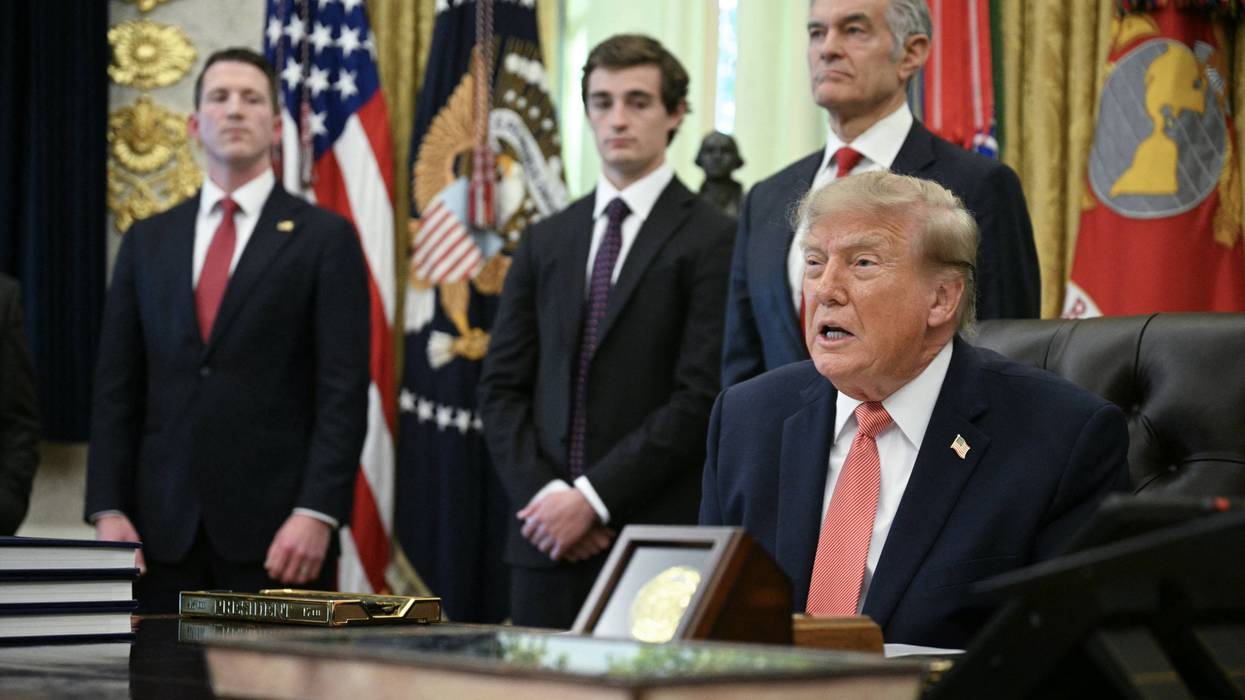
While the UN chief also said that Group of 20 nations "must lead," one of the G20's key members—and the world's biggest historical climate polluter—the United States, has ditched the Paris Agreement, again, under Big Oil-backed President Donald Trump's second administration, as part of broader agendas supporting fossil fuels and attacking international cooperation.
The report itself highlights that "emissions growth slowed down in the G20," with the Trump-led US "being the major exception," and "currently, the six largest emitters in terms of total GHG emissions are China, the United States of America, India, the European Union, the Russian Federation, and Indonesia—noting that in per capita terms, India and Indonesia are much lower emitters."
Within the United States and beyond, climate scientists and campaigners used the report to renew pressure on governments to push strong policies to reduce planet-heating emissions. Among them was Fenton Lutunatabua, Pacific and Caribbean lead at the advocacy group 350.org, who said that "this report is clear: Fossil fuels are driving us beyond the 1.5°C limit."
"The fastest and fairest way back is not to bet on unproven technologies, but to cut emissions now, end the expansion of fossil fuels, and protect the forests, oceans, and ecosystems that already keep carbon out of the atmosphere," he said. "We know this works: Since the Paris Agreement, global renewable electricity capacity has grown three times faster than expected, and the report shows that bold climate policies cut emissions at scale."
"But what's on the table now is far from enough, putting us on track for around 2.6°C of warming. We need more, and we can do more," he added. "Every five years of CO2 emissions at current levels pushes peak warming up by around 0.1°C, and every tenth of a degree is measured in lives. The time for action is now."
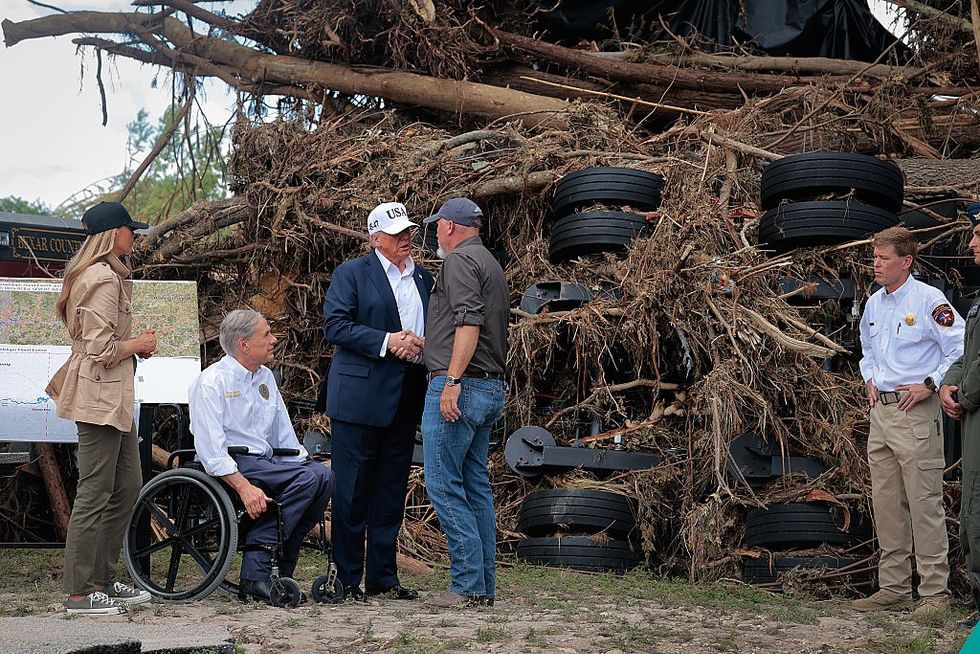 President Donald Trump, first lady Melania Trump, and Texas Gov. Greg Abbott meet with local emergency services personnel as they survey flood damage along the Guadalupe River on July 11, 2025, in Kerrville, Texas. (Photo by Chip Somodevilla/Getty Images)
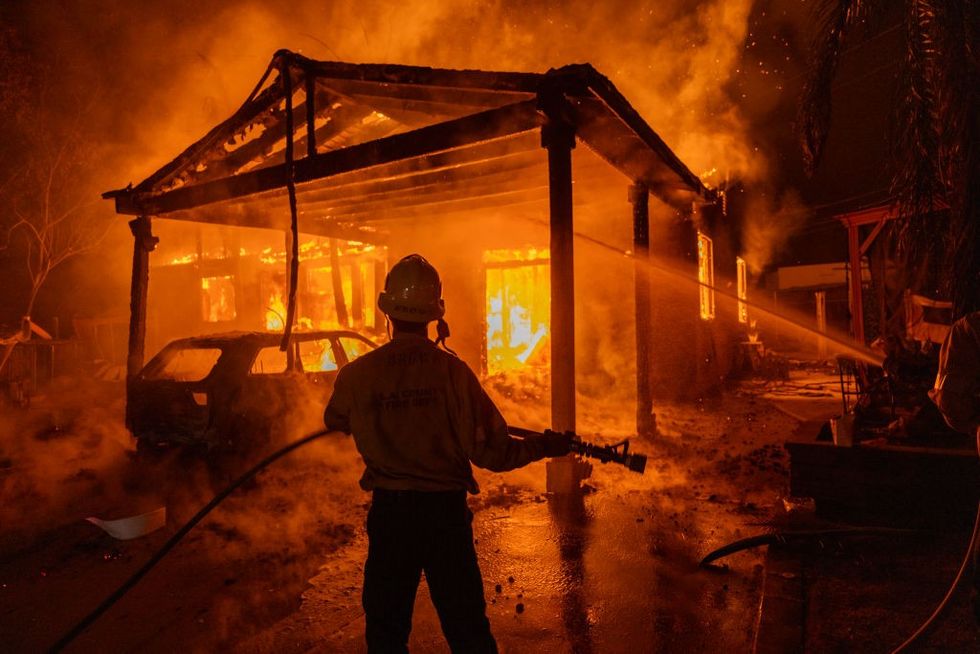 Firefighters battle the Eaton Fire on January 8, 2025, in Altadena, California. (Photo by David McNew/Getty Images)