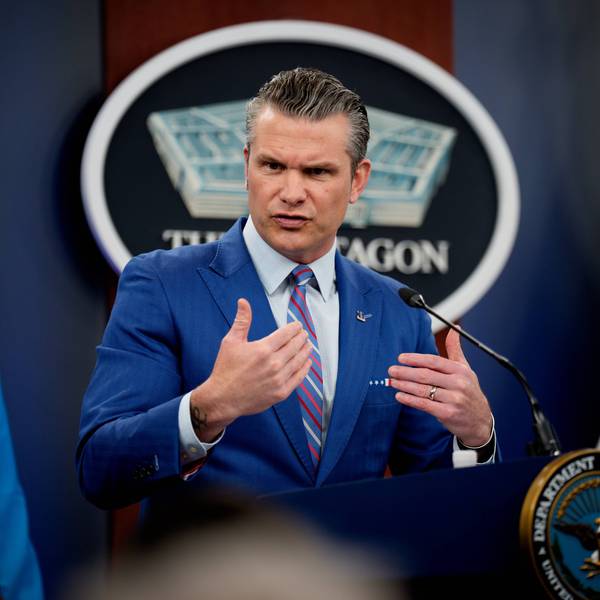

In response to U.S. Secretary of Defense Pete Hegseth claiming on live television earlier this week that "nobody was texting war plans," The Atlantic magazine on Wednesday morning published the "war plans" that were, in fact, shared on the private sector messaging app Signal by top members of President Donald Trump's national security team, including Hegseth and national security advisor Mike Waltz.
It was The Atlantic's Jeffrey Goldberg who on Monday published a bombshell report about how he was, seemingly "inadvertently," added to the Signal group chat by Waltz, a conversation that, in addition to Hegseth, also included director of national security Tulsi Gabbard, CIA director John Ratcliffe, White House deputy chief of staff Stephen Miller, Vice President JD Vance, and others.
In the new piece published, Goldberg said that public denials by these top officials since the original reporting presented the magazine "with a dilemma" about what to do with information the editorial team had initially withheld, citing national security concerns.
"These are strike plans. There must be a broad investigation of how compromised our national security is because of their shocking incompetence." — Rep. Veronica Escobar (D-Texas)
Though its editorial decision to withhold information was criticized by some journalists who believe the public has a right to know such details—including reporter Ken Klippenstein who accused the magazine of falling prey to "media paternalism" by not initally releasing the full contents of the chat—Goldberg explained The Atlantic's decision this way:
we withheld specific information related to weapons and to the timing of attacks that we found in certain texts. As a general rule, we do not publish information about military operations if that information could possibly jeopardize the lives of U.S. personnel. That is why we chose to characterize the nature of the information being shared, not specific details about the attacks.
However—citing Hegseth's on-air denial Monday, a statement by Trump that nothing in the chat was "classified," as well as testimony before a committee in the U.S. Senate on Tuesday by Gabbard and Ratcliffe, both of whom said under oath that classified information was not shared—Goldberg said the magazine's assessment changed.
"We believe," writes Goldberg in the latest piece, "that people should see the texts in order to reach their own conclusions. There is a clear public interest in disclosing the sort of information that Trump advisers included in nonsecure communications channels, especially because senior administration figures are attempting to downplay the significance of the messages that were shared."
Given that the nation's highest-level national security officials, up to and including the President of the United States, have said the material is not classified, the magazine acknowledged—and since the attack plans were for an operation already carried out against Houthis targets in Yemen—it would be strange if The Atlantic still felt not at liberty to publish them.
After reaching out to various agencies in advance of its decision to publish, Goldberg reports that the White House still objected to the release of the exchange, with press secretary Karoline Leavitt claiming that even though "there was no classified information transmitted in the group chat," the administration holds that what was said on the unsecured, third-party communication app was "intended to be a an [sic] internal and private deliberation amongst high-level senior staff and sensitive information was discussed."
What follows are screenshots of the detailed war plans discussed on the Signal group chat by Trump's top officials, as reported by The Atlantic:
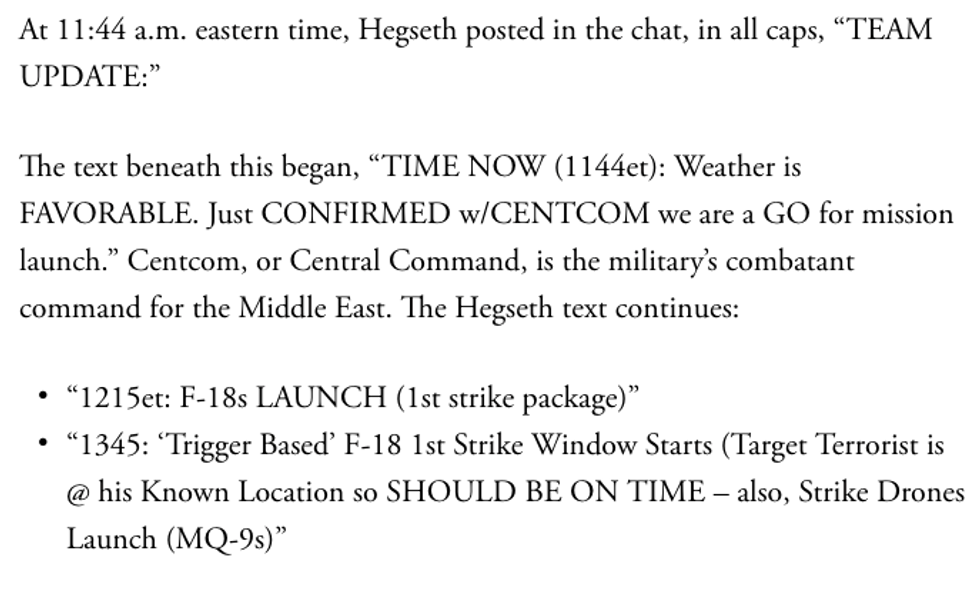
After this portion, Goldberg notes: "If this text had been received by someone hostile to American interests—or someone merely indiscreet, and with access to social media—the Houthis would have had time to prepare for what was meant to be a surprise attack on their strongholds. The consequences for American pilots could have been catastrophic."
More details:
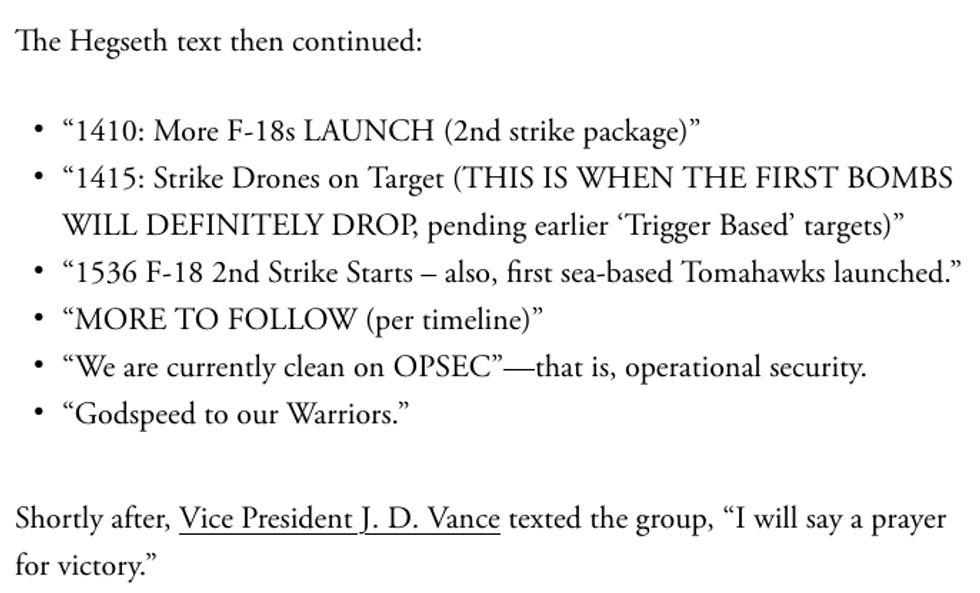
And then these paragraphs:
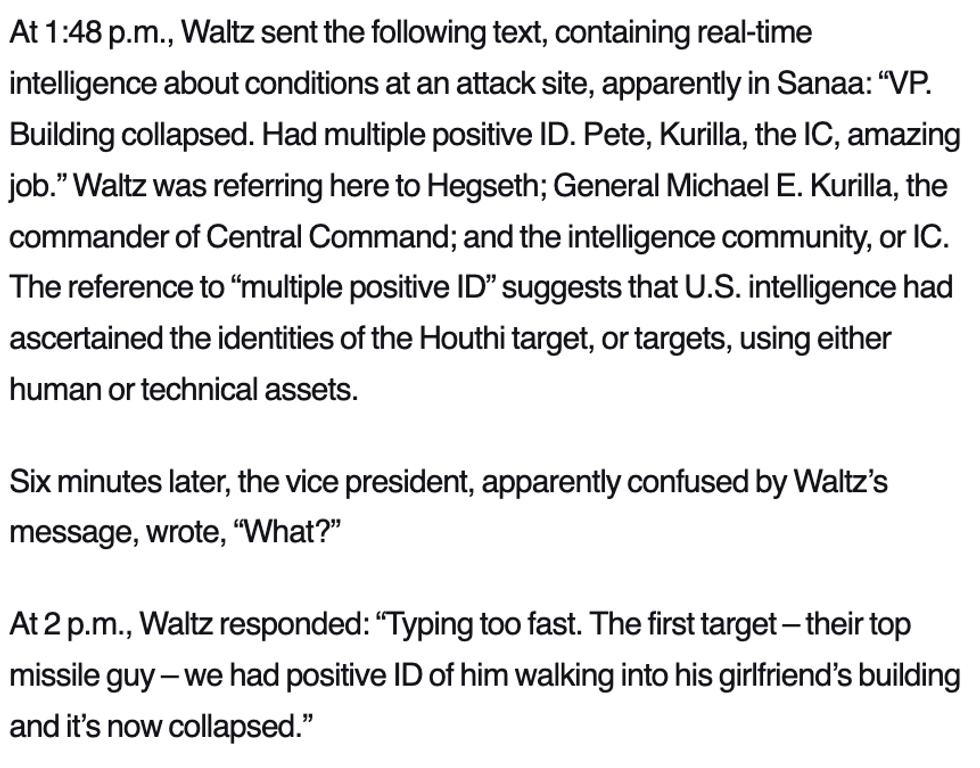
While The Atlantic's new reporting on Wednesday sits behind a paywall, reaction to it was immediate and widespread.
"Hegseth repeatedly lied to the American people and should be fired—along with all the others in the chat," said Rep. Veronica Escobar (D-Texas) in response to Goldberg's latest revelations. "These are strike plans. There must be a broad investigation of how compromised our national security is because of their shocking incompetence."
On Wednesday, two Democratic House members—Rep. Gerald E. Connolly, Ranking Member of the Committee on Oversight and Government Reform, and Rep. Maxwell Alejandro Frost, Ranking Member of the Subcommittee on Economic Growth, Energy Policy, and Regulatory Affairs—launched a congressional probe into whether or not war plans were discussed in the group chat and called on every official involved to preserve all related documents and communications.
"This incident raises grave concerns about the misuse of unsecured communication platforms for classified discussions and the potential that American military and intelligence professionals may have been compromised by the reckless dissemination of such classified material,” Connolly and Frost wrote in a letter addressed to all the officials involved.
Given their testimony before the Senate on Tuesday, Ratcliffe and Gabbard may come under specific scrutiny by members of that committee and other lawmakers.
"A reminder that various administration officials lied under oath in the Senate yesterday," said former Democratic congressman Mondaire Jones, "which is a crime punishable by imprisonment."
In response to U.S. Secretary of Defense Pete Hegseth claiming on live television earlier this week that "nobody was texting war plans," The Atlantic magazine on Wednesday morning published the "war plans" that were, in fact, shared on the private sector messaging app Signal by top members of President Donald Trump's national security team, including Hegseth and national security advisor Mike Waltz.
It was The Atlantic's Jeffrey Goldberg who on Monday published a bombshell report about how he was, seemingly "inadvertently," added to the Signal group chat by Waltz, a conversation that, in addition to Hegseth, also included director of national security Tulsi Gabbard, CIA director John Ratcliffe, White House deputy chief of staff Stephen Miller, Vice President JD Vance, and others.
In the new piece published, Goldberg said that public denials by these top officials since the original reporting presented the magazine "with a dilemma" about what to do with information the editorial team had initially withheld, citing national security concerns.
"These are strike plans. There must be a broad investigation of how compromised our national security is because of their shocking incompetence." — Rep. Veronica Escobar (D-Texas)
Though its editorial decision to withhold information was criticized by some journalists who believe the public has a right to know such details—including reporter Ken Klippenstein who accused the magazine of falling prey to "media paternalism" by not initally releasing the full contents of the chat—Goldberg explained The Atlantic's decision this way:
we withheld specific information related to weapons and to the timing of attacks that we found in certain texts. As a general rule, we do not publish information about military operations if that information could possibly jeopardize the lives of U.S. personnel. That is why we chose to characterize the nature of the information being shared, not specific details about the attacks.
However—citing Hegseth's on-air denial Monday, a statement by Trump that nothing in the chat was "classified," as well as testimony before a committee in the U.S. Senate on Tuesday by Gabbard and Ratcliffe, both of whom said under oath that classified information was not shared—Goldberg said the magazine's assessment changed.
"We believe," writes Goldberg in the latest piece, "that people should see the texts in order to reach their own conclusions. There is a clear public interest in disclosing the sort of information that Trump advisers included in nonsecure communications channels, especially because senior administration figures are attempting to downplay the significance of the messages that were shared."
Given that the nation's highest-level national security officials, up to and including the President of the United States, have said the material is not classified, the magazine acknowledged—and since the attack plans were for an operation already carried out against Houthis targets in Yemen—it would be strange if The Atlantic still felt not at liberty to publish them.
After reaching out to various agencies in advance of its decision to publish, Goldberg reports that the White House still objected to the release of the exchange, with press secretary Karoline Leavitt claiming that even though "there was no classified information transmitted in the group chat," the administration holds that what was said on the unsecured, third-party communication app was "intended to be a an [sic] internal and private deliberation amongst high-level senior staff and sensitive information was discussed."
What follows are screenshots of the detailed war plans discussed on the Signal group chat by Trump's top officials, as reported by The Atlantic:
After this portion, Goldberg notes: "If this text had been received by someone hostile to American interests—or someone merely indiscreet, and with access to social media—the Houthis would have had time to prepare for what was meant to be a surprise attack on their strongholds. The consequences for American pilots could have been catastrophic."
More details:
And then these paragraphs:
While The Atlantic's new reporting on Wednesday sits behind a paywall, reaction to it was immediate and widespread.
"Hegseth repeatedly lied to the American people and should be fired—along with all the others in the chat," said Rep. Veronica Escobar (D-Texas) in response to Goldberg's latest revelations. "These are strike plans. There must be a broad investigation of how compromised our national security is because of their shocking incompetence."
On Wednesday, two Democratic House members—Rep. Gerald E. Connolly, Ranking Member of the Committee on Oversight and Government Reform, and Rep. Maxwell Alejandro Frost, Ranking Member of the Subcommittee on Economic Growth, Energy Policy, and Regulatory Affairs—launched a congressional probe into whether or not war plans were discussed in the group chat and called on every official involved to preserve all related documents and communications.
"This incident raises grave concerns about the misuse of unsecured communication platforms for classified discussions and the potential that American military and intelligence professionals may have been compromised by the reckless dissemination of such classified material,” Connolly and Frost wrote in a letter addressed to all the officials involved.
Given their testimony before the Senate on Tuesday, Ratcliffe and Gabbard may come under specific scrutiny by members of that committee and other lawmakers.
"A reminder that various administration officials lied under oath in the Senate yesterday," said former Democratic congressman Mondaire Jones, "which is a crime punishable by imprisonment."