SUBSCRIBE TO OUR FREE NEWSLETTER
Daily news & progressive opinion—funded by the people, not the corporations—delivered straight to your inbox.
5
#000000
#FFFFFF
To donate by check, phone, or other method, see our More Ways to Give page.
Daily news & progressive opinion—funded by the people, not the corporations—delivered straight to your inbox.
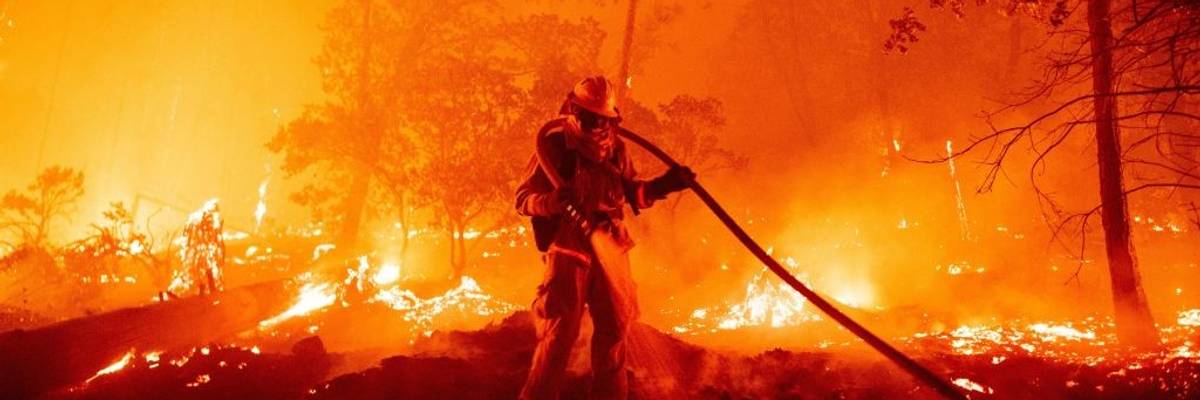
A firefighter douses flames as they push toward homes during the Creek Fire in the Cascadel Woods area of unincorporated Madera County, California on September 7, 2020. The El Niño event of 2026 is expected to cause a variety of extreme weather, including dry conditions in some regions and extreme rainfall in others, in 2027.
"As long as we continue to burn fossil fuels," said one scientist, El Niño "occurs on an increasingly hotter baseline, making it much more difficult for communities to deal with the consequences.”
Although “El Niño comes and goes," as one climate scientist said of the naturally occurring warm-weather phenomenon on Monday, experts are in agreement that this year is different—with meteorologists already recording a temperature rise of 3.07°C in the Pacific Ocean, putting it at a statistical tie with November 2015, when El Niño caused the ocean to warm by 3.08°C.
The temperature rise is not expected to peak until November and December, when an average of 14 models examined by Zeke Hausfather of Carbon Brief and Berkeley Earth found that a temperature rise of 4.1°C is forecast.
The event has been underway since June, Hausfather wrote, and has been gathering strength "faster than any previous event on record."
Scientists typically track the strength of El Niño—which leads to heavy rainfall, higher global temperatures, and other extreme weather as warmer Pacific waters are pushed to the south—using the Niño 3.4 anomaly, or ONI, which determines how much hotter the central Pacific is compared with a 30-year rolling average.
A temperature rise above 2.0°C is considered a "very strong" El Niño, and scientists and policymakers are already calling this year's event a "super El Niño," with some experts using the terms "Godzilla-level" and "jaw-dropping" to describe the weather conditions that can be expected in the coming months due to the warmer climate.
As Common Dreams reported late last month, planetary heating driven by fossil fuel emissions is intensifying El Niño, while the naturally occurring phenomenon can in turn worsen the impacts of the climate emergency.
In the last 40 years scientists have recorded a 16% increase in the strength of El Niño events, according to a study published in Science last month. They've also gotten 36% stronger than they were before industrialization began.
The "double whammy," as The Guardian called it, could make 2027 the hottest year ever recorded, blowing through heat records that have just been set this year—and that have been linked to the deaths of people around the world from extreme heat and flooding.
“This event is a huge redistribution of energy in the climate system and is dangerous because it is unfolding on top of a much warmer, human-influenced climate system," climate scientist Friederike Otto of Imperial College London told The Guardian. “So, in many places around the world we will see never-before-experienced heat extremes, with all their consequences on health, food security, and water stress."
Despite the fact that El Niño predates the human-caused climate emergency, Otto said, "as long as we continue to burn fossil fuels, it occurs on an increasingly hotter baseline, making it much more difficult for communities to deal with the consequences.”
This year's event is likely to be the most intense El Niño in 1,000 years, reported to The Guardian, with hotter and drier conditions already linked to deadly wildfires in Indonesia and crop losses in Central America and the Caribbean region due to drought conditions. Rice production this season is expected to fail in Indonesia, according to the Salata Institute for Climate and Sustainability at Harvard University.
As the Southern Hemisphere's summer months approach, southern Africa and Australia are at heightened risk of wildfires and droughts as well. Meanwhile, cocoa production could be damaged by extreme rainfall in parts of South America.
"All strong El Niño events on record have continued to strengthen well into the winter—and the models are in near-unanimous agreement that this one will, too," wrote Hausfather at Carbon Brief. "If the forecast holds, the current event will peak between November and January at a level far beyond any event previously observed in the instrumental record."
In California on Monday, Democratic Gov. Gavin Newsom declared a state of emergency in an effort to prepare communities for El Niño's impacts in the coming months, which could include coastal flooding and heavy snow in mountain regions.
Hausfather noted that strong El Niño events like those that occurred in 1997 and 2015 were also "associated with hundreds of billions of dollars in damages globally."
"This event," he told The Guardian, "is leaving those past ones in the dust."
Dear Common Dreams reader, It’s been nearly 30 years since I co-founded Common Dreams with my late wife, Lina Newhouser. We had the radical notion that journalism should serve the public good, not corporate profits. It was clear to us from the outset what it would take to build such a project. No paid advertisements. No corporate sponsors. No millionaire publisher telling us what to think or do. Many people said we wouldn't last a year, but we proved those doubters wrong. Together with a tremendous team of journalists and dedicated staff, we built an independent media outlet free from the constraints of profits and corporate control. Our mission has always been simple: To inform. To inspire. To ignite change for the common good. Building Common Dreams was not easy. Our survival was never guaranteed. When you take on the most powerful forces—Wall Street greed, fossil fuel industry destruction, Big Tech lobbyists, and uber-rich oligarchs who have spent billions upon billions rigging the economy and democracy in their favor—the only bulwark you have is supporters who believe in your work. But here’s the urgent message from me today. It's never been this bad out there. And it's never been this hard to keep us going. At the very moment Common Dreams is most needed, the threats we face are intensifying. We need your support now more than ever. We don't accept corporate advertising and never will. We don't have a paywall because we don't think people should be blocked from critical news based on their ability to pay. Everything we do is funded by the donations of readers like you. When everyone does the little they can afford, we are strong. But if that support retreats or dries up, so do we. Will you donate now to make sure Common Dreams not only survives but thrives? —Craig Brown, Co-founder |
Although “El Niño comes and goes," as one climate scientist said of the naturally occurring warm-weather phenomenon on Monday, experts are in agreement that this year is different—with meteorologists already recording a temperature rise of 3.07°C in the Pacific Ocean, putting it at a statistical tie with November 2015, when El Niño caused the ocean to warm by 3.08°C.
The temperature rise is not expected to peak until November and December, when an average of 14 models examined by Zeke Hausfather of Carbon Brief and Berkeley Earth found that a temperature rise of 4.1°C is forecast.
The event has been underway since June, Hausfather wrote, and has been gathering strength "faster than any previous event on record."
Scientists typically track the strength of El Niño—which leads to heavy rainfall, higher global temperatures, and other extreme weather as warmer Pacific waters are pushed to the south—using the Niño 3.4 anomaly, or ONI, which determines how much hotter the central Pacific is compared with a 30-year rolling average.
A temperature rise above 2.0°C is considered a "very strong" El Niño, and scientists and policymakers are already calling this year's event a "super El Niño," with some experts using the terms "Godzilla-level" and "jaw-dropping" to describe the weather conditions that can be expected in the coming months due to the warmer climate.
As Common Dreams reported late last month, planetary heating driven by fossil fuel emissions is intensifying El Niño, while the naturally occurring phenomenon can in turn worsen the impacts of the climate emergency.
In the last 40 years scientists have recorded a 16% increase in the strength of El Niño events, according to a study published in Science last month. They've also gotten 36% stronger than they were before industrialization began.
The "double whammy," as The Guardian called it, could make 2027 the hottest year ever recorded, blowing through heat records that have just been set this year—and that have been linked to the deaths of people around the world from extreme heat and flooding.
“This event is a huge redistribution of energy in the climate system and is dangerous because it is unfolding on top of a much warmer, human-influenced climate system," climate scientist Friederike Otto of Imperial College London told The Guardian. “So, in many places around the world we will see never-before-experienced heat extremes, with all their consequences on health, food security, and water stress."
Despite the fact that El Niño predates the human-caused climate emergency, Otto said, "as long as we continue to burn fossil fuels, it occurs on an increasingly hotter baseline, making it much more difficult for communities to deal with the consequences.”
This year's event is likely to be the most intense El Niño in 1,000 years, reported to The Guardian, with hotter and drier conditions already linked to deadly wildfires in Indonesia and crop losses in Central America and the Caribbean region due to drought conditions. Rice production this season is expected to fail in Indonesia, according to the Salata Institute for Climate and Sustainability at Harvard University.
As the Southern Hemisphere's summer months approach, southern Africa and Australia are at heightened risk of wildfires and droughts as well. Meanwhile, cocoa production could be damaged by extreme rainfall in parts of South America.
"All strong El Niño events on record have continued to strengthen well into the winter—and the models are in near-unanimous agreement that this one will, too," wrote Hausfather at Carbon Brief. "If the forecast holds, the current event will peak between November and January at a level far beyond any event previously observed in the instrumental record."
In California on Monday, Democratic Gov. Gavin Newsom declared a state of emergency in an effort to prepare communities for El Niño's impacts in the coming months, which could include coastal flooding and heavy snow in mountain regions.
Hausfather noted that strong El Niño events like those that occurred in 1997 and 2015 were also "associated with hundreds of billions of dollars in damages globally."
"This event," he told The Guardian, "is leaving those past ones in the dust."
Although “El Niño comes and goes," as one climate scientist said of the naturally occurring warm-weather phenomenon on Monday, experts are in agreement that this year is different—with meteorologists already recording a temperature rise of 3.07°C in the Pacific Ocean, putting it at a statistical tie with November 2015, when El Niño caused the ocean to warm by 3.08°C.
The temperature rise is not expected to peak until November and December, when an average of 14 models examined by Zeke Hausfather of Carbon Brief and Berkeley Earth found that a temperature rise of 4.1°C is forecast.
The event has been underway since June, Hausfather wrote, and has been gathering strength "faster than any previous event on record."
Scientists typically track the strength of El Niño—which leads to heavy rainfall, higher global temperatures, and other extreme weather as warmer Pacific waters are pushed to the south—using the Niño 3.4 anomaly, or ONI, which determines how much hotter the central Pacific is compared with a 30-year rolling average.
A temperature rise above 2.0°C is considered a "very strong" El Niño, and scientists and policymakers are already calling this year's event a "super El Niño," with some experts using the terms "Godzilla-level" and "jaw-dropping" to describe the weather conditions that can be expected in the coming months due to the warmer climate.
As Common Dreams reported late last month, planetary heating driven by fossil fuel emissions is intensifying El Niño, while the naturally occurring phenomenon can in turn worsen the impacts of the climate emergency.
In the last 40 years scientists have recorded a 16% increase in the strength of El Niño events, according to a study published in Science last month. They've also gotten 36% stronger than they were before industrialization began.
The "double whammy," as The Guardian called it, could make 2027 the hottest year ever recorded, blowing through heat records that have just been set this year—and that have been linked to the deaths of people around the world from extreme heat and flooding.
“This event is a huge redistribution of energy in the climate system and is dangerous because it is unfolding on top of a much warmer, human-influenced climate system," climate scientist Friederike Otto of Imperial College London told The Guardian. “So, in many places around the world we will see never-before-experienced heat extremes, with all their consequences on health, food security, and water stress."
Despite the fact that El Niño predates the human-caused climate emergency, Otto said, "as long as we continue to burn fossil fuels, it occurs on an increasingly hotter baseline, making it much more difficult for communities to deal with the consequences.”
This year's event is likely to be the most intense El Niño in 1,000 years, reported to The Guardian, with hotter and drier conditions already linked to deadly wildfires in Indonesia and crop losses in Central America and the Caribbean region due to drought conditions. Rice production this season is expected to fail in Indonesia, according to the Salata Institute for Climate and Sustainability at Harvard University.
As the Southern Hemisphere's summer months approach, southern Africa and Australia are at heightened risk of wildfires and droughts as well. Meanwhile, cocoa production could be damaged by extreme rainfall in parts of South America.
"All strong El Niño events on record have continued to strengthen well into the winter—and the models are in near-unanimous agreement that this one will, too," wrote Hausfather at Carbon Brief. "If the forecast holds, the current event will peak between November and January at a level far beyond any event previously observed in the instrumental record."
In California on Monday, Democratic Gov. Gavin Newsom declared a state of emergency in an effort to prepare communities for El Niño's impacts in the coming months, which could include coastal flooding and heavy snow in mountain regions.
Hausfather noted that strong El Niño events like those that occurred in 1997 and 2015 were also "associated with hundreds of billions of dollars in damages globally."
"This event," he told The Guardian, "is leaving those past ones in the dust."