SUBSCRIBE TO OUR FREE NEWSLETTER
Daily news & progressive opinion—funded by the people, not the corporations—delivered straight to your inbox.
5
#000000
#FFFFFF
To donate by check, phone, or other method, see our More Ways to Give page.
Daily news & progressive opinion—funded by the people, not the corporations—delivered straight to your inbox.
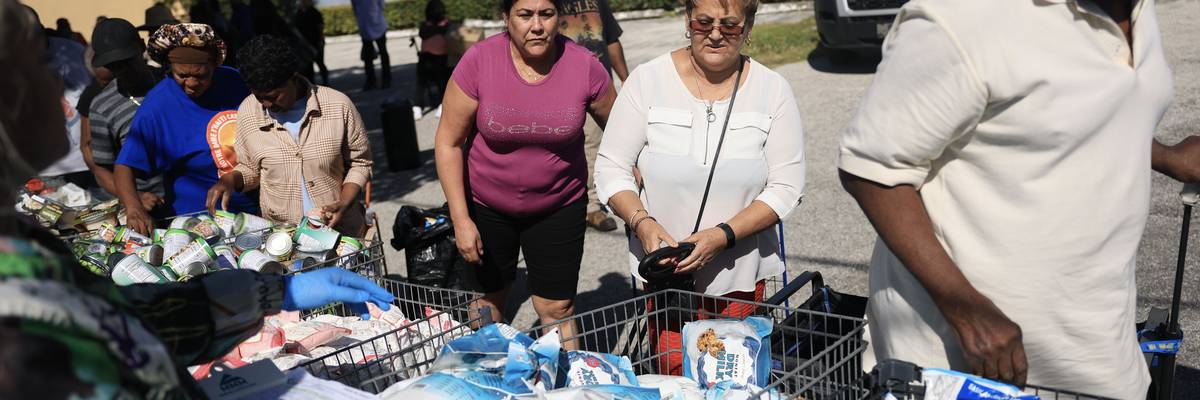
People receive donated food in Miami on October 30, 2025.
"It cannot be said enough that people aren't being 'lifted' or 'moved off' SNAP—struggling families are losing the help they need to afford groceries because of HR 1's cuts," said one expert.
Food banks across the United States are experiencing increased demand not seen since the Covid-19 pandemic as higher consumer prices and food aid cuts enacted by congressional Republicans and President Donald Trump cause pain for millions of vulnerable families.
The so-called One Big Beautiful Bill (OBBBA, or HR 1) passed by the Republican-controlled Congress and signed into law by Trump last July 4 contains the biggest cuts to Supplemental Nutrition Assistance Program (SNAP), or food stamps, in the nation's history.
According to US Department of Agriculture data, participation in SNAP dropped by 8% nationwide in the six months following the law's signing. A recent analysis by the Center for Budget and Policy Priorities found that around 2.5 million people have lost food aid since the legislation took effect.
Laura Lester, CEO of Feeding Alabama, told Al.com that the state is "on track to lose up to 100,000 people off of SNAP benefits by the end of this year."
“We are already hearing from those impacted who no longer have access to food,” said Lester. “Homeless children and seniors are the ones who are suffering. We have absolutely seen an increase in the number of people who don’t have enough to eat coming to our pantries.”
The OBBBA contains new qualification requirements for people experiencing homelessness, veterans, former foster youth, and older adults. The Trump administration says the new rules are meant to ensure that only the truly needy receive benefits. However, the more stringent requirements are harming some of the most vulnerable people.
“To see seniors and young women with children lose their benefits, it’s heartbreaking,” Dan Saltzman, president of Dave’s Markets, a Cleveland-area grocery store chain, told Signal Cleveland. Saltzman said his business' revenue from SNAP has declined by about 10% over the past year.
Compliance procedures are proving an exclusionary barrier to qualified aid applicants.
“Tens of thousands of SNAP participants are facing new hurdles just to maintain assistance,” New Jersey Human Services Commissioner Stephen Cha said last week. “Many residents who remain eligible for assistance could still lose coverage or food support because complex paperwork or missed deadlines prevent them from completing required steps."
Kristin Warzocha, CEO of Greater Cleveland Food Bank—which served more than 400,000 people last year—said that she has "talked to quite a number of people lately who are seniors who are struggling to get by with rising prices."
“They’re worried about the cost of groceries. They’re worried because their rent has gone up. And they just can’t make ends meet anymore," she added. "They just can’t do it. So they’re coming here for food.”
Jennie Jean Davidson, executive director at Neighborhood House, a Louisville food bank, told Spectrum News 1 that "honestly, demand for what we do is up in every area."
"We have waiting lists in our child development center and in our youth programming," she explained. "Demand in our food pantry has been going up month-over-month for about three years now and it’s just continuing to climb. We’re seeing a lot of need in the community.”
Trump's tariffs, war of choice on Iran, and attacks on the social safety net are driving up inflation, and household debt, exacerbating the struggles of millions of Americans. While he campaigned on promises to lower prices on "day one," Trump admitted Tuesday that Americans' financial struggles aren't on his mind, "not even a little bit," as he tries to negotiate an end to the war he started with Israel against Iran.
"We're seeing a lot of uneasiness amongst people in general," Community Food Bank of Southern Arizona president and CEO Natalie Jayroe told KGUN on Tuesday. "So many things are changing. Nobody knows when this inflation is going to stop. They don't know when the price of gas is going to start to go down again. We've had cuts in some of the funding that families normally depend on."
“Right now, we're reaching about 6,200 children and we do that primarily through our summer feeding programs that take place in schools and other camps," she added. “So many of our children depend on school breakfast and lunch during the year. In our case here in Southern Arizona and the five counties that we serve, that's 88,000 children."
Dear Common Dreams reader, It’s been nearly 30 years since I co-founded Common Dreams with my late wife, Lina Newhouser. We had the radical notion that journalism should serve the public good, not corporate profits. It was clear to us from the outset what it would take to build such a project. No paid advertisements. No corporate sponsors. No millionaire publisher telling us what to think or do. Many people said we wouldn't last a year, but we proved those doubters wrong. Together with a tremendous team of journalists and dedicated staff, we built an independent media outlet free from the constraints of profits and corporate control. Our mission has always been simple: To inform. To inspire. To ignite change for the common good. Building Common Dreams was not easy. Our survival was never guaranteed. When you take on the most powerful forces—Wall Street greed, fossil fuel industry destruction, Big Tech lobbyists, and uber-rich oligarchs who have spent billions upon billions rigging the economy and democracy in their favor—the only bulwark you have is supporters who believe in your work. But here’s the urgent message from me today. It's never been this bad out there. And it's never been this hard to keep us going. At the very moment Common Dreams is most needed, the threats we face are intensifying. We need your support now more than ever. We don't accept corporate advertising and never will. We don't have a paywall because we don't think people should be blocked from critical news based on their ability to pay. Everything we do is funded by the donations of readers like you. When everyone does the little they can afford, we are strong. But if that support retreats or dries up, so do we. Will you donate now to make sure Common Dreams not only survives but thrives? —Craig Brown, Co-founder |
Food banks across the United States are experiencing increased demand not seen since the Covid-19 pandemic as higher consumer prices and food aid cuts enacted by congressional Republicans and President Donald Trump cause pain for millions of vulnerable families.
The so-called One Big Beautiful Bill (OBBBA, or HR 1) passed by the Republican-controlled Congress and signed into law by Trump last July 4 contains the biggest cuts to Supplemental Nutrition Assistance Program (SNAP), or food stamps, in the nation's history.
According to US Department of Agriculture data, participation in SNAP dropped by 8% nationwide in the six months following the law's signing. A recent analysis by the Center for Budget and Policy Priorities found that around 2.5 million people have lost food aid since the legislation took effect.
Laura Lester, CEO of Feeding Alabama, told Al.com that the state is "on track to lose up to 100,000 people off of SNAP benefits by the end of this year."
“We are already hearing from those impacted who no longer have access to food,” said Lester. “Homeless children and seniors are the ones who are suffering. We have absolutely seen an increase in the number of people who don’t have enough to eat coming to our pantries.”
The OBBBA contains new qualification requirements for people experiencing homelessness, veterans, former foster youth, and older adults. The Trump administration says the new rules are meant to ensure that only the truly needy receive benefits. However, the more stringent requirements are harming some of the most vulnerable people.
“To see seniors and young women with children lose their benefits, it’s heartbreaking,” Dan Saltzman, president of Dave’s Markets, a Cleveland-area grocery store chain, told Signal Cleveland. Saltzman said his business' revenue from SNAP has declined by about 10% over the past year.
Compliance procedures are proving an exclusionary barrier to qualified aid applicants.
“Tens of thousands of SNAP participants are facing new hurdles just to maintain assistance,” New Jersey Human Services Commissioner Stephen Cha said last week. “Many residents who remain eligible for assistance could still lose coverage or food support because complex paperwork or missed deadlines prevent them from completing required steps."
Kristin Warzocha, CEO of Greater Cleveland Food Bank—which served more than 400,000 people last year—said that she has "talked to quite a number of people lately who are seniors who are struggling to get by with rising prices."
“They’re worried about the cost of groceries. They’re worried because their rent has gone up. And they just can’t make ends meet anymore," she added. "They just can’t do it. So they’re coming here for food.”
Jennie Jean Davidson, executive director at Neighborhood House, a Louisville food bank, told Spectrum News 1 that "honestly, demand for what we do is up in every area."
"We have waiting lists in our child development center and in our youth programming," she explained. "Demand in our food pantry has been going up month-over-month for about three years now and it’s just continuing to climb. We’re seeing a lot of need in the community.”
Trump's tariffs, war of choice on Iran, and attacks on the social safety net are driving up inflation, and household debt, exacerbating the struggles of millions of Americans. While he campaigned on promises to lower prices on "day one," Trump admitted Tuesday that Americans' financial struggles aren't on his mind, "not even a little bit," as he tries to negotiate an end to the war he started with Israel against Iran.
"We're seeing a lot of uneasiness amongst people in general," Community Food Bank of Southern Arizona president and CEO Natalie Jayroe told KGUN on Tuesday. "So many things are changing. Nobody knows when this inflation is going to stop. They don't know when the price of gas is going to start to go down again. We've had cuts in some of the funding that families normally depend on."
“Right now, we're reaching about 6,200 children and we do that primarily through our summer feeding programs that take place in schools and other camps," she added. “So many of our children depend on school breakfast and lunch during the year. In our case here in Southern Arizona and the five counties that we serve, that's 88,000 children."
Food banks across the United States are experiencing increased demand not seen since the Covid-19 pandemic as higher consumer prices and food aid cuts enacted by congressional Republicans and President Donald Trump cause pain for millions of vulnerable families.
The so-called One Big Beautiful Bill (OBBBA, or HR 1) passed by the Republican-controlled Congress and signed into law by Trump last July 4 contains the biggest cuts to Supplemental Nutrition Assistance Program (SNAP), or food stamps, in the nation's history.
According to US Department of Agriculture data, participation in SNAP dropped by 8% nationwide in the six months following the law's signing. A recent analysis by the Center for Budget and Policy Priorities found that around 2.5 million people have lost food aid since the legislation took effect.
Laura Lester, CEO of Feeding Alabama, told Al.com that the state is "on track to lose up to 100,000 people off of SNAP benefits by the end of this year."
“We are already hearing from those impacted who no longer have access to food,” said Lester. “Homeless children and seniors are the ones who are suffering. We have absolutely seen an increase in the number of people who don’t have enough to eat coming to our pantries.”
The OBBBA contains new qualification requirements for people experiencing homelessness, veterans, former foster youth, and older adults. The Trump administration says the new rules are meant to ensure that only the truly needy receive benefits. However, the more stringent requirements are harming some of the most vulnerable people.
“To see seniors and young women with children lose their benefits, it’s heartbreaking,” Dan Saltzman, president of Dave’s Markets, a Cleveland-area grocery store chain, told Signal Cleveland. Saltzman said his business' revenue from SNAP has declined by about 10% over the past year.
Compliance procedures are proving an exclusionary barrier to qualified aid applicants.
“Tens of thousands of SNAP participants are facing new hurdles just to maintain assistance,” New Jersey Human Services Commissioner Stephen Cha said last week. “Many residents who remain eligible for assistance could still lose coverage or food support because complex paperwork or missed deadlines prevent them from completing required steps."
Kristin Warzocha, CEO of Greater Cleveland Food Bank—which served more than 400,000 people last year—said that she has "talked to quite a number of people lately who are seniors who are struggling to get by with rising prices."
“They’re worried about the cost of groceries. They’re worried because their rent has gone up. And they just can’t make ends meet anymore," she added. "They just can’t do it. So they’re coming here for food.”
Jennie Jean Davidson, executive director at Neighborhood House, a Louisville food bank, told Spectrum News 1 that "honestly, demand for what we do is up in every area."
"We have waiting lists in our child development center and in our youth programming," she explained. "Demand in our food pantry has been going up month-over-month for about three years now and it’s just continuing to climb. We’re seeing a lot of need in the community.”
Trump's tariffs, war of choice on Iran, and attacks on the social safety net are driving up inflation, and household debt, exacerbating the struggles of millions of Americans. While he campaigned on promises to lower prices on "day one," Trump admitted Tuesday that Americans' financial struggles aren't on his mind, "not even a little bit," as he tries to negotiate an end to the war he started with Israel against Iran.
"We're seeing a lot of uneasiness amongst people in general," Community Food Bank of Southern Arizona president and CEO Natalie Jayroe told KGUN on Tuesday. "So many things are changing. Nobody knows when this inflation is going to stop. They don't know when the price of gas is going to start to go down again. We've had cuts in some of the funding that families normally depend on."
“Right now, we're reaching about 6,200 children and we do that primarily through our summer feeding programs that take place in schools and other camps," she added. “So many of our children depend on school breakfast and lunch during the year. In our case here in Southern Arizona and the five counties that we serve, that's 88,000 children."