SUBSCRIBE TO OUR FREE NEWSLETTER
Daily news & progressive opinion—funded by the people, not the corporations—delivered straight to your inbox.
5
#000000
#FFFFFF
To donate by check, phone, or other method, see our More Ways to Give page.
Daily news & progressive opinion—funded by the people, not the corporations—delivered straight to your inbox.
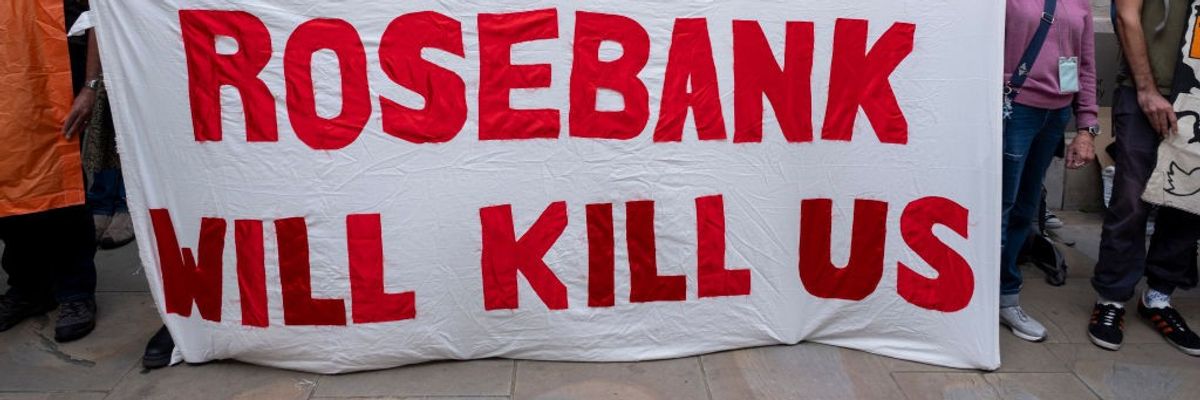
Activists hold a white sign reading "Rosebank will kill us" on September, 27, 2023 in London, United Kingdom.
Oceana U.K.'s leader called the decision "a massive win for campaigners and another step towards... a cleaner, greener future for our seas, planet, and climate."
Climate campaigners celebrated Thursday after the United Kingdom's new Labour government announced it will not legally defend decisions to allow controversial offshore drilling in a pair of areas in the North Sea.
The two sites are Shell's Jackdaw gas field and the Rosebank oil field, owned by Equinor and Ithaca Energy. Both projects have been loudly criticized by international green groups as well as U.K. opponents.
"This is amazing news and a BIG WIN for the climate. The government must now properly support affected workers and prioritize investment in green jobs,"
declared Greenpeace U.K., which along with the group Uplift had demanded judicial reviews.
The approvals for both North Sea sites occurred under Conservative rule—in 2022 for Jackdaw and last year for Rosebank, the country's biggest untapped oil field. Voters handed control of the government back to the Labour Party in May.
Then, as The Guardian detailed, "in June, the cases against the oil and gas fields received a boost when the Supreme Court ruled in a separate case that 'scope 3' emissions—that is, the burning of fossil fuels rather than just the building of the infrastructure to do so—should be taken into account when approving projects."
"Now we need to see a just transition plan for workers and communities across the U.K. and an end extraction in the North Sea for good!"
The U.K. Department for Energy Security and Net Zero, led by Secretary Ed Miliband, cited the "landmark" Supreme Court ruling in a Thursday statement that highlighted the government's decision not to defend the approvals "will save the taxpayer money" and "this litigation does not mean the licences for Jackdaw and Rosebank have been withdrawn."
"Oil and gas production in the North Sea will be a key component of the U.K. energy landscape for decades to come as it transitions to our clean energy future in a way that protects jobs," the department claimed, while also pledging to "consult later this year on the implementation of its manifesto position not to issue new oil and gas licenses to explore new fields."
Welcoming the U.K. government's acceptance of the recent high court ruling, Uplift founder and executive director Tessa Khan
said on social media that "the immediate consequence... is that the Scottish Court of Session is very likely to quash the decision approving Rosebank, although we're likely to have to wait a while before that's confirmed."
"If Equinor and Ithaca Energy decide they still want to press ahead with developing the field," Khan explained, "then the next step will be for them to submit a new environmental statement to the [government] and regulator... that includes the scope 3 emissions from the field."
"If you need reminding, those emissions are massive: the same as 56 coal-fired power plants running for a year or the annual emissions of the world's 28 poorest countries," she added. "If Equinor and Ithaca try to push Rosebank through again, the U.K. [government] must reject it."
Greenpeace similarly stressed that "Rosebank and Jackdaw would generate a vast amount of emissions while doing nothing to lower energy bills," and "the only real winners from giving them the greenlight would be greedy oil giants Shell and Equinor."
"To lower bills, improve people's health, upgrade our economy," the group argued, the government must: increase renewable energy; better insulate homes; and boost support for green jobs.
Celebrations over the government's decision and calls for further action weren't limited to the groups behind the legal challenges.
Oceana U.K. executive director praised the "incredible work" by Greenpeace and Uplift, and called the government dropping its defense "a massive win for campaigners and another step towards... a cleaner, greener future for our seas, planet, and climate."
Oil Change International also applauded the government's "incredibly important and correct decision."
"There is no defending more fossil fuel extraction," the organization said. "Now we need to see a just transition plan for workers and communities across the U.K. and an end extraction in the North Sea for good!"
Global Witness similarly celebrated the government's move, declaring on social media that "this is brilliant news!"
"New oilfields are an act of climate vandalism," the group added. "Governments must prioritize people, not polluters' profit."
Dear Common Dreams reader, It’s been nearly 30 years since I co-founded Common Dreams with my late wife, Lina Newhouser. We had the radical notion that journalism should serve the public good, not corporate profits. It was clear to us from the outset what it would take to build such a project. No paid advertisements. No corporate sponsors. No millionaire publisher telling us what to think or do. Many people said we wouldn't last a year, but we proved those doubters wrong. Together with a tremendous team of journalists and dedicated staff, we built an independent media outlet free from the constraints of profits and corporate control. Our mission has always been simple: To inform. To inspire. To ignite change for the common good. Building Common Dreams was not easy. Our survival was never guaranteed. When you take on the most powerful forces—Wall Street greed, fossil fuel industry destruction, Big Tech lobbyists, and uber-rich oligarchs who have spent billions upon billions rigging the economy and democracy in their favor—the only bulwark you have is supporters who believe in your work. But here’s the urgent message from me today. It's never been this bad out there. And it's never been this hard to keep us going. At the very moment Common Dreams is most needed, the threats we face are intensifying. We need your support now more than ever. We don't accept corporate advertising and never will. We don't have a paywall because we don't think people should be blocked from critical news based on their ability to pay. Everything we do is funded by the donations of readers like you. When everyone does the little they can afford, we are strong. But if that support retreats or dries up, so do we. Will you donate now to make sure Common Dreams not only survives but thrives? —Craig Brown, Co-founder |
Climate campaigners celebrated Thursday after the United Kingdom's new Labour government announced it will not legally defend decisions to allow controversial offshore drilling in a pair of areas in the North Sea.
The two sites are Shell's Jackdaw gas field and the Rosebank oil field, owned by Equinor and Ithaca Energy. Both projects have been loudly criticized by international green groups as well as U.K. opponents.
"This is amazing news and a BIG WIN for the climate. The government must now properly support affected workers and prioritize investment in green jobs,"
declared Greenpeace U.K., which along with the group Uplift had demanded judicial reviews.
The approvals for both North Sea sites occurred under Conservative rule—in 2022 for Jackdaw and last year for Rosebank, the country's biggest untapped oil field. Voters handed control of the government back to the Labour Party in May.
Then, as The Guardian detailed, "in June, the cases against the oil and gas fields received a boost when the Supreme Court ruled in a separate case that 'scope 3' emissions—that is, the burning of fossil fuels rather than just the building of the infrastructure to do so—should be taken into account when approving projects."
"Now we need to see a just transition plan for workers and communities across the U.K. and an end extraction in the North Sea for good!"
The U.K. Department for Energy Security and Net Zero, led by Secretary Ed Miliband, cited the "landmark" Supreme Court ruling in a Thursday statement that highlighted the government's decision not to defend the approvals "will save the taxpayer money" and "this litigation does not mean the licences for Jackdaw and Rosebank have been withdrawn."
"Oil and gas production in the North Sea will be a key component of the U.K. energy landscape for decades to come as it transitions to our clean energy future in a way that protects jobs," the department claimed, while also pledging to "consult later this year on the implementation of its manifesto position not to issue new oil and gas licenses to explore new fields."
Welcoming the U.K. government's acceptance of the recent high court ruling, Uplift founder and executive director Tessa Khan
said on social media that "the immediate consequence... is that the Scottish Court of Session is very likely to quash the decision approving Rosebank, although we're likely to have to wait a while before that's confirmed."
"If Equinor and Ithaca Energy decide they still want to press ahead with developing the field," Khan explained, "then the next step will be for them to submit a new environmental statement to the [government] and regulator... that includes the scope 3 emissions from the field."
"If you need reminding, those emissions are massive: the same as 56 coal-fired power plants running for a year or the annual emissions of the world's 28 poorest countries," she added. "If Equinor and Ithaca try to push Rosebank through again, the U.K. [government] must reject it."
Greenpeace similarly stressed that "Rosebank and Jackdaw would generate a vast amount of emissions while doing nothing to lower energy bills," and "the only real winners from giving them the greenlight would be greedy oil giants Shell and Equinor."
"To lower bills, improve people's health, upgrade our economy," the group argued, the government must: increase renewable energy; better insulate homes; and boost support for green jobs.
Celebrations over the government's decision and calls for further action weren't limited to the groups behind the legal challenges.
Oceana U.K. executive director praised the "incredible work" by Greenpeace and Uplift, and called the government dropping its defense "a massive win for campaigners and another step towards... a cleaner, greener future for our seas, planet, and climate."
Oil Change International also applauded the government's "incredibly important and correct decision."
"There is no defending more fossil fuel extraction," the organization said. "Now we need to see a just transition plan for workers and communities across the U.K. and an end extraction in the North Sea for good!"
Global Witness similarly celebrated the government's move, declaring on social media that "this is brilliant news!"
"New oilfields are an act of climate vandalism," the group added. "Governments must prioritize people, not polluters' profit."
Climate campaigners celebrated Thursday after the United Kingdom's new Labour government announced it will not legally defend decisions to allow controversial offshore drilling in a pair of areas in the North Sea.
The two sites are Shell's Jackdaw gas field and the Rosebank oil field, owned by Equinor and Ithaca Energy. Both projects have been loudly criticized by international green groups as well as U.K. opponents.
"This is amazing news and a BIG WIN for the climate. The government must now properly support affected workers and prioritize investment in green jobs,"
declared Greenpeace U.K., which along with the group Uplift had demanded judicial reviews.
The approvals for both North Sea sites occurred under Conservative rule—in 2022 for Jackdaw and last year for Rosebank, the country's biggest untapped oil field. Voters handed control of the government back to the Labour Party in May.
Then, as The Guardian detailed, "in June, the cases against the oil and gas fields received a boost when the Supreme Court ruled in a separate case that 'scope 3' emissions—that is, the burning of fossil fuels rather than just the building of the infrastructure to do so—should be taken into account when approving projects."
"Now we need to see a just transition plan for workers and communities across the U.K. and an end extraction in the North Sea for good!"
The U.K. Department for Energy Security and Net Zero, led by Secretary Ed Miliband, cited the "landmark" Supreme Court ruling in a Thursday statement that highlighted the government's decision not to defend the approvals "will save the taxpayer money" and "this litigation does not mean the licences for Jackdaw and Rosebank have been withdrawn."
"Oil and gas production in the North Sea will be a key component of the U.K. energy landscape for decades to come as it transitions to our clean energy future in a way that protects jobs," the department claimed, while also pledging to "consult later this year on the implementation of its manifesto position not to issue new oil and gas licenses to explore new fields."
Welcoming the U.K. government's acceptance of the recent high court ruling, Uplift founder and executive director Tessa Khan
said on social media that "the immediate consequence... is that the Scottish Court of Session is very likely to quash the decision approving Rosebank, although we're likely to have to wait a while before that's confirmed."
"If Equinor and Ithaca Energy decide they still want to press ahead with developing the field," Khan explained, "then the next step will be for them to submit a new environmental statement to the [government] and regulator... that includes the scope 3 emissions from the field."
"If you need reminding, those emissions are massive: the same as 56 coal-fired power plants running for a year or the annual emissions of the world's 28 poorest countries," she added. "If Equinor and Ithaca try to push Rosebank through again, the U.K. [government] must reject it."
Greenpeace similarly stressed that "Rosebank and Jackdaw would generate a vast amount of emissions while doing nothing to lower energy bills," and "the only real winners from giving them the greenlight would be greedy oil giants Shell and Equinor."
"To lower bills, improve people's health, upgrade our economy," the group argued, the government must: increase renewable energy; better insulate homes; and boost support for green jobs.
Celebrations over the government's decision and calls for further action weren't limited to the groups behind the legal challenges.
Oceana U.K. executive director praised the "incredible work" by Greenpeace and Uplift, and called the government dropping its defense "a massive win for campaigners and another step towards... a cleaner, greener future for our seas, planet, and climate."
Oil Change International also applauded the government's "incredibly important and correct decision."
"There is no defending more fossil fuel extraction," the organization said. "Now we need to see a just transition plan for workers and communities across the U.K. and an end extraction in the North Sea for good!"
Global Witness similarly celebrated the government's move, declaring on social media that "this is brilliant news!"
"New oilfields are an act of climate vandalism," the group added. "Governments must prioritize people, not polluters' profit."