
SUBSCRIBE TO OUR FREE NEWSLETTER
Daily news & progressive opinion—funded by the people, not the corporations—delivered straight to your inbox.
5
#000000
#FFFFFF
To donate by check, phone, or other method, see our More Ways to Give page.


Daily news & progressive opinion—funded by the people, not the corporations—delivered straight to your inbox.
As experts and research continue to make the case for overhauling humanity's destructive relationship with nature, La Via Campesina--a global movement of peasants, farmers, landless people, rural women and youth, Indigenous individuals, migrants, and agricultural workers--echoed that message on Wednesday.
"The solution is in the rebuilding of the relationship between human beings and nature, where life, collective well-being, and ecological rhythms--not greed and profit--guide the actions of nations and peoples."
--Manifesto
The movement, which was founded nearly three decades ago and is made up of scores of groups in over 80 countries across Africa, Asia, Europe, and the Americas that collectively represent millions of people, released an "Anti-Imperialist Manifesto in Defense of the Environment" ahead of global actions planned for Saturday.
"Putting a stop to capitalist barbarism is the central task of our time," the manifesto declares. "We need to put an end to the domination of capital over life in order to create a world that is just, egalitarian, and vibrant, so that we all can live well and in peace."
Backed by scientific findings on the climate and biodiversity crises, the movement takes aim at "the destructive power of the current stage of capitalism," highlighting how "the unrestrained extraction and exploitation of natural resources for profit by the large corporations, and the logic of the capitalist system, have depleted our planet."
As the manifesto explains, "we are experiencing the worst environmental crisis in the history of humanity," and that it will only get worse absent global intervention:
Climate change is already affecting people's lives all across the world, and this is not the only consequence of the environmental crisis. The world's water is contaminated by plastics and pesticides and the springs are drying up. We are also seeing dramatic rates of extinction of the planet's biodiversity as well as large scale biopiracy--where commercial interests patent naturally occurring biochemical or genetic material imposing limits on how they can be used even in their naturally occurring environments. The soil is being degraded by deforestation and monocropping, and large regions are being completely destroyed by large-scale mining.
"The Covid-19 pandemic is the latest manifestation of this environmental and systemic crisis," the manifesto notes.
Since the ongoing coronavirus outbreak started, public health experts and world leaders have repeatedly called for developing, in the words of famed conservationist Jane Goodall, "a new mindset for our survival" to prevent future pandemics.
However, human exploitation of nature continues, despite the pandemic's significant death toll and economic fallout, and the clear threats of business as usual.
The manifesto--published in English, Spanish, and French--slams imperialists of the Global North, including and especially the United States, for continuing to "attack peripheral countries looking to privatize common goods that the people, the real owners of natural resources, used to take care of in each country."
"It is important also to highlight the nefarious role that military activities play in the destruction of the planet," the manifesto says. "In addition to carrying our constant attacks on the lives of the people themselves, the USA military, with its allies, is one of the biggest contaminators in the world, though its toxic legacy of depleted uranium, and its use of oil, fuel for airplanes, pesticides, and defoliants like Agent Orange and lead."
The movement also blasts transnational companies for advancing a planet-wrecking agricultural model based on monocrops and pesticide use and, more broadly, for increasing "their capacity to exploit common goods, pushing forward in mining projects, deforestation, and the private appropriation of water among other things."
"Some corporations, instead of combating the causes of planetary destruction, focus on green capitalism, converting natural resources into commodities and new areas for market speculation, like carbon credits, environmental preservation credits, and other false solutions that will not resolve the social and ecological needs of the people," the movement points out.
"This path will inevitably lead to the destruction of humanity and of nature as we know it," the manifesto says. "It is a project of death, domination, and destruction."
"The solution is in the rebuilding of the relationship between human beings and nature, where life, collective well-being, and ecological rhythms--not greed and profit--guide the actions of nations and peoples," it asserts.
According to La Via Campesina, "It is a solution focused on agroecological production of food; the democratization of the access to land through agrarian reform; the protection and care of common goods such as water, biodiversity and land; and the transition to an energy model that responds to the real needs of the working class with social and environmental justice, overcoming patriarchy and racism."
People across the globe are planning actions for June 5, World Environment Day, to demand the protection of Mother Earth and the "full implementation" of the United Nations Declaration on the Rights of Peasants and Other People Working in Rural Areas (UNDROP), La Via Campesina said Wednesday in a statement about the upcoming #InDefenseOfThePlanet actions.
"We must also urgently unite against the forthcoming corporate-led U.N. Food [Systems] Summit," the statement noted, "as it promotes false solutions which will not only worsen the current climate and environmental crisis but will also constitute a serious attack to our rights as peasants, Indigenous communities, women, migrants, and rural communities."
"The very investigations conducted by the Public Prosecutor's office have confirmed the direct involvement of the DESA Company in the assassination of my daughter... it is not possible that their license for [natural resource] exploitation remains active. We demand that the National Congress cancel the license!"
So declared Austraberta Flores, courageous mother of slain activist Berta Caceres, at the public launch of the campaign "Defensoras de la Madre Tierra" (Women Defenders of Mother Earth) on September 6, 2016 in Tegucigalpa, Honduras.
The Defensoras Campaign spotlights the historic role women have played and are playing today in demanding fulfillment of their right to life, food, and land, and in defense of their territories. Supported by Oxfam, UN Women and the international NGO human rights group in Honduras, the Campaign brings together 28 member organizations representing women, Afro-Honduran (Garifuna) and indigenous peoples, civil society organizations and small farmer associations. These include the Fraternal Organization of Afro-Hondurans (OFRANEH), Via Campesina Honduras, the Council for the Integral Development of Women Farmers (CODIMCA), the Association of Non-Governmental Organizations (ASONOG), and Center for the Studies of Honduran Women (CEM-H). Caceres' family is also actively involved.
The campaign also highlights women activists like Berta who have been killed and current activists who are continuing the fight to protect their lands and livelihoods such as Miriam Miranda of OFRANEH who is leading the fight to protect her people's collectively owned land on Honduras' northern coast. It also aims to expose the risks that all Hondurans are facing from uncontrolled exploration and exploitation of the country's national resources.
Since the 2009 coup d'etat in Honduras seven years ago, the Honduran government has fast-tracked license granting to national and international companies for natural resource extraction. Today, there are almost 800 active licenses with 537 conceded for mining exploitation and 252 for energy projects, such as the Agua Zarca hydroelectric project owned by the company DESA, linked to the murder of Berta Caceres. Many of these projects are located on lands belonging to indigenous and Garifuna communities and cultivated by small farmers, leading to often violent conflicts in Honduras and many other parts of the world.
The Honduran women who have come together in the Defensoras Campaign are demanding that the DESA license for the Agua Zarca project be cancelled. Last week, hundreds of women from across the country gathered in a hotel near the legislative assembly to launch the campaign during which Berta's mother introduced a symbolic petition to the Honduran legislative assembly demanding the cancellation of the DESA's license for the Agua Zarca project. That afternoon, the leaders of the main opposition parties announced that they will heed Berta's mother's call to cancel the license for the Agua Zarca project and formally introduce a bill to Congress. This is extremely heartening news for campaign organizers in Honduras and we're hopeful the bill can garner the votes needed to ensure passage. They are sure to keep up the pressure!
The organizations that have come together under the banner of Defensoras de la Madre Tierra are also demanding passage of a law to implement the International Labour Organization's Convention 169 on Indigenous and Tribal Peoples (ILO 169). The Convention requires that indigenous peoples be consulted to seek their free, prior and informed consent for any projects that may affect the lands they customarily own, occupy or otherwise use. Although the Convention was ratified by Honduras 1995, and thus is recognized by the country as international law, no secondary legislation has been enacted to guarantee its implementation. Passage of such a law, as the Defensoras demand, would constitute a critical step toward upholding indigenous peoples' rights, and reducing conflicts that arise when their territories are appropriated and their human rights violated.
This exciting and innovative campaign, honoring women environmental activists and fighting for justice, is part of a Global Call to Action - #LandRightsNow - to secure all indigenous and community land rights everywhere. Securing these rights is vital to eradicating hunger and poverty; protecting the environment and fighting climate change; and building a world of justice where human rights are protected for all. For more information visit landrightsnow.org.
Just days before the progressive National Assembly of Venezuela was dissolved, deputies passed a law which lays the foundation for a truly democratic food system. The country has not only banned genetically modified seeds, but set up democratic structures to ensure that seeds cannot be privatized and indigenous knowledge cannot be sold off to corporations. President Maduro signed the proposal into law before New Year, when a new anti-Maduro Assembly was sworn in.
Since Hugo Chavez's day, Venezuela has always held out against agribusiness, including GM, famously halting 500,000 acres of Monsanto corn in 2004 . In fact, Chavez's formal strategy for the country talked about creating an "an eco-socialist model of production based on a harmonic relationship between humans and nature." The aim, explicitly, was food sovereignty - democratic control of food production.
"Ultimately Venezuela realizes, the only way to make the vision of food sovereignty a reality, is economic democracy."
But that didn't stop agribusiness trying to get a foothold in the country. A war is being waged by big agribusiness, which is trying to monopolize the very means of life - seeds - right across the world. In Africa, Latin America, Asia, even Europe. agribusiness is lobbying for new stronger intellectual property laws so they can more easily take traditional knowledge and resources and patent them, profiting from monopoly rights.
Agribusiness has been lobbying law-makers under the pretence that GM seeds will end food shortages the country is currently experiencing. But Venezuela's strong peasant movement, part of the international peasant network La Via Campesina, fought back. They defeated a 2013 bill that would have provided a 'back door' to GM and initiating a two year democratic process, involving deputies, campaigners, peasants and indigenous groups, to forge a genuinely progressive seed law.
The result is the law passed before Christmas. It promotes agroecological production methods - that's a form of farming that works with nature and avoids chemicals, pesticides and monocultures. It aims to make the county independent of international food markets. It outlaws the privatization of seeds and promotes instead small and medium scale farming and biodiversity. Article 8 "promotes, in a spirit of solidarity, the free exchange of seed and opposes the conversion of seed into intellectual or patented property or any other form of privatization."
Venezuela's step is hugely impressive, first because of the food shortages the country is undergoing - a result of deep dependency on the international market and destabilization efforts coming from inside and outside the country. One commentator points out "Venezuelans are not being fooled by promises of a quick fix to increase food production." Food sovereignty can produce far more than more intensive methods of farming, especially over the long-term.
But second it is impressive because it extends decision-making deep down into Venezuelan society. Ordinary citizens have an ongoing role to play in regulating seeds. In an attempt to decentralize power, a Popular Council has been established, which will join officials and politicians in setting long-term food policy. Ultimately Venezuela realizes, the only way to make the vision of food sovereignty a reality, is economic democracy.
To all those countries fighting off agribusiness, Venezuela has lit a beacon of hope.
The World Trade Organization (WTO) kicked off its 10th ministerial conference in Kenya on Tuesday to develop a new free trade agreement, as grassroots activists rallied worldwide against measures they say would undermine the rights of small-scale farmers in developing countries.
It is the first time the WTO has met in Africa, where free trade and globalization have left a legacy of poverty, unemployment, and other institutional crises in numerous countries. The four-day ministerial conference (MC10) will center around a set of trade barriers between wealthy and developing nations. The talks are starting where a previous round of negotiations left off in 2001 in Doha, Qatar--although a few of the WTO's 162 members, including the U.S. and the European Union (EU), are pushing for the organization to craft an entirely new set of rules rather than iron out the old ones.
On the ground in Nairobi, La Via Campesina, an Indigenous and peasant-run food sovereignty movement, said the WTO is aiming to strengthen a "corporate-driven free trade regime" while ignoring solutions that would protect small-scale farmers and increase food security worldwide.
One particularly contentious issue at MC10 involves whether to allow developing nations the power to raise tariffs on imported goods in order to protect their own farmers' livelihoods. Western leaders are now claiming that certain countries, such as China and India, have made so much economic progress in the intervening 14 years since the Doha talks that their tariff privileges should be revoked.
"WTO led by U.S. and EU and their [corporate] interests affects the sovereignty of the African countries."
--La Via Campesina
But developing nations counter that the WTO has long favored rich countries with preferential agricultural subsidies, allowing the U.S. and others to benefit from global trade deals while farmers in Africa and Asia continue to struggle.
Via Campesina charged that hosting MC10 in Kenya is an attempt by the WTO to whitewash its own contributions to many African countries' economic destruction.
"After many years of ignoring African challenges posed by global trading system, the WTO--one of the principal instruments of global economic governance--comes to the continent to seek legitimacy," Via Campesina said in a statement Wednesday. "WTO led by U.S. and EU and their [corporate] interests affects the sovereignty of the African countries. It undermines countries' constitutions by imposing rules which compromises their policy space, human rights and deny FOOD SOVEREIGNTY."
Indeed, as All Africa's Aggrey Mutambo reports, it is uncertain whether the WTO's agenda "represents the interests of tens of millions of impoverished farmers and even if it did whether the rich countries are interested in solving other people's problems."
Mutambo writes:
Making it easy for poor countries to add value to agricultural products would have ensured that farmers are paid more and jobs are created.
[....] Yesterday, activists under the umbrella of Social Movement Working Group against WTO charged that Kenya and Africa as a whole should pull out of the WTO because they have been getting a raw deal.
"Seeking to push issues like Trade Facilitation will not address the skewed nature of the WTO agreements as they will only serve to facilitate the multinationals to continue dominating the fragile Kenyan market at the expense of local entrepreneurs," the activists said in a statement last evening.
Farmers in India's North Karnataka region also staged demonstrations warning that the WTO's new proposals would continue favoring corporations at the expense of social and economic justice. According to The Hindu:
The Nairobi meeting was aimed at speeding up the implementation of various anti-farmer policies. Successive governments had failed to address the problems of farmers, who were reeling under crop and financial losses and committing suicides, alleged the protesters.
John Hilary, executive director of social and economic justice advocacy group War on Want, explained the disastrous effects of the WTO's previous negotiations and deals for an op-ed in The Independent on Tuesday:
The WTO's first summit after the launch of the Doha Round collapsed in acrimonious failure. The next was marked by pitched battles in the streets of Hong Kong as riot police fought Asian farmers desperately trying to save their livelihoods from the WTO's free trade agenda.
[....] It was the WTO's poisonous cocktail of trade expansion and market deregulation that led to the economic crisis of 2008. Years of export-led growth resulted in a crisis of overproduction that could only be sustained with mountains of debt.
Economist Yash Tandon, CEO of the Southern & Eastern Trade Information and Negotiations Institute, told Voice of America on Wednesday, "The WTO is asymmetrical, unequal and the power is held by the Western countries in league with the secretariat of the WTO, which is totally biased against us [Africa]. So in that kind of climate where they are pushing for what they call free trade, it's totally unbalanced against us."
Loosening financial restrictions for wealthy nations faces stiff opposition from grassroots groups--but the matter is not so simple. As Global Justice Now policy and campaigns head Polly Jones warned on Tuesday, "an impasse at the WTO risks increasing mega-regional trade deals" like the Trade in Services Agreement (TISA) or the Transatlantic Trade and Investment Partnership (TTIP).
According to Hilary, the only solution to "breaking the cycle of economic and ecological crisis" is to shut down the WTO altogether. "For the planet to survive, the WTO must die," he wrote.
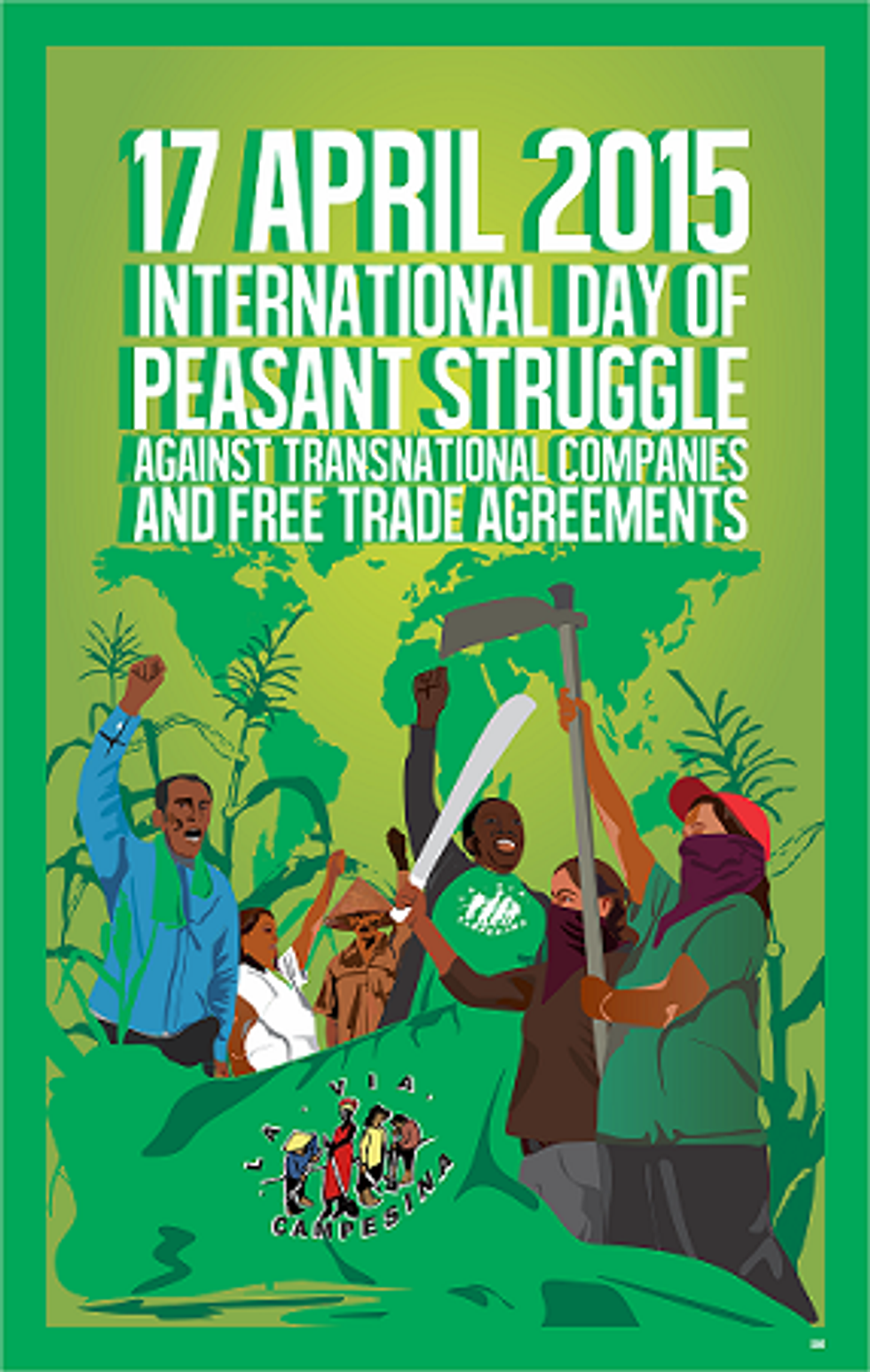
This week activists around the world will take to the streets for two days of action to challenge corporate power. Friday is La Via Campesina's International Day of Peasant Struggle when food producers will gather to resist the global takeover of land, seeds and livelihoods by big business.
This week activists around the world will take to the streets for two days of action to challenge corporate power. Friday is La Via Campesina's International Day of Peasant Struggle when food producers will gather to resist the global takeover of land, seeds and livelihoods by big business. Then on Saturday, thousands of citizens will demand an end to free trade deals, including the Transatlantic Trade & Investment Partnership (TTIP) currently being hammered out by the EU and US governments.
So why are these days of action back to back? Farmers are some of the hardest hit by free trade deals that hand control of our food systems to corporations. Here are five reasons why TTIP and similar trader deals would be bad news for farmers:
1. Democracy, the Coca Cola way
The US and EU governments have been lambasted for negotiating TTIP behind closed doors. But one group has had plenty of access to decision makers- corporate lobbyists. During TTIP's preparation phase, no sector lobbied the European Commission more than agribusiness sector. In fact, food and agri-trader lobbyists, including those for Unilever, Nestle and Coca cola, had more contact with the commission than those from the pharmaceutical, chemical, financial and car industries put together. Yet small-scale farmers have been left out in the cold. The UK's Land Workers Alliance said, "We believe this process is wholly undemocratic and undermines the integrity of those governments who seek to make an example of their democracy."

2. (T)Tipping the playing field
The US and EU governments currently provide support for their farmer through a series of tariffs on key goods to ensure that their sectors are not undermined by cheap imports or fluctuations in global trade. Yet under TTIP, many of these tariffs could be removed. US and EU small-scale farmers, already playing on an uneven playing field with big business, fear that they would fail to operate under TTIP's reforms. Some have said that they would be forced to adopt more intensive farming methods, forgoing sustainable and traditional practices.
3. Sowing the seeds for Monsanto
Due to the EU's tight restrictions on genetically-modified (GM) plant materials, EU farmers have been largely free from the control of GM seed companies. Yet in the US, where growth of GM food is widespread, farmers have faced rising debts under contracts for GM seeds with companies like Monstanto and Syngenta. Others have been sued after their crops have been contaminated with the companies' patented produce. While EU officials have denied that GM laws will change under TTIP, US negotiators have made clear they will continue to push the EU to reform these policies under the trade deal.
4. This land is.... your land?
One of the biggest barriers in building a better, fairer food system is the price of land. With corporations buying up land for large-scale farms, or simply to speculate on its price, small-scale and young farmers are being priced out. It's no wonder that only 6% of both EU and US farmers are under thirty-five. With TTIP's free market reforms, land prices would rocket even higher. Any hope of land reform (currently being mooted in Scotland) could be challenged through TTIP's proposed Investor State Dispute Settlement that would let corporations take states to court if new policies impede their ability to make profit.
5. Local food? Overruled
Across the US and Europe, local authorities are using their buying power to support local, sustainable food economies. New schemes and polices are seeing local governments ensure that state institutions like schools use public money to buy good food from local growers. Yet both EU and US TTIP negotiators see this a threat to the free trade doctrine, and are calling for such public procurement policies to be overruled..
Find an action near you on Global Trade Day
For millennia, the practice of saving and exchanging seeds has been fundamental to crop production in farming communities across the globe. Now, faced with a growing push on the part of governments and corporate agribusiness to limit this practice and thus threaten the food sovereignty of millions, farmers worldwide are fighting back.
International peasant farmer and food justice groups La Via Campesina and Grain on Wednesday released a new publication detailing how corporate interests are threatening these age-old techniques through privatization, so-called free trade agreements, and aggressive 'seed laws,' and what small farmers and indigenous groups are doing to resist these efforts.
According to the publication, entitled Seed Laws That Criminalize Farmers: Resistance and Fightback (pdf), since the rise of 'seed laws,' which grew from the large-scale production and commercialization of seeds, the traditional practice of seed saving and sharing has been under threat.
While 'seed laws' often refer to intellectual property rules such as patent laws, the report notes that the criminalization of peasant seed practices comes in a number of forms, including "those that regulate trade and investments; regulations related to the health of plants; certification and so-called 'good agricultural practices' related to marketing; or so-called biosafety regulations."
These laws are often passed at the behest of biotechnology companies such as Monsanto, Dow, and Syngenta, which boast a "very strong" lobbying machine. Further, they are usually crafted with vague, misleading language and ushered through under a veil of "misinformation" and "secrecy," the report adds.
"As a whole," it continues, "these laws often result in peasant seeds being decreed illegal, branded as inadequate, and treated as a source of risk to be eliminated."
So what can be done?
Grain and La Via Campesina hope their document will serve as a resource to "strengthen the resistance by ensuring that as many people as possible--especially in the rural communities that are most affected--understand these industry-backed laws, their impacts and objectives, as well as the capacity of social movements to replace them with laws that protect peasants' rights."
Already, grassroots groups empowered with information are resisting these efforts.
In Ghana, a coalition of students, trade unions, and small scale farmer organizations have mobilized against a pending Plant Breeders' Rights Bill, that would place aggressive legal restrictions against a farmer's use of seeds--giving preference to cash crops and paving the way for transnational corporations to operate in that country.
In 2014, Chilean farmers won an important victory against an attempt to privatize peasant seeds, which industry lobbyists and government pushed for years.
Mexican farmers are currently embroiled in a massive fight against an effort to introduce genetically modified (GM) maize in that country. As the groups describe:
When it was announced that corporations would seek to plant GMOs on a large commercial scale (on an area of over 4 million hectares--as large as the country of El Salvador), a broad mobilisation began. Alliances were formed among peasant communities, indigenous peoples, trade unions, academics, urban groups and others to alert the public about the threat of contaminating maize in its world centre of origin. As a part of this mobilisation, farmers organised a hunger strike in the spring of 2012. Finally, since 2013, a coalition of farmers organisations and their allies have been pursuing a legal action. Their efforts have resulted in a court ruling that has, at least for now, stopped the commercial planting of GM maize.
In a statement, Guy Kastler with La Via Campesina declared, "Control over seeds must remain in peasants' hands."
"This is the principle, based in the production process, that guarantees the food sovereignty of rural communities and urban populations against multinationals and their enormous profits," Kastler continues. "Over centuries, peasant farmers have created the thousands of varieties of crops that are the basis of the world's food supply and diversified diets."
Collective adrenaline ran high as the World Social Forum opened on March 24 in Tunis. It had not yet been five years since a peaceful revolution brought a dictatorship long backed by Western political superpowers to its knees and ignited the fire of the Arab Spring that burns to this day. And it had not yet been a week since shooters stormed the Bardo Museum, killing 22, and retesting the resolve of a delicately budding democracy.
Tens of thousands of delegates from across the globe converged in Tunis not only to show support for Tunisian sovereignty, but also to share their own local struggles and solutions while advocating change in the face of interlinked systemic injustices. The opening march easily demonstrated the diversity of the constituency--bands of Tunisian students in perfect stride with Latin American labor organizers and Sub-Saharan African small-scale food producers, knit together by the unraveling food, climate, energy, and financial crises.
Amidst this vibrant mix of social actors, it was no coincidence that Via Campesina, the world's largest--and arguably best organized--movement showed up in full force with a delegation from five continents. "It is on us to do something," said Elizabeth Mpofu, the Zimbabwean farmer and organizational powerhouse who leads Via Campesina's 250+ million peasant, pastoralist, fisher and indigenous members. "We know we are poor, but we are also very intelligent, and we know what we want," she added.
Via Campesina has shown repeated political sophistication in articulating exactly what it wants as a movement, especially in direct confrontation to the present tetrad crisis. In 1996, the movement spotlighted the term "food sovereignty", challenging corporate control of agriculture and putting access to food precisely where it belongs--in the hands of rural peasant producers. Although it remained in relative obscurity in its nascent days, the concept of food sovereignty has now entered a wide variety of transnational, as well as national and local, policy spaces.
Representatives from and allies of Via Campesina have always been careful to connect hunger and power in the global food system to governance of natural resources, principally land and water. A variety of mainstream development trends threaten smallholder land tenure, from special economic zones to extractive industries to monocrop agricultural production for export. Critics point to these large-scale resource transactions as land grabs contributing to a global land rush that dispossesses marginalized people from their territories en masse.
"In Mali, we have seen a frontal attack on our land," said Massa Kone, a leader from the Malian Convergence Against Land Grabbing (CMAT), a growing alliance that includes prominent Via Campesina member organizations. Kone explained that in his native West African agro-pastoralist country par excellence, 87 percent of the population is engaged in food production. Land grabs for big agriculture routinely menace that livelihood, where the insolvent Malian government offers land leases of up to 99 years and other alluring incentives to multinational corporations.
But CMAT is fighting back. "We have forced the government to listen to us, and we are now regarded as a key actor on all land issues in Mali," said Kone. "Our convergence is leading toward a new land law with peasants leading that process," he elaborated excitedly.
In fact, CMAT is part of a broader alliance of African social movements that penned the Dakar Declaration Against Land and Water Grabbing at the October 2014 African Social Forum in Senegal. That statement, firmly denouncing corporate and state takeovers of land and water, opened the way for an urgently needed global convergence of struggles--one that would subsequently be debated at the World Social Forum.
Delivering on that promise, Via Campesina and a cluster of its strategic allies organized a three-day global convergence of land and water struggles in Tunis--providing firsthand accounts of resource rights violations across multiple geographical spaces, and introducing tools ranging from grassroots organizing practices to international governance and human rights mechanisms to address those interrelated land and water grievances. It also offered a vital space from where to strategize on how to build unity and coordinated action in the face of adversity.
This participatory and organic process culminated in a new declaration that underscores the urgency of land and water grabs as well as community pledges for action and specific policy asks. Perhaps even more importantly, in the early stages of broadening the convergence, authors of the Dakar declaration brought the initiative to Tunis as an invitation to global allies to debate and add to the ideas and claims outlined in the original document--and in so doing, build the power needed to stop land and water grabs.
Adding to the energy in Tunis, strong political connections were also forged between varied convergences--including, but not limited to, the land and water process. Seasoned activists organized a climate convergence to accentuate the disproportionate approaches to the climate crisis that sideline marginalized communities in the Global South while wealthy governments and corporations accelerate their pollution. Additionally, delegations to Tunis coordinated a global convergence of resistances to corporate power that featured a series of campaign strategy workshops to build alternatives to free trade, squarely placing people and the planet before profits. Via Campesina co-convened each of these processes.
A new resolve emanated across these spaces with a final convergence of convergences, where activist organizers from the land and water, climate, and resistance to corporate power meetings were able to identify systemic faults underpinning the food, climate, energy, and financial crises. It also opened windows for concerted action in relevant global political gatherings such as the upcoming COP 21 in Paris. "In order to maintain order in this world, we need these conversations," reflected Carlos Marentes, a Via Campesina leader and farmworkers' organizer from the U.S.-Mexico border.
As the World Social Forum closed on March 28 with yet another march through downtown Tunis, many voiced one of its founding slogans: another world is possible. And echoing the spirit of the revolution that rocked the small North African nation not so long ago, frontline activists showed determination in building their own future--however trying that process might be.
A new report by NASA and the National Oceanic and Atmospheric Administration (NOAA) indisputably confirms what many scientists had predicted: 2014 is officially the hottest year on record. And this past year is not an anomaly--the previous ten hottest years on the books have all occurred since 1998.
A new report by NASA and the National Oceanic and Atmospheric Administration (NOAA) indisputably confirms what many scientists had predicted: 2014 is officially the hottest year on record. And this past year is not an anomaly--the previous ten hottest years on the books have all occurred since 1998. This announcement adds to the urgency expressed just last month in Lima, where political leaders and business tycoons from around the world met for the 20th yearly session of the Conference of the Parties (COP 20) to the UN Framework Convention on Climate Change (UNFCCC). The gathering in Peru was historic in that it was the last time the decision-making body would meet before COP 21 in Paris next December, where an international and legally binding agreement on climate will be signed.
However, growing movements of those on the frontlines of climate disruption argue that the high-level political remedies touted at venues such as the COP amount to false promises and leave out marginalized voices. Via Campesina is perhaps the most prominent of these movements, with more than 250 million peasant, pastoralist, and indigenous members from around the world. Along with allies ranging from labor to environmental networks, Via Campesina organized the Cumbre de los Pueblos (Peoples Summit) in its own grassroots rendition of the COP 20 process in Lima to promote bottom-up solutions to the climate crisis and refute the corporate-driven and exclusionary nature of the official negotiations.
Two policies highly promoted at COP 20 were Reducing Emissions from Deforestation and Forest Degradation (REDD) and Climate-Smart Agriculture, both aimed at reducing temperatures worldwide through carbon trading. At a first glance, REDD and Climate-Smart Agriculture appear laudable actions--especially given what are seemingly climate-friendly names. But under the surface, these programs create chaos within already volatile ecosystems and sabotage humble livelihoods.
Take REDD for example. In a nutshell, REDD allows wealthy industrialized countries and corporations to continue polluting by buying forests in the Global South to offset the carbon they release into the atmosphere through their practices elsewhere. These forests, meticulously managed by generations of indigenous people, are folded into the market--often resulting in the forced eviction of communities. Even worse, REDD makes no distinction between natural forests and industrial tree plantations--meaning that its implementation often results in massive loss of biodiversity.
"There is no excuse to turn nature into a commodity," said Tom Goldtooth, director of the U.S. and Canada-based Indigenous Environmental Network, a close ally of Via Campesina. Both groups are strongly opposed to REDD and work together in spaces such as the No REDD in Africa Network. Goldtooth spoke powerfully at the Peoples Summit in Lima, warning against the interconnected nature of imperialism, militarization, and market-dependent strategies. "We reject the WTO of the sky," he concluded.
Climate-Smart Agriculture, another centerpiece strategy to the COP proceedings, basically takes the tenets of REDD and applies them to farmland. Between 44 and 57 percent of all greenhouse gas emissions are from food production, and the overwhelming majority of these discharges are the direct result of wasteful industrial agriculture. Climate-Smart Agriculture builds on staples of the Green Revolution--modified seeds, chemical pesticides, and synthetic fertilizers in the name of intensification and productivity--to impose new biotechnology on farmers around the world, creating yet another wave of dependency on markets. Just as with REDD, investors from the Global North will receive carbon credits from their contribution to Climate-Smart Agriculture projects in the Global South, thus increasing speculation within the food system by expanding its profit value.
"There's absolutely nothing smart about 'Climate-Smart Agriculture.'"--Chavannes Jean-Baptiste, La Via Campesina in Haiti
"There's absolutely nothing smart about it," said Chavannes Jean-Baptiste, a Haitian Via Campesina leader who coordinates the movement's work around climate change, in a critical workshop on Climate-Smart Agriculture in Lima. "The climate crisis is rooted in capitalism, which is also in crisis as an economic system," he explained. "Entrepreneurs are trying to emerge from this crisis, and as a way of doing so are creating green capitalism, of which Climate-Smart Agriculture is typical."
The slogan of the Peoples Summit in Lima--"change the system, not the climate"--is one that will persist throughout the year and into next December's COP 21 in Paris, where a parallel Peoples Summit will again accompany official negotiations. Via Campesina and its tight network of allies are committed to their cutting-edge alternatives, particularly food sovereignty and agroecology.
Food sovereignty assumes the fundamental principal that rural working people and their urban counterparts--not market institutions and corporations--should govern the global food system. Agroecology is the key practice for realizing food sovereignty, building local markets through ecological methods grounded in tried-and-true ancestral knowledge. In that process, carbon is sequestered in the soil--helping to curb global warming patterns while protecting territorial rights. "Agroecology can double food production in entire regions within ten years, while mitigating climate change and alleviating rural poverty," stated Olivier de Schutter, former UN Special Rapporteur on the Right to Food upon presentation of his March 2011 report to the Human Rights Council.
REDD and Climate-Smart Agriculture are experimental programs with irreversible implications on the environment, while food sovereignty and agroecology respect the earth's natural systems. "Food sovereignty is our struggle against capitalism and the way it shapes our land," said Nivia Regina da Silva, representative of the Landless Workers Movement (MST) in Brazil. MST is a founding member movement of Via Campesina that, among other initiatives, runs political training and agroecology schools throughout the country. Along with other Via Campesina members and allies, MST organized a lively conference on food sovereignty that was a focal point of the Peoples Summit in Lima.
"Peasant agriculture can feed the world and cool the planet," affirmed Jean-Baptiste.
Via Campesina's activism around climate is integral to its obligation of representing those most affected by systemic injustice. And this year, while high-level negotiations further unfold, the movement and its allies will be sure to turn up the heat every step of the way.
The U.S. Court of Appeals ruled in favor of Monsanto and its patented seeds last Monday by throwing out a case tirelessly petitioned for by organic farmers. That decision dealt yet another blow to the small-scale agricultural community--it was only last month that the U.S. Supreme Court unanimously affirmed the agricultural giant's "license agreement" yet again.

But Via Campesina, the global agrarian movement made up of more than 200 million peasants in 80 countries, is not ceding to big agriculture. This week, Via Campesina held its VI International Organizing Conference in Jakarta, Indonesia, reaffirming its fundamental commitment to seed sovereignty.
With the Green Revolution came a promise to end hunger through so-called miracle seeds. Instead, it ushered in seed property rights, domination and even criminalization of small-scale farmers, and waves of transnational corporate control of agriculture. Under "Monsanto Laws," more specifically known as UPOV 91, patents prohibit farm-saved seeds and peasant seeds for which multinational corporations have filed patents. UPOV 91 works hand-in-glove with the Plant Variety Protection Act that asserted heritage seeds counterfeit to standardized industrial varieties.
These policies, adopted by one country after another, routinely displace peasants in the Global South and wreak havoc on the environment. In the Global North, native seeds have nearly reached extinction while hybrid (and often chemical GMO) varieties take their place.
"After 30 to 40 years of the Green Revolution, we've lost our seeds," said Guy Kastler, a small-scale farmer from France. Kastler explained that he and other agricultural activists from Europe traveled to Latin America, Asia, and Africa to find and learn about peasant seeds. Those learning exchanges led Via Campesina to launch its Seed Campaign in 2001, through which it advocates the recovery, protection, and preservation of peasant seeds in each of its geographic regions--with a specific focus on those hardest hit by corporate seed policy.
Chile--a laboratory for neoliberalism--has churned out some of the worst agricultural policies in Latin America. Francisca "Pancha" Rodriguez defied Pinochet's unmerciful military regime, literally carrying indigenous seeds in the folds of her skirts across international borders where they could be safely stored while her husband fought on the revolutionary frontlines. Today Pancha plays an integral role in Via Campesina's Seed Campaign through the National Association of Indigenous and Rural Women (ANAMURI). She has trained countless women at home and across the world. "Locally, we understood what would happen if people lost their seeds," Pancha offered, "But this is not only our battle. It is a universal struggle that we are turning into a rural revolution."
Chukki Nanjundaswamy, a farmer who is part of Karnataka State Farmers Association (KRRS), explained that when Green Revolution technology hit India in the '60s peasants lost seeds because they were told to use modified high-yield varieties. "At first the companies offered free packets, but then they started charging," she said. "High-yield seeds don't grow in the rain-fed regions where sixty percent of Indian farmers work." Through KRRS and Via Campesina, Nanjundaswamy breeds natural seeds on her own farm, sets up community seed banks with local activists, and advocates Agroecology through zero-budget natural farming.
"Seeds are life," Nelson Mudzingwa, a farmer from Zimbabwe, passionately explained. "Without seeds there is no food, and without food there is no life." Nelson's local grassroots movement, Zimbabwe Small Organic Farmers Forum (ZIMSOFF), was only ratified as a Via Campesina member organization this week--but its advocacy around seeds has been more than a decade in the making. In fact, Nelson himself has been saving heirloom seeds ever since he can remember, and said that it is at the heart of agricultural tradition passed down from his forefathers. "On my farm, not even a single grain grows from outside my fence," he proudly added.
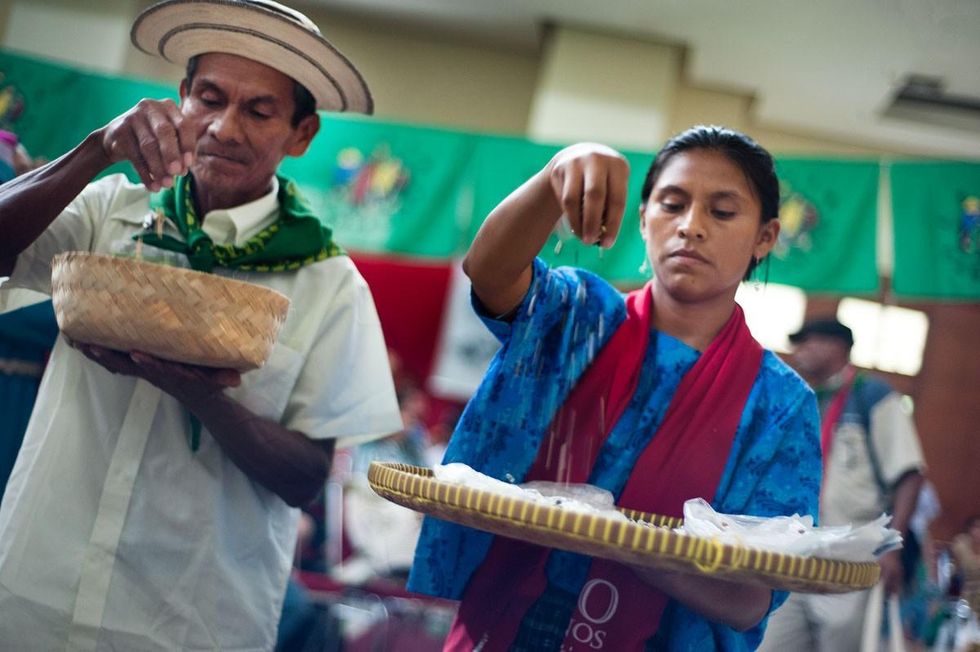
One of the main events at Via Campesina's gathering this week was an outdoor Agroecology fair where farmers exchanged experience and practices. That learning opportunity closed with a ceremony in which farmers exchanged their indigenous seeds from five continents. Peasant activists throughout the movement, working on complex interrelated issues--from land grabs to climate change to migration--agree that it all starts with control of their seeds.