SUBSCRIBE TO OUR FREE NEWSLETTER
Daily news & progressive opinion—funded by the people, not the corporations—delivered straight to your inbox.
5
#000000
#FFFFFF
To donate by check, phone, or other method, see our More Ways to Give page.
Daily news & progressive opinion—funded by the people, not the corporations—delivered straight to your inbox.
"Outside group spending this year is almost double the rate of any prior year," noted one critic. "Not a good thing."
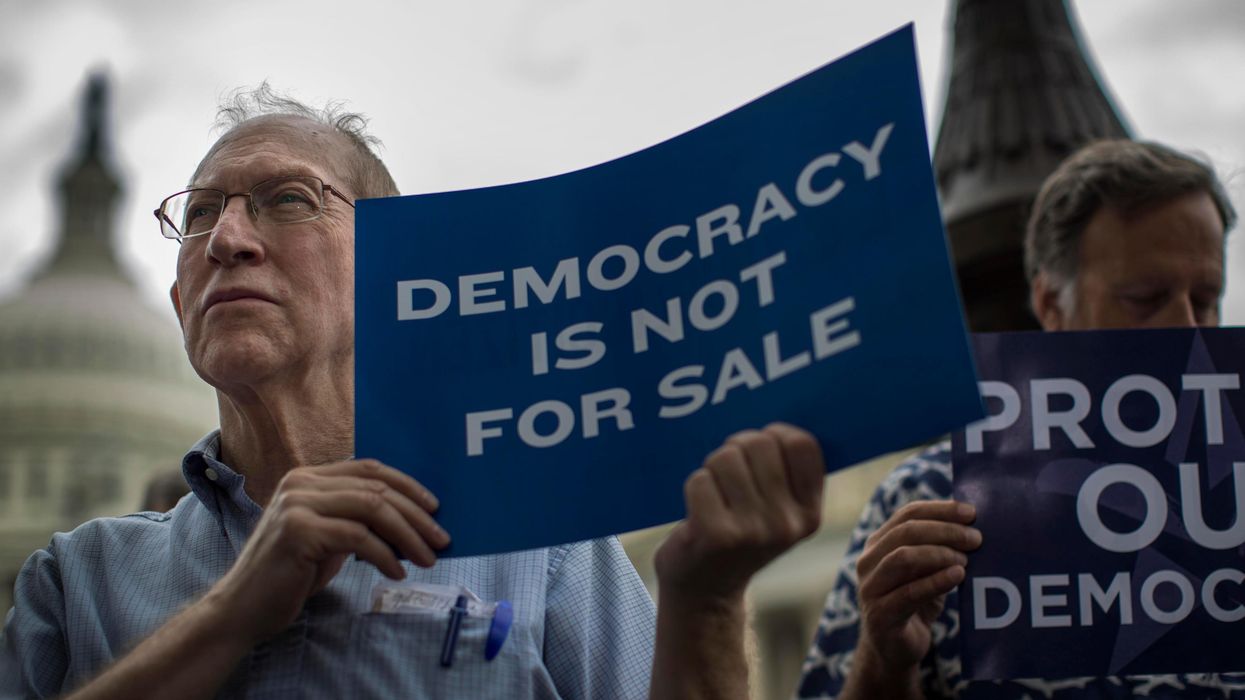
Empowered by the U.S. Supreme Court's 2010 Citizens United v. Federal Election Commission ruling allowing unlimited independent financial contributions to support political campaigns, outside spending during the current election cycle has hit a record $1 billion, according to a report published Thursday by the watchdog group OpenSecrets.
"Super PACs and other outside groups that can raise and spend unlimited sums of money have poured about $1.1 billion into 2024 federal elections as of August 15—nearly twice what similar groups spent over the same period in the 2020 presidential election cycle when independent expenditures hit an all-time record," OpenSecrets said.
"More than half of all outside spending during the 2024 cycle—about $585.8 million—has gone into the presidential election, which saw an especially expensive Republican presidential nominating contest," the group added.
"The largest spender, by far, is former President Donald Trump's flagship super PAC, Make America Great Again Inc.," the report notes. "To date, MAGA Inc. has spent about $125.1 million boosting Trump in the presidential election, including nearly $33.2 million attacking his GOP rivals and more than $65.6 million opposing President Joe Biden."
"Future Forward and American Bridge 21st Century, the first and second-largest Democratic hybrid PACs, have spent a combined $74.7 million on the presidential race as of August 15," the publication adds. "Both super PACs pivoted to supporting Vice President Kamala Harris after Biden suspended his campaign last month."
Other key findings in the report include:
AIPAC—which vowed to spend $100 million on 2024 elections—played a key role in defeating Democratic Reps. Jamaal Bowman (N.Y.) and Cori Bush (Mo.) in recent primaries. The group has come under fire for attacking Black and brown members of Congress and for supporting Republicans who took part in Trump's attempt to overturn the 2020 presidential election results.
In an effort to curb the flood of dark money and other outside spending, House Democrats led by Reps. Adam Schiff (Calif.), Pramila Jayapal (Wash.), Dean Phillips (Minn.), and Jim McGovern (Mass.) last year
proposed a constitutional amendment to overturn Citizens United.
" Citizens United was one of the most egregious enablers of special interest money, but it was only the latest in a long line of Supreme Court cases that opened the floodgates," Schiff's office said at the time. "To truly rein in dark money, we must amend our Constitution."
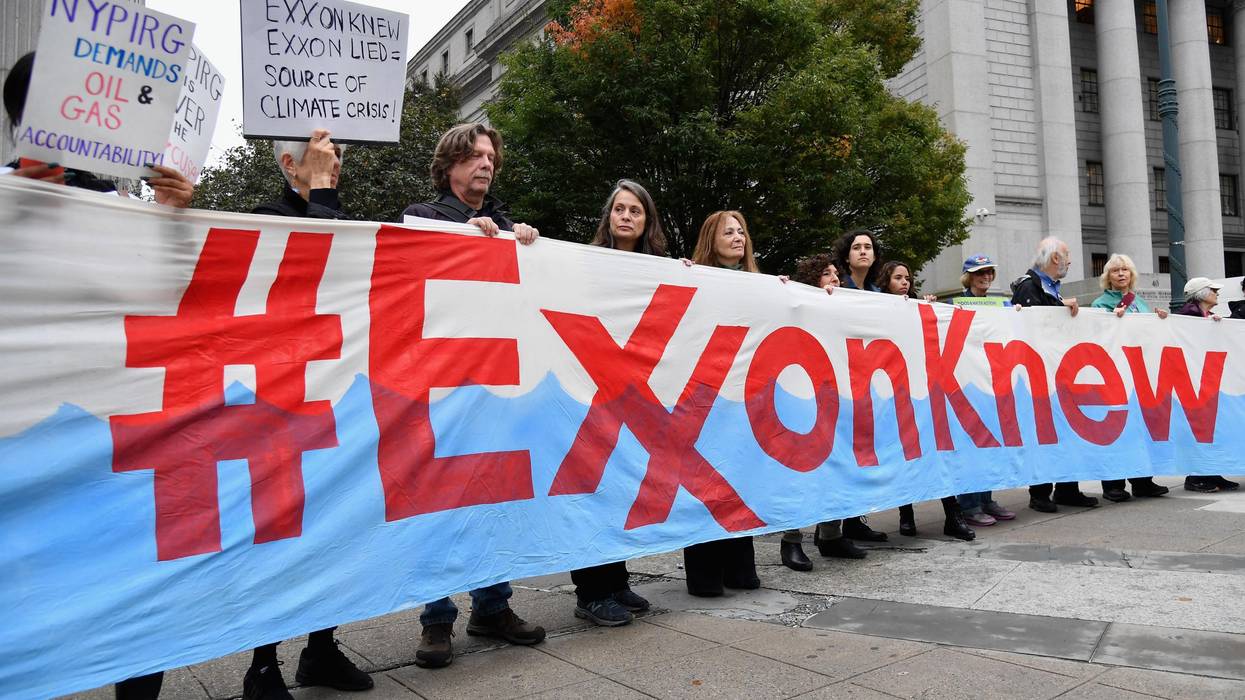
The lies uttered and underwritten by the Koch brothers and ExxonMobil executives—as well as their employees and PACs’ contributions to climate science deniers in Congress—have had serious consequences.
I have spent the better part of the last 12 years writing about lies. My colleagues call it “disinformation,” and I generally do, too, but let’s call it for what it is: lying. During this stretch, I have written more than 200 articles and columns, and most of them were either about CEOs who lie, experts who lie, scientists who lie, attorneys general who lie, legislators who lie, or a president who lies. And I’m not talking about run-of-the-mill white lies. I’m talking about lies that have grave consequences for the future of the planet.
(I should add that I also wrote 65 columns featuring Q&As with scientists and experts who work for my organization, theUnion of Concerned Scientists, or UCS. They don’t lie. They follow the science. The series is called “Ask a Scientist,” and the last one I wrote will run in mid-May.)
After a dozen years unmasking lies and five years before that overseeing UCS’s media relations operation, I am leaving the organization. But before I walk out the door, I wanted to provide a retrospective of some of my columns on the biggest sponsors of climate disinformation in the country: ExxonMobil CEO Darren Woods; his predecessor, Rex Tillerson; and Charles Koch, CEO of the coal, oil, and gas conglomerate Koch Industries.
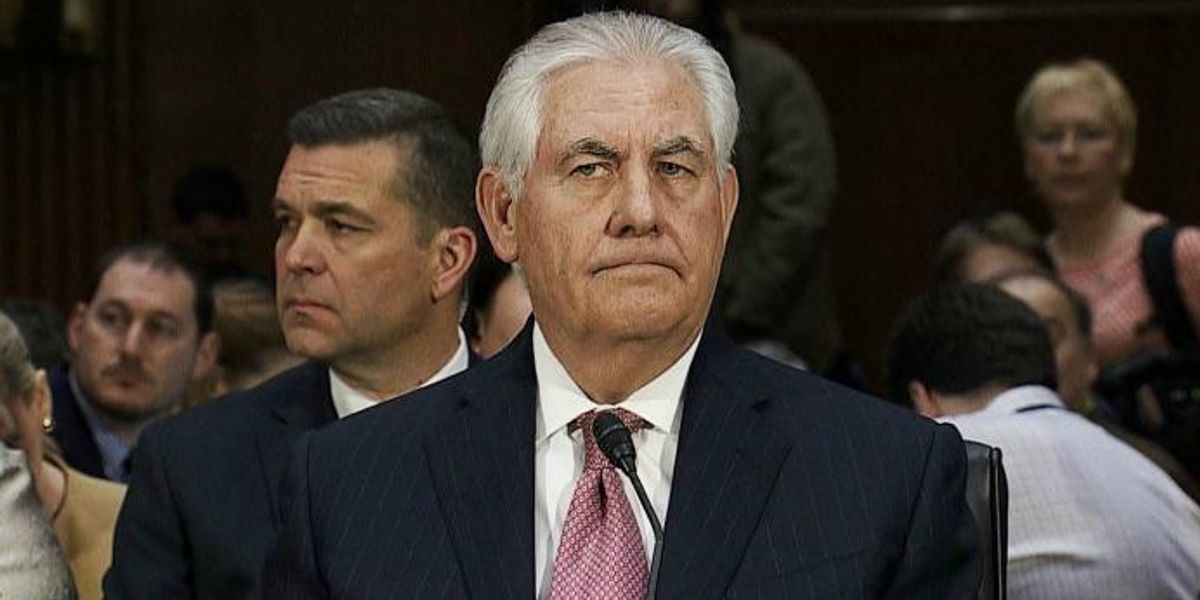
ExxonMobil CEO Rex Tillerson appears at his confirmation hearing on Capitol Hill. (Photo: NBC News/Screengrab)
I wrote more columns about ExxonMobil and its top executives than any other major source of climate lies. Most of these pieces were about the company’s support for a seemingly independent network of anti-regulation, “free-market” nonprofits that spread falsehoods about the reality and seriousness of climate change. ExxonMobil spent at least $39 million on some 70 of these organizations from 1998 through 2020, more than any funder besides Charles Koch and his brother David, co-owner of Koch Industries until his death in 2019.
I first wrote about ExxonMobil in March 2013 after I saw the company’s then-CEO, Rex Tillerson, on the Charlie Rose talk show, who provided me with fodder for perhaps my favorite of two dozen ExxonMobil-related columns.
Rose asked Tillerson open-ended questions on a range of subjects, including climate change and national energy policy. And Rose did, at times, ask follow-up questions. But in nearly every instance, Rose listened politely, refrained from challenging Tillerson on the facts, and went on to his next question. So I decided to write a column in which I pretended to have been on the show alongside Tillerson, calling it “Rex & Me: The Charlie Rose Show You Should Have Seen Last Friday,” a nod to Michael Moore’s first film, Roger & Me.
ExxonMobil wants to be seen as a good corporate citizen. It wants to protect what academics call its “social license,” meaning that it wants to be seen as being legitimate, credible, and trustworthy. At the same time, however, the company has continued to expand oil and gas development and fund climate science denier groups that undermine efforts to address climate change.
The column featured excerpts from Rose and Tillerson’s hour-long conversation with comments I inserted as if I were sitting there in the studio rebutting Tillerson’s statements.
Rose first asked Tillerson about his take on global warming. Repeating his company’s long-standing talking point, Tillerson emphasized scientific uncertainty, despite the fact that Exxon’s own scientists had been warning management about “potentially catastrophic” human-caused global warming since at least 1977. “We have continued to study this issue for decades…,” he said. “The facts remain there are uncertainties around the climate, climate change, why it’s changing, what the principal drivers of climate change are.”
In my retelling of the show, I quickly pointed out that the United Nations Intergovernmental Panel on Climate Change had by then concluded that “most” of the increase in average global temperatures since 1950 was “very likely” due to the increase in human-made carbon emissions.
When Rose asked Tillerson if there is a link between extreme weather events and global warming, Tillerson told Rose that he had “seen no scientific studies to confirm [one].” In the original broadcast, Rose went on to another topic. But before he was able to do that in my imaginary scenario, I corrected the record. “There is, in fact, substantial scientific evidence that there’s a strong link between global warming and heat waves and coastal flooding from sea-level rise,” I said. “There’s also a strong link to heavy precipitation and drought, depending on the region and time of the year.”
Later in the hour, Tillerson told Rose that the federal government should end subsidies for renewable energy. “I mean, wind has received subsidies for more than 20 years now,” he said. “Maybe if we took the subsidy off and it was challenged and had to perform, people would take it to a new level.”
It was a bogus argument that fossil fuel proponents would repeat ad nauseum over the next 10 years, so when Rose failed to provide some needed context, I jumped in.
“Rex,” I interjected, “it’s bizarre that your top national energy priority is ending federal support for renewables… [W]hat about the oil and gas industry’s subsidies and tax breaks?” I then explained that, at the time, the oil and gas industry had been receiving an average of $4.86 billion (in 2010 dollars) in federal tax breaks and subsidies for nearly 100 years. “Renewables,” I added, “have gotten peanuts in comparison.”
Four years later, when Tillerson testified before the Senate Foreign Relations Committee after former President Donald Trump nominated him to be his secretary of state, a senator asked him if he would pursue the Group of 20 pledge to eliminate fossil fuel subsidies. His reply? “I’m not aware of anything the fossil fuel industry gets that I would characterize as a subsidy.”
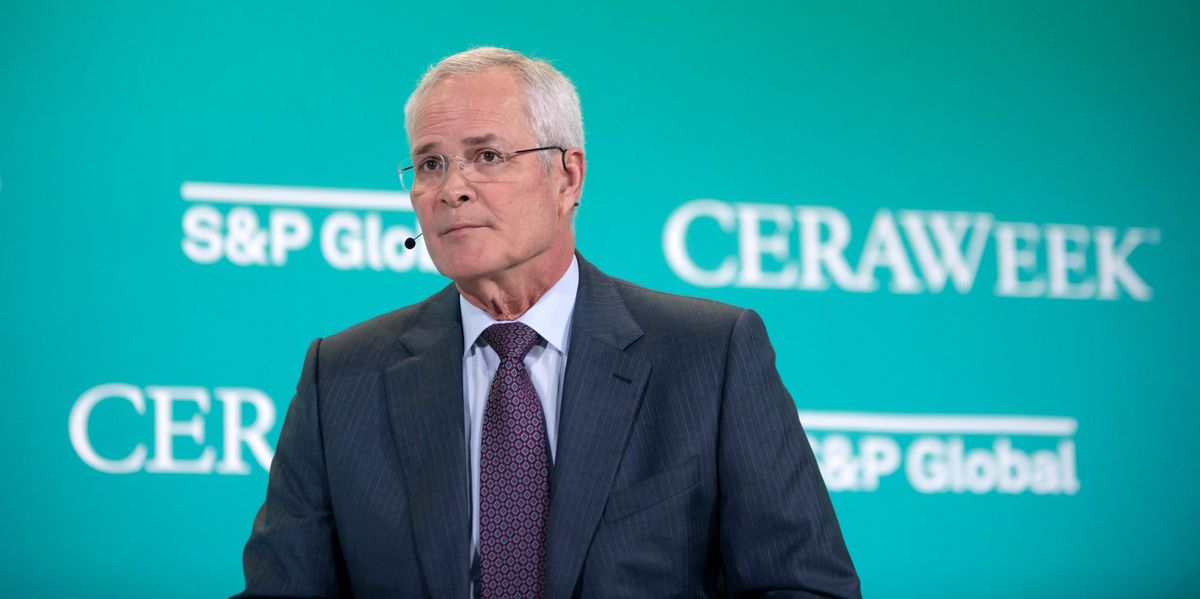
Exxon CEO Darren Woods speaks at an international energy conference. (Photo: Mark Felix/AFP via Getty Images)
Tillerson’s successor, Darren Woods, now 59, has carried on his company’s tradition of deceit. During an October 2021 hearing the House Oversight and Reform Committee held on the oil industry’s decades-long climate disinformation campaign, Woods—one of four oil company executives testifying that day—was asked if he would “commit right here to stop funding organizations that reject the science of climate change.”
“We do not support climate denial,” he replied. “We do not ask people to lobby for anything different than our publicly supported [climate] positions.”
The history of that lie bears retelling. For years, ExxonMobil executives have acknowledged climate change is happening—but not its cause—and insisted they want to be “part of the solution.” And since 2015, they have claimed that their company supports the goals of the Paris climate agreement, which was brokered that year. Why? ExxonMobil wants to be seen as a good corporate citizen. It wants to protect what academics call its “social license,” meaning that it wants to be seen as being legitimate, credible, and trustworthy. At the same time, however, the company has continued to expand oil and gas development and fund climate science denier groups that undermine efforts to address climate change.
The genesis of ExxonMobil’s brazen hypocrisy can be traced back to 2007. In January of that year, UCS released consultant (now UCS editorial director) Seth Shulman’s report, “Smoke, Mirrors, and Hot Air: How ExxonMobil Uses Big Tobacco’s Tactics to Manufacture Uncertainty on Climate Science,” revealing that the company had spent $16 million between 1998 and 2005 on more than 40 anti-regulation think tanks to launder its message. When asked by a Greenwire reporter a month later about the grantees identified in the UCS report, Kenneth Cohen, then ExxonMobil’s vice president of public affairs, said the company had stopped funding them. Hardly. In 2007 alone, the company gave $2 million to 37 denier groups, including the American Legislative Exchange Council, Heartland Institute, and Manhattan Institute.
In July 2015, after UCS discovered that Exxon (before it merged with Mobil) was aware of the threat posed by climate change more than 30 years earlier and had been intentionally deceiving the public for decades, reporters contacted ExxonMobil spokesman Richard Keil for comment. One reporter asked him about ExxonMobil’s long history of funding climate change denier groups. “I’m here to talk to you about the present,” Keil said. “…We do not fund or support those who deny the reality of climate change.”
I wrote a column a week later dissecting Keil’s carefully crafted whopper. “Technically [Keil was correct], perhaps, because practically no one can say with a straight face that global warming isn’t happening anymore,” I wrote. “Most, if not all, of the people who used to deny the reality of climate change have morphed into climate science deniers. They now concede that climate change is real, but reject the scientific consensus that human activity—mainly burning fossil fuels—is driving it. Likewise, they understate the potential consequences, contend that we can easily adapt to them, and fight government efforts to curb carbon emissions and promote renewable energy. ExxonMobil is still funding those folks, big time.”
By its own accounting, ExxonMobil has continued to fund those folks—albeit fewer of them—to this day. For at least a decade, the company has been listing its grantees in its annual World Giving Report, and beginning in 2015 I wrote a column every year citing how much it gave climate science denier groups the previous year until its 2021 report on its 2020 outlays, when it stopped listing grantees receiving less than $100,000. Previously, its reports included grants of $5,000 or more. That lack of transparency has made it impossible to discern exactly how much the company is still spending on climate disinformation, but nonetheless it amounts to hundreds of thousands of dollars a year.
My 2021 column on the company’s grants from 2020, “Despite Cutbacks, ExxonMobil Continues to Fund Climate Science Denial,” ran two days before Woods and top executives from BP America, Chevron, and Shell testified before the House Oversight Committee. Despite Woods’s insistence at the hearing that his company does not support “climate denial” and does not ask its grantees to support anything other than its official climate-related pronouncements, three ExxonMobil grantees that received at least $100,000 in 2020 contradicted the company’s professed positions. They included a climate science-denying economist at the American Enterprise Institute (AEI), which has received more than $5 million from ExxonMobil since 1998; George Washington University’s anti-regulation Regulatory Studies Center, which opposed stronger efficiency standards for home appliances and vehicles that would significantly reduce carbon emissions; and the U.S. Chamber of Commerce, which at the time dubiously called for “the increased use of natural gas” to “further progress” in addressing climate change.
Since I wrote that column, my last one on ExxonMobil’s annual grants, the company’s Worldwide Giving Report in 2022 indicated that in 2021, ExxonMobil contributed another $150,000 to AEI and $150,000 to the GWU Regulatory Studies Center. The company has yet to publish a report for its grantmaking in 2022, let alone 2023.
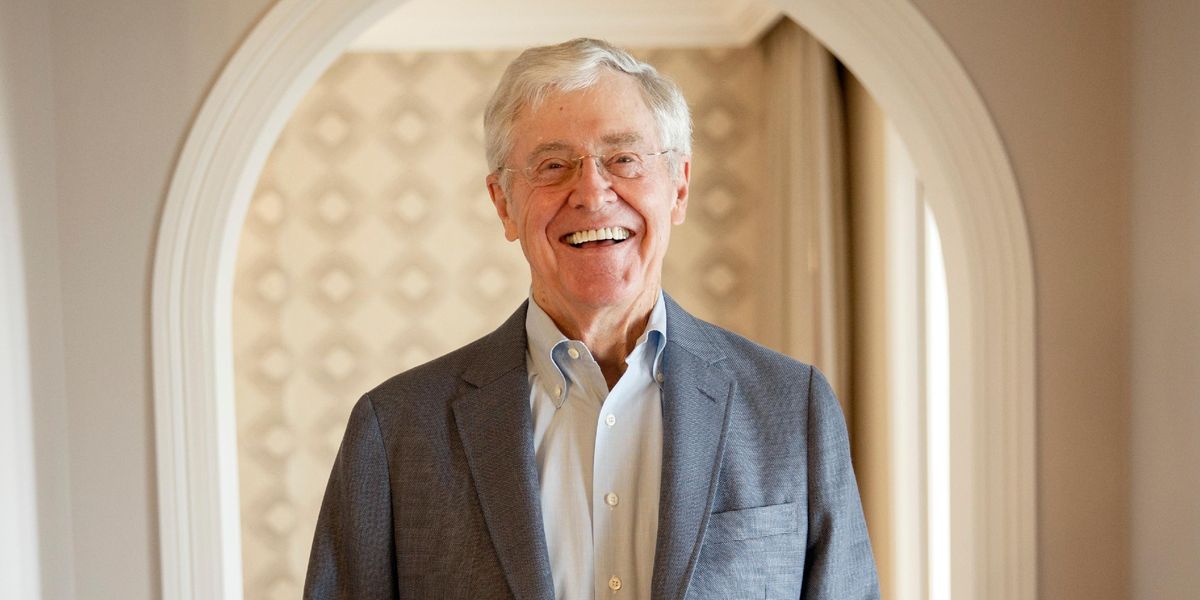
Billionaire Charles Koch stands for a portrait on Monday, August 3, 2015 in Dana Point, California. (Photo: Patrick T. Fallon for The Washington Post via Getty Images)
My other bête noire is the 88-year-old libertarian industrialist Charles Koch—the 22th-richest person in the world with a net worth of $67.6 billion—and his network of uber-rich friends and “free-market” think tanks and advocacy groups. From 1997 through 2020, Koch family-controlled foundations donated more than $160 million to at least 90 groups to manufacture doubt about climate science and delay efforts to address global warming—four times more than even what ExxonMobil reportedly spent over the same time period.
Koch is a lot more doctrinaire than his current counterpart at ExxonMobil. Woods downplays the central role human activity—mainly burning fossil fuels—plays in triggering climate change, but he has grudgingly conceded that global warming poses an “existential threat.” Koch, by contrast, has never acknowledged that climate change is a serious problem and has questioned—with no evidence—the veracity of climate models, which studies have found to be quite accurate.
For more than two decades, the Koch network has been diligently spreading disinformation to sabotage efforts to transition to a clean energy economy, more often than not by attacking proposed climate policies on economic grounds. Over the last 12 years, I wrote eight columns on the Koch network’s escapades, including:
But my favorite Koch column is my most recent one, “It’s Time for Charles Koch to Testify About His Climate Change Disinformation Campaign,” which ran in March 2022. I urged the House Oversight Committee to pull Koch in for questioning before it ended its investigation given the fact that he “is as consequential a disinformer as the four oil company executives who testified last fall … combined.”
Unfortunately, the committee did not take my advice, but the column did give me the opportunity to report on the considerable amount Koch Industries’ political action committees (PACs) and employees spend on campaign contributions, how much the company spends on lobbying, and the fact at least 50 Koch network alumni landed key positions in the Trump administration. They included Education Secretary Betsy DeVos, Energy Secretary Rick Perry, Environmental Protection Agency Administrator Scott Pruitt, White House Legislative Affairs Director Marc Short, and… Vice President Mike Pence, who led Trump’s transition team. Egged on by Koch devotees both inside and outside the government—as well as by more than 60 executive branch staff from the Koch-funded Heritage Foundation—the Trump administration rolled back at least 260 regulations, including more than 100 environmental safeguards.
As I said at the beginning of this essay, the lies uttered and underwritten by the Koch brothers and ExxonMobil executives—as well as their employees and PACs’ generous campaign contributions to climate science deniers in Congress—have had serious consequences.
Last year, the United States suffered an unprecedented number of climate change-related billion-dollar disasters, including record heatwaves, drought, wildfires, and floods, according to the National Oceanic and Atmospheric Administration. The 28 extreme weather events collectively caused nearly $93 billion in damage. Last year also was hottest in at least 173 years, according to the Copernicus Climate Change Service. The annual temperature was 1.48°C (2.66°F) above the preindustrial average.
While the world is burning up, oil industry profits last year—while lower than in 2022—were still quite robust. The two U.S. oil giants, ExxonMobil and Chevron, netted $36 billion and $21.3 billion respectively. Chevron CEO Mike Wirth, one of the oil company executives who testified before the House Oversight Committee in October 2021, boasted that Chevron “returned more cash to shareholders and produced more oil and natural gas [in 2023] than any year in the company’s history.” Meanwhile, Koch Industries’ annual revenue was $115 billion last year, down slightly from $125 billion in 2022. (Because the company is privately held, it is not required to divulge profit data.)
Cities, counties, states, and U.S. territories are now taking steps to hold these and other fossil fuel companies, as well as their trade associations, accountable. So far, some 40 of them have filed 28 lawsuits in state and territory courts for fraud and damages. Chicago and Bucks County, Pennsylvania, 30 miles north of Philadelphia, are the most recent municipalities to file a climate lawsuit. In both cases, the defendants include BP America, Chevron, ConocoPhillips, ExxonMobil, Philips 66, and Shell, as well as the American Petroleum Institute (API), the oil industry’s biggest trade association.
ExxonMobil has been named as a defendant in all of the cases. To date, Koch Industries has been named in only one, filed by the state of Minnesota in June 2020. That lawsuit alleges that API, ExxonMobil, and Koch Industries, which owns an oil refinery in the state, violated state consumer protection laws by misleading Minnesotans about the role fossil fuels play in causing the climate crisis.
As I pointed out in a column about Minnesota’s lawsuit, the state has a storied history when it comes to such litigation. It was one of the first states to sue the tobacco industry, and its lawsuit in the 1990s—the only one that made it to trial—resulted in a groundbreaking settlement of $6 billion over the first 25 years and $200 million annually thereafter. The case also pried 35 million pages of documents from tobacco company files revealing details of the industry’s campaign to sow doubt about the links between smoking and disease. As UCS pointed out in its 2007 exposé of ExxonMobil’s climate disinformation campaign, the tobacco and fossil fuel industries used many of the same strategies and tactics.
U.S. climate litigation is only expected to grow this year, following the U.S. Supreme Court’s rejection of the oil industry’s attempts to transfer climate lawsuits from state courts to federal courts, where industry lawyers believe they are more likely to prevail. If the lawsuits are ultimately successful, courts could order oil companies and their trade associations to pay out hundreds of billions of dollars to impacted communities.
That eventuality, much like the deserved comeuppance the tobacco industry received, would be a just outcome. But even a huge payout wouldn’t begin to compensate for the damage already done by Koch and ExxonMobil lies.
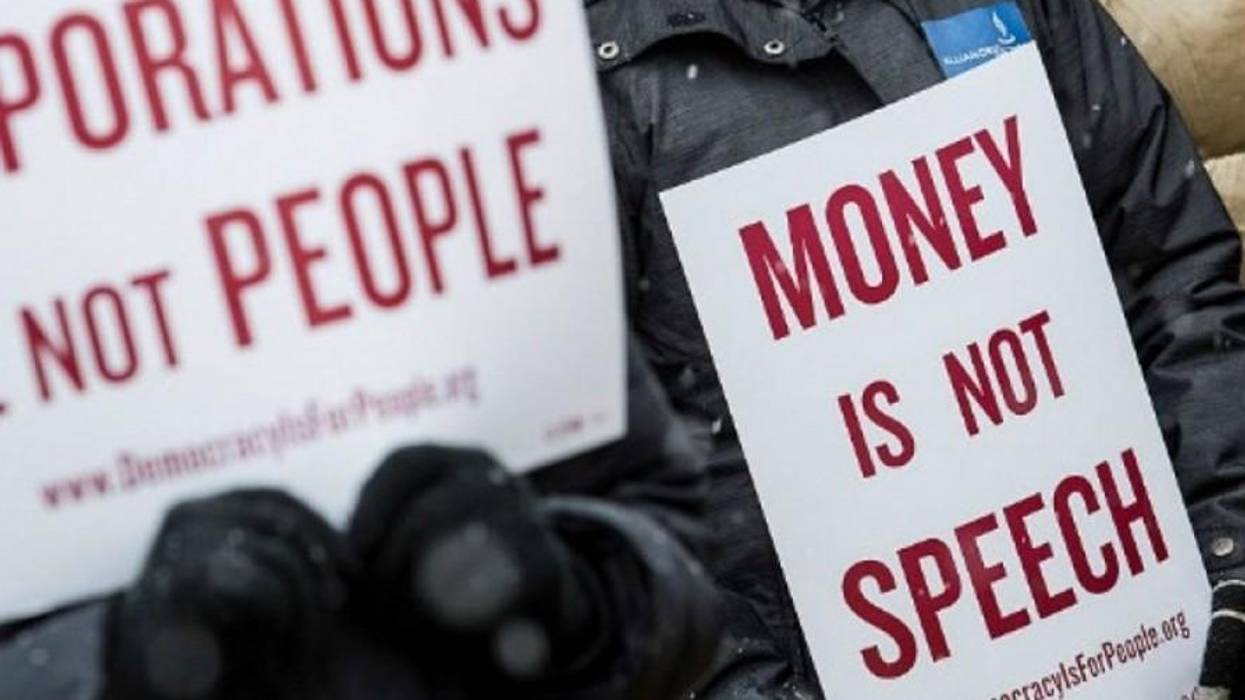
"Contributions from dark money groups and shell companies are outpacing all prior elections and may even surpass the roughly $660 million in contributions from unknown sources that flooded 2020 elections."
Dark money groups are spending at record levels in their efforts to influence the outcome of the 2024 U.S. elections, an analysis published Wednesday by OpenSecrets revealed.
According to the watchdog, the "unprecedented surge" in spending by dark money groups—which, thanks to the U.S. Supreme Court's 2010 Citizens United v. Federal Election Commission ruling don't have to disclose their donors—topped $162 million in 2023, "surpassing the level of dark contributions seen at the same point in any prior election cycle."
"So far this election cycle, contributions from dark money groups and shell companies are outpacing all prior elections and may even surpass the roughly $660 million in contributions from unknown sources that flooded 2020 elections—a cycle that attracted over $1 billion in total dark money," the group said.
According to OpenSecrets' analysis, super PACs and other dark money groups supporting Democrats have spent $85 million during this election cycle, while contributions backing Republicans have totaled $74 million so far. If the trend holds, this will be the fourth consecutive election cycle in which Democrats enjoyed a dark money advantage.
Americans for Prosperity Action, a right-wing hybrid PAC led by billionaire Charles Koch, has reported around $25 million in contributions so far this election cycle—far more than any other dark money group. Senate Majority PAC, which supports Democrats, has spent over $16.7 million, while the conservative Congressional Leadership Fund is in third place with more than $15.8 million in donations.
In an effort to tackle dark money's corrupting influence, U.S. Sen. Sheldon Whitehouse (D-R.I.) and Rep. Judy Chu (D-Calif.) last month introduced legislation aimed at closing a loophole that lets wealthy individuals make tax-free asset donations to dark money groups.
Dark money is back in the headlines amid scrutiny over the right-wing billionaires behind the upcoming No Labels third-party "unity" ticket and $100 million blitz unleashed by the American Israel Political Action Committee against Democrats who criticize Israel's genocidal war on Gaza.
As context, the median household income in Kansas is just shy of $70,000, meaning that Mr. Koch’s windfall would be the equivalent of more than 12 years’ worth of income for the typical Kansas household.
Last week, both houses of the Kansas legislature approved a significant tax cut centered around replacing the state’s graduated rate income tax structure with a flat tax instead. The bulk of this would flow to upper-income families, mostly through lowering the state’s top income tax rate from 5.7 to 5.25 percent. This tax cut would be especially lucrative for the state’s wealthiest individual, billionaire Charles Koch. We estimate that Mr. Koch could expect to receive a tax cut in the neighborhood of $875,000 per year. As context, the median household income in Kansas is just shy of $70,000, meaning that Mr. Koch’s windfall would be the equivalent of more than 12 years’ worth of income for the typical Kansas household.
It bears noting that an $875,000 annual tax cut is more than 7,500 times larger than the $116 average tax cut that the middle 20 percent of earners could expect to receive under this legislation.
The figure below combines data from the ITEP Tax Microsimulation Model with an off-model analysis performed using data on Mr. Koch’s finances that were reported by Pro Publica and Forbes. According to the ITEP Model, the top 1 percent of earners in Kansas would see far larger tax cuts under this legislation than anyone among the bottom 99 percent of families. The $6,608 average tax cut going to top earners is 57 times larger than the average cut for middle-income earners and 114 times larger than the average cut for the state’s lowest-income residents. But some members of the top 1 percent, almost certainly including Mr. Koch, would receive tax cuts far larger than $6,608.
The ITEP Model analyzes tax impacts across the income scale for all state and local tax types. But the model’s ability to estimate effects at the extreme reaches of the economic scale, particularly at the state level, is limited by IRS restrictions on reporting of top earners’ incomes and deductions. Typically, the highest income group for which we report tax data is the top 1 percent of earners. Supplementing our model data with additional data on the nation’s wealthiest families allows us to offer a fuller picture of tax impacts than the model alone can provide.
Without access to Mr. Koch’s Kansas tax filings, it is not possible to compute his precise tax cut with certainty. But a reasonable estimate can be arrived at using federal tax return data reported by ProPublica.
That reporting indicated that Mr. Koch enjoyed an average federal adjusted gross income of $213 million dollars per year across the six-year period spanning 2013 to 2018, and average federal taxable income of approximately $141 million per year. Adjusting those figures to account for differences in state and federal definitions of taxable income, and growing them in line with recent increases in Mr. Koch’s wealth as reported by Forbes, leads us to conclude that his state taxable income is likely in the vicinity of $194 million today. For somebody with an income at that level, the tax bracket and exemption changes contained in the legislation that recently passed the Kansas legislature would provide a tax cut of roughly $875,000 per year.
Choosing to cut taxes for high-income families in Kansas will inevitably require the state to do less of something else instead, be it fewer teacher pay raises, less frequent infrastructure maintenance, or any number of other reductions in public services.
Mr. Koch could also expect to receive additional sales and property tax cuts under the bill, but those would amount to little more than a rounding error relative to the far larger windfall he would receive from the top income tax rate reduction.
It bears noting that an $875,000 annual tax cut is more than 7,500 times larger than the $116 average tax cut that the middle 20 percent of earners could expect to receive under this legislation. Similar, it is more than 15,000 times larger than the $58 average tax cut that the state’s lowest earners could expect to receive.
Across the country, state revenue and budget outlooks are rapidly becoming less rosy than they have been during the last few years. As surpluses dwindle and some states begin to face shortfalls, the tradeoffs associated with deep tax cutting will become harder to ignore. Choosing to cut taxes for high-income families in Kansas will inevitably require the state to do less of something else instead, be it fewer teacher pay raises, less frequent infrastructure maintenance, or any number of other reductions in public services. Lawmakers should imagine what Kansas could do for its residents with $875,000 a year, and then ask a simple question: is that money better spent on helping our communities thrive, or lining the pockets of a single billionaire?
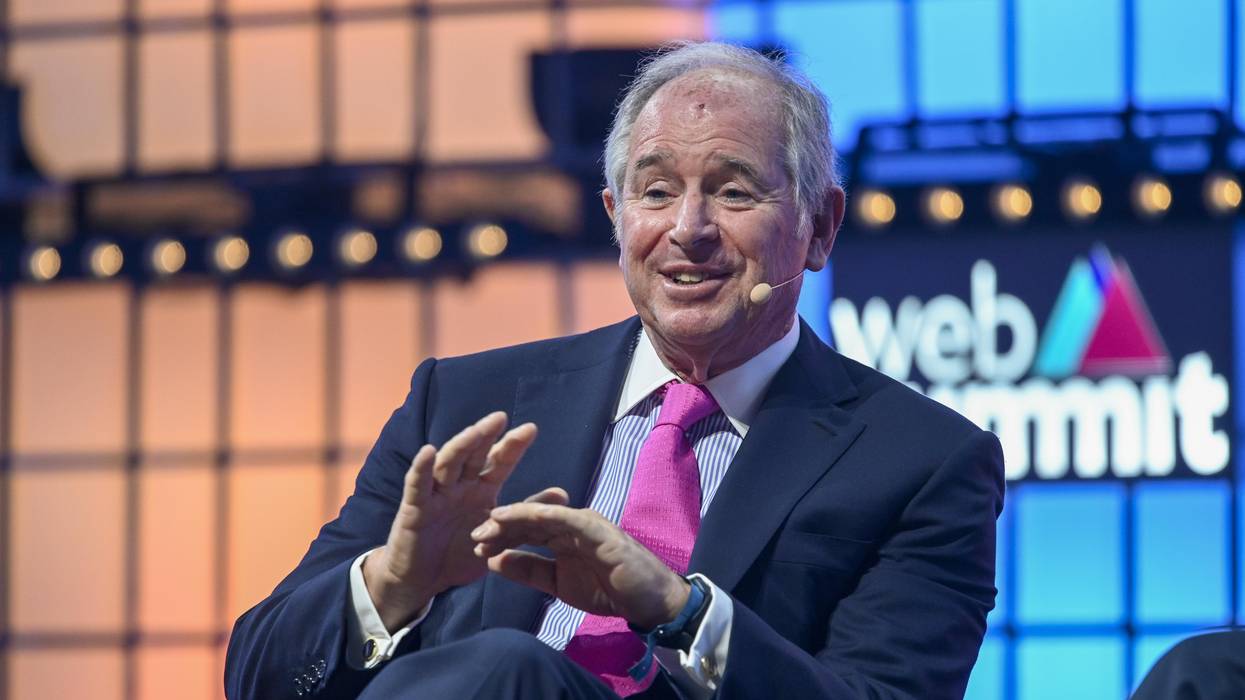
A few dozen billionaires are spending tens of millions of dollars on the 2022 midterm elections--mostly to support Republican candidates, including many who have parroted the dangerous lie that the 2020 presidential election was stolen--in a bid to ensure that Congress is full of lawmakers willing "to make their wealthy benefactors even richer," according to a fresh analysis.
"What's good for billionaires--including cutting taxes on the rich and corporations--is bad for working families."
Titled Billionaires Buying Elections, the report from Americans for Tax Fairness (ATF) details how "billionaires are increasingly using their personal fortunes and the profits of connected corporations to drown out regular voters' voices and elect hand-picked candidates who further rig the nation's economy--especially the tax system."
A pair of super PACs tasked with securing Republican majorities in the House and Senate--the Congressional Leadership Fund (CLF) and the Senate Leadership Fund (SLF)--raised a combined $188.3 million through the first 16 months of the 2022 campaign cycle, according to ATF. Nearly half--$89.4 million, or 48%--came from just 27 billionaires. A whopping 86% of the GOP's billionaire money came from "Wall Street tycoons" who are arguably the biggest beneficiaries of glaring loopholes in the tax code.
The Democratic counterparts of those two super PACs--the House Majority PAC and the Senate Majority PAC--raised a combined $154 million over the same time period. A smaller share--$25.8 million, or 17%--came from 19 billionaires. A majority of billionaire contributions to Democratic candidates also came from the finance and investment sector (35%), but other industries were also well-represented, including cryptocurrency (26%), and tech (18%).
"Unlike candidates and party committees, super PACs can raise unlimited donations from individuals and corporations," ATF explained. "In return they are not supposed to coordinate activities with the campaigns they support but instead act independently, though that rule is often flouted."
Top billionaire donors to congressional super PACs include hedge fund magnate Ken Griffin, who has given more than $28.5 million to CLF and SLF, and private equity mogul Stephen Schwarzman, who has pumped $20 million into the GOP's two super PACs.
"Anti-democratic vote-buying," ATF wrote, "has been facilitated by--and is facilitating--the accelerating wealth growth of the billionaire class and the record profits of the corporations they own."
The combined net worth of the nation's roughly 750 billionaires surged by $2 trillion, or 70%, during the first two years of the Covid-19 pandemic. The collective wealth of the 27 billionaires bankrolling the GOP's super PACs alone soared by $82.4 billion over that time period, meaning that the $89.4 million they have donated to CLF and SLF constitutes less than 0.1% of their overall pandemic-era gains.
Meanwhile, the return on that modest investment could amount to billions of dollars if Republicans take back Congress in November and preserve their 2017 tax cuts or further slash taxes on superrich people and the corporations they own.
Over a recent nine-year period, the 400 wealthiest people in the U.S. paid an average effective federal income tax rate of just 8.2% when the increased value of their stock holdings is included in their income. That is a lower rate than the nationwide average of 13.3% in 2019.
As ATF explained, focusing on contributions to congressional super PACs fails "to capture the full political influence of billionaires, who in addition to personal donations also steer money to favored candidates from related corporations and organizations."
Billionaires are among the ultrawealthy Americans who control corporations through their extensive stock holdings. Many corporate giants have been distorting the upcoming midterms, ATF pointed out, by spending tens of millions to help GOP candidates who have vowed to defend special tax breaks for the top 1% get elected, including 144 far-right members of Congress who voted to overturn President Joe Biden's electoral victory.
According to the report, seven powerful corporations--AT&T, Chevron, ExxonMobil, FedEx, GM, Merck, and UPS--have collectively given nearly $1.5 million to dozens of election deniers and various Republican PACs and election committees this campaign cycle. The companies' demonstrated lack of concern for democracy, ATF noted, likely stems from their desire to keep dodging taxes. In 2021, these firms paid an average federal income tax rate of just 2.7% on a combined $78.4 billion in profits.
"We need to rein in billionaire political and economic power through campaign finance reforms and tax reforms such as a billionaires income tax."
Notably, Peter Thiel, the co-founder of PayPal who is worth about $5 billion and openly opposed to democracy, has been spending big on his preferred Republican candidates but not through the GOP's congressional super PACs.
Thiel "has so far spent almost $30 million through super PACs supporting the 2022 senatorial bids of two former employees who share his anti-democratic and anti-tax beliefs," ATF found. "J.D. Vance won the Ohio Republican U.S. Senate primary thanks in part to Thiel's $15 million in spending. Blake Masters has a fighting chance in Arizona's GOP U.S. Senate primary in August due to Thiel's $13.5 million in contributions."
Another source of "billionaire dominance of campaign financing, especially on the Republican side," wrote ATF, are so-called "dark money" groups, which are not required to disclose the identity of their donors. Some dark money groups--including Club for Growth, which has received $32 million from billionaire Wall Street trader Jeffrey Yass over the years--are "notorious for having bankrolled insurrectionist members of Congress" like Sen. Josh Hawley (R-Mo.) and Lauren Boebert (R-Colo.), ATF noted.
According to the report:
Politically active billionaire Charles Koch has not personally donated to either GOP super PAC this cycle, but his corporation--Koch Industries--has so far given them a total of $1.75 million.
Two of the biggest "dark money" groups, which do not disclose their donors, are essentially sister groups to the two congressional GOP super PACs. American Action Network gave at least $26 million to CLF in the 2020 cycle and $18.7 million so far this cycle. One Nation donated $77.5 million to SLF last cycle and has given $16.5 million so far this cycle.
The ability of the nation's wealthiest individuals to translate their disproportionate economic power into political clout has increased exponentially since the U.S. Supreme Court's 2010 Citizens United decision eliminated effective limits on campaign contributions.
According to the report:
"Billionaires, who are used to buying whatever they want, have increasingly dedicated their almost unlimited resources to buying American elections," Frank Clemente, executive director of ATF, said in a statement.
"The problem is what's good for billionaires--including cutting taxes on the rich and corporations--is bad for working families," said Clemente. "We need to rein in billionaire political and economic power through campaign finance reforms and tax reforms such as a billionaires income tax."
Several legislative proposals have emerged to tax the increased value of assets owned by the nation's wealthiest households each year regardless of whether they sell or keep them, which would ensure that income derived from wealth is taxed more like income earned from work.
Biden's plan would raise an estimated $360 billion over 10 years, while Sen. Ron Wyden's (D-Ore.) plan would raise an estimated $550 billion over a decade, and Rep. Jamaal Bowman's (D-N.Y.) proposal possibly even more.
Billionaire-backed Democratic Sen. Joe Manchin (W.Va.), however, has joined Senate Republicans in opposing such a measure.
Over the past several decades, corporate lawyers, right-wing activists, Republican officials, and dark money groups with deep pockets have been laying the groundwork for a far-reaching legal assault on the federal government's ability to regulate U.S. industry--including the oil and gas sector threatening the planet.
On Thursday, their investments bore major fruit.
In a 6-3 decision along ideological lines, a Supreme Court packed with right-wing judges handpicked and boosted by some of the same forces leading the yearslong crusade against the power of regulatory agencies--which conservatives often dub the "administrative state"--dramatically restricted the Environmental Protection Agency's authority to rein in greenhouse gas pollution from power plants.
"The court deals yet another blow to the ability of the United States to democratically govern in the face of severe public policy crises."
On its face, the ruling in West Virginia v. EPA appears limited in scope, pertaining to a specific section of the 1970 Clean Air Act and zeroing in on the reach of a single government agency.
But experts saw in the decision, authored by Chief Justice John Roberts, an ominous warning that the Supreme Court is ramping up its assault on the federal government's capacity to act on matters ranging from environmental protection to workplace safety to public health to consumer protection.
Lawrence Gostin, a professor at Georgetown Law, argued that the high court's right-wing majority wasn't really concerned with the Clean Power Plan, an Obama-era zombie regulation at the center of West Virginia that never even took effect.
"It was the conservative court's larger agenda to gut the regulatory state and decimate executive powers to protect Americans' health and safety," wrote Gostin, who contended that "the ripple effects of West Virginia v. EPA are profound" and could hinder other key federal agencies such as the Centers for Disease Control and Prevention, the Food and Drug Administration, and the Occupational Safety and Health Administration.
"Congress doesn't have a magic crystal ball that can predict every future health hazard," Gostin added. "Nor does Congress have the expertise. That's why Congress has delegated wide powers to health and safety agencies. They have the expertise and flexibility to safeguard the public from major threats."
William Boyd, an environmental law professor at the University of California Los Angeles, agreed with Gostin's analysis, telling Vox that he believes the West Virginia ruling "can be seen as part of a larger trend directed at restricting the ability of EPA and other agencies to protect health, safety, and the environment."
"This starts at the top with the Supreme Court," he noted, "but it will ripple through the federal judiciary as decisions accumulate and the jurisprudence that has taken over the last half-century to accommodate the regulatory state is diminished and hollowed out."
The West Virginia ruling was a long time in the making, the product of coordinated efforts by GOP attorneys general, the fossil fuel industry, and shadowy organizations such as the Federalist Society.
For years, the industry-backed legal group has been building up a pipeline of far-right judges that Republican politicians have dutifully attached to the nation's judiciary, pumping young, often under-qualified, and business-friendly judges into district courts, appeals courts, and the highest court in the land. (All six sitting conservative Supreme Court justices have ties to the Federalist Society.)
Among the organization's donors is Koch Industries, the multinational oil and gas behemoth whose current billionaire leader, Charles Koch, and his late brother David have financed a vast apparatus of think tanks and advocacy organizations that've grown so influential that they frequently write entire laws for GOP legislatures to rubber stamp.
As The Lever's Andrew Perez reported earlier this year, groups linked to the Koch network took a serious interest in the West Virginia case, which was led by a group of Republican attorneys general and major coal companies. The Supreme Court agreed to take up the case last October.
"Koch's Americans for Prosperity Foundation filed an amicus brief in the case arguing that the EPA should not be permitted to 'impose its will on the nation through regulatory diktat,'" Perez observed. "Several more Koch-funded dark money groups have filed similar amicus briefs in the case. That includes the Cato Institute, the New Civil Liberties Alliance, the Competitive Enterprise Institute, and the Mountain States Legal Foundation."
"The New Civil Liberties Alliance also received $1 million from the 85 Fund, a charitable foundation steered by Trump judicial adviser Leonard Leo," Perez added. "A longtime executive at the Federalist Society, a conservative lawyers group, Leo also helps direct the Judicial Crisis Network, a dark money group that spent tens of millions leading the confirmation campaigns for Gorsuch, Kavanaugh, and Barrett."
As Jane Mayer, the award-winning investigative journalist and author of Dark Money: The Hidden History of the Billionaires Behind the Rise of the Radical Right, put it Thursday, the West Virginia decision is "payoff for 40 years of dark money from some of the planet's biggest polluters."
Top Republican officials and lawmakers responded enthusiastically to Thursday's ruling, which is likely to have global consequences given the United States' status as the largest historical emitter of carbon dioxide.
"Today, the court made the correct decision to rein in the EPA, an unelected bureaucracy," West Virginia Attorney General Patrick Morrisey, who spearheaded the case.
"And we're not done," he added. "My office will continue to fight for the rights of West Virginians when those in Washington try to go too far in asserting broad powers without the people's support."
Senate Minority Leader Mitch McConnell (R-Ky.), who is hoping to take back the upper chamber's gavel in the upcoming midterms, hailed the majority's opinion and warned "other overeager bureaucrats" to "take notice."
In the decision itself, the court's conservatives defined West Virginia v. EPA as a "major questions case," invoking an obscure and novel legal doctrine that insists federal agencies must have explicit and specific congressional authorization to act on matters deemed politically or economically significant.
"The court embraced the doctrine in a full-blown way, making clear that it views a wide range of agency protections as potential targets for abolition."
As Bloomberg's Noah Feldman explains, "the major questions doctrine appears to take a very large bite out of" the so-called Chevron doctrine, which states that "the courts must defer to agencies' reasonable interpretation of laws passed by Congress."
The implications of the major questions doctrine's emergence as a guiding principle for the court are vast. In her dissent in West Virginia, liberal Justice Elena Kagan observed that "the court has never even used the term 'major questions doctrine' before."
"Let's say the obvious: The stakes here are high," Kagan wrote. "Yet the court today prevents congressionally authorized agency action to curb power plants' carbon dioxide emissions. The court appoints itself--instead of Congress or the expert agency--the decisionmaker on climate policy. I cannot think of many things more frightening."
Jenny Breen, associate professor at the Syracuse University College of Law, similarly argued in an email to Common Dreams that the court's West Virginia ruling "relies on judicial overreaching to undermine public policy and the legitimacy of government more broadly."
"The majority did not like the agency's approach to regulating power plants," Breen wrote. "But only in this new universe of governance-by-judicial-fiat should any of us care what John Roberts thinks is the best approach to regulating power plants. Congress gave that job to the EPA, not the Supreme Court."
"In taking that decision for itself," Breen added, "the court deals yet another blow to the ability of the United States to democratically govern in the face of severe public policy crises."
While the conservative-dominated court may not have overtly wielded the major questions doctrine against the federal government's regulatory powers in previous cases, Mekela Panditharatne and Martha Kinsella of the Brennan Center for Justice note that it has "obliquely" relied on the doctrine to "strike down the Centers for Disease Control and Prevention's eviction moratorium and block the Occupational Health and Safety Administration's mandate that large employers ensure their workers are vaccinated or frequently tested for Covid-19."
"In Thursday's case, the court embraced the doctrine in a full-blown way, making clear that it views a wide range of agency protections as potential targets for abolition," they warned. "By gutting regulatory agencies' ability to use existing statutory authority to respond to contemporary societal needs, the court places the onus on Congress to amend countless laws to expressly authorize agencies to 'make decisions of vast economic and political significance,' whatever that means."
"The suggestion that Congress just needs to pass more explicit instructions to agencies in order for the government to perform core functions is easier said than done," Panditharatne and a Kinsella added. "For his part, Justice Gorsuch in concurrence, alarmingly, raises the specter that agency action without express congressional authorization could be deemed to violate the Constitution, a position the dissent vehemently rejects."
The institutional obstacles for Congress to step into the void created by the court's ruling are enormous, including but not limited to the Senate's 60-vote legislative filibuster. Corporate-friendly Democrats and the Republican Party--made up of industry-funded lawmakers wedded to mass deregulation--are also sure to stonewall any congressional attempts to make regulatory agencies' statutory authority to fight the climate emergency and other crises more explicit.
The ultimate result, observers fear, could be the sweeping defanging of the federal government that corporate America and the conservative movement have sought for decades.
"These politicians in black robes know full well that, with Mitch McConnell in a leadership position doing the bidding of Koch and the oil and gas industry, this Congress will not pass any substantial climate change mitigation legislation," Lisa Graves, the executive director of True North Research, told The Intercept.
In a series of tweets on Thursday, the Green New Deal Network asked Americans to "imagine a future where the USDA can't regulate what chemicals are in your food."
"Imagine a reality where the FDIC can't protect your money from greedy bankers and investors. And imagine a world where the FDA can't prevent pharmacies from stocking up with literal poisons," the group added. "This is the endgame."
Today marks the twelfth anniversary of one of the most destructive rulings ever issued by the U.S. Supreme Court, Citizens United v. Federal Election Commission.
That ruling from the Court led by Chief Justice John Roberts unleashed a tsunami of "dark money" engulfing every major national and state election since then. The billionaires pumping millions into our elections are known to their political beneficiaries but not to most Americans.
One consequence is the ruinous chasm between what can pass Congress--such as huge tax cuts for billionaires like Charles Koch and Elon Musk--and what cannot. Elected officials whose fortunes are tied to the favor of such billionaires can block popular proposals with near impunity.
"The billionaires pumping millions into our elections are known to their political beneficiaries but not to most Americans."
The result is a vicious cycle of thwarting policies that could help us all thrive--things like making billionaires pay their fair share, protecting the freedom to vote, securing paid sick leave for all, and investing in innovative ideas to respond to the climate crisis--while entrenching the economic and political power of the richest few.
This destabilizes not only the health of our economy but also our ability to function as a free and democratic society.
Certainly, the Dred Scot decision and the century of its racist progeny that followed caused greater wreckage of Black lives and more, but the Citizens United ruling is deeply pernicious.
It is also a bellwether for the radically reactionary edicts that the sharply right-wing Roberts Court is poised to issue later this year. This is the first full Supreme Court term that includes all three of the unworthy judges that Donald Trump--and dark money--installed as umpires.
The group called "Citizens United" was launched in 1988 by Floyd Brown, a GOP insider responsible for the race-baiting "Willie Horton" ad, which helped George H.W. Bush win more white voters and, with them, the White House. In 1992, David Bossie joined Brown at Citizens United where they worked alongside Koch-funded groups to block Democratic proposals, such as the health care reforms proposed by Bill and Hillary Clinton. Bossie is now more widely known as a senior Trump advisor in 2016 and 2020.
Before then, Bossie worked briefly for Rep. Dan Burton (R-IN) on the investigation of the Clintons under the pretext of the Whitewater scandal before Bossie was forced out over his controversial tactics. In 2000, Bossie took the revolving door back to Citizens United, where he focused on defeating the presidential bids of John Kerry and Hillary Clinton. Under Bossie, Citizens United also opposed the 2002 Bipartisan Campaign Finance Reform Act (BCRA, known as the McCain-Feingold Act) along with the Kochs' "Citizens for a Sound Economy" (the predecessor of "Americans for Prosperity") and people like the now infamous Cleta Mitchell.
BCRA passed by a wide, bipartisan vote, but that did not stop dark money addicts like Sen. Mitch McConnell (R-KY) from trying to get the Supreme Court to strike it down. He failed, but that was before John Roberts and Sam Alito were appointed to the Court by George W. Bush. McConnell was aided in this effort by the American Civil Liberties Union, which was lauded by the Koch-funded Federalist Society and other right-wing groups for doing so.
BCRA was a multi-year effort to limit dark money spending that was eluding the donation limits and disclosure requirements of the "Federal Election Campaign Act," the Nixon era reform that had replaced the inadequate "Federal Corruption Act." BCRA's measures were rooted in the Senate investigation of dark money operations like "Triad," which was linked to Charles Koch long before he became a household name for his political spending. Dating back to 1976, Koch had funded efforts to overturn federal anti-corruption laws. His fortune helped underwrite the Libertarian Party's brief in the Buckley v. Valeo Supreme Court ruling, which planted the seed for the notion that money is speech, the poisonous root of the Citizens United decision.
BCRA redefined an "electioneering communication" as a broadcast communication that mentions a candidate in the weeks right before a primary or general election, setting limits on such activity. In response, Bossie recast his group's electoral strategy as "documentary" films and books. In the lead up to the 2008 election, Bossie sought to have BCRA declared unconstitutional and to block the Federal Election Commission from requiring the disclosure of who funded what amounted to his movie-length ad. In July 2008, he lost his suit and sought review by the Roberts Court. Just ten days after Barack Obama won the 2008 presidential election, the Court took jurisdiction.
One of the very first amicus briefs filed in support of Citizens United was filed by one of the very first special interest groups created by Koch when he was merely a multi-millionaire: the Cato Institute, which was previously named the Charles Koch Foundation. Other Koch-tied groups also filed briefs, such as the Center for Competitive Politics (which was launched by Koch ally Brad Smith and which now calls itself the "Institute for Free Speech," a fancy way of writing "dark money").
The Roberts Court held oral arguments that spring, but decided not to issue a ruling. Instead, it ordered a rare second argument in September 2009. With that the die was cast.
More groups and politicians tied to Koch money and other billionaires then submitted amicus briefs on a new question: whether to overrule previous decisions, including the case McConnell lost just six years earlier. The only thing that had really changed in those few years was that Roberts and Alito were placed on the Court, with the help of Federalist Society leader Leonard Leo.
Roberts tapped Justice Anthony Kennedy to pen the ruling. On January 20, 2010, the Court issued a 5-4 decision that struck down BCRA's most important protections against dark money. Usually Supreme Court decisions are issued in the summer, but this partisan ruling was timed to fall on future presidential inauguration days. The date also maximized the ability of dark money groups to influence the primary and the general elections in the 2010 midterms.
As Kennedy, Roberts, Alito, Clarence Thomas, and Antonin Scalia were crafting the majority ruling, Bossie was working with the then-largely unknown Steve Bannon on another Citizens United video blaming the 2008 financial crisis on... baby boomers. That is, Bossie was trying to help the GOP yet again by pointing the blame away from Wall Street's reckless greed, the Bush administration's lax oversight of "Too Big to Fail" banks, and the pressure campaign of Kochs' Citizens for a Sound Economy to repeal Glass-Steagall restrictions on financial gambling (which Bill Clinton signed into law).
Kennedy's decision barred Congress--and with it the American voting public--from limiting dark money in our elections. It did so by effectively altering the meaning of our First Amendment to give new rights to billionaires. Justice John Paul Stevens and the three justices appointed by Democrats strongly objected. Public interest groups like the Center for Media and Democracy, Move to Amend, and Public Citizen condemned the decision too and called for a constitutional amendment to overturn it.
The only congressional remedy available, according to Kennedy, was disclosure, but he erroneously assumed the funders of this spending by "outside" groups would be revealed to the public. They were not and are not still. That is because Sen. McConnell has used the filibuster and the GOP's power to block disclosure of major donors to so-called "issue ads" in elections.
There is also no disclosure required for similar spending to pack the Court with judges chosen to help overturn legal precedents that billionaires, and their servants like McConnell, do not like.
What we did not know back when Kennedy read his 5-4 ruling was that two of the justices on his side had been part of Koch's political strategy meetings. It was only later we learned that in 2010 Charles Koch himself had sent his fellow right-wing billionaires a secret invitation bragging that "Past meetings have featured such notable leaders as Supreme Court Justices Antonin Scalia and Clarence Thomas" (emphasis added).
Thomas claimed he had just dropped by to visit his wife, Virginia Thomas, at Koch's meeting in Palm Desert because he was supposedly in town for a "Federalist Society" event that was not publicized anywhere. Leo later claimed the Federalist Society paid the Thomases' travel expenses to Palm Desert. The Thomases also attended a small, private dinner hosted by Koch near his posh estate there.
Notably, Thomas has failed to recuse himself from any of the cases that Koch-groups are involved in as parties or amicus, such as the Americans for Prosperity case last year where the Roberts Court decreed that a decades-old rule requiring non-profit groups to disclose their major donors to oversight agencies was suddenly unconstitutional. Meanwhile, his wife's political extremism and partisan activities have only seemingly increased with the advent of Trump. Senator Sheldon Whitehouse (D-RI) has called for better recusal requirements and more disclosure of who is really funding the "flotilla" of amicus briefs. He has also held hearings on the need to reform the Court and expose the dark money groups helping to pack the Court.
Another thing we now know is that Charles Koch made tax cuts and Supreme Court appointments the top two priorities for his political operations during the Trump administration, as uncovered by journalists with Documented and The Intercept. Koch secretly told his billionaire network that he was working with Leonard Leo on efforts to get Trump's judicial nominees confirmed. His political arm, Americans for Prosperity, also bragged publicly about how much it spent--from undisclosed sources--to push through Trump's Supreme Court nominees, which were chosen from the slate hand-picked by Leo and Don McGahn.
After Scalia died unexpectedly in February 2016, the Leo web of dark money groups surged with cash from secret sources to help block President Obama's nominee, Merrick Garland. They peddled the made-up claim that a vacancy could not be filled during a presidential election year.
"But-for the seats stolen by Republicans during presidential election years, the Court would now have a majority of judges appointed by Democratic presidents rather than Republican appointees hand-picked to reverse legal precedents like Roe v. Wade."
As Robert O'Harrow and Shawn Boberg of the Washington Post documented in 2019, Leo's web got huge sums from secret sources to help secure the confirmation of far-right activist Neil Gorsuch into that stolen seat. Leo's web also pushed through Whitewater investigation alum Brett Kavanaugh, despite documentation he lied under oath and evidence he sexually assaulted Dr. Christine Blasey Ford. The web also helped Amy Coney Barrett get confirmed less than a month before the 2020 presidential election despite her very controversial record.
But-for the seats stolen by Republicans during presidential election years, the Court would now have a majority of judges appointed by Democratic presidents rather than Republican appointees hand-picked to reverse legal precedents like Roe v. Wade.
What we also knew then is that Citizens United would unleash a mountain of dark money. We just did not know how much. In 2015, Koch Industries registered the url 889million.com, after his political network announced it planned to spend that specific amount to influence the 2016 election. That is, Koch was planning to deploy nearly one billion dollars in that election cycle, without revealing who else was contributing to that bomb of cash or how much of it was from himself or his company, the second largest privately held corporation in the United States.
Koch is not alone. Billionaire Robert Mercer and his daughter Rebekah stepped in to bankroll dark money groups to help Trump win. They also worked with Trump's strategist and Bossie's buddy Steve Bannon on Cambridge Analytica's efforts to use data-mining to micro-target voters.
Although Koch made noise about his decision not to endorse Trump in 2016, his political operation spent hundreds of millions to help the GOP win the Senate and other elective offices, a ground game that buoyed Trump. The Mercers have reportedly pulled back, but right-wing billionaire Peter Thiel has stepped in to help Trump launch his new social media operation. Other dark money groups surrounding Trump, like Turning Point USA, are also expanding their operations, so bankable is Trump's Big Lie grift.
Trump's rise is more attributable to his appeal to racist and economic fears of middle class whites than to dark money, but it is dark money that is buttressing him. It is also dark money that is helping the politicians who are marching to his tune, implementing the anti-democracy agenda he mapped out on Jan. 6, 2021, when he incited the violent insurrection at the Capitol.
Citizens United really should be called "Billionaires United." It has unleashed corporate titans and heirs of corporate treasuries--and Charles Koch is both--to use their massive wealth to reshape American politics and policies to suit their personal desires. The ruling is also an end-run around the legal precedent of one person, one vote. That is because it gives billionaires what Bob McChesney and John Nichols call a "dollarocracy." That is where rich people with more money have more say in our elections than most Americans. That is also a big part of what's broken in our country.
Citizens United is also part of a triumvirate of rulings by the right-wing Roberts Court that literally precipitated the unfolding disaster we are witnessing today on voting rights and redistricting.
But-for the ruling of the Roberts' Court to gut the Voting Rights Act (in Shelby County, Alabama v. Holder), the GOP would not be able to so easily advance Trump's deceitful demands that the freedom to vote be restricted based on his Big (and lucrative) Lie that the presidential election was stolen.
And but-for its ruling (in Rucho v. Common Cause) that limited the power of federal courts to protect voters from surgically-manipulated legislative map boundaries, the GOP would not be so free to gerrymander maps that award majority power to its politicians even when its party cannot win a majority in state-wide elections. It is Roberts' Court that has empowered the grossly distorted maps being engineered by GOP-controlled legislatures to preserve their power and try to capture the U.S. House of Representatives in 2022 and the rest of this decade. It is not a done deal, however. Though difficult, election turn-out by Democrats could still overcome these distortions.
Despite Roberts' hand in these destructive rulings, somehow his approval rating is higher than Dr. Anthony Fauci, according to a recent Gallup poll.
With American elections unmoored from real accountability to ordinary voters, the Roberts Court is taking aim at limiting the power of the federal government to protect other freedoms, except for the freedom to exercise one's religion. There, the Court has recrafted that right from a shield into a sword to strike out at equality and at a secular society that separates church and state.
The coming Roberts' Court decision on Roe will embrace religious objections of a minority of Americans to women's reproductive rights, even if it claims otherwise. The Roberts faction appears ready to take away women's fundamental freedom to choose their destiny (at least in the early stages of a pregnancy) without interference from the state. The Court will likely claim it is embracing local democracy, but what that really means is letting predominantly white male legislators in GOP-redistricted states transmute their religious beliefs--and that of the billionaires helping them retain power--into legally binding rules that supplant the equal rights of all women.
"The Roberts Court is rapidly headed toward disarming federal power as America faces enormous challenges like climate change and pandemics that can only be mitigated by a robust national government, not a "free" market that puts its own profits ahead of the public well being."
That is not all that is at stake.
The Roberts Court has been hand-picked to advance the goal of overturning numerous legal precedents that protect other freedoms. Leo, the dark money court-packer, boasted to funders at the right-wing Council on National Policy that America stands at the precipice of the "revival" of what he calls the "structural constitution." That phrase is being popularized to give a mantel of legitimacy to the coming judicial edicts blocking the power of federal agencies to regulate corporations on climate, Covid-19, and more.
The Roberts Court will claim that the law commands it, just as the Supreme Court did in the infamous Lochner Era, when the Court helmed by former president William Howard Taft repeatedly struck down progressive laws that sought to limit the power of corporations. Notably, in Roberts' year-end pronouncement, he repeatedly referenced Taft as preserving the "independence" of the Court from claims it was not-even though Taft is actually notorious for how he used the power of the Supreme Court to protect industries from regulation. Talk about foreshadowing.
The coming Roberts Court decisions likely to strike down the power of federal agencies will almost certainly be framed as pro-democracy. The Roberts faction may rule that the EPA cannot regulate carbon as pollution that endangers the public without Congress expressly passing a law about carbon specifically. They know that politicians beholden to carbon kings, like Koch, would likely use the filibuster and other tactics to block such legislation to try to remedy such a judicial ruling, just as Sen. McConnell has done in response to Citizens United.
The Roberts Court is rapidly headed toward disarming federal power as America faces enormous challenges like climate change and pandemics that can only be mitigated by a robust national government, not a "free" market that puts its own profits ahead of the public well being.
The only silver lining of the reactionary revolution being orchestrated by John Roberts' Court is that perhaps it will fuel a season or many seasons of citizen activism to overturn these regressive rulings. Hopefully, most people will not continue to be deceived by his crafting of claims that the Court is a fair umpire and that his very partisan faction is not partisan at all.
And, hopefully, the rulings to come will mark not the beginning of this new majority on the Court, but the beginning of its end.