SUBSCRIBE TO OUR FREE NEWSLETTER
Daily news & progressive opinion—funded by the people, not the corporations—delivered straight to your inbox.
5
#000000
#FFFFFF
To donate by check, phone, or other method, see our More Ways to Give page.
Daily news & progressive opinion—funded by the people, not the corporations—delivered straight to your inbox.
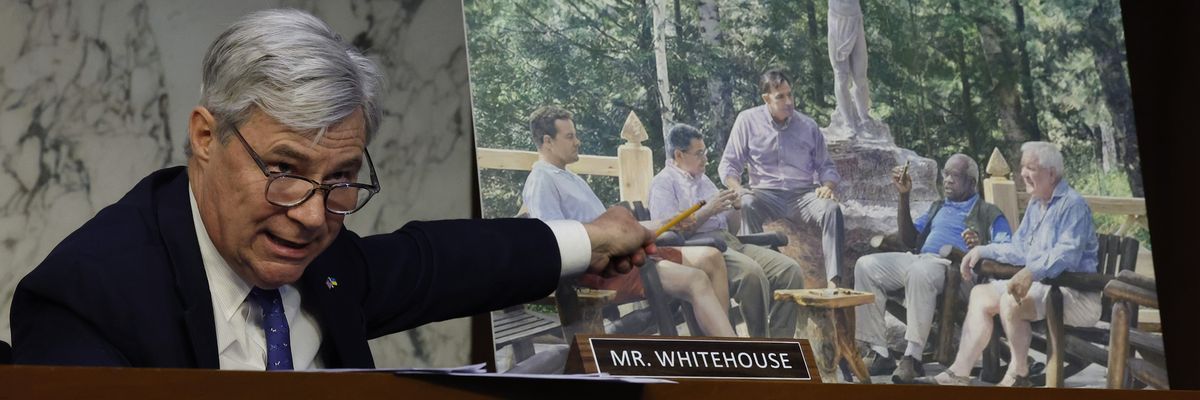
Sen. Sheldon Whitehouse (D-R.I.) displays a copy of a painting featuring Supreme Court Justice Clarence Thomas and other conservative figures during a hearing on May 2, 2023.
"Billionaires attempting to influence politics from the shadows should not be rewarded with taxpayer subsidies," said Sen. Sheldon Whitehouse.
Legislation introduced Tuesday by a pair of Democratic lawmakers would close a loophole that lets billionaires donate assets to dark money organizations without paying any taxes.
The U.S. tax code allows write-offs when appreciated assets such as shares of stock are donated to a charity, but the tax break doesn't apply when the assets are given to political groups.
However, donations to 501(c)(4) organizations—which are allowed to engage in some political activity as long as it's not their primary purpose—are exempt from capital gains taxes, a loophole that Sen. Sheldon Whitehouse (D-R.I.) and Rep. Judy Chu (D-Calif.) are looking to shutter with their End Tax Breaks for Dark Money Act.
Whitehouse, a member of the Senate Judiciary Committee who has focused extensively on the corrupting effects of dark money, said the need for the bill was made clear by what ProPublica and The Lever described as "the largest known donation to a political advocacy group in U.S. history."
The investigative outlets reported in 2022 that billionaire manufacturing magnate Barre Seid donated his 100% ownership stake in Tripp Lite, a maker of electrical equipment, to Marble Freedom Trust, a group controlled by Federalist Society co-chairman Leonard Leo.
The donation, completed in 2021, was worth $1.6 billion. According to ProPublica and The Lever, the structure of the gift allowed Seid to avoid up to $400 million in taxes.
"It's a clear sign of a broken tax code when a single donor can transfer assets worth $1.6 billion to a dark money political group without paying a penny in taxes," Whitehouse said in a statement Tuesday. "Billionaires attempting to influence politics from the shadows should not be rewarded with taxpayer subsidies."
"We cannot allow millionaires and billionaires to run roughshod over our democracy and then reward them for it with a tax break."
If passed, the End Tax Breaks for Dark Money Act would ensure that donations of appreciated assets to 501(c)(4) organizations are subjected to the same rules as gifts to political action committees (PACs) and parties.
"Thanks to the far-right Supreme Court, billionaires already have outsized influence to decide our nation's politics; through a loophole in the tax code, they can even secure massive public subsidies for lobbying and campaigning when they secretly donate their wealth to certain nonprofits instead of traditional political organizations," said Chu. "We can decrease the impact the wealthy have on our politics by applying capital gains taxes to donations of appreciated property to nonprofits that engage in lobbying and political activity—the same way they are already treated when made to traditional political organizations like PACs."
The new bill comes amid an election season that is already flooded with outside spending.
The watchdog OpenSecrets reported last month that super PACs and other groups "have already poured nearly $318 million into spending on presidential and congressional races as of January 14—more than six times as much as had been spent at this point in 2020."
Thanks to the Supreme Court's 2010 Citizens United ruling, super PACs can raise and spend unlimited sums on federal elections—often without being fully transparent about their donors.
Morris Pearl, chairman of the Patriotic Millionaires, said Tuesday that "there is no justifiable reason why wealthy people like me should be allowed to dominate our political system by donating an entire $1.6 billion company to a dark money political group."
"But perhaps more egregious is the $400 million tax break that comes from doing so," said Pearl. "It's a perfect example of how this provision in the tax code is used by the ultrawealthy to manipulate the levers of government while simultaneously dodging their obligation to pay taxes. We cannot allow millionaires and billionaires to run roughshod over our democracy and then reward them for it with a tax break."
Dear Common Dreams reader, It’s been nearly 30 years since I co-founded Common Dreams with my late wife, Lina Newhouser. We had the radical notion that journalism should serve the public good, not corporate profits. It was clear to us from the outset what it would take to build such a project. No paid advertisements. No corporate sponsors. No millionaire publisher telling us what to think or do. Many people said we wouldn't last a year, but we proved those doubters wrong. Together with a tremendous team of journalists and dedicated staff, we built an independent media outlet free from the constraints of profits and corporate control. Our mission has always been simple: To inform. To inspire. To ignite change for the common good. Building Common Dreams was not easy. Our survival was never guaranteed. When you take on the most powerful forces—Wall Street greed, fossil fuel industry destruction, Big Tech lobbyists, and uber-rich oligarchs who have spent billions upon billions rigging the economy and democracy in their favor—the only bulwark you have is supporters who believe in your work. But here’s the urgent message from me today. It's never been this bad out there. And it's never been this hard to keep us going. At the very moment Common Dreams is most needed, the threats we face are intensifying. We need your support now more than ever. We don't accept corporate advertising and never will. We don't have a paywall because we don't think people should be blocked from critical news based on their ability to pay. Everything we do is funded by the donations of readers like you. When everyone does the little they can afford, we are strong. But if that support retreats or dries up, so do we. Will you donate now to make sure Common Dreams not only survives but thrives? —Craig Brown, Co-founder |
Legislation introduced Tuesday by a pair of Democratic lawmakers would close a loophole that lets billionaires donate assets to dark money organizations without paying any taxes.
The U.S. tax code allows write-offs when appreciated assets such as shares of stock are donated to a charity, but the tax break doesn't apply when the assets are given to political groups.
However, donations to 501(c)(4) organizations—which are allowed to engage in some political activity as long as it's not their primary purpose—are exempt from capital gains taxes, a loophole that Sen. Sheldon Whitehouse (D-R.I.) and Rep. Judy Chu (D-Calif.) are looking to shutter with their End Tax Breaks for Dark Money Act.
Whitehouse, a member of the Senate Judiciary Committee who has focused extensively on the corrupting effects of dark money, said the need for the bill was made clear by what ProPublica and The Lever described as "the largest known donation to a political advocacy group in U.S. history."
The investigative outlets reported in 2022 that billionaire manufacturing magnate Barre Seid donated his 100% ownership stake in Tripp Lite, a maker of electrical equipment, to Marble Freedom Trust, a group controlled by Federalist Society co-chairman Leonard Leo.
The donation, completed in 2021, was worth $1.6 billion. According to ProPublica and The Lever, the structure of the gift allowed Seid to avoid up to $400 million in taxes.
"It's a clear sign of a broken tax code when a single donor can transfer assets worth $1.6 billion to a dark money political group without paying a penny in taxes," Whitehouse said in a statement Tuesday. "Billionaires attempting to influence politics from the shadows should not be rewarded with taxpayer subsidies."
"We cannot allow millionaires and billionaires to run roughshod over our democracy and then reward them for it with a tax break."
If passed, the End Tax Breaks for Dark Money Act would ensure that donations of appreciated assets to 501(c)(4) organizations are subjected to the same rules as gifts to political action committees (PACs) and parties.
"Thanks to the far-right Supreme Court, billionaires already have outsized influence to decide our nation's politics; through a loophole in the tax code, they can even secure massive public subsidies for lobbying and campaigning when they secretly donate their wealth to certain nonprofits instead of traditional political organizations," said Chu. "We can decrease the impact the wealthy have on our politics by applying capital gains taxes to donations of appreciated property to nonprofits that engage in lobbying and political activity—the same way they are already treated when made to traditional political organizations like PACs."
The new bill comes amid an election season that is already flooded with outside spending.
The watchdog OpenSecrets reported last month that super PACs and other groups "have already poured nearly $318 million into spending on presidential and congressional races as of January 14—more than six times as much as had been spent at this point in 2020."
Thanks to the Supreme Court's 2010 Citizens United ruling, super PACs can raise and spend unlimited sums on federal elections—often without being fully transparent about their donors.
Morris Pearl, chairman of the Patriotic Millionaires, said Tuesday that "there is no justifiable reason why wealthy people like me should be allowed to dominate our political system by donating an entire $1.6 billion company to a dark money political group."
"But perhaps more egregious is the $400 million tax break that comes from doing so," said Pearl. "It's a perfect example of how this provision in the tax code is used by the ultrawealthy to manipulate the levers of government while simultaneously dodging their obligation to pay taxes. We cannot allow millionaires and billionaires to run roughshod over our democracy and then reward them for it with a tax break."
Legislation introduced Tuesday by a pair of Democratic lawmakers would close a loophole that lets billionaires donate assets to dark money organizations without paying any taxes.
The U.S. tax code allows write-offs when appreciated assets such as shares of stock are donated to a charity, but the tax break doesn't apply when the assets are given to political groups.
However, donations to 501(c)(4) organizations—which are allowed to engage in some political activity as long as it's not their primary purpose—are exempt from capital gains taxes, a loophole that Sen. Sheldon Whitehouse (D-R.I.) and Rep. Judy Chu (D-Calif.) are looking to shutter with their End Tax Breaks for Dark Money Act.
Whitehouse, a member of the Senate Judiciary Committee who has focused extensively on the corrupting effects of dark money, said the need for the bill was made clear by what ProPublica and The Lever described as "the largest known donation to a political advocacy group in U.S. history."
The investigative outlets reported in 2022 that billionaire manufacturing magnate Barre Seid donated his 100% ownership stake in Tripp Lite, a maker of electrical equipment, to Marble Freedom Trust, a group controlled by Federalist Society co-chairman Leonard Leo.
The donation, completed in 2021, was worth $1.6 billion. According to ProPublica and The Lever, the structure of the gift allowed Seid to avoid up to $400 million in taxes.
"It's a clear sign of a broken tax code when a single donor can transfer assets worth $1.6 billion to a dark money political group without paying a penny in taxes," Whitehouse said in a statement Tuesday. "Billionaires attempting to influence politics from the shadows should not be rewarded with taxpayer subsidies."
"We cannot allow millionaires and billionaires to run roughshod over our democracy and then reward them for it with a tax break."
If passed, the End Tax Breaks for Dark Money Act would ensure that donations of appreciated assets to 501(c)(4) organizations are subjected to the same rules as gifts to political action committees (PACs) and parties.
"Thanks to the far-right Supreme Court, billionaires already have outsized influence to decide our nation's politics; through a loophole in the tax code, they can even secure massive public subsidies for lobbying and campaigning when they secretly donate their wealth to certain nonprofits instead of traditional political organizations," said Chu. "We can decrease the impact the wealthy have on our politics by applying capital gains taxes to donations of appreciated property to nonprofits that engage in lobbying and political activity—the same way they are already treated when made to traditional political organizations like PACs."
The new bill comes amid an election season that is already flooded with outside spending.
The watchdog OpenSecrets reported last month that super PACs and other groups "have already poured nearly $318 million into spending on presidential and congressional races as of January 14—more than six times as much as had been spent at this point in 2020."
Thanks to the Supreme Court's 2010 Citizens United ruling, super PACs can raise and spend unlimited sums on federal elections—often without being fully transparent about their donors.
Morris Pearl, chairman of the Patriotic Millionaires, said Tuesday that "there is no justifiable reason why wealthy people like me should be allowed to dominate our political system by donating an entire $1.6 billion company to a dark money political group."
"But perhaps more egregious is the $400 million tax break that comes from doing so," said Pearl. "It's a perfect example of how this provision in the tax code is used by the ultrawealthy to manipulate the levers of government while simultaneously dodging their obligation to pay taxes. We cannot allow millionaires and billionaires to run roughshod over our democracy and then reward them for it with a tax break."