SUBSCRIBE TO OUR FREE NEWSLETTER
Daily news & progressive opinion—funded by the people, not the corporations—delivered straight to your inbox.
5
#000000
#FFFFFF
To donate by check, phone, or other method, see our More Ways to Give page.
Daily news & progressive opinion—funded by the people, not the corporations—delivered straight to your inbox.
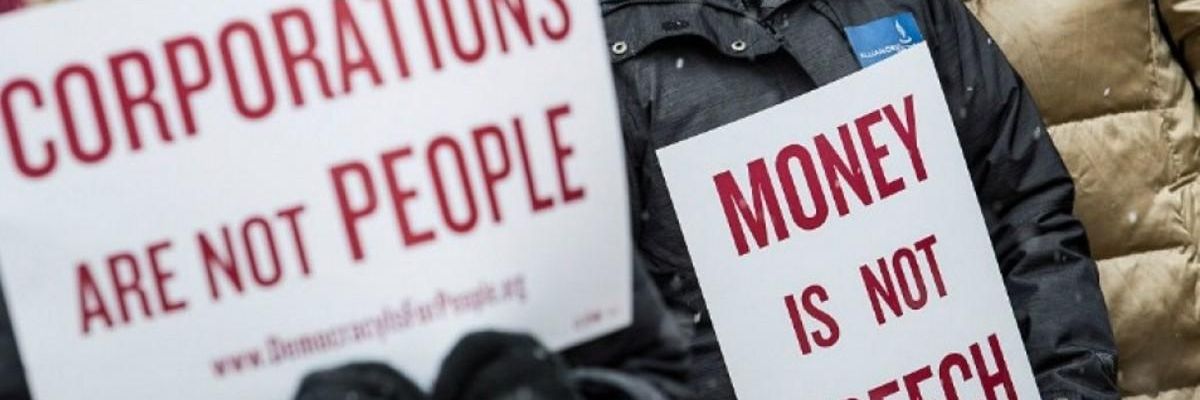
Attendees hold signs as they listen to speakers during a rally calling for an end to corporate money in politics and to mark the fifth anniversary of the Supreme Court's Citizens United decision on January 21, 2015 in Washington, D.C.
"It's time to ensure our democracy works for all people by getting big money out of politics and ensuring every voter's voice is heard," said Rep. Pramila Jayapal.
To end an era in which wealthy corporations and billionaires have been given free rein to spend nearly unlimited money on political campaigns, Democrats in the U.S. House on Thursday proposed a constitutional amendment that would overturn the hugely consequential Citizens United v. Federal Election Commission decision by U.S. Supreme Court, saying the ruling "has dangerously eroded" the government's ability to serve the public interest.
Reps. Adam Schiff (D-Calif.), Pramila Jayapal (D-Wash.), Dean Phillips (D-Minn.), and Jim McGovern (D-Mass.) led dozens of co-sponsors in introducing the Democracy for All Amendment two days before the 13th anniversary of the Citizens United decision, in which the court struck down a ban on corporate independent expenditures.
According to Schiff, the constitutional amendment—which the congressman first proposed in 2013—would:
The proposal, said the campaign finance reform group End Citizens United, "strikes at the heart" of the 2010 ruling.
"It would affirm the right of the people to pass state and federal laws by restoring Congress' and the states' authority to place [limits] on political spending," said the group.
In addition to overturning Citizens United, the Democrats aim to overturn the "fundamental flaws" and legal precedents that underpinned the court's reasoning in 2010 and in "an entire line of cases dating back to the 1976 Buckley v. Valeo decision, which prevented meaningful regulation of campaign expenditures by corporations and special interest groups."
"Citizens United was one of the most egregious enablers of special interest money, but it was only the latest in a long line of Supreme Court cases that opened the floodgates. To truly rein in dark money, we must amend our Constitution," Schiff's office said. "The Democracy for All Amendment will close legal loopholes that wealthy megadonors, corporations, and special interest groups have exploited for far too long, and return power to the people once and for all."
The 2010 ruling allowed special interest groups and corporations to create super PACs, which can accept unlimited donations—including from "dark money groups" whose contributors are hidden from the public—and spend unlimited amounts of money on campaigns.
John Bonifaz, president and co-founder of Free Speech For People, said the amendment would allow for overall campaign spending limits and public campaign financing systems and would end the big money dominance of our elections."
The Democracy for All Act would affirm, said Jayapal, that "corporations are not people and money is not speech."
"In every election following Citizens United, billions of dollars of dark money have been dumped into our electoral system, giving corporations and the richest Americans outsized power and influence," said the congresswoman. "It's time to ensure our democracy works for all people by getting big money out of politics and ensuring every voter's voice is heard."
Dear Common Dreams reader, It’s been nearly 30 years since I co-founded Common Dreams with my late wife, Lina Newhouser. We had the radical notion that journalism should serve the public good, not corporate profits. It was clear to us from the outset what it would take to build such a project. No paid advertisements. No corporate sponsors. No millionaire publisher telling us what to think or do. Many people said we wouldn't last a year, but we proved those doubters wrong. Together with a tremendous team of journalists and dedicated staff, we built an independent media outlet free from the constraints of profits and corporate control. Our mission has always been simple: To inform. To inspire. To ignite change for the common good. Building Common Dreams was not easy. Our survival was never guaranteed. When you take on the most powerful forces—Wall Street greed, fossil fuel industry destruction, Big Tech lobbyists, and uber-rich oligarchs who have spent billions upon billions rigging the economy and democracy in their favor—the only bulwark you have is supporters who believe in your work. But here’s the urgent message from me today. It's never been this bad out there. And it's never been this hard to keep us going. At the very moment Common Dreams is most needed, the threats we face are intensifying. We need your support now more than ever. We don't accept corporate advertising and never will. We don't have a paywall because we don't think people should be blocked from critical news based on their ability to pay. Everything we do is funded by the donations of readers like you. When everyone does the little they can afford, we are strong. But if that support retreats or dries up, so do we. Will you donate now to make sure Common Dreams not only survives but thrives? —Craig Brown, Co-founder |
To end an era in which wealthy corporations and billionaires have been given free rein to spend nearly unlimited money on political campaigns, Democrats in the U.S. House on Thursday proposed a constitutional amendment that would overturn the hugely consequential Citizens United v. Federal Election Commission decision by U.S. Supreme Court, saying the ruling "has dangerously eroded" the government's ability to serve the public interest.
Reps. Adam Schiff (D-Calif.), Pramila Jayapal (D-Wash.), Dean Phillips (D-Minn.), and Jim McGovern (D-Mass.) led dozens of co-sponsors in introducing the Democracy for All Amendment two days before the 13th anniversary of the Citizens United decision, in which the court struck down a ban on corporate independent expenditures.
According to Schiff, the constitutional amendment—which the congressman first proposed in 2013—would:
The proposal, said the campaign finance reform group End Citizens United, "strikes at the heart" of the 2010 ruling.
"It would affirm the right of the people to pass state and federal laws by restoring Congress' and the states' authority to place [limits] on political spending," said the group.
In addition to overturning Citizens United, the Democrats aim to overturn the "fundamental flaws" and legal precedents that underpinned the court's reasoning in 2010 and in "an entire line of cases dating back to the 1976 Buckley v. Valeo decision, which prevented meaningful regulation of campaign expenditures by corporations and special interest groups."
"Citizens United was one of the most egregious enablers of special interest money, but it was only the latest in a long line of Supreme Court cases that opened the floodgates. To truly rein in dark money, we must amend our Constitution," Schiff's office said. "The Democracy for All Amendment will close legal loopholes that wealthy megadonors, corporations, and special interest groups have exploited for far too long, and return power to the people once and for all."
The 2010 ruling allowed special interest groups and corporations to create super PACs, which can accept unlimited donations—including from "dark money groups" whose contributors are hidden from the public—and spend unlimited amounts of money on campaigns.
John Bonifaz, president and co-founder of Free Speech For People, said the amendment would allow for overall campaign spending limits and public campaign financing systems and would end the big money dominance of our elections."
The Democracy for All Act would affirm, said Jayapal, that "corporations are not people and money is not speech."
"In every election following Citizens United, billions of dollars of dark money have been dumped into our electoral system, giving corporations and the richest Americans outsized power and influence," said the congresswoman. "It's time to ensure our democracy works for all people by getting big money out of politics and ensuring every voter's voice is heard."
To end an era in which wealthy corporations and billionaires have been given free rein to spend nearly unlimited money on political campaigns, Democrats in the U.S. House on Thursday proposed a constitutional amendment that would overturn the hugely consequential Citizens United v. Federal Election Commission decision by U.S. Supreme Court, saying the ruling "has dangerously eroded" the government's ability to serve the public interest.
Reps. Adam Schiff (D-Calif.), Pramila Jayapal (D-Wash.), Dean Phillips (D-Minn.), and Jim McGovern (D-Mass.) led dozens of co-sponsors in introducing the Democracy for All Amendment two days before the 13th anniversary of the Citizens United decision, in which the court struck down a ban on corporate independent expenditures.
According to Schiff, the constitutional amendment—which the congressman first proposed in 2013—would:
The proposal, said the campaign finance reform group End Citizens United, "strikes at the heart" of the 2010 ruling.
"It would affirm the right of the people to pass state and federal laws by restoring Congress' and the states' authority to place [limits] on political spending," said the group.
In addition to overturning Citizens United, the Democrats aim to overturn the "fundamental flaws" and legal precedents that underpinned the court's reasoning in 2010 and in "an entire line of cases dating back to the 1976 Buckley v. Valeo decision, which prevented meaningful regulation of campaign expenditures by corporations and special interest groups."
"Citizens United was one of the most egregious enablers of special interest money, but it was only the latest in a long line of Supreme Court cases that opened the floodgates. To truly rein in dark money, we must amend our Constitution," Schiff's office said. "The Democracy for All Amendment will close legal loopholes that wealthy megadonors, corporations, and special interest groups have exploited for far too long, and return power to the people once and for all."
The 2010 ruling allowed special interest groups and corporations to create super PACs, which can accept unlimited donations—including from "dark money groups" whose contributors are hidden from the public—and spend unlimited amounts of money on campaigns.
John Bonifaz, president and co-founder of Free Speech For People, said the amendment would allow for overall campaign spending limits and public campaign financing systems and would end the big money dominance of our elections."
The Democracy for All Act would affirm, said Jayapal, that "corporations are not people and money is not speech."
"In every election following Citizens United, billions of dollars of dark money have been dumped into our electoral system, giving corporations and the richest Americans outsized power and influence," said the congresswoman. "It's time to ensure our democracy works for all people by getting big money out of politics and ensuring every voter's voice is heard."