SUBSCRIBE TO OUR FREE NEWSLETTER
Daily news & progressive opinion—funded by the people, not the corporations—delivered straight to your inbox.
5
#000000
#FFFFFF
To donate by check, phone, or other method, see our More Ways to Give page.


Daily news & progressive opinion—funded by the people, not the corporations—delivered straight to your inbox.

Linda Benesch, lbenesch@socialsecurityworks.org
The following is a statement from Nancy Altman, President of Social Security Works, on the Trump administration’s FY 2026 budget blueprint:
“Donald Trump ran for President on a promise to protect Social Security. This budget breaks that promise.
It keeps funding for the Social Security Administration (SSA) flat, which is a de-facto cut since SSA’s fixed costs, such as field office rents, go up every year by over $600 million.
Furthermore, it forces SSA to spend more money on so-called “program integrity” — clawing back money from Americans who have been overpaid through no fault of their own — which creates extreme hardship, including homelessness.
The truth is that Social Security is extremely understaffed, which is increasing backlogs and wait times. This budget will make those backlogs and delays worse. It will make mistakes — including the Orwellian nightmare of being inadvertently declared dead when you are not — harder to fix.
This budget’s cuts to Social Security are right in line with Elon Musk’s DOGE, which has pushed out over 7,000 SSA workers, including some of the most experienced and highly trained. Many Social Security field offices have lost half their staff, even as DOGE is forcing millions more people a year to visit those offices. What good are earned benefits that Americans can’t access?
Despite these massive cuts, as well as cuts to other essential programs like Meals on Wheels, the Trump administration continues to lie that it is protecting seniors and Social Security. No one should believe them.”
Social Security Works' mission is to: Protect and improve the economic security of disadvantaged and at-risk populations; Safeguard the economic security of those dependent, now or in the future, on Social Security; and Maintain Social Security as a vehicle of social justice.
“This alarming spike in the use of the death penalty is due to a small, isolated group of states willing to carry out executions at all costs, despite the continued global trend towards abolition," said Amnesty International's secretary general Agnès Callamard.
With its number of state-sponsored executions nearly doubling in 2025, the United States joined an ignominious handful of nations around the globe that helped bring death penalty punishments worldwide last year to their highest level in nearly half a century.
Amnesty International released its annual review of the death penalty on Monday, showing that the "staggering" overall increase of executions—up from 1,518 in 2024 to at least 2,707 people—was due "to a handful of governments determined to rule by fear."
While 17 nations carried out at least one death sentence in 2025, it was significant increases in five of those countries—the United States, Iran, Saudi Arabia, Kuwait, Egypt, and Singapore—that account for the historic spike. With rates in those countries doubling or even tripling compared to the 2024 figures, Amnesty found, executions overall rose by 78% worldwide in 2025.
As the human rights group notes:
Iranian authorities, the main drivers behind the spike, executed at least 2,159 people, more than double its 2024 figure. Elsewhere, Saudi Arabia raised its execution tally to at least 356, using the death penalty extensively for drug-related offenses. Executions in Kuwait almost tripled (from 6 to 17), while they near doubled in Egypt (from 13 to 23), Singapore (from 9 to 17), and the United States of America (from 25 to 47).
Notably, the 2025 total put forth by Amnesty does not include thousands of executions the human rights group believes were carried out in China, which it says likely carries out thousands each year.
“This alarming spike in the use of the death penalty is due to a small, isolated group of states willing to carry out executions at all costs, despite the continued global trend towards abolition," said Agnès Callamard, Amnesty International’s secretary general. "From China, Iran, North Korea and Saudi Arabia to Yemen, Kuwait, Singapore and the USA, this shameless minority are weaponizing the death penalty to instill fear, crush dissent and show the strength state institutions have over disadvantaged people and marginalized communities."
Under President Donald Trump, who has championed the return of the federal death penalty during both his first and second terms in office, the 47 executions took place across 11 states, with the highest number being carried out in Florida, where 19 people were killed.

Despite the surge in countries like the US and Iran, Amnesty highlighted that "progress was made elsewhere around the world, proving hope is stronger than fear."
The report notes that no "executions or death sentences were recorded in Europe and Central Asia" and that, for the 17th consecutive year, the US remained the "only country in the Americas to execute people, with close to half of all US executions carried out in Florida."
The group celebrated legislative progress in countries like Nigeria and Lebanon, where bills were introduced in the last year to abolish the death penalty once and for all.
“With human rights under threat around the world, millions of people continue to fight against the death penalty each year in a powerful demonstration of our shared humanity,” said Callamard in her statement. “Total abolition is possible if we all stand strong against the isolated few. We must keep the flame of abolition burning bright until the world is entirely free from the shadows of the gallows."
"The only realistic path to a diplomatic breakthrough would require Washington to engage more directly with the structure and substance of the Iranian proposal itself," said a national security expert.
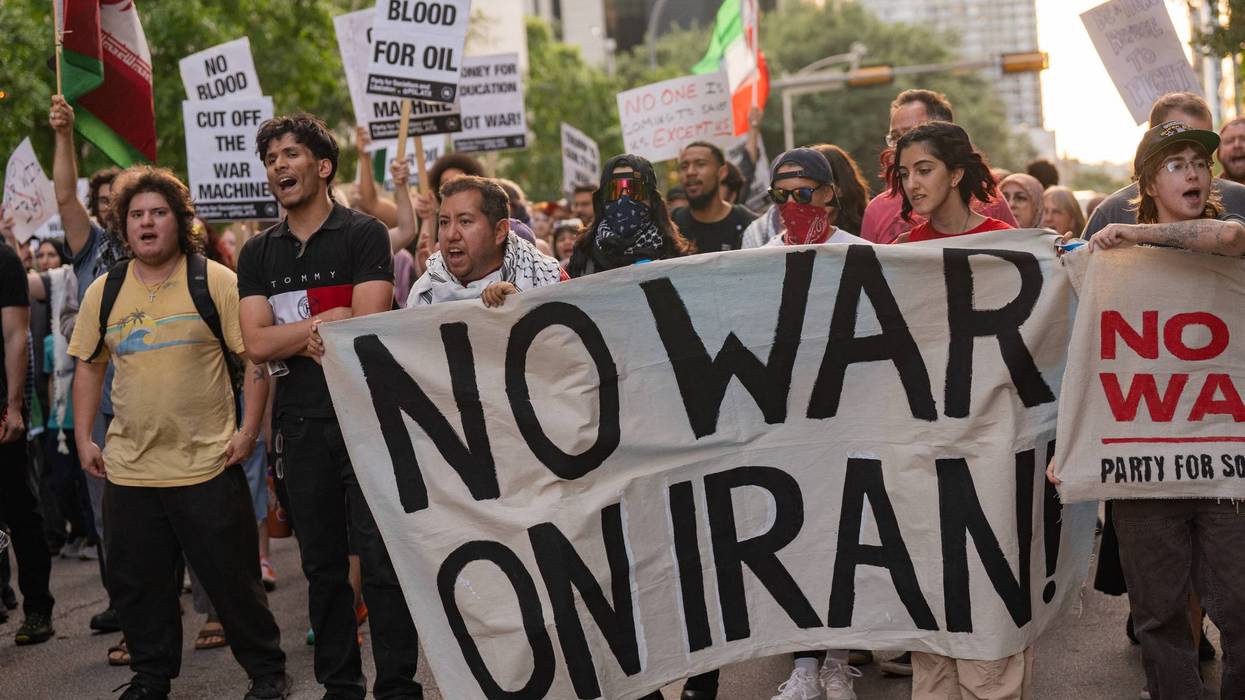
With the economic impact of the war on Iran linked to President Donald Trump's plummeting approval rating, the president issued his latest threat to destroy the Middle Eastern country Sunday as he demanded negotiators "get moving, FAST" to end the conflict the US and Israel began by choice in February.
"For Iran, the Clock is Ticking," said the president in a Truth Social post, adding that if a peace deal is not reached soon, "there won’t be anything left of them. TIME IS OF THE ESSENCE!”
Trump rejected Iran's latest peace proposal last week; the country has reportedly offered significant concessions on its uranium enrichment, but seeks to have separate nuclear talks after achieving peace and reaching a deal to reopen the Strait of Hormuz, which the Iranians effectively closed in retaliation for the US-Israeli attacks.
Since launching the conflict, Trump has demanded the dismantling of Iran's missile arsenal as well as its nuclear program, which Iran has said is not for military purposes, and has called for the country to cut ties with its regional allies.
Iran's Mehr news agency said Sunday that Trump had offered "no tangible concessions" in his response to the Iranians' latest proposal.
"The United States," said the news outlet, "wants to obtain concessions that it failed to obtain during the war, which will lead to an impasse in the negotiations."
Trump told Fox News in Beijing over the weekend that the Iranians are "crazy, and you know what? Because of that, they cannot have a nuclear weapon," explaining why he viewed it as "unacceptable" for nuclear talks to take place separately after a peace deal is brokered.
Trump reportedly spoke to Israeli Prime Minister Benjamin Netanyahu Sunday about the possibility of renewing strikes on Iran, which would break a ceasefire that was reached more than a month ago.
Danny Citrinowicz, a senior researcher at the Institute for National Security Studies, said Sunday that "the only realistic path to a diplomatic breakthrough would require Washington to engage more directly with the structure and substance of the Iranian proposal itself."
"Iran’s priorities remain consistent: ending what it views as economic siege conditions, reopening maritime access and reducing pressure in the Gulf, negotiating an end to the broader conflict, and only afterward addressing the nuclear issue," said Citrinowicz. "At the present moment, it is difficult to see the Iranian leadership agreeing to any framework that does not meaningfully engage with those core demands."
As with Trump's earlier threats of violence, including one in April in which he declared that Iran's entire civilization would die, "never to be brought back again," Iranian officials said the president's latest comments—which followed his posting of an image of himself on a military ship accompanied by the words, "It was the calm before the storm"—would not be tolerated.
A spokesperson for Iran's armed forces, Abolfazl Shakarchi, told Mehr that "repeating any folly to compensate for America’s disgrace in the Third Imposed War against Iran will result in nothing but receiving more crushing and severe blows."
Reporting for Al Jazeera, correspondent Almigdad Alruhaid said that the "kind of language" displayed by Trump on Sunday "is not acceptable here in Tehran. They are projecting defiance rather than [giving] an immediate response to this kind of rhetoric."
“Behind all of this rhetoric, there is awareness that the diplomatic window right now is narrowing,” said Alruhid.
Meanwhile, US Sen. Lindsey Graham (R-SC) urged Trump to "hurt them more" in order to force a deal, calling on the president to go through with bombing Iran's energy infrastructure as he's threatened to in recent months.
Uber-warmonger Lindsey Graham calls on Trump to bomb Iran's energy infrastructure.
The reason why Trump didn't do this during the war - despite threatening it - was because he realized Tehran would retaliate and take out the energy infrastructure in the GCC states. This would… pic.twitter.com/rvrewkavNr
— Trita Parsi (@tparsi) May 17, 2026
"The reason why Trump didn't do this during the war—despite threatening it—was because he realized Tehran would retaliate and take out the energy infrastructure in the [Gulf Cooperation Council] states," said Trita Parsi, executive vice president at the Quincy Institute for Responsible Statecraft. "This would lead to a far worse oil crisis—one rooted in production problems, not just a bottleneck in the Persian Gulf."
"The global economy would be thrown into a deep recession. Fuel shortages would lead to food shortages worldwide. Trump's presidency would be destroyed," he said. "None of this matters to Lindsey. He'll burn the entire planet as long as he gets his war. Trump's biggest mistake has been to listen to Lindsey and his allies."
"Like any country, Cuba has the right to defend itself against external aggression," said the Cuban embassy. "It is called self-defense, and it is protected by International Law and the UN Charter."
Cuban officials said the Trump administration is making "increasingly implausible accusations" against the country as it pushes to justify, "without any excuse, a military attack against Cuba," after an unnamed White House official told the news outlet Axios that the Cubans have been "discussing plans" to launch drones against the US.
"Cuba is the country under attack," said the Cuban embassy in a statement, months into a ramped-up oil blockade by the US that has left the island's electric grid in a "critical state" and forced frequent rolling blackouts as well as causing a healthcare crisis, with tens of thousands of people waiting for surgeries.
But in Axios' article, the Trump administration official took pains to push the notion that the US, with its nearly $1 trillion-per-year military, could face attacks from the tiny Caribbean nation 90 miles south of Florida because officials there have been preparing defensive capabilities.
Axios reported that, according to classified intelligence it viewed, Cuba has acquired more than 300 drones and has been considering plans to attack the US military base at Guantanamo Bay, various US military vessels, and Key West, Florida.
The country has been acquiring drones from Russia and Iran since 2023 and has sought more aid from Russia in recent months, according to the report. Intelligence intercepts have also shown Cuba is "trying to learn about how Iran has resisted us," the official said, referring to Iran's use of unmanned aircraft, its closure of the Strait of Hormuz, and its attacks on US military outposts in the Middle East in response to the US-Israel war on the country that began in February.
The Cuban embassy further responded with a reminder that "like any country, Cuba has the right to defend itself against external aggression."
"Those from the US who seek the submission and, in fact, the destruction of the Cuban nation through military aggression and war, do not waste a single moment fabricating pretexts, creating and spreading falsehoods, and distorting as extraordinary the logical preparation required to face a potential aggression," said the embassy.
Journalist José Luis Granados Ceja, who is based in Mexico City and covers Latin America for Drop Site News, emphasized that "Cuba has the right to self-defense."
"It would be arguably be wise for Cuba to incorporate a tool that has proven to be an extraordinary effective weapon and a powerful tool of dissuasion as part of its self-defense strategy," said Granados Ceja.
Axios said the classified intelligence "could become a pretext for US military action" that President Donald Trump has expressed an interest in taking numerous times, before acknowledging toward the end of the article that "US officials don't believe Cuba is an imminent threat, or actively planning to attack American interests."
Rather, the intelligence showed that Cuban officials "have been discussing drone warfare plans in case hostilities erupt as relations with the US continue to deteriorate"—suggesting they could use drones in self-defense if attacked by the US.
The reporting carried echoes of Secretary of State Marco Rubio's rationale for attacking Iran in February. He stunned legal experts days after the war began by explaining that the US had decided to wage war on the Middle Eastern country because it feared Iran would retaliate after Israel began attacking it.
"The imminent threat was that we knew that if Iran was attacked, and we believed they would be attacked, that they would immediately come after us," Rubio said.
The claim that Cuba's reported preparations make the island a threat to US security "is a lie—with purpose," said David Adler, co-general coordinator of Progressive International.
"Marco Rubio and his stenographers at Axios are manufacturing consent for the invasion of Cuba," said Adler. "To fall for this flimsy propaganda is to fail the most basic test of civic literacy. And the stakes are millions of Cuban lives off our coast."
Rubio, the son of Cuban immigrants, has long sought regime change in the socialist country.
Axios' reporting came days after CIA Director John Ratcliffe traveled to Cuba to pressure officials into complying with US demands, likely including political and economic reforms, heightening fears that the US could be planning a military attack unless the country complies.
White House officials also told CBS News Friday that the Department of Justice is preparing to criminally indict former Cuban President Raúl Castro for shooting down planes that belonged to a US group that had flown into Cuba's airspace in the 1990s. In January, US forces invaded Venezuela and abducted President Nicolás Maduro, bringing him to the US where he was charged with drug trafficking, and pleaded not guilty.
Former Obama administration staffer and Pod Save America co-host Tommy Vietor said Sunday that "lots of signals pointing towards an imminent US regime change operation against Cuba."
"The latest," he said of the Axios article, "is this blatant effort to launder a pretext for war through the media."