SUBSCRIBE TO OUR FREE NEWSLETTER
Daily news & progressive opinion—funded by the people, not the corporations—delivered straight to your inbox.
5
#000000
#FFFFFF
To donate by check, phone, or other method, see our More Ways to Give page.
Daily news & progressive opinion—funded by the people, not the corporations—delivered straight to your inbox.
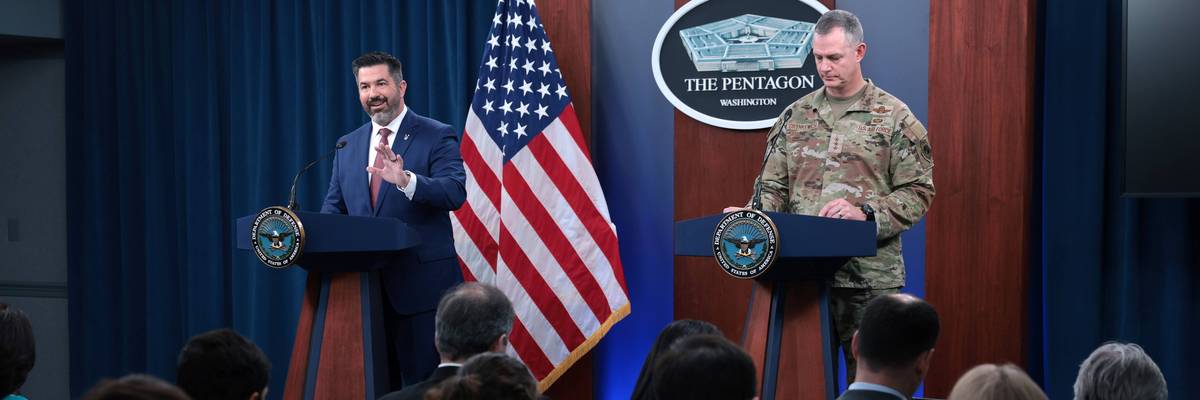
Chief US Department of Defense spokesperson Sean Parnell and Joint Staff Director for Operations Lt. Gen. Alexus Grynkewich participate in a press conference at the Pentagon in Arlington, Virginia on March 17, 2025.
"It's unfortunate that it took this long for the Pentagon's ridiculous policy to be thrown in the trash," said one press freedom advocate.
A federal judge in Washington, DC blocked the US Department of Defense's widely decried press policy on Friday, which The New York Times and reporter Julian Barnes had argued violates their rights under the First and Fifth amendments to the Constitution.
The Times filed its lawsuit in December, shortly after the first briefing for the "Pentagon Propaganda Corps," which critics called those who signed the DOD's pledge not to report on any information unless it is explicitly authorized by the Trump administration. Journalists who refused the agreement turned over their press credentials and carried out boxes of their belongings.
"A primary purpose of the First Amendment is to enable the press to publish what it will and the public to read what it chooses, free of any official proscription," Judge Paul Friedman, who was appointed to the US District Court for DC by former President Bill Clinton, wrote in a 40-page opinion.
"Those who drafted the First Amendment believed that the nation's security requires a free press and an informed people and that such security is endangered by governmental suppression of political speech," he continued. "That principle has preserved the nation’s security for almost 250 years. It must not be abandoned now."
Friedman recognized that "national security must be protected, the security of our troops must be protected, and war plans must be protected," but also stressed that "especially in light of the country's recent incursion into Venezuela and its ongoing war with Iran, it is more important than ever that the public have access to information from a variety of perspectives about what its government is doing—so that the public can support government policies, if it wants to support them; protest, if it wants to protest; and decide based on full, complete, and open information who they are going to vote for in the next election."
The newspaper said that Friday's ruling "enforces the constitutionally protected rights for the free press in this country. Americans deserve visibility into how their government is being run, and the actions the military is taking in their name and with their tax dollars. Today's ruling reaffirms the right of the Times and other independent media to continue to ask questions on the public's behalf."
The Times had hired a prominent First Amendment lawyer, Theodore Boutrous Jr. of Gibson Dunn, who celebrated the decision as "a powerful rejection of the Pentagon's effort to impede freedom of the press and the reporting of vital information to the American people during a time of war."
"As the court recognized, those provisions violate not only the First Amendment and the due process clause, but also the founding principle that the nation's security depends upon a free press," Boutrous said. "The district court's opinion is not just a win for the Times, Mr. Barnes, and other journalists, but most importantly, for the American people who benefit from their coverage of the Pentagon."
Seth Stern, chief of advocacy at Freedom of the Press Foundation, also welcomed the ruling, saying that "the judge was right to see the Pentagon's outrageous censorship for what it is, but this wasn't exactly a close call. If the same issue was presented as a hypothetical question on a first-year law school exam, the professor would be criticized for making the test too easy."
"It's shocking that this sweeping prior restraint was the official policy of our federal government and that Department of Justice lawyers had the nerve to argue that journalists asking questions of the government is criminal," Stern declared. "Fifty years ago, the Supreme Court called prior restraints on the press 'the most serious and the least tolerable' of First Amendment violations. At the time, the court was talking about relatively targeted orders restraining specific reporting because of a specific alleged threat—like in the Pentagon Papers case, where the government falsely claimed that the documents about the Vietnam War leaked by Daniel Ellsberg threatened national security."
"Courts back then could never have anticipated the government broadly restraining all reporting that it doesn't authorize without any justification beyond hypothetical speculation," he added. "It's unfortunate that it took this long for the Pentagon's ridiculous policy to be thrown in the trash. Especially now that we are spending money and blood on yet another war based on constantly shifting pretexts, journalists should double down on their commitment to finding out what the Pentagon does not want the public to know rather than parroting 'authorized' narratives."
The Trump administration has not yet said whether it will appeal the decision in the case, which was brought against the DOD—which President Donald Trump calls the Department of War—as well as Defense Secretary Pete Hegseth and the Pentagon’s chief spokesperson, Sean Parnell.
Dear Common Dreams reader, It’s been nearly 30 years since I co-founded Common Dreams with my late wife, Lina Newhouser. We had the radical notion that journalism should serve the public good, not corporate profits. It was clear to us from the outset what it would take to build such a project. No paid advertisements. No corporate sponsors. No millionaire publisher telling us what to think or do. Many people said we wouldn't last a year, but we proved those doubters wrong. Together with a tremendous team of journalists and dedicated staff, we built an independent media outlet free from the constraints of profits and corporate control. Our mission has always been simple: To inform. To inspire. To ignite change for the common good. Building Common Dreams was not easy. Our survival was never guaranteed. When you take on the most powerful forces—Wall Street greed, fossil fuel industry destruction, Big Tech lobbyists, and uber-rich oligarchs who have spent billions upon billions rigging the economy and democracy in their favor—the only bulwark you have is supporters who believe in your work. But here’s the urgent message from me today. It's never been this bad out there. And it's never been this hard to keep us going. At the very moment Common Dreams is most needed, the threats we face are intensifying. We need your support now more than ever. We don't accept corporate advertising and never will. We don't have a paywall because we don't think people should be blocked from critical news based on their ability to pay. Everything we do is funded by the donations of readers like you. When everyone does the little they can afford, we are strong. But if that support retreats or dries up, so do we. Will you donate now to make sure Common Dreams not only survives but thrives? —Craig Brown, Co-founder |
A federal judge in Washington, DC blocked the US Department of Defense's widely decried press policy on Friday, which The New York Times and reporter Julian Barnes had argued violates their rights under the First and Fifth amendments to the Constitution.
The Times filed its lawsuit in December, shortly after the first briefing for the "Pentagon Propaganda Corps," which critics called those who signed the DOD's pledge not to report on any information unless it is explicitly authorized by the Trump administration. Journalists who refused the agreement turned over their press credentials and carried out boxes of their belongings.
"A primary purpose of the First Amendment is to enable the press to publish what it will and the public to read what it chooses, free of any official proscription," Judge Paul Friedman, who was appointed to the US District Court for DC by former President Bill Clinton, wrote in a 40-page opinion.
"Those who drafted the First Amendment believed that the nation's security requires a free press and an informed people and that such security is endangered by governmental suppression of political speech," he continued. "That principle has preserved the nation’s security for almost 250 years. It must not be abandoned now."
Friedman recognized that "national security must be protected, the security of our troops must be protected, and war plans must be protected," but also stressed that "especially in light of the country's recent incursion into Venezuela and its ongoing war with Iran, it is more important than ever that the public have access to information from a variety of perspectives about what its government is doing—so that the public can support government policies, if it wants to support them; protest, if it wants to protest; and decide based on full, complete, and open information who they are going to vote for in the next election."
The newspaper said that Friday's ruling "enforces the constitutionally protected rights for the free press in this country. Americans deserve visibility into how their government is being run, and the actions the military is taking in their name and with their tax dollars. Today's ruling reaffirms the right of the Times and other independent media to continue to ask questions on the public's behalf."
The Times had hired a prominent First Amendment lawyer, Theodore Boutrous Jr. of Gibson Dunn, who celebrated the decision as "a powerful rejection of the Pentagon's effort to impede freedom of the press and the reporting of vital information to the American people during a time of war."
"As the court recognized, those provisions violate not only the First Amendment and the due process clause, but also the founding principle that the nation's security depends upon a free press," Boutrous said. "The district court's opinion is not just a win for the Times, Mr. Barnes, and other journalists, but most importantly, for the American people who benefit from their coverage of the Pentagon."
Seth Stern, chief of advocacy at Freedom of the Press Foundation, also welcomed the ruling, saying that "the judge was right to see the Pentagon's outrageous censorship for what it is, but this wasn't exactly a close call. If the same issue was presented as a hypothetical question on a first-year law school exam, the professor would be criticized for making the test too easy."
"It's shocking that this sweeping prior restraint was the official policy of our federal government and that Department of Justice lawyers had the nerve to argue that journalists asking questions of the government is criminal," Stern declared. "Fifty years ago, the Supreme Court called prior restraints on the press 'the most serious and the least tolerable' of First Amendment violations. At the time, the court was talking about relatively targeted orders restraining specific reporting because of a specific alleged threat—like in the Pentagon Papers case, where the government falsely claimed that the documents about the Vietnam War leaked by Daniel Ellsberg threatened national security."
"Courts back then could never have anticipated the government broadly restraining all reporting that it doesn't authorize without any justification beyond hypothetical speculation," he added. "It's unfortunate that it took this long for the Pentagon's ridiculous policy to be thrown in the trash. Especially now that we are spending money and blood on yet another war based on constantly shifting pretexts, journalists should double down on their commitment to finding out what the Pentagon does not want the public to know rather than parroting 'authorized' narratives."
The Trump administration has not yet said whether it will appeal the decision in the case, which was brought against the DOD—which President Donald Trump calls the Department of War—as well as Defense Secretary Pete Hegseth and the Pentagon’s chief spokesperson, Sean Parnell.
A federal judge in Washington, DC blocked the US Department of Defense's widely decried press policy on Friday, which The New York Times and reporter Julian Barnes had argued violates their rights under the First and Fifth amendments to the Constitution.
The Times filed its lawsuit in December, shortly after the first briefing for the "Pentagon Propaganda Corps," which critics called those who signed the DOD's pledge not to report on any information unless it is explicitly authorized by the Trump administration. Journalists who refused the agreement turned over their press credentials and carried out boxes of their belongings.
"A primary purpose of the First Amendment is to enable the press to publish what it will and the public to read what it chooses, free of any official proscription," Judge Paul Friedman, who was appointed to the US District Court for DC by former President Bill Clinton, wrote in a 40-page opinion.
"Those who drafted the First Amendment believed that the nation's security requires a free press and an informed people and that such security is endangered by governmental suppression of political speech," he continued. "That principle has preserved the nation’s security for almost 250 years. It must not be abandoned now."
Friedman recognized that "national security must be protected, the security of our troops must be protected, and war plans must be protected," but also stressed that "especially in light of the country's recent incursion into Venezuela and its ongoing war with Iran, it is more important than ever that the public have access to information from a variety of perspectives about what its government is doing—so that the public can support government policies, if it wants to support them; protest, if it wants to protest; and decide based on full, complete, and open information who they are going to vote for in the next election."
The newspaper said that Friday's ruling "enforces the constitutionally protected rights for the free press in this country. Americans deserve visibility into how their government is being run, and the actions the military is taking in their name and with their tax dollars. Today's ruling reaffirms the right of the Times and other independent media to continue to ask questions on the public's behalf."
The Times had hired a prominent First Amendment lawyer, Theodore Boutrous Jr. of Gibson Dunn, who celebrated the decision as "a powerful rejection of the Pentagon's effort to impede freedom of the press and the reporting of vital information to the American people during a time of war."
"As the court recognized, those provisions violate not only the First Amendment and the due process clause, but also the founding principle that the nation's security depends upon a free press," Boutrous said. "The district court's opinion is not just a win for the Times, Mr. Barnes, and other journalists, but most importantly, for the American people who benefit from their coverage of the Pentagon."
Seth Stern, chief of advocacy at Freedom of the Press Foundation, also welcomed the ruling, saying that "the judge was right to see the Pentagon's outrageous censorship for what it is, but this wasn't exactly a close call. If the same issue was presented as a hypothetical question on a first-year law school exam, the professor would be criticized for making the test too easy."
"It's shocking that this sweeping prior restraint was the official policy of our federal government and that Department of Justice lawyers had the nerve to argue that journalists asking questions of the government is criminal," Stern declared. "Fifty years ago, the Supreme Court called prior restraints on the press 'the most serious and the least tolerable' of First Amendment violations. At the time, the court was talking about relatively targeted orders restraining specific reporting because of a specific alleged threat—like in the Pentagon Papers case, where the government falsely claimed that the documents about the Vietnam War leaked by Daniel Ellsberg threatened national security."
"Courts back then could never have anticipated the government broadly restraining all reporting that it doesn't authorize without any justification beyond hypothetical speculation," he added. "It's unfortunate that it took this long for the Pentagon's ridiculous policy to be thrown in the trash. Especially now that we are spending money and blood on yet another war based on constantly shifting pretexts, journalists should double down on their commitment to finding out what the Pentagon does not want the public to know rather than parroting 'authorized' narratives."
The Trump administration has not yet said whether it will appeal the decision in the case, which was brought against the DOD—which President Donald Trump calls the Department of War—as well as Defense Secretary Pete Hegseth and the Pentagon’s chief spokesperson, Sean Parnell.