SUBSCRIBE TO OUR FREE NEWSLETTER
Daily news & progressive opinion—funded by the people, not the corporations—delivered straight to your inbox.
5
#000000
#FFFFFF
To donate by check, phone, or other method, see our More Ways to Give page.
Daily news & progressive opinion—funded by the people, not the corporations—delivered straight to your inbox.
There is an astonishing statistic in a Pew research study released in 2020 on perceptions of how different countries handled COVID-19.
Only 15 percent of people in a dozen countries around the world thought the United States was doing a good job of addressing the pandemic. That sharply contrasted with how Americans felt: 47 percent praised their own government's management of COVID-19.
We're going to have to have a serious sit-down about this problem of economic growth and our unexamined assumptions about more, more, more.
What's astonishing is that people outside the United States had a much better understanding of what was going on inside this country. By all objective standards, America was doing a terrible job back in 2020. We had the highest number of infections and the highest number of deaths. We had critical shortages of personal protective equipment, and hospitals in a number of cities and rural areas were completely overwhelmed. Contact tracing was sporadic and masking requirements inconsistent. The federal government was incoherent, to put it mildly, and states veered off in very different directions, some of them suicidal.
So, how could nearly half of America give a thumb's up to such a nightmare? Part of it was pure nationalism (whatever America does is by definition great), part ideological (whatever the Trump administration did was by definition great), and part of it simply ignorance (the pandemic was a hoax, the numbers were exaggerated, it's bad all over).
This perception gap between outsiders and insiders does not bode well for the global response to the climate crisis. After all, the tendency has been to point fingers at others and rarely at one's self. Everyone has criticized China for its expanding carbon footprint. The Global South has criticized the industrialized north for producing the lion's share of carbon emissions over the last 150 years. The United States has been attacked for its devotion to fossil fuels, its radical swings in policy, and its ungenerous arrogance.
They are all correct. But rarely are such judgments balanced by self-criticism.
The domestic-international gap in perceptions is not quite as large on climate change as it was on the pandemic back in 2020. For instance, 39 percent of non-Americans surveyed by Pew in 2021 rated the U.S. record on climate change as "good." A much larger number of Americans, 49 percent, share that opinion. More troubling is the ideological gap in the United States, with 67 percent of those on the right and only 26 percent on the left thinking that the U.S. record is good.
In Glasgow
Such gaps in perception were on full display at the big climate confab that's taking place in Glasgow. Last week, leaders gathered to make declarations while critics mobilized in the streets to decry the insufficiency of those efforts. This week, the negotiators try to transform the declarations into numbers.
A couple of those declarations look promising. A deal on beginning to reverse deforestation by 2030 would be a great step forward (of course, a similar agreement in 2014 would also have been a great step forward). A pact to cut methane levels by 30 percent by 2030 is certainly welcome, but the biggest sinners in this regard (India, Russia, and China) are not yet on board.
The assembled leaders agreed to what they have called the "Glasgow Breakthrough Agenda" covering five sectors that account for half of all carbon emissions: power, road transport, steel, hydrogen, and agriculture. This collection of initiatives is meant to create 20 million jobs and increase global GDP by 4 percent over what it would otherwise be by 2030.
Deeply troubling in all of these declarations is the continued reliance on private finance to lead the way toward a carbon-neutral world, like the pledge from the captains of finance to push for cleaner technologies. Unfortunately, they are not making a comparable commitment to stop investing in fossil fuels.
Just as citizens of countries tend to view the climate policies of their own governments more favorably than outsiders do, the leaders of the international community generally have a self-congratulatory approach to their own efforts. Those on the outside of the Glasgow meetings, on the other hand, were harshly critical. "Blah, blah, blah," said Greta Thunberg in one of her latest jeremiads against the insufficiency of response.
Let's be clear: it's not nothing.
Going into the Glasgow meeting, the cumulative impact of all the pledges countries have made to reduce their carbon emissions would have led to the world heating up to 2.1 degrees Celsius (over pre-industrial levels) by 2100. Factoring in the pledges made at Glasgow, according to the International Energy Agency, will bring down that number to 1.8 degrees.
It's not the 1.5 degree-level that represents the consensus of scientists and activists who want to avoid the worst effects of climate change. But it's also the first time that the international community has managed to get below the 2-degree mark, which was the upper level established by the Paris accords.
But wait, this analysis comes with a number of important asterisks.
First, despite all the fine words surrounding the Paris Accords, countries have largely not met the agreement's voluntary limits. Five years after making those commitments, countries were on track to reduce carbon emissions by a mere 5.5 percent by 2030 compared to the minimum requirement of 40-50 percent.
That's probably a generous estimate. According to the latest Intergovernmental Panel on Climate Change report, meeting the Paris commitments would only result, by 2030, in a 1 percent reduction from 2010 levels.
Both estimates, in any case, are probably off because, as The Washington Post reports this week, the data is incomplete and sometimes falsified outright. Algeria hasn't reported since 2000, Qatar since 2007, Iran since 2010, China since 2014, Libya and Taiwan since, well, never: in all, 45 countries haven't reported data since 2009. No country claims the carbon emissions from international travel and shipping (more than a billion tons a year). Countries like Russia and Malaysia have subtracted carbon emissions from their balance sheets based on their forests, and sometimes those estimates bear little relationship to reality. Even the emissions they do report don't line up with the estimates of independent assessments. According to the Post, as much as 13.3 billion tons of carbon each year goes unreported.
Compounding this problem is the so-called brown recovery. The modest reductions in carbon emissions that took place during the COVID-19 economic shutdowns are being obliterated by the burst of post-pandemic economic activity. The world could have built back better in a sustainable manner. Instead, it is building back brown.
So, let's take another look at the IEA prediction of substantial progress after Glasgow. The UN's own estimate, released this week, suggests that the combined reduction in global temperature as a result of the Glasgow pledges--given the failures to meet earlier commitments, the gaps in the data, and the current upsurge in post-pandemic emissions--will be a mere .1 degrees, not .3 degrees. And the world is heading not toward a 2.1-degree Celsius increase by the turn of the next century but 2.5 degrees.
So, the gap between perception and reality has some very dangerous consequences indeed.
To narrow that gap, activists will have to continue to push governments to do better. Individuals think they are doing enough, think that their governments are doing enough, and on the whole consider climate change to be somebody else's problem. They have to be persuaded otherwise.
Bridging the Gap
One of the great compromises--or grand delusions, if you prefer--at the heart of the Breakthrough Agenda is encapsulated in the phrase "green growth." At Glasgow, the luminaries promise millions more jobs and a boost in global GDP. Political leaders are not in the business of taking things away from people, of promising belt-tightening, of Scrooging everyone's Black Friday buying spree. At Glasgow, like pretty much everywhere else, politicians promised more jobs (green ones), more energy (the clean kind), more gadgets (like electric cars).
More, more, more has been humanity's mantra for the last 150 years or so. It used to be only the watchword of the rich. The industrial revolution democratized the phrase.
The problem, however, is that the planet can no longer accommodate our collective voracity. There just isn't enough stuff to go around.
Oh, yes, of course, sunlight is unlimited and will be for the next umpteen million years. But the resources it takes to capture that sunlight--the materials for the solar panels, the energy to build those panels, the land to site solar farms--are not unlimited. The same applies to wind and waves and geothermal.
So, we're going to have to have a serious sit-down about this problem of economic growth and our unexamined assumptions about more, more, more.
That needs to be a global conversation, but the north continues to out-consume the south by an order of nine to one, if you compare the per capita carbon footprint of the United States (15.53) with that of Indonesia (1.72). So, global equity has to be part of this conversation as well--transferring resources to the Global South on an unprecedented level to ensure an equitable green transition.
It's not just a bill of reparations for what the industrialized world has extracted--often through outright theft--over the last few hundred years. It would also need to reverse the current outflow of resources from the Global South. As I wrote recently for TomDispatch, "By one estimate, the Global North enjoys a $2.2 trillion annual benefit in the form of underpriced labor and commodities from there, an extraction that rivals the magnitude of the colonial era." And that doesn't even count the debt repayment outflow. Or the costs associated with ongoing climate change, which disproportionately affects the Global South.
Here, the gap in perceptions turns deadly. Consumers can believe that they are doing their part by buying electric cars. Americans can believe their government is going the extra mile with the clean energy provisions of the new infrastructure bill (all those charging stations) and perhaps one day the Build Back Better bill as well. Europeans can feel good about themselves by meeting the goals of their new Fit for 55 provisions (which mandate a 55 percent reduction of carbon emissions from 1990 levels by 2030). The international community is awash in self-congratulation after the meeting in Glasgow and all the promises made.
But all that good feeling will leave us thinking that we've done enough. In this case, the perfect needs to be the enemy of the merely good. As the waters continue to rise, good simply is no longer good enough.
Last week, at the UN climate negotiations, the International Energy Agency announced that pledges made thus far could hold warming to 1.8 or 1.9degC. Yet an investigation published on Sunday by The Washington Post found that countries' pledges are based on faulty data. And a report released on Tuesday by Climate Action Tracker, a research group that monitors action on greenhouse gas emissions reductions, found that the targets will, at best, keep temperatures to 2.7degC (5degF). That same day, the United Nations Environmental Programme (UNEP) published its annual Emissions Gap report, which matched the Climate Action Tracker's findings: current pledges will lead to 2.7degC.
The Climate Action Tracker based their conclusions on the Nationally Determined Contributions (NDCs) that each country released before the talks. The NDCs, which are publicly available on the United Nations Framework Convention on Climate Change (UNFCCC) website, spell out how each country plans to cut greenhouse gas emissions. The plans range from specific to vague, and from extremely short to hundreds of pages. Under the Paris Agreement, which was adopted at COP21 in Paris in 2015 and went into effect in 2016, each country needs to submit its NDC every five years.
Because of the sheer volume of countries involved, the Climate Action Tracker focused on the 40 countries that are responsible for 80 percent of the world's emissions, and ranked their plans based on how likely they are to result in the necessary cuts.
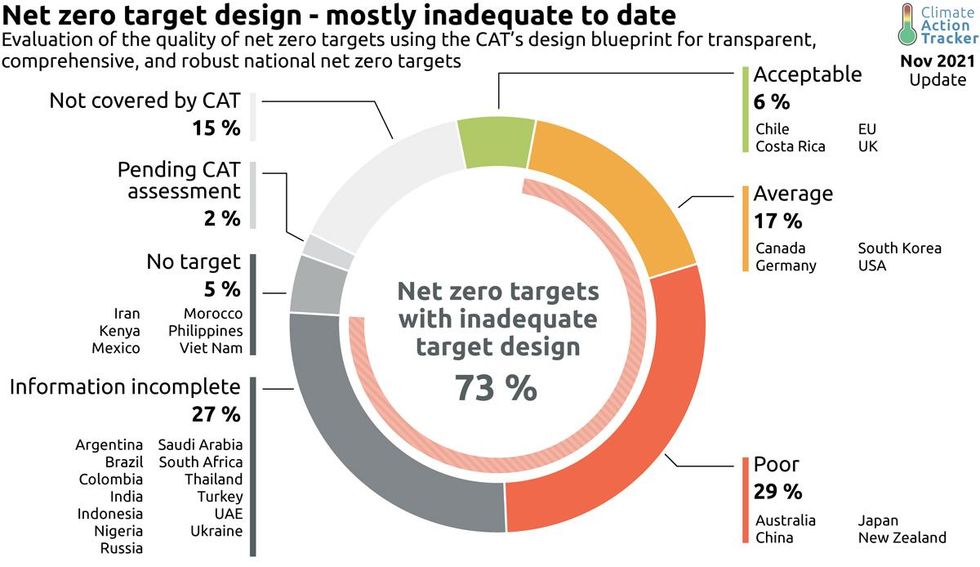
Image courtesy of the Climate Action Tracker.
Only four negotiating parties--Chile, Costa Rica, the European Union, and the United Kingdom--had plans that CAT found acceptable for holding warming to the Glasgow talks' stated goal of holding warming to 1.5degC (or "1.5 to stay alive" as negotiators from island nations say).
The reason these countries have managed to delude themselves and others? Instead of laying out concrete plans to drastically cut emissions immediately, during the next crucial two decades, some countries plan to cut their emissions only minimally, and balance what is left by doing things like buying carbon offsets, planting trees, and investing in carbon capture technology. Instead of cutting their greenhouse gas emissions to zero, they would reach something they call "net zero."
The simple phrase that begat a legion of creative accounting
When countries promise that they can reach net zero without making sharp cuts to emissions in the next decade, those claims should not be taken at face value. The commitments are too far into the future and action is needed now. Reliable, quantifiable methods of carbon capture and sequestration do not exist yet at the scale necessary to help meet those targets. A country could embark on a massive reforestation project, only to see those forests decimated by wildfires or illegal logging. They could invest in carbon capture technology that fails to pan out. They could restore wetlands, only to see them thrashed by climate change-intensified hurricanes. A coal plant can be shut down in a day, while a forest takes decades to grow.
Furthermore, many net zero schemes rely on carbon markets, offset schemes, and using lands in the global south as carbon sinks--a tactic that might mean forced removal of the people currently living on them. The use of lands as carbon sinks is referred to as "nature-based solutions." Sara Shaw, climate justice and energy programme coordinator at Friends of the Earth International said, it "rings alarm bells. Clearly, it's an intoxicating idea, that after decades of inaction nature can come to save us from climate breakdown. But 'Nature Based Solutions' will likely lead to land grabs, food insecurity and rights violations for people already on the sharp edge of climate impacts."
There simply is not enough land and trees in the world to soak up the emissions of big polluters and northern governments. For these reasons, organizations ranging from Friends of the Earth to Indigenous Environmental Network, from Power Shift Africa to the Third World Network and many others, are calling for "Real Solutions Not 'Net Zero," and satirists like Australia's The Juice are directly mocking net zero as a fantasy.
As Meena Raman, from the environmental group Friends of the Earth Malaysia, said at a press briefing last week, "Offsetting is no longer a solution. It has to be real zero. And it should have been real zero yesterday."
Promise now, deliver later
Another problem is how many countries are planning on reducing their emissions in the next decades, rather than this one. The greenhouse gas emissions cuts that nations have laid out in their NDCs fall into two categories: short-term (by 2030); and long-term (by 2050 for developed nations and by 2060 for developing nations).
What matters most is that these short-term emissions cuts are made this decade. But most of last week's good news was based on long-term commitments, which gives the nations making those pledges over a decade before they can be held accountable for failing to meet their emissions goals.
At a press briefing, Professor Niklas Hohne, of the NewClimate Institute, one of the two organizations who put out the Climate Action Tracker report, said "We now have more than 140 governments announcing net zero targets that cover more than 90 percent of global greenhouse emissions. And at first sight, that's positive news. If we then assume that all of these countries indeed meet their net zero targets, then we calculate a temperature increase by the end of the century of 1.8 degrees."
That, said Hohne, is the optimistic scenario. But it is not a likely one. "It's not time to sit back and relax," he added. "Because not a single country has short-term policies in place to put itself on track towards its own net zero targets. Right now, the net zero targets are a good vision but they have to be backed by short-term action otherwise, otherwise they are simply not credible. And that's also where this COP has moved only a small step forward. We still have a huge gap. Assuming all countries implement everything they have proposed here, we would still emit twice as much as we should in 2030 compared to if we want to be on a 1.5 pathway."
If one takes into account only the short-term targets that the nations participating in COP26 have made for 2030, temperatures would rise by 2.4 C. If one looks at their existing (not promised) policies and actions, temperatures will increase to 2.7degC. "All countries have to go back and rethink what they can do," Hohne said. "And the only way to do that is to go into emergency mode. Governments have to do something substantially different."
Given this urgency, developing nations are calling for NDCs to be reported every year instead of every five years, a demand that was included in the draft text published on Wednesday morning, and to develop even more ambitious short-term actions. "The key issue for us is not net zero targets in 2050 particularly for the rich world," said Meena Raman. "Net zero by 2050 is too little, too late, particularly for the rich world."
On Tuesday morning, at a press conference held by the Republic of the Marshall Islands, Tina Stege, Climate Envoy for the Marshall Islands expressed similar sentiments: "I think we need to see folks coming back on commitments in 2022. For these things to have impact and make sense you have to start next year. The decade of action is now."
More than just a COP problem
This use of the term "net zero" to delay action is not unique to COP 26. A report from Corporate Accountability published last month and titled "The Big Con: How Polluters Are Advancing a 'Net Zero' Climate Agenda to Delay, Deceive and Deny," found that Microsoft, for example, has based its plan to reach net zero by 2030 on a still-unproven carbon capture technology.
But it is especially critical at the UN climate negotiations because of its capacity to block what nations in the developing world are calling for instead: ambitious short-term commitments backed by action and the phase out of fossil fuels. Yesterday's draft of the COP26's final decision text mentioned fossil fuels for the first time with a demand to "accelerate the phase out of coal and subsidies for fossil fuels."
Jennifer Morgan, Executive Director of Greenpeace International, said: "What's very concerning here in Glasgow is that the first draft of the climate pact text is already exceptionally weak. Usually the text starts with some ambition, which then gets watered down. To keep 1.5 alive, four words must be added: 'fossil fuels phase out,' and countries must come back next year to close the gap."
Tina Stege, Climate Envoy for the Marshall Islands, too, stated that concrete, near-term action was the only viable solution to the climate crisis. "We can't just have promises of what we're going to do; we actually have to have actions to back them up," Stege said. "As we laid out, on policies like phasing out coal, policies on methane, ending of fossil fuel subsidies, these are the concrete actions that need to happen now."
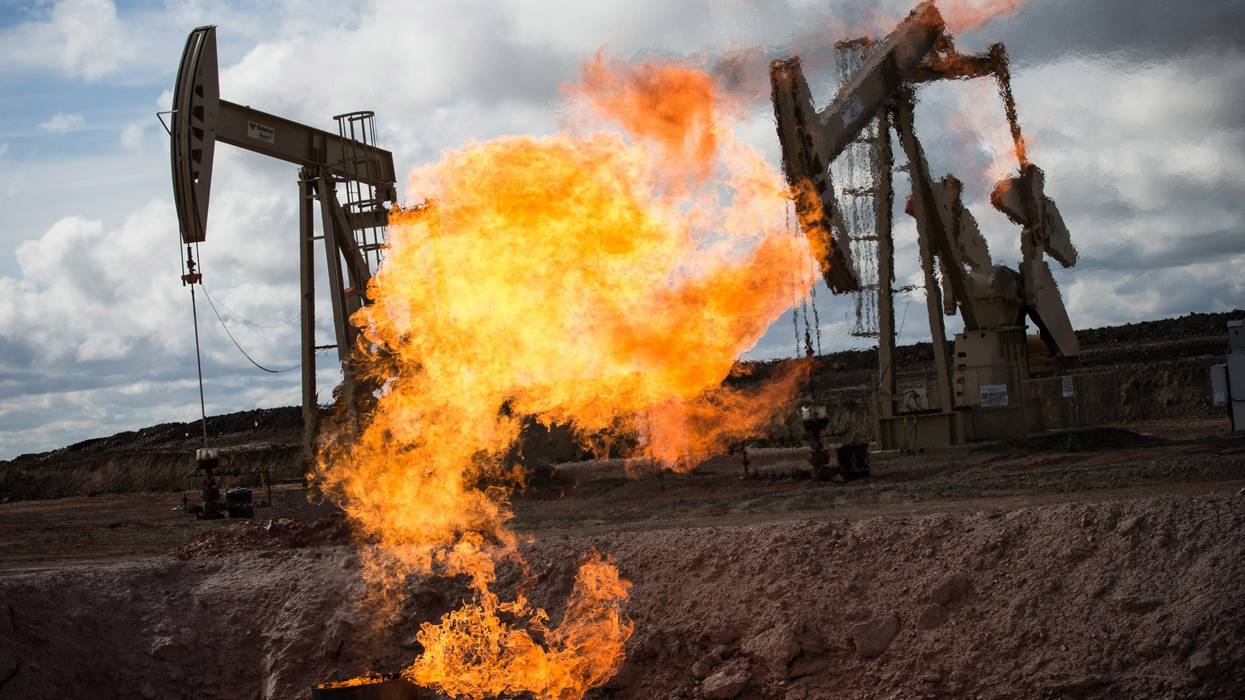
Building on a "bombshell" release from earlier this year, the International Energy Agency on Thursday published a report on pathways to cut planet-heating methane emissions from fossil fuels 75% by 2030, which the IEA calls "essential" to combating the climate emergency.
"It is inexcusable that massive amounts of methane continue to be allowed to just seep into the air from fossil fuel operations."
When the Paris-based global energy watchdog in May released its Net-Zero by 2050 roadmap that signaled the need to keep fossil fuels in the ground, Greenpeace International executive director Jennifer Morgan declared, "Finally the IEA is starting to get it."
While discussions on greenhouse gas emissions often center on carbon dioxide, the focus of the new report--Curtailing Methane Emissions From Fossil Fuel Operations: Pathways to a 75% cut by 2030--is up to 87 times more potent than CO2 over a 20-year period.
Methane, which is more potent than CO2 but also disappears more quickly, "has contributed to around 30% of the global rise in temperatures to date," the report says, "and curbing these emissions is the most effective means available for limiting global warming in the near term."
The report continues:
Emissions from fossil fuel operations present a major opportunity in this respect, since the pathways to reduction are both clear and cost-effective. Fossil fuel operations generated close to 120 [million tonnes] of methane in 2020--nearly one-third of all methane emissions from human activity. The scope for reducing these emissions is enormous. This is particularly true in the oil and gas sector, where it is possible to avoid more than 70% of current emissions with existing technology, and where around 45% could be avoided at no net cost.
Reducing fossil fuel demand alone will not do the job quickly or effectively enough, which means early and concerted abatement efforts by governments and industry are essential. Under the IEA's Net-Zero Emissions by 2050 Scenario, methane emissions from fossil fuel operations would need to fall by around 75% between 2020 and 2030. Only about one-third of this decrease is the result of reduced consumption of fossil fuels, principally coal. Most of the decline comes from the rapid deployment of measures and technologies to eliminate avoidable methane emissions by 2030.
Offering "practical steps that can be taken by countries and companies to secure a 75% reduction," the report calls on both governments and businesses to take urgent action.
While the IEA highlighted the necessity of cutting methane, some climate campaigners reiterated the broader need for a "managed decline in oil and gas production, starting now." As Oil Change International's David Tong put it: "That needs to be the top focus, even as we address methane."
IEA executive director Fatih Birol, in a statement about the new report, acknowledged recent efforts to address methane pollution.
"At a time when we are constantly being reminded of the damaging effects of climate change," Birol said, "it is inexcusable that massive amounts of methane continue to be allowed to just seep into the air from fossil fuel operations."
"These emissions are avoidable, the solutions are proven and even profitable in many cases. And the benefits in terms of avoided near-term warming are huge," he added. "I welcome the renewed impetus behind this issue with the Global Methane Pledge, announced by the European Union and the United States, and urge all countries and companies to step up their actions."
Related Content

Unveiled last month during an event hosted by U.S. President Joe Biden, the pledge aims to reduce all methane emissions worldwide at least 30% by 2030. Though climate campaigners charge that it doesn't go far enough, the agency's statement noted Thursday that "if the world achieves the 75% cut in methane from fossil fuel operations as described in the new IEA report, this would lower total human-caused methane emissions by around 25%, and so would go a long way to achieving the aim of the Global Methane Pledge."
Jonathan Banks, Clean Air Task Force's international director for super pollutants, said that the IEA's report "makes clear that making substantial cuts to methane emissions from the fossil fuel sector is the lowest hanging fruit in global climate policy."
"Multiple sectors are contributing to the global methane crisis, and there are opportunities to reduce methane emissions from each of them," he added, "but it's clear from this report that cutting emissions from the oil, gas, and coal sectors is a critical opportunity to do it at pace and scale. We need substantial, economy-wide methane reductions this decade for us to stand a chance of avoiding the worst climate tipping points."
The report comes just ahead of COP 26, the United Nations summit set to kick off in Scotland at the end of the month. In anticipation of that and new methane policies from the U.S. Environmental Protection Agency (EPA), Earthworks policy director Lauren Pagel recently proposed a more ambitious goal, which she repeated in a statement Thursday.
"This is a pivotal moment," Pagel said. "The Biden administration can either be a leader on methane pollution or cave to industry and risk climate catastrophe. The EPA has the authority under the Clean Air Act to cut oil and gas methane pollution by 65% by 2025. Their new rules must use that full authority."
"While cutting methane is a vital start, it is not enough," she added. "The U.S. must begin a managed decline of fossil fuels that centers industry workers and frontline communities who are most exposed to the health and climate impacts of fossil fuels."
Climate campaigners and energy experts are responding to a recent rise in fossil fuel demand by reiterating the necessity of rapidly transitioning to renewable sources like solar and wind, with Swedish activist Greta Thunberg warning Monday that "we are still speeding in the wrong direction."
Thunberg yet again took aim at world leaders' empty promises to combat the climate emergency, including through policies and investments provoked by the Covid-19 pandemic. As she put it: "So much for 'building back better' and a 'green recovery.'"
The 18-year-old--whose solo protests outside the Swedish Parliament sparked the global youth-led Fridays for Future movement--was reacting on Twitter to new reporting from Reuters that demand for coal and gas has topped pre-coronavirus highs, "with oil not far behind, dealing a setback to hopes the pandemic would spur a faster transition to clean energy."
Reuters highlighted figures from the International Energy Agency (IEA), the global energy watchdog which made clear in May that countries' current climate pledges are deeply inadequate and allowing new fossil fuel projects is incompatible with the global goal to dramatically cut planet-heating pollution.
Three-quarters of the world's total energy demand is still met by fossil fuels and both coal and gas demand are projected to surpass 2019 levels, according to the IEA. Coal demand is expected to rise 4.5% this year and gas demand is on track to increase 3.2%, after falling 1.9% last year.
As the news agency reported:
Global natural gas shortages, record gas and coal prices, a power crunch in China, and a three-year high on oil prices all tell one story--demand for energy has roared back and the world still needs fossil fuels to meet most of those energy needs.
"The demand fall during the pandemic was entirely linked to governments' decision to restrict movements and had nothing to do with the energy transition," Cuneyt Kazokoglu, head of oil demand analysis at FGE told Reuters.
"The energy transition and decarbonization are decade-long strategies and do not happen overnight."
Fatih Birol, head of the Paris-based IEA, has recently not only agreed with the consultant's analysis but also made a case for transitioning power systems.
Faced with a steep rise in European gas prices last month, Birol said in a statement that "it is inaccurate and misleading to lay the responsibility at the door of the clean energy transition."
"Today's situation is a reminder to governments, especially as we seek to accelerate clean energy transitions, of the importance of secure and affordable energy supplies--particularly for the most vulnerable people in our societies," Birol added. "Well-managed clean energy transitions are a solution to the issues that we are seeing in gas and electricity markets today--not the cause of them."
"Well-managed clean energy transitions are a solution to the issues that we are seeing in gas and electricity markets today--not the cause of them."
--Fatih Birol, IEA
Reporting last week on the rising demand for gas and its impact on electricity bills and factories, The New York Times noted that "growing concerns about climate change, expressed by shareholders or via court cases like the decision by a Dutch court in May ordering Royal Dutch Shell to cut greenhouse-gas emissions, may make some companies hesitate to invest in new multibillion-dollar fossil fuel projects."
While one expert at the consultancy Rystad Energy suggested that such hesitancy could lead to "more volatile" markets, the Times added that a shift to power from clean sources like wind and solar eventually "may help protect consumers from the tyranny of the global commodity markets," though "the events of this fall suggest that goal is some distance away."
In response to that report, some experts called for speeding up the transition to clean energy and storage rather than clinging to gas. The Times coverage came as youth climate leaders, including Thunberg and Ugandan activist Vanessa Nakate, marched through Milan, Italy.
That march followed the United Nations-sponsored Youth4Climate summit that featured speeches from Thunberg and Nakate, and was held to craft proposals for attendees of the U.N. conference known as COP 26, set to begin in Glasgow, Scotland later this month.
"'Build back better.' Blah blah blah," Thunberg said in her address. "This is all we hear from our so-called leaders. Words--words that sound great but so far have led to no action. Our hopes and dreams drowned in their empty words and promises."
It just takes common sense to see that the climate change math of the Biden administration is not adding up: You cannot approve massive oil drilling projects if you want to swiftly reach net-zero emissions.
That is exactly what the administration did when it sided with ConocoPhillips in the company's bid to drill for more than a half billion barrels of oil in the National Petroleum Reserve (NPR) in the Alaskan Arctic, erecting infrastructure that will be in operation for 30 years or more. After spending $6 million in federal funds and generating more than 3,600 pages of environmental analysis, the Biden administration's brief, recently filed in federal district court, argues that the lease the Trump administration granted to ConocoPhillips is "valid"--including its impacts on the climate.
Given the dire threat we face, it cannot comport with any rationale for supporting ConocoPhillips.
Not surprisingly, the decision drew applause from ConocoPhillips Alaska President Erec Isaacson. The 23.4-million-acre reserve, on Alaska's central north coast, and under the control of the Interior Department's Bureau of Land Management, was created in 1923 in case the Navy needed emergency oil.
Nearly a century later, that need has been outstripped by the need to leave as much oil in the ground as possible. In an Earth Day fact sheet in April, the Biden administration said it is setting the nation on a firm path toward cutting emissions in half over the next nine years, a carbon-free power sector by 2035 and net zero emissions by 2050. "The United States is not waiting, the costs of delay are too great, and our nation is resolved to act now," the fact sheet said. "Climate change poses an existential threat."
Given the dire threat we face, it cannot comport with any rationale for supporting ConocoPhillips. The project would make a mockery of being on a firm path in cutting emissions when the government itself says the project might spew 260 million metric tons of global warming emissions into the atmosphere over the next 30 years, equivalent to the annual emissions from 63 coal-fired plants.
The drilling would also threaten extremely fragile ecosystems for some of the world's greatest concentrations of nesting and migrating wildlife. While less publicized than the 19.3-million-acre Arctic National Wildlife Refuge along the northeast coast run by the US Fish and Wildlife Service, the NPR is home to a dazzling array of polar bears, seals, walruses, loons, shorebirds, caribou, and peregrine falcons.
Climate change poses such an existential threat that this spring the International Energy Agency--the intergovernmental energy analysis forum for members of the Organization for Economic Development and Cooperation--said all nations must act now. With global carbon dioxide emissions rising again as many COVID-19 restrictions end, the IEA said 2021 is a "critical year at the start of a critical decade" to commit to a "total transformation" of energy. It warned that achieving net zero emissions "hinges on a singular, unwavering focus," adding that: "There is no need for investment in new fossil fuel supply."
The wavering by the Biden administration on extracting the nation from fossil fuel extraction threatens to neuter the many good things the administration is doing, such as suspending the Trump administration's leases in the Arctic National Wildlife Refuge, opposing the now-canceled Keystone XL pipeline, pausing new oil and gas drilling leases on federal lands (although that effort is now tangled in a court case), and bringing the United States back into the Paris climate accords.
Other actions and inactions are also concerning. Aside from upholding the Trump administration's permit for ConocoPhillips, the Biden White House whiffed on shutting down the controversial Dakota Access Pipeline until it could be fully reviewed. Particularly contentious to Indigenous tribes is how the pipeline, which carries oil from North Dakota to Illinois, goes under a reservoir of the Missouri River near the Standing Rock reservation. The administration has also taken no position so far on the proposed expansion of Enbridge's Line 3 pipeline, that would bring Canadian tar-sands oil through ecologically sensitive parts of Minnesota and tribal lands.
The complicated, partisan web of politics offers a probable reason why the Biden administration is not going all out to fight climate change from the start. The ConocoPhillips project is championed by Alaska Senators Lisa Murkowski and Dan Sullivan, both of whom were among the few Republicans to vote to confirm Interior Secretary Deb Haaland. Murkowski is also one of the tiny handful of Republican senators who has been known to very occasionally vote with Democrats on major legislation.
Just as sticky on the Democratic side are politicians such as West Virginia Senator Joe Manchin. In a Senate split 50-50 along party lines, Manchin (along with Murkowski) already hampered the Biden administration's carbon mitigation efforts by nixing Elizabeth Klein, Biden's first choice to be deputy energy secretary, complaining that she wasn't friendly enough with the oil and gas industry.
Manchin, the chair of the Senate Energy and Natural Resources Committee, supported the replacement nominee, Tommy Beaudreau, who was approved by the committee for a Senate confirmation vote by an 18-1 margin. As a lawyer, Beaudreau has represented the development of offshore wind and the fossil fuel industry, leading Manchin to describe him as someone whom both sides of the aisle "can work with."
Concern about the Biden administration's record to date prompted several environmental groups wrote a June 10 letter to Interior Secretary Deb Haaland urging her and the Biden administration to halt new drilling permits and cancel any oil and gas leases that were unlawfully rushed through by the Trump administration.
While diplomatically praising the Biden administration's general climate leadership in a press release, the signatories to the letter were adamant about the need for more action now. One of them, Natasha Leger, executive director of the Citizens for a Healthy Community, said, "The Biden administration needs to stop the federal government's complicity in climate degradation by ending new oil and gas leasing and permitting on federal lands."
President Biden may be trying to avoid drawing a line in the sand, but it's looking likely that one may be forced upon him by his base. Back when he was vice president, the Obama White House, pushed an "all-of-the-above" energy strategy. Then-Vice President Biden presided during a period when rapid growth of fracked natural gas supplanted coal, which helped to slash overall global warming emissions in the United States. But those positive effects are now in the past; natural gas and its primary component, methane, are now major impediments to fighting climate change.
Even in 2014, then-Vice President Biden recognized that the time was coming for the nation to say no to any new fossil fuels. In a speech that year to a Goldman Sachs energy summit, he said, "What is the long play? To state the obvious, I'm not an investment banker, but I wouldn't go long on investments that lead to carbon pollution. I'd bid a little more on clean energy. There's a convergence around addressing climate change and carbon emissions, both here and abroad."
President Biden now has his chance to say no. The time for the long play is here and the opportunity won't last.
Despite the growing necessity of transitioning to renewable energy, the share of fossil fuels in the world's total energy mix barely changed during a recent decade, according to a report released Tuesday by the Paris-based think tank REN21.
"The share of fossil fuels in final energy consumption has not moved by an inch."
--Rana Adib, REN21
"We are waking up to the bitter reality that the climate policy promises over the past 10 years have mostly been empty words," said REN21 executive director Rana Adib.
"The share of fossil fuels in final energy consumption has not moved by an inch," Adib added. "Phasing them out and making renewables the new norm are the strongest actions we can take."
The group's Renewables 2021 Global Status Report (pdf) says that fossil fuels accounted for 80.3% of energy consumption in 2009, compared with 80.2% in 2019. Over that period, "modern renewables" only grew from 8.7% to 11.2%.
The 2019 breakdown in the renewables category--based on data from the International Energy Agency (IEA)--was: 1% biofuels for transport; 2.4% wind, solar, biomass, geothermal, and ocean power; 3.6% hydropower; and 4.2% biomass, solar, and geothermal heat.
REN21's latest annual report comes after the IEA last month projected significant increases in renewable capacity over the next two years and warned that fossil fuels must stay in the ground to avoid the most catastrophic impacts of the human-caused climate emergency.
"2020 could have been a game-changer," the think tank noted in a statement (pdf). "Economies worldwide were ravaged by the Covid-19 pandemic. Primary energy demand fell by 4%."
However, Group of 20 (G20) countries, "the planet's biggest polluters, barely met or even missed their unambitious renewable energy targets," the statement continued. "But the benefits of renewables in terms of health, climate, and job creation are indisputable."
REN21 found that the five G20 nations with renewable energy goals struggled to reach them, while the remaining members of the international forum--which includes the European Union and 19 countries with major economies--didn't even have such targets.
The new report, the statement added, "shows that we are nowhere near the necessary paradigm shift towards a clean, healthier, and more equitable energy future."
Although the pandemic era has seen some bolder climate commitments--including net-zero carbon emissions targets from China, Japan, and South Korea--coronavirus recovery packages have also featured hefty investments in fossil fuels, especially compared with funds put toward renewable energy.
"Unfortunately the harsh lesson from the pandemic is that most governments did not use the unique opportunity to further curtail carbon pollution and break the resistance of the fossil fuel incumbents," said Stephan Singer, a senior adviser at Climate Action Network (CAN) International. "What counts for them is corporate profit--neither the climate nor people's health."
REN21 highlights the recent rise in renewable capacity and that "it is now cheaper to build new wind or solar PV plants than to operate existing coal-fired power plants," bolstering scientists' warnings and activists' demands about the necessity of overhauling the global energy system.
Reporting on the findings Tuesday, Reuters pointed out that "renewables also are outcompeting new natural gas-fired power plants on cost in many locations, and are the cheapest sources of new electricity generation in countries across all major continents."
According to Sam Kimmins, head of the global corporate renewable energy initiative RE100, "The renewable energy transition is gaining pace because it makes business sense as well as environmental sense."
"Renewable electricity is already creating millions of jobs, saving businesses money, and providing energy access to millions," Kimmins said. "But businesses and governments need to go faster, not only for the environment, but to remain competitive in a renewably powered 21st-century economy."
In a series of tweets about the new report, the climate advocacy group 350.org declared that "rich governments are doing the EXACT OPPOSITE of what they need to do" and emphasized the need to not only invest in renewables but also urgently end the use of fossil fuels.
REN21's Adib concurred, saying that "governments must not only support renewables but also rapidly decommission fossil fuel capacity."
"A good way to accelerate development is to make the uptake of renewable energy a key performance indicator for every economic activity, every budget, and every single public purchase," she said. "Thus, every ministry should have short- and long-term targets and plans to shift to renewable energy coupled with clear end-dates for fossil fuels."
The International Energy Agency (IEA) is the world's most influential energy forecaster. Providing in-depth policy advice to dozens of national governments, the IEA has long been a friend of fossil fuel executives, regularly encouraging evermore fossil fuel development, even in the face of evermore dire climate warnings. But all that started to change last week.
The IEA released a special report that represents the agency's first attempt at modeling an energy pathway that is compatible with limiting global warming to 1.5degC, the aspirational goal of the Paris Agreement.
Chase is the first major US bank to commit to 2030 climate targets; by setting the bar so devastatingly low they have made it easier for other Wall Street banks to engage in similar acts of greenwashing.Perhaps the single most important sentence in the 224-page report is this one: "There is no need for investment in new fossil fuel supply in our net zero pathway." In other words, if we want to curtail global warming to 1.5degC--and thus slow the rate of species extinction and prevent millions of early deaths--we cannot invest a single dollar more in expanding the fossil fuel industry.
Compare this with JPMorgan Chase. In October of last year, Chase, the world's largest funder of fossil fuels, announced that it was going to align its business model with the Paris Agreement. The pledge came only after years of campaigning by activists and was widely welcomed. The most exciting part of the announcement was Chase's promise to release 2030 climate targets.
Well, Chase just released those targets--and they are worse than even the most pessimistic among us feared.
Rather than actually reducing the overall greenhouse gas emissions associated with its lending, Chase has created a convoluted accounting trick known as "carbon intensity", pledging that by 2030, it will achieve a 15% reduction in the "carbon intensity" of the oil and gas firms it finances.
The most important thing to know here is that reductions in "carbon intensity" and reductions in "actual greenhouse gas emissions" are two very different things.
Imagine you are the CEO of an oil firm. Your company owns 1,000 oil wells; it doesn't own any windmills. Now Chase gives you a $10 billion loan. You use that loan to buy 400 new oil wells and 200 windmills. You now own 400 additional oil wells. This means you are digging up and burning more oil than ever before; your overall contributions to climate change have gone up significantly. But because you are now also profiting from wind power, the "carbon intensity" of your company has gone down--an accounting trick that enables your oil company to both expand oil production and meet Chase's callow climate targets.
What it boils down to is this: While the IEA states that there can be no new investment in the expansion of fossil fuels, Chase doesn't plan to reduce its investments in new fossil fuel supply at all within the next decade.
This is concerning (not to mention deeply immoral) for a number of reasons: Chase is the first major US bank to commit to 2030 climate targets; by setting the bar so devastatingly low they have made it easier for other Wall Street banks to engage in similar acts of greenwashing. Just 100 fossil fuel companies are responsible for 71% of all history's climate pollution; if Wall Street is willing to give them a pass, it is basically passing on climate action of any sort.
We need a government that is willing to step in, stop the money pipeline to climate chaos, and force Wall Street to treat global warming like the crisis it is.The fact that the media has largely fallen for Chase's big climate lie is also of concern. "JPMorgan Chase Pledges to Cut Carbon Emissions in Lending Portfolios," read one uncritical Bloomberg headline. Even the normally rigorous Guardian recently fawned about how Wall Street is acting on the climate crisis. After years of the media's failure to accurately report on the climate crisis, it is upsetting to see major media outlets fail like this.
All of this would, of course, be less alarming if the White House understood that companies like JPMorgan are a major part of the problem--and that regulating them is a major part of the solution. But that is far from the case. "No government is going to solve this problem," said US Special Climate Envoy, John Kerry in a recent interview. "The solutions are going to come from the private sector."
Kerry's words are especially alarming. Whether it's sustainable investing funds that are riddled with fossil fuels, insurance companies building coal mines, or banks making empty climate pledges, it's clear that Wall Street cannot be counted on to solve the climate crisis for us.
We need a government that is willing to step in, stop the money pipeline to climate chaos, and force Wall Street to treat global warming like the crisis it is. As the IEA has made abundantly clear that starts with ensuring that not a single dollar more goes toward expanding the fossil fuel industry.
For years, we've seen fossil fuel companies and governments justify their fossil fuel expansion plans--from the TransMountain tar sands pipeline expansion to Arctic oil drilling to the Adani coal mine--on the backs of scenarios from the International Energy Agency (IEA).
This was possible because, until today, the world's most influential energy modelling agency had not produced a scenario actually aligned with the full ambition of the Paris Agreement goals. That's true no longer.
Today, after years of pressure from climate advocates, investors, businesses, and diplomats, the IEA finally released its first ever fully fledged energy scenario aligned with the urgent goal of limiting global warming to 1.5 degrees Celsius (degC). As with past IEA modelling efforts, this new scenario needs some fixes (more on that below), and we're still analyzing all of its implications. But one conclusion in particular stands out to us at Oil Change International (OCI).
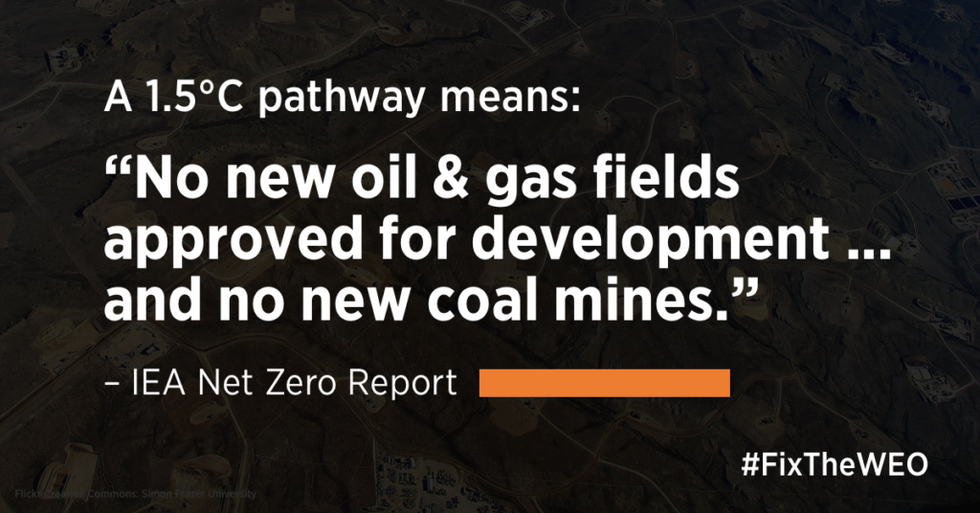
In its Summary for Policymakers, in a bolded headline, the IEA finds that, "There is no need for investment in new fossil fuel supply in our net zero pathway."
They add, "Beyond projects already committed as of 2021, there are no new oil and gas fields approved for development in our pathway, and no new coal mines or mine extensions are required."
This is huge. An agency that has consistently boosted new oil and gas development in its flagship annual World Energy Outlook (WEO) is now backing up the global call to stop the expansion of fossil fuel extraction.
Big Oil and Gas companies and the governments of fossil fuel-producing countries have lost one of their key covers for claiming that developing new oil and gas reserves is fully consistent with their commitments to "net zero" or the Paris Agreement. People around the world who have been demanding that governments, banks, and other financial institutions stop enabling the expansion of oil, gas, and coal extraction can point to the IEA's "authoritative" analysis reaching the same conclusion.
Of course, the IEA is behind the curve. OCI has been analyzing the disconnect between new fossil fuel development and the Paris goals since 2016. We found then that already operating or under construction oil and gas fields and coal mines contain enough fossil fuel reserves to push the world well beyond 1.5 degrees of warming. The implication was as clear then as it is now: The world must stop digging new holes, and focus instead on managing a rapid and equitable wind down of already developed extraction.
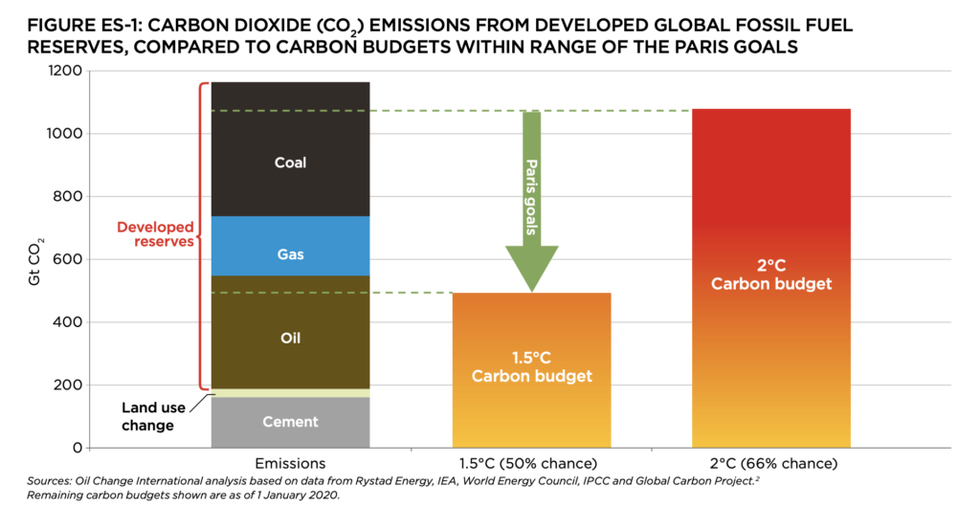
With the IEA's fully Paris-aligned scenario now saying the same, companies like Shell and Total can no longer comfortably point to the IEA to defend their plans to expand gas extraction. The UK government, which helped commission this new IEA report, will have a tougher time claiming that its decision to keep the door open to new licenses for offshore exploration and extraction fits with its Paris commitment. In fact, IEA director Dr. Fatih Birol has already today confronted the UK over its continued support for oil, gas, and coal expansion and investment. And major fossil banks like JPMorgan Chase and Citi have a new minimum baseline for "stress testing" their portfolios and the legitimacy of their net zero plans.
The IEA finally embracing a 1.5degC-aligned pathway as "the energy future we all need" is a major milestone. But the IEA must do much more beyond today's report to prove its climate credibility and commitment, particularly given the agency is positioning itself to play an advisory role at COP26.
To guide policies and investments towards a future fully aligned with the Paris goals, the IEA must go beyond developing a 1.5degC-aligned scenario and position it at the heart of the WEO. It is the WEO that decision makers look to year after year to guide trillions in public and private capital, and which the IEA itself calls the "gold standard of energy analysis."
Dr. Birol made a welcome announcement last week, committing that this new 1.5degC-aligned scenario will be "integral" to WEO 2021 and future WEOs. But we don't know yet what that will mean in practice.
In WEO 2019, the IEA dismissed a 1.5degC-aligned energy transformation as "very difficult and very expensive" and spent only seven of 600 plus pages discussing it. WEO 2020 included a short 1.5degC-aligned energy "case" to 2030, the building block of today's report. However, that case was rarely mentioned outside of the chapter devoted to it. The summaries of other chapters still primarily focused on the Stated Energy Policies Scenario (STEPS), a pathway towards catastrophic levels of global warming.
The scenario that the IEA positions as the central scenario in the WEO commonly becomes what governments and investors use as their default for energy decision making, guiding trillions of dollars of investment. The IEA must seize this moment to transform its flagship WEO report, putting a 1.5degC scenario at the center, and focusing each headline, chapter, and graph on the implications of it.
The IEA also needs to revisit and fix risky and bad choices within its modelling between now and WEO 2021. Below we provide an overview of ways in which the IEA must improve its scenario to drive the world towards the bold and just energy solutions we need, based on initial analysis from OCI and partner groups.
Underestimating wind and solar. While the IEA closing the door on new fossil fuel extraction is a welcome shift, the IEA's new "Net Zero Energy" roadmap continues to underestimate the growth potential and cost declines of solar and wind power, a chronic problem at the IEA. Kingsmill Bond, an energy transition expert at Carbon Tracker Initiative, has noted that the IEA's scenario forecasts rapid solar capacity growth until 2030 (22 percent per year). But that growth drops to 8 percent per year to 2040 and 3 percent per year to 2050. The latest scenario by the Energy Transitions Commission shows solar power providing twice as much energy in 2050 compared to the IEA's new scenario (27-35 terawatts vs 14.5 terawatts).
As a consequence of underselling wind and solar, the IEA makes room for dirty, riskier alternatives to meet energy demand.
Gambling on CCS. The IEA assumes that carbon capture and storage (CCS) projects will wipe out 1.6 billion tonnes (Gt) of CO2 pollution as soon as 2030. The IEA admits that CCS projects only have capacity to sequester 0.04 Gt of emissions at present. Most of that capacity is currently devoted to pumping more oil out of the ground. Relying on CCS to grow almost 4,000 percent over the next nine years is wildly optimistic given the technology's poor track record and failure to take off to date. It's also an irresponsible gamble. The IEA's own report acknowledges that, with greater investment in already proven renewable energy technologies, it wouldn't be necessary to expand fossil fuel-based CCS. This alternative "Low CCUS Case" mentioned in the report should be the base assumption.
Clinging to fossil gas. By gambling on a massive scale-up of CCS taking away some of its emissions, the IEA's 1.5degC scenario also makes room for dangerous levels of fossil gas reliance this decade. In the IEA's model, gas does not peak until 2025 and declines by only 6 percent below 2020 levels by 2030. By contrast, the 2020 Production Gap Report, released by the United Nations Environment Programme and a consortium of global research organisations, shows gas declining by a median of 3 percent per year between now and 2030 in 1.5degC-consistent pathways. Moreover, even if the carbon emissions from burning fossil gas to produce electricity or hydrogen are effectively captured, that will not remove the health and pollution impacts communities face where the gas is being extracted.
Projecting dangerous growth in bioenergy. Fossil fuel production and use should be replaced with truly clean energy solutions. Bioenergy does not fit that bill. Yet, the IEA's scenario relies on a 65 percent increase in bioenergy from 2020 to 2050, increasing the total land area devoted to bioenergy production by 25% to 410 million hectares in 2050, an area the size of India and Pakistan combined. Growth in bioenergy production is already linked to land grabs and human rights violations, food insecurity, and loss of biodiversity. As Hannah Mowat, campaigns coordinator with Fern, puts it, "Instead of burning trees for energy, we should focus on cutting fossil fuel use, maximising energy efficiency and increasing renewables such as solar, wind, heat pumps and geothermal."
All in all, today's 1.5degC report release is a major step forward for the IEA. Its first effort to model a 1.5-aligned energy future makes a clear case that this transformation is critical and achievable, requires deep emissions cuts by 2030 and a "huge decline" in fossil fuels, and, if done in a just and inclusive way, would improve people's well-being and livelihoods all over the world.
At the same time, we can't grade the IEA only against its past performance. The ultimate measure is whether the agency drives forward solutions that are bold enough to stem the climate crisis and protect the communities on its frontlines, not the polluters responsible for causing it. In this regard, the IEA has more homework to complete.
But now that the head of the IEA is proclaiming that, "The world does not need any new investments in oil, coal or gas," it will be a whole lot harder for governments, oil and gas companies, banks, and insurers to justify their own support for continued expansion. And that is undoubtedly a huge win for the climate.
To avoid the most catastrophic effects of the climate emergency, countries around the world must immediately transition from extracting and burning fossil fuels to utilizing renewable sources like solar and wind, the International Energy Agency said Tuesday in a landmark report detailing what governments need to do to achieve a net-zero energy system by 2050.
"When this conservative institution is demanding an end to fossil fuels it really is time for governments to ditch the net-zero rhetoric and take immediate action to cut their support for polluting corporations."
--Anna Vickerstaff, 350.org
Described by Food & Water Watch policy director Mitch Jones as "a testament to both the power of the international climate movement and the urgency of the crisis we face," the IEA's new report, Net Zero by 2050: A Roadmap for the Global Energy Sector, stated that there is "no need for investment in new fossil fuel supply in our net-zero pathway."
"It's huge to have the world's most influential energy modelers bolstering the global call to stop licensing and financing new fossil fuel extraction," Kelly Trout, interim Energy Transitions and Futures program director at Oil Change International, said in a statement. "Governments, banks, and big oil and gas companies can no longer use the IEA as a shield to claim that their support for fossil fuel expansion is consistent with the Paris Agreement."
While climate experts and justice advocates have long stressed the need to rapidly slash greenhouse gas (GHG) emissions to prevent the average global temperature from increasing more than 1.5degC above preindustrial levels, the new report from the IEA--historically friendly to the fossil fuel industry's prerogatives--is particularly significant; it marks the first time the world's leading energy policy adviser has acknowledged that existing climate pledges are woefully inadequate and that approving new coal, oil, and gas projects is incompatible with drastically reducing the planet-heating pollution responsible for destabilizing Earth's climate.
"Finally the IEA is starting to get it: If we're to have a fighting chance of meeting the objectives of the Paris agreement, the world needs to phase out fossil fuels," Jennifer Morgan, executive director of Greenpeace International, said in response to the IEA's 1.5degC-aligned net-zero scenario. "We can't even burn--or afford to burn--all the reserves we've currently got."
"To avert climate catastrophe and biodiversity devastation, and to maintain an 'unwavering policy focus on climate change in the net-zero pathway,' governments and regulators have to act and that means an end to licensing for new oil and gas now," Morgan added. "The IEA has spelled it out once and for all: if you're in a hole, stop digging."
In a statement, Anna Vickerstaff, the United Kingdom team lead at 350.org, said that "in the past, the International Energy Agency has been hesitant to call time on the fossil fuel industry--not anymore."
"When this conservative institution is demanding an end to fossil fuels it really is time for governments to ditch the net-zero rhetoric and take immediate action to cut their support for polluting corporations," Vickerstaff continued. "The growing call for concrete action is impossible to ignore. It's time to end fossil fuels."
While a growing number of countries, including major economies like the United States and the European Union, have recently pledged to cut GHG emissions by at least 50% below 2005 levels by the end of this decade on the way to net-zero by midcentury, IEA executive director Fatih Birol told the New York Times in an interview that "the sheer magnitude of changes needed to get to net-zero emissions by 2050 is still not fully understood by many governments and investors."
"There's still a huge gap between the rhetoric and the reality," said Birol, who warned last month that despite the economic slowdown caused by the Covid-19 pandemic, global GHG emissions did not decline significantly in 2020 and are on pace to increase in 2021 due to an uptick in coal burning along with lackluster green recovery policies.
Emphasizing that there is still a viable path to net-zero emissions but that it is narrow and "hinges on a singular, unwavering focus from all governments--working together with one another, and with businesses, investors, and citizens--" the IEA explained the changes required to limit global warming to 1.5degC.
The report outlined "400 milestones to guide the global journey to net-zero by 2050," providing governments worldwide with a potential timeline to usher in an era of clean energy and stave off climate destruction. The report also stressed the need for internationally coordinated action, without which global carbon emissions "will not fall to net-zero by 2050."
"Net-zero is being used by the world's biggest polluters and governments as a facade to evade responsibility and disguise their inaction or harmful action on the climate crisis."
--Landry Nientereste, 350.org
"For many rich countries, achieving net-zero emissions will be more difficult and costly without international cooperation," the report noted. "For many developing countries, the pathway to net-zero without international assistance is not clear. Technical and financial support is needed to ensure deployment of key technologies and infrastructure."
The report stated that "to reach net-zero emissions by 2050, annual clean energy investment worldwide will need to more than triple by 2030 to around $4 trillion," something the IEA said would "create millions of new jobs." To take one example, quadrupling global solar power by 2030 "is equivalent to installing the world's current largest solar park roughly every day" for the rest of the decade.
"The clean energy transition is for and about people," said Birol in a statement. "Our roadmap shows that the enormous challenge of rapidly transitioning to a net-zero energy system is also a huge opportunity for our economies."
"The transition must be fair and inclusive, leaving nobody behind," Birol added, alluding to the objective of meeting the needs of the nearly 800 million people who lack electricity and the 2.6 billion who lack clean cooking solutions. "We have to ensure that developing economies receive the financing and technological know-how they need to build out their energy systems to meet the needs of their expanding populations and economies in a sustainable way."
While the report noted that decarbonizing the global economy in the span of three decades necessitates "the massive deployment of all available clean energy technologies--such as renewables, electric vehicles, and energy efficient building retrofits--between now and 2030," the IEA also called for substantially increasing and reprioritizing research and development because "in 2050, almost half the reductions come from technologies that are currently only at the demonstration or prototype phase."
Although the report's call for halting investment in fossil fuels won praise from progressive advocates, the fact that the IEA's emissions reduction roadmap after 2030 relies heavily on nonexistent technologies such as carbon capture, utilization, and storage (CCUS) elicited criticism.
"Gambling the climate on a 4,000% increase in carbon capture and storage by 2030 is extraordinarily risky and, the IEA's own analysis shows, not necessary," said David Tong, a senior campaigner at Oil Change International. "Instead of banking on a consistently underperforming and still polluting technology, the IEA should be accelerating the phase-out of fossil gas and coal by relying on proven wind and solar solutions."
"We need the IEA to be a beacon pointing the way to a truly clean, Paris-aligned future," Tong added. "With today's report, that light is starting to appear, but it is not yet shining as bright as it must."
In addition, Landry Nientereste, the Africa managing director at 350.org, warned that "net-zero"--which allows companies like Shell and BP to "offset" their carbon emissions by planting trees--"is being used by the world's biggest polluters and governments as a facade to evade responsibility and disguise their inaction or harmful action on the climate crisis."
"There is a growing risk," Nientereste said, "that reports such as these are shifting the narrative away from the rapid and 'real' emissions reductions that climate justice requires."
Climate campaigners and experts welcomed new renewable power projections released Tuesday by the Paris-based International Energy Agency.
Despite the coronavirus pandemic, the amount of renewable electricity capacity added last year soared by 45% to 280 gigawatts (GW), an increase that the IEA's analysis expects to become the "new normal."
Driven by "huge additions of solar and wind," the increase in 2020 was the greatest year-on-year jump since 1999. The IEA forecasts that about 270 GW of renewable capacity will be added this year, followed by nearly 280 GW in 2022.
In other words, as Greenpeace put it in a Tuesday tweet about the agency's new report: "The future of energy? Bright and breezy."
"Wind and solar power are giving us more reasons to be optimistic about our climate goals as they break record after record. Last year, the increase in renewable capacity accounted for 90% of the entire global power sector's expansion," IEA executive director Fatih Birol said in a statement.
"Governments need to build on this promising momentum through policies that encourage greater investment in solar and wind, in the additional grid infrastructure they will require, and in other key renewable technologies such as hydropower, bioenergy, and geothermal," Birol added. "A massive expansion of clean electricity is essential to giving the world a chance of achieving its net-zero goals."
Ahead of a global climate summit planned for November, governments are in the process of revealing their updated commitments to cut greenhouse gas emissions in line with the Paris agreement's more ambitious goal of limiting global temperature rise this century to 1.5degC. One analysis released last week found that nations' latest targets put the planet on track for 2.4degC of warming by 2100.
While greater government ambition and action is clearly needed to meet international goals, the latest projections still provided some hope. Heymi Bahar, lead author of the IEA's new report, told The Guardian that the 2020 renewables boom was "unprecedented."
Bahar told the newspaper that record-level auctions for new renewable power projects by governments coupled with increased private business investments represents serious "momentum" and is set to become "the new normal for renewable energy."
The IEA's new numbers for the next couple years notably have been revised upward by over 25% from the agency's November estimates.
Carbon Brief pointed out Tuesday that "the IEA has repeatedly raised its expectations for wind and solar over the past decade, drawing fire from critics that say--in the words of a 2019 Reuters article--that it has 'underplay[ed] the speed at which the world could switch renewable sources of energy."
Though action is needed across various industries worldwide to reduce planet-heating emissions, the energy sector is by far the biggest contributor. As the World Resources Institute noted in December, "The top three greenhouse gas emitters--China, the European Union, and the United States--contribute 41.5% of total global emissions, while the bottom 100 countries only account for only 3.6%."
The IEA projects some shifts among top polluters in the years ahead:
China is at the center of global renewable demand and supply, accounting for around 40% of global renewable capacity growth for several years. In 2020, China's share rose to 50% for the first time due to a rush to complete projects before government subsidies were phased out. In 2021-22 renewables growth in China is set to stabilize at levels that are below the 2020 record but still over 50% above where it was during the 2017-19 period. Any slowdown in China in the coming years will be compensated for by strong growth in Europe, the United States, India, and Latin America where government support and falling prices for solar PV and wind continue to drive installations.
The Guardian reported that the new IEA forecasts don't take into account recent pledges from U.S. President Joe Biden, who took office in January and has since vowed to halve the nation's emissions over the next decade. Though the plan represents a major shift from his predecessor, climate justice campaigners argue it is "not good enough" and more must be done.