

SUBSCRIBE TO OUR FREE NEWSLETTER
Daily news & progressive opinion—funded by the people, not the corporations—delivered straight to your inbox.
5
#000000
#FFFFFF
To donate by check, phone, or other method, see our More Ways to Give page.
Daily news & progressive opinion—funded by the people, not the corporations—delivered straight to your inbox.
Corporate media failed to cover the dangers of business-friendly trade deals in 2015, despite growing grassroots opposition to such pacts--and increasing public awareness about their contents.
Will 2016 be the year looming toxic trade policies catapult into the mainstream? Sierra Club trade representative Ilana Solomon hopes so.
"If we continue this work and build our movement we will build a new model of trade that puts the interests of communities and the environment before the interests of multinational corporations," Solomon wrote this month.
"Our short-term work is to stop harmful trade agreements," she said. "Our long-term work is to continue to build our movement so strong and fierce that it becomes unthinkable for governments to allow trade rules to undermine environmental and public interest policies because the backlash would be too severe."
Here are the deals you need to know to be part of the fight in the coming year:
It was a "great day for corporate America" when the U.S. Senate passed Fast Track, or Trade Promotion Authority (TPA), in June, effectively surrendering legislators' ability to fully debate or even amend trade agreements like the TPP that have been negotiated entirely in secret. And when the text of the deal was finally released this fall, it confirmed the worst fears of environmentalists, public health advocates, and digital rights activists: the TPP, they said, was "worse than anything we could've imagined."
Thanks to Fast Track, President Barack Obama will be able to unilaterally sign the TPP for the U.S. after February 4, 2016. But it's not a done deal yet.
As Electronic Frontier Foundation's Maira Sutton explained earlier this month:
Both congressional houses must ratify the agreement in the form of approving "implementing legislation" that the White House will submit to lawmakers. This submission will happen after the President's signature, likely sometime in April or May. Once that happens, the House has 60 days from the bill's introduction to hold a vote on it and the Senate gets another 30 days, so 90 days in total, to approve or reject it. Since this second timeline only begins when the White House decides that they're ready for it, it all rests on whether the executive branch believes that it has the votes to get it through both houses. That's why it's critical that we call on our lawmakers to come out against this agreement: because that's how we can stop it.
"If we want to ensure that laws don't just uphold powerful private interests, but are designed and implemented with the public's best interests in mind," Sutton wrote, "then we must stop the TPP--for the sake of the Internet, our rights, and our future."
And the 2016 elections could prove helpful to those who oppose the corporate-friendly pact. The Japan Times reported Thursday that the pact "looks increasingly unlikely to be implemented before U.S. President Barack Obama's tenure ends due to opposition among leading presidential candidates and some industries."
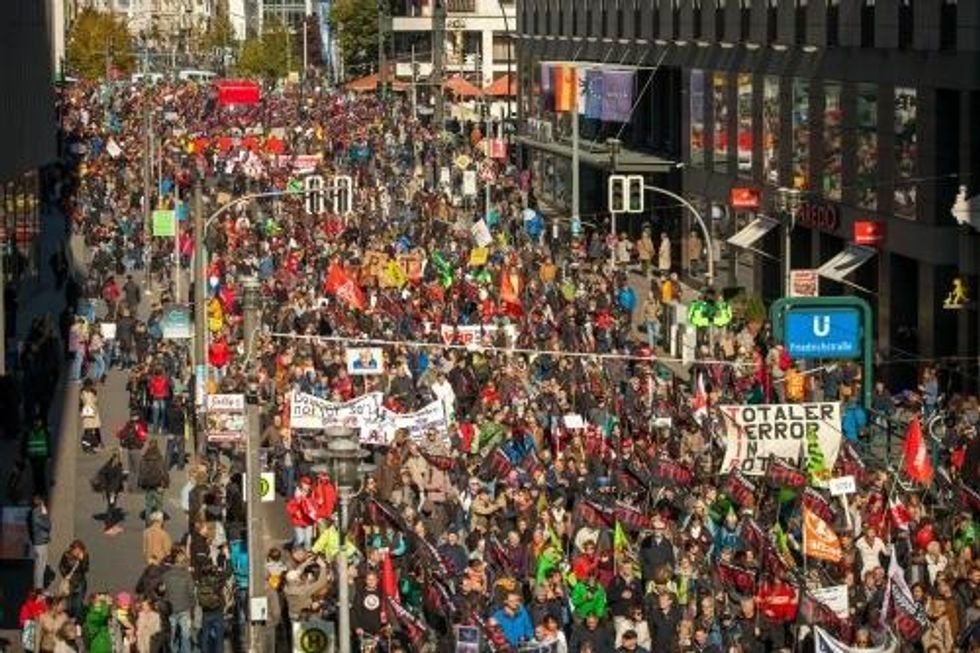
October saw hundreds of thousands of Europeans pour into the streets of Brussels to voice their opposition to the TTIP, which would cover more than 40 percent of global GDP. And push back against the so-called trade deal, which would have negative implications for everything from human rights and global climate goals to democracy and food safety, goes much deeper than that. As of October, more than three million people had signed a petition demanding an end to the TTIP negotiations--showing, as Global Justice Now director Nick Dearden said, "that the EU does not have the public mandate to continue this deal."
Indeed, there appears to be brewing discontent across the continent, with the president of the German Bundestag, or parliament, in late-October threatening to vote against the TTIP due to its lack of transparency and democratic legitimacy. That statement came on the heels of remarks made by a French trade minister in September, who said "France is considering all options including an outright termination of negotiations" due to TTIP talks appearing to favor American interests.
As American Prospect co-founder and editor Robert Kuttner posited in an op-ed earlier this year, both the TTIP and TPP could be "on the verge of collapse from their own contradictory goals and incoherent logic."
TISA may be the least well-known of the so-called Big Three "strategic neoliberal trade deals being advanced by the Obama administration," as WikiLeaks puts it--but its dangers loom just as large.
Leaks in 2015 exposed how the pact "favors privatization over public services, limits governmental action on issues ranging from safety to the environment using trade as a smokescreen to limit citizen rights," Larry Cohen, president of Communications Workers of America, said in June. Our World is Not For Sale, a group that has been working against TISA since 2013, described the deal in July as "a developed countries' corporate wish lists for services which seeks to bypass resistance from the global South to this agenda inside the WTO, and to secure an agreement on services without confronting the continued inequities on agriculture, intellectual property, cotton subsidies, and many other issues."
In 2016, we can only hope that people power will pressure more countries to follow the lead of Uruguay, which in September decided to end its involvement in TISA negotiations. In doing so, Friends of the Earth activists Viviana Barreto and Sam Cossar-Gilbert wrote at Common Dreams, "Uruguay has created a blueprint of how to beat these corporate-driven agreements. A strong coalition of trade unions, environmentalists and farmers working together on an effective public campaign were able to take on the interests of the world's biggest companies and win."
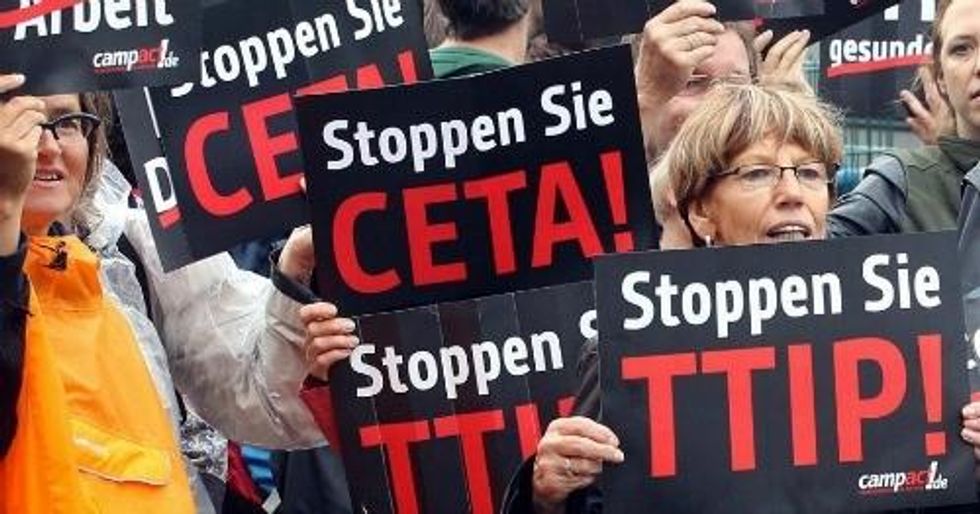
"What's exciting about CETA," Council of Canadians trade campaigner Sujata Dey wrote earlier this month, "is that Europeans actually have the power to defeat it."
As Common Dreams reported in October, the Canada-EU deal would create "a parallel legal system for corporations" that could make "regulations in sensitive public service sectors such as education, water, health, social welfare, and pensions prone to all kinds of investor attacks."
"What is at stake in trade agreements such as TTIP and CETA is our right to vital services, and more, it is about our ability to steer services of all kinds to the benefit of society at large," the Brussels-based Corporate Europe Observatory declared at the time. "If left to their own course, trade negotiations will eventually make it impossible to implement decisions for the common good."
According to Council of Canadians, it is expected that CETA will go before the European Parliament for ratification votes either in late 2016 or early 2017. Prime Minister Justin Trudeau has already instructed trade minister Chrystia Freeland "to implement" CETA.
This year, our campaign to fight the anti-user Trans-Pacific Partnership (TPP) agreement was a rollercoaster. Our mobilization against the Fast Track trade bill resulted in some major twists and turns before the sudden conclusion of the negotiations in the Fall, then finally after more than five years of secrecy, the governments officially released the completed TPP text. This definitively confirmed that this trade agreement contained a whole host of restrictive digital policies--including bans on circumventing DRM, heavy-handed criminal and civil penalties for copyright infringement, and excessive copyright term lengths. This, of course, was hardly surprising given the secret, corporate-captured process that plagued this deal from the very beginning.
As we continue the fight against the TPP's ratification into 2016, it's important to take stock of the critical battles we've won. This year was particularly notable in how much we could delay the conclusion and signature of the deal. That can largely be credited to hundreds of public interest organizations and individuals who worked together to put the brakes on the passage of the Fast Track legislation.
By the time the debate on Fast Track (officially called the Trade Promotion Authority) came to a head this past Summer, we had already been organizing to oppose it for months. We knew that if we wanted to stop the TPP, killing the Fast Track bill was our best chance to prevent the undemocratic process from worsening.
When TPP's supporters in Congress began to roll out the Fast Track bill, they weren't expecting it to be as controversial as it was. We sent hundreds of thousands of calls, emails, and petition signatures against the bill. We met with lawmakers and carried with us the letters of opposition from businesses and other interest groups against the TPP to clarify that a vote for Fast Track would essentially be a vote supporting a toxic deal for Internet freedom and user rights.
This made it difficult for the White House to get the support it needed to pass the bill, putting TPP itself at a standstill. Since the TPP wouldn't have been able to pass in the U.S. without Fast Track, the countries weren't willing to put their chips on the table until they knew how the trade bill would shake out in the United States. Additionally, TPP's delay meant the spotlight would be put on ratification of the deal during the U.S. presidential election. It would raise significant questions about its support under Canada's new government. This shifting political dynamic across the TPP countries was exactly what the U.S. Trade Representative wanted to avoid by passing Fast Track in early 2015. Of course, Fast Track ultimately did pass in Congress after some wild congressional maneuvers, but we had already damaged the White House's precious timeline.
By bringing the public's attention to the failures of transparency and oversight with the Fast Track process, we were also able to help bring about some minor procedural improvements. Most notably, it stipulated some timelines for how and when the text would be released: for example, it had to be released online in full within 30 days of the President announcing his intent to sign the deal. It would have been better if the bill hadn't passed at all, but these mandates are useful in constraining how the U.S. Trade Representative rolls forward with TPP's passage, and that gives us an advantage in how we strategize our fight to stop it.
So, with the elections looming in the U.S. and Canada, trade negotiators were now under pressure to conclude the deal. And they ultimately managed to finish it on October 5. A month later, when they released the final official text, we, at long last, were able to dig into the details of the TPP and confirm that it carried Hollywood's wish list of restrictive copyright rules, including a few other rotten bad digital policy provisions that we had never been able to see before. We've analyzed the TPP to explain in concrete terms how it would impact all kinds of people's digital rights, from students, journalists, and free software users, and even how it will affect our digital security.
We are still in the midst of this fight to stop the TPP. President Obama and the other leaders of TPP countries are likely to meet in February to sign the completed deal. That's why EFF joined dozens of other groups to protest the deal in the streets of Washington D.C. But what we'll really need to do is to take advantage of these shifting political landscapes and drive a wedge into the deal's ratification in all the TPP countries. Our strategy is to focus on stopping this deal in the U.S. because that will effectively also defeat it in the 11 other countries--that's also where we have our best shot to kill this thing for good.
If you're in the United States, urge your lawmakers to call a hearing on the contents of the TPP that will impact your digital rights, and, more importantly, to vote this deal down when it comes to them for ratification:
After years of secrecy, the full contents of the 12-nation Trans-Pacific Partnership (TPP) will soon be revealed.
According to Kevin Collier at Daily Dot, U.S. Trade Representative Michael Froman said the text will be made available to the public in approximately 30 days--on or around November 7.
"[We] look forward to having it released as soon as possible," Froman said in a press call Wednesday that was embargoed until Thursday morning. "We're shooting to do it within the 30 days following the completion of the negotiations."
Under the terms of the Fast Track legislation passed earlier this year, lawmakers cannot amend or filibuster the pro-corporate "trade" deal completed this week.
President Barack Obama must wait at least 90 days after formally notifying Congress of the deal before he can sign it and send it to Capitol Hill, and the full text of the agreement must be made public for at least 60 of those days. Congress gets to spend the first 30 days privately reviewing the documents and consulting with the administration.
As Kelsey Snell wrote for the Washington Post, that 60-day public comment window "will provide critical insight into how much popular support the deal may receive. A poor reception during the public phase could make it difficult for Obama to rally support when it comes time for Congress to vote."
Snell continued:
The next step will be for the U.S. International Trade Commission to conduct a full economic review of the deal. The agency has up to 105 days to complete that work but the process could take much less time.
Once the implementing bill is introduced in the House and the Senate, Congress has a maximum of 90 days to approve or disapprove the trade deal but can move much more quickly.
However, Public Citizen's Lori Wallach has pointed out (pdf) that 2016 election politics may imperil the deal. The intense national battle over trade authority was just a preview of the massive opposition the TPP will face, given that Democratic and Republican members of Congress and the public soon will be able to see the specific TPP terms that threaten their interests," she said (pdf) on Monday.
After the Senate joined the House of Representatives in granting President Barack Obama fast-track authority to negotiate trade agreements, National Public Radio aired one report (Morning Edition, 6/25/15) on the legislative action that paves the way for the Trans-Pacific Partnership (TPP), the Transatlantic Trade and Investment Partnership (TTIP) and other corporate-friendly international deals. The report, by correspondent Yuki Noguchi, had three sources:
That's it-according to a search of the Nexis news database, those three corporate lobbyists are all the voices National Public Radio chose to air on the victory of fast-track (or "fast-tract," as the NPR News headline writer had it). What of the literally thousands of labor, environmental and other public interest groups that strenuously opposed giving Obama fast-track authority? They were relegated to a one-line summary from Noguchi:
Labor and environmental groups criticized the fast-track deal, calling it worse than the North American Free Trade Agreement passed two decades ago.
To which manufacturing lobbyist Dempsey was allowed to retort: "The critics are just wrong." So much for the opponents' perspective.
To her credit, Noguchi does correct Dempsey's claim about NAFTA, saying, "After an initial bump following NAFTA, manufacturing employment declined." But that raises the question: If business lobbyists are presenting a distorted picture of the impact of trade deals, why are they the only ones you're allowing to talk to your listeners about trade deals?
ACTION: Please ask NPR ombud Elizabeth Jensen to investigate why NPR News talked only with corporate lobbyists to cover the victory of fast track.
CONTACT: You can contact Ms. Jensen via NPR's contact form or via Twitter: @ejensenNYC.
I tried to stay emotionally distanced from this one. It didn't work. When the White House and Republican leaders got the votes they needed in the Senate to advance "fast track" Trade Promotion Authority on Tuesday, June 23, it was crushing.
Democratic congressional leaders did not roll over for this vote.
All observers agree that fast track will soon become law, making it easier for President Barack Obama to pass the controversial trade pacts in the works with Pacific Rim nations and the European Union. That will be a serious setback to the movements for the environment, labor rights, and affordable pharmaceuticals, among others.
But after observing painful trade votes for more than 20 years, this one left me feeling that opponents should be holding their heads higher than ever before as they regroup for the next phase of the fight. Here are a few reasons why:
1. A diverse progressive coalition showed that people power can put up a real fight against big money.
The votes on fast track could not have been closer. The House vote was a razor-thin 218 to 208, while the Senate's vote to cutoff debate passed without a single vote to spare.
The opposition included all the regulars from labor, environmental, faith, immigrant, food safety, and consumer groups. But some newish players also stepped up, like the Electronic Frontier Foundation on Internet access, as well as global health, civil rights, and civil liberties groups.
One result was more airtime for trade-related concerns that have been largely ignored in the past, including the anti-democratic investment rules and impacts on seafood safety, access to medicines, and climate. These new relationships will pay off in future fights. As Leo W. Gerard, international president of the United Steelworkers, put it, "Progressive forces have new energy from this fight."
2. The battle exposed deep divisions within the United States, empowering allies in other countries.
U.S. Democratic congressional leaders did not roll over for this vote, so opponents in other countries can now count them on their side. And who knows what will happen when citizens of other countries, who are likely to be hard-hit by these deals, see the final text of the agreement?
Unions are a critical source of donations and boots on the ground for electoral campaigns.
The example of the Free Trade Area of the Americas is instructive here. After 11 years of negotiations, those 34-country talks collapsed in 2005. President George W. Bush had fast-track authority to pass the FTAA, but that turned out not to matter. In the end, Brazil and other South American countries refused to give in to the U.S. corporate-driven agenda.
3. The showdown drove a shift in the discourse.
House Democratic Leader Nancy Pelosi, who in 1993 voted in favor of the North American Free Trade Agreement, rebuffed intense pressure from President Obama to support fast track and called for a "new paradigm" on trade. She called for global engagement that "enables voices from all aspects of the world's economies to be heard."
Even former Treasury Secretary Larry Summers, another NAFTA promoter, stated that "A reflexive presumption in favor of free trade should not be used to justify further agreements." There were also signs of growing alliances across political lines, with perhaps the most notable example being a joint op-ed by the libertarian Cato Institute and the progressive Public Citizen.
4. Labor unions made strong vows to punish pro-fast track Democrats.
The AFL-CIO and other unions froze campaign contributions to members of Congress starting in March to pressure them to vote the right way. In the aftermath of Tuesday's Senate vote, Communications Workers of America President Chris Shelton said, "for those who opposed the broadest coalition of Americans ever, we will find and support candidates who will stand with working families. That's how we'll take on the corporate Democrats who oppose a working family agenda."
This battle was not just about fast track.
Unions are a critical source of donations and boots on the ground for electoral campaigns. A strong message that labor support should not be taken for granted could change the dynamic of the party for years to come.
5. The strong opposition to Obama's trade agenda augurs well for other progressive fights.
This battle was not just about fast track. It was a reflection of increased concern about inequality and the sense that the rules have been rigged against ordinary Americans in favor of large corporations and the wealthy. We can build on this in future efforts over taxes, budgets, labor rights, and other issues.
6. The demands to see the secret text got some results.
WikiLeaks made public two draft chapters of the Trans-Pacific Partnership, giving ammo to the opposition and making many wonder why we were having to rely on Julian Assange for this information.
While the fast-track bill doesn't do anywhere near enough to respond to secrecy concerns, it does require the executive branch to make public the full text of new trade agreements for 60 days before they are sent to Congress. Then lawmakers need to wait at least another 30 days before voting.
In the TPP's case, this could help stretch out the timeline into the heat of election season, when Democrats will be even more sensitive to pressure from their base. As Public Citizen President Robert Weissman noted, "When the inexcusable and anti-democratic veil of secrecy surrounding the TPP is finally lifted, and the American people see what is actually in the agreement, they are going to force their representatives in Washington to vote that deal down."
The debate over trade is red-hot these days. Proponents in Congress are revving up this week to push through their 'Plan B' after a grassroots uprising took them by surprise earlier this month and defeated 'Plan A', which the Obama administration had hoped would grant it 'fast track' trade negotiating authority designed to facilitate completion and quick passage of the Trans-Pacific Partnership (TPP) free trade agreement.
As with most controversies over legislation, spin and hyperbole dominate the news cycle. The Washington Post editorial board has dedicated more than its share of newsprint (6 editorials in the last 2 months) to lambast 'fast track' opponents, in particular the labor movement, asserting that trade expansion was central to US economic growth after World War II and that failure to get 'fast track' and enact the TPP will only undermine our prosperity and security.
To be fair, it's not just the Washington Post on this offensive. One of the most common arguments made by the administration and other proponents of 'fast track' and the TPP is that more free trade agreements, which include a whole host of rules and regulations protecting corporate investment, will boost US economic growth. Opponents are portrayed as Luddites who fail to understand that a rising tide lifts all boats. There is more to be gained through increased exports, the argument goes, even if there may be some job loss from global competition and outsourcing.
Well, here's a news flash, particularly for those with a simplistic view of history and a belief that little changes: the International Monetary Fund (IMF) has shown that 'trickle-down' economics is dead!
Just last week, that venerated institution of global finance released a powerful research report demonstrating that when the incomes of the richest 20 percent rise in relation to the rest of the population, GDP actually declines over the medium term. That's right, the same institution that brought us the market fundamentalism known as the "Washington Consensus" in the 1980s now asserts that wealth doesn't 'trickle-down' to boost employment or wages. Instead, the IMF found that when the incomes of the poorest 20 percent increases, GDP expands.
This welcome revelation means policies that serve to benefit the wealthiest in society actually pose a threat to the overall economy and stifle poverty reduction. That includes all those rules in free trade agreements like the TPP that benefit investors and expand monopoly protections. The IMF research strongly argues that governments should advance public policies focused on expanding the economic opportunities of low- and middle-income groups.
Members of Congress, particularly proponents of 'fast track' and TPP, should take heed of this important message: unless a trade agreement actually serves to raise incomes for low and middle income families, it will not boost overall economic growth and can instead worsen inequality. Neither the Obama administration nor other proponents have demonstrated that these trade agreements will benefit those on the lower end of the economic spectrum, as the well-respected economist Jeffrey Sachs has pointed out. To the contrary, many have indicated how the myriad rules embedded in the agreements will benefit special interests over the wider public interest.
This raises two related concerns. First, the TPP threatens to worsen economic inequality across member countries, including here in the US. Second, by raising inequality, the TPP could actually undermine economic growth, which has shown to be the key factor in reducing poverty.
Nobel-prize winning economist Joe Stiglitz has similarly challenged the simplistic economic reasoning used by 'fast track' and TPP proponents. It had been disappointing to see the Obama administration and many in Congress ignoring the advice of the former chair of President Clinton's Council of Economic Advisors.
In a last-ditch effort to win additional votes in Congress, the US Trade Representative has been quoted as saying that some poorer countries party to the TPP could get special considerations based on their level of development - permitting them to postpone adoption of some intellectual property protections that affect access to medicines. Yet even if such provisions were to make it into the final TPP text, they would make little difference. Research from Oxfam America and Doctors Without Borders shows that measures under consideration ignore existing inequalities within countries, and in any case would be inadequate to overcome adverse effects of TPP rules on access to medicines.
So who's really calling the shots on US trade policy, and why is it on course to exacerbate inequality, which undermines economic growth? Well to start, there seems to be a gaping hole exposed in the democratic process. How else could the President and Congress dismiss historic numbers of Americans speaking out against the TPP, let alone commonsense economic advice from luminaries like Joseph Stiglitz and Jeffrey Sachs, among others?
It should come as no surprise that corporate interests drive trade agreements. And Congress listens because corporations pay big in terms of campaign dollars. As the Guardian reported last month, fast-tracking the TPP was only possible after huge sums of corporate money passed into the hands of many Senators. Out of the $1,148,971 contributed between January and March 2015 by the corporate members of the US Business Coalition for TPP to US Senators, an average $17,676.48 was donated to each of the 65 'yea' votes. Another analysis showed that 24 of 28 House Democrats supporting 'fast track' received money from drug and medical device companies.
Corporations have also enjoyed highly unequal treatment compared to the public in terms of shaping the agreement's content. Over 500 corporate lobbyists have been named "advisors" and given national security clearance to get privileged access to the text, while consumers and public interest groups have been kept in the dark about key details. The cozy relationship between industry representatives and US trade negotiators has no doubt helped ensure the trade rules in the TPP will benefit corporate interests.
Thus, inequality begets more inequality - so unjust! Yet in fast track round one, there was a strong ray of hope when grassroots efforts to defend the public interest achieved a big upset. As we enter round two, will Members of Congress listen to the public and heed the analysis of the revered global economic stalwart, the International Monetary Fund?
This blog post was co-authored by Stephanie Burgos, Oxfam America's Economic Justice Policy Manager.
On Tuesday, the Senate narrowly advanced a bill giving President Barack Obama--and the next president--"Fast Track" or Trade Promotion Authority to ram through the Trans-Pacific Partnership with almost no democratic oversight. The vote is a major victory for multinational corporations and the global one percent. While hundreds of unelected, unaccountable corporate big-wigs literally wrote the rules that will shape our global economy in coming years, our democratically-elected leaders will only be allowed an up-or-down vote on the final agreement. Congress, in essence, has just written the corporate elite a giant blank check.
"When it comes to the fight for people and the planet, almost just isn't good enough."
The vote was a big defeat, that much cannot be denied. But the fight over fast track shows the growing power of populist progressives. Millions of Americans raised their voices and demanded Congress put people and the planet before corporate profits. Thousands wrote letters, made calls, and marched in the street. Hundreds of organizations, from grassroots community organizers to environmental groups to unions to food safety activists and internet freedom groups, pushed Congressional leaders to stand by their constituents. Barack Obama and the Republicans were expecting a slam dunk but they had to use every play in the book to squeak through the corporate agenda. What seemed like a foregone conclusion a few months ago passed by just one vote in both the House and the Senate.
Ultimately though, coming close to victory won't protect our communities from corporate power grabs like TPA. It won't stop the mammoth backroom trade deal from allowing corporations to challenge U.S. laws--and the laws of other sovereign nations--from common sense protections. It won't help workers at home and abroad who will see their wages plummet and their labor rights undermined. It won't keep money-hungry corporations from running roughshod over environmental protections. When it comes to the fight for people and the planet, "almost" just isn't good enough.
We lost because too many Democrats still belong to Wall Street. Corporate America owns the soul of the Democratic Party and is fighting tooth and nail to contain the progressive populist rebellion. This bill--a top priority of Democratic President Barack Obama--wouldn't have passed without millions from corporate lobbyists and the votes of 13 pro-Wall Street Democrats: Patty Murray and Maria Cantwell of Washington, Mark Warner and Tim Kaine of Virginia, Michael Bennet of Colorado, Dianne Feinstein of California, Tom Carper and Chris Coons of Delaware, Heidi Heitkamp of North Dakota, Claire McCaskill of Missouri, Bill Nelson of Florida, Jeanne Shaheen of New Hampshire and Ron Wyden of Oregon. These thirteen Senate turncoats were joined by 28 pro-Wall Street Democrats in the House.
And Hillary Clinton, the current front-runner for the Democratic presidential nomination, remained largely silent. While in recent months Clinton has embraced progressive populism in her speeches, her silence on trade reveals her posturing as little more than cheap talk. She once called the TPP the "gold standard" trade agreement and she has gone to great lengths to avoid taking a firm stance on TPP as a candidate, reinforcing the public's impression that she can't be trusted to stand with everyday people over Wall Street executives. When the opportunity arose to take a progressive stand for people and planet, the supposed Democratic standard-bearer stayed mum.
"The TPA vote is one more example of why we need to radically transform our political system, not just tinker around the edges."
For many of us, this loss is a bitter pill to swallow. For many millions of families here and around the world, this loss will mean less food on the table, more toxins in the air, less rights in the workplace and a smaller voice in our governments. We are facing a triple crisis: rising economic and racial inequality, a hijacked democracy and a planet in peril. Trade Promotion Authority and the Trans Pacific Partnership will heighten, not alleviate, the crisis we face.
The TPA vote is one more example of why we need to radically transform our political system, not just tinker around the edges. We can't settle for Wall Street Democrats who turn a deaf ear to the voice of the people. We can't limp along when corporate bosses rake in more and more while workers scrape by with less and less. We can't stand by while Black lives are stolen and our planet slowly boils.
We've got to be prepared this November, but we can't afford to be distracted by a single appealing candidate or by a single important election. The problem goes beyond one candidate or one election. We don't need a savior. We must build an independent political movement that puts people and planet over corporate profits. We've got to find, train and elect hundreds of movement candidates and build a new left pole in American politics. Only then can we create an economy where people and planet, not profits, are the bottom line.
This independent movement can't use the same old strategies. We can no longer afford to sit by as Democrats sell out our communities. There's no time to opt for the lesser of two evils. We cannot rest content to reinforce the barricades, we must climb the walls and mount our own attacks. How do we begin? We put corporate-owned Democrats on notice. You can't serve profits over people and expect to get our vote. We must challenge Wall Street Democrats like the 42 Democrats who voted "Yes" for TPA.
The TPA vote was a bright line in the sand, a chance for Democrats in Congress to declare their allegiance to people and planet or to the 1%. For at least 42 Democrats, their choice--and our choice next election cycle--is clear. If we want different outcomes, we must look to Main Street, not Wall Street. If we want new leaders, we have to look to ourselves.
We need millions of people and thousands of movement candidates working together to build a new left pole in American political life and a new future. And we've got to start today.
The Senate narrowly invoked cloture on fast-track trade legislation Tuesday morning, setting up a final vote Wednesday that will surely send the bill to President Obama's desk for his signature.
In so doing, Congress will surrender remarkable authority to Obama and his successors. For the next six years, Congress will be unable to amend any trade deal signed by the president, and only 50 votes will be required for Senate passage--a reduced burden that hasn't been granted to minimum-wage hikes, equal-pay legislation, gun control, campaign-finance reform, nor any other non-budgetary legislation of the Obama era.
In exchange, these future administrations will promise to be guided by negotiating objectives in the fast-track legislation on human rights, labor standards, and the environment, though many experts and congressional Democrats have decried the objectives as meaningless--in some cases they are satisfied if the president self-certifies that unspecified "progress" was made towards the negotiating goal.
The Senate wasn't supposed to have to vote again; it passed fast-track legislation weeks ago and sent it to the House. But House liberals rebelled and temporarily killed the House package by voting down a program that provides job training to workers screwed over by trade deals. This program was a Democratic priority, but one they strategically killed in order to hopefully stop the entire fast-track passage.
But House Speaker John Boehner held another vote last week and sent fast track back to the Senate without the trade-assistance program, and so the Senate had to vote again on this bill.
There was substantial doubt that Senate Democrats would back fast track without trade assistance for workers, but they did--resting on assurances from congressional Republicans that they will pass the assistance program soon.
The final vote was 60-37, achieving cloture by the thinnest possible margin. (Three senators were absent; Tennessee Republican Bob Corker was delayed getting to Washington, but said he would have voted for fast track; Senators Robert Menendez and Mike Lee both voted "no" last time.)
After the vote, Senator Sherrod Brown took the Senate floor and declared, "This is a day of celebration in the corporate suites of this country, to be sure."
Senator and presidential candidate Bernie Sanders added that "this trade agreement was supported by virtually every major corporation in this country, the vast majority of whom have outsourced millions of jobs to low-wage countries all over the world."
Thirteen Senate Democrats helped get fast track over the line: Michael Bennet of Colorado, Maria Cantwell and Patty Murray of Washington, Tom Carper and Chris Coons of Delaware, Dianne Feinstein of California, Heidi Heitkamp of North Dakota, Tim Kaine and Mark Warner of Virginia, Claire McCaskill of Missouri, Bill Nelson of Florida, Ron Wyden of Oregon, and Jeanne Shaheen of New Hampshire.
Right off the bat, some progressive activists pledged to exact a price for supporting fast track. "The Senate Democrats who allowed Fast Track should know that this vote will be remembered, it will not be erased, and we will hold you accountable," said Jim Dean of Democracy for America in a statement. "Accountability could mean primaries now or in the future, taking no action in your next difficult election, or support for progressive alternatives in future Senate leadership elections. Make no mistake, the memory of this clear betrayal of working families will follow you for years to come."
The threat about Senate leadership elections is particularly notable; Senator Patty Murray is reportedly seeking the whip post in the new Senate, and provided a crucial vote for fast track. The current whip and her presumed competitor for the post, Senator Dick Durbin, voted against fast track.
Once Fast Track passes tomorrow (there is only a 50-vote requirement post-cloture, which this bill will easily achieve) and Obama signs Fast Track, the fight turns to the highly controversial Trans-Pacific Partnership.
Sometime in the late summer or early fall, the Obama administration will finally release the full TPP text, after the president signs it. After 90 days, Congress can vote on it.
Without question, fast track makes the TPP much more likely to pass. No amendments can gum up the process or chase off support, and we already can easily see there are 50 votes in the Senate based on the fast-track votes. But the House remains no sure thing for the TPP. Fast track twice passed by only two votes.
When the TPP actually comes out, there will be some really ugly details that are likely to enrage liberals and solidify opposition among Democrats. For months the White House has been dodging some criticisms of the TPP by stressing that the text isn't final, but that will no longer be an option.
The unknown details of the TPP, incidentally, are what Hillary Clinton cites for not yet having an official position on the trade deal. If the Democrat base gets truly riled up when the details do come out, she may end up opposing the deal. This would give cover for every congressional Democrat to do the same.
Members of the House will also be in the thick of their reelection campaign this fall, and increased progressive activism and actual primary challengers will no doubt make a TPP vote even harder.
On the Republican side, Boehner will almost surely have a more difficult time gathering Republican votes for the TPP than he did for fast track. One argument frequently made by Republicans during the congressional fast-track debate was that it benefited the GOP, too--that it was also a vote to give a theoretical Republican president in 2017 immense power to shape trade deals without congressional meddling. That has no application to the TPP debate.
And 2016 will no doubt have the same effect on the Republican side, as incumbents face challenges from opponents to their right who may decide to blast them for supporting Obama's trade agenda. The presidential race provides more pressure, and we're already seeing it: Only weeks ago, Ted Cruz voted to move fast track. Tuesday, he released an op-ed on Breitbart.com bashing "Obamatrade" and voted against cloture.
So while progressives lost the fast-track battle, the trade debate isn't quite over yet. "What [the vote] doesn't mean is that Congress must pass [the TPP]," said Robert Weissman, president of Public Citizen. "When the inexcusable and anti-democratic veil of secrecy surrounding the TPP is finally lifted, and the American people see what is actually in the agreement, they are going to force their representatives in Washington to vote that deal down."
In a win for multinational corporations and the global one percent, the U.S. Senate on Tuesday narrowly advanced Fast Track, or Trade Promotion Authority (TPA), ensuring for all practical purposes the continued rubber-stamping of clandestine trade agreements like the Trans-Pacific Partnership (TPP) and TransAtlantic Trade and Investment Partnership (TTIP).
The cloture motion to end debate needed 60 votes and it got just that, passing the chamber 60-37. The full roll call is here. A final vote will come on Wednesday. Having overcome the biggest hurdle, the legislation is expected to pass, and will then be sent to President Barack Obama's desk to become law.
Sen. Bernie Sanders (I-Vt.), who campaigned vigorously against Fast Track, said the vote represented a win for corporate America. "The vote today--pushed by multi-national corporations, pharmaceutical companies and Wall Street--will mean a continuation of disastrous trade policies which have cost our country millions of decent-paying jobs," the presidential candidate said in a statement.
And Sen. Sherrod Brown (D-Ohio), another of the most vocal opponents of Fast Track, railed against TPA moments before the vote, accusing Congress of turning on its "moral" obligation to assist the working class.
"How shameful," Brown said. "We're making this decision knowing people will lose their jobs because of our action."
According to The Hill:
Thirteen Democrats backed fast-track in Tuesday's vote, handing Senate Majority Leader Mitch McConnell (R-Ky.) a major legislative victory. Sen. Ben Cardin (D-Md.) voted against the procedural motion.
The Democrats cast "yes" votes even though the trade package did not include a worker's assistance program for people displaced by increased trade. The Trade Adjustment Assistance (TAA) program was a part of the last fast-track package approved by the Senate in May, but became a key part of opposition to the package among Democrats in the House.
Lori Wallach, director of Public Citizen's Global Trade Watch, pointed out that the vote only came about via "elaborate legislative contortions and gimmicks designed to hand multinational corporations their top priority."
Such contortions were necessary, she added, "because the American people overwhelmingly oppose these deals, notwithstanding an endless barrage of propaganda."
Indeed, the response from the progressive grassroots was fast--and furious.
"We're outraged that Congress today voted to fast track pollution, rather than the job-creating clean energy we need to address climate change," said May Boeve, executive director of 350.org. "It's clear this deal would extend the world's dependence on fracked gas, forbid our negotiators from ever using trade agreements in the fight against global warming, and make it easier for big polluters to burn carbon while suing anyone who gets in the way. That's why we're so disappointed President Obama has taken up the banner for ramming this legislative pollution through the halls of Congress, in a way he never pushed for a climate bill."
Groups threatened political fall-out for those Democrats who voted in favor of Fast Track.
"Senate Democrats who just voted to proceed on Fast Track for the job-killing Trans-Pacific Partnership openly betrayed the grassroots Democratic activists who helped elect them and have been exceedingly clear in their opposition to any legislation that allows more NAFTA-style trade deals to be jammed through Congress," said Jim Dean, chair of Democracy for America. "The Senate Democrats who allowed Fast Track should know that this vote will be remembered, it will not be erased, and we will hold you accountable."
Wenonah Hauter, executive director of Food & Water Watch, echoed that warning as she declared, "The senators who provided the margin of Fast Track victory will face angry voters in their next elections. Constituents will hold them accountable for putting the interests of transnational corporations ahead of the public."
In addition to calling out Senate Democrats who "betrayed people and the planet" by voting for cloture on Tuesday, National People's Action Campaign executive director George Goehl lambasted "the virtual silence of the leading Democratic candidate for president," which he said "shows the stranglehold corporations have over both political parties."
And Sarah Anderson, director of the Global Economy program at the Institute for Policy Studies, said it was clear who will benefit most if the pending deals are given final passage. Today is a "great day for the big money interests," she said following the Senate vote.
On May 8th at Nike's headquarters, President Obama denounced opponents of the hotly contested Trans-Pacific Partnership as ill informed. "(C)ritics warn that parts of this deal would undermine American regulation....They're making this stuff up. This is just not true. No trade agreement is going to force us to change our laws."
On May 8th at Nike's headquarters, President Obama denounced opponents of the hotly contested Trans-Pacific Partnership as ill informed. "(C)ritics warn that parts of this deal would undermine American regulation....They're making this stuff up. This is just not true. No trade agreement is going to force us to change our laws."
On May 18th the World Trade Organization (WTO) issued a final ruling in favor of Canada and Mexico in a case involving a US law requiring country-of-origin labels on packages of beef, pork, chicken and other kinds of meat. The WTO three judge panel estimated economic damages of more than $3 billion. These will be meted out by Canada and Mexico as retaliatory tariffs on a potentially wide array of U.S. industries, from "California wines to Minnesota mattresses," as Gerry Ritz, Canada's Minister of Agriculture predicted.
"The only way for the United States to avoid billions in immediate retaliation is to repeal COOL," Ritz announced.
Congress hastened to comply. The day the WTO issued its ruling Rep. Michael Conway (R-TX) introduced legislation to overturn the COOL law. On June 10th the House overwhelmingly passed the bill, 300-131.
The COOL decision and its almost immediate legislative impact demonstrated in real time the inaccuracy of President Obama's comments. Encompassing 12 Pacific Rim countries with 40 percent of the world's economy the Trans-Pacific Partnership would be the largest trade agreement since the WTO was formed in 1995. But to call it a trade agreement is both accurate and misleading for it conjures up images of agreements that largely target tariffs. That is no longer the case. Of TPP's 29 draft chapters, only five deal with traditional trade issues.
Modern trade agreements have less to do with trade than with sovereignty. The primary focus of modern trade agreements is the elimination of existing national and subnational laws that regulate commerce.
The decision about whether a country can force the livestock industry to reveal where their animals were reared and slaughtered is behind us. Currently under consideration by the WTO is whether a country can force businesses that sell a lethal product to make the packaging of that product unattractive.
The product is tobacco. Before the 1990s the US government actively assisted American tobacco in opening up markets in Asia by threatening trade fights with countries like Japan, Thailand, Taiwan and South Korea that refused to overturn domestic laws impeding companies from using sophisticated marketing techniques.
In the 1970s and 1980s, as evidence of the malignant effects of tobacco accumulated states and cities began to enact anti-smoking initiatives. In the 1990's lawsuits by states resulted in a $200 billion settlement with tobacco companies and the discovery of concrete evidence that they had willfully kept from the American public the evidence that smoking can and in many cases does cripple or kill.
The increasingly schizophrenic nature of US tobacco policies led the GAO to issue a report aptly titled: Dichotomy Between U.S. Tobacco Export Policy and Antismoking Initiatives. The GAO asked lawmakers to clarify which values would guide their decision-making. "If the Congress believes that trade concerns should predominate, then it should do nothing to alter the current trade policy process. The U.S. government can simultaneously continue to actively help U.S. cigarette exporters overcome foreign trade barriers and promote awareness of the dangers of smoking and further restrict the circumstances in which smoking may take place," it advised. "If Congress believes that health considerations should have primacy, the Congress could grant the Department of Health and Human Services the responsibility to decide whether to pursue trade initiatives involving products with substantial adverse health consequences."
At the end of his term President Bill Clinton issued an executive order forbidding the US government to advocate on tobacco's behalf.
But by that time we had given birth to a new planetary organization, the WTO and new trade rules that for the first time allowed corporations to sue countries directly for damages caused by regulations. Adding insult to injury their suit would be heard in a new extra territorial judicial system comprised largely of judges who has been trade lawyers often representing corporations similar to those who would come before them.
In this new judicial system largely designed by corporations there is no conflict of interest. Indeed, the head of the three judge WTO panel the decided the COOL case had served as Mexico's deputy General Counsel for Trade Negotiations for a decade and had acted as Mexico's lead counsel in several WTO disputes.
As countries began to follow the lead of the United States and enact significant restrictions on tobacco products the tobacco companies repeatedly sued under this new judicial system, claiming economic damages for the violation of their copyrights, the diminishing value of their brand name and the expropriation of their intellectual property.
Sometimes tobacco companies sue countries directly, as in the case of Uruguay and Australia. Sometimes they do so indirectly by paying some or all of the legal costs of suits brought by countries like Honduras, Indonesia, Dominican Republic and Cuba.
In May 2014 the WTO appointed a panel to review the many tobacco product-related lawsuits. It expects to issue a final ruling during the second half of 2016.
Given the sordid history of tobacco companies abusing their newly gained ability to sue governments directly President Obama initially was not going to allow that ability to be expanded to 12 additional countries through the TPP. In September 2013 the Washington Post editorialized, "Initially the Obama administration favored a TPP provision exempting individual nations' tobacco regulations...from legal attack as 'non-tariff barriers' to the free flow of goods. The idea was that, when it comes to controlling a uniquely dangerous product, there's no such thing as 'protectionism'."
But Obama later backtracked and the TPP will simply require governments to consult before challenging each other's tobacco rules and still allows tobacco companies to mount legal challenges.
So far the tobacco lawsuits have not targeted the United State, but that could change. Thomas Bollyky, a former US trade negotiator, observes, "U.S. federal, state, and local laws include many of the same regulations that the tobacco industry has challenged in Uruguay, Norway, and elsewhere."
One of the most pernicious effects of the new trade rules is that they allow giant corporations to cow countries with a limited capacity to defend themselves. As John Oliver informs us, in 2014 Philip Morris International sent a letter to Togo threatening that tiny country with "an incalculable amount of international trade litigation" if it implemented a tobacco product packaging law. Togo abandoned the initiative. Uruguay has been able to defend itself for the last 5 years in part because of financial assistance from the World Health Organization and former New York City Mayor Michael Bloomberg.
Would a US city or small state be financially able to defend itself if a global corporation were to sue to overturn laws that require government contracts to favor local businesses and local workers?
The contents of new trade agreements like the TPP largely comprise a laundry list of corporate aspirations.
To understand its bias we might engage in a thought exercise. What if a trade agreement were designed to protect and nurture labor rather than capital? Several U.S. trade agreements have included "side agreements" on labor but these lack the enforcement mechanisms accorded to capital. There is no extraterritorial judicial system to hear suits by workers or unions. Instead these agreements establish a multi-national forum where nations can be held responsible for not enforcing labor laws they have on the books. As the Heritage Foundation concludes, "they are largely meaningless."
At present the International Labor Organization's (ILO) 186 member nations have signed a Declaration on Fundamental Principles and Rights at Work that, according to the ILO "commits Member States to respect and promote principles and rights in four categories, whether or not they have ratified the relevant Conventions. These categories are: freedom of association and the effective recognition of the right to collective bargaining, the elimination of forced or compulsory labour, the abolition of child labour and the elimination of discrimination in respect of employment and occupation."
But the ILO's Declaration, like the labor side agreements of US trade agreements lack an enforcement mechanism. Member nations can refuse to ratify any individual standard. Of the eight core conventions, the U.S. for example has ratified only two. It should go without saying that neither workers nor unions have the right to sue for economic damages in a world court comprised of judges who had formerly served as labor lawyers.
If the TPP's enforcement mechanisms were as toothless as those of labor side agreements or the ILO Declaration there would be no need for fast track. If the labor side agreements or the ILO Declaration had enforcement mechanisms as vigorous as those of the TPP I daresay the vote on fast track would be lopsidedly against.
The clear and present evidence of the far-reaching negative impact of the TPP is compelling. Rather than being forced to have an up or down vote on a bill consisting of thousands of pages of fine print after only a very limited debate and with no amendments, we should engage in a spirited national conversation about the values that should guide international trade agreements and what type of enforcement mechanisms would best serve the public interest.