

SUBSCRIBE TO OUR FREE NEWSLETTER
Daily news & progressive opinion—funded by the people, not the corporations—delivered straight to your inbox.
5
#000000
#FFFFFF
To donate by check, phone, or other method, see our More Ways to Give page.
Daily news & progressive opinion—funded by the people, not the corporations—delivered straight to your inbox.
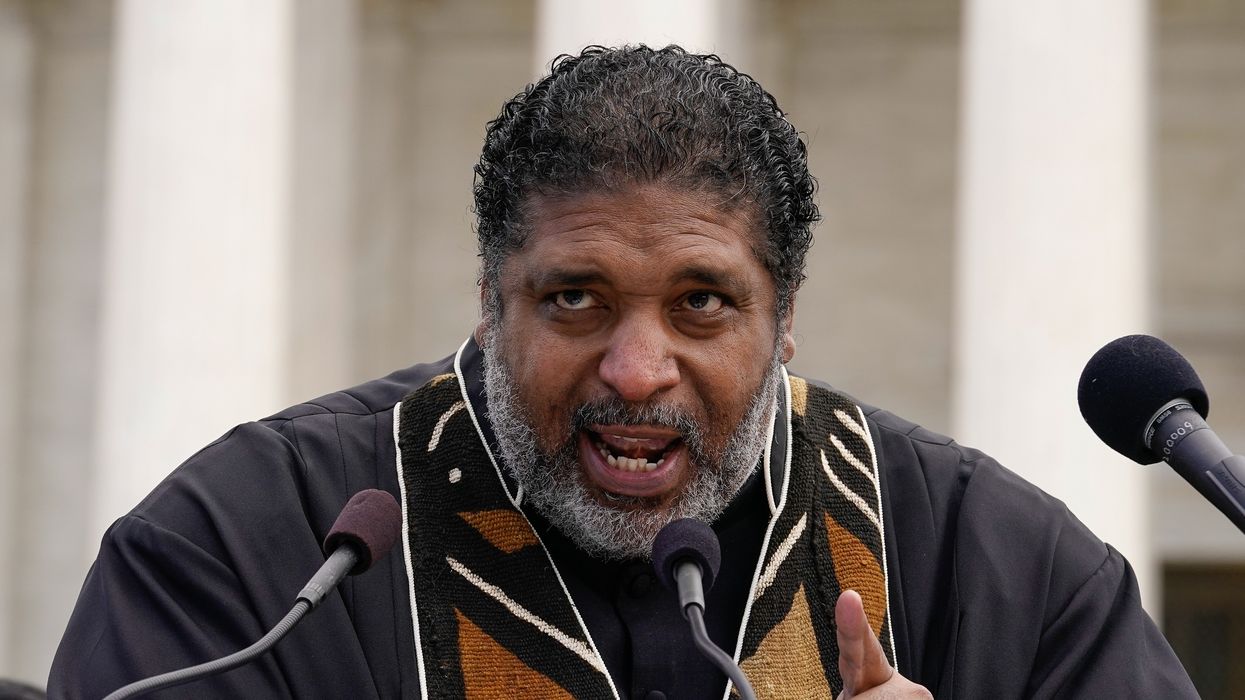
"This is no time for foolishness, photo-ops, and flaky commitments," declares a letter from faith leaders including Bishop William Barber II and Rev. Dr. Liz Theoharis of the Poor People's Campaign.
" Selma is sacred ground. It is, in a very real sense, the delivery room where the possibility of a true democracy was born. It is no place to play or to be for political pretense. Either you're serious or not. If you're coming, come on Sunday, the actual day of remembrance. If you're coming, come with a commitment to fight for what these people were willing to give their lives for."
That's the message that faith and rights leaders sent in a Monday letter to U.S. President Joe Biden and members of Congress ahead of the anniversary of Bloody Sunday—when white police officers violently assaulted civil rights advocates, including future Congressman John Lewis (D-Ga.), as they marched across the Edmund Pettus Bridge in Alabama on March 7, 1965.
The sign-on letter is led by the co-chairs of the Poor People's Campaign: A National Call for Moral Revival—Bishop William Barber II and Rev. Dr. Liz Theoharis—along with former Democratic Alabama state Sen. Hank Sanders, Faya Rose Touré, Rev. Mark Thompson, Rebecca Marion, and Rev. Carolyn Foster. It is open for signature on the Repairers of the Breach website.
"#SelmaIsSacredGround, not a place for political pretense."
"This is a critical year in the life of our country," the seven initial signatories wrote. "On the one hand, the president and progressive members of Congress have fought to pass policies that have lifted up Americans in many ways. From Covid relief measures to infrastructure investments to child tax credits that lifted millions of children out of poverty (for a brief moment) to the appointment of the first Black woman Supreme Court Justice, we can celebrate some real progress."
"But, on the other hand, with a Democratic president and control of the House and Senate for two years, Democratic leadership was unable to raise the federal minimum wage," they continued, also noting that a few obstructionist Democrats repeatedly helped Senate Republicans block efforts to restore the Voting Rights Act by supporting the filibuster.
That obstruction, they explained, enabled "regressive legislative bodies across the nation to pass more voter suppression bills than any time since Jim Crow and to go through another round of dangerous redistricting, which nullifies the potential power of progressive voting coalitions by stacking and packing votes in certain districts to predetermine outcomes before any vote is cast."
Highlighting research that shows tens of millions of Americans face some form of voter suppression, the letter leaders argue that if Biden and other politicians plan to visit Selma—which was recently devastated by a tornado—for the Bloody Sunday anniversary, they should "declare that the fight for voting rights and the restoration of what they marched across that bridge for is not over."
The letter also demands urgent action on living wages and investments in rural areas, stressing that millions of people—particularly in Southern states—live "in poverty and low-wealth conditions" and remain "uninsured or underinsured at a time when we have more people on healthcare than ever before," three years into the Covid-19 pandemic.
"Those of us who are planning to be in Selma to honor the struggle for voting rights and economic justice should be willing to protest and engage nonviolently if politicians attempt to do moral harm to the memory and the sacredness of what happened on Bloody Sunday," declares the letter. "This is no time for foolishness, photo-ops, and flaky commitments."
"Let us be clear: To honor the memory of Bloody Sunday is to work for the full restoration of the Voting Rights Act, the passage of the original For the People Act that John Lewis helped to write, not the bill that was watered down by Joe Manchin," the letter continues, calling out the pro-filibuster West Virginia Democrat infamous for thwarting his own party's agenda.
"To commemorate Bloody Sunday," the letter adds, "is to commit to raising of the minimum wage to a living wage, to ensuring that every American has adequate healthcare, and to enacting economic development that touches poor and low-wealth communities."
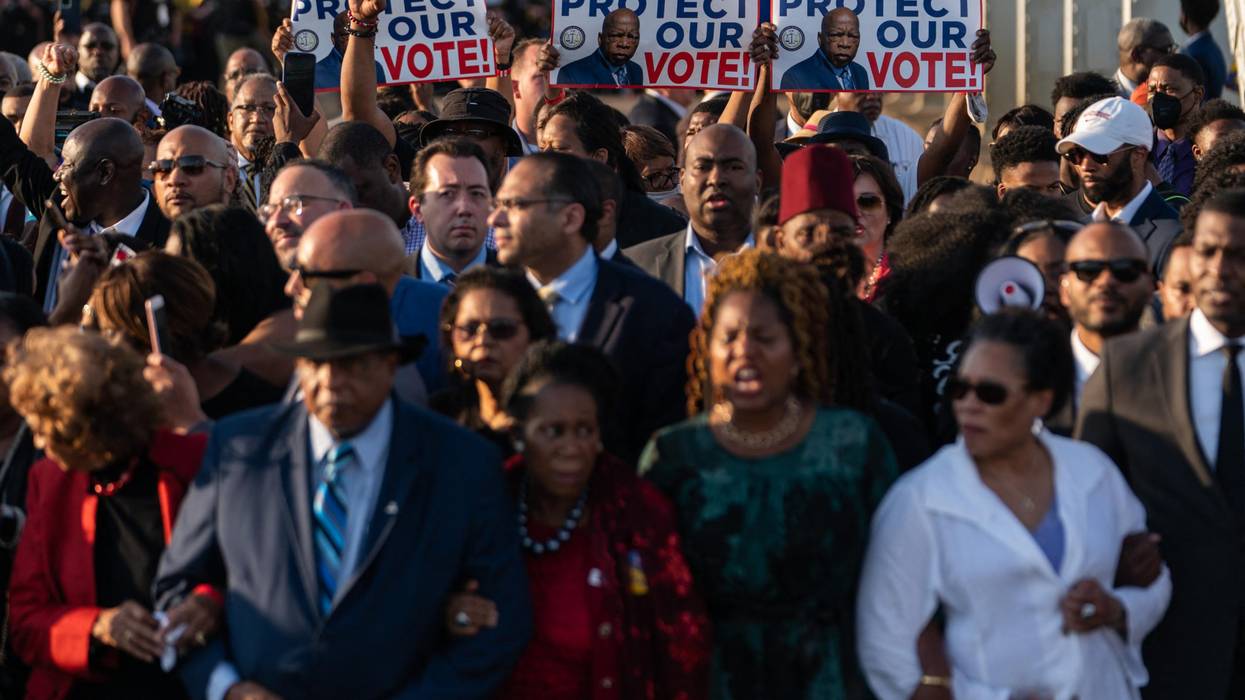
Politicians for both parties loudly praise the courage of Ukrainians defending their democracy from the Russian invasion. Yet, bipartisan defense of democracy disappears when the question is democracy at home. Mar. 7 marked the 57th anniversary of "Bloody Sunday" in 1965, when the police attack of a peaceful march of Blacks seeking the right to vote in Selma, Alabama, stirred the outrage that led to passage of the Voting Rights Act.
At stake is the direction of the country. Republicans have voted against raising the minimum wage, paid family leave, support for families with children, affordable day care, affordable prescription drugs, and fair taxes on the rich.
Today the right to vote is once more in question.
We witness the second great drive to suppress voting in American history. The first came after the Civil War, when the constitutional amendment to free the slaves and guarantee the right to vote to African Americans sparked a vicious reaction across the South to enforce segregation and suppress the right to vote.
Today, Republican politicians are making it harder to vote, particularly for those in urban areas, on Native American reservations and on college campuses. In July 2021, the Brennan Center reported that lawmakers had introduced at least 389 restrictive bills in 48 states in the 2021 legislative sessions, while 17 states enacted 28 new laws that restrict voting access.
Partisan gerrymandering has been given a free pass by right-wing judges on the Supreme Court. Worse, election officials are under assault. One in six have received threats of violence; one in three say they feel unsafe. As President Joe Biden declared, "We're facing the most significant test of our democracy since the Civil War."
The reason for the assault is clear. After 2020, Republicans know that they are the minority and their prospects are getting worse with younger, more diverse voters. In the last presidential election, Donald Trump captured a stunning 74 million votes, but Joe Biden won 81 million.
When the House of Representatives took up legislation to revive the Voting Rights Act, what used to enjoy bipartisan support was passed, but with a partisan divide. Similarly, when the Senate considered the For the People Act to create federal safeguards on voting rights, limit the role of secret money in politics and rein in gerrymandering, Republican Sen. Mike Lee of Utah described it as a bill "written in Hell by the Devil himself." Republicans used a filibuster to block passage of both bills.
The anniversary of Selma reminds us of how democracy is defended. Southern senators blocked any reforms at the federal level for years. In the states, police and organized terror enforced the suppression of Black votes.
African Americans won the right to vote because we and our allies marched for it, demonstrated for it, were beaten and died to gain it. And finally, after Selma, people of conscience demanded that the country live up to its Constitution and its democratic ideals. That is when President Lyndon Johnson could overcome the filibuster and pass the Voting Rights Act.
If the new voter suppression effort is to be overcome, it won't come from the White House or Congress. The Justice Department will do its best, but will face obstruction from right-wing judges. In states controlled by Republicans, the onslaught is brazen and clear.
What is needed now is massive, unrelenting, passionate organizing to register people to vote and to get them to the polls. Mobilized people won't be intimidated. With organization, the tricks and traps passed to suppress the vote can be overcome. Workers will have to sacrifice if early voting hours are restricted. Urban voters will have to put up with long lines, since polling sites are being eliminated. Mail-in ballots will face more obstacles. College students may need to organize the ID needed to qualify to vote on their campuses.
At stake is the direction of the country. Republicans have voted against raising the minimum wage, paid family leave, support for families with children, affordable day care, affordable prescription drugs, and fair taxes on the rich. They oppose action on catastrophic climate change. They vote against reproductive choice, civil rights, environmental and worker protections. They oppose tuition-free college and student debt relief.
All of these are supported by the vast majority of Americans. So, Republicans try to make voting harder.
We don't have to risk the bullets of the Ku Klux Klan or the billy clubs of Southern sheriffs as the marchers of Selma faced. We do have to organize to make our voices heard and our votes cast and counted. Historically, the core of the reform majority--African Americans, Hispanics, single women, the young--turn out in smaller numbers in off-year elections.
We can't afford that this year. At stake is literally what kind of country we will live in.
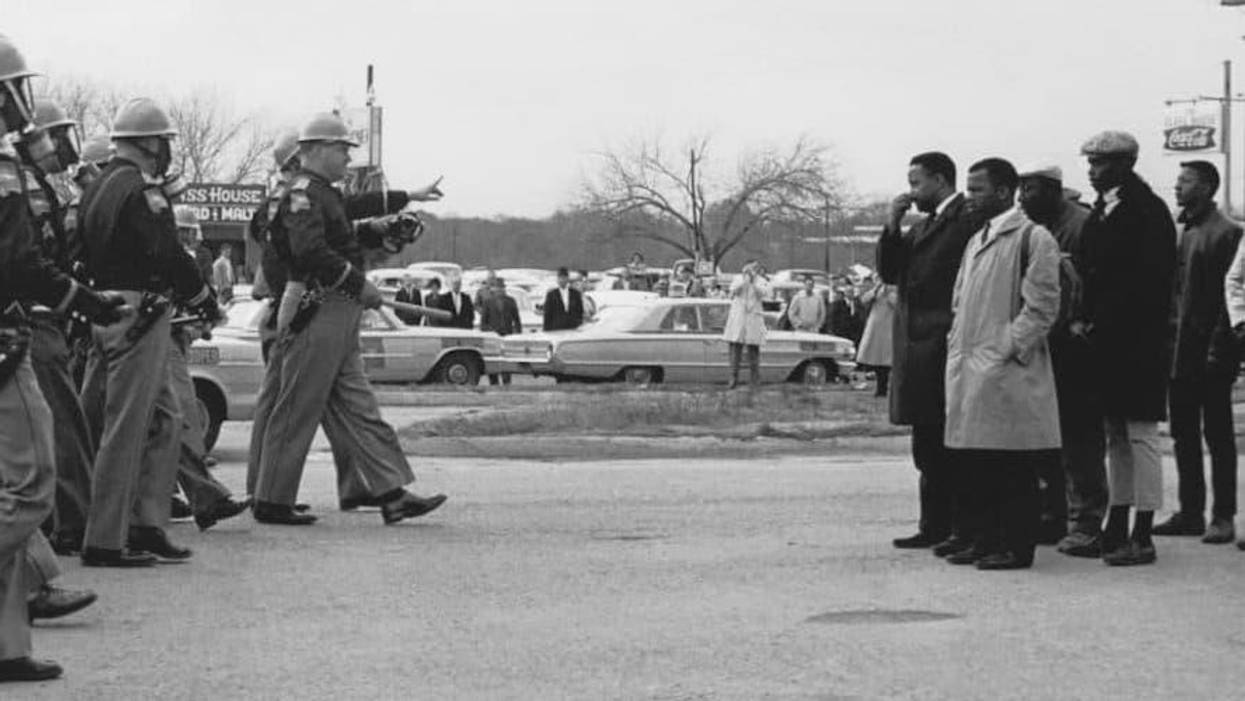
John Lewis, the Georgia Congressman who led the Student Nonviolent Coordinating Committee (SNCC) and was one of the "Big Six" civil rights leaders who organized the 1963 March on Washington, is being remembered as one of our greatest American heroes, in large part because he was willing to risk his life in non-violent protests against white supremacy.
Lewis was arrested over 40 times in non-violent sit-ins, Freedom Rides, and protests. On March 7, 1965, his skull was fractured, and he was almost murdered, by an Alabama state trooper when he led 600 peaceful civil rights protestors on a march from Selma to Montgomery, Alabama to demand voting rights.
Lewis and the other nonviolent protestors were brutally attacked by mounted police armed with clubs, whips, and rubber tubing wrapped in barbed wire as they peacefully tried to cross the Edmund Pettus Bridge in Selma.
The violent images of this horrendous, unprovoked police brutality against peaceful protestors were broadcast on the national network news that night to over 60 million viewers, and outraged much of the nation. The images, when broadcast worldwide, also publicly shamed the United States on the world stage.
Lewis and the other protestors would have been within their moral rights to have returned the next day armed with rocks, bricks, Molotov cocktails, and even firearms to protect themselves from such police brutality. But whether or not one is a pacifist, to have responded to force with force would have been political disaster for the civil rights movement.
Instead, Rev. Martin Luther King returned to Selma two weeks later to complete the march for voting rights that Lewis had started. On March 25, King led 25,000 nonviolent protestors the steps of the State Capitol in Montgomery, where he delivered his now-famous How Long, Not Long speech:
Once more, the method of nonviolent resistance was unsheathed from its scabbard, and once again an entire community was mobilized to confront the adversary. And again the brutality of a dying order shrieks across the land. Yet, Selma, Alabama, became a shining moment in the conscience of man. If the worst in American life lurked in its dark street, the best of American instincts arose passionately from across the nation.
These images, too, were seen across the country and around the world. Today, the brave sacrifice of Lewis and his fellow nonviolent protestors is largely credited for the passage of the 1965 Voting Rights Act, This landmark legislation, which prohibits racial discrimination in voting, is the cornerstone of defending the right to vote guaranteed by the Fourteenth and Fifteenth Amendments to the Constitution, but has been eroded in recent years by the conservative majority on the U.S. Supreme Court.
Today, Donald Trump has opened a full frontal attack on voting rights, threatening to delay or even suspend elections. In a transparent attempt to scare suburban whites into reelecting him, Trump is doing everything in his power to provoke antiracist protestors in Portland and other cities to forsake nonviolent protest and engage in violent resistance to the heavily armed federal officers in full camouflage uniforms he has ordered into American cities.
Let's be clear: Camouflage uniforms are designed to provide disguise in jungle warfare, not to intimidate protestors on the streets of American cities. But that's exactly what Trump is using them for. Sending in unidentified, camouflage-wearing federal agents to seize peaceful protestors off the streets is straight out of the playbook of Russian President Vladimir Putin, who sent "little green men"--unidentified Russian troops--to invade the Ukraine in 2014.
Sending Federal troops into American streets is Kabuki theater--reality television--by Trump. He wants to create TV images that appear to reflect urban carnage. TV footage of protestors attacking camouflage-wearing police and federal officers with Molotov cocktails, rocks, and bricks is exactly what Trump wants. (It wouldn't even surprise me if Trump has undercover agents provoking protestors to use violence.)
If we want to win, we can't let Trump provoke us into violence. We must honor John Lewis, and his hard-won victories for civil rights, by following his example of nonviolent resistance.
One can have academic arguments about whether violence is ever acceptable to fight injustice. I would personally argue that at least in the cases of the American Revolution, The Civil War, and World War II, violence was necessary. Others may differ.
But right now, violent protests would be the gift to Trump that he's begging for. Don't give it to him.
The street violence of the late 1960s was used by Republican operatives to pave the way for Richard Nixon's election as president in 1968. The implementation of the "Southern Strategy" of stoking irrational fears of Black people among poor and working-class whites to cement them to the Republican Party led right up to Trump's 2016 victory, and is still with us today.
The 1967 riots in major cities like Newark, Detroit, and Milwaukee, the 1968 assassinations of Martin Luther King and Robert F. Kennedy, and the police riots at the 1968 Democratic Convention all contributed to Richard Nixon's narrow victory. Nixon's victory consolidated power in a white supremacist oligarchy for the next half century.
Trump is on the ropes. Don't give him the gift of violent confrontations that he's so blatantly and transparently trying to provoke to rescue his campaign.
Honor John Lewis. Meet police brutality with nonviolent resistance.
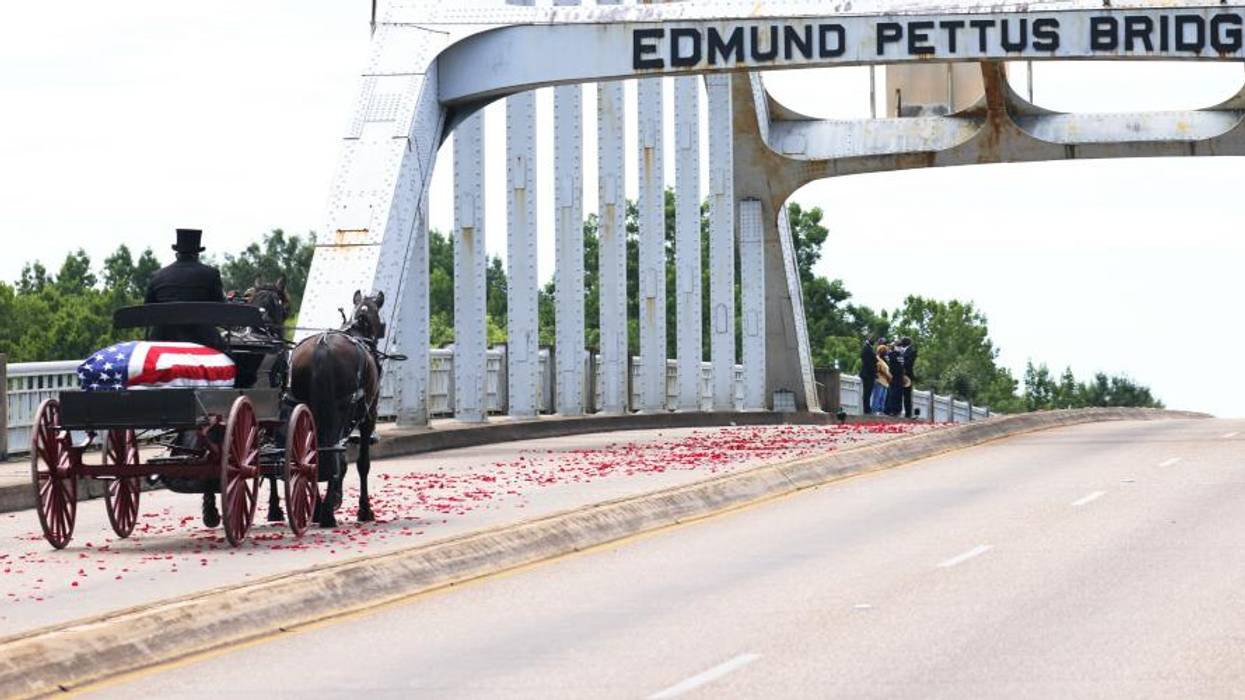
The casket of Congressman John Lewis, who died on July 17 following a battle with pancreatic cancer, was carried across the Edmund Pettus Bridge in Selma on Sunday 55 years after the Georgia Democrat led a civil rights protest march and was beaten by Alabama state troopers in an event that has since been known as Bloody Sunday.
Lewis's final journey across the bridge by horse-drawn caisson followed a service at the Brown Chapel A.M.E. Church in Selma and came before the late civil rights icon will lie in state at the U.S. Capitol next week. The Washington Post reported Thursday that "only a smaller, invitation-only group will be allowed inside the building on Monday afternoon for a ceremony under the Capitol Rotunda. Lewis's casket will then be moved to the top of the steps at the East Front of the Capitol for public viewing."
The Sunday service and bridge crossing, which was live-streamed and drew a crowd, elicited a fresh wave of tributes honoring Lewis's legacy. In a tweet Sunday, Sen. Kamala Harris (D-Calif.) called the crossing "an incredibly moving and fitting tribute for John Lewis, a man who carried the baton of justice until the very end."
Bernice King, the daughter of Martin Luther King Jr., on Sunday shared a recent personal memory of Lewis, writing on Twitter that "when I visited Uncle John a week before he died, I looked in his eyes and said, 'Well done.' I told him that I loved him and that we are going to continue to fight. So I must mourn and move at the same time."
Filmmaker Ava DuVernay wondered: "When Alabama state troopers beat and bloodied him on the Edmund Pettus Bridge in 1965, could a young John Lewis ever have imagined this day? That he'd live to be 80. That he'd be a lawmaker for decades. That his remains would cross the bridge again, this time lined with roses."
The rose petals on the bridge represented the blood spilled on March 7, 1965, when state troopers attacked Lewis--then chairman of the Student Nonviolent Coordinating Committee--and his fellow marchers with billy clubs and tear gas. Lewis, who suffered a fractured skull, later said, "I thought I was going to die on that bridge."
Kristen Clarke, president and executive director of the Lawyers' Committee for Civil Rights Under Law, expressed hope that the bridge will soon bear Lewis's name.
The bridge is currently named for a former Confederate general and Ku Klux Klan leader. In the years after Bloody Sunday, Lewis led subsequent marches across the bridge, including earlier this year. Since his death in mid-July, calls have mounted for the bridge to be renamed to honor Lewis.
As the Post's reporting on the John Lewis Bridge Project explained Sunday:
There are two petitions now, on Change.org and the project's website, that have picked up steam since Lewis's death. As of Saturday, about 715,000 people had signed them, including Selma director Ava DuVernay, Kerry Washington, Paul McCartney, Dan Rather and Pettus' great-great-granddaughter, Caroline Randall Williams, who is black.
DuVernay tweeted: "Edmund Pettus Bridge should be the John Lewis Bridge. Named for a hero. Not a murderer. Join this call. It's past due." The Rev. Jesse Jackson has also voiced support for the renaming. A separate fundraising campaign is being hosted by ActBlue, an organization that raises money for liberal grass-roots causes.
When Lewis walked across the bridge with House Speaker Nancy Pelosi (D-Calif.) in March, he told a crowd that had gathered that "it is good to be in Selma, Alabama, one more time... To take a little walk to try to dramatize the need for the rights of all our people to be able to participate in the democratic process."
In 1965, public outrage over televised footage of the brutality endured by civil rights activists on Bloody Sunday helped push Congress to pass the Voting Rights Act within months. Journalist Ari Berman, who has written extensively about voting rights in the United States, took to Twitter Sunday to call out Senate Majority Leader Mitch McConnell (R-Ky.) for holding up a vote on a bill to restore the landmark law.
Concerns about voting rights have grown this year in the midst of the coronavirus pandemic and President Donald Trump's baseless attacks on vote-by-mail.
"The biggest issue is we have an election in the middle of a health crisis and we haven't put adequate resources into dealing with that," Cliff Albright, a Georgia activist who co-founded Black Voters Matter, told USA Today Saturday. "From where I stand, it's almost like we're fighting similar issues that John Lewis and his friends fought."
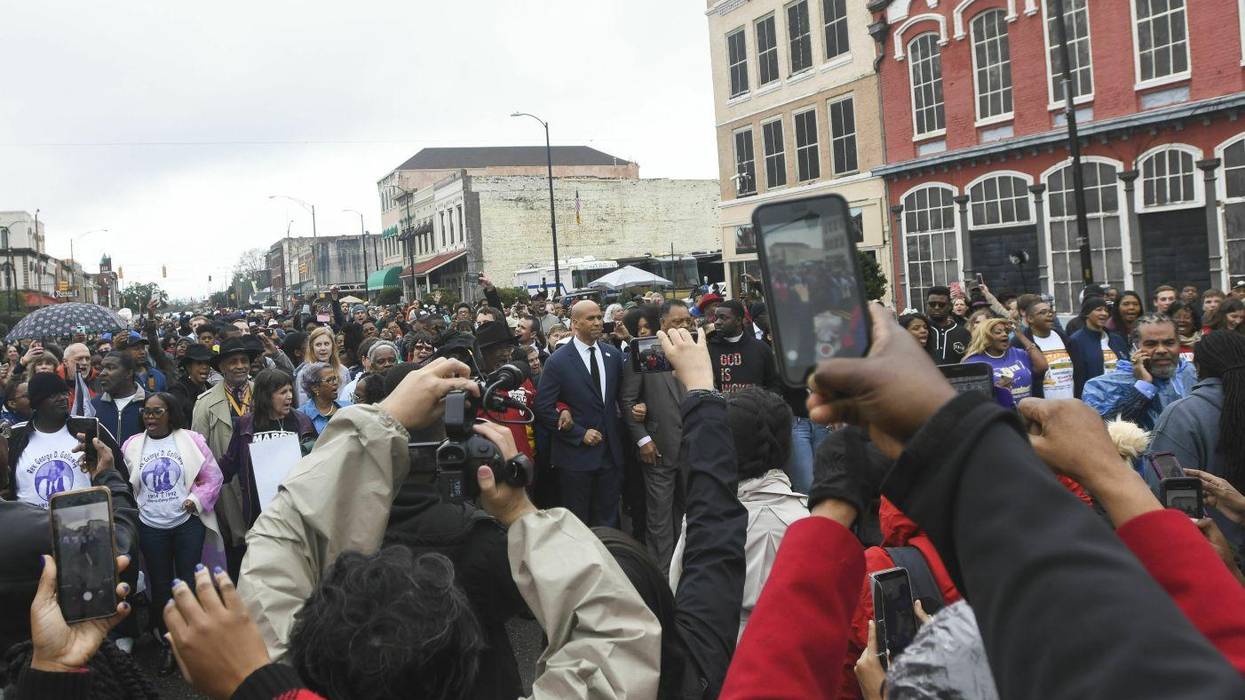
This past weekend, political leaders from across the country gathered in Selma, Alabama, to commemorate "Bloody Sunday," the 1965 march across the Edmund Pettus Bridge where peaceful demonstrators, attempting to cross the bridge, were violently driven back by Alabama State Troopers, Dallas County Sheriff's deputies and a horse-mounted posse wielding billy clubs and water hoses to savage the crowd.
The horrors played on TV sets across the country generated a national outrage that provided the final impetus for passage of the 1965 Voting Rights Act.
In many ways, Selma is the birthplace of modern democracy in America, helping to secure the right to vote for African Americans and the young, and for providing the foundation for future battles for equality, including the equal rights of women.
When former Alabama Gov. George Wallace was ill late in his life, I joined him for prayer. I asked him why he unleashed the troopers on the demonstrators in 1965. He said, "I did them a favor."
Wallace argued that the mob would have been much worse on the peaceful marchers. He never even considered that he might have used the troopers to protect them from the mob. That was a mentality that, as Dr. Martin Luther King taught, could only be challenged by nonviolent protest that demonstrated our humanity while demanding our rights.
Democrats should see Selma and rural America as both an obligation and an opportunity.
In the commemorative ceremonies this year, presidential candidates Sen. Bernie Sanders and Cory Booker, as well as Sen. Sherrod Brown and former Secretary of State Hillary Clinton were joined by many legislators and political leaders. They sensibly called on participants to rise up again to challenge the revival of systematic efforts to suppress the vote and to push back against the outrageous Supreme Court decision in Shelby v. Holder. This decision gutted enforcement provisions of the Voting Rights Act, and opened the floodgates to a wave of discriminatory state laws meant to keep people of color from exercising their right to vote.
There are laws that now require new forms of ID, voting districts have been gerrymandered and voter rolls purged. Laws now limit early voting and polling places have been closed or move without notice, and much, much more. The brave marchers in 1965 did their part for democracy, now it is up to us to defend it and extend it.
At the same time, while Selma is the birthplace of modern democracy, it is in danger of becoming a prop. Selma is the ninth poorest small town in America and 40 percent of its residents live in poverty. It exemplifies the rural and small-town America that has been left out of the recovery.
Democrats tend to see rural America as Trump country. Trump appealed to rural voters by stoking their fears and turning them against each other, but he has come up with no plan to help them. Trump offers only hate, not hope.
The new Democratic majority in the House is in many ways the fruit of the sacrifices made at Selma and elsewhere. Democrats should see Selma and rural America as both an obligation and an opportunity. What's needed is a comprehensive rural reconstruction plan, a modern version of what Franklin D. Roosevelt did when he built the Tennessee Valley Authority and modernized the Department of Agriculture, which literally electrified rural America.
Today, the Department of Agriculture has the authority and the capacity to invest in water and sewage systems, modernize utilities, provide broadband to underserved communities, offer zero interest loans to community centers and subsidize affordable housing. What we need is a plan and a budget to get this done. House Democrats should make this a priority.
Let's honor those who sacrificed so much by repealing voter suppression laws. But let us also make Selma the birthplace of a new economic justice in rural America. Selma should be more than a symbol of past struggles; it must also become a beacon for a new hope.

In 1965, Martin Luther King, Jr. led marchers to the Dallas County Courthouse in Selma, Alabama to demand their right to vote. When they got there, they were arrested. That arrest, and the police brutality that followed it, galvanized the nation and forced passage of the Voting Rights Act.
Yet in 2018, many of us still do not have our right to vote. More than six million nationwide are disenfranchised because of state laws rooted in white supremacy. Millions more don't vote because someone lied and told us we can't, because we are or were in prison or have a conviction in our past.
So now we've come back to Selma to finish what King started: to recover and restore his movement.
I come to Selma every year on Bloody Sunday. That's the day in March when King's marchers were met by riot police on Edmund Pettis Bridge. Now, this anniversary is a jubilee: we cross the bridge to celebrate how far we've come, with marching bands, banners and choirs.
But there's more work to be done. So we start every year's jubilee with a "Backwards March": Holding hands, I join other pastors and the formerly incarcerated to march backwards across the bridge, at the head of the parade. No one crosses the bridge until we've finished. Then the celebration continues.
Why do we march backwards? To remind us of everyone who's been left behind. We've got to go back and get them, and get things right, so we can move forward.
We march under this banner: "From the back of the bus to the front of the prison, the struggle continues."
I am formerly incarcerated myself. When I was released, I took the state of Alabama to court to regain my vote, then to restore this right to others. Because of these efforts, a quarter of a million in Alabama now have their voting rights restored.
But many still don't know they can vote. So since 2003, with help from the Drug Policy Alliance and Project South, I've gone inside jails to register voters. Because even if you're on the inside in Alabama, if you're not yet convicted, or convicted of a misdemeanor or a nonviolent drug offense, you can vote. No matter what you've been told.
These millions of men and women - the incarcerated and formerly incarcerated - are America's truly forgotten. They're not on anybody's list, or in anybody's poll; they've never been counted. No one ever thought we'd overcome the odds and vote.
Alabama's GOP has fought me every step of the way. Why? Because the last thing they want is for these millions of voters to regain their rights. One of the officials who opposed me most, Mike Hubbard, is now in prison for fraud. He can vote now, too, thanks to our efforts. You can't make this up.
Slavery still exists in the United States. That's because the Thirteenth Amendment to the Constitution, which abolished slavery in 1865, says it can still exist "as a punishment for crime." Prisoners all across this country are forced to work for free, or for pennies on the dollar.
But that's not all the Constitution says. The Eighth Amendment also bans "cruel and unusual punishment." What punishment is more more cruel and unusual than this modern form of slavery?
And in states all across the South, intentionally vague "Moral Turpitude" clauses bar those convicted of crimes from the vote. So in 2008, I sued Alabama and forced the state to allow me to extend voting rights to prisoners. In 2017, Alabama finally passed a law to clearly define crimes of "moral turpitude" which has re-enfranchised most of the 286,000 people with felony convictions in the state. But many of them still don't know they can vote. And hundreds of thousands more across the South - in Florida alone, there are 1.3 million - are waiting for this right to be restored.
So yes, there's work to be done.
Now, we've launched #Free2Vote, a multi-state initiative with the People's Action Mass Liberation Campaign, Project South & the Southern Movement Assembly to register voters inside and outside of prisons and jails.
The only thing that declares your full citizenship is the right to vote. So we'll continue in Alabama, then move on to Florida, Georgia and other states of the South and North where voters have been disenfranchised through mass incarceration. A hundred million Americans are impacted by criminal convictions.
This is an insight I learned in Selma. Non-violence, one of our great lessons from Dr. King, has been misinterpreted by some to mean "non-movement." But the truth is, we need a powerful movement for voting rights, economic and racial justice, just as much today as we did fifty-three years ago.
So it's time to fulfill Dr. King's dream - to restore and revive his movement. We must go back, get what was lost, and move forward to restore the right to vote to America's truly forgotten men and women: the incarcerated, formerly incarcerated, those with criminal convictions as well as those sitting in jail who aren't convicted of anything, just waiting for trial.
On March 7, 1965, 25-year-old John Lewis, already a veteran of the Freedom Rides, Mississippi's Freedom Summer and Martin Luther King Jr.'s March on Washington, walked ahead of 600 civil rights activists as they crossed the Edmund Pettus Bridge in Selma, Alabama, on the first leg of what was meant to be a peaceful march for voting rights.
As they stepped off the end of the bridge, a posse of 150 state troopers and deputy sheriffs attacked them, wielding clubs, bullwhips and tear gas. Lewis was beaten to within an inch of his life. But he took the horrible pummeling of "Bloody Sunday" and survived to lead another march a week later. This time they kept going -- all the way to the state capitol in Montgomery, 50 miles away.
Fifty-one years later, on Wednesday, on the floor of the House of Representatives, John Lewis, now 76 and a member of Congress for nearly three decades, took another courageous and principled stand. Many of his Democratic colleagues joined him for a sit-in on the floor of the House chamber itself, the same kind of protest he and his fellow activists used so effectively during the 1960s.
This time they were agitating against one of the most grievous human rights horrors of all: the gun violence running amok in America, including the recent abomination of 49 deaths at that nightclub in Orlando, Florida. There have been nearly 100,000 gun deaths in the United States since the school murders in Newtown, Connecticut, just three and a half years ago.
In Selma in 1965, television cameras sent pictures of what was happening on the Pettus Bridge around the country and a shocked American public took to heart how deep the wounds remained between black and white. On Wednesday, Republican House leadership, as cruel and cold-of-heart as those Alabama state troopers, gaveled the House out of session so the cameras of C-SPAN could not show the American people the courage of those House members sitting on the floor and telling the National Rifle Association and its bought-and-paid-for politicians to go to hell.
Despite the GOP's attempt to shut television's probing eye, the demonstrators used social media like Facebook and Twitter to get out their story, putting their cell phones to good use and sending out photos and video of their action across the country and the world (C-SPAN wound up putting much of their footage on the air). Lewis tweeted, "Sometimes you have to get in the way. You have to make some noise by speaking up and speaking out against injustice and inaction. #goodtrouble."
In a letter to Republican House Speaker Paul Ryan, Rep. Lewis and his colleague Rep. Katherine Clark asked, "What is this Congress waiting for? ...We stand with thousands of brokenhearted families who have not been served by this Congress and millions more who are counting on us to find the moral courage to do the right thing. We stand together in our refusal to sit by while this Congress abdicates its fundamental responsibility to protect American families from harm."
Once again, the Republican leaders of Congress have been revealed for what they are: useful stooges of the gun merchants who would sell to anyone -- from the mentally ill to a terrorist-in-waiting to a lurking mass murderer. And the Republican Party once again has shown itself an enabler of death, the enemy of life, a threat to the republic itself.
Today, John Lewis said, "The time is always right to do right. Our time is now." The heroism on the Pettus Bridge turned the tide against the inhumanity of segregation. Today's protest in the House of Representatives might mark the beginning of the end of the gun industry's grip on American life and liberty.
Save
Noted civil rights organizer and activist Diane Nash, who had led the initial walk across the Edmund Pettus Bridge in Selma, Alabama, boycotted the 50th anniversary commemoration march this weekend because of the "insulting" participation of former President George W. Bush.
Nash told NewsOne Now on Saturday that she "refused to march" once it was apparent that the former president "was going to be a part of it."
"I think the Selma Movement was about nonviolence and peace and democracy and George Bush stands for just the opposite--for violence and war and stolen elections," said Nash.
Nash, along with her husband at the time James Bevel and a handful of others, co-founded the Student Nonviolent Coordinating Committee (SNCC) and initiated the Alabama Voting Rights Project, which culminated in the infamous Selma to Montgomery marches. During one attempt to cross the Edmund Pettus Bridge in Selma, activists were violently attacked by local police forces, an encounter that was caught on camera by local news sources and broadcasted widely, drawing national attention to the southern civil rights movement.
During the brief interview with NewsOne, Nash also referenced the Bush administration's use of torture, adding that she "thought that this was not an appropriate event for him."
"George Bush's presence is an insult to me and to people who really do believe in nonviolence," Nash continued, voicing concern that the nonviolent legacy of the Selma Movement would now be "confused."
A vocal proponent of the principle of nonviolence, in addition to her role in organizing the Alabama Voting Rights Project, Nash is also credited with helping launch the initial lunch counter sit-ins in Nashville as well as the Freedom Rider bus desegregation efforts. Because of her leadership, Nash was appointed by President John F. Kennedy to a national committee that prepared for the passage of the Civil Rights Act of 1964.
"Back in the 1960's we did not know if nonviolence would work," Nash told NewsOne. "Now we know that it does." Nash said that she thought the Selma March anniversary "should have been a celebration of nonviolence," which she added, was "definitely one of the most significant social inventions of the 20th century."
The entire NewsOne interview with Diane Nash can be viewed below.
As political leaders, celebrities, and civil rights activists descend on the city of Selma, Alabama this weekend to commemorate the famous march that culminated in the brutal assault by local law enforcement that became known as 'Bloody Sunday' on March 7, 1965, both veteran participants and a younger generation of racial justice advocates are making it clear that even after fifty years of struggle--despite monumental victories won by those who marched and died for the cause --the ultimate fight aimed at securing equal rights, economic justice, and shared opportunities is far from over.
"When you look around and see how things really are, and see the disparity in healthcare and economics and education and jobs ... the struggle still continues." --Fred Gray, civil rights attorneyHaving marched across the now-historic Edmund Pettus Bridge alongside hundreds of others, including Martin Luther King, Jr., in Selma on that day fifty years ago, Rep. John Lewis (D-Ga.) said this week that for him, the bridge "is a sacred place" because "that's where some of us gave a little blood and where some people almost died." During the police onslaught, Lewis had his skull fractured by a state trooper's billy club.
The Associated Press offered this short depiction of the march, including events preceding and following 'Bloody Sunday,' using clips from speeches and archival footage:
According to Lewis, "That bridge - what happened on that Sunday have changed America forever." As history notes, President Lyndon B. Johnson signed the The Voting Rights Act of 1965 into law just months after the 'Bloody Sunday' incident and the march in Selma, which exposed for many the unquestionable brutality of political repression and police aggression in the South. To this day, the march is widely credited as triggering a key shift in national public opinion and provided political traction for the idea that the right to vote was a necessary and key protection that deserved federal legislation.
As columnist Leonard Pitts, Jr. writes on Saturday:
By rights, this 50th anniversary of those events should be an unalloyed celebration. After all, the marchers, fortified by men and women of good will from all over the country, eventually crossed that bridge under federal protection, marched for four days up Highway 80 and made it to, as the song says, glory. They stood at the state capital in Montgomery and heard Martin Luther King exhort them to hold on and be strong. "Truth crushed to earth," he thundered, "will rise again!"
The Voting Rights Act was signed into law. And African Americans, who had been excluded from the ballot box for generations, went on to help elevate scores of citizens who looked like them to the mayor's office, the governor's mansion, the White House.
Pitts Jr., however, along with many others, recognizes that even as the historic march deserves commemoration and celebration for the gains it provided or symbolized, there have been tremendous lapses in progress--specifically in recent years--and the persistent ravages of racism, economic inequality, and disparity of opportunity remain deeply ingrained in Alabama, across the South, and beyond.
Fred Gray, an attorney and leading civil rights activist in the sixties, said this week that having been "involved with it from the very beginning and seeing it from totally segregated to where it is now, we've made some progress."
But, he added, "when you look around and see how things really are, and see the disparity in healthcare and economics and education and jobs ... the struggle still continues. If anything, it should encourage us to do a better job."
"Celebrations, commemorations and movies make people feel good, but the reality is that voting rights have been rolled back dramatically in recent years." --Hank Sanders and Faya Rose Toure
And take husband and wife couple Hank Sanders and Faya Rose Toure, who in an op-ed in the New York Times on Saturday describe how they settled in Selma subsequent to the famous march in order to make the fight for voting rights in Alabama a temporary commitment, but repeatedly determined--over the course of the five decades since--to remain as they recognized victory for equal access and civil rights remained elusive.
Now in their seventies, Sanders, who serves as U.S. Congressman representing Alabama's 23rd District, and Toure, a civil rights attorney, write:
We came to Selma in 1971, newly married and fresh out of Harvard Law School. Our intentions were to stay for five years. We were sure that by then Dr. King's vision of voting rights would have been realized. Over 40 years later, not only are the fruits scarce, but the roots are shallow and feeble.
Celebrations, commemorations and movies make people feel good, but the reality is that voting rights have been rolled back dramatically in recent years. The Supreme Court's 2013 ruling in Shelby County v. Holder effectively gutted the Voting Rights Act, striking down a central provision requiring certain states, including Alabama, to obtain federal clearance before changing voting procedures. Since then, several states have limited access to voting by blacks and others. Today, all Alabama voters must show photo identification. In Alabama and other states, this I.D. must be government-issued. These policies, which disproportionately affect minority, poor and elderly voters who are less likely to possess government-issued I.D.s, are the 21st-century equivalent of the Jim Crow-era poll tax and literacy test.
Wendy Weiser, director of the democracy program for the Brennan Center for Justice at NYU School of Law, notes how the weakening of the Voting Rights Act at the federal level is made worse by these aggressive state-level attacks, which appear to be directly tied to the positive turnout of minority voters in recent national elections. Weiser writes:
"New assault on voting rights is being ignored by the same lawmakers who are coming to Selma to celebrate." --Cornell William Brooks, NAACPThe push to restrict voting came after a surge in participation among African-Americans and certain other groups in 2008. Recent studies found that the more a state experienced increases in minority and low-income voter turnout, the more likely it was to push and pass laws cutting back on voting rights. The Brennan Center similarly found that of the 11 states with the highest black turnout in 2008, seven passed laws making it harder to vote. Of the 12 states with the largest Hispanic population growth in the 2010 Census, nine states did so. And of the 15 states that used to face special monitoring under the VRA because of a history of racial discrimination in elections, nine states passed laws that make it more difficult to vote.
Unfortunately, efforts to restrict voting show no signs of abating. In the first few weeks of this year, legislation was introduced in 17 states and already progressed in two.
All this points to an urgent and continuing need for strong legal protections for voting rights -- protections sought and won by the brave marchers 50 years ago in Selma.
President of the NAACP Cornell William Brooks marked the anniversary of Selma by voicing celebration for the bravery of those who marched fifty years ago, but also said nobody should lose sight that voting rights are under sustained attack nationwide.
In fact, Brooks added, "this new assault on voting rights is being ignored by the same lawmakers who are coming to Selma to celebrate" the sacrifices of those who were beaten and bloodied on the Edmund Pettus Bridge.
"Selma is now," he declared and vowed the NAACP would "not rest until every American has unfettered access to the ballot box" in every state and community across the country.
"When we look forward, we've got to think about not just how to we defend what we've won and earned, but what the new models and new systems for protections are that we need for the future." --Rashad Robinson, ColorofChangeMeanwhile, younger activists and organizers--such as Rashad Robinson, executive director of ColorofChange, and Patrisse Cullors, Opal Tometi and Alicia Garza, co-founders of the #BlackLivesMatter project--were asked this week to weigh in on the legacy of Selma in the context of contemporary fights against police violence, structural racism, and other struggles.
Asked by the Washington Post about what's needed to fight back against the attack on voting rights, Robinson said, just like in the 1960s, it will take "a movement" to win the necessary fights.
Reflecting on Selma, Robinson said, "reminds all of us that movements and organizing and advocacy are the fuel that brings about change. Sometimes we think about change being elections and putting certain people in power, but it's the movement underneath that helps the people we put in power bring about the policies that we want."
He added, "When we look forward, we've got to think about not just how to we defend what we've won and earned, but what the new models and new systems for protections are that we need for the future."
During a Twitter chat hosted by NBC News this week exploring the intersection of Selma and the current movement for racial justice, Opal Tometi said, "The fight has changed in many ways, but at its core the challenge remain[s] the same."
Regarding the loss of progress on voting rights, she added, "The thing about racism is that it always morphs to undermine progress."
As Pitts, Jr. opined: "It is disheartening that we find ourselves forced to fight again a battle already won. But the events of half a century past whisper to us a demand for our toughness and faith in the face of that hard truth. They remind us that injustice is resilient."
But, he concluded, also resilient is the "truth crushed to earth" that those who marched with Dr. King in 1965 carried with them and those who continue that struggle today so bravely affirm.
In this 50th anniversary year of the Selma-to-Montgomery March and the Voting Rights Act it helped inspire, national media will focus on the iconic images of "Bloody Sunday," the words of Dr. Martin Luther King Jr., the interracial marchers, and President Lyndon Johnson signing the Voting Rights Act. This version of history, emphasizing a top-down narrative and isolated events, reinforces the master narrative which civil rights activists describe as, "Rosa sat down, Martin stood up, and the white folks came South to save the day."
But there is a "people's history" of Selma that we all can learn from--one that is needed especially now. The exclusion of Blacks and other people of color from voting is still a live issue. Sheriff's deputies may no longer be beating people to keep them from registering to vote, but in 2013 the Supreme Court ruled in Shelby v. Holder that the Justice Department may no longer evaluate laws passed in the former Confederacy for racial bias. And as a new movement emerges, insisting that Black Lives Matter, young people can draw inspiration and wisdom from the courage, imagination, and accomplishments of activists who went before.
Here are 10 points to keep in mind about Selma's civil rights history.
1. The Selma voting rights campaign started long before the modern Civil Rights Movement.
Mrs. Amelia Platts Boynton, her husband Samuel William Boynton, and other African American activists founded the Dallas County Voters' League (DCVL) in the 1930s. The DCVL became the base for a group of activists who pursued voting rights and economic independence.
2. Selma was one of the communities where the Student Nonviolent Coordinating Committee (SNCC) began organizing in the early 1960s.
In 1963, seasoned activists Colia (Liddell) and Bernard Lafayette came to Selma as field staff for the Student Nonviolent Coordinating Committee (SNCC), known as "Snick." Founded by the young people who initiated the 1960 sit-in movement, SNCC had moved into Deep South, majority-black communities doing the dangerous work of organizing with local residents around voter registration.
Working with the Boyntons and other DCVL members, the Lafayettes held Citizenship School classes focused on the literacy test required for voter registration and canvassed door-to-door, encouraging African Americans to try to register to vote. Prathia Hall, a SNCC field secretary who came to Selma in the fall of 1963, explained in Hands on the Freedom Plow:
The 1965 Selma Movement could never have happened if SNCC hadn't been there opening up Selma in 1962 and 1963. The later, nationally known movement was the product of more than two years of very careful, very slow work.
3. The white power structure used economic, "legal," and extra-legal means, including terrorism, to prevent African Americans from accessing their Constitutional right to vote and to impede organizing efforts.
SNCC's organizing was necessary and extremely challenging because African Americans in Selma, despite being a majority in the community, were systematically disfranchised by the white elite who used literacy tests, economic intimidation, and violence to maintain the status quo.
According to a 1961 Civil Rights Commission report, only 130 of 15,115 eligible Dallas County Blacks were registered to vote. The situation was even worse in neighboring Wilcox and Lowndes counties. There were virtually no Blacks on the voting rolls in these rural counties that were roughly 80 percent Black. Ironically, in some Alabama counties, more than 100 percent of the eligible white population was registered.
While many people are aware of the violent attacks during Bloody Sunday (when, on March 7, 1965, police brutally attacked marchers in Selma), white repression in Selma was systematic and longstanding. Selma was home to Sheriff Jim Clark, a violent racist, and one of Alabama's strongest white Citizens' Councils--made up of the community's white elite and dedicated to preserving white supremacy. The threat of violence was so strong that most African Americans were afraid to attend a mass meeting. Most of the Lafayettes' first recruits were high school students. Too young to vote, they canvassed and taught classes to adults. Prathia Hall remembers the danger in Alabama: "...[I]n Gadsden, the police used cattle prods on the torn feet [of young protesters] and stuck the prods into the groins of boys. Selma was just brutal. Civil rights workers came into town under the cover of darkness."
4. Though civil rights activists typically used nonviolent tactics in public demonstrations, at home and in their own communities they consistently used weapons to defend themselves.
On June 12, 1963, the night Medgar Evers was assassinated in Jackson, Mississippi, whites viciously attacked Bernard Lafayette outside his apartment in Selma in what many believe was a coordinated effort to suppress Black activism.
Lafayette believed in nonviolence, but his life was probably saved by a neighbor who shot into the air to scare away the white attackers.
This practice of armed self-defense was woven into the Movement and, because neither local nor federal law enforcement offered sufficient protection, it was essential for keeping nonviolent activists alive.
5. Local, state, and federal institutions conspired and were complicit in preventing black voting.
Even with the work of SNCC and the Dallas County Voters' League, it was almost impossible for African Americans to register to vote. The registrar's office was only open twice a month and potential applicants were routinely and arbitrarily rejected. Some were physically attacked and others fired from their jobs. Howard Zinn, who visited Selma in the fall of 1963 as a SNCC advisor, offers a glimpse of the repression, noting that white officials had fired teachers for trying to register and regularly arrested SNCC workers, sometimes beating them in jail. In one instance, a police officer knocked a 19-year-old girl unconscious and brutalized her with a cattle prod.
In another example, in summer 1964, Judge James Hare issued an injunction making it illegal for three or more people to congregate. This made demonstrations and voter registration work almost impossible while SNCC pursued the slow appeals process. Although the Justice Department pursued its own legal action to address discrimination against Black voters, its attorneys offered no protection and did nothing to intervene when local officials openly flaunted the 1957 Civil Rights Act.
The FBI was even worse. In addition to refusing to protect civil rights workers attacked in front of agents, the FBI spied on and tried to discredit movement activists. In 1964, the FBI sent King an anonymous and threatening note urging him to commit suicide and later smeared white activist Viola Liuzzo who was murdered after coming from Detroit to participate in the Selma-to-Montgomery March.
6. SNCC developed creative tactics to highlight Black demand for the vote and the raw violence at the heart of Jim Crow.
To highlight African Americans' desire to vote and encourage a sense of collective struggle, SNCC organized a Freedom Day on Monday, Oct. 7, 1963, one of the monthly registration days. They invited Black celebrities, like James Baldwin and Dick Gregory, so Blacks in Selma would know they weren't alone.
Over the course of the day, 350 African Americans stood in line to register, but the registrar processed only 40 applications and white lawmen refused to allow people to leave the line and return. Lawmen also arrested three SNCC workers who stood on federal property holding signs promoting voter registration.
By mid-afternoon, SNCC was so concerned about those who had been standing all day in the bright sun, that two field secretaries loaded up their arms with water and sandwiches and approached the would-be voters.
Highway patrolmen immediately attacked and arrested the two men, while three FBI agents and two Justice Department attorneys refused to intervene. (Read an account of the day by Howard Zinn here.)
This federal inaction was typical, even though southern white officials openly defied both the Civil Rights Act of 1957 and Constitutional protections of free assembly and speech. The FBI insisted it had no authority to act because these were local police matters, but consistently ignored such constraints to arrest bank robbers and others violating federal law.
7. Selma activists invited Dr. King to join an active Movement with a long history.
By late 1964, Martin Luther King, Jr. and the Southern Christian Leadership Conference (SCLC) were looking for a local community where they could launch a campaign to force the country to confront the southern white power structure's widespread discrimination against prospective Black voters.
At the same time, Mrs. Boynton, the long-time leader of the Dallas County Voters' League, wanted to escalate the struggle in Selma and invited SCLC in. SCLC saw Selma as ideal because: (1) The ongoing work of SNCC and the DCVL provided a strong base of organizers and people who could be counted on to attend mass meetings, march in demonstrations, attempt to register, and canvass prospective registrants; (2) Sheriff Jim Clark's volatile white supremacy led King to believe he was likely to attack peaceful protesters in public, drawing national attention to the white violence underlying Black disfranchisement; and finally, (3) the Justice Department's own lawsuit charging racial discrimination in Dallas County voter registration reinforced the need for action.
8. Youth and teachers played a significant role in the Selma Movement.
An important breakthrough in the Selma Movement came when school teachers, angered by a physical attack on Mrs. Boynton, marched to the Courthouse on Jan. 22, 1965. Despite the prominence of King and a handful of ministers in history books, throughout the South most teachers and ministers stayed on the sidelines during the movement. Hired and paid by white school boards and superintendents, teachers who joined the Civil Rights Movement faced almost certain job loss.
In Selma, the "teacher's march" was particularly important to the young activists at the heart of the Selma movement. One of them, Sheyann Webb, was just 8 years old and a regular participant in the marches. She reflects in Voices of Freedom:
What impressed me most about the day that the teachers marched was just the idea of them being there. Prior to their marching, I used to have to go to school and it was like a report, you know. They were just as afraid as my parents were, because they could lose their jobs. It was amazing to see how many teachers participated. They follow[ed] us that day. It was just a thrill.
9. Women were central to the movement, but they were sometimes pushed to the side and today their contributions are often overlooked.
In Selma, for example, Mrs. Amelia Boynton was a stalwart with the DCVL and played a critical role for decades in nurturing African American efforts to register to vote. She welcomed SNCC to town and helped support the younger activists and their work. When Judge Hare's injunction slowed the grassroots organizing, she initiated the invitation to King and SCLC.
Marie Foster, another local activist, taught Citizenship classes even before SNCC arrived. In early 1965 when SCLC began escalating the confrontation in Selma, Mrs. Boynton and Marie Foster were both in the thick of things, inspiring others and putting their own bodies on the line. They were leaders on Bloody Sunday and the subsequent march to Montgomery.
Though Colia Liddell Lafayette worked side-by-side with her husband Bernard, recruiting student workers and doing the painstaking work of building a grassroots movement in Selma, she has become almost invisible and typically mentioned only in passing, as his wife.
Diane Nash, whose plan for a nonviolent war on Montgomery inspired the initial Selma march, was already a seasoned veteran, leading the Nashville sit-ins, helping found SNCC, and taking decisive action to carry the freedom rides forward.
These are just a few of the many women who were critical to the movement's success--in Selma and across the country.
10. Though President Lyndon Johnson is typically credited with passage of the Voting Rights Act, the Movement forced the issue and made it happen.
The Selma Campaign is considered a major success for the Civil Rights Movement, largely because it was an immediate catalyst for the passage of the Voting Rights Act of 1965. Signed into law by President Lyndon B. Johnson on Aug. 6, 1965, the Voting Rights Act guaranteed active federal protection of southern African Americans' right to vote.
While Johnson did support the Voting Rights Act, the critical push for the legislation came from the Movement itself. SNCC's community organizing of rural African Americans, especially in Mississippi, made it increasingly difficult for the country to ignore the pervasive, violent, and official white opposition to Black voting and African American demands for full citizenship. This, in conjunction with the demonstrations organized by SCLC, generated public support for voting rights legislation.
* * *
This brief introduction to Selma's bottom up history can help students and others learn valuable lessons for today. As SNCC veteran and filmmaker Judy Richardson said,
"If we don't learn that it was people just like us--our mothers, our uncles, our classmates, our clergy--who made and sustained the modern Civil Rights Movement, then we won't know we can do it again. And then the other side wins--even before we ever begin the fight."
* * *
A longer version of this article can be found on the Teaching for Change website.