

5
#000000
#FFFFFF
To donate by check, phone, or other method, see our More Ways to Give page.
Daily news & progressive opinion—funded by the people, not the corporations—delivered straight to your inbox.

“Hiding the consumer narratives and concealing the wrongdoing of corporations and powerful interests—that’s what you do if you’re afraid of the truth,” said one advocate.
Consumer complaints against financial companies have skyrocketed over the past three years, and the trend drove President Donald Trump's Consumer Financial Protection Bureau to take action Friday—but not against the firms that have been accused of charging unfair fees, failing to resolve disputed credit card charges, attempting to wrongly collect debts, and other offenses.
Instead, the CFPB announced that it would no longer be publishing complaint "narratives"—the written description by a complainant of their interaction with the financial company—or data visualizations in the database of complaints, hiding from public view consumers' remarks on the institutions' business practices.
“Hiding the consumer narratives and concealing the wrongdoing of corporations and powerful interests—that’s what you do if you’re afraid of the truth,” said Diane Thompson, deputy director and chief advocacy officer at the National Consumer Law Center, in response to the bureau's announcement. “Nothing could be a clearer sign of the Trump CFPB’s choice to stand against ordinary people and for corporate power and predation.”
The CFPB asserted that "the utility" of the public database of complaint narratives has proven "minimal" since the bureau began publishing the complaints in 2015, four years after it began allowing consumers to submit the complaints, as required by law.
"By their very nature, complaint narratives reflect negative consumer experiences and present only one side of an issue," said the CFPB.
Christine Hines, senior policy director at the National Association of Consumer Advocates, suggested that presenting "only one side" of an interaction that a consumer has with a financial institution is the point of the database.
"Nearly 6 million consumers who have filed with the CFPB have received some kind of relief, such as getting money back or getting a mistake on a credit report fixed. That’s a real, tangible benefit the public database makes possible."
“As it shuts down narratives in the complaint database, this CFPB is disregarding its obligation to make the marketplace fair and transparent for everyday consumers, and instead, is helping big banks, lenders, debt collectors, credit bureaus, and others to evade public scrutiny and accountability,” said Hines.
Companies have 15 days to respond to a complaint before the CFPB makes the consumers' comments public. The bureau has published more than 17 million complaints that have been made since 2011, and in each of the last three years, the complaints have doubled annually.
The bureau received 6.6. million complaints in 2025, up from 3.2 million in 2024 and 1.6 million in 2023.
Erie Meyer, who served as chief technologist at the CFPB and helped build the complaint database, accused the Trump administration of "inventing excuses to hide credit reporting and Wall Street abuses from the public."
"More than 17 million people have filed complaints with the CFPB about their credit report, mortgage provider, student loan servicer, payment app, or bank account—and the CFPB in turn has worked diligently to resolve these problems, even saving people’s homes from foreclosure and cars from repossession," said Meyer. "Taking down this data doesn’t protect consumers from confusion, but it does protect companies from public transparency and scrutiny."
Meyer also pushed back against the administration's claim that the database is rife with "confusing or misleading information" submitted by complainants.
"The CFPB complaint database and its narratives are the earliest warning system we have for what’s breaking in the economy," said Meyer. "Before a single story is published, the CFPB confirms the person is a real customer of that company. The company gets two weeks to respond, on the record, in public. That’s not an anonymous internet review—that’s closer to due process than most Americans get anywhere else in their financial lives. Burying this information is an intentional decision to make corporate misconduct harder to see.”
The new rule was announced two months after former CFPB acting Director Russell Vought purged the bureau's backlog of complaints and made other changes that, the administration said, were aimed at eliminating artificial intelligence-generated and duplicative complaints.
The database, said Public Interest Research Network consumer campaign director Mike Litt, ensures that "companies have an incentive to respond to and fix problems precisely because complaints are made public."
“Hiding the ‘narratives’ or any other part of the CFPB’s Consumer Complaint Database would truly hurt consumers. Americans deserve user-friendly, searchable access to details about these issues, so they can make educated purchasing decisions," said Litt. "Nearly 6 million consumers who have filed with the CFPB have received some kind of relief, such as getting money back or getting a mistake on a credit report fixed. That’s a real, tangible benefit the public database makes possible."
Adam Rust, director of financial services at the Consumer Federation of America, added that law enforcement agencies, Congress, and the press have all been informed by complaint narratives "on what problems are occurring in their communities."
“These narratives, all published with consumer consent, convey the emotional hurt caused when companies act without regard for the law," said Rust. "It’s wrong, especially at a time when so many people are struggling to make ends meet, to blunt their voices.”

"These criminal actions by the settlers, supported or acquiesced to by Israel, the occupying power, are making life unbearable for these Palestinian families, and are clearly aimed at forcing them to leave."
"The horrors unfolding in Qusra are far from an isolated incident," a leader at Amnesty International declared Friday as the Israel Defense Forces and police failed to remove Israeli settlers who have besieged Palestinian homes in the illegally occupied West Bank since Sunday.
Erika Guevara Rosas, Amnesty's senior director for research, advocacy, policy, and campaigns, said that the events in the village over the past week "reflect the relentless escalation and expansion of an accelerating and well-documented pattern of coordinated and strategic settler terror, enabled, backed, and funded by the state of Israel, with the aim of displacing Palestinians across the occupied West Bank."
"The three families under siege have been threatened, harassed, and attacked by Israeli settlers from nearby outposts for several months," she stressed. With settlers having cut off the water and electricity, residents are "running out of food, and lack access to basic necessities," she added, and local activists have been unable to deliver supplies.
The Amnesty statement followed similar condemnation from the Office of the United Nations High Commissioner for Human Rights (OHCHR), which said Thursday that "these criminal actions by the settlers, supported or acquiesced to by Israel, the occupying power, are making life unbearable for these Palestinian families, and are clearly aimed at forcing them to leave their homes and land. Time is running out for these three families before they are forcibly displaced."
The Palestinian Ministry of Foreign Affairs also said Thursday that it "condemns in the strongest terms the dangerous escalation in settler terrorism," highlighting that the attack has involved "sabotage of electricity and water networks, shooting at houses, and attempts to burn children, in systematic assaults that can only be described as terroristic, aimed at the displacement and extermination of the Palestinian people."
The Israeli newspaper Haaretz reported Friday that "IDF and Border Police forces have attempted several times this week to evacuate the settlers, but they have remained at the site. The group initially put up a shade canopy there, despite the presence of soldiers. Border Police forces arrived at the site and dismantled the canopy, yet the settlers remained at a nearby location, waiting for the forces to leave."
Ziv Stahl, executive director of the Israeli rights group Yesh Din, told The Associated Press that "it's like a kids' game, like cat and mouse... It's clearly not a matter of capability but a matter of will."
Qusra resident Abdul Kareem Hassan similarly told Al Jazeera that "this is all a charade," and if the IDF "were serious, the whole operation would not take them one hour. We're talking about 20 settlers. If they would treat them the same way they treat Palestinians, they could finish in less than an hour."
IDF troops have long been accused of and documented not interfering with or even aiding in Israeli settler violence against Palestinians in the West Bank.
One of the besieged homes is owned by Palestinian-American Loui Ridi, who is based in Ohio. His brother and nephew are among those trapped.
US Ambassador to Israel Mike Huckabee said on social media Thursday that his embassy "has been VERY involved and the IDF and Israel police have gone at our request to remove the Israeli terrorists doing this. The actions of those doing this to this family’s home is criminal... Actions by those who carried out this horrific act of terror meant to intimidate and harass this family are disgusting. No excuse for such thuggish behavior."
Huckabee later shared a video from the scene, then claimed on Friday that Israeli "'settlers' are not the problem," and the violent ones are a "very small minority who do great damage to Palestinian families and to Israel." The ambassador also pointed to The Jerusalem Post's reporting on one settlement leader, Ysrael Ganz, condemning the outpost in Qusra.
Reuters reported that Ridi welcomed Huckabee's initial remarks but also said they were not enough. He told the news agency that "we need protection. We need supplies. We need to live freely in our house."
As Common Dreams reported Wednesday, Ramiz Alakbarov, the United Nations special coordinator for the Middle East peace process, told the UN Security Council the previous day that demolitions of civilian infrastructure, mass displacement of Palestinians, and illegal settlement expansion have brought the West Bank to a "breaking point."
While settler attacks were once concentrated in the Israeli-controlled Area C, Alakbarov said, settlers are increasingly behaving violently toward Palestinians in Areas A and B. Guevara Rosas noted that "the homes targeted in these attacks are located in Area B of the West Bank, supposedly under Palestinian administrative control and Israeli military control, according to the classification of the Oslo Accords."
"Yet Palestinian Red Crescent ambulances trying to deliver food and water to the homes were also attacked by settlers. Despite these violent attacks, Israeli forces allowed the settlers to remain [in] close proximity to the Palestinian families' homes," she said. Sources told Amnesty that for several hours on Thursday, the IDF forced two besieged families and six neighboring households to evacuate their homes.
Al Jazeera's Nida Ibrahim similarly reported that "Israeli soldiers initially tried to move the trapped families out of their homes while settlers remained camped outside. The families refused, not trusting that the Israeli soldiers would allow them back into their homes, and were eventually grouped together in one home."
Guevara Rosas argued that "for far too long, the world has ignored the immense, unfathomable suffering of Palestinians being uprooted and erased from land they have inhabited for generations. The international community must stop treating such incidents as ‘isolated’ and instead hold Israel accountable."
"Israel, as the occupying power, has a legal obligation to protect the Palestinian population under its control and not to stand by or worse, stand with settlers—while they lay siege to Palestinian homes and cut off families’ access to healthcare, electricity, and water for days on end" she continued.
"States must end any form of direct and indirect support for Israel's unlawful occupation of the occupied Palestinian territory and its brutal system of apartheid, including its illegal settlement enterprise," said the Amnesty leader, whose group has also joined advocates and experts around the world in denouncing Israel's ongoing violence against Palestinians in the Gaza Strip as genocide.
"This includes banning trade and investment that contribute to the maintenance of Israeli settlements, as well as ending any cooperation and assistance to entities and individuals involved in the settlement enterprise," Guevara Rosas said. "States should also show no further hesitation in imposing targeted sanctions on senior Israeli officials allegedly responsible for international crimes, including the crimes against humanity of apartheid, and forcible transfer of Palestinians in the unlawfully occupied West Bank."
She added that "it is imperative that states demonstrate unequivocal resolve by increasing protective measures for Palestinian communities at risk of displacement and using all their diplomatic and political leverage to secure the return of forcibly displaced Palestinians to their homes. Failure to act would further embolden Israel and state-backed Israeli settlers to continue their unlawful and violent actions against Palestinians, who are left unprotected and without any recourse to justice."
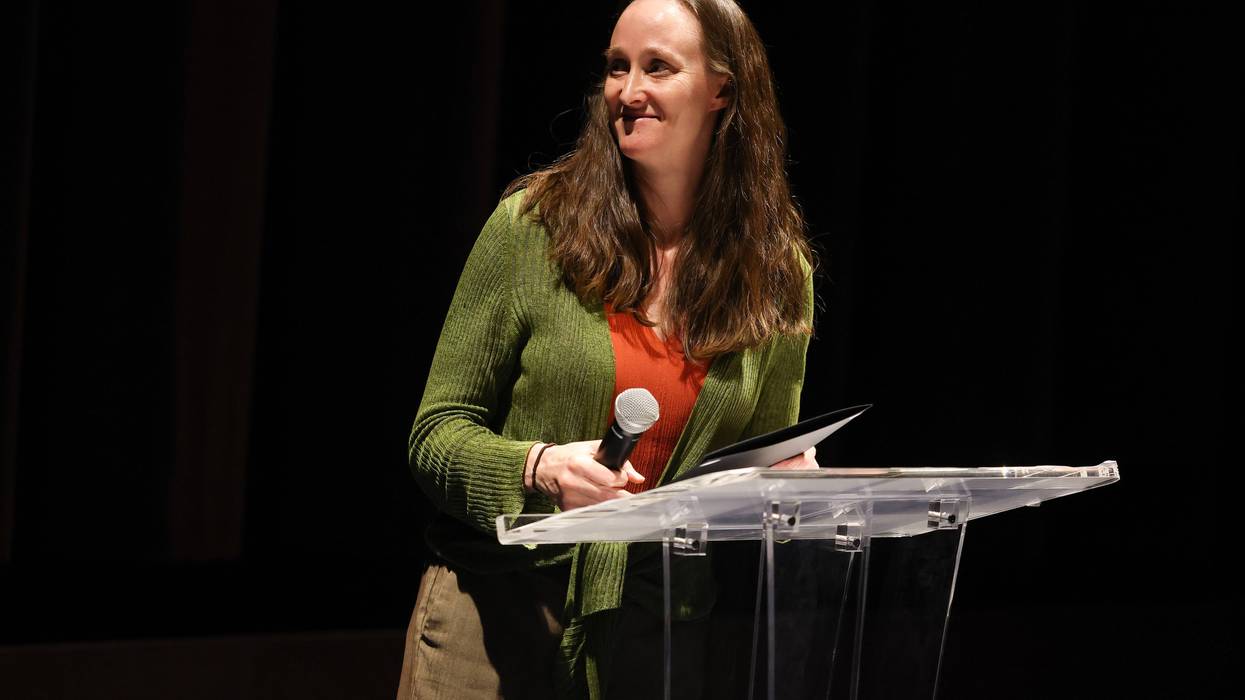
Seattle's City Council used a budget surplus to enact Wilson's proposal to provide free breakfast and lunch to 49,000 public school students.
Seattle's public school students will be eating for free this year after the City Council approved $3.6 million in funding for school breakfast and lunch this week.
It was the realization of a proposal made in April by Seattle's democratic socialist mayor, Katie Wilson, to expand the city's targeted school lunch program to cover all students.
The council had rejected the proposal earlier this summer in favor of an approach that delayed the school lunch program by a year and narrowly focused on expanding access for only the lowest-income students, which opponents argued still left many hungry kids with nothing.
That plan was met with immediate backlash, and the council swiftly changed course. On Tuesday, it voted unanimously to reallocate surplus funds from an affordable housing redevelopment project to fund a universal school meal program.
In addition to providing free breakfast and lunch to Seattle's roughly 49,000 public school students beginning next month, the new program will also provide more support to low-income students during weekends and school vacations.
The program is expected to extend well into the future, with funding in 2027-28 coming from an education levy voters approved in November. After that, Washington's new "high-earners" tax is expected to kick in, and students across the entire state will enjoy free meals, though that tax still faces legal challenges.
Wilson called the plan "a tremendous victory for families across our city that will make Seattle more affordable."
The plan fulfills a key campaign promise for Wilson, who came into office in November on the same wave of progressive enthusiasm as New York City's democratic socialist mayor, Zohran Mamdani.
Also on Tuesday, the City Council approved Wilson's legislation banning rental junk fees—including administrative service fees, pet rent, and package fees.

"We are feverishly fundraising and talking to the board about the need to provide grants, but in reality, we are limited," said the executive director of the Central Illinois Food Bank.
Food banks across the US, from New Mexico to Oregon to Illinois, are seeing massive increases in demand as the unprecedented federal nutrition aid cuts that President Donald Trump signed into law last summer take hold, stripping benefits from millions of Americans amid elevated grocery costs—a recipe for disaster.
"Our freezers are getting empty," Eddie Nelson, the manager of a food bank in Dallas, Oregon, told an Oregon Public Broadcasting reporter earlier this week. The outlet noted that the line for the food bank "stretches out the door and around the corner at the end of the month, when federal food stamp benefits dry up and families struggle to fill their pantries."
An estimated 4.5 million people, including roughly 1.5 million children, have lost Supplemental Nutrition Assistance Program (SNAP) benefits since the Trump-GOP budget law took effect last year, enshrining around $200 billion in cuts—the largest in the program's history—as well as new work reporting requirements that are expected to put millions more at risk of losing aid.
The large-scale loss of benefits and expectations of even more hardship in the near future have heavily strained local food banks.
Pam Molitoris, executive director of the Central Illinois Food Bank, said during a panel discussion last month that his organization "cannot absorb" the damage from the federal nutrition cuts, noting that "we are one meal to every nine meals provided by SNAP."
"We are feverishly fundraising and talking to the board about the need to provide grants, but in reality, we are limited," said Molitoris.
Roadrunner Food Bank in Albuquerque, New Mexico said it has seen a massive increase in demand this year as the combination of aid cuts and a worsening cost-of-living crisis forces families to seek out charities for assistance. More than 18,000 people lost SNAP benefits in New Mexico between July 2025 and April 2026, according to a tracker maintained by the Center on Budget and Policy Priorities.
“You could look at it like SNAP is the first line of defense against food insecurity in our country; food banks are the last line of defense," Jason Riggs, Roadrunner's director of advocacy, said earlier this week. "So the idea is we need both."
Feeding America, a nonprofit network of hundreds of food banks, says the Trump-GOP cuts to SNAP equate to up to 9 billion meals lost per year—"more than the entire Feeding America network of food banks, meal programs, and church pantries provided last year."
In the face of growing evidence of the damage their cuts have inflicted on communities across the US, Republican lawmakers have shown no inclination to seriously mitigate the impacts—much less reverse the funding reductions. GOP senators are currently working to advance a farm bill that would only delay for one year the Republican budget law's potentially catastrophic shift of a significant portion of SNAP costs to states.
Earlier this month, the Republican farm legislation failed to advance out of committee due to Democratic opposition and the absence of Sen. Mitch McConnell (R-Ky.).
"While it is a step in the right direction to give states more time to implement the benefit cost-share, increasing the SNAP cost for states in exchange for a one year delay only increases the unprecedented burden on states. Children will suffer as a result," said George Kelemen, senior vice president of the No Kid Hungry campaign. "Already, 4.5 million people, including over a million kids, have lost access to SNAP over the past year."
"Those families are now missing out on the nutritious food SNAP provides," Kelemen added, "and sadly that number will only grow under this proposal."

Not only does the partnership "create an inherent conflict of interest," it "fails the journalists who have been assaulted and falsely arrested while covering immigration enforcement actions and protests."
More than 800 unionized journalists and other media workers at USA Today Co. demanded this week that the nation’s largest newspaper chain abandon a newly announced partnership with surveillance tech giant Palantir to collect and analyze reader data, warning that the deal threatens privacy, public trust, and newsroom independence.
USA Today Co. chair Mike Reed told investors during an August 6 meeting that the company, formerly known as Gannett, is working with Palantir to “drive more effective and faster monetization across our platform" by using its software to collect and analyze reader data. Reed did not say how long USA Today had been using the software.
In a statement released earlier this week, workers represented by The NewsGuild-CWA said they were “shocked” by the company’s decision to partner with the controversial data analytics firm. Thirty-one unions representing employees across USA Today Co. publications have called on management to immediately terminate the agreement.
"We have significant ethical issues with Palantir, whose artificial intelligence (AI) software has been used to advance widespread surveillance and power immigration crackdowns," the union said. "Not only does partnering with Palantir, a major player in the news we cover, create an inherent conflict of interest, but it fails the journalists who have been assaulted and falsely arrested while covering immigration enforcement actions and protests."
Journalists are committed to upholding First Amendment principles to serve the democratic process. That’s in direct contrast with a company like Palantir, whose cofounder, Peter Thiel, once said freedom and democracy were not compatible. newsguild.org/usa-today-jo...
[image or embed]
— The NewsGuild-CWA (@newsguild.org) August 10, 2026 at 9:02 AM
"USA Today Co. has provided minimal details about this partnership and the parameters of its agreement with Palantir," the statement continues. "We have serious concerns and questions about how readers’ personal information and data will be used under this partnership and how their data would be protected. Without answers, how can journalists encourage readers to subscribe to our news outlets?"
The journalists noted that billionaire Palantir co-founder Peter Thiel—who "once said freedom and democracy were not compatible"—is responsible for products tied to human rights abuses and privacy violations.
"Technologists and even former employees have warned that it’s not far-fetched to imagine a future where Palantir’s AI technology is used to surveil American citizens and target dissidents," their statement notes. "And throughout history, journalists are often the first to be targeted."
"These concerns should be reason enough for USA Today Co. to steer clear," the journalists asserted. "This partnership with Palantir arrives as USA Today Co. executives dive headfirst into AI without sufficient regard for workers or the public after decimating newsrooms across the country."
"We will continue pushing back on ill-planned attempts to force AI into our newsrooms and onto our readers, who deserve quality, human-led journalism," they added. "We will advocate for the responsible use of new technologies when it emboldens our journalists and their work instead of shamelessly promoting AI to support profit-driven corporate edicts."
News organizations increasingly operate not just as publishers, but as data collection businesses. The USA Today journalists' concerns come against a backdrop of increasingly sophisticated tracking across digital news. USA Today Co.'s own public Data Collection Explorer shows that the company already operates an extensive system for collecting, routing, and analyzing user data across its publications and platforms, including through third-party analytics vendors.
Mike Davis, a reporter for the Asbury Park Press—a USA Today Co. newspaper in southern New Jersey—told NiemanLab that “part of the problem" with the Palantir partnership "is that we know very, very little" about how the company's software is being used.
“It’s pretty surprising that our company would unilaterally decide to bring in such a controversial partner like Palantir without providing a complete explanation to its employees, most of whom are naturally skeptical journalists," Davis said.
“An investigative reporter who keeps a ton of sensitive notes, source information, and confidential documents on their devices is going to be naturally concerned about protecting that information, and who could blame them?” he added. “It’s pretty hard to trust management’s intentions when the goalposts shift so often that there’s always a fear that what’s true today won’t be true in six months. We’ve all seen the years of disinvestment in local news, especially in the name of going all-in on AI.”

"I go after what I want, but maybe that’s what they don’t like," said the congresswoman.
It's been five days since US Rep. Alexandria Ocasio-Cortez, a potential 2028 presidential contender, went public with her decision to freeze her eggs.
But the response from right-wing influencers and operatives has already given her an opportunity to turn the discussion of her fertility into one that addresses Republican policies driving the affordability crisis, questions how committed the right really is to "freedom," and points out conservatives' hypocrisy when they urge women to "have babies younger"—while applying little of the same pressure to young men.
Ocasio-Cortez (D-NY) announced her decision to freeze her eggs last Sunday with the first in a series of Instagram videos in which her nearly 10 million followers have been able to follow along as she injects hormones and attends ultrasound appointments in preparation for the procedure—all while appearing on news programs to discuss foreign and domestic policy and talking to her followers about the side effects as well as the cost of fertility preservation treatment.
"I want you all to see that, because women can do anything,” Ocasio-Cortez, often known as AOC, told her followers. “And I think it’s badass that I’m going to be, you know, giving myself shots in the greenroom, get my glam on, roll out, talk about international events, domestic policy, elections, pop out, live my life, do my thing.”
Right-wing commentators who have bemoaned low birth rates and attacked liberal women for buying "into the feminist lie and spend[ing] their childbearing years climbing the career ladder," as podcaster Katie Miller said, immediately pounced on AOC's decision.
Allie Beth Stuckey, a popular right-wing podcaster and author of the books Toxic Empathy and You're Not Enough (And That's Okay), the latter of which warned against "the toxic culture of self-love," responded to the 36-year-old progressive congresswoman's videos with a list of reasons she should have already had children. She accused AOC of being "selfish and irresponsible" for potentially becoming a mother after 40 and said she was "glamorizing the lie that women can have it all."
Miller, the wife of President Donald Trump's homeland security adviser, Stephen Miller, allowed that "we should celebrate" a woman's efforts to have children in the future, but said that “more women should get married and have babies younger," while a spokesperson for Turning Point USA, the right-wing group founded by the late Charlie Kirk, said AOC's fertility decisions were a "cautionary tale" for women.
Meanwhile, conspiracy theorist Laura Loomer, who is said to have considerable influence in the White House, announced that AOC had "failed as a woman" and had “wasted her entire 30s living with a man pretending to be engaged when she could have gotten married and had a baby." (It was reported this week that AOC's long-term relationship had ended.)
Some conservatives questioned whether attacking the popular, social media-savvy lawmaker over her desire to have children was a wise move for the MAGA movement, with one former Office of the Director of National Intelligence official, Alexa Henning, telling The Times in the UK that "dunking on AOC for freezing her eggs is not a winning message with women voters."
On Thursday evening, Ocasio-Cortez suggested Henning was right to be concerned, as she posted her latest Instagram video on the topic.
She said she has found "the freak-out" around her egg-freezing process to be "pretty funny," because "my choice is a threat to them."
"Despite the rhetoric they use and the bald eagles that they plaster all over the place, they actually really do not believe in a free country," said AOC. "Very aggressively do not believe in a free country, because they attack everyone who exercises their freedom to choose all sorts of lives... They attack those who choose the life that they don't lead or a life that they don't approve of."
"And people say you’re peddling this 'dangerous lie that women can have it all.' You know, maybe in life you can’t have everything, but here’s the secret: You can have a hell of a lot. And I am very grateful for my life. I go after what I want, but maybe that’s what they don’t like either," she continued, before shrugging: "Too bad for them."
AOC: I also find the freakout around it pretty funny as well. I’m not gonna lie. A commentator that was like, “What she’s doing is peddling the dangerous lie that women can have it all.” Can you believe that?
What I find funny is that my choice is a threat to them. Despite the… pic.twitter.com/rwpPL8YH0F
— Acyn (@Acyn) August 14, 2026
She emphasized that the procedure "is not a guarantee" that she'll be able to use the eggs to have children later in life, but said the process had relieved "a certain amount of anxiety or stress that can come with feeling like you are in a race against biology that men simply don't have to engage in."
She then took aim at commentators like Stuckey and Miller for directing their pronatalist pressure campaigns disproportionately at young women.
"In straight relationships, who are you supposed to be having babies with?" said AOC. "They aren't pressuring men to be ready to have a baby young, as the way that they are pressuring women to have a baby when they're young."
AOC: For all of these right-wing people who are harping about women having to and needing to have families at a young age—and again, if that’s your choice, that’s amazing—but they are doing nothing to make sure that men in their culture respect and value women.
In fact, many of… pic.twitter.com/ox70tJzth1
— Acyn (@Acyn) August 14, 2026
The congresswoman then suggested that while Erika Kirk, Charlie Kirk's widow and now the CEO of Turning Point USA, recently told a crowd of young college graduates to "have more kids than you can afford," financial concerns may play a role in falling birthrates and delayed parenthood. Housing unaffordability has soared to record highs in recent years, while Trump's tariff policies and war in Iran have contributed to rising costs for groceries, gas, and other essentials. Republicans have also attacked government healthcare programs including Medicaid and Affordable Care Act subsidies, and about a third of Americans reported cutting back on spending in order to afford healthcare last year.
"The basics are more expensive than they've ever been," said Ocasio-Cortez. "For a lot of people, we would have kids at a much younger age if the conditions were right, if women got paid equally, and if people in general were paid enough and things were affordable enough that you feel like you could comfortably provide for a child."
With her series of videos, said Amanda Litman, executive director of the political action committee Run for Something, AOC had opened up "a larger conversation on women, ambition, family, gender politics, and so much more."
Journalist Zaid Jilani suggested right-wing commentators had fallen into a trap: "Intentionally or unintentionally she got the Republicans to act really weird."
The response from influential commentators on the right "is why her allies think she could run for the White House," wrote Katy Balls, Washington editor for The Times. "Her ability to set the terms of debate and trigger the right just as Trump does the left."

"Yet again, Trump has betrayed the American people and put billionaires ahead of working families.”
The world's ten largest pharmaceutical giants reaped around $300 billion in combined global revenue during the first half of 2026 as millions of people in the US—the country with the highest drug prices in the world—stretched, skipped, or rationed doses to afford their medications, despite President Donald Trump's lofty pledges to slash costs.
An analysis released Thursday by the advocacy group Protect Our Care estimates that Johnson & Johnson, Novartis, AbbVie, Merck, Pfizer, and other pharma behemoths collectively reported $298 billion in revenue in the first half of the year—a $24 billion increase compared to 2025—and distributed $63 billion in benefits to shareholders in the form of share repurchases and dividends.
"The numbers speak for themselves," said Vaishu Jawahar, director of policy programs at Protect Our Care. "While big drug companies make record-breaking sales, raking in billions more than they did last year, a growing number of Americans are struggling to afford their prescription drugs. Yet again, Trump has betrayed the American people and put billionaires ahead of working families.”
Throughout his second White House term, Trump has made mathematically impossible claims about his efforts to curb drug costs, asserting repeatedly that he has cut prices by upwards of 1,000%. Critics of the Trump administration's approach have noted that it has relied on voluntary and secretive deals with pharmaceutical companies, which have gone on to raise prices after meeting with the president and showering him with praise.
One high-profile administration initiative, TrumpRX, has been widely denounced as a scam that will do virtually nothing to lower drug costs for most Americans. The president has also worked to weaken the Medicare drug price negotiation program established during the Biden administration.
“Instead of lowering drug prices for seniors, Trump is holding backroom deals with big drug companies and handing them blockbuster giveaways," said Jawahar. "He has created loopholes for industry giants to evade price negotiations and jack up drug prices for seniors."
The advocacy group Patients for Affordable Drugs noted in a March report that during the first week of 2026, pharmaceutical companies "increased prices on 64 oncology drugs, with 73% of hikes exceeding inflation."
Sixty percent of US adults say they are struggling or worried about being able to afford their prescription medications, according to recent polling from the health policy research organization KFF. The group said that number marked the highest level since 2018.
Separate polling released in March by the West Health-Gallup Center on Healthcare in America found that tens of millions of people in the US "said they have made at least one trade-off with daily living expenses to afford healthcare," including skipping a meal, prolonging a current prescription, and cutting back on utilities.

"I am dying. There isn't a feeling for me to even feel."
Israel is causing a wave of preventable cancer deaths in Gaza, leaving an estimated 17,000 people with no avenue for treatment.
As Reuters reported on Thursday, Israel has destroyed the only specialized cancer hospital in the strip and is preventing Palestinians from seeking treatment outside the exclave.
The result: Doctors say that cancer patients in Gaza are dying at between double and triple the rate they were before Israel began its genocidal war there. Israel's restrictions on aid entering Gaza have made chemotherapy and other forms of treatment inaccessible.
33-year-old Khuloud Abu Sahmoud, a mother of two with ovarian cancer who spoke with Reuters, has been waiting to exit Gaza for nearly a year to receive treatment.
According to Middle East Eye, she is one of at least 4,000 cancer patients in Gaza who have been issued medical referrals to leave the strip but who have been stuck waiting for final permission from Israeli authorities.
In the meantime, her cancer has metastasized to her lungs and bones.
"I am dying. There isn't a feeling for me to even feel," Sahmoud told Middle East Eye. "Every day my disease progresses."
She said that her fingernails have all fallen out and she has been left "just waiting to die."
"The border crossing for me is the only lifeline. The only vein for me to be saved, to receive treatment abroad," she said. "I haven't taken any treatment for three months. I'm living on painkillers."
She said she made her request to travel in October 2025 after a ceasefire was reached between Israel and Hamas, which was supposed to allow for aid to flow freely into Gaza and for people to leave.
"There has been no response to any appeal so far," Sahmoud said. "We haven't received any calls."
The Coordinator of Government Activities in the Territories (COGAT), the Israeli military authority responsible for administering civilian matters in Gaza, has denied that it is blocking Palestinians from receiving treatment, with a spokesperson stating that permission to travel is "wholly dependent on the receiving country's request.”
But the agency's own medical evacuation procedure requires that every patient leaving Gaza undergoes Israeli security screening and “will not be approved if there are security reasons that prevent their passage.”
Israel has also imposed strict numerical restrictions on the number of people allowed to leave through the Rafah crossing, the main exit point from the strip.
Palestinian health officials said only about 11,000 people in total—not just cancer patients—have been allowed to exit since the crossing reopened in February, an average of about 55-60 people per calendar day. This is fewer than half the number who were expected to leave following the ceasefire.
According to Reuters, "a further 20,000 patients, including 5,000 with cancer, are registered for treatment abroad but not yet permitted to leave."
All of the 36 hospitals and most primary healthcare facilities in Gaza have sustained damage from Israeli attacks, with only around half even partially functioning, according to the World Health Organization. As of the ceasefire, WHO reported that more than 1,700 Palestinian healthcare workers, including doctors, nurses, and paramedics, have been killed.
"Since the genocidal war on the Gaza Strip, among the most severely affected groups by this extermination are oncology and cancer patients," said Mohammed Abu Selmia, the director of Al-Shifa Hospital, which has been repeatedly raided, besieged, and damaged, and has just recently restarted oncology services.
Selmia said this is because of the restrictions on the entry of chemotherapy treatments and Israel's destruction of diagnostic equipment, including MRI facilities.
"This group is suffering immensely," he said. "Recently, we have been recording a significant number of deaths ranging from three to five daily because patients are not receiving the chemotherapy needed to save their lives."
The official death toll from Israel's military campaign in Gaza since October 2023 sits at 73,389, according to the Gaza Ministry of Health. But this only includes violent deaths from the war itself.
Independent analyses have suggested that the true death toll is much higher when factoring in those who have perished due to disease and starvation as a result of Israel's attacks on medical facilities, civilian infrastructure, and restrictions on aid.
Another cancer patient, Elham al-Skafi, said, "They stopped giving me chemotherapy because it is not available in Gaza."
"I come in to get nutritional fluids, just so I can stay on my feet, and blood transfusions," she said. "That is what is currently available. This is what I take."
She said she's had a transfer referral for over a year and a half now to leave the country for treatment.
"I am sitting and waiting," she said. "If the crossings were open, I would have left."

"Being mocked on stage by a man in a bin does not exactly provide the optics of a heroic struggle against the establishment," said one critic.
Nigel Farage, the leader of the UK's far-right Reform Party, has emerged victorious in a by-election in which his main opponent was Count Binface, a comedian who dresses in an oversized trashcan helmet.
However, some Farage critics predicted his victory would prove fleeting given that he now faces a renewed parliamentary inquiry into an undisclosed £5m gift he received from Christopher Harborne, a Thai-based cryptocurrency billionaire.
Additionally, rival Count Binface received 27% of all votes in the election, a record number for a parody candidate in a race that was boycotted by all major UK political policies.
Writing in The Guardian, columnist Owen Jones described Farage as "a rattled, embattled politician," noting that the Reform leader did not even attend the official results event, presumably because he found little reason to celebrate having "beaten a man in a bin."
"Being mocked on stage by a man in a bin," Jones wrote, "does not exactly provide the optics of a heroic struggle against the establishment."
Jones said that while it's too early to write Farage off, he questioned whether the Reform leader is really cut out for the long slog of parliamentary politics.
"Here is a man who appears to enjoy the high life and feel parliamentary politics damages his earning potential," Jones concluded. "He seems increasingly riled by the sort of scrutiny he has long managed to avoid. Perhaps, after a pointless triumph over a bin, he may simply decide he has had enough."
In an analysis published Friday by The Washington Post, international correspondent Steve Hendrix wrote that Farage's own party appears worried that his win over Binface will prove costly, as he "remains in danger of being overcome by the corruption accusations the special election was meant to dispel."
"Farage had meant for the election to produce a resounding endorsement by his voters, a win to be trumpeted as a rebuke to the establishment," Hendrix explained. "Instead, he skipped the traditional announcement ceremony Friday and canceled a scheduled speech."
Binface, meanwhile, declared himself the winner among "the candidates who bothered to turn up for the results" and delivered a "victory speech" in which he crowed about the record number of votes he received against the embattled Reform leader.
I came first in the Clacton by-election! Of the candidates who bothered to turn up for the results. Here is my victory speech! pic.twitter.com/PBaLO10P2j
— Count Binface (@CountBinface) August 14, 2026
"Against Nigel Farage, I've got 10,000% more votes than I got against [Labour UK Prime Minister] Andy Burnham," Binface said. "What does that tell you? Well, it tells you that Nigel, who said he didn't want to be humiliated, maybe has been... Over one and four people in this constituency would rather have Count Binface as their MP than the leader of Reform UK."

"Another day, another Trump policy to make voting harder. His new target? Nursing homes."
The Trump administration's far-reaching assault on voting rights has extended to nursing homes, a group of Democratic senators warned on Thursday, pointing to federal guidance recently issued by the Center for Medicare and Medicaid Services.
The guidance, released in July, removes previous recommendations on how nursing home staff can assist residents in exercising their constitutional rights and warns facility employees against violating "federal or state voting laws." The guidance points to a highly dubious Texas case in which a social worker was charged with orchestrating an election fraud scheme, even though no improper votes were cast.
In a letter sent earlier this week to CMS Administrator Mehmet Oz, Sens. Alex Padilla (D-Calif.), Elizabeth Warren (D-Mass.), and 11 other Democrats argued that the agency's July guidance "may intimidate nursing home staff from helping residents exercise their constitutional right to vote and ultimately prevent nursing home residents from voting."
"The nation’s 1.2 million nursing home residents face unique problems in obtaining access to the voting booth," the lawmakers added, "and must not be denied their rights because they are disabled, elderly, lack transit, or face difficulties in obtaining a ballot or voting in person."
The senators emphasized that the new CMS memo breaks with guidance issued during President Donald Trump's first term in the White House. That guidance, issued in October 2020, states that "nursing homes should have a plan to ensure residents can exercise their right to vote, whether in person, by mail, absentee, or other authorized process."
Such language is entirely absent from the new guidance, which focuses heavily on preventing voter fraud—an obsession of Trump's, despite it being extremely rare in the US.
"CMS's release of this memo is just the latest in a series of actions the Trump administration has taken to restrict vote by mail and undermine the right to vote based on unfounded allegations of voter fraud tied to the president’s denial of prior valid election results," the Democratic senators wrote in their letter. "We are concerned that by highlighting examples of prior voter fraud investigations and threatening criminal penalties on nursing home staff—many of whom are legal immigrants who have already been targeted by Trump’s immigration policies—CMS’s July 2026 guidance may intimidate nursing home staff from helping residents with the voting process."
"And the removal of guidance on vote by mail procedures, combined with specific threats to investigate nursing home staff for assisting residents who are exercising their right to vote, may deter nursing homes from assisting residents with voting by mail," they added. "Ultimately, we are concerned that the changes to CMS’s guidance will result in the disenfranchisement of nursing home residents."
Another day, another Trump policy to make voting harder.
His new target? Nursing homes.
Dr. Oz issued a memo that seems designed to intimidate nursing home staff from helping residents vote.
I’m calling on Dr. Oz to withdraw this guidance and stop impeding the right to… https://t.co/Fg4LA4pH9p
— Elizabeth Warren (@SenWarren) August 13, 2026
The Houston Chronicle, in its coverage of the new CMS guidance, spotlights the Trump administration's decision to cite the Texas case, which involved social worker Kelly Brunner.
"When Kelly Brunner was tasked in 2020 with getting the State Supported Living Center in Mexia ready to vote, she was excited to assist the residents with intellectual and developmental disorders prepare for a big election. Instead, her work as the assistant voter registrar at the facility east of Waco spiraled into a nightmare," the outlet noted. "Brunner admitted making technical errors in the complicated registration system, which were all quickly caught; no resident cast an improper vote. Yet, pushed by Attorney General Ken Paxton—who at the time was promoting President Donald Trump’s false claims of a rigged presidential election—she was criminally charged with orchestrating one of the largest election fraud cases ever in Texas."
"Brunner spent $50,000 on lawyers, pleaded guilty to minor charges to put it behind her, lost her teacher’s license and nearly her social worker’s license," the Chronicle added. "Still, she thought the episode was finally over—until... [CMS] cited Brunner as the reason it needed to officially place employees of long-term care facilities on notice that they should be on the lookout for voter fraud in the upcoming midterm elections."
Richard Mollot, executive director of the New York-based Long Term Care Community Coalition, told the Chronicle that the Trump administration's heavy focus on preventing voter fraud "will have a chilling effect" on nursing home resident voting.
"The language is important,” said Mollot. “Most nursing homes will do as little as possible; if you’re not affirmatively telling them what to do, they won’t do it."

"This is what happens when you have an out-of-control agency that has been given billions in a bottomless slush fund by Trump and the Republican Congress," said one House Democrat.
Democrats in both chambers of Congress this week have joined rights advocates in forcefully denouncing plans for US Immigration and Customs Enforcement to spend up to $20 million on "gloves that can deliver painful electric shocks."
The Department of Homeland Security (DHS) on Monday published a notice about buying thousands of Generated Low Output Voltage Emitter (GLOVE) devices from Kentucky-based Compliant Technologies, drawing media coverage and condemnation.
"$20 million of taxpayer money for electric shock gloves?! This is horrifying and infuriating," said Sen. Jacky Rosen (D-Nev.). "It's exactly why so many... Democrats voted against billions of dollars in additional funding for ICE. This rogue agency uses cruel tactics like these and hasn't demonstrated any willingness to de-escalate—and the Trump administration refuses to rein them in."
Sen. Adam Schiff (D-Calif.) similarly ripped Republican lawmakers who narrowly control the Senate and House of Representatives, stressing that they "had the opportunity to rein in" ICE and Customs and Border Protection (CBP) but "refused."
"Instead they handed DHS BILLIONS more of your tax dollars without any constraint after the shooting and killing [of] individuals in the streets," Schiff said, referring to legislation passed in June. "Now, ICE is looking to purchase electrical shock gloves to continue terrorizing our communities. How soon will they be used to inflict further cruelty?"
Sharing a report about the planned purchase on social media, Sen. John Hickenlooper (D-Colo.) wrote: "Beyond cruel. This is appalling and inhumane."
President Donald Trump's "secret police force needs to be stopped," he added. "Not a single penny for ICE."
Since returning to office last year, Trump has flooded various cities with federal immigration agents, resulting in numerous deaths and rights violations. January polling by YouGov shows that 58% of Americans describe Immigration and Customs Enforcement tactics as "too forceful," 57% don't approve of how ICE is handling its job, and 46%—a plurality—support abolishing the agency.
Sen. Chris Murphy (D-Conn.) nodded to such findings in his response to the GLOVE notice, emphasizing that "this is just not the government people want. A government so sadistic and cruel that it delights in using your hard-earned tax dollars to buy gloves that shock people upon contact."
House Democrats also spoke out against the agency's plans, with Florida Congressman Maxwell Frost saying: "As if assaulting people and shooting people in the streets wasn't enough. Now, they're spending $20 million of YOUR taxpayer dollars on painful electric shock gloves for their masked, lawless goons. ICE must be stopped."
Describing ICE's plans as "absolutely appalling," Rep. Shontel Brown (D-Ohio) said that "this is what happens when you have an out-of-control agency that has been given billions in a bottomless slush fund by Trump and the Republican Congress."
Congresswoman Zoe Lofgren (D-Calif.) also called out the GOP: "This is what House Republicans voted for. Instead of spending your taxpayer dollars on healthcare or education, they spent it on shock gloves for masked, out-of-control ICE agents."
Rep. Pramila Jayapal (D-Wash.), who is an immigrant, said: "Let's be clear about what's happening. This is an agency that has already killed more than 50 people in its custody. An agency accused of racial profiling, of blocking members of Congress from oversight visits, of terrorizing communities under the guise of enforcement. And now they want new tools to hurt people, tools designed to disrupt someone's ability to even respond."
"We are not going to look away from this," Jayapal pledged. "I will keep fighting for oversight, for accountability, and for an immigration system that treats people with dignity, not one that arms itself against them."
Noting that the agency is "known to torture and kill our neighbors," Rep. Seth Moulton (D-Mass.) said, "Abolish and prosecute ICE."
Rep. Diana DeGette (D-Colo.) concurred, declaring: "This is shameful! People have suffered enough from these violent ICE agents. This rogue agency must be abolished, not given more ways to hurt our neighbors and terrorize our communities."
So did Rep. Ayanna Pressley (D-Mass.). Calling the GLOVE proposal "terrifying, cruel, and inhumane," she said that "ICE is a rogue agency that moves with disregard for public safety, constitutional rights, and basic human dignity. If agents have gloves that electrocute anyone they touch, we're all in danger. We must abolish ICE, end qualified immunity, and protect our neighbors."
Democratic Congresswomen Delia Ramirez (Ill.) and Yvette Clarke (NY) introduced a related bill in January: the Melt ICE Act.
"Under no circumstances can DHS be trusted with electric shock gloves and the power to inflict 'sudden' death!" Ramirez, the daughter of immigrants, said Wednesday. "The cruelty of the Trump administration knows no bounds. Congress must act! Let’s pass my Melt ICE Act and dismantle DHS."
Elected Democrats' outrage over the agency's intentions came as a Democratic National Committee panel on Thursday advanced a resolution calling to abolish ICE, and New York Times reporting revealed that DHS investigated left-wing groups after CBP agents killed Alex Pretti in Minnesota.
Democrats aim to reclaim majorities in both chambers in the November midterm elections.