SUBSCRIBE TO OUR FREE NEWSLETTER
Daily news & progressive opinion—funded by the people, not the corporations—delivered straight to your inbox.
5
#000000
#FFFFFF
To donate by check, phone, or other method, see our More Ways to Give page.
Daily news & progressive opinion—funded by the people, not the corporations—delivered straight to your inbox.
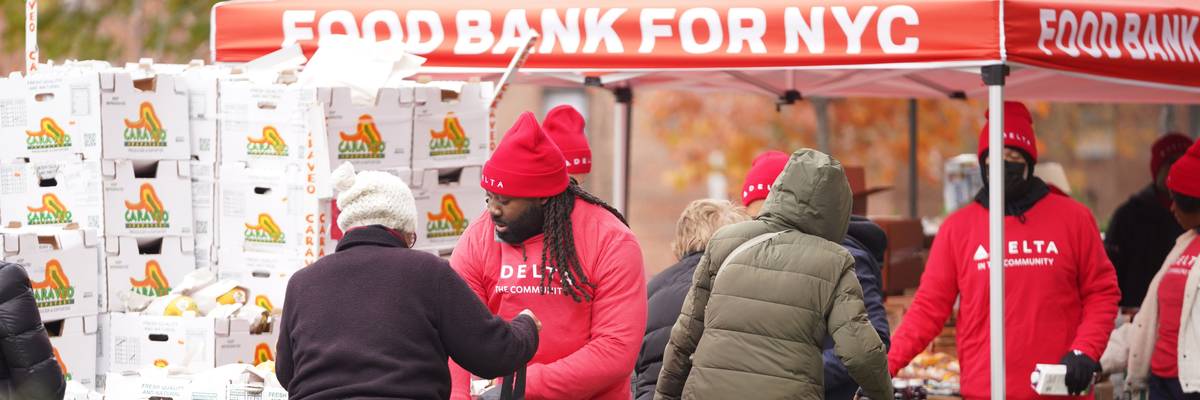
People receive food at a distribution station in New York City on November 12, 2025.
"We are feverishly fundraising and talking to the board about the need to provide grants, but in reality, we are limited," said the executive director of the Central Illinois Food Bank.
Food banks across the US, from New Mexico to Oregon to Illinois, are seeing massive increases in demand as the unprecedented federal nutrition aid cuts that President Donald Trump signed into law last summer take hold, stripping benefits from millions of Americans amid elevated grocery costs—a recipe for disaster.
"Our freezers are getting empty," Eddie Nelson, the manager of a food bank in Dallas, Oregon, told an Oregon Public Broadcasting reporter earlier this week. The outlet noted that the line for the food bank "stretches out the door and around the corner at the end of the month, when federal food stamp benefits dry up and families struggle to fill their pantries."
An estimated 4.5 million people, including roughly 1.5 million children, have lost Supplemental Nutrition Assistance Program (SNAP) benefits since the Trump-GOP budget law took effect last year, enshrining around $200 billion in cuts—the largest in the program's history—as well as new work reporting requirements that are expected to put millions more at risk of losing aid.
The large-scale loss of benefits and expectations of even more hardship in the near future have heavily strained local food banks.
Pam Molitoris, executive director of the Central Illinois Food Bank, said during a panel discussion last month that his organization "cannot absorb" the damage from the federal nutrition cuts, noting that "we are one meal to every nine meals provided by SNAP."
"We are feverishly fundraising and talking to the board about the need to provide grants, but in reality, we are limited," said Molitoris.
Roadrunner Food Bank in Albuquerque, New Mexico said it has seen a massive increase in demand this year as the combination of aid cuts and a worsening cost-of-living crisis forces families to seek out charities for assistance. More than 18,000 people lost SNAP benefits in New Mexico between July 2025 and April 2026, according to a tracker maintained by the Center on Budget and Policy Priorities.
“You could look at it like SNAP is the first line of defense against food insecurity in our country; food banks are the last line of defense," Jason Riggs, Roadrunner's director of advocacy, said earlier this week. "So the idea is we need both."
Feeding America, a nonprofit network of hundreds of food banks, says the Trump-GOP cuts to SNAP equate to up to 9 billion meals lost per year—"more than the entire Feeding America network of food banks, meal programs, and church pantries provided last year."
In the face of growing evidence of the damage their cuts have inflicted on communities across the US, Republican lawmakers have shown no inclination to seriously mitigate the impacts—much less reverse the funding reductions. GOP senators are currently working to advance a farm bill that would only delay for one year the Republican budget law's potentially catastrophic shift of a significant portion of SNAP costs to states.
Earlier this month, the Republican farm legislation failed to advance out of committee due to Democratic opposition and the absence of Sen. Mitch McConnell (R-Ky.).
"While it is a step in the right direction to give states more time to implement the benefit cost-share, increasing the SNAP cost for states in exchange for a one year delay only increases the unprecedented burden on states. Children will suffer as a result," said George Kelemen, senior vice president of the No Kid Hungry campaign. "Already, 4.5 million people, including over a million kids, have lost access to SNAP over the past year."
"Those families are now missing out on the nutritious food SNAP provides," Kelemen added, "and sadly that number will only grow under this proposal."
Dear Common Dreams reader, It’s been nearly 30 years since I co-founded Common Dreams with my late wife, Lina Newhouser. We had the radical notion that journalism should serve the public good, not corporate profits. It was clear to us from the outset what it would take to build such a project. No paid advertisements. No corporate sponsors. No millionaire publisher telling us what to think or do. Many people said we wouldn't last a year, but we proved those doubters wrong. Together with a tremendous team of journalists and dedicated staff, we built an independent media outlet free from the constraints of profits and corporate control. Our mission has always been simple: To inform. To inspire. To ignite change for the common good. Building Common Dreams was not easy. Our survival was never guaranteed. When you take on the most powerful forces—Wall Street greed, fossil fuel industry destruction, Big Tech lobbyists, and uber-rich oligarchs who have spent billions upon billions rigging the economy and democracy in their favor—the only bulwark you have is supporters who believe in your work. But here’s the urgent message from me today. It's never been this bad out there. And it's never been this hard to keep us going. At the very moment Common Dreams is most needed, the threats we face are intensifying. We need your support now more than ever. We don't accept corporate advertising and never will. We don't have a paywall because we don't think people should be blocked from critical news based on their ability to pay. Everything we do is funded by the donations of readers like you. When everyone does the little they can afford, we are strong. But if that support retreats or dries up, so do we. Will you donate now to make sure Common Dreams not only survives but thrives? —Craig Brown, Co-founder |
Food banks across the US, from New Mexico to Oregon to Illinois, are seeing massive increases in demand as the unprecedented federal nutrition aid cuts that President Donald Trump signed into law last summer take hold, stripping benefits from millions of Americans amid elevated grocery costs—a recipe for disaster.
"Our freezers are getting empty," Eddie Nelson, the manager of a food bank in Dallas, Oregon, told an Oregon Public Broadcasting reporter earlier this week. The outlet noted that the line for the food bank "stretches out the door and around the corner at the end of the month, when federal food stamp benefits dry up and families struggle to fill their pantries."
An estimated 4.5 million people, including roughly 1.5 million children, have lost Supplemental Nutrition Assistance Program (SNAP) benefits since the Trump-GOP budget law took effect last year, enshrining around $200 billion in cuts—the largest in the program's history—as well as new work reporting requirements that are expected to put millions more at risk of losing aid.
The large-scale loss of benefits and expectations of even more hardship in the near future have heavily strained local food banks.
Pam Molitoris, executive director of the Central Illinois Food Bank, said during a panel discussion last month that his organization "cannot absorb" the damage from the federal nutrition cuts, noting that "we are one meal to every nine meals provided by SNAP."
"We are feverishly fundraising and talking to the board about the need to provide grants, but in reality, we are limited," said Molitoris.
Roadrunner Food Bank in Albuquerque, New Mexico said it has seen a massive increase in demand this year as the combination of aid cuts and a worsening cost-of-living crisis forces families to seek out charities for assistance. More than 18,000 people lost SNAP benefits in New Mexico between July 2025 and April 2026, according to a tracker maintained by the Center on Budget and Policy Priorities.
“You could look at it like SNAP is the first line of defense against food insecurity in our country; food banks are the last line of defense," Jason Riggs, Roadrunner's director of advocacy, said earlier this week. "So the idea is we need both."
Feeding America, a nonprofit network of hundreds of food banks, says the Trump-GOP cuts to SNAP equate to up to 9 billion meals lost per year—"more than the entire Feeding America network of food banks, meal programs, and church pantries provided last year."
In the face of growing evidence of the damage their cuts have inflicted on communities across the US, Republican lawmakers have shown no inclination to seriously mitigate the impacts—much less reverse the funding reductions. GOP senators are currently working to advance a farm bill that would only delay for one year the Republican budget law's potentially catastrophic shift of a significant portion of SNAP costs to states.
Earlier this month, the Republican farm legislation failed to advance out of committee due to Democratic opposition and the absence of Sen. Mitch McConnell (R-Ky.).
"While it is a step in the right direction to give states more time to implement the benefit cost-share, increasing the SNAP cost for states in exchange for a one year delay only increases the unprecedented burden on states. Children will suffer as a result," said George Kelemen, senior vice president of the No Kid Hungry campaign. "Already, 4.5 million people, including over a million kids, have lost access to SNAP over the past year."
"Those families are now missing out on the nutritious food SNAP provides," Kelemen added, "and sadly that number will only grow under this proposal."
Food banks across the US, from New Mexico to Oregon to Illinois, are seeing massive increases in demand as the unprecedented federal nutrition aid cuts that President Donald Trump signed into law last summer take hold, stripping benefits from millions of Americans amid elevated grocery costs—a recipe for disaster.
"Our freezers are getting empty," Eddie Nelson, the manager of a food bank in Dallas, Oregon, told an Oregon Public Broadcasting reporter earlier this week. The outlet noted that the line for the food bank "stretches out the door and around the corner at the end of the month, when federal food stamp benefits dry up and families struggle to fill their pantries."
An estimated 4.5 million people, including roughly 1.5 million children, have lost Supplemental Nutrition Assistance Program (SNAP) benefits since the Trump-GOP budget law took effect last year, enshrining around $200 billion in cuts—the largest in the program's history—as well as new work reporting requirements that are expected to put millions more at risk of losing aid.
The large-scale loss of benefits and expectations of even more hardship in the near future have heavily strained local food banks.
Pam Molitoris, executive director of the Central Illinois Food Bank, said during a panel discussion last month that his organization "cannot absorb" the damage from the federal nutrition cuts, noting that "we are one meal to every nine meals provided by SNAP."
"We are feverishly fundraising and talking to the board about the need to provide grants, but in reality, we are limited," said Molitoris.
Roadrunner Food Bank in Albuquerque, New Mexico said it has seen a massive increase in demand this year as the combination of aid cuts and a worsening cost-of-living crisis forces families to seek out charities for assistance. More than 18,000 people lost SNAP benefits in New Mexico between July 2025 and April 2026, according to a tracker maintained by the Center on Budget and Policy Priorities.
“You could look at it like SNAP is the first line of defense against food insecurity in our country; food banks are the last line of defense," Jason Riggs, Roadrunner's director of advocacy, said earlier this week. "So the idea is we need both."
Feeding America, a nonprofit network of hundreds of food banks, says the Trump-GOP cuts to SNAP equate to up to 9 billion meals lost per year—"more than the entire Feeding America network of food banks, meal programs, and church pantries provided last year."
In the face of growing evidence of the damage their cuts have inflicted on communities across the US, Republican lawmakers have shown no inclination to seriously mitigate the impacts—much less reverse the funding reductions. GOP senators are currently working to advance a farm bill that would only delay for one year the Republican budget law's potentially catastrophic shift of a significant portion of SNAP costs to states.
Earlier this month, the Republican farm legislation failed to advance out of committee due to Democratic opposition and the absence of Sen. Mitch McConnell (R-Ky.).
"While it is a step in the right direction to give states more time to implement the benefit cost-share, increasing the SNAP cost for states in exchange for a one year delay only increases the unprecedented burden on states. Children will suffer as a result," said George Kelemen, senior vice president of the No Kid Hungry campaign. "Already, 4.5 million people, including over a million kids, have lost access to SNAP over the past year."
"Those families are now missing out on the nutritious food SNAP provides," Kelemen added, "and sadly that number will only grow under this proposal."