
SUBSCRIBE TO OUR FREE NEWSLETTER
Daily news & progressive opinion—funded by the people, not the corporations—delivered straight to your inbox.
5
#000000
#FFFFFF
To donate by check, phone, or other method, see our More Ways to Give page.
Daily news & progressive opinion—funded by the people, not the corporations—delivered straight to your inbox.
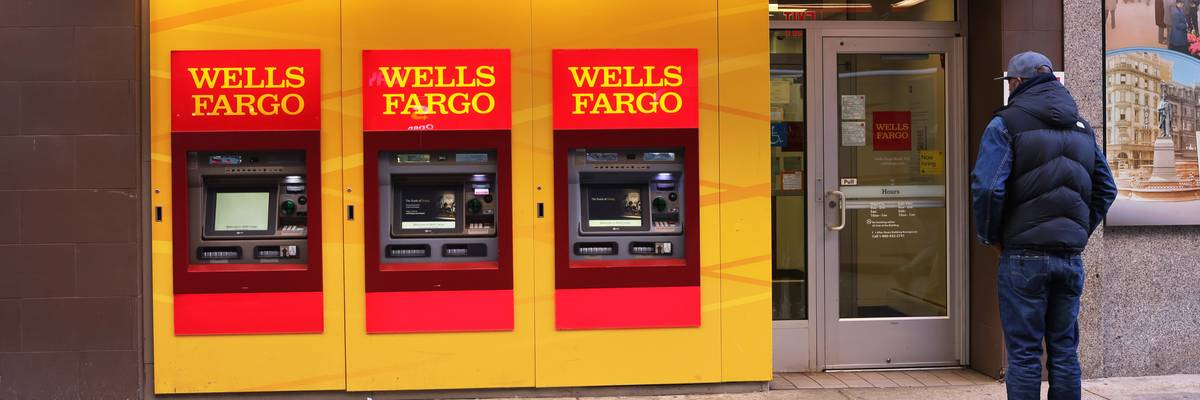
People walk past a Wells Fargo bank on 14th Street on December 20, 2022 in New York City.
“Hiding the consumer narratives and concealing the wrongdoing of corporations and powerful interests—that’s what you do if you’re afraid of the truth,” said one advocate.
Consumer complaints against financial companies have skyrocketed over the past three years, and the trend drove President Donald Trump's Consumer Financial Protection Bureau to take action Friday—but not against the firms that have been accused of charging unfair fees, failing to resolve disputed credit card charges, attempting to wrongly collect debts, and other offenses.
Instead, the CFPB announced that it would no longer be publishing complaint "narratives"—the written description by a complainant of their interaction with the financial company—or data visualizations in the database of complaints, hiding from public view consumers' remarks on the institutions' business practices.
“Hiding the consumer narratives and concealing the wrongdoing of corporations and powerful interests—that’s what you do if you’re afraid of the truth,” said Diane Thompson, deputy director and chief advocacy officer at the National Consumer Law Center, in response to the bureau's announcement. “Nothing could be a clearer sign of the Trump CFPB’s choice to stand against ordinary people and for corporate power and predation.”
The CFPB asserted that "the utility" of the public database of complaint narratives has proven "minimal" since the bureau began publishing the complaints in 2015, four years after it began allowing consumers to submit the complaints, as required by law.
"By their very nature, complaint narratives reflect negative consumer experiences and present only one side of an issue," said the CFPB.
Christine Hines, senior policy director at the National Association of Consumer Advocates, suggested that presenting "only one side" of an interaction that a consumer has with a financial institution is the point of the database.
"Nearly 6 million consumers who have filed with the CFPB have received some kind of relief, such as getting money back or getting a mistake on a credit report fixed. That’s a real, tangible benefit the public database makes possible."
“As it shuts down narratives in the complaint database, this CFPB is disregarding its obligation to make the marketplace fair and transparent for everyday consumers, and instead, is helping big banks, lenders, debt collectors, credit bureaus, and others to evade public scrutiny and accountability,” said Hines.
Companies have 15 days to respond to a complaint before the CFPB makes the consumers' comments public. The bureau has published more than 17 million complaints that have been made since 2011, and in each of the last three years, the complaints have doubled annually.
The bureau received 6.6. million complaints in 2025, up from 3.2 million in 2024 and 1.6 million in 2023.
Erie Meyer, who served as chief technologist at the CFPB and helped build the complaint database, accused the Trump administration of "inventing excuses to hide credit reporting and Wall Street abuses from the public."
"More than 17 million people have filed complaints with the CFPB about their credit report, mortgage provider, student loan servicer, payment app, or bank account—and the CFPB in turn has worked diligently to resolve these problems, even saving people’s homes from foreclosure and cars from repossession," said Meyer. "Taking down this data doesn’t protect consumers from confusion, but it does protect companies from public transparency and scrutiny."
Meyer also pushed back against the administration's claim that the database is rife with "confusing or misleading information" submitted by complainants.
"The CFPB complaint database and its narratives are the earliest warning system we have for what’s breaking in the economy," said Meyer. "Before a single story is published, the CFPB confirms the person is a real customer of that company. The company gets two weeks to respond, on the record, in public. That’s not an anonymous internet review—that’s closer to due process than most Americans get anywhere else in their financial lives. Burying this information is an intentional decision to make corporate misconduct harder to see.”
The new rule was announced two months after former CFPB acting Director Russell Vought purged the bureau's backlog of complaints and made other changes that, the administration said, were aimed at eliminating artificial intelligence-generated and duplicative complaints.
The database, said Public Interest Research Network consumer campaign director Mike Litt, ensures that "companies have an incentive to respond to and fix problems precisely because complaints are made public."
“Hiding the ‘narratives’ or any other part of the CFPB’s Consumer Complaint Database would truly hurt consumers. Americans deserve user-friendly, searchable access to details about these issues, so they can make educated purchasing decisions," said Litt. "Nearly 6 million consumers who have filed with the CFPB have received some kind of relief, such as getting money back or getting a mistake on a credit report fixed. That’s a real, tangible benefit the public database makes possible."
Adam Rust, director of financial services at the Consumer Federation of America, added that law enforcement agencies, Congress, and the press have all been informed by complaint narratives "on what problems are occurring in their communities."
“These narratives, all published with consumer consent, convey the emotional hurt caused when companies act without regard for the law," said Rust. "It’s wrong, especially at a time when so many people are struggling to make ends meet, to blunt their voices.”
This country and this world are at a monumental crossroads. US voters have an opportunity to beat back the forces of fascism and confront the billionaires who are rigging the economy, our media system, and our democracy, making it increasingly impossible for ordinary people to get by. We’re not just talking about the election. We’re talking about what must be done once these fascist elements are vanquished from power. We need a bolder set of solutions than what either major party has so far been willing to offer and a working-class movement ready to fight like hell for it. Trump didn't emerge from nowhere. The conditions that fueled MAGA authoritarianism were created by decades of radical neoliberal economic policies and a corrupt political system dominated by corporate interests. They slashed taxes on the super-rich, promising that the benefits would trickle down. They said giveaways to the corporate titans would make life more affordable for the rest of us. It was all bullshit. And when a bitter, betrayed populace searches for someone to blame, right-wing demagogues have little trouble finding scapegoats. People know when they're being lied to, but you won't hear any of this from the corporate media. Only independent journalism—powered and funded by people who believe in building a better world—can deliver truly trustworthy daily news. If you share our vision, please contribute whatever you can to sustain our work. |
Consumer complaints against financial companies have skyrocketed over the past three years, and the trend drove President Donald Trump's Consumer Financial Protection Bureau to take action Friday—but not against the firms that have been accused of charging unfair fees, failing to resolve disputed credit card charges, attempting to wrongly collect debts, and other offenses.
Instead, the CFPB announced that it would no longer be publishing complaint "narratives"—the written description by a complainant of their interaction with the financial company—or data visualizations in the database of complaints, hiding from public view consumers' remarks on the institutions' business practices.
“Hiding the consumer narratives and concealing the wrongdoing of corporations and powerful interests—that’s what you do if you’re afraid of the truth,” said Diane Thompson, deputy director and chief advocacy officer at the National Consumer Law Center, in response to the bureau's announcement. “Nothing could be a clearer sign of the Trump CFPB’s choice to stand against ordinary people and for corporate power and predation.”
The CFPB asserted that "the utility" of the public database of complaint narratives has proven "minimal" since the bureau began publishing the complaints in 2015, four years after it began allowing consumers to submit the complaints, as required by law.
"By their very nature, complaint narratives reflect negative consumer experiences and present only one side of an issue," said the CFPB.
Christine Hines, senior policy director at the National Association of Consumer Advocates, suggested that presenting "only one side" of an interaction that a consumer has with a financial institution is the point of the database.
"Nearly 6 million consumers who have filed with the CFPB have received some kind of relief, such as getting money back or getting a mistake on a credit report fixed. That’s a real, tangible benefit the public database makes possible."
“As it shuts down narratives in the complaint database, this CFPB is disregarding its obligation to make the marketplace fair and transparent for everyday consumers, and instead, is helping big banks, lenders, debt collectors, credit bureaus, and others to evade public scrutiny and accountability,” said Hines.
Companies have 15 days to respond to a complaint before the CFPB makes the consumers' comments public. The bureau has published more than 17 million complaints that have been made since 2011, and in each of the last three years, the complaints have doubled annually.
The bureau received 6.6. million complaints in 2025, up from 3.2 million in 2024 and 1.6 million in 2023.
Erie Meyer, who served as chief technologist at the CFPB and helped build the complaint database, accused the Trump administration of "inventing excuses to hide credit reporting and Wall Street abuses from the public."
"More than 17 million people have filed complaints with the CFPB about their credit report, mortgage provider, student loan servicer, payment app, or bank account—and the CFPB in turn has worked diligently to resolve these problems, even saving people’s homes from foreclosure and cars from repossession," said Meyer. "Taking down this data doesn’t protect consumers from confusion, but it does protect companies from public transparency and scrutiny."
Meyer also pushed back against the administration's claim that the database is rife with "confusing or misleading information" submitted by complainants.
"The CFPB complaint database and its narratives are the earliest warning system we have for what’s breaking in the economy," said Meyer. "Before a single story is published, the CFPB confirms the person is a real customer of that company. The company gets two weeks to respond, on the record, in public. That’s not an anonymous internet review—that’s closer to due process than most Americans get anywhere else in their financial lives. Burying this information is an intentional decision to make corporate misconduct harder to see.”
The new rule was announced two months after former CFPB acting Director Russell Vought purged the bureau's backlog of complaints and made other changes that, the administration said, were aimed at eliminating artificial intelligence-generated and duplicative complaints.
The database, said Public Interest Research Network consumer campaign director Mike Litt, ensures that "companies have an incentive to respond to and fix problems precisely because complaints are made public."
“Hiding the ‘narratives’ or any other part of the CFPB’s Consumer Complaint Database would truly hurt consumers. Americans deserve user-friendly, searchable access to details about these issues, so they can make educated purchasing decisions," said Litt. "Nearly 6 million consumers who have filed with the CFPB have received some kind of relief, such as getting money back or getting a mistake on a credit report fixed. That’s a real, tangible benefit the public database makes possible."
Adam Rust, director of financial services at the Consumer Federation of America, added that law enforcement agencies, Congress, and the press have all been informed by complaint narratives "on what problems are occurring in their communities."
“These narratives, all published with consumer consent, convey the emotional hurt caused when companies act without regard for the law," said Rust. "It’s wrong, especially at a time when so many people are struggling to make ends meet, to blunt their voices.”
Consumer complaints against financial companies have skyrocketed over the past three years, and the trend drove President Donald Trump's Consumer Financial Protection Bureau to take action Friday—but not against the firms that have been accused of charging unfair fees, failing to resolve disputed credit card charges, attempting to wrongly collect debts, and other offenses.
Instead, the CFPB announced that it would no longer be publishing complaint "narratives"—the written description by a complainant of their interaction with the financial company—or data visualizations in the database of complaints, hiding from public view consumers' remarks on the institutions' business practices.
“Hiding the consumer narratives and concealing the wrongdoing of corporations and powerful interests—that’s what you do if you’re afraid of the truth,” said Diane Thompson, deputy director and chief advocacy officer at the National Consumer Law Center, in response to the bureau's announcement. “Nothing could be a clearer sign of the Trump CFPB’s choice to stand against ordinary people and for corporate power and predation.”
The CFPB asserted that "the utility" of the public database of complaint narratives has proven "minimal" since the bureau began publishing the complaints in 2015, four years after it began allowing consumers to submit the complaints, as required by law.
"By their very nature, complaint narratives reflect negative consumer experiences and present only one side of an issue," said the CFPB.
Christine Hines, senior policy director at the National Association of Consumer Advocates, suggested that presenting "only one side" of an interaction that a consumer has with a financial institution is the point of the database.
"Nearly 6 million consumers who have filed with the CFPB have received some kind of relief, such as getting money back or getting a mistake on a credit report fixed. That’s a real, tangible benefit the public database makes possible."
“As it shuts down narratives in the complaint database, this CFPB is disregarding its obligation to make the marketplace fair and transparent for everyday consumers, and instead, is helping big banks, lenders, debt collectors, credit bureaus, and others to evade public scrutiny and accountability,” said Hines.
Companies have 15 days to respond to a complaint before the CFPB makes the consumers' comments public. The bureau has published more than 17 million complaints that have been made since 2011, and in each of the last three years, the complaints have doubled annually.
The bureau received 6.6. million complaints in 2025, up from 3.2 million in 2024 and 1.6 million in 2023.
Erie Meyer, who served as chief technologist at the CFPB and helped build the complaint database, accused the Trump administration of "inventing excuses to hide credit reporting and Wall Street abuses from the public."
"More than 17 million people have filed complaints with the CFPB about their credit report, mortgage provider, student loan servicer, payment app, or bank account—and the CFPB in turn has worked diligently to resolve these problems, even saving people’s homes from foreclosure and cars from repossession," said Meyer. "Taking down this data doesn’t protect consumers from confusion, but it does protect companies from public transparency and scrutiny."
Meyer also pushed back against the administration's claim that the database is rife with "confusing or misleading information" submitted by complainants.
"The CFPB complaint database and its narratives are the earliest warning system we have for what’s breaking in the economy," said Meyer. "Before a single story is published, the CFPB confirms the person is a real customer of that company. The company gets two weeks to respond, on the record, in public. That’s not an anonymous internet review—that’s closer to due process than most Americans get anywhere else in their financial lives. Burying this information is an intentional decision to make corporate misconduct harder to see.”
The new rule was announced two months after former CFPB acting Director Russell Vought purged the bureau's backlog of complaints and made other changes that, the administration said, were aimed at eliminating artificial intelligence-generated and duplicative complaints.
The database, said Public Interest Research Network consumer campaign director Mike Litt, ensures that "companies have an incentive to respond to and fix problems precisely because complaints are made public."
“Hiding the ‘narratives’ or any other part of the CFPB’s Consumer Complaint Database would truly hurt consumers. Americans deserve user-friendly, searchable access to details about these issues, so they can make educated purchasing decisions," said Litt. "Nearly 6 million consumers who have filed with the CFPB have received some kind of relief, such as getting money back or getting a mistake on a credit report fixed. That’s a real, tangible benefit the public database makes possible."
Adam Rust, director of financial services at the Consumer Federation of America, added that law enforcement agencies, Congress, and the press have all been informed by complaint narratives "on what problems are occurring in their communities."
“These narratives, all published with consumer consent, convey the emotional hurt caused when companies act without regard for the law," said Rust. "It’s wrong, especially at a time when so many people are struggling to make ends meet, to blunt their voices.”