SUBSCRIBE TO OUR FREE NEWSLETTER
Daily news & progressive opinion—funded by the people, not the corporations—delivered straight to your inbox.
5
#000000
#FFFFFF
To donate by check, phone, or other method, see our More Ways to Give page.
Daily news & progressive opinion—funded by the people, not the corporations—delivered straight to your inbox.
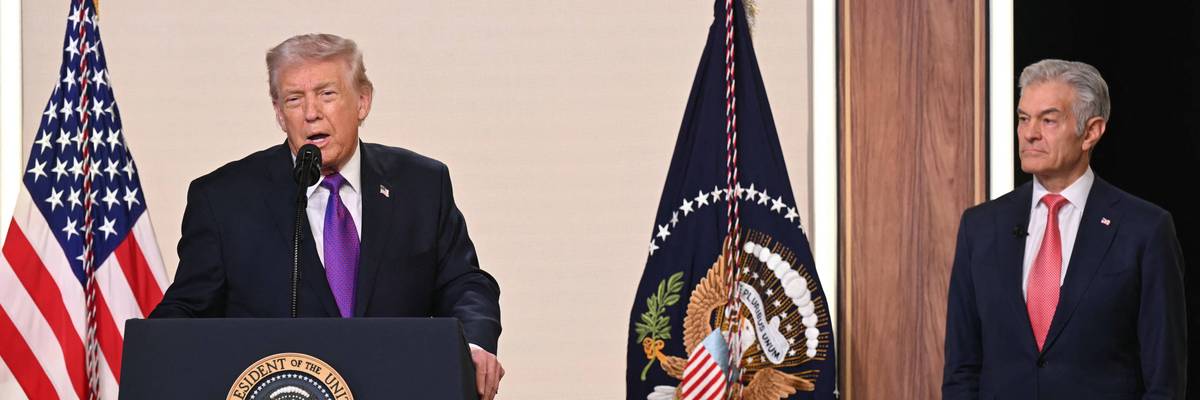
US President Donald Trump speaks in the South Court Auditorium of the White House on February 5, 2026.
"Yet again, Trump has betrayed the American people and put billionaires ahead of working families.”
The world's ten largest pharmaceutical giants reaped around $300 billion in combined global revenue during the first half of 2026 as millions of people in the US—the country with the highest drug prices in the world—stretched, skipped, or rationed doses to afford their medications, despite President Donald Trump's lofty pledges to slash costs.
An analysis released Thursday by the advocacy group Protect Our Care estimates that Johnson & Johnson, Novartis, AbbVie, Merck, Pfizer, and other pharma behemoths collectively reported $298 billion in revenue in the first half of the year—a $24 billion increase compared to 2025—and distributed $63 billion in benefits to shareholders in the form of share repurchases and dividends.
"The numbers speak for themselves," said Vaishu Jawahar, director of policy programs at Protect Our Care. "While big drug companies make record-breaking sales, raking in billions more than they did last year, a growing number of Americans are struggling to afford their prescription drugs. Yet again, Trump has betrayed the American people and put billionaires ahead of working families.”
Throughout his second White House term, Trump has made mathematically impossible claims about his efforts to curb drug costs, asserting repeatedly that he has cut prices by upwards of 1,000%. Critics of the Trump administration's approach have noted that it has relied on voluntary and secretive deals with pharmaceutical companies, which have gone on to raise prices after meeting with the president and showering him with praise.
One high-profile administration initiative, TrumpRX, has been widely denounced as a scam that will do virtually nothing to lower drug costs for most Americans. The president has also worked to weaken the Medicare drug price negotiation program established during the Biden administration.
“Instead of lowering drug prices for seniors, Trump is holding backroom deals with big drug companies and handing them blockbuster giveaways," said Jawahar. "He has created loopholes for industry giants to evade price negotiations and jack up drug prices for seniors."
The advocacy group Patients for Affordable Drugs noted in a March report that during the first week of 2026, pharmaceutical companies "increased prices on 64 oncology drugs, with 73% of hikes exceeding inflation."
Sixty percent of US adults say they are struggling or worried about being able to afford their prescription medications, according to recent polling from the health policy research organization KFF. The group said that number marked the highest level since 2018.
Separate polling released in March by the West Health-Gallup Center on Healthcare in America found that tens of millions of people in the US "said they have made at least one trade-off with daily living expenses to afford healthcare," including skipping a meal, prolonging a current prescription, and cutting back on utilities.
Dear Common Dreams reader, It’s been nearly 30 years since I co-founded Common Dreams with my late wife, Lina Newhouser. We had the radical notion that journalism should serve the public good, not corporate profits. It was clear to us from the outset what it would take to build such a project. No paid advertisements. No corporate sponsors. No millionaire publisher telling us what to think or do. Many people said we wouldn't last a year, but we proved those doubters wrong. Together with a tremendous team of journalists and dedicated staff, we built an independent media outlet free from the constraints of profits and corporate control. Our mission has always been simple: To inform. To inspire. To ignite change for the common good. Building Common Dreams was not easy. Our survival was never guaranteed. When you take on the most powerful forces—Wall Street greed, fossil fuel industry destruction, Big Tech lobbyists, and uber-rich oligarchs who have spent billions upon billions rigging the economy and democracy in their favor—the only bulwark you have is supporters who believe in your work. But here’s the urgent message from me today. It's never been this bad out there. And it's never been this hard to keep us going. At the very moment Common Dreams is most needed, the threats we face are intensifying. We need your support now more than ever. We don't accept corporate advertising and never will. We don't have a paywall because we don't think people should be blocked from critical news based on their ability to pay. Everything we do is funded by the donations of readers like you. When everyone does the little they can afford, we are strong. But if that support retreats or dries up, so do we. Will you donate now to make sure Common Dreams not only survives but thrives? —Craig Brown, Co-founder |
The world's ten largest pharmaceutical giants reaped around $300 billion in combined global revenue during the first half of 2026 as millions of people in the US—the country with the highest drug prices in the world—stretched, skipped, or rationed doses to afford their medications, despite President Donald Trump's lofty pledges to slash costs.
An analysis released Thursday by the advocacy group Protect Our Care estimates that Johnson & Johnson, Novartis, AbbVie, Merck, Pfizer, and other pharma behemoths collectively reported $298 billion in revenue in the first half of the year—a $24 billion increase compared to 2025—and distributed $63 billion in benefits to shareholders in the form of share repurchases and dividends.
"The numbers speak for themselves," said Vaishu Jawahar, director of policy programs at Protect Our Care. "While big drug companies make record-breaking sales, raking in billions more than they did last year, a growing number of Americans are struggling to afford their prescription drugs. Yet again, Trump has betrayed the American people and put billionaires ahead of working families.”
Throughout his second White House term, Trump has made mathematically impossible claims about his efforts to curb drug costs, asserting repeatedly that he has cut prices by upwards of 1,000%. Critics of the Trump administration's approach have noted that it has relied on voluntary and secretive deals with pharmaceutical companies, which have gone on to raise prices after meeting with the president and showering him with praise.
One high-profile administration initiative, TrumpRX, has been widely denounced as a scam that will do virtually nothing to lower drug costs for most Americans. The president has also worked to weaken the Medicare drug price negotiation program established during the Biden administration.
“Instead of lowering drug prices for seniors, Trump is holding backroom deals with big drug companies and handing them blockbuster giveaways," said Jawahar. "He has created loopholes for industry giants to evade price negotiations and jack up drug prices for seniors."
The advocacy group Patients for Affordable Drugs noted in a March report that during the first week of 2026, pharmaceutical companies "increased prices on 64 oncology drugs, with 73% of hikes exceeding inflation."
Sixty percent of US adults say they are struggling or worried about being able to afford their prescription medications, according to recent polling from the health policy research organization KFF. The group said that number marked the highest level since 2018.
Separate polling released in March by the West Health-Gallup Center on Healthcare in America found that tens of millions of people in the US "said they have made at least one trade-off with daily living expenses to afford healthcare," including skipping a meal, prolonging a current prescription, and cutting back on utilities.
The world's ten largest pharmaceutical giants reaped around $300 billion in combined global revenue during the first half of 2026 as millions of people in the US—the country with the highest drug prices in the world—stretched, skipped, or rationed doses to afford their medications, despite President Donald Trump's lofty pledges to slash costs.
An analysis released Thursday by the advocacy group Protect Our Care estimates that Johnson & Johnson, Novartis, AbbVie, Merck, Pfizer, and other pharma behemoths collectively reported $298 billion in revenue in the first half of the year—a $24 billion increase compared to 2025—and distributed $63 billion in benefits to shareholders in the form of share repurchases and dividends.
"The numbers speak for themselves," said Vaishu Jawahar, director of policy programs at Protect Our Care. "While big drug companies make record-breaking sales, raking in billions more than they did last year, a growing number of Americans are struggling to afford their prescription drugs. Yet again, Trump has betrayed the American people and put billionaires ahead of working families.”
Throughout his second White House term, Trump has made mathematically impossible claims about his efforts to curb drug costs, asserting repeatedly that he has cut prices by upwards of 1,000%. Critics of the Trump administration's approach have noted that it has relied on voluntary and secretive deals with pharmaceutical companies, which have gone on to raise prices after meeting with the president and showering him with praise.
One high-profile administration initiative, TrumpRX, has been widely denounced as a scam that will do virtually nothing to lower drug costs for most Americans. The president has also worked to weaken the Medicare drug price negotiation program established during the Biden administration.
“Instead of lowering drug prices for seniors, Trump is holding backroom deals with big drug companies and handing them blockbuster giveaways," said Jawahar. "He has created loopholes for industry giants to evade price negotiations and jack up drug prices for seniors."
The advocacy group Patients for Affordable Drugs noted in a March report that during the first week of 2026, pharmaceutical companies "increased prices on 64 oncology drugs, with 73% of hikes exceeding inflation."
Sixty percent of US adults say they are struggling or worried about being able to afford their prescription medications, according to recent polling from the health policy research organization KFF. The group said that number marked the highest level since 2018.
Separate polling released in March by the West Health-Gallup Center on Healthcare in America found that tens of millions of people in the US "said they have made at least one trade-off with daily living expenses to afford healthcare," including skipping a meal, prolonging a current prescription, and cutting back on utilities.