SUBSCRIBE TO OUR FREE NEWSLETTER
Daily news & progressive opinion—funded by the people, not the corporations—delivered straight to your inbox.
5
#000000
#FFFFFF
To donate by check, phone, or other method, see our More Ways to Give page.


Daily news & progressive opinion—funded by the people, not the corporations—delivered straight to your inbox.
Civil rights advocates on Monday demanded justice after a 15-year-old boy was killed by a fire during a police attack on a home in New Mexico's largest city.
"This is a systemic statewide problem mostly affecting people of color who are disproportionately victims of police violence."
Brett Rosenau--whose father was shot dead by police before he was born--died after Albuquerque Police Department (APD) officers threw tear gas grenades into a home in Southeast Albuquerque during a Wednesday standoff in which the teen was a bystander.
"Any time a police encounter leads to the death of a person in our community, we must demand a full and unbiased accounting of how it happened," Barron Jones, senior policy strategist at the ACLU of New Mexico, said in a statement. "It is especially heartbreaking when our community loses a child in an interaction with local police."
"This latest incident is another tragic example of an extremely deadly year for the Albuquerque Police Department," he continued. "New Mexico regularly ranks first or second nationwide in the rate of people killed by police. This is a systemic statewide problem mostly affecting people of color who are disproportionately victims of police violence."
"The loss of yet another young, and by all accounts, innocent Black boy during a police encounter is a story all too familiar and should trigger scrutiny from the highest level." Jones added. "Rosenau's loved ones deserve answers and our community must be assured that proper accountability will be applied to fatal police encounters like this one."
According to the Albuquerque Journal, officers with APD's Investigative Services Unit were attempting to serve felony warrants to 27-year-old Qiaunt Kelley at a house in the 8100 block of San Joaquin SE on Wednesday evening when Rosenau followed Kelley into the residence.
As the standoff drew on for hours, a SWAT team was called in, and in the early morning hours of Thursday, officers attacked the home with an unknown number of Flameless Tri-Chamber tear gas canisters and rounds of powder-based chemicals in a bid to force Kelley outside.
"They started throwing gas bombs in there," Elizabeth Fields, whose sister owns the house, told the Journal. "The whole house went up in flames."
According to the Journal, more than an hour passed between the time police used tear gas and when smoke began billowing from the house. Suffering from burn injuries as flames engulfed the home, Kelley eventually came outside. Rosenau and one of two dogs in the house never made it out alive.
APD spokesperson Gilbert Gallegos said Sunday that "the preliminary results of an autopsy cited the cause of death as smoke inhalation," while APD Chief Harold Medina said earlier that "we're working to determine" if a tear gas grenade "caused the fire."
Speaking of APD officers, Fields remarked: "They said, 'Well, we were trying to negotiate.' It's 2022! These are Black men that fear the police. You really thought you were going get them to come out the house?"
One of the home's residents, Deja, told Source NM, "I don't have nowhere to go now, and I don't know where my son is going to live. I don't know where my mom is going to live."
Medina acknowledged that tear gas canisters have a history of sparking fires and said that if an investigation proves APD actions caused Rosenau's death, "we will take steps to ensure this never happens again."
Rosenau's killing sparked protests in Albuquerque's International District and on the campus of the University of New Mexico, where Moneka Stevens, a member of the All-African People's Revolutionary Party, told the Daily Lobo that "they had a different bar for this child's life."
"They took his body from the home and they left it outside--his burnt body--and the community had to demand and beg to have the dignity to cover him up," she added.
"When the family told [officers] repeatedly there was a child in the house, they did not care. You know why? Because he's African. They do not care for our lives...They did not care for that home. They use war weapons in our communities that created a fire that burned a child alive."
APD has been slow to comply with court-ordered reforms after a U.S. Justice Department investigation completed in 2014 found that it engaged in "a pattern or practice of use of excessive force" after 20 people were killed by officers in a four-year period.
In contrast, APD officers have encouraged right-wing militias, including some whom officers described as "heavily armed friendlies" who harassed racial justice protesters in the wake of the 2020 police murder of George Floyd in Minneapolis.
Members of a far right militia group were arrested Monday evening in Albuquerque after a standoff at a statue of a notoriously brutal conquistador in the New Mexico city turned violent with a demonstrator advocating for the removal of the monument shot and sent to the hospital.
"The shooting tonight was a tragic, outrageous, and unacceptable act of violence and it has no place in our city," tweeted Mayor Tim Keller shortly after the incident.
The dispute centered on a monument to conquistador Juan de Onate, whose brutality toward the area's Indigenous population in the late 16th and early 17th centuries, particularly the Acoma people, was extreme even for its time.
"If you look at it logically, he was no one to celebrate," Santa Fe activist Elena Ortiz told the Albuquerque Journal.
As the New York Times detailed:
Onate's period as governor was marked by a violent repression considered severe even by the standards of his time. He killed 800 Indigenous people in Acoma Pueblo and ordered his men to cut off the foot of at least 24 male captives. Spanish authorities convicted him on charges of excessive violence and cruelty, permanently exiling him from New Mexico.
"Melt them down and recast them as commemorative pieces," Acoma artist Maurus Chino told the Times of monuments to the conquistador.
A statue of Onate in Albuquerque, named "La Jornada," was the focal point of Monday's protest. As dusk fell, demonstrators began attempting to pull the monument down from its pedestal on the Albuquerque Museum grounds.
At that point, members of the New Mexico Civil Guard militia group moved in, attacking the protesters. Within minutes, gunshots rang out and one man had been shot.
The victim was transported to a hospital where he was listed as in critical condition. A number of militia members were arrested, including a man in a blue shirt identified as the shooter who yelled that his father was a sheriff.
The relative ease and peacefulness with which the heavily armed white militia members were gently arrested was not lost on critics who noted the disconnect between the treatment of the far-right extremists who had just shot a man and the killings of unarmed black men by police caught on camera in recent years.
The right wing militia movement's involvement in the protests is a cause for concern in New Mexico, tweeted Sen. Martin Heinrich (D-N.M.).
"This is not the first report of heavily armed civilian militias appearing at protests around New Mexico in recent weeks," said Heinrich. "These extremists cannot be allowed to silence peaceful protests or inflict violence."
The right-wing militia's attempts failed to keep the Onate monument in place Monday. Hours after the shooting, Keller announced he was having the statue removed; the city took the statue down early Tuesday.
In its latest budget request, the Trump administration is asking for a near-record $750 billion for the Pentagon and related defense activities, an astonishing figure by any measure. If passed by Congress, it will, in fact, be one of the largest military budgets in American history, topping peak levels reached during the Korean and Vietnam Wars. And keep one thing in mind: that $750 billion represents only part of the actual annual cost of our national security state.
There are at least 10 separate pots of money dedicated to fighting wars, preparing for yet more wars, and dealing with the consequences of wars already fought. So the next time a president, a general, a secretary of defense, or a hawkish member of Congress insists that the U.S. military is woefully underfunded, think twice. A careful look at U.S. defense expenditures offers a healthy corrective to such wildly inaccurate claims.
Now, let's take a brief dollar-by-dollar tour of the U.S. national security state of 2019, tallying the sums up as we go, and see just where we finally land (or perhaps the word should be "soar"), financially speaking.
The Pentagon's "Base" Budget: The Pentagon's regular, or "base," budget is slated to be $544.5 billion in Fiscal Year 2020, a healthy sum but only a modest down payment on total military spending.
As you might imagine, that base budget provides basic operating funds for the Department of Defense, much of which will actually be squandered on preparations for ongoing wars never authorized by Congress, overpriced weapons systems that aren't actually needed, or outright waste, an expansive category that includes everything from cost overruns to unnecessary bureaucracy. That $544.5 billion is the amount publicly reported by the Pentagon for its essential expenses and includes as well $9.6 billion in mandatory spending that goes toward items like military retirement.
Among those basic expenses, let's start with waste, a category even the biggest boosters of Pentagon spending can't defend. The Pentagon's own Defense Business Board found that cutting unnecessary overhead, including a bloated bureaucracy and a startlingly large shadow workforce of private contractors, would save $125 billion over five years. Perhaps you won't be surprised to learn that the board's proposal has done little to quiet calls for more money. Instead, from the highest reaches of the Pentagon (and the president himself) came a proposal to create a Space Force, a sixth military service that's all but guaranteed to further bloat its bureaucracy and duplicate work already being done by the other services. Even Pentagon planners estimate that the future Space Force will cost $13 billion over the next five years (and that's undoubtedly a low-ball figure).
In addition, the Defense Department employs an army of private contractors -- more than 600,000 of them -- many doing jobs that could be done far more cheaply by civilian government employees. Cutting the private contractor work force by 15% to a mere half-million people would promptly save more than $20 billion per year. And don't forget the cost overruns on major weapons programs like the Ground-Based Strategic Deterrent -- the Pentagon's unwieldy name for the Air Force's new intercontinental ballistic missile -- and routine overpayments for even minor spare parts (like $8,000 for a helicopter gear worth less than $500, a markup of more than 1,500%).
Then there are the overpriced weapons systems the military can't even afford to operate like the $13-billion aircraft carrier, 200 nuclear bombers at $564 million a pop, and the F-35 combat aircraft, the most expensive weapons system in history, at a price tag of at least $1.4 trillion over the lifetime of the program. The Project On Government Oversight (POGO) has found -- and the Government Accountability Office recently substantiated -- that, despite years of work and staggering costs, the F-35 may never perform as advertised.
And don't forget the Pentagon's recent push for long-range strike weapons and new reconnaissance systems designed for future wars with a nuclear-armed Russia or China, the kind of conflicts that could easily escalate into World War III, where such weaponry would be beside the point. Imagine if any of that money were devoted to figuring out how to prevent such conflicts, rather than hatching yet more schemes for how to fight them.
Base Budget total: $554.1 billion
The War Budget: As if its regular budget weren't enough, the Pentagon also maintains its very own slush fund, formally known as the Overseas Contingency Operations account, or OCO. In theory, the fund is meant to pay for the war on terror -- that is, the U.S. wars in Afghanistan, Iraq, Somalia, Syria, and elsewhere across the Middle East and Africa. In practice, it does that and so much more.
After a fight over shutting down the government led to the formation of a bipartisan commission on deficit reduction -- known as Simpson-Bowles after its co-chairs, former Clinton Chief of Staff Erskine Bowles and former Republican Senator Alan Simpson -- Congress passed the Budget Control Act of 2011. It officially put caps on both military and domestic spending that were supposed to save a total of $2 trillion over 10 years. Half of that figure was to come from the Pentagon, as well as from nuclear weapons spending at the Department of Energy. As it happened, though, there was a huge loophole: that war budget was exempt from the caps. The Pentagon promptly began to put tens of billions of dollars into it for pet projects that had nothing whatsoever to do with current wars (and the process has never stopped). The level of abuse of this fund remained largely secret for years, with the Pentagon admitting only in 2016 that just half of the money in the OCO went to actual wars, prompting critics and numerous members of Congress -- including then-Congressman Mick Mulvaney, now President Trump's latest chief of staff -- to dub it a "slush fund."
This year's budget proposal supersizes the slush in that fund to a figure that would likely be considered absurd if it weren't part of the Pentagon budget. Of the nearly $174 billion proposed for the war budget and "emergency" funding, only a little more than $25 billion is meant to directly pay for the wars in Iraq, Afghanistan, and elsewhere. The rest will be set aside for what's termed "enduring" activities that would continue even if those wars ended, or to pay for routine Pentagon activities that couldn't be funded within the constraints of the budget caps. The Democratic-controlled House of Representatives is expected to work to alter this arrangement. Even if the House leadership were to have its way, however, most of its reductions in the war budget would be offset by lifting caps on the regular Pentagon budget by corresponding amounts. (It's worth noting that President Trump's budget calls for someday eliminating the slush fund.)
The 2020 OCO also includes $9.2 billion in "emergency" spending for building Trump's beloved wall on the U.S.-Mexico border, among other things.Talk about a slush fund! There is no emergency, of course. The executive branch is just seizing taxpayer dollars that Congress refused to provide. Even supporters of the president's wall should be troubled by this money grab. As 36 former Republican members of Congress recently argued, "What powers are ceded to a president whose policies you support may also be used by presidents whose policies you abhor." Of all of Trump's "security"-related proposals, this is undoubtedly the most likely to be eliminated, or at least scaled back, given the congressional Democrats against it.
War Budget total: $173.8 billion
Running tally: $727.9 billion
The Department of Energy/Nuclear Budget: It may surprise you to know that work on the deadliest weapons in the U.S. arsenal, nuclear warheads, is housed in the Department of Energy (DOE), not the Pentagon. The DOE's National Nuclear Security Administration runs a nationwide research, development, and production network for nuclear warheads and naval nuclear reactors that stretches from Livermore, California, to Albuquerque and Los Alamos, New Mexico, to Kansas City, Missouri, to Oak Ridge, Tennessee, to Savannah River, South Carolina. Its laboratories also have a long history of program mismanagement, with some projects coming in at nearly eight times the initial estimates.
Nuclear Budget total: $24.8 billion
Running tally: $752.7 billion
"Defense Related Activities": This category covers the $9 billion that annually goes to agencies other than the Pentagon, the bulk of it to the FBI for homeland security-related activities.
Defense Related Activities total: $9 billion
Running tally: $761.7 billion
The five categories outlined above make up the budget of what's officially known as "national defense." Under the Budget Control Act, this spending should have been capped at $630 billion. The $761.7 billion proposed for the 2020 budget is, however, only the beginning of the story.
The Veterans Affairs Budget: The wars of this century have created a new generation of veterans. In all, over 2.7 million U.S. military personnel have cycled through the conflicts in Iraq and Afghanistan since 2001. Many of them remain in need of substantial support to deal with the physical and mental wounds of war. As a result, the budget for the Department of Veterans Affairs has gone through the roof, more than tripling in this century to a proposed $216 billion. And this massive figure may not even prove enough to provide the necessary services.
More than 6,900 U.S. military personnel have died in Washington's post-9/11 wars, with more than 30,000 wounded in Iraq and Afghanistan alone. These casualties are, however, just the tip of the iceberg. Hundreds of thousands of returning troops suffer from post-traumatic stress disorder (PTSD), illnesses created by exposure to toxic burn pits, or traumatic brain injuries. The U.S. government is committed to providing care for these veterans for the rest of their lives. An analysis by the Costs of War Project at Brown University has determined that obligations to veterans of the Iraq and Afghan wars alone will total more than $1 trillion in the years to come. This cost of war is rarely considered when leaders in Washington decide to send U.S. troops into combat.
Veterans Affairs total: $216 billion
Running tally: $977.7 billion
The Homeland Security Budget: The Department of Homeland Security (DHS) is a mega-agency created after the 9/11 attacks. At the time, it swallowed 22 then-existing government organizations, creating a massive department that currently has nearly a quarter of a million employees. Agencies that are now part of DHS include the Coast Guard, the Federal Emergency Management Agency (FEMA), Customs and Border Protection, Immigration and Customs Enforcement (ICE), Citizenship and Immigration Services, the Secret Service, the Federal Law Enforcement Training Center, the Domestic Nuclear Detection Office, and the Office of Intelligence and Analysis.
While some of DHS's activities -- such as airport security and defense against the smuggling of a nuclear weapon or "dirty bomb" into our midst -- have a clear security rationale, many others do not. ICE -- America's deportation force -- has done far more to cause suffering among innocent people than to thwart criminals or terrorists. Other questionable DHS activities include grants to local law enforcement agencies to help them buy military-grade equipment.
Homeland Security total: $69.2 billion
Running tally: $1.0469 trillion
The International Affairs Budget: This includes the budgets of the State Department and the U.S. Agency for International Development (USAID). Diplomacy is one of the most effective ways to make the United States and the world more secure, but it has been under assault in the Trump years. The Fiscal Year 2020 budget calls for a one-third cut in international affairs spending, leaving it at about one-fifteenth of the amount allocated for the Pentagon and related agencies grouped under the category of "national defense." And that doesn't even account for the fact that more than 10% of the international affairs budget supports military aid efforts, most notably the $5.4 billion Foreign Military Financing (FMF) program. The bulk of FMF goes to Israel and Egypt, but in all over a dozen countries receive funding under it, including Jordan, Lebanon, Djibouti, Tunisia, Estonia, Latvia, Lithuania, Ukraine, Georgia, the Philippines, and Vietnam.
International Affairs total: $51 billion
Running tally: $1.0979 trillion
The Intelligence Budget: The United States has 17 separate intelligence agencies. In addition to the DHS Office of Intelligence and Analysis and the FBI, mentioned above, they are the CIA; the National Security Agency; the Defense Intelligence Agency; the State Department's Bureau of Intelligence and Research; the Drug Enforcement Agency's Office of National Security Intelligence; the Treasury Department's Office of Intelligence and Analysis; the Department of Energy's Office of Intelligence and Counterintelligence; the National Reconnaissance Office; the National Geospatial-Intelligence Agency; Air Force Intelligence, Surveillance and Reconnaissance; the Army's Intelligence and Security Command; the Office of Naval Intelligence; Marine Corps Intelligence; and Coast Guard Intelligence. And then there's that 17th one, the Office of the Director of National Intelligence, set up to coordinate the activities of the other 16.
We know remarkably little about the nature of the nation's intelligence spending, other than its supposed total, released in a report every year. By now, it's more than $80 billion. The bulk of this funding, including for the CIA and NSA, is believed to be hidden under obscure line items in the Pentagon budget. Since intelligence spending is not a separate funding stream, it's not counted in our tally below (though, for all we know, some of it should be).
Intelligence Budget total: $80 billion
Running tally (still): $1.0979 trillion
Defense Share of Interest on the National Debt: The interest on the national debt is well on its way to becoming one of the most expensive items in the federal budget. Within a decade, it is projected to exceed the Pentagon's regular budget in size. For now, of the more than $500 billion in interest taxpayers fork over to service the government's debt each year, about $156 billion can be attributed to Pentagon spending.
Defense Share of National Debt total: $156.3 billion
Final tally: $1.2542 trillion
So, our final annual tally for war, preparations for war, and the impact of war comes to more than $1.25 trillion -- more than double the Pentagon's base budget. If the average taxpayer were aware that this amount was being spent in the name of national defense -- with much of it wasted, misguided, or simply counterproductive -- it might be far harder for the national security state to consume ever-growing sums with minimal public pushback. For now, however, the gravy train is running full speed ahead and its main beneficiaries -- Lockheed Martin, Boeing, Northrop Grumman, and their cohorts -- are laughing all the way to the bank.
Signatories' Note: We are inviting teachers and scholars--elementary and secondary school teachers, college and university faculty, graduate students, independent scholars and writers, investigative journalists, librarians, editors, museum professionals, and other educators and researchers--from the United States, Canada, and around the world to join us in the campaign to protect the Arctic National Wildlife Refuge and uphold Indigenous Rights. This letter with all signatories will be submitted to the Bureau of Land Management on March 13, 2019, the deadline for public comments on the draft Environmental Impact Statement for the Coastal Plain Oil and Gas Leasing Program. [To endorse this letter, send an email to thelastoil@unm.edu, with your name, affiliation, and state/province/country.]
As teachers and scholars from across the United States, Canada, and other parts of the world, we are united in our opposition to oil and gas exploration and drilling in the Coastal Plain of the Arctic National Wildlife Refuge in Alaska. We strongly condemn the draft Environmental Impact Statement (EIS) for the Coastal Plain Oil and Gas Leasing Program and the rushed process by which the Bureau of Land Management (BLM) prepared the document. Downplaying the dangers of expanding fossil fuel development in the Arctic, and disregarding scientific data and concerns raised by Indigenous peoples, the BLM is also shutting the public out of the process, undermining a core purpose of the National Environmental Policy Act.
Fossil fuel development in the Coastal Plain would devastate an Arctic nursery of global significance. It would violate human rights, jeopardize food security, and threaten the health and safety of Indigenous communities. It would contribute to the escalating crises of climate change and biological annihilation. The Arctic Refuge is an irreplaceable ecological treasure. Its fate should not be decided on an expedited timeline that prioritizes outcome over process to benefit the oil industry and its allies.
Ever since drilling proponents snuck an Arctic Refuge leasing provision into the 2017 Tax Cuts and Jobs Act, the Trump administration has been moving aggressively to rush through the required Environmental Impact Statement. During the scoping phase of the EIS, the BLM held only one public hearing outside of Alaska--in Washington, DC, on a Friday night in mid-June 2018. Still, a large number of people showed up to voice their concerns about the ecological, cultural, and climate impacts of drilling in the Arctic Refuge.
Dismissing the concerns raised by the public and Indigenous peoples and "relying on outdated and incomplete science," the BLM hastily assembled a draft EIS and released it on December 20, 2018, the day before the longest government shutdown in US history began.
The Neets'aii Gwich'in tribal governments of Arctic Village and Venetie, who worked in a government-to-government capacity in the EIS process, denounced the BLM draft. In a press release, the tribes claimed: "The draft goes so far as to boldly declare that oil and gas development in the caribou calving grounds will have no impact at all on the Tribe's subsistence hunting practices." Equally important is that the government did not adequately consult the tribes prior to the release of the document. "Today's release was done with no prior notification to our Tribal Councils, who have met with the BLM for months on a government-to-government basis," said Native Village of Venetie Tribal Government Executive Director Tonya Garnett. "The total lack of regard to our tribal governments on an issue of such importance really demonstrates how BLM leadership views their trust responsibility to our Tribes."
The draft EIS set the deadline for public comments to end on February 11, 2019. On December 21, 2018, the Arctic Village and Venetie tribal governments were joined by a coalition of environmental and Indigenous human rights organizations in submitting requests to extend the public comment period--to April 29, 2019--to ensure robust participation by the interested public. On January 14, 2019, in the midst of the government shutdown, the coalition submitted additional requests, reiterating the need for the extension of the public comment period and asking that additional public hearings be held across the nation so that members of the public outside of Alaska are given an opportunity to have their voices heard. Finally, the coalition requested that notice of the hearings be provided at least two weeks prior to the first hearing date to give the public sufficient time to prepare remarks.
When the BLM announced its plans on January 30, 2019, the agency failed to respond to the requests from the coalition and instead offered a much shorter extension until March 13. The BLM also announced only one public hearing outside of Alaska--again, as during the scoping phase, in Washington, DC. But this second round of hearings was structured on an even more compressed timescale to invite even less public input. The BLM stipulated that all public hearings be finished within a much shorter window of time--starting on February 4 and ending on February 13--and that the first hearing would happen just two business days after the announcement, not the two-week notice requested by the coalition. These decisions underscore the Trump administration's rampant and repeated efforts to stifle public participation in the process.
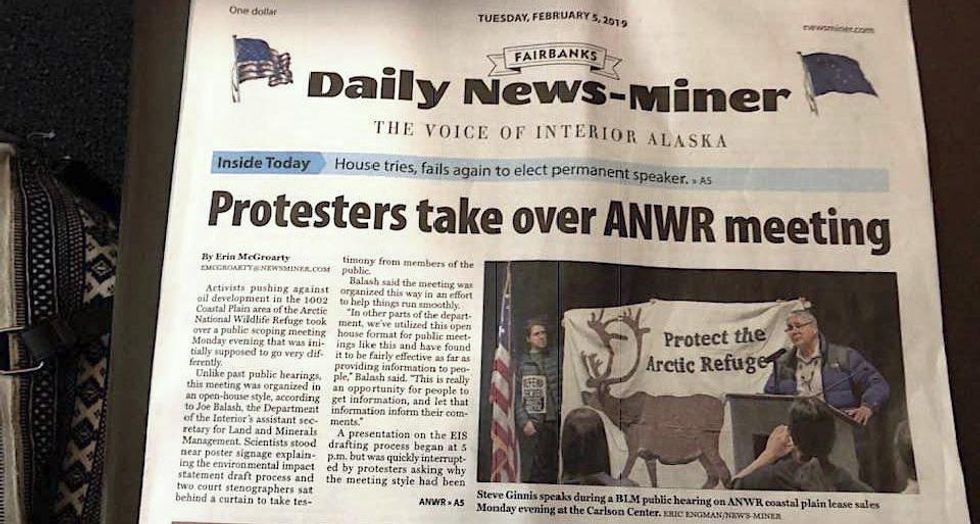
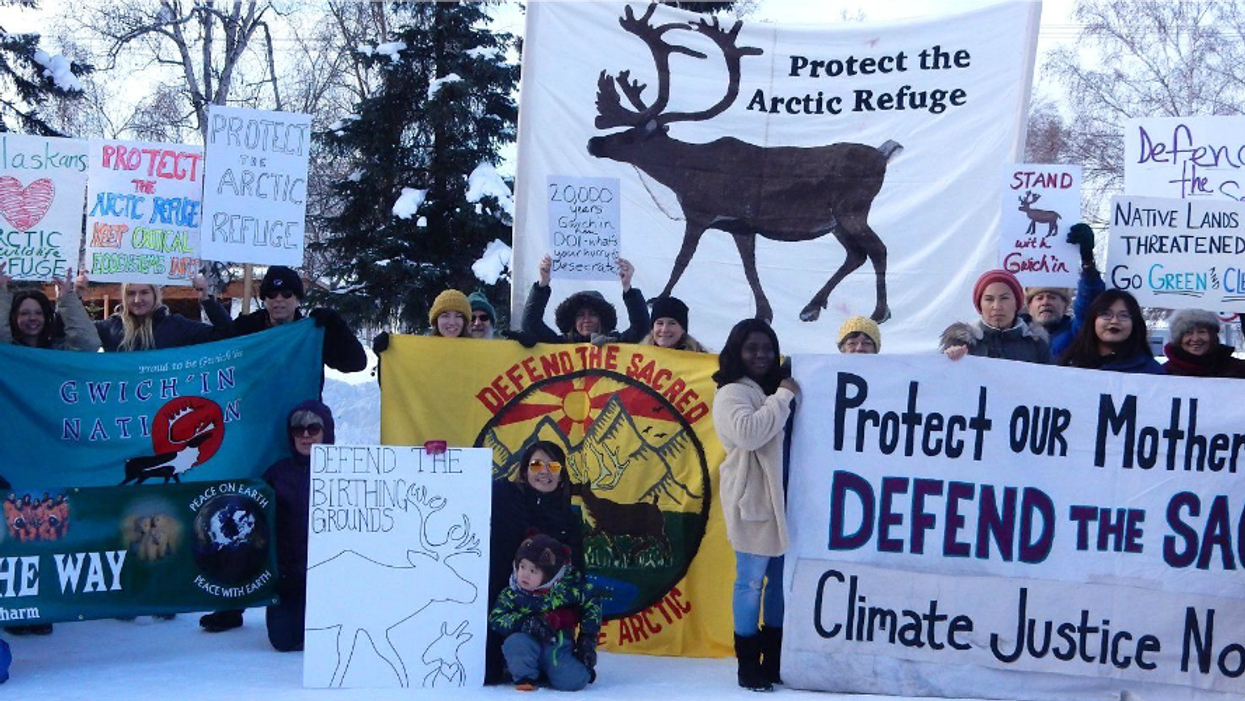
Indeed, the first BLM hearing, held in Fairbanks on February 4, did not even include a public forum: it was merely an "open house" information session for agency officials to provide an overview of the draft EIS. Gwich'in and Inupiat elders and leaders spoke out against this injustice, and demanded the right to be heard. "We are beyond frustrated that our elders are not allowed to speak today," one leader explained. Tribal members and grassroots groups--including Defend the Sacred Alaska, Native Movement Alaska, and the Fairbanks Climate Action Coalition--joined together to turn the anti-democratic charade into what one participant called a "People's Hearing."
The voices of the people need to be heard, because the BLM's rushed process has resulted in a flawed environmental review.

The draft EIS fails to address the ecological impacts of drilling. Fossil fuel development would degrade the habitat of the Porcupine Caribou Herd as well as that of migratory birds, polar bears, and other creatures. More than 200,000 caribou embark every year on the longest land migration of any animal on earth, journeying from their wintering grounds in Canada and Alaska to the Coastal Plain, where they calve and nurse their young. According to caribou biologists, the entirety of the calving and nursing grounds that stretch from the Arctic Refuge to the adjacent Ivvavik National Park in the Yukon Territory of Canada should be protected if the herd is to survive and thrive. With caribou herds across Canada and the circumpolar world in severe decline, the Department of the Interior should respect scientific and traditional ecological knowledge to sustain this transnational herd. Likewise, the draft EIS minimizes development impacts on the nesting and feeding habitats of millions of birds that migrate to the refuge from all fifty US states and all over the world. Nor does it adequately consider the impacts on polar bears, now listed as threatened under the Endangered Species Act, as their traditional sea ice habitat continues to disappear due to rapid Arctic warming. As we are in the midst of what scientists call biological annihilation, these impacts on wildlife need to be considered fully, not ignored or minimized to expedite drilling.
The draft EIS fails to address Indigenous rights and environmental justice. For the Gwich'in communities on both sides of the US-Canada border, the prospect of drilling represents an existential threat to their culture. The Gwich'in have relied upon the Porcupine Caribou Herd for their nutritional, cultural, and spiritual sustenance for millennia. To them, the Coastal Plain is Iizhik Gwats'an Gwandaii Goodlit (the Sacred Place Where Life Begins). Their food security, human rights, and cultural future are all stake in this decision. For many Inupiat people who call the area home, fossil fuel development would lead to increased social stress and air pollution with potentially severe health impacts on community members. The dangerous levels of toxic pollutants emitted by drilling could cause respiratory illnesses and other health problems, as has been documented in Nuiqsut following the development of the Alpine oil field. Indigenous voices must be heard, not marginalized and brushed aside in the rush to develop.
The draft EIS fails to address climate change. Fossil fuel extraction would contribute to further warming of the already rapidly-warming Arctic--an action that would affect the whole earth, as the Arctic is a critical integrator of our planet's climate systems. As climate scientists keep telling us, we are living through a pivotal moment in history, a time in which the US and other nations around the world need to transition to a sustainable energy future. Deciding not to drill in the Arctic Refuge would be a crucial step in this direction.
Instead of racing to turn a wildlife sanctuary into an oil field, the BLM needs to assess the full impacts of drilling on the ecological, cultural, wilderness, and subsistence values of the Arctic Refuge. The fossil fuel industry has already developed large portions of northern Alaska. The Coastal Plain of the Arctic Refuge--a contiguous stretch of unparalleled public land that constitutes about 5% of Alaska's Arctic coast--should be protected permanently not auctioned off at breakneck speed.
Since the Trump administration is attempting to complete this significant environmental review in a rushed and undemocratic manner, environmental and Indigenous activists have decided to take ownership of the process and create their own democratic structures. The coalition has organized a series of Public Community Hearings in March. Independent of the BLM's hasty and flawed process, these hearings will amplify voices of the public and highlight the administration's suppression of public participation. The public hearings represent a democratic push from below, an effort to enlist--rather than exclude--all people in this critical environmental debate. The coalition has scheduled public hearings in three cities: Albuquerque, New Mexico, on March 5; Denver, Colorado, on March 8; and Seattle, Washington (date will be announced soon on the letter web-page).
As teachers and scholars, we know that younger generations are worried about the escalating dangers to our planet's biological, climate, and life-support systems. The short-term drive to drill in the Arctic undercuts their hopes for a sustainable future. The natural and cultural values of the Arctic Refuge far exceed any oil that may lie beneath the Coastal Plain. Rather than rushing to lease and drill, the US government should keep this cherished place and vibrant ecosystem protected for generations to come.
Sincerely,
Rosemary Ahtuangaruak (Inupiaq), Arctic Indigenous Scholar, Arctic Research Consortium of the United States (Alaska, USA)
Subhankar Banerjee, Lannan Chair and Professor of Art and Ecology, University of New Mexico (New Mexico, USA)
Finis Dunaway, Professor of History, Trent University (Ontario, Canada)
Norma Kassi (Vuntut Gwitchin), Director of Indigenous Collaboration at the Arctic Institute of Community-Based Research (Yukon, Canada)
Here are two numbers to chew on.
226 years. That's how long it's taken for this country to elect a woman like me to congress.
56 years. That's how long people like me have been able to vote.
Native Americans are the first inhabitants of this land. Yet we are one of the last groups recognized to vote and one of the last groups to have a representative in Congress. Native peoples gained nationwide access to voting rights only with the 1965 Civil Rights Act - which means my grandparents could not vote when they turned 18.
I remember when Ben Nighthorse Campbell was elected to the US Senate in 1992. A decade later I was walking the halls of the US Capitol as a young intern, and I remember seeing a photo of him sitting on a motorcycle. I thought to myself: "There he is. He's the one that made it. He represents us." He was my icon, because he was the only one.
Two and a half decades later, young Native women across the country now have new icons to look up to. Deb Haaland and Sharice Davids made history this week by becoming the first Native American women ever elected to Congress. That's right: the very first.
Deb is from the Laguna Pueblo and is a well-known member in the Albuquerque and Santa Fe communities for her civic engagement. She was also my moot court partner at the University of New Mexico School of Law. We spent countless hours reviewing mock briefs together and preparing for oral argument. She's one of the most incredible Native women I know, a dedicated, determined, and humble servant of the people. Within 48 hours of being elected, she immediately called for a probe for missing and murdered Indigenous women - a crisis in Indian Country that U.S. leaders have failed to take action on.
Congresswoman-elect Sharice Davids is a member of the Ho-Chunk Nation. Like me, she is a Native lesbian attorney. She made history this week by also being elected the first openly LGBT congressperson from the state of Kansas.
Close your eyes. Imagine for just a moment that you're me. It's 2018 and for the first time in history, people like you have been elected to Congress. Imagine how you'd feel if one of our highest bodies of leadership, a body designed to represent its constituents, suddenly included people like you when it never had before.
Remember when that photo went viral of Parker Curry standing in front of First Lady Michelle Obama's portrait at the National Portrait Gallery? I think I'm feeling something like what she felt in that moment. There was so much awe and wonder in little Parker's expression. I'm...a number... of years older than Parker was in that photo, but I find myself looking at images of Deb and Sharice and grinning just as wildly with excitement. Those images hold so much promise for me and other women and girls like me.
We all need the promise of mentors and leaders who look like us. These are the people paving the way for others, breaking the ceiling and laying the foundation for a better tomorrow. That's one of the reasons why communities like Standing Rock stood up to voter suppression in the 2018 election and quadrupled their voter turnout from 2014.
Did you catch that? Yes, voter suppression. 56 years after the Voting Rights Act was passed, and five years after it was undermined by the Supreme Court, and Native American communities are still subjected to the same type of pathetic, harmful, and racist limitations that were imposed on people like me just a generation ago.
If we want little girls of color to grow up believing that their vote matters, that they can rise to the highest office in the land - we have to prove it to them. Little girls of color across this country struggle to find a doll that looks like them much less a congressional representative. Little boys of color grow up taking in movies and TV shows that paint men of color as dangerous. We have to work for representation of all people and identities so that we can provide positive examples for little ones to grow into. To learn more about the power of seeing your identity reflected in the world around you, check out Unpacking the Invisible Knapsack by Peggy McIntosh.
As for me, I know that I'm going to be telling the story of Deb and Sharice next time I talk to my little nieces and cousins. I want them to know they can grow up to be anything they want to be.
Faced with the looming threat that right-wing candidate Jair Bolsonaro could soon win the second-round of elections and become the next president of Brazil, hundreds of economists from across the country and around the globe have joined forces to declare their support for Fernando Haddad, the Workers' Party candidate, in order to save the nation's democracy and protect "essential values" like social inclusion, peace, and equal protection under the law.
"We believe that democracy, search for peace, individual freedoms, plurality of opinions, tackling prejudice and inequalities (of income, race, regional and gender) are non-negotiable and essential values." --Declaration of Economists in Support of Brazilian Democracy While not all signers of the declaration against Bolsonaro necessarily agree with every bit of Haddad's economic plan, they warn that a victory by the nation's regressive and far-right forces puts "Brazilian democracy and the institutions of the rule of Law" at stake.
According to Brazilian-American social scientist Luisa Abbott Galvao in a piece posted to Common Dreams Monday, the Bolsonaro campaign was built on his "disdain for democracy and glorification of authoritarianism."
The candidate, Galvao explained, has "gained infamy worldwide for past comments praising torturers and for asserting during a 1999 televised appearance that the Brazilian dictatorship should have executed 'at least 30,000' people. As a presidential candidate, Bolsonaro has called for political opponents to be shot, promised to deny the legitimacy of any election results that don't declare him the winner, and refused to partake in debates ahead of the general elections."
Additionally worrying, she added, is the manner in which the preferred candidate of the nation's wealthy and powerful elite "has capitalized on Brazil's deep economic and social inequality to push for an agenda that will undoubtedly drive even bigger rifts into the Brazilian socioeconomic fabric and further disenfranchise the country's most vulnerable people."
Posted in Portuguese here and in English below, the declaration signed by the hundreds of economists states: "We believe that democracy, search for peace, individual freedoms, plurality of opinions, tackling prejudice and inequalities (of income, race, regional and gender) are non-negotiable and essential values."
Read the full declaration and list of signatories below.
The signatories of this declaration have varying positions on economics; some, in fact, are outright critics of the economic policy adopted by the Workers' Party (PT) administrations. That said, what is at stake now is Brazilian democracy and the institutions of the Rule of Law.
We believe that democracy, search for peace, individual freedoms, plurality of opinions, tackling prejudice and inequalities (of income, race, regional and gender) are non-negotiable and essential values.
Therefore, it is imperative to have a position regarding the choice of the next Brazilian President. Fernando Haddad is, in this second round, the best alternative to ensure respect for these values.
We accordingly sign this declaration in support of his candidacy for political and economic stability, environmentally-sustainable development, social inclusion, and the fight against corruption. To ensure these democratic ends, we will maintain a critical and vigilant stance towards the elected government of Brazil in 2018.
Economistas que atuam no Brasil - Adesoes iniciais
Andre M. Cunha
Andre Nassif
Adriana Amado
Andre Chagas
Andre Roncaglia
Antonio Correa de Lacerda
Arthur Amorim Braganca
Bernard Appy
Carlos Eduardo Carvalho
Carmen Feijo
Cristina Froes de Borja Reis
Daniel Cerqueira
Daniela Magalhaes Prates
Dante Aldrighi
Darlene Dias
David Kupfer
Eduardo Correia de Souza
Eliane Cristina Araujo
Esther Dweck
Eustaquio Reis
Fernanda G. Cardoso
Frederico Gonzaga Jayme Jr.
Geraldo Biasoto Jr.
Gilberto Tadeu Lima
Hedibert Freitas Lopes
Joaquim P. Andrade
Joao Sayad
Jose Heleno Faro
Jose Luis Oreiro
Jose Roberto Afonso
Julio Sergio Gomes de Almeida
Laura Carvalho
Leda Maria Paulani
Lena Lavinas
Leonardo Weller
Lucia Helena Salgado
Luciano Coutinho
Luiz Carlos Bresser Pereira
Luiz Gonzaga de Mello Belluzzo
Luiz Fernando de Paula
Manoel Carlos de Castro Pires
Marcia Bezerra
Marcio Favilla Lucca de Paula
Maria Luiza Falcao
Maria Sylvia Saes
Marta Castilho
Mauro Boianovsky
Monica Viegas
Naercio Aquino Menezes Filho
Nelson Marconi
Nelson Henrique Barbosa Filho
Paulo Furquim de Azevedo
Paulo Nogueira Batista Jr.
Ramon Garcia Fernandez
Reynaldo Fernandes
Ricardo Carneiro
Rudinei Toneto Jr
Sergio Gobetti
Thiago Fonseca Morello
Economistas que atuam no Brasil
Aderbal Oliveira Damasceno
Adhemar Mineiro
Adriana Nunes Ferreira
Adroaldo Quintela
Afranio Garcia Jr.
Alberto Di Sabbato
Alain Herscovici
Alexis Toribio Dantas
Aline Souza Magalhaes
Amanda de Albuquerque
Ana Celia Castro
AnaCecilia Milagres
Ana Flavia Machado
Ana Maria Hermeto C. de Oliveira
Ana Urraca Ruiz
Andre Martins Biancarelli
Andre de Melo Modenesi
Andre Mourthe de Oliveira
Andre Nassif
Andrea Simone Rente Leao
Andres Ferrari Haines
Anna Mortara
Beatriz Macchione Saes
Bernardo P. Campolina Diniz
Betty Nogueira Rocha
Biancca Castro
Bruno M. de Conti
Camila Kimie Ugino
Carolina T. Baltar
Carlos A. Medeiros
Carlos Gadelha
Carlos Henrique Lopes Rodrigues
Carlos Mielitz
Cassio Garcia Ribeiro
Clelio Campolina Diniz
Cristiane Garcez
Cristina Lemos
Daniele da Rocha Faria
Debora Freire
Denis Maracci Gimenez
Denise Gentil
Ebenezer Pereira Couto
Edison Rodrigues Barreto Jr
Eduardo Costa Pinto
Elena Soihet
Eliana Ribeiro da Silva
Eneas G. de Carvalho
Ernani Torres
Fabio Sa Earp
Fabio Terra
Fabricio Missio
Flavio Azevedo Marques de Saes
Fernando Amorim Teixeira
Francisco de Assis Costa
Francisco Luiz C. Lopreato
Frederico Mazzucchelli
Gabriela Freitas da Cruz
George Flexor
Gilberto de Assis Libanio
Guilherme Delgado
Guilherme Grandi
Gustavo Britto
Helena Lastres
Henrique Tahan Novaes
Hugo Eduardo A. da G. Cerqueira
Igor Briguiet
Ilmar Ferreira Silva
Isabela Nogueira
Jennifer Hermann
Joao Hallak Neto
Joao Romero
Joao Saboia
Jose Carlos Braga
Jose Celso Cardoso Jr
Jose Eduardo Cassiolato
Jose Gabriel Porcile Meirelles
Jose Jorge Gebara
Jose Sergio Leite Lopes
Kaio Vital da Costa
Karina Kato
Laura Schiavon
Lauro Mattei
Leon Santiago Mendes Suhett
Leonardo Marco Muls
Lilian Nogueira Rolim
Lourival Batista de Oliveira Junior
Luiz Antonio Elias
Luiz Martins de Melo
Mauro Boianovsky
Marcos Antonio Macedo Cintra
Marcelo Miterhof
Marcio Wohlers
Margarita Silvia Olivera
Margarida Batista
Maria Antonieta Del Tedesco Lins
Maria Carolina Capistrano
Maria Cristina Penido de Freitas
Maria de Lourdes Rollemberg Mollo
Maria Luiza Falcao Silva
Maria Luiza Levi
Mariana Ribeiro Jansen Ferreira
Marina Sequetto Pereira
Mario Marcos Sampaio Rodarte
Maryse Farhi
Mateus Girafa Lachtermacher
Mauricio Borges Lemos
Mauricio Muniz
Mauro Arruda
Mauro Osorio
Miguel Bruno
Milena Fernandes de Oliveira
Nathalia Crissia Posena
Niemeyer Almeida Filho
Nilson Maciel de Paula
Nina Quintanilha Araujo
Norberto Montani Martins
Paula Alexandra Nazareth
Paulo Baltar
Paulo Guimaraes
Paulo Sergio Fracalanza
Pedro Amaral
Peter May
Raquel A. Ramos
Renata Lebre La Rovere
Renata Lins
Rene de Carvalho
Ricardo Henriques
Ricardo Machado Ruiz
Ricardo Meilman Cohn
Ricardo Schaeffer
Roberto Vermulm
Rogerio Gomes
Sandro Augusto Viegas Leao
Simone Deos
Thiago Mandarino
Ulisses Pereira dos Santos
Vitor Pereira
Walter Tadahiro Shima
Wilnes Henrique
Zina Angelica Caceres Benavides
Economistas que atuam no exterior
George Akerlof, USA - Premio Nobel em Economia, 2001
Adam Aboobaker , USA
Agnes Labrousse, Franca
Ajit Zacharias, USA
Alan Cibils, Argentina
Alberto Botta, UK
Alessandro Caiani, Italia
Alexander Guschanski, UK
Alfredo Saad Filho, UK
Amit Bhaduri, India
Amitava Krishna Dutt, USA
Andrea Califano , Italia
Andrea Roventini, Italia
Angel Vilarino Sanz, Espanha
Anne Eydoux, Franca
Annina Kaltenbunner, UK
Antoine Mandel, Franca
Antonella Stirati, Italia
Avinash Persaud, UK
Barbara Fritz , Alemanha
Bernhard Leubolt, Belgica
Bhola Khan, Nigeria
Bill Black, USA
Brittany Nicole McGhee, Alemanha
Bruno Bonizzi, UK
Bruno Theret, Franca
Byasdeb Dasgupta, India
C.P. Chandrasekhar, India
Carlo D'Ippoliti, Italia
Carlos A. Carrasco, Mexico
Carlos Mielitz, Italia
Carmen Diana Deere, USA
Christian Gehrke, Austria
Claire Pignol, Franca
Dani Rodrik, USA
Daria Pignalosa, Italia
Dominique Plihon
Edwin Le Heron, Franca
Eileen Appelbaum, USA
Eric Berr, Franca
Eugenio Caverzasi, Italia
Federico Tamagni, Italia
Fiona Tregenna, Africa do Sul
Francisco Louca, Portugal
Fred Mosseley, UK
Frido Wenten, UK
Gary Dymski, UK
Gennaro Zezza, Italia
Gerald Epstein, USA
Giorgio Fagiolo, Italia
Giovanni Villavicencio, Mexico
Ha-Joon Chang, UK
Hee-Young Shin, USA
Hulya Dagdeviren, UK
Heinz D. Kurz, Austria
Ilhan Dogus, Alemanha
Ilias Alami, Holanda
Imko Meyenburg, UK
Ingo Schmidt, Canada
Isabel Ortiz, USA
Ivan Velasquez, USA
Jaime Marques Pereira
Jaime Ros, Mexico
James Galbraith, USA
Jan Kregel, USA
Jan Priewe, Alemanha
Jayati Ghosh, India
Jean-Francois Ponsot, Franca
Jeff Madrick, USA
Jessica Sklair, UK
John Hall, USA
John Williamson, USA
John Willoughby, USA
Jonathan Marie, Franca
Jorge Buzaglo, Suecia
Jorge Garcia-Arias, Espanha
Jorim Gerrard, Franca
Jose Gabriel Palma, UK
Juan Grigera, Argentina
Julimar Bichara, Espanha
Kevin Costa, Franca
Lance Taylor, USA
Leonardo E. Stanley, Argentina
Leslie Carnoye, Franca
Lionello Franco Punzo, Italia
Louison Cahen-Fourot, Austria
Luana Ladu, Alemanha
Luca Zamparelli, Italia
Luis Bertola, Uruguay
Machiko Nissanke, UK
Manfred Max-Nee, Chile
Marco Mazzoli, Italia
Marco Missaglia, Italia
Marco Valente, Italia
Margarida Antunes, Portugal
Maria Cristina Barbieri Goes, Italia
Maria Cristina Marcuzzo, Italia
Maria Savona, UK
Marianna Mazzucato, UK
Mario Cassetti, Italia
Mario Tonveronachi, Italia
Mark Setterfield, USA
Mark Weisbrot, USA
Mary C. King, USA
Martha Carro Fernandez, Espanha
Mathieu Beraud, Franca
Matias Vernengo, USA
Matteo Deleidi, Italia
Matthieu Montalban, Franca
Maurin Masselin, Franca
Mauro gallegati, Italia
Mauro Napoletano, Franca
Mauro Virgino de Sena e Silva, Inglaterra
Megan Ward, Alemanha
Michel Heinrich, Alemanha
Michael Lipton, UK
Michael Meeropol, USA
Michael Roberts, UK
Mogens Ove Madsen, Dinamarca
Monika Meireles, Mexico
Mritiunjoy Mohanty, India
Murat Yildizoglu, Franca
Natalya Naqvi, UK
Nathalie Coutinet, Franca
Nicolas Piluso, Franca
Nicolette Cattaneo, Africa do Sul
Nikolaos Karagiannis, USA
Noemi Levy Orlik, Mexico
Oscar Ugarteche, Mexico
Ozlem Onaran, UK
Patricia E. Perkins, Canada
Patrick Bond, Africa do Sul
Paul Hudson, USA
Paul Mason, UK
Peter Dorman, USA
Philip Arestis, UK
Philippe Lege, Franca
Pierre Salama, Franca
Stephany Griffith-Jones, UK
Richard Parker, USA
Robert A. Blecker, USA
Roberto Frenkel, Argentina
Robert Guttmann, Franca
Roberto Veneziani, UK
Robin Hahnel, USA
Robin King , USA
Rodrigo Adao, USA
Sebastian Gechert, Alemanha
Sergio Cesaratto, Italia
Steven Fazzari , USA
Sunanda Sen, India
Susanne Soederberg, Canada
Terry McKinley, UK
Thierry Kirat, Franca
Thomas Palley, USA
Thorvaldur Gylfason, Islandia
Torsten Niechoj, Alemanha
Valpy FitzGerald, UK
Venkatesh Athreya, India
Victor Manuel Isidro Luna, Mexico
Yanis Varoufakis, Grecia
Yilmaz Akyuz, Suica
With our democracy in free fall, many are terrified, but I'm convinced that there is one thing with the power to turn the tide.
And what is that?
At the risk of sounding corny, or even ridiculous, I believe the one force with the power we need now is "falling in love with democracy." I know love can't be forced, but I also know that to love we must first get acquainted. So, let's ask, What, exactly, does democracy mean to us? Is it worthy of our devotion?
That's the conversation I long for and offer these thoughts as an invitation.
For some, the answer's easy: Democracy equals a market plus elections.
But I don't think so. A lot of societies have both, yet too many of their citizens are barely surviving. Take the world's largest democracy, India. Almost one in four children is stunted by poor nutrition and impure water, often with life-long consequences.
Elections plus a market do not democracy make.
For others democracy is more complex--grounded in a system of representative governance, the separation of powers, including an independent judiciary, and, of course, the right to speak and assemble freely. But in many countries with these constitutional protections officially in place, much of the citizenry isn't thriving. South Africa is one example.
So, we must dig. What is democracy, anyway?
For me, it is a culture that lives democracy as a never-ending journey. "Democracy is becoming, rather than being. It can easily be lost, but never is fully won," observed William Hastie, our first African-American federal appellate judge, adding: "Its essence is eternal struggle."
For sure, the journey of democracy is unending, but its direction is clear:
First, democracy is a journey away concentrated power. From Hitler and Mao to Big Oil and Facebook--tightly held power has proven to lead humans to justify narrow self-seeking and so much worse--from atrocities all the way to genocide. Psychological experiments now confirm at least one reason: power over others dampens empathy.
Democracy is thus a journey toward the opposite, widely dispersed power.
That walk includes getting big money out of politics, defeating the assault on voting rights and reforms that ensure every vote counts. Already, at state, county, and local levels, a citizen-led movement is changing the rules to create more inclusive and accountable power. A favorite example of mine is what Seattle citizens accomplished in 2015 by passing "democracy vouchers" enabling voters to receive four $25 vouchers they can then offer to their preferred candidates for key city offices. For the first time, regular citizens can run for these positions and most residents can contribute. Now citizens in Austin and Albuquerque are pursuing similar, democracy-enhancing innovations.
Second, democracy is a journey away from secrecy. Vast experience confirms that in a cloak of secrecy we're more apt to behave badly. Take an example with monumental consequences: Before the big crash of 2008, Wall St. bankers were feverishly pushing risky derivatives on the unsuspecting. Assuming no one was watching, they lived by "a little industry code": IBGYBG, "I'll be gone. You'll be gone," meaning they knew they could get out unscathed and enriched before their schemes imploded. And they were right.
So democracy is a journey toward the opposite: transparency. On this walk, Americans demand to know whose money is influencing political choices.
Thanks to Jane Mayer's book "Dark Money" and organizations such as Open Secrets and Maplight, exposing the flow of political money, Americans are learning that what we don't know does hurt us. We're demanding to know whose money is influencing political choices. Last year, California passed the DISCLOSE ACT so its citizens will know which deep pockets are paying for political ads. And, in early August , a U.S. District Court judge ruled to invalidate a Federal Election Commission regulation that had permitted anonymity for donors to "dark-money" groups. So far, upheld by the Supreme Court, it's a transparency breakthrough for democracy.
Before jumping ahead, let me share an amusing story about transparency's power, or even the thought of it. At a UK university too many faculty weren't paying for their "honor system" coffee. But when a clever psychology professor hung a photo of human eyes looking down on them, and the professors paid three times as much for their coffee!
Third, democracy is movement away from a culture of blame.
When it comes to the destructive tendency to point fingers, humans are particularly vulnerable. While homo sapiens have evolved many positive traits--including capacities for cooperation, empathy, and a sensibility to fairness--that make democracy possible, our tendency to push away, or even punish, those we perceive as different is our Achilles heel. Even babies reveal this sad proclivity.
So, we're easy prey for the powerful who stoke blame to serve their own ends, including more power. From our nation's founding, for example, many whites have used messages--both hidden and overt--to encourage whites to blame people of color for their ills. In the last half century their messages, for example, have suggested that government helps undeserving people of color while disadvantaging whites.
Then came Trump and our simmering culture of blame began to boil.
Thus, democracy is the journey toward the opposite, toward a culture of mutual accountability. Finger pointing, admittedly, may be a natural human gesture, but we can acknowledge the deeper truth, put so simply by Rabbi Abraham Joshua Heschel: "Few are guilty, but all are responsible." I love that. And here's my less-eloquent, related thought: "Since we're all connected, we're all implicated."
So, pointing a finger may be okay, but only if it comes full circle. Recall the bankers I called out above? Even there, all of us need to shoulder some smidgeon of responsibility, asking: Where were we citizens when Bill Clinton set us up for the crash by de-regulating the financial industry?
Fortunately, a culture of shared responsibility can be taught and learned.
Certainly, our culture's progress toward racial inclusion--though painfully unfinished--is testimony to that possibility. Elsewhere, consider Germany. While only beginning to reckon with the atrocities of its colonization in Africa, Germany has issued formal apologies and paid reparations to victims of the Holocaust. Germans teach their youth about the Holocaust and in public places embed pointed reminders of the human cost. Or consider that after Rwanda's genocide, many citizens engaged in impressive social learning, helping bridge the cavernous divide.
But the threat of this human tendency "to other" requires constant vigilance. Proof in this moment is the rise of a German political movement scapegoating immigrants.
The great news is that today in America a citizens' "movement of movements" is uniting a wide range of issue-passions to ensure our society is on the journey toward ever-greater realization of the three conditions laid out here that define democracy for me.
I fear that "falling in love" with democracy could seem ridiculous to those who've absorbed the notion of democracy is a boring duty we suffer through to get what we really want, personal freedoms. But "dull duty" is not what I've discovered within the rising Democracy Movement. Feeling victimized by a rigged system is no fun at all, but learning and expressing our views and creating fair rules fostering the essential conditions for real democracy? Now, that's thrilling!
My point is simple. Shedding any sense of democracy as a burdensome obligation, let's explore together what democracy really means to us, including its role in meeting perhaps our most basic needs beyond the physical: our need power, meaning, and connection. In a word, dignity.
Here are some helpful starting points for that conversation. Then, gaining confidence from our courageous brothers and sisters in the already-stirring Democracy Movement, we might just take that leap of love ourselves.
________
Note: Don't miss watching the companion video to this article - one of Frances Moore Lappe's Thought Sparks Video Series in which she opens her heart about what fortifies her in this scary time. Each week for nine weeks or more, her Small Planet Institute will release an informal 2-to-5-minute video in which Frances shares her often-surprising, liberating takes on hope, democracy, and courage.
Before there was Christine Blasey Ford, there was Recy Taylor, an African-American woman who was raped by six white men in 1944 and fought for justice with the help of Rosa Parks. And in between the two of them, there was Anita Hill, Tarana Burke, Alyssa Milano, Lupita Nyong'o, Tanya Selveratnam, Aly Raisman, and many, many more.
For centuries, women have experienced violence and harassment, and many have spoken out. #MeToo brought us to a new phase in building the movement to end gender-based violence, magnifying and connecting thousands of voices as they shared their stories. Despite women's achievement of formal equality, #MeToo exposed how common such violence is, the widespread silencing and dismissal of survivors, and the myriad ways violence undermines survivors' security, dignity, and opportunities.
The President and Senate Judiciary Committee are far from the only powerful people and institutions that limit investigations, disbelieve survivors, and fault people for coming forward. Discrimination against survivors infiltrates all aspects of life, including the responses of law enforcement, employers, housing providers, and schools, to name a few. Speaking out about violence is a crucial step. But law enforcement, employers, housing providers, and schools must also step up and acknowledge how their policies and practices contribute to violence.
"Why didn't you report?" is the refrain so many survivors face when they disclose violence for the first time. But too often, police dismiss survivors who go to law enforcement. This attitude results in governments' decisions not to test thousands of rape kits in cities like Detroit, Albuquerque, and Washington DC, based on officers' assumptions that there was no sexual assault. It also explains why one in three survivors feel less safe after contacting police.
Survivors also bear punishment for filing complaints. They are ostracized by their communities or accused of lying and prosecuted for false reporting, only to be exonerated years later. Sometimes cities enforce policies that hold victims responsible for crimes in their homes, resulting in their eviction.
Survivors are frequently denied employment, educational support, housing, and other benefits due to violence and harassment. They are retaliated against by supervisors for breaking their silence. Schools ignore their requests for accommodations or protection, pushing them out. Landlords evict them for resisting sexual demands. Veterans seeking disability benefits based on PTSD as a result of military sexual trauma are rejected unjustly, because they cannot meet a standard of corroboration that is not demanded of veterans with other forms of PTSD.
And victims have gone to law enforcement only to face sexual harassment and assault by officers themselves. Filling a criminal report can subject survivors to further violence, committed by those who are supposed to hold perpetrators accountable.
The multiple layers of discrimination that survivors experience, and the network of systems that foster it, could leave one feeling hopeless. But what we saw with so many of the survivors who have spoken out is that they are challenging the institutions that further perpetuate violence. In telling their stories, they are survivors, and also advocates and leaders pushing for change.
I have witnessed this first-hand as an attorney at the ACLU representing survivors of gender-based violence. I have been awed by Lakisha Briggs, Nancy Markham, and Rosetta Watson, who are all survivors of domestic violence who either faced eviction or were evicted because they called 911. They successfully challenged local nuisance laws adopted by their cities in Pennsylvania, Arizona, and Missouri, ensuring that other survivors no longer are forced to choose between their homes and police protection.
I had the honor of working with Rachel Bradshaw-Bean, a student in Texas who was sent to a disciplinary program for engaging in "lewd behavior" after she reported being sexually assaulted at her high school. She filed a Title IX civil rights complaint against the school district, leading to major reforms for how they respond to sexual harassment and violence. And this month, PBS is featuring the Home Truth documentary on the life and work of Jessica Lenahan, a Colorado woman who became a human rights activist after Colorado police refused to enforce her restraining order against her ex-husband, leading to the death of her three daughters.
Our society is one that has long accepted and encouraged the victimization of women and other marginalized people. Today, survivors are building power by coming forward, seeing and hearing each other, calling on and providing support, and challenging the norms that have silenced victims. We will continue our work to dismantle the policies and practices that have allowed violence and discrimination to flourish.
In a piece for the Atlantic (6/20/18), former George W. Bush speechwriter David Frum countered statements by MSNBC's Chris Hayes, in which Hayes described a harrowing first-person account of a mother forcibly separated from her child at the US/Mexico border as reading like "the literature of a totalitarian government":
As Hayes elaborates his horror at the separation of mother from child, he seems to arrive at a conclusion that there is something inherently oppressive about any kind of immigration rule at all....The border crosser goes to them. She is not just "living her life ... and then all of a sudden, the state can come in and wrench your life apart." She, of her own volition, traveled hundreds of miles to challenge the authority of a foreign state to police its frontiers. When her challenge failed--when she was apprehended and detained--what happened next must have felt harsh and frightening. But dictatorial? Totalitarian? In democracies, too, the wrong side of the law is an inescapably uncomfortable place to find yourself.
Frum's argument presents the US as unimplicated in the surge in Central American migration except as its victim, a "sovereign state" that must "police its frontiers." His concluding worry about "the surges that will soon follow from the rest of the planet if the present surge is not checked" suggests he's given little thought to the particular forces driving people from that region, much less how those relate to US foreign and economic policy.
The immigrants that Frum is speaking of come largely from the Central American countries of El Salvador, Honduras and Guatemala, an area known as the Northern Triangle. According to the Pew Research Center, there are 3 million total immigrants from these countries in the US, and about half of those immigrants are undocumented. While Mexican immigration has been falling in recent years, Central American immigration has increased: from 2007 through 2015, the total number of Northern Triangle immigrants rose by 25 percent.
Yet much media coverage of immigration misses out on why large numbers of people from the Northern Triangle are migrating to the US in the first place.
Over the past three generations, the Northern Triangle countries, long marked by profound levels of inequality, have each experienced horribly destructive civil wars and military coups. Unsurprisingly, the United States has been intimately involved in each of these, supporting anti-Communist regimes during the Cold War and protecting US business interests with truly disastrous results.
In 1954, the CIA orchestrated a coup to remove President Jacobo Arbenz, the democratically elected leader of Guatemala, at the behest of United Fruit Company (now Chiquita), the country's largest landowner. During the subsequent civil war that lasted until 1996, the US gave military and financial support to a succession of right-wing governments that committed large-scale human rights abuses that killed hundreds of thousands.
In Honduras in the 1980s, the CIA trained right-wing death squads like Battalion 316 that tortured and assassinated the government's left-wing political opponents. In 2009, the US State Department under Hillary Clinton supported the overthrow of Honduran President Manuel Zelaya by graduates of the School of the Americas, a notorious US military training academy. The coup created waves of protests and escalated murders of hundreds of activists, including indigenous leader Berta Caceres.
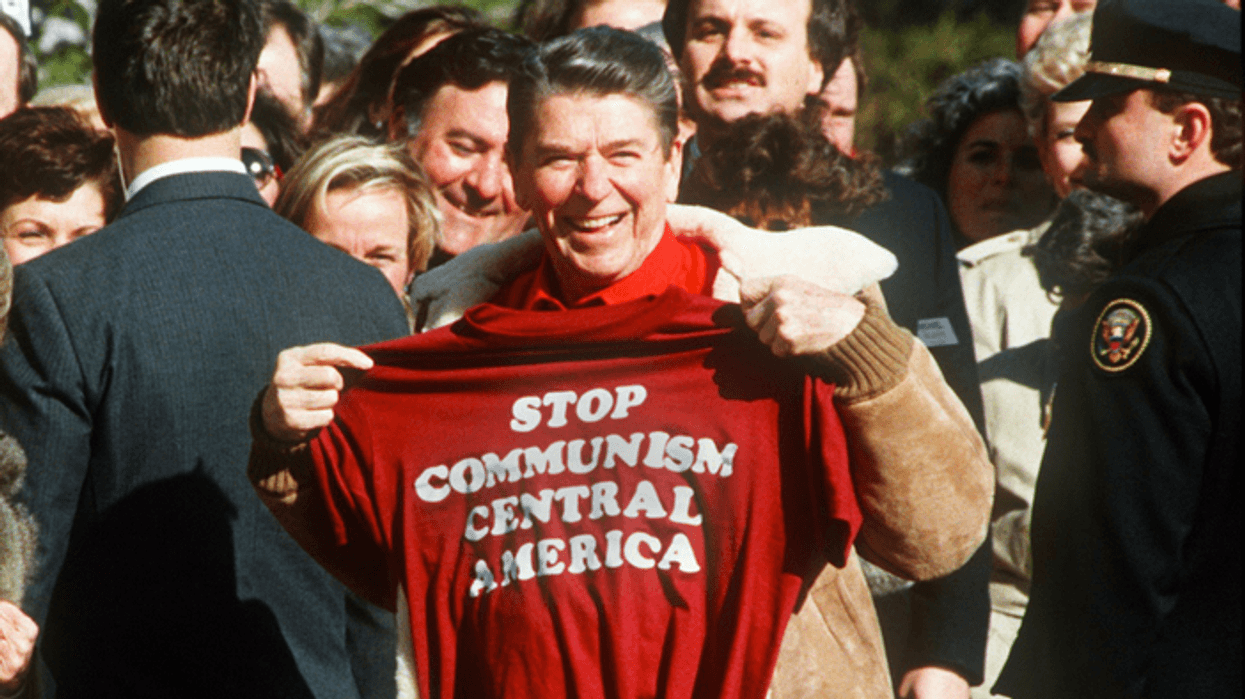
In El Salvador, when a military coup in 1979 sparked the formation of a leftist guerilla movement known as the Farabundo Marti National Liberation Front (FMLN), first the Carter and then the Reagan administration backed the anti-Communist junta in the ensuing civil war by supplying training, military equipment, arms and financial support totalling $6 billion. Much of the aid and arms ended up supporting the junta's paramilitary death squads. In 1980, these death squads assassinated Catholic Archbishop Oscar Romero during a sermon, and later that year raped and murdered four American nuns. In 1981, junta forces massacred over a thousand people, mostly women, children and the elderly, in the village of El Mozote. The perpetrators, the Atlacatl Battalion, had recently completed training with the U.S. military at Fort Bragg prior to the massacre. The CIA also funded presidential candidate and junta leader Napoleon Duarte prior to his election in 1984 in order to throw a wrench in peace talks, a move that dragged the war on for another eight years.
The Salvadoran civil war, which ultimately ended along with the Cold War in 1992, is estimated to have claimed the lives of up to 75,000 Salvadorans, including over 50,000 civilians, with 85 percent of deaths at the hands of the Salvadoran government and its paramilitary allies. Top US officials like Secretary of State Alexander Haig, Assistant Secretary of State Elliott Abrams and UN Ambassador Jeane Kirkpatrick each denied or obscured the human rights abuses and massacres in El Salvador order to maintain congressional funding for the Salvadoran military junta and other anti-Communist authoritarian regimes throughout Central America. Abrams later called the Reagan administration's record in El Salvador "one of fabulous achievement."
El Salvador provides perhaps the most striking case of how US responsibility is obscured in the current immigration debate, based on the notoriety of Mara Salvatrucha, a predominantly Salvadoran street gang better known as MS-13.
MS-13 has become a major scapegoat for Donald Trump and right-wing media in rationalizing harsh immigration policies. The Trump administration has referred to MS-13 gang members as "animals" who "infest" the United States--rhetoric that, as the Washington Post's Greg Sargent (5/25/18) noted, "slaps the dehumanizing slur on the least sympathetic subgroup and then conflates that subgroup with the larger group that is the real target."
This scapegoating seems to have worked: According to a recent HuffPost/YouGov survey, over 85 percent of Trump voters believe that MS-13 is a major threat to the United States as a whole. This level of anxiety seems misplaced, considering that even the Justice Department claims MS-13 has only about 10,000 members in the US.
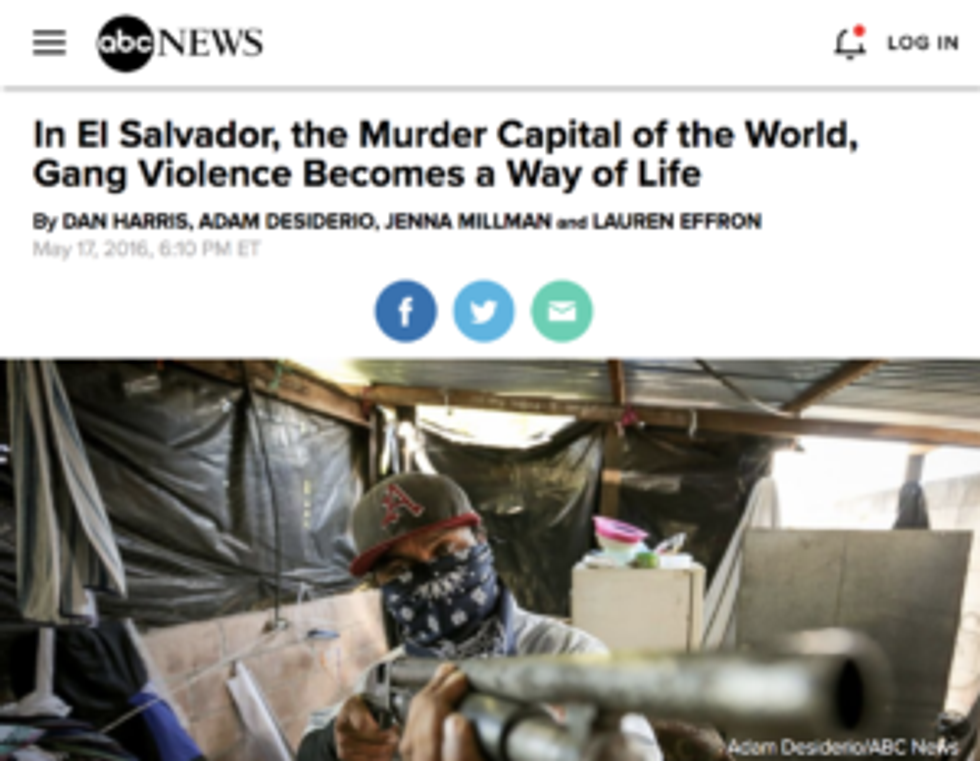
For Salvadorans, though, the fear is very real: In 2017, El Salvador had the most murders per capita on the entire planet (109 per 100,000), followed by Honduras (64 per 100,000), with Guatemala coming in at number nine (31 per 100,000). And with stories like "In El Salvador, the Murder Capital of the World, Gang Violence Becomes a Way of Life" (ABC News, 5/17/16) and "Organised Violence Is Ravaging Central America and Displacing Thousands" (Guardian, 6/29/17), media have used that violence to fan fears of MS-13 making inroads into US cities and suburbs.
But what Trump's racist rhetoric and fearmongering media alike ignore is that MS-13 is partially a product of US policy. The gang was actually founded in the Pico Union neighborhood of Los Angeles in the early 1980s, by Salvadoran immigrants and refugees from its civil war. Its subsequent growth from a small street gang in the US to a transnational criminal organization based out of the Northern Triangle provides an illuminating case study of how US foreign policy choices can backfire spectacularly.
The violence of the Salvadoran civil war sparked a mass exodus of Salvadorans to the United States. In 1970, there were only 15,717 Salvadoran born immigrants living in the US. By 1980, there were 94,447 Salvadoran-born immigrants in the US, shooting up to 465,433 by 1990. Undocumented Salvadorans were granted Temporary Protected Status from 1990 through 1994; TPS was extended following a catastrophic earthquake in 2001, and has been periodically renewed since. However, the Trump administration recently revoked TPS for El Salvador, effective September 2019.
During and after the civil war, a majority of Salvadoran-born immigrants ended up in Southern California, particularly in ethnically segregated neighborhoods in Los Angeles, which was at the time in the midst of violence gang turf wars stemming from the crack cocaine epidemic--itself partially the product of plummeting cocaine prices as the result of drug-smuggling by the CIA-backed Nicaraguan Contra rebels. In this atmosphere, young, impoverished Salvadoran immigrants formed small street gangs like MS-13 and the Eighteenth Street Gang (also known as Barrio 18) for protection from local African-American and Mexican gangs.
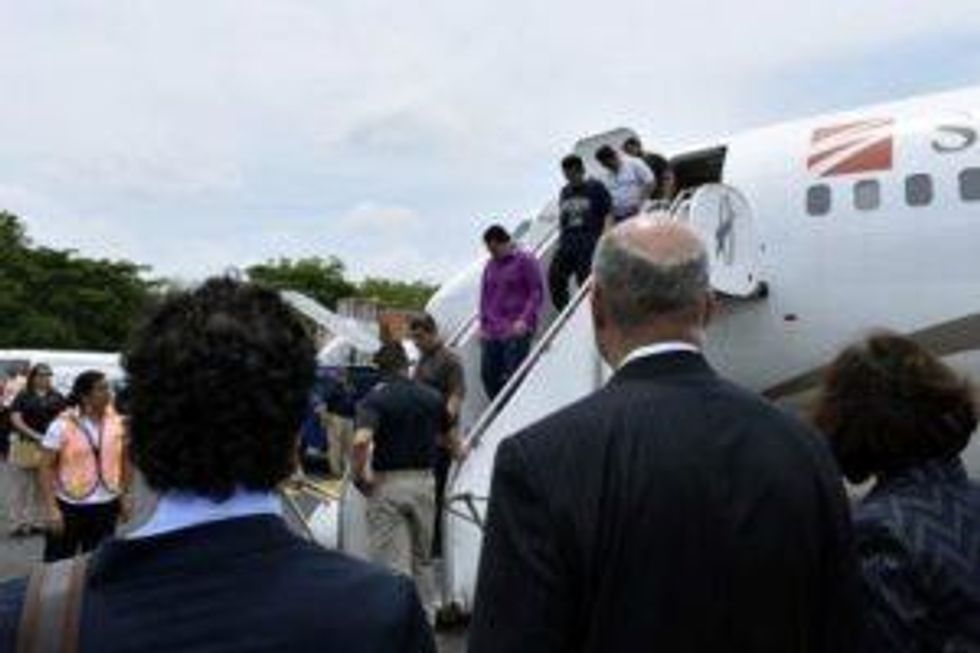
Following the end of the civil war in the '90s and continued gang violence in Southern California and the Washington, DC, metro area--the other major destination for Salvadoran immigrants--the Clinton administration engaged in a policy of mass deportation of immigrants with criminal records, beginning with the 1996 Illegal Immigration Reform and Immigrant Responsibility Act. This was a continuation of policies of the Reagan administration, who deported thousands of Salvadorans seeking asylum from the civil war. An estimate by the UN Office on Drugs and Crime counted almost 46,000 deportations of immigrants with criminal records (undocumented or not) to El Salvador from the US between 1998 and 2005.
El Salvador, just off its decade-plus-long civil war, was hardly equipped with the institutions necessary to deal with a massive influx of gang members from the United States. Gangs like MS-13 quickly integrated with already established street gangs within the country, bringing back elements of US gang culture such as symbols, identities and norms like tattoos or graffiti that helped bring local gang sets under the MS-13 umbrella.
The response of the Salvadoran government (and other Northern Triangle countries) was to crack down and lock up large numbers of suspected gang members in the early 2000s, a policy known as mano dura, or "firm hand." Over 30,000 arrests were made under the policy in El Salvador, although many cases were thrown out due to illegal arrests and lack of evidence. Despite this, the arrests concentrated large numbers of gang members in one place: Jails and prisons served as effective locations for centralizing the organization of gangs that were previously only loosely affiliated.
While these newly integrated gangs in El Salvador are still less centralized than Mexican drug cartels, the mano dura policies nonetheless allowed gangs to better coordinate across varied gang sets, and expand extortion rackets to tax neighbors and businesses on their turf, using threats of violence. These extortion rackets, along with continued violence between gangs over turf, have created an atmosphere of fear that Salvadoran families quite reasonably want to get away from.
Increased deportations of Salvadoran gang members during the Trump administration will likely have the effect of further swelling gang membership numbers in El Salvador, which will in turn lead to more migration as Salvadorans flee gang extortion rackets and violence. Even police have reservations about the harsh immigration policies, and MS-13 gang members have acknowledged that deportation policies help expand their numbers.
Continued gang crackdowns by the Salvadoran government over the past few years are also an issue that the US has a hand in: Salvadoran security forces accused by the UN of extrajudicial killings of gang members have received millions in US aid and training from the FBI and DEA. Ongoing violent confrontations between Salvadoran law enforcement and gangs also contribute to a climate of fear and resentment among Salvadorans as well. Just as tough-on-crime policies have generally failed to reduce crime in the US, in El Salvador and the other Northern Triangle countries they have just as bad a track record, as shown by the failure of the mano dura policies.
The end of Temporary Protected Status for over 200,000 Salvadorans, and their likely subsequent deportation, will also have a major effect on the Salvadoran economy by decreasing remittances from the United States, which account for over about a sixth of the country's GDP. The end of TPS, combined with high levels of unemployment and underemployment that are partially attributable to US neoliberal economic policies like the 2006 Central American Free Trade Agreement (CAFTA), will likely increase the poverty that feeds youth gang membership and immigration. As Mark Tseng-Putterman noted in Medium (6/20/18), "There are few connections being drawn between the weakening of Central American rural agricultural economies at the hands of CAFTA and the rise in migration from the region in the years since." Indeed, the destructive impact of US trade policy in Latin America over the years has been actively obscured by the devotion of corporate media to "free trade" nostrums. As New York Times columnist Thomas Friedman explained when he endorsed CAFTA in a 2006 CNBC interview: "I didn't even know what was in it. I just knew two words: free trade."
While the United States does not necessarily deserve 100 percent of the blame for the conflicts and economic policies that have led to increases in Northern Triangle violence or immigration, it is certainly a major culprit, and has poured fuel on the fire every time it has had the opportunity to do otherwise.

Yet media ignore this crucial context when discussing current American immigration policies. The Washington Post's pieces on immigration or MS-13 have seldom mentioned the Salvadoran civil war when discussing immigration, let alone the outsized US involvement in the conflict. Out of hundreds of Post articles on Latin American immigration in the past six months, only a few even mention the Salvadoran civil war (1/11/18, 1/31/18, 2/12/18, 3/12/18, 5/30/18, 6/29/18, 7/2/18). One article in the DC Metro Weekend section (6/14/18) did mention immigration in relation to the civil war, but only in the context of where to get some tasty Salvadoran food in Maryland, while another article (3/2/18) on Venezuelan immigration mentioned the Salvadoran civil war in passing. Only Jose Miguel Cruz's January 31 article and Micaela Sviatschi's February 12 article mentioned any US involvement in the Salvadoran civil war. While the Post has explored the connection in greater detail in the past, one would think that the current child migrant separation policy and continuing high levels of Northern Triangle immigration would warrant nuanced and detailed coverage now.
The New York Times fared little better, only mentioning the Salvadoran civil war in the context of immigration or MS-13 a handful times in the past six months (1/13/18, 1/18/18, 1/31/18, 2/8/18, 2/17/18, 3/1/18, 4/30/18, 5/23/18, 5/26/18, 6/12/18), including a book review roundup (1/27/18) and a factchecking article on Trump's claims about MS-13 (7/1/18). Yet of these articles, only three contained any mention of US involvement in the civil war: the January 13 op-ed by Lauren Markham, the January 18 op-ed by Linda Greenhouse and the May 26 article by Elizabeth Malkin. (Malkin's piece was less focused on current immigration issues, centering on the El Mozote Massacre.) The rest of the articles only briefly mentioned the Salvadoran civil war.
The corporate press has done a generally good job of covering the staggering number of human rights abuses of ICE, including the presence of immigrant detainment camps and the separation of over 2,000 child migrants and asylum seekers from their parents at the US/Mexico border. Other outlets have been better on connecting the imperialist history of US foreign policy with the current immigration issues, like Current Affairs (8/1/16), Vox (5/21/18), The Conversation (5/8/17), Vice (6/28/18) and the Philadelphia Inquirer (6/21/18). Even the Atlantic has published pieces (1/20/18, 3/4/18) that explore the web of US policies that have contributed to the current immigration crisis in Central America.
The fact that neoconservatives like David Frum continually obscure the blowback of imperialist US foreign policy is unsurprising. Perhaps more outrageous is the failure of the establishment press, especially the Washington Post and the New York Times, to grapple with how current immigration issues are connected to US intervention in Central America, and the subsequent gang violence it helped trigger. As Mark Tseng-Putterman (Medium, 6/20/18) aptly put it, the US empire thrives on amnesia. It is the job of the media to inform the public with the nuance and context necessary to understand America's role in the current Central American immigration crisis.
As someone who was born and raised in the border state of New Mexico, I'm very familiar with political speak about immigrants and the border, especially when it comes to talking about safety.
After 9/11, concerns about safety led to the passing of the Homeland Security Act, which created a new cabinet department as well as a new law enforcement agency: Immigration and Customs Enforcement, or ICE. ICE was given a never-before-seen level of criminal and civil authority -- in theory, to keep Americans safe.
It's now the largest investigative branch of the Homeland Security department. Unlike other law enforcement agencies like the FBI or DEA, ICE doesn't answer to the Department of Justice, which for decades has at least paid lip service to due process.
Far from being a law enforcement agency, ICE has become the closest thing we have to a lawless organization.
Rather than keeping Americans safe, the organization has become a menace, wasting taxpayer money while doing tremendous violence to communities that pose no threat. From separating families to having 3-year-olds stand trial for deportation, and from staking out churches to stealing immigrants' identities to open up fraudulent credit cards, ICE embodies cruelty.
More worrying still, people are dying in ICE custody at alarming rates.
In May, a transgender woman from Honduras named Roxsana Hernandez died in ICE custody in New Mexico. Roxsana came to the United States seeking asylum from persecution and violence in her home country.
Rather than being treated with the dignity and respect befitting all humans, and particularly those seeking asylum, she was detained by ICE and held in a freezing cold cell with the lights turned on 24 hours a day. This approach to detention is so common it has a name -- the icebox, because the cells feel as cold as a freezer.
As a queer, gender non-conforming New Mexican, this hit close to home for me. Not only did Roxsana come to this country because she wanted the safety to live her life as her authentic self, but she died in Albuquerque, my hometown. She died a terrifying and lonely death due to complications of pneumonia, likely caused by the frigid conditions of her detention.
I have to say: Her death certainly doesn't make me any safer.
In another devastating case, Pablo Villavicencio, an undocumented man originally from Ecuador, was detained by ICE while he was delivering pizza to a military base in New York City. Pablo lives in New York with his wife and young children, all of whom are U.S. citizens. His detention and possible deportation certainly won't make me, or anyone else, any safer.
ICE was created to protect the U.S. from terrorism. But it seems the biggest threats they can identify are refugees and workers supporting their families. If you ask me, ICE is the one terrorizing people.
Unfortunately, ICE has become even more aggressive in the past 18 months -- and not just against people from Mexico and Central America. The number of Haitians deported rose from 300 in 2016 to 5,500 in 2017 -- as if almost the entire city of Aspen, Colorado were deported. The rate of deportation for people from Somalia nearly doubled during the same time.
To what end?
At this point, ICE's targeting of families and non-threatening individuals makes it clear that it's beyond reform. Immigrants aren't threats to the nation's security -- they're people, just like you and me, who are trying to make the best of their circumstances.
We need to find better ways to make sure our communities are safe without relying on a lawless, violent organization. It can't be that hard -- we did it for centuries before the Homeland Security Act. ICE must be abolished.