SUBSCRIBE TO OUR FREE NEWSLETTER
Daily news & progressive opinion—funded by the people, not the corporations—delivered straight to your inbox.
5
#000000
#FFFFFF
To donate by check, phone, or other method, see our More Ways to Give page.

"Maybe it's not for her," Trump said, suggesting Zacharia may continue working for him “in some form, but maybe a more pleasant form.”
Zacharia, who stepped into the role formerly held by Karoline Leavitt, lasted a total of five days in the job. That's less than half the tenure of Anthony Scaramucci—who departed his role as White House communications director after just 11 days during Trump's first term.
Her qualifications were in doubt from the moment Trump plucked her from an obscure role as a Fox News commentator for the highly visible job. Journalists dug up old posts in which she promoted the QAnon and Pizzagate conspiracies, as well as Trump's false claims that the 2020 election was stolen.
From the start of Zacharia's disastrous briefing on Tuesday, many observers predicted it could also be her last.
She was relentlessly panned after struggling to read through her fully scripted remarks (and at one point accidentally referring to her husband as "my president"). She cut the briefing short after just 14 minutes, taking only three questions, all from right-wing outlets.
It also became clear that, despite Trump's introduction of her as "an attorney," she'd never actually passed the bar exam and had misrepresented her credentials for years.
Asked by reporters earlier this week in which state she had passed the bar exam, she said, “When I moved to China" before later claiming not to have heard the question.
Even Fox News host Sean Hannity—a longtime Trump loyalist—challenged her explanation, confronting her Thursday with a report documenting “15 social media posts where you identify yourself as an attorney.”
“I think they were retweets,” Zacharia replied, arguing to a flummoxed Hannity that sharing the posts did not constitute endorsing the title.
While Zacharia's inability to do damage control appeared to do her in, Democratic strategist Mike Nellis emphasized that the problem was not her dishonesty—a trait that is practically a prerequisite to serve in the Trump administration.
"Katie Zacharia wasn't fired because she lied," Nellis wrote on social media. "It was because she was a bad liar. It's a key distinction.”
To some, Zacharia's tenure represented a disastrous culmination of Trump's willingness to eschew competence and experience for personal flattery and undying loyalty when appointing officials during his second term.
Zacharia said she got on Trump's radar by scheduling her TV appearances when she knew he'd be watching.
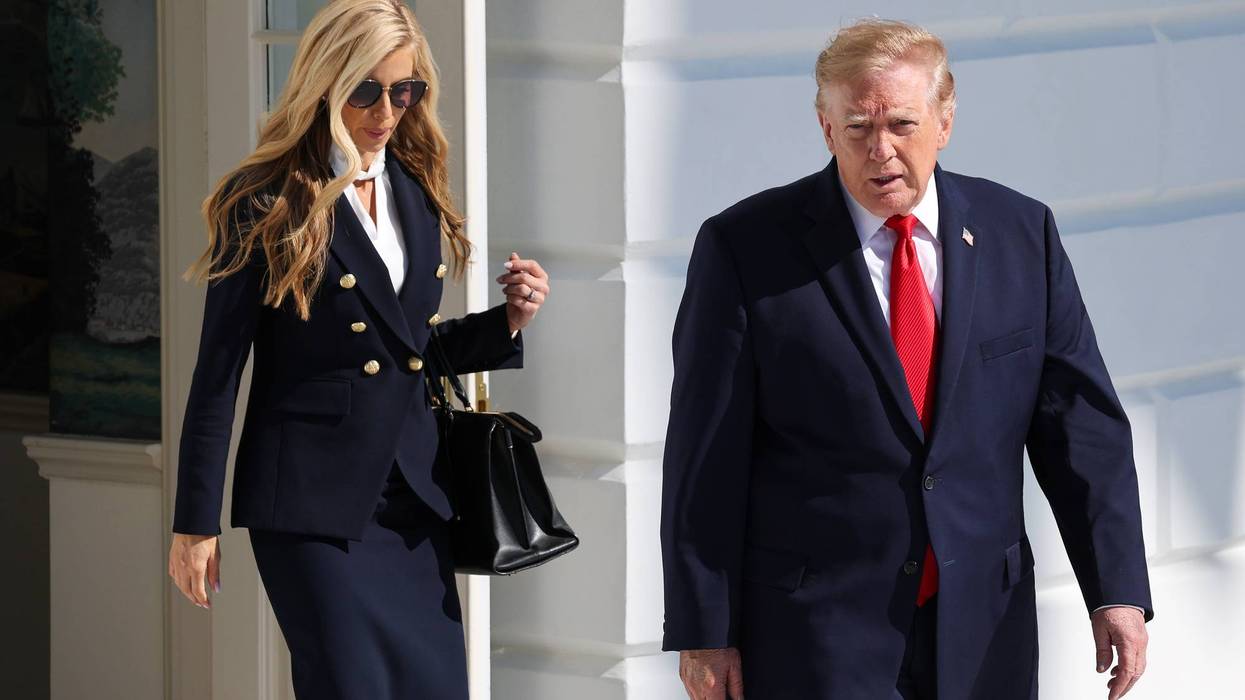
While other advisers questioned the pick, Zacharia's appointment was reportedly championed by Natalie Harp, Trump’s ever-present personal assistant and a fellow blonde conservative television personality.
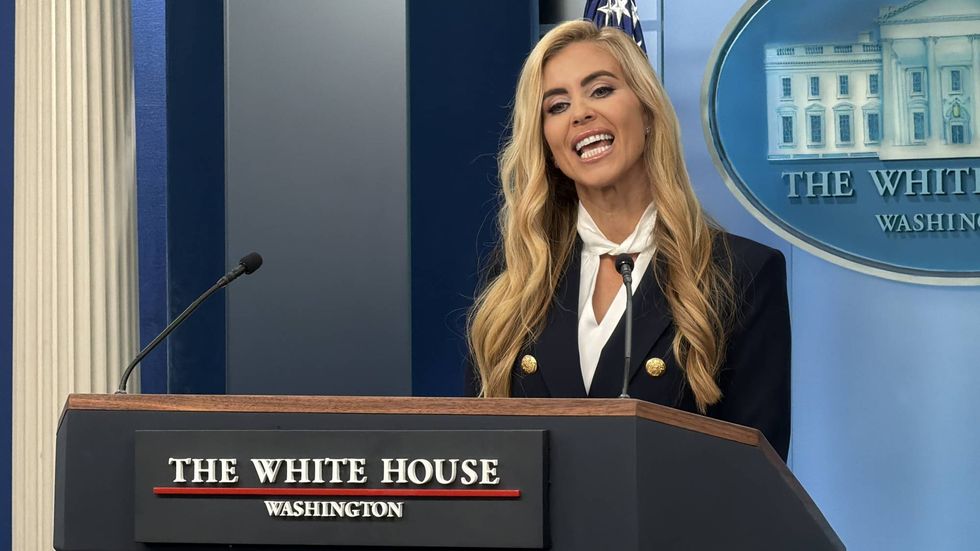 White House press secretary Katie Zacharia speaks during a news briefing in the James S. Brady Press Briefing Room of the White House on October 13, 2026, in Washington, DC. (Photo by Chip Somodevilla/Getty Images)
"She looks nice for him," said former Republican National Committee chairman Michael Steele on MS NOW. "She fits his idea of the blonde white female standing at that podium publicly pronouncing his noise in a way that makes him, when he's watching it, feel good."
Steele emphasized that with just weeks left before a midterm election widely viewed as a referendum on Trump, "the White House is voiceless."
"They do not have a press secretary in place," he said, "because the president picked an incompetent individual to do the job."
Though very few seemed to think Zacharia could turn things around, she did have one person in her corner—perhaps the only other person who could possibly understand her experience: Scaramucci.
While others bet she would not even last "one Scaramucci," The Mooch himself predicted—even after her disastrous Hannity appearance on Thursday—that "she will make it. I have the over."
Following news on Friday that she did not, in fact, make it, Scaramucci wrote: "Records are made to be broken. But I take no pleasure in other people's pain."
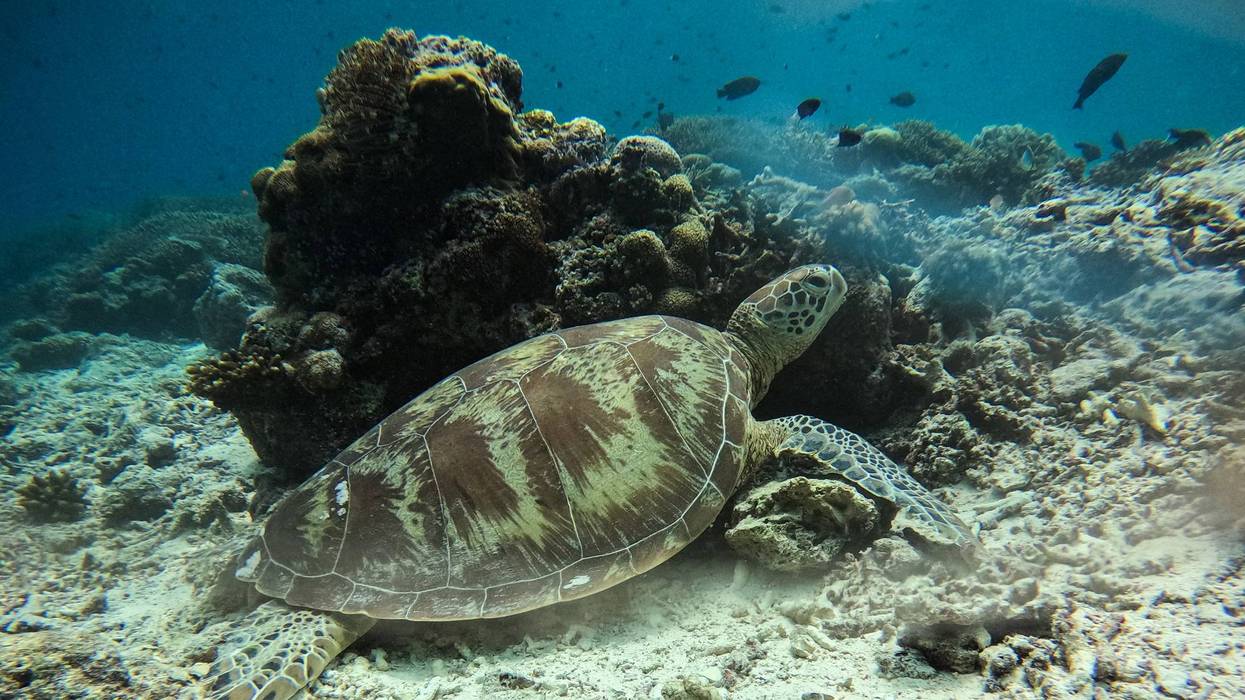
The study, published in the journal Nature, found that as of 2020, about 44% of coral species were threatened, compared with about one-third in 2008.
David Obura, a marine biologist and lead author of the study, said the new assessment "provides the most comprehensive evaluation to date of global extinction risk among reef-building corals, and a stark warning of the accelerating increase in global threats to coral reefs."
But he said it also "highlights the challenges we face in addressing major data and knowledge gaps on the status of species at global scales, at the same time as having to take urgent decisions to reduce the drivers of global declines in critical species and ecosystems.”
The researchers stressed that the data they analyzed understates the danger. The assessment does not take into account the damage from the devastating bleaching event that began in 2023 and lasted until mid-2025. According to the National Oceanic and Atmospheric Administration (NOAA), it was the largest such event ever recorded, exposing about 84% of the world's coral reef area to bleaching-level heat stress and causing widespread coral deaths.
It also doesn't take into account what meteorologists have projected could be the strongest El Niño ever, which could break ocean temperature records in the coming months, likely leading to another massive die-off of corals.
"It is entirely possible that reassessing the status of corals just after this coming El Niño may show them to have crossed the 50% mark of the proportion of species at elevated risk of extinction," Obura told AFP.
He noted that a previous "super" El Niño, in 1997-98, also caused tremendous damage to reefs.
"That this coming event is worse than that, after three intervening global bleaching events, is a terrifying reality," he said.
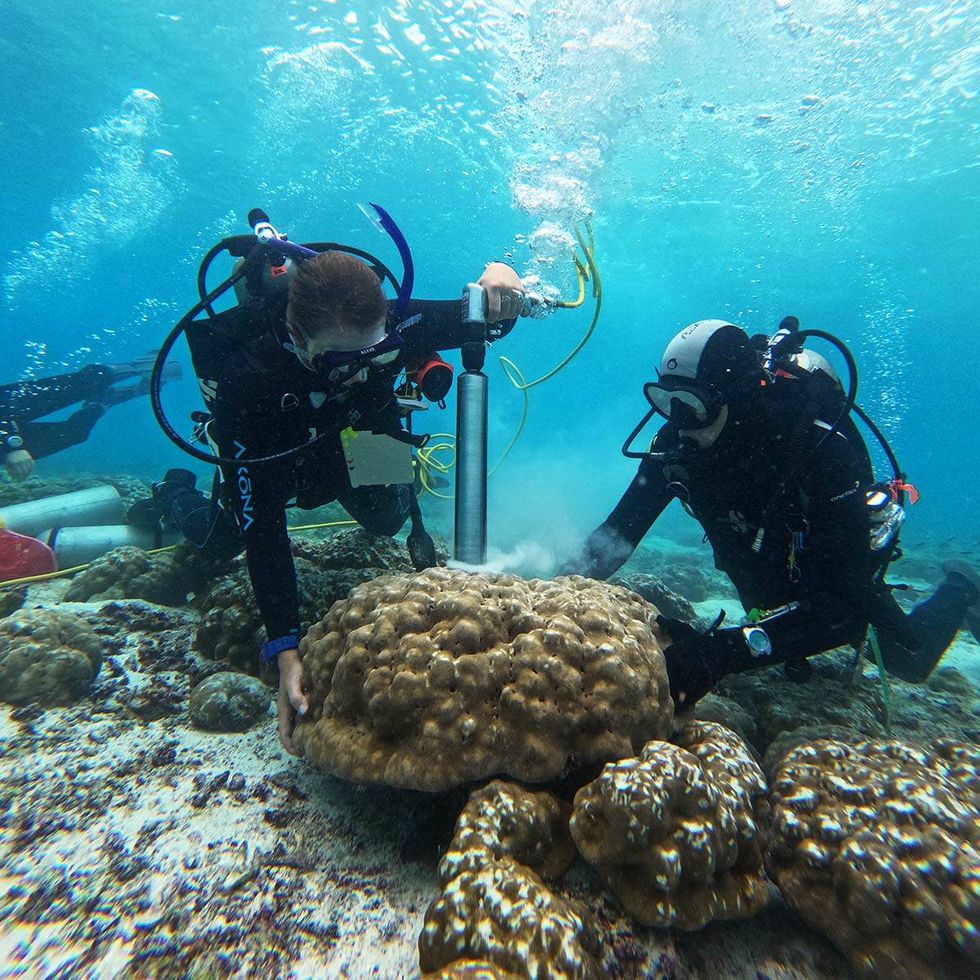 Researchers extract a fossil coral core sample from a massive coral colony in the Galápagos Islands to reconstruct historical climate and El Niño cycles as part of a study published in Science on August 27, 2026. (Photo by Julia Cole/Science)
In the new assessment, researchers found that human-caused climate change is the primary threat to reef-building coral, determining the fate of about 90% of the species at greatest risk.
They emphasized that coral reef health is more complex than simply "survival" versus "disappearance," and that every reduction in global greenhouse gas emissions matters.
“Coral reefs can feel a world away..." said Françoise Cabada-Blanco, a marine ecologist at the University of Portsmouth and co-author of the study. "But they cover a tiny fraction of the ocean floor, while supporting an enormous share of marine life and the food, coastal protection and livelihoods of millions of people."
"What happens to them affects all of us," she said. "The message from this assessment is that every tenth of a degree of warming we avoid gives corals a better chance—so action now really does count.”
A report published last year concluded that the globe had already passed the 1.2°C warming threshold for widespread coral reef dieback and found that unless global temperatures drop substantially, reefs could largely disappear.
“The crisis facing corals is deadly serious,” said Miyoko Sakashita, oceans director at the Center for Biological Diversity. “If we don’t take swift action to curb climate pollution, we could lose half of them forever.”
“We’ve already seen a lot of disruptions to sea life from the much warmer waters El Niño has brought this year, and I’m really worried about what that will do to threatened coral species," she added. "Coral reefs are the backbone of the ocean, and we can’t have a healthy marine ecosystem without them.”