5
#000000
#FFFFFF
To donate by check, phone, or other method, see our More Ways to Give page.
Daily news & progressive opinion—funded by the people, not the corporations—delivered straight to your inbox.
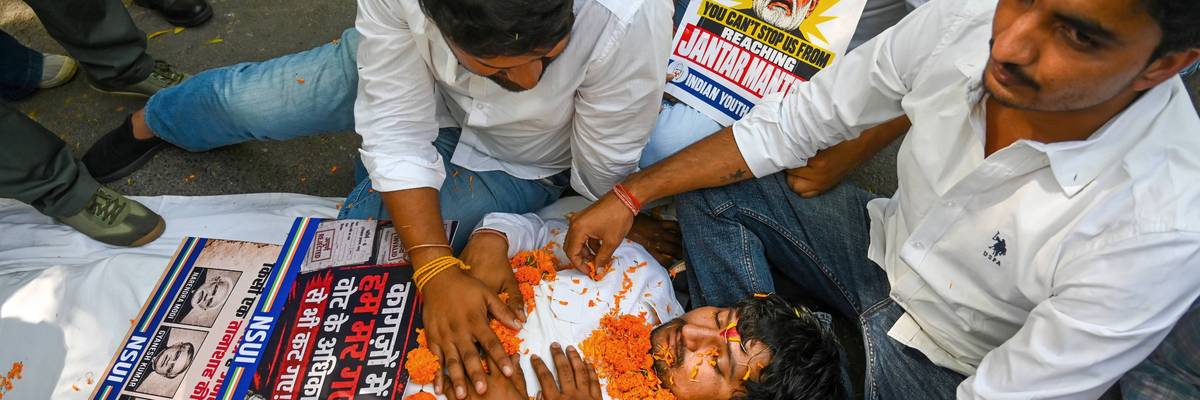
The National Students' Union of India (NSUI) holds a symbolic protest with demonstrators posing as voters who were kicked off of voter rolls on October 5, 2026 in New Delhi, India.
Hundreds of people have been arrested in recent days at youth-led protests over the removal of more than 130 million names from voter rolls.
As one advocate warned India's Supreme Court on Monday that "this country will burn" unless action is taken to stop what thousands of protesters have denounced as an illegal purge of voters by the head of the country's Election Commission, the court demanded accountability from Prime Minister Narendra Modi's government.
Chief Justice Surya Kant said in a hearing that the court had not approved changes to a new form used by the Election Commission of India for registering new voters, contradicting a statement from the ECI last month which said the document had been upheld by the court.
"Modified Form 6 has not been approved by us, let us be very clear," said Kant.
The court called on Modi's government, the ECI, and the head of the commission, Gyanesh Kumar, to answer "in a clear, transparent manner” for the massive upheaval of the national voter rolls, from which more than 130 million names have been removed in recent months.
The changes to the voter list have sparked calls for Kumar's resignation, particularly at protests that have erupted across the country, led by student groups and the Cockroach Janta Party (CJP), a political movement led by young people whom Kant compared to cockroaches earlier this year.
The group's website declares, "Gyanesh, it's done, bro," and thousands of people have joined protests like those that forced the resignation of India's education minister over the summer.
Last week, hundreds of protesters were detained, with journalists reportedly among those who were arrested—prompting outcry from Amnesty International over the government's "blatant attack on the rights to liberty and freedom of peaceful assembly."
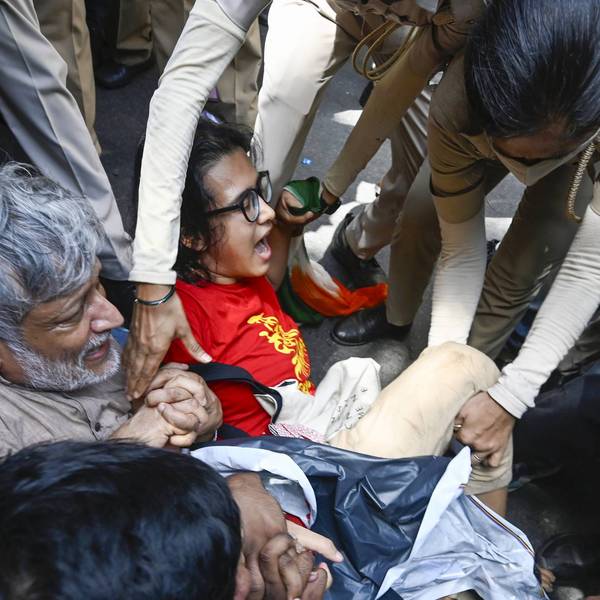
In New Delhi in particular, police have been denounced for their aggressive response to the uprising, forcing hundreds of people into police vehicles. Authorities said they were investigating reports that officers had sexually assaulted three journalists at the protests over the weekend.
The Supreme Court took up two petitions Monday, questioning the credibility of the ECI's efforts to "purify" the voter rolls, as the commission has said, and calling for an independent inquiry into Kumar's management of the "special intensive revision" (SIR) process.
Another hearing will be held later this week.
Kant said the court wanted a response from Kumar and the commission about allegations that decisions about the SIR were made unilaterally by Kumar. Media reports last month said the two other ECI commissioners had objected to the revision of voter rolls, which the government has claimed is aimed at eliminating duplicates and the names of dead and ineligible voters, as well as "illegal infiltrators."
People across Delhi and states including Bihar and West Bengal have said they were wrongly removed from voter rolls, and protesters have said the revision appeared to target Muslim voters, who have opposed Modi's Bharatiya Janata Party.
Protesters on Monday symbolically posed as dead people to show that voters have been wrongly eliminated from voter rolls, despite still being alive and eligible to participate in elections.
“Deletions of voters have been made in the largest democracy,” Menaka Guruswamy, a lawyer for one of the petitioners who brought the cases to the Supreme Court, told The Guardian. “We have grown up with free and fair elections, that is not the case now.”
Dear Common Dreams reader, It’s been nearly 30 years since I co-founded Common Dreams with my late wife, Lina Newhouser. We had the radical notion that journalism should serve the public good, not corporate profits. It was clear to us from the outset what it would take to build such a project. No paid advertisements. No corporate sponsors. No millionaire publisher telling us what to think or do. Many people said we wouldn't last a year, but we proved those doubters wrong. Together with a tremendous team of journalists and dedicated staff, we built an independent media outlet free from the constraints of profits and corporate control. Our mission has always been simple: To inform. To inspire. To ignite change for the common good. Building Common Dreams was not easy. Our survival was never guaranteed. When you take on the most powerful forces—Wall Street greed, fossil fuel industry destruction, Big Tech lobbyists, and uber-rich oligarchs who have spent billions upon billions rigging the economy and democracy in their favor—the only bulwark you have is supporters who believe in your work. But here’s the urgent message from me today. It's never been this bad out there. And it's never been this hard to keep us going. At the very moment Common Dreams is most needed, the threats we face are intensifying. We need your support now more than ever. We don't accept corporate advertising and never will. We don't have a paywall because we don't think people should be blocked from critical news based on their ability to pay. Everything we do is funded by the donations of readers like you. When everyone does the little they can afford, we are strong. But if that support retreats or dries up, so do we. Will you donate now to make sure Common Dreams not only survives but thrives? —Craig Brown, Co-founder |
As one advocate warned India's Supreme Court on Monday that "this country will burn" unless action is taken to stop what thousands of protesters have denounced as an illegal purge of voters by the head of the country's Election Commission, the court demanded accountability from Prime Minister Narendra Modi's government.
Chief Justice Surya Kant said in a hearing that the court had not approved changes to a new form used by the Election Commission of India for registering new voters, contradicting a statement from the ECI last month which said the document had been upheld by the court.
"Modified Form 6 has not been approved by us, let us be very clear," said Kant.
The court called on Modi's government, the ECI, and the head of the commission, Gyanesh Kumar, to answer "in a clear, transparent manner” for the massive upheaval of the national voter rolls, from which more than 130 million names have been removed in recent months.
The changes to the voter list have sparked calls for Kumar's resignation, particularly at protests that have erupted across the country, led by student groups and the Cockroach Janta Party (CJP), a political movement led by young people whom Kant compared to cockroaches earlier this year.
The group's website declares, "Gyanesh, it's done, bro," and thousands of people have joined protests like those that forced the resignation of India's education minister over the summer.
Last week, hundreds of protesters were detained, with journalists reportedly among those who were arrested—prompting outcry from Amnesty International over the government's "blatant attack on the rights to liberty and freedom of peaceful assembly."
In New Delhi in particular, police have been denounced for their aggressive response to the uprising, forcing hundreds of people into police vehicles. Authorities said they were investigating reports that officers had sexually assaulted three journalists at the protests over the weekend.
The Supreme Court took up two petitions Monday, questioning the credibility of the ECI's efforts to "purify" the voter rolls, as the commission has said, and calling for an independent inquiry into Kumar's management of the "special intensive revision" (SIR) process.
Another hearing will be held later this week.
Kant said the court wanted a response from Kumar and the commission about allegations that decisions about the SIR were made unilaterally by Kumar. Media reports last month said the two other ECI commissioners had objected to the revision of voter rolls, which the government has claimed is aimed at eliminating duplicates and the names of dead and ineligible voters, as well as "illegal infiltrators."
People across Delhi and states including Bihar and West Bengal have said they were wrongly removed from voter rolls, and protesters have said the revision appeared to target Muslim voters, who have opposed Modi's Bharatiya Janata Party.
Protesters on Monday symbolically posed as dead people to show that voters have been wrongly eliminated from voter rolls, despite still being alive and eligible to participate in elections.
“Deletions of voters have been made in the largest democracy,” Menaka Guruswamy, a lawyer for one of the petitioners who brought the cases to the Supreme Court, told The Guardian. “We have grown up with free and fair elections, that is not the case now.”
As one advocate warned India's Supreme Court on Monday that "this country will burn" unless action is taken to stop what thousands of protesters have denounced as an illegal purge of voters by the head of the country's Election Commission, the court demanded accountability from Prime Minister Narendra Modi's government.
Chief Justice Surya Kant said in a hearing that the court had not approved changes to a new form used by the Election Commission of India for registering new voters, contradicting a statement from the ECI last month which said the document had been upheld by the court.
"Modified Form 6 has not been approved by us, let us be very clear," said Kant.
The court called on Modi's government, the ECI, and the head of the commission, Gyanesh Kumar, to answer "in a clear, transparent manner” for the massive upheaval of the national voter rolls, from which more than 130 million names have been removed in recent months.
The changes to the voter list have sparked calls for Kumar's resignation, particularly at protests that have erupted across the country, led by student groups and the Cockroach Janta Party (CJP), a political movement led by young people whom Kant compared to cockroaches earlier this year.
The group's website declares, "Gyanesh, it's done, bro," and thousands of people have joined protests like those that forced the resignation of India's education minister over the summer.
Last week, hundreds of protesters were detained, with journalists reportedly among those who were arrested—prompting outcry from Amnesty International over the government's "blatant attack on the rights to liberty and freedom of peaceful assembly."
In New Delhi in particular, police have been denounced for their aggressive response to the uprising, forcing hundreds of people into police vehicles. Authorities said they were investigating reports that officers had sexually assaulted three journalists at the protests over the weekend.
The Supreme Court took up two petitions Monday, questioning the credibility of the ECI's efforts to "purify" the voter rolls, as the commission has said, and calling for an independent inquiry into Kumar's management of the "special intensive revision" (SIR) process.
Another hearing will be held later this week.
Kant said the court wanted a response from Kumar and the commission about allegations that decisions about the SIR were made unilaterally by Kumar. Media reports last month said the two other ECI commissioners had objected to the revision of voter rolls, which the government has claimed is aimed at eliminating duplicates and the names of dead and ineligible voters, as well as "illegal infiltrators."
People across Delhi and states including Bihar and West Bengal have said they were wrongly removed from voter rolls, and protesters have said the revision appeared to target Muslim voters, who have opposed Modi's Bharatiya Janata Party.
Protesters on Monday symbolically posed as dead people to show that voters have been wrongly eliminated from voter rolls, despite still being alive and eligible to participate in elections.
“Deletions of voters have been made in the largest democracy,” Menaka Guruswamy, a lawyer for one of the petitioners who brought the cases to the Supreme Court, told The Guardian. “We have grown up with free and fair elections, that is not the case now.”