SUBSCRIBE TO OUR FREE NEWSLETTER
Daily news & progressive opinion—funded by the people, not the corporations—delivered straight to your inbox.
5
#000000
#FFFFFF
To donate by check, phone, or other method, see our More Ways to Give page.
Daily news & progressive opinion—funded by the people, not the corporations—delivered straight to your inbox.
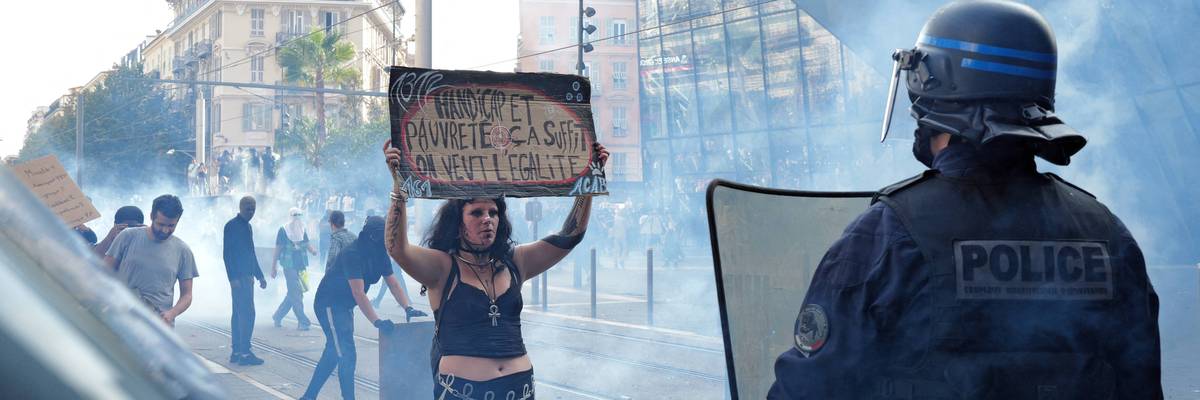
A protester holds a sign in front of a police officer in Nice, southern France, on October 17, 2026.
"For years we've had climate, economy, and equality problems, but the government is not doing anything about it," said one protester.
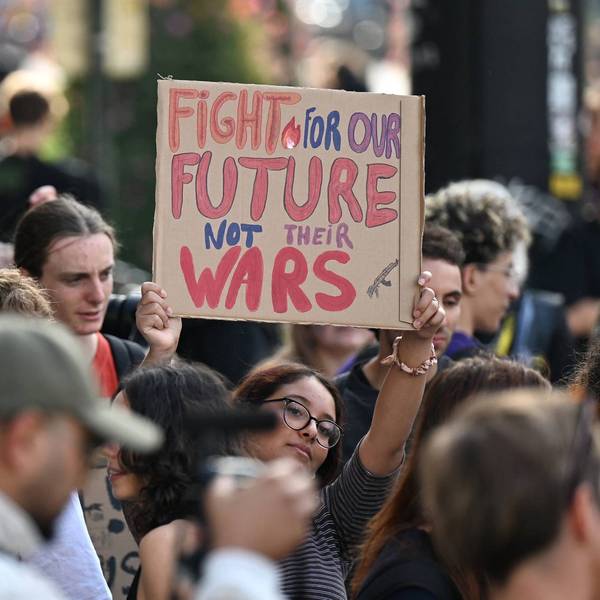
Protests erupted throughout France on Saturday, with demonstrators citing a wide variety of grievances including inequality, the high cost of living, and poor conditions in the nation's schools.
As reported by Agence France-Presse, tens of thousands of demonstrators marched in Paris and other cities to protest what they said was inaction by the French government on the biggest problems facing the country.
"For years we've had climate, economy, and equality problems," one protester identified as Agnes told AFP, "but the government is not doing anything about it."
18-year-old student Kamil Alahyan told AFP that there are "so many reasons" to protest, including "the elections coming up in 2027, politicians who lie, the ultra-rich who've been taking more and more wealth over the past 10 years."
A 19-year-old protester identified as Lola expressed a similar view in an interview published by The Guardian on Saturday.
"We are fighting because the cost of living is too harsh," Lola said, "because the price of fuel is too high, because high school pupils are being violently attacked and hurt all over the country just for trying to protest and ask for more teachers and decent learning conditions."
Student organizer Ryad Rani told AFP that "the government is trembling and it's right to tremble because when the French people are angry, they never let up."
Saturday's demonstrations mark the expansion of a movement that began last month when students blockaded their schools to protest staffing shortages, dilapidated buildings, and a widely criticized university application system.
According to The New York Times, demonstrations took place in at least 140 cities across the country.
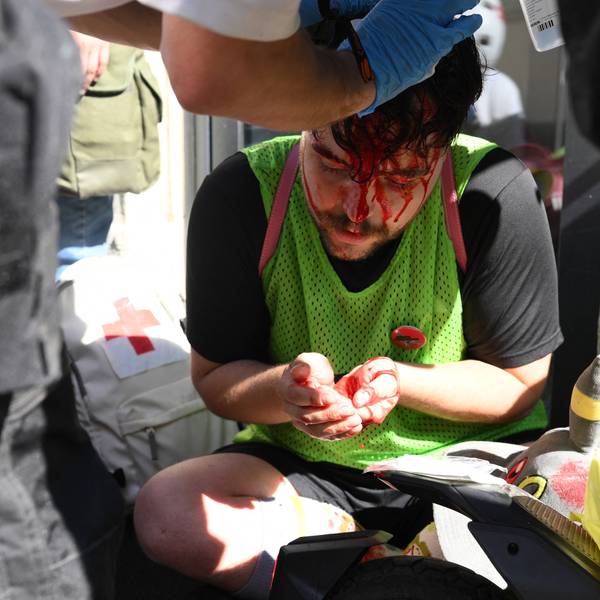
Some of the protests did turn violent in major cities including Lyon, Marseille, and Paris, AFP reported. A Saturday BBC report claimed that more than 270 protesters have been arrested nationwide.
French Prime Minister Sébastien Lecornu accused "ultra-left groups" of inciting violence at the demonstrations.
"To those who clearly want to use these acts of violence as a 'warm-up' ahead of the presidential election, let me be clear: we will not be intimidated," Lecornu wrote in a social media post. "No one will impose their political agenda through violence."
Jean-Luc Mélenchon, leader the left-wing France Unbowed party, slammed the media for focusing too much on the isolated incidents of violence and not reporting on the overwhelmingly peaceful nature of the demonstrations.
"Crowds of people everywhere, calm and joyful everywhere when the police aren't around," Mélenchon wrote in a social media post that featured photos of peaceful marches from across the country, which he described as "images you won't see in the official media."
Dear Common Dreams reader, It’s been nearly 30 years since I co-founded Common Dreams with my late wife, Lina Newhouser. We had the radical notion that journalism should serve the public good, not corporate profits. It was clear to us from the outset what it would take to build such a project. No paid advertisements. No corporate sponsors. No millionaire publisher telling us what to think or do. Many people said we wouldn't last a year, but we proved those doubters wrong. Together with a tremendous team of journalists and dedicated staff, we built an independent media outlet free from the constraints of profits and corporate control. Our mission has always been simple: To inform. To inspire. To ignite change for the common good. Building Common Dreams was not easy. Our survival was never guaranteed. When you take on the most powerful forces—Wall Street greed, fossil fuel industry destruction, Big Tech lobbyists, and uber-rich oligarchs who have spent billions upon billions rigging the economy and democracy in their favor—the only bulwark you have is supporters who believe in your work. But here’s the urgent message from me today. It's never been this bad out there. And it's never been this hard to keep us going. At the very moment Common Dreams is most needed, the threats we face are intensifying. We need your support now more than ever. We don't accept corporate advertising and never will. We don't have a paywall because we don't think people should be blocked from critical news based on their ability to pay. Everything we do is funded by the donations of readers like you. When everyone does the little they can afford, we are strong. But if that support retreats or dries up, so do we. Will you donate now to make sure Common Dreams not only survives but thrives? —Craig Brown, Co-founder |
Protests erupted throughout France on Saturday, with demonstrators citing a wide variety of grievances including inequality, the high cost of living, and poor conditions in the nation's schools.
As reported by Agence France-Presse, tens of thousands of demonstrators marched in Paris and other cities to protest what they said was inaction by the French government on the biggest problems facing the country.
"For years we've had climate, economy, and equality problems," one protester identified as Agnes told AFP, "but the government is not doing anything about it."
18-year-old student Kamil Alahyan told AFP that there are "so many reasons" to protest, including "the elections coming up in 2027, politicians who lie, the ultra-rich who've been taking more and more wealth over the past 10 years."
A 19-year-old protester identified as Lola expressed a similar view in an interview published by The Guardian on Saturday.
"We are fighting because the cost of living is too harsh," Lola said, "because the price of fuel is too high, because high school pupils are being violently attacked and hurt all over the country just for trying to protest and ask for more teachers and decent learning conditions."
Student organizer Ryad Rani told AFP that "the government is trembling and it's right to tremble because when the French people are angry, they never let up."
Saturday's demonstrations mark the expansion of a movement that began last month when students blockaded their schools to protest staffing shortages, dilapidated buildings, and a widely criticized university application system.
According to The New York Times, demonstrations took place in at least 140 cities across the country.
Some of the protests did turn violent in major cities including Lyon, Marseille, and Paris, AFP reported. A Saturday BBC report claimed that more than 270 protesters have been arrested nationwide.
French Prime Minister Sébastien Lecornu accused "ultra-left groups" of inciting violence at the demonstrations.
"To those who clearly want to use these acts of violence as a 'warm-up' ahead of the presidential election, let me be clear: we will not be intimidated," Lecornu wrote in a social media post. "No one will impose their political agenda through violence."
Jean-Luc Mélenchon, leader the left-wing France Unbowed party, slammed the media for focusing too much on the isolated incidents of violence and not reporting on the overwhelmingly peaceful nature of the demonstrations.
"Crowds of people everywhere, calm and joyful everywhere when the police aren't around," Mélenchon wrote in a social media post that featured photos of peaceful marches from across the country, which he described as "images you won't see in the official media."
Protests erupted throughout France on Saturday, with demonstrators citing a wide variety of grievances including inequality, the high cost of living, and poor conditions in the nation's schools.
As reported by Agence France-Presse, tens of thousands of demonstrators marched in Paris and other cities to protest what they said was inaction by the French government on the biggest problems facing the country.
"For years we've had climate, economy, and equality problems," one protester identified as Agnes told AFP, "but the government is not doing anything about it."
18-year-old student Kamil Alahyan told AFP that there are "so many reasons" to protest, including "the elections coming up in 2027, politicians who lie, the ultra-rich who've been taking more and more wealth over the past 10 years."
A 19-year-old protester identified as Lola expressed a similar view in an interview published by The Guardian on Saturday.
"We are fighting because the cost of living is too harsh," Lola said, "because the price of fuel is too high, because high school pupils are being violently attacked and hurt all over the country just for trying to protest and ask for more teachers and decent learning conditions."
Student organizer Ryad Rani told AFP that "the government is trembling and it's right to tremble because when the French people are angry, they never let up."
Saturday's demonstrations mark the expansion of a movement that began last month when students blockaded their schools to protest staffing shortages, dilapidated buildings, and a widely criticized university application system.
According to The New York Times, demonstrations took place in at least 140 cities across the country.
Some of the protests did turn violent in major cities including Lyon, Marseille, and Paris, AFP reported. A Saturday BBC report claimed that more than 270 protesters have been arrested nationwide.
French Prime Minister Sébastien Lecornu accused "ultra-left groups" of inciting violence at the demonstrations.
"To those who clearly want to use these acts of violence as a 'warm-up' ahead of the presidential election, let me be clear: we will not be intimidated," Lecornu wrote in a social media post. "No one will impose their political agenda through violence."
Jean-Luc Mélenchon, leader the left-wing France Unbowed party, slammed the media for focusing too much on the isolated incidents of violence and not reporting on the overwhelmingly peaceful nature of the demonstrations.
"Crowds of people everywhere, calm and joyful everywhere when the police aren't around," Mélenchon wrote in a social media post that featured photos of peaceful marches from across the country, which he described as "images you won't see in the official media."