SUBSCRIBE TO OUR FREE NEWSLETTER
Daily news & progressive opinion—funded by the people, not the corporations—delivered straight to your inbox.
5
#000000
#FFFFFF
To donate by check, phone, or other method, see our More Ways to Give page.
Daily news & progressive opinion—funded by the people, not the corporations—delivered straight to your inbox.
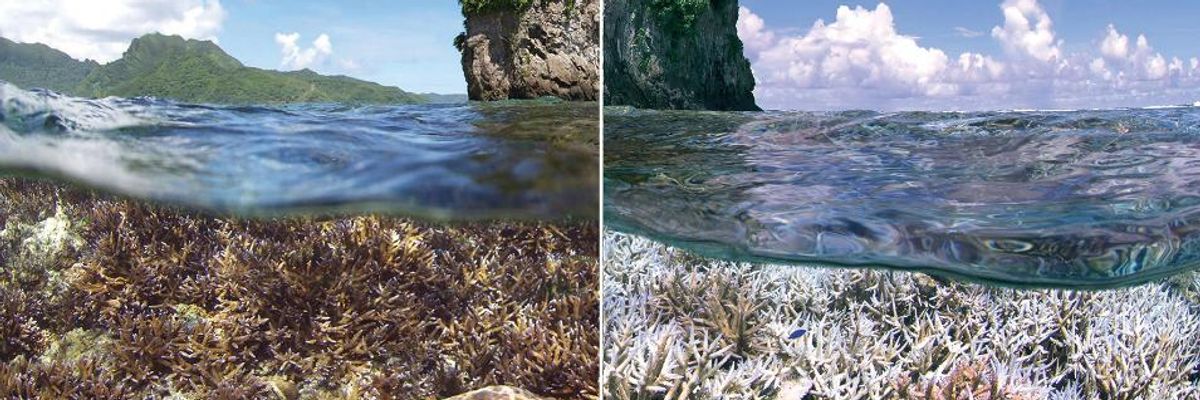
United Nations scientists estimate that global temperature rise of just 2degC could kill 99% of the planet's corals.
In a new report about how the world's coral reefs face "the combined threats of climate change, pollution, and overfishing"--endangering the future of marine biodiversity--a London-based nonprofit calls for greater global efforts to end the climate crisis and ensure the survival of these vital underwater ecosystems.
The report, entitled Marine Havens Under Threat: The impacts of the climate crisis on tropical coral reefs and the communities that rely on them (pdf), was published Wednesday by the Environmental Justice Foundation (EJF).
EJF warns that because of human activities that heat and pollute the planet, coral reefs "are under imminent risk of destruction," pointing to a recent estimate from the United Nations' Intergovernmental Panel on Climate Change (IPCC) that global warming of 2degC could kill 99% of all corals.
The ocean, which covers more than 70% of the planet, "has taken up between 20-30% of total anthropogenic CO2 emissions since the 1980s causing further ocean acidification," according to an IPCC special report from last year. The lead author of a study published last week said that "the amount of heat we have put in the world's oceans in the past 25 years equals to 3.6 billion Hiroshima atom-bomb explosions."
Some scientists refer to three key climate-related pressures on the marine environment--warming, acidification, and oxygen loss--as the "deadly trio." Experts also warn that human-caused global heating leads to sea level rise and certain extreme weather events becoming more frequent and intense.
"As the global temperature rises, reefs will be put at risk from warming oceans, higher frequency cyclones, increased precipitation, sea level rise, rising acidification, and changing ocean circulation," the EJF report says. "These factors alter the delicate balance of conditions necessary for tropical coral reefs to function, causing bleaching and destruction of reefs. In many cases, this damage is irreversible."
Marine heatwaves, which experts warn will become more common as humans continue to heat the planet, have led to major coral bleaching events around the world in recent years. A study from 2018 concluded that the Great Barrier Reef off the coast of Australia, the world's largest coral system, was "forever damaged" following back-to-back bleaching events that collectively killed half of the corals.
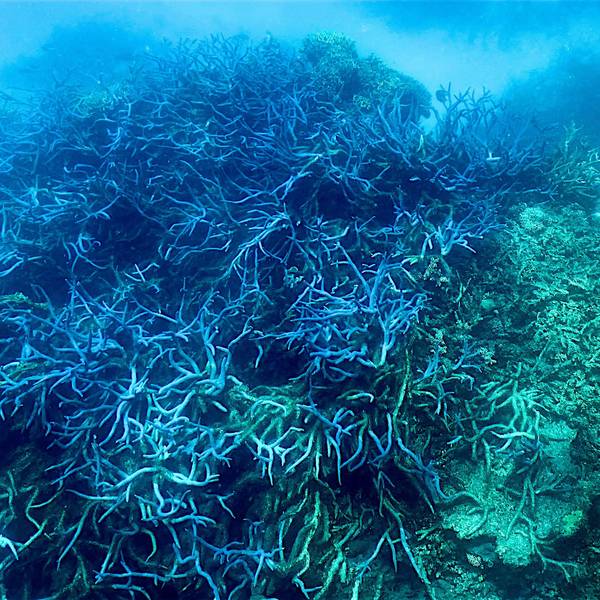
Bleaching refers to when stressors such as warm water and pollution lead coral to expel algae, its main food source, and turn white. Bleached coral faces a greater risk of disease and death but can recover if surrounding conditions improve. Last year, a study about severe marine heatwaves heightened alarm about the future; researchers found cases where "the water temperatures are so warm that the coral animal doesn't bleach--in terms of a loss of its symbiosis--the animal dies and its underlying skeleton is all that remains."
EJF, in its new report and an accompanying video, highlighted the consequences of coral bleaching and death events for both marine wildlife and humans.
"Tropical coral reefs support an estimated quarter of all marine species: hundreds of thousands of animal and plant species, who rely on the reef for food, shelter, and a safe place to live and reproduce," the report says. "These complex ecosystems include hard and soft corals, sponges, crustaceans, molluscs, fish, sea turtles, sharks, dolphins, and much more--including 'foundation' and 'keystone' species such as corals and sea turtles."
The report also spotlights a U.N. estimate that at least 275 million people rely on healthy coral reefs as an "essential source of food, employment, income, and storm protection for coastal communities."
In terms of the economic value of coral reefs, EJF puts tourism and recreation at $9.6 billion, coastal protection at $9 billion, fisheries at $5.7 billion, and wildlife at $5.5 billion. Directly below the economic figures, the report features "a note of caution: Valuing biodiversity in this way is of course subjective, how do we put a value on a species' intrinsic right to exist?"
To combat the triple threat that coral reefs are facing, EJF puts forth recommendations to end the climate crisis: implement the Paris agreement and fully transition all industrial economies to zero carbon by 2030, create a European Union inter-agency taskforce "to drive a more effective, integrated" global response, and establish a U.N. special rapporteur on human rights, economic well-being, and climate change.
EJF presents another set of specific recommendations to ensure that remaining corals "survive the climate change that is irreversible," calling for an end to illegal and unsustainable fishing as well as pollution that harms coral, including agricultural runoff, sewage, and plastic. The group also calls for expanding marine protected areas to cover at least 30% of the ocean, and assuring that such zones have "clear restrictions and effective conservation aims."
"In all deliberations and future negotiations," the report adds, "all stakeholders must be included, with special reference to local communities."
Acknowledging that coral reefs "are not only a vital source of food and income for millions of people" but also "home to a vast diversity of irreplaceable wildlife," EJF executive director Steve Trent warned Wednesday that "failure to act now to protect them will cause environmental ruin and with it a human tragedy."
Dear Common Dreams reader, It’s been nearly 30 years since I co-founded Common Dreams with my late wife, Lina Newhouser. We had the radical notion that journalism should serve the public good, not corporate profits. It was clear to us from the outset what it would take to build such a project. No paid advertisements. No corporate sponsors. No millionaire publisher telling us what to think or do. Many people said we wouldn't last a year, but we proved those doubters wrong. Together with a tremendous team of journalists and dedicated staff, we built an independent media outlet free from the constraints of profits and corporate control. Our mission has always been simple: To inform. To inspire. To ignite change for the common good. Building Common Dreams was not easy. Our survival was never guaranteed. When you take on the most powerful forces—Wall Street greed, fossil fuel industry destruction, Big Tech lobbyists, and uber-rich oligarchs who have spent billions upon billions rigging the economy and democracy in their favor—the only bulwark you have is supporters who believe in your work. But here’s the urgent message from me today. It's never been this bad out there. And it's never been this hard to keep us going. At the very moment Common Dreams is most needed, the threats we face are intensifying. We need your support now more than ever. We don't accept corporate advertising and never will. We don't have a paywall because we don't think people should be blocked from critical news based on their ability to pay. Everything we do is funded by the donations of readers like you. When everyone does the little they can afford, we are strong. But if that support retreats or dries up, so do we. Will you donate now to make sure Common Dreams not only survives but thrives? —Craig Brown, Co-founder |
In a new report about how the world's coral reefs face "the combined threats of climate change, pollution, and overfishing"--endangering the future of marine biodiversity--a London-based nonprofit calls for greater global efforts to end the climate crisis and ensure the survival of these vital underwater ecosystems.
The report, entitled Marine Havens Under Threat: The impacts of the climate crisis on tropical coral reefs and the communities that rely on them (pdf), was published Wednesday by the Environmental Justice Foundation (EJF).
EJF warns that because of human activities that heat and pollute the planet, coral reefs "are under imminent risk of destruction," pointing to a recent estimate from the United Nations' Intergovernmental Panel on Climate Change (IPCC) that global warming of 2degC could kill 99% of all corals.
The ocean, which covers more than 70% of the planet, "has taken up between 20-30% of total anthropogenic CO2 emissions since the 1980s causing further ocean acidification," according to an IPCC special report from last year. The lead author of a study published last week said that "the amount of heat we have put in the world's oceans in the past 25 years equals to 3.6 billion Hiroshima atom-bomb explosions."
Some scientists refer to three key climate-related pressures on the marine environment--warming, acidification, and oxygen loss--as the "deadly trio." Experts also warn that human-caused global heating leads to sea level rise and certain extreme weather events becoming more frequent and intense.
"As the global temperature rises, reefs will be put at risk from warming oceans, higher frequency cyclones, increased precipitation, sea level rise, rising acidification, and changing ocean circulation," the EJF report says. "These factors alter the delicate balance of conditions necessary for tropical coral reefs to function, causing bleaching and destruction of reefs. In many cases, this damage is irreversible."
Marine heatwaves, which experts warn will become more common as humans continue to heat the planet, have led to major coral bleaching events around the world in recent years. A study from 2018 concluded that the Great Barrier Reef off the coast of Australia, the world's largest coral system, was "forever damaged" following back-to-back bleaching events that collectively killed half of the corals.
Bleaching refers to when stressors such as warm water and pollution lead coral to expel algae, its main food source, and turn white. Bleached coral faces a greater risk of disease and death but can recover if surrounding conditions improve. Last year, a study about severe marine heatwaves heightened alarm about the future; researchers found cases where "the water temperatures are so warm that the coral animal doesn't bleach--in terms of a loss of its symbiosis--the animal dies and its underlying skeleton is all that remains."
EJF, in its new report and an accompanying video, highlighted the consequences of coral bleaching and death events for both marine wildlife and humans.
"Tropical coral reefs support an estimated quarter of all marine species: hundreds of thousands of animal and plant species, who rely on the reef for food, shelter, and a safe place to live and reproduce," the report says. "These complex ecosystems include hard and soft corals, sponges, crustaceans, molluscs, fish, sea turtles, sharks, dolphins, and much more--including 'foundation' and 'keystone' species such as corals and sea turtles."
The report also spotlights a U.N. estimate that at least 275 million people rely on healthy coral reefs as an "essential source of food, employment, income, and storm protection for coastal communities."
In terms of the economic value of coral reefs, EJF puts tourism and recreation at $9.6 billion, coastal protection at $9 billion, fisheries at $5.7 billion, and wildlife at $5.5 billion. Directly below the economic figures, the report features "a note of caution: Valuing biodiversity in this way is of course subjective, how do we put a value on a species' intrinsic right to exist?"
To combat the triple threat that coral reefs are facing, EJF puts forth recommendations to end the climate crisis: implement the Paris agreement and fully transition all industrial economies to zero carbon by 2030, create a European Union inter-agency taskforce "to drive a more effective, integrated" global response, and establish a U.N. special rapporteur on human rights, economic well-being, and climate change.
EJF presents another set of specific recommendations to ensure that remaining corals "survive the climate change that is irreversible," calling for an end to illegal and unsustainable fishing as well as pollution that harms coral, including agricultural runoff, sewage, and plastic. The group also calls for expanding marine protected areas to cover at least 30% of the ocean, and assuring that such zones have "clear restrictions and effective conservation aims."
"In all deliberations and future negotiations," the report adds, "all stakeholders must be included, with special reference to local communities."
Acknowledging that coral reefs "are not only a vital source of food and income for millions of people" but also "home to a vast diversity of irreplaceable wildlife," EJF executive director Steve Trent warned Wednesday that "failure to act now to protect them will cause environmental ruin and with it a human tragedy."
In a new report about how the world's coral reefs face "the combined threats of climate change, pollution, and overfishing"--endangering the future of marine biodiversity--a London-based nonprofit calls for greater global efforts to end the climate crisis and ensure the survival of these vital underwater ecosystems.
The report, entitled Marine Havens Under Threat: The impacts of the climate crisis on tropical coral reefs and the communities that rely on them (pdf), was published Wednesday by the Environmental Justice Foundation (EJF).
EJF warns that because of human activities that heat and pollute the planet, coral reefs "are under imminent risk of destruction," pointing to a recent estimate from the United Nations' Intergovernmental Panel on Climate Change (IPCC) that global warming of 2degC could kill 99% of all corals.
The ocean, which covers more than 70% of the planet, "has taken up between 20-30% of total anthropogenic CO2 emissions since the 1980s causing further ocean acidification," according to an IPCC special report from last year. The lead author of a study published last week said that "the amount of heat we have put in the world's oceans in the past 25 years equals to 3.6 billion Hiroshima atom-bomb explosions."
Some scientists refer to three key climate-related pressures on the marine environment--warming, acidification, and oxygen loss--as the "deadly trio." Experts also warn that human-caused global heating leads to sea level rise and certain extreme weather events becoming more frequent and intense.
"As the global temperature rises, reefs will be put at risk from warming oceans, higher frequency cyclones, increased precipitation, sea level rise, rising acidification, and changing ocean circulation," the EJF report says. "These factors alter the delicate balance of conditions necessary for tropical coral reefs to function, causing bleaching and destruction of reefs. In many cases, this damage is irreversible."
Marine heatwaves, which experts warn will become more common as humans continue to heat the planet, have led to major coral bleaching events around the world in recent years. A study from 2018 concluded that the Great Barrier Reef off the coast of Australia, the world's largest coral system, was "forever damaged" following back-to-back bleaching events that collectively killed half of the corals.
Bleaching refers to when stressors such as warm water and pollution lead coral to expel algae, its main food source, and turn white. Bleached coral faces a greater risk of disease and death but can recover if surrounding conditions improve. Last year, a study about severe marine heatwaves heightened alarm about the future; researchers found cases where "the water temperatures are so warm that the coral animal doesn't bleach--in terms of a loss of its symbiosis--the animal dies and its underlying skeleton is all that remains."
EJF, in its new report and an accompanying video, highlighted the consequences of coral bleaching and death events for both marine wildlife and humans.
"Tropical coral reefs support an estimated quarter of all marine species: hundreds of thousands of animal and plant species, who rely on the reef for food, shelter, and a safe place to live and reproduce," the report says. "These complex ecosystems include hard and soft corals, sponges, crustaceans, molluscs, fish, sea turtles, sharks, dolphins, and much more--including 'foundation' and 'keystone' species such as corals and sea turtles."
The report also spotlights a U.N. estimate that at least 275 million people rely on healthy coral reefs as an "essential source of food, employment, income, and storm protection for coastal communities."
In terms of the economic value of coral reefs, EJF puts tourism and recreation at $9.6 billion, coastal protection at $9 billion, fisheries at $5.7 billion, and wildlife at $5.5 billion. Directly below the economic figures, the report features "a note of caution: Valuing biodiversity in this way is of course subjective, how do we put a value on a species' intrinsic right to exist?"
To combat the triple threat that coral reefs are facing, EJF puts forth recommendations to end the climate crisis: implement the Paris agreement and fully transition all industrial economies to zero carbon by 2030, create a European Union inter-agency taskforce "to drive a more effective, integrated" global response, and establish a U.N. special rapporteur on human rights, economic well-being, and climate change.
EJF presents another set of specific recommendations to ensure that remaining corals "survive the climate change that is irreversible," calling for an end to illegal and unsustainable fishing as well as pollution that harms coral, including agricultural runoff, sewage, and plastic. The group also calls for expanding marine protected areas to cover at least 30% of the ocean, and assuring that such zones have "clear restrictions and effective conservation aims."
"In all deliberations and future negotiations," the report adds, "all stakeholders must be included, with special reference to local communities."
Acknowledging that coral reefs "are not only a vital source of food and income for millions of people" but also "home to a vast diversity of irreplaceable wildlife," EJF executive director Steve Trent warned Wednesday that "failure to act now to protect them will cause environmental ruin and with it a human tragedy."