Vance Defends 'Vile' Ramaswamy Ad, Offering Preview of 'Venom' He's Likely to Deploy in 2028 Race
Vivek Ramaswamy's ad exposed him as "digusting, vile, and unfit," said one former Republican lawmaker, but "JD Vance arrives to show there’s someone even worse."
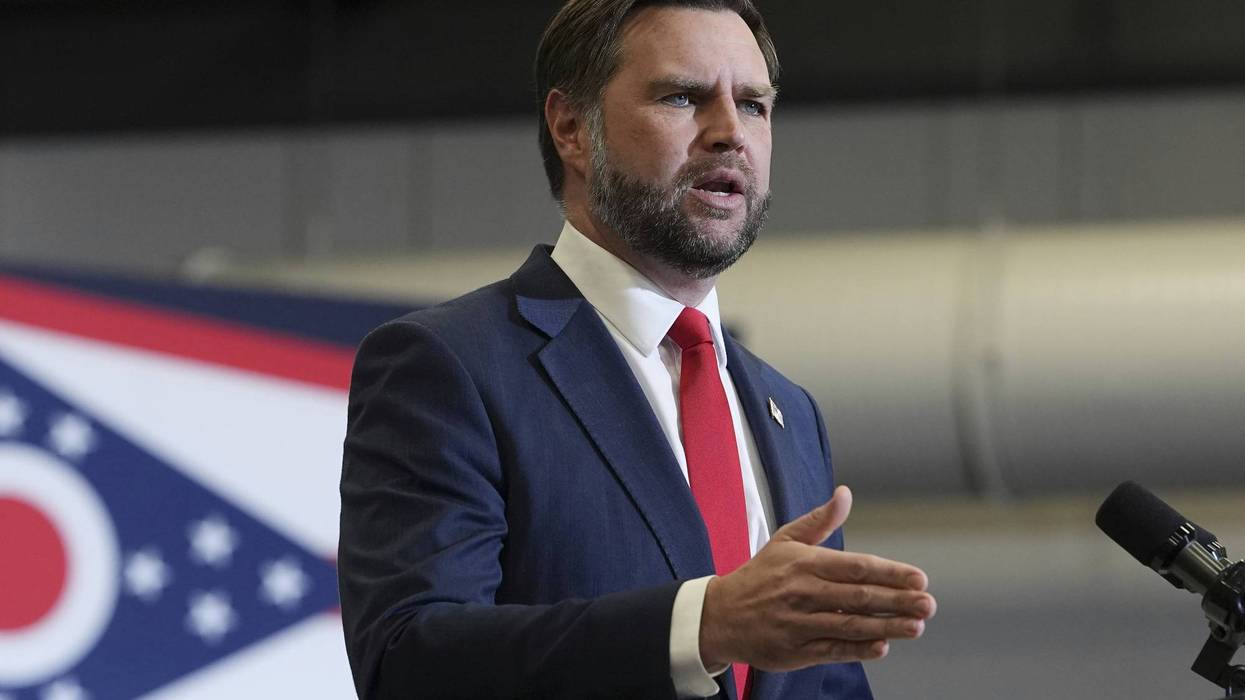
A day after the Republican gubernatorial candidate in Ohio, Vivek Ramaswamy, stunned political observers by releasing an ad that featured the estranged mother of his opponent, Amy Acton, calling Acton "a liar," Vice President JD Vance told reporters during an appearance in the state that he was "disgusted."
But the vice president, widely viewed as the likely heir to President Donald Trump's far-right MAGA movement, wasn't disturbed by the content of the ad, in which Acton's biological mother, Donna Arthur, accused Acton of lying about experiencing homelessness as a child.
He wasn't troubled by the fact that Ramaswamy's campaign had enlisted the help of Arthur even though she lost custody of her children and hadn't seen Acton since 1978, when the Democratic candidate was 12 and testified in court that her stepfather, Arthur's husband, had raped Acton. And he didn't express horror over the fact that Arthur fled the state with her husband to avoid legal liability and stayed married to him until his death in 2004 despite his alleged abuse of her daughter, only to be featured in an ad attacking Acton more than two decades later.
Instead, Vance reserved his "disgust" for Republicans who condemned the ad, which Ramaswamy's campaign is now planning to spend $4 million streaming ahead of Election Day.
While the ad has been called "the most disgusting, pathetic ad ever created in the history of political ads" by one observer and has resulted in calls for an end to Ramaswamy's political career, Vance shrugged off the content of the 60-second video by saying, "Politics is a tough business."
He called on his fellow Republicans, some of whom have denounced the ad, to put aside concerns about attacking Acton, whose allegations are backed up by court records—and to focus instead on the dangers posed by Democratic candidates like Acton who have called to expand healthcare access, lower costs for working Americans, and support workers' rights.
"My message to my fellow elected Republicans is if you actually believe in the things you say you believe in, stop whining about an advertisement and go win the race in 13 days," Vance told reporters in Cincinnati.
WOW -- Vance *defends* Ramaswamy's reprehensible ad 👇Q: Ramaswamy's campaign put out a controversial ad featuring his opponent's mother. Some Republicans are backing away from that. Do you think that ad was appropriate?JD VANCE: Well, I'll be honest with you. Whether the ad was appropriate or not is not really my concern. My concern is who is gonna govern. I have to admit I'm a little bit disgusted when I see Republicans who are whining more about that ad than they are about what the Democrats want to do.
— Aaron Rupar (@atrupar) October 21, 2026
The vice president added that "whether the ad was appropriate or not is not really my concern" and said he was "disgusted" to see Republicans "who are whining more about that advertisement than they are about what the congressional Democrats and other Democrats want to do to the United States of America."
Vance's position on Ramaswamy's tactics—deployed as Acton was leading him by seven points in one poll by Marist College—brought to mind, for some observers, his comments in 2024 about the Trump campaign's spreading of racist, baseless lies about the Haitian population of Springfield, Ohio eating their neighbors' pets during the presidential race.
Vance told CNN at the time that he was willing “to create stories so that the... media actually pays attention to the suffering of the American people."
"Vance's earlier Haitian pet-eating lie and his current embrace of Vivek's weaponization of child abuse are providing a pretty ugly picture of what the Vance 2028 presidential campaign is going to look like," said Jessica Reidl of the Brookings Institution. "Just venom, lies, and smears all the way down."
Republicans who have attempted to distance themselves from Ramaswamy's ad include US Sen. John Husted of Ohio and the state's secretary of state, Frank LaRose, both of whom said they would not have chosen to run such an advertisement. LaRose said his office was reviewing complaints about the video.
An aide for Sen. Mike Lee (R-Utah) deleted a social media post sharing the video and apologized for amplifying it “after researching it, and the disturbing allegations.” Casey Putsch, who ran against Ramaswamy in the GOP primary, said he would cross party lines to "vote for Amy and end Vivek's political future in America" in light of the ad, while former United Nations Ambassador Nikki Haley, who sparred with Ramaswamy during the 2024 race, also denounced the video.
After Vance's press conference, former US Rep. Barbara Comstock (R-Va.) said that while the ad had exposed Ramaswamy as "digusting, vile, and unfit, JD Vance arrives to show there’s someone even worse."
In addition to the press conference, Vance spoke about the ad and doubled down on attacking Acton at a rally in his home state on Wednesday.
"Now the media and the Democrats in the state of Ohio are obsessed because guess what, Vivek Ramaswamy had the audacity to run a TV commercial which calls it out like it is and calls Amy Acton a liar," said Vance.
WOW -- Vance *defends* Ramaswamy's reprehensible ad 👇Q: Ramaswamy's campaign put out a controversial ad featuring his opponent's mother. Some Republicans are backing away from that. Do you think that ad was appropriate?
JD Vance: "Now the media and the Democrats in the state of Ohio are obsessed because Vivek Ramaswamy had the audacity to run a TV commercial which calls it out like it is and calls Amy Acton a liar" https://t.co/iWKrOKclmW
— Aaron Rupar (@atrupar) October 21, 2026
He then said that Ohio voters "see through" Acton's "fraudulent activity" before egging on an audience member who suggested the Democratic candidate is an alcoholic.
"Somebody said alcohol," the vice president said with a grin. "You can say it sir, I can't."
Gillian Branstetter, a communications strategist with the ACLU, said that with less than two weeks to go until Election Day, Vance's closing midterm argument amounts to "please help us smear a child rape victim to overcome the electoral hurdle of our failing president."
As families across the US struggle with rising prices at the gas pump, grocery store, and doctor's office—linked to Trump's war on Iran, tariff policy, and Republicans' healthcare cuts—the president's approval rating stands at 32%, according to a recent Reuters poll.
Ryan Grim of Drop Site News called Vance's attacks on Acton "truly despicable given JD’s own upbringing" by his mother, who struggled with substance use disorder, which he wrote about in the memoir Hillbilly Elegy.
"JD Vance doubling down on the claim that Amy Acton and her brother are lying about being abused as children. If he is so sure, then why did the state strip custody?" said Grim. "What if his mom was still an addict and did an ad calling JD a liar for his book? Would he be ok with that? Soulless behavior."
The vice president, said journalist Pedro L. Gonzalez, is giving voters a choice "between a party that downplays child sexual abuse and attempts to discredit the victims or the party that doesn’t do that."
"That is his closing pitch," said Gonzalez, "and I hope the only thing people remember him for."