SUBSCRIBE TO OUR FREE NEWSLETTER
Daily news & progressive opinion—funded by the people, not the corporations—delivered straight to your inbox.
5
#000000
#FFFFFF
To donate by check, phone, or other method, see our More Ways to Give page.
Daily news & progressive opinion—funded by the people, not the corporations—delivered straight to your inbox.
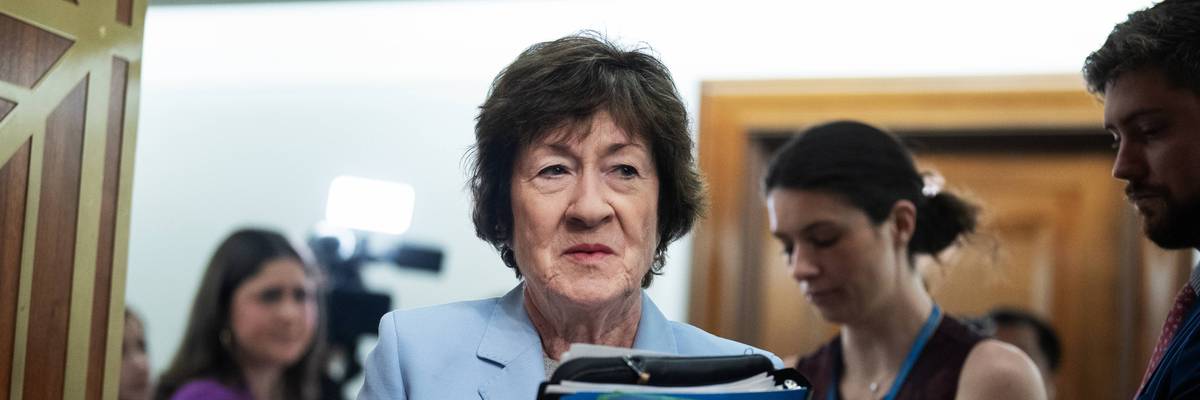
Sen. Susan Collins (R-Maine) arrives for a Senate committee hearing June 17, 2026.
The Republican senator running for a sixth term has postured as a champion of rural healthcare, but the Medicaid cuts she voted to advance are set to devastate vulnerable communities in Maine and across the US.
In recent weeks, Mainers have been inundated with ads touting Republican Sen. Susan Collins' role in securing passage of a $50 billion fund aimed at shoring up beleaguered rural healthcare systems across the US—including $190 million earmarked for her state.
But the ads, purchased by Collins' campaign directly and by the dark money group One Nation, neglect to mention a key fact: The Republican budget law that implements the Rural Health Transformation Program (RHTP) also contains the largest cuts to Medicaid in the program's history, rendering the $50 billion fund a mere Band-Aid on a massive wound.
According to one analysis, the GOP law's estimated cuts to federal Medicaid spending in rural areas over the next decade will amount to nearly triple the RHTP's funding. Maine is expected to lose nearly $3 billion in federal Medicaid funds over the next 10 years due to the Republican law—a massive hit that the pro-Collins campaign ads predictably avoid.
Collins, who is running for a sixth term against Democratic nominee Graham Platner, emphasizes that she voted against final passage of the GOP budget legislation, known as the One Big Beautiful Bill Act (OBBBA). But Collins cast a decisive procedural vote that allowed the bill, which also delivered massive tax breaks to the wealthy and large corporations, to advance to the Senate floor, where her Republican colleagues did the rest. President Donald Trump signed the bill into law last summer.
"Susan Collins is only bipartisan when it doesn't matter," declares a 30-second ad unveiled Wednesday by the Platner campaign, which highlighted the incumbent senator's vote to advance the OBBBA and pilloried her reputation as a "moderate."
The Republican law's Medicaid cuts, which total nearly $1 trillion, are expected to cost Maine hospitals $66 million per year in revenue and strip health coverage from tens of thousands of residents—projections that Collins' ads omit.
"Maine will be forced to offset budget holes caused by this bill by terminating coverage for families, eliminating essential health services, and cutting provider rates so drastically that doctors and hospitals are forced to close their doors—particularly in rural communities," the advocacy group Families USA warned in an analysis of the Republican budget measure. "Hospitals like Cary Medical Center and Northern Light AR Gould Hospital in Aroostook County, Northern Light Maine Coast Hospital in Hancock County, and Calais Community Hospital in Washington County will be at greater financial risk of closing due to Medicaid cuts in the bill."
"While more funding for rural healthcare is always welcome, political messaging about new funding cannot obscure the reality for states."
Nationwide, the impacts of the Medicaid cuts—which include new work requirements and other bureaucratic barriers—are expected to be devastating for years to come. A tracker maintained by Protect Our Care shows that more than 1,000 hospitals, clinics, wards, and nursing homes are "facing closure or cuts" following OBBBA's passage.
Maine Family Planning, the state's largest network of reproductive health clinics, was forced to end primary care services late last year due to the Republican budget law.
“Behind each pin is a story,” Anne Shoup, senior adviser to Protect Our Care, said Wednesday, referencing the markers on the group's hospital closure tracker. "Whether it’s an expectant mother losing access to prenatal care after the nearest rural hospital was forced to close its maternity ward, or seniors driving hours each way for care that used to be down the road, or people with disabilities facing gaps in caregiving that allow them to stay in their own homes, these pins represent our neighbors, our parents, and our kids. They deserve better than to have their healthcare gutted to write a check to the ultra-wealthy.”
The health policy organization KFF has said it is "highly unlikely that any state will receive more money from the rural health fund than it will lose" from Medicaid cuts and other federal policy changes, calling into question Collins' characterization of the RHTP money as transformative for Maine's rural healthcare system.
"RHTP is like lending someone a bucket to catch rain from a leaking roof," Mark Shaffer, an analyst at the Maine Center for Economic Policy, wrote last month. "It’s too small to hold what’s falling and is taken away before the roof ever gets fixed. The cruel irony is while hospitals scramble to manage the leak, millions of Americans have simply been pushed out of the system entirely and left to fend for themselves. And this was all done to support tax cuts for the wealthy."
A 30-second pro-Collins ad released earlier this year by One Nation—a GOP-aligned dark money group that has already dropped $20 million on ads supporting the Republican incumbent—described the $190 million in RHTP funds awarded to Maine for the first year of the program as quite literally lifesaving.
The problem, as the Maine Beacon pointed out, is that "no funds had actually been distributed at the time Collins’ ad aired in mid-March 2026."
"In fact, the Maine Department of Health and Human Services did not receive full approval for the program’s budget until the end of March, weeks after the ad began running," the Beacon observed. "State officials said during a Rural Health Fund Seminar on March 31 that they are still working to finalize contracts and hire staff, with funds not expected to be distributed until later in 2026."
In a March 27 statement, Collins took credit for preserving the $190 million in federal rural health funding for Maine, claiming it was "at risk" of being rescinded and reallocated by the Trump administration. (In early April, the office of Maine Gov. Janet Mills denied the funding was ever in jeopardy.)
Earlier this week, KFF Health News reported that Maine is one of several states that have been forced to make changes to their plans to spend the rural health funds as the Trump administration exerts "tight control" over the money. One restriction imposed by the Centers for Medicare and Medicaid Services—headed by Mehmet Oz—bars states from spending more than 15% of allotted RHTP funds on payments to rural hospitals and other providers for patient care.
Collins' ads celebrating the program as an unequivocal victory for rural healthcare include no mention of the spending limitation—which is not in the language of the GOP budget law—or the Trump administration's vice-like grip on the funds.
"It has frankly been surprising to me as a longtime observer of legislative officials, that the GOP members of Congress who were the cheerleaders of the RHTP as a rural hospital fund have not raised any substantial complaints as the Trump administration created this severe funding limit that impacts struggling rural hospitals in their own districts," Adam Searing, an associate professor at Georgetown University's Center for Children and Families, wrote in March.
"While more funding for rural healthcare is always welcome," wrote Searing, "political messaging about new funding cannot obscure the reality for states."
Dear Common Dreams reader, It’s been nearly 30 years since I co-founded Common Dreams with my late wife, Lina Newhouser. We had the radical notion that journalism should serve the public good, not corporate profits. It was clear to us from the outset what it would take to build such a project. No paid advertisements. No corporate sponsors. No millionaire publisher telling us what to think or do. Many people said we wouldn't last a year, but we proved those doubters wrong. Together with a tremendous team of journalists and dedicated staff, we built an independent media outlet free from the constraints of profits and corporate control. Our mission has always been simple: To inform. To inspire. To ignite change for the common good. Building Common Dreams was not easy. Our survival was never guaranteed. When you take on the most powerful forces—Wall Street greed, fossil fuel industry destruction, Big Tech lobbyists, and uber-rich oligarchs who have spent billions upon billions rigging the economy and democracy in their favor—the only bulwark you have is supporters who believe in your work. But here’s the urgent message from me today. It's never been this bad out there. And it's never been this hard to keep us going. At the very moment Common Dreams is most needed, the threats we face are intensifying. We need your support now more than ever. We don't accept corporate advertising and never will. We don't have a paywall because we don't think people should be blocked from critical news based on their ability to pay. Everything we do is funded by the donations of readers like you. When everyone does the little they can afford, we are strong. But if that support retreats or dries up, so do we. Will you donate now to make sure Common Dreams not only survives but thrives? —Craig Brown, Co-founder |
In recent weeks, Mainers have been inundated with ads touting Republican Sen. Susan Collins' role in securing passage of a $50 billion fund aimed at shoring up beleaguered rural healthcare systems across the US—including $190 million earmarked for her state.
But the ads, purchased by Collins' campaign directly and by the dark money group One Nation, neglect to mention a key fact: The Republican budget law that implements the Rural Health Transformation Program (RHTP) also contains the largest cuts to Medicaid in the program's history, rendering the $50 billion fund a mere Band-Aid on a massive wound.
According to one analysis, the GOP law's estimated cuts to federal Medicaid spending in rural areas over the next decade will amount to nearly triple the RHTP's funding. Maine is expected to lose nearly $3 billion in federal Medicaid funds over the next 10 years due to the Republican law—a massive hit that the pro-Collins campaign ads predictably avoid.
Collins, who is running for a sixth term against Democratic nominee Graham Platner, emphasizes that she voted against final passage of the GOP budget legislation, known as the One Big Beautiful Bill Act (OBBBA). But Collins cast a decisive procedural vote that allowed the bill, which also delivered massive tax breaks to the wealthy and large corporations, to advance to the Senate floor, where her Republican colleagues did the rest. President Donald Trump signed the bill into law last summer.
"Susan Collins is only bipartisan when it doesn't matter," declares a 30-second ad unveiled Wednesday by the Platner campaign, which highlighted the incumbent senator's vote to advance the OBBBA and pilloried her reputation as a "moderate."
The Republican law's Medicaid cuts, which total nearly $1 trillion, are expected to cost Maine hospitals $66 million per year in revenue and strip health coverage from tens of thousands of residents—projections that Collins' ads omit.
"Maine will be forced to offset budget holes caused by this bill by terminating coverage for families, eliminating essential health services, and cutting provider rates so drastically that doctors and hospitals are forced to close their doors—particularly in rural communities," the advocacy group Families USA warned in an analysis of the Republican budget measure. "Hospitals like Cary Medical Center and Northern Light AR Gould Hospital in Aroostook County, Northern Light Maine Coast Hospital in Hancock County, and Calais Community Hospital in Washington County will be at greater financial risk of closing due to Medicaid cuts in the bill."
"While more funding for rural healthcare is always welcome, political messaging about new funding cannot obscure the reality for states."
Nationwide, the impacts of the Medicaid cuts—which include new work requirements and other bureaucratic barriers—are expected to be devastating for years to come. A tracker maintained by Protect Our Care shows that more than 1,000 hospitals, clinics, wards, and nursing homes are "facing closure or cuts" following OBBBA's passage.
Maine Family Planning, the state's largest network of reproductive health clinics, was forced to end primary care services late last year due to the Republican budget law.
“Behind each pin is a story,” Anne Shoup, senior adviser to Protect Our Care, said Wednesday, referencing the markers on the group's hospital closure tracker. "Whether it’s an expectant mother losing access to prenatal care after the nearest rural hospital was forced to close its maternity ward, or seniors driving hours each way for care that used to be down the road, or people with disabilities facing gaps in caregiving that allow them to stay in their own homes, these pins represent our neighbors, our parents, and our kids. They deserve better than to have their healthcare gutted to write a check to the ultra-wealthy.”
The health policy organization KFF has said it is "highly unlikely that any state will receive more money from the rural health fund than it will lose" from Medicaid cuts and other federal policy changes, calling into question Collins' characterization of the RHTP money as transformative for Maine's rural healthcare system.
"RHTP is like lending someone a bucket to catch rain from a leaking roof," Mark Shaffer, an analyst at the Maine Center for Economic Policy, wrote last month. "It’s too small to hold what’s falling and is taken away before the roof ever gets fixed. The cruel irony is while hospitals scramble to manage the leak, millions of Americans have simply been pushed out of the system entirely and left to fend for themselves. And this was all done to support tax cuts for the wealthy."
A 30-second pro-Collins ad released earlier this year by One Nation—a GOP-aligned dark money group that has already dropped $20 million on ads supporting the Republican incumbent—described the $190 million in RHTP funds awarded to Maine for the first year of the program as quite literally lifesaving.
The problem, as the Maine Beacon pointed out, is that "no funds had actually been distributed at the time Collins’ ad aired in mid-March 2026."
"In fact, the Maine Department of Health and Human Services did not receive full approval for the program’s budget until the end of March, weeks after the ad began running," the Beacon observed. "State officials said during a Rural Health Fund Seminar on March 31 that they are still working to finalize contracts and hire staff, with funds not expected to be distributed until later in 2026."
In a March 27 statement, Collins took credit for preserving the $190 million in federal rural health funding for Maine, claiming it was "at risk" of being rescinded and reallocated by the Trump administration. (In early April, the office of Maine Gov. Janet Mills denied the funding was ever in jeopardy.)
Earlier this week, KFF Health News reported that Maine is one of several states that have been forced to make changes to their plans to spend the rural health funds as the Trump administration exerts "tight control" over the money. One restriction imposed by the Centers for Medicare and Medicaid Services—headed by Mehmet Oz—bars states from spending more than 15% of allotted RHTP funds on payments to rural hospitals and other providers for patient care.
Collins' ads celebrating the program as an unequivocal victory for rural healthcare include no mention of the spending limitation—which is not in the language of the GOP budget law—or the Trump administration's vice-like grip on the funds.
"It has frankly been surprising to me as a longtime observer of legislative officials, that the GOP members of Congress who were the cheerleaders of the RHTP as a rural hospital fund have not raised any substantial complaints as the Trump administration created this severe funding limit that impacts struggling rural hospitals in their own districts," Adam Searing, an associate professor at Georgetown University's Center for Children and Families, wrote in March.
"While more funding for rural healthcare is always welcome," wrote Searing, "political messaging about new funding cannot obscure the reality for states."
In recent weeks, Mainers have been inundated with ads touting Republican Sen. Susan Collins' role in securing passage of a $50 billion fund aimed at shoring up beleaguered rural healthcare systems across the US—including $190 million earmarked for her state.
But the ads, purchased by Collins' campaign directly and by the dark money group One Nation, neglect to mention a key fact: The Republican budget law that implements the Rural Health Transformation Program (RHTP) also contains the largest cuts to Medicaid in the program's history, rendering the $50 billion fund a mere Band-Aid on a massive wound.
According to one analysis, the GOP law's estimated cuts to federal Medicaid spending in rural areas over the next decade will amount to nearly triple the RHTP's funding. Maine is expected to lose nearly $3 billion in federal Medicaid funds over the next 10 years due to the Republican law—a massive hit that the pro-Collins campaign ads predictably avoid.
Collins, who is running for a sixth term against Democratic nominee Graham Platner, emphasizes that she voted against final passage of the GOP budget legislation, known as the One Big Beautiful Bill Act (OBBBA). But Collins cast a decisive procedural vote that allowed the bill, which also delivered massive tax breaks to the wealthy and large corporations, to advance to the Senate floor, where her Republican colleagues did the rest. President Donald Trump signed the bill into law last summer.
"Susan Collins is only bipartisan when it doesn't matter," declares a 30-second ad unveiled Wednesday by the Platner campaign, which highlighted the incumbent senator's vote to advance the OBBBA and pilloried her reputation as a "moderate."
The Republican law's Medicaid cuts, which total nearly $1 trillion, are expected to cost Maine hospitals $66 million per year in revenue and strip health coverage from tens of thousands of residents—projections that Collins' ads omit.
"Maine will be forced to offset budget holes caused by this bill by terminating coverage for families, eliminating essential health services, and cutting provider rates so drastically that doctors and hospitals are forced to close their doors—particularly in rural communities," the advocacy group Families USA warned in an analysis of the Republican budget measure. "Hospitals like Cary Medical Center and Northern Light AR Gould Hospital in Aroostook County, Northern Light Maine Coast Hospital in Hancock County, and Calais Community Hospital in Washington County will be at greater financial risk of closing due to Medicaid cuts in the bill."
"While more funding for rural healthcare is always welcome, political messaging about new funding cannot obscure the reality for states."
Nationwide, the impacts of the Medicaid cuts—which include new work requirements and other bureaucratic barriers—are expected to be devastating for years to come. A tracker maintained by Protect Our Care shows that more than 1,000 hospitals, clinics, wards, and nursing homes are "facing closure or cuts" following OBBBA's passage.
Maine Family Planning, the state's largest network of reproductive health clinics, was forced to end primary care services late last year due to the Republican budget law.
“Behind each pin is a story,” Anne Shoup, senior adviser to Protect Our Care, said Wednesday, referencing the markers on the group's hospital closure tracker. "Whether it’s an expectant mother losing access to prenatal care after the nearest rural hospital was forced to close its maternity ward, or seniors driving hours each way for care that used to be down the road, or people with disabilities facing gaps in caregiving that allow them to stay in their own homes, these pins represent our neighbors, our parents, and our kids. They deserve better than to have their healthcare gutted to write a check to the ultra-wealthy.”
The health policy organization KFF has said it is "highly unlikely that any state will receive more money from the rural health fund than it will lose" from Medicaid cuts and other federal policy changes, calling into question Collins' characterization of the RHTP money as transformative for Maine's rural healthcare system.
"RHTP is like lending someone a bucket to catch rain from a leaking roof," Mark Shaffer, an analyst at the Maine Center for Economic Policy, wrote last month. "It’s too small to hold what’s falling and is taken away before the roof ever gets fixed. The cruel irony is while hospitals scramble to manage the leak, millions of Americans have simply been pushed out of the system entirely and left to fend for themselves. And this was all done to support tax cuts for the wealthy."
A 30-second pro-Collins ad released earlier this year by One Nation—a GOP-aligned dark money group that has already dropped $20 million on ads supporting the Republican incumbent—described the $190 million in RHTP funds awarded to Maine for the first year of the program as quite literally lifesaving.
The problem, as the Maine Beacon pointed out, is that "no funds had actually been distributed at the time Collins’ ad aired in mid-March 2026."
"In fact, the Maine Department of Health and Human Services did not receive full approval for the program’s budget until the end of March, weeks after the ad began running," the Beacon observed. "State officials said during a Rural Health Fund Seminar on March 31 that they are still working to finalize contracts and hire staff, with funds not expected to be distributed until later in 2026."
In a March 27 statement, Collins took credit for preserving the $190 million in federal rural health funding for Maine, claiming it was "at risk" of being rescinded and reallocated by the Trump administration. (In early April, the office of Maine Gov. Janet Mills denied the funding was ever in jeopardy.)
Earlier this week, KFF Health News reported that Maine is one of several states that have been forced to make changes to their plans to spend the rural health funds as the Trump administration exerts "tight control" over the money. One restriction imposed by the Centers for Medicare and Medicaid Services—headed by Mehmet Oz—bars states from spending more than 15% of allotted RHTP funds on payments to rural hospitals and other providers for patient care.
Collins' ads celebrating the program as an unequivocal victory for rural healthcare include no mention of the spending limitation—which is not in the language of the GOP budget law—or the Trump administration's vice-like grip on the funds.
"It has frankly been surprising to me as a longtime observer of legislative officials, that the GOP members of Congress who were the cheerleaders of the RHTP as a rural hospital fund have not raised any substantial complaints as the Trump administration created this severe funding limit that impacts struggling rural hospitals in their own districts," Adam Searing, an associate professor at Georgetown University's Center for Children and Families, wrote in March.
"While more funding for rural healthcare is always welcome," wrote Searing, "political messaging about new funding cannot obscure the reality for states."