‘Rats Run Away’: Facing Criminal Probe, Flávio Bolsonaro Flees Brazil to US After Loss to Lula
"This reveals the DNA of Bolsonarism," said one critic. "Bolsonarism is made of cowardice."
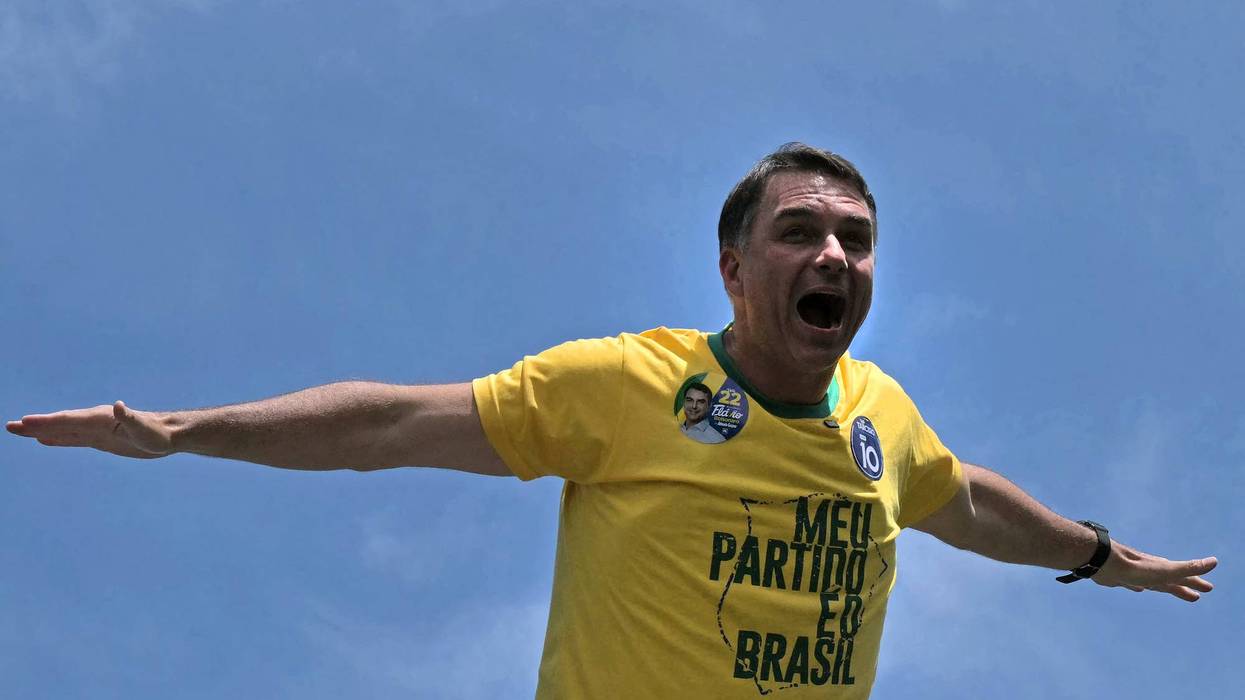
Just one day after vowing he would remain in Brazil to disprove allegations of money laundering, corruption, and other crimes, far-right Brazilian Sen. Flávio Bolsonaro followed in his disgraced father's footsteps by fleeing to the United States after losing a presidential election.
Bolsonaro, his wife Fernanda Bolsonaro, and their two daughters, ages 14 and 12, left Brazil for an unknown location in the United States, according to initial reporting by Isadora Teixeira at the Brasília-based news site Metrópoles, which was subsequently confirmed by other Brazilian and international media.
The Argentinian site Infobae reported that Bolsonaro and his family may have crossed into Argentina—which is run by his ally, far-right President Javier Milei—and then traveled to the US in a private jet. It is not known where the family went in the US.
Bolsonaro's brother, Eduardo Bolsonaro, lives in Texas while facing criminal punishment in Brazil after trying to use the Trump administration to pressure Brazilian authorities over the prosecution of his father, former President Jair Bolsonaro, who last year was convicted of conspiring to violently remain in power following leftist President Luiz Inácio Lula da Silva's 2022 election win.
Flávio Bolsonaro, a 45-year-old senator representing Rio de Janeiro, was defeated by Lula in Sunday's second-round election, but refused to accept the results and groundlessly demanded an annulment. The following day, Supreme Court Justice Alexandre de Moraes ordered the seizure of Bolsonaro's passport. He was supposed to have turned in the document Tuesday, but he didn't.
US President Donald Trump also cast doubt on the election's outcome, saying the contest appeared to be "rigged."
Jair Bolsonaro also fled to the United States while refusing to acknowledge his own 2022 defeat, which occurred during the administration of former President Joe Biden.
Like Trump, Bolsonaro incited a violent insurrection in his nation's capital following his loss.
Unlike Trump, Bolsonaro was held accountable for his crimes, and, in addition to a 27-year prison sentence—now being served under house arrest—is banned from running for any political office for the rest of the decade.
Now, with Trump back in the White House and Secretary of State Marco Rubio in charge at Foggy Bottom, Bolsonaro and his relatives are set to be issued US visas, a senior State Department official told The Associated Press.
The younger Bolsonaro's flight—which may have been aided by his obtaining an Italian passport in 2023—contradicts his pledge on Monday, when he said, "I have never thought about leaving the country" and "I will hand over my passports and defend myself against this travesty."
He was referring to de Morães' order to surrender his passport amid accusations of corruption, money laundering, tax evasion, and foreign currency violations.
Bolsonaro is also the subject of an inquiry pertaining to the millions of dollars he raised from a disgraced banker implicated in a massive corrupt plot to finance a biopic of Jair Bolsonaro.
The senator has not been charged and denies any wrongdoing.
Bolsonaro's flight stands in stark contrast to Lula, who spent 580 days in prison after being convicted in corruption cases stemming from the sprawling Operation Car Wash investigation.
In 2021, Brazil’s Supreme Federal Court annulled Lula’s convictions on procedural grounds, ruling that the court in Curitiba lacked jurisdiction over the cases and separately finding that former judge Sergio Moro had acted with bias in one of them. The decisions restored Lula’s political rights and eligibility to run for office, paving the way for his 2022 presidential victory over Bolsonaro.
Lula responded to the senator's departure by saying, "Unfortunately, the Bolsonaro family is like that."
"Brazil is his second homeland," the president continued, accusing Bolsonaro of "bootlicking in the United States."
Secretary-General of the Brazilian Presidency Guilherme Castro Boulos ripped Bolsonaro, saying: "Leaders face things head-on! Rats run away!”
"It is a shameful thing, which should make Brazilian society as a whole reflect, especially those who supported and voted for Flávio Bolsonaro," Boulos asserted. "He slapped his supporters in the face and left them on the side of the road."
"Almost 60 million Brazilians trusted him as political leadership to run the country, and 24 hours later, he flees," he continued. "And it's no use coming up with this talk of persecution, of dictatorship. He ran away because he must."
"This reveals the DNA of Bolsonarism," Boulos added. "Bolsonarism is made of cowardice."
Erika Hilton, a member of the Chamber of Deputies—the lower house of Brazil's Legislature—representing São Paulo for the Socialism and Liberty Party, weighed in on social media, calling Bolsonaro "a traitor to the homeland."
In the United States, Congressman Joaquin Castro (D-Texas) said on X that "losing an election is not grounds for asylum."
"Yet the Trump administration is giving Flávio Bolsonaro safe haven in the United States," he continued. "The Trump administration owes Congress answers on its role helping Bolsonaro flee Brazil in contravention of Brazilian law."
Mark Weisbrot, co-director of the Center for Economic Policy and Research (CEPR), told Common Dreams:
Trump is now the most corrupt president in US history, raking in billions from his presidency. It's no surprise when the most powerful corrupt authoritarian government in the hemisphere uses international law designed to protect the persecuted to shield another corrupt authoritarian government from criminal prosecution. Perhaps this is what is meant by the Trump-led 'Shield of the Americas.'
Francesca Emanuele, senior international policy associate at CEPR, noted that "the United States has long served as a destination for numerous right-wing Latin American political figures who fled their home countries while facing corruption allegations, criminal investigations, or accusations of grave human rights violations, including crimes against humanity."
"The list is extensive," she added, "ranging from former presidents such as Panama’s Ricardo Martinelli and Bolivia’s Gonzalo Sánchez de Lozada to dictators such as Nicaragua’s Anastasio Somoza."
Emanuele also contrasted the actions of the Bolsonaros and Lula, arguing that the latter's decision to remain in Brazil "reflected a commitment to the Brazilian people and a determination to defend his rights through the country’s own institutions, even when those institutions failed to uphold them."
"Rather than leaving Brazil," she told Common Dreams, "Lula stayed, fought to clear his name, and continued his political struggle alongside the people he sought to represent."