SUBSCRIBE TO OUR FREE NEWSLETTER
Daily news & progressive opinion—funded by the people, not the corporations—delivered straight to your inbox.
5
#000000
#FFFFFF
To donate by check, phone, or other method, see our More Ways to Give page.
Daily news & progressive opinion—funded by the people, not the corporations—delivered straight to your inbox.
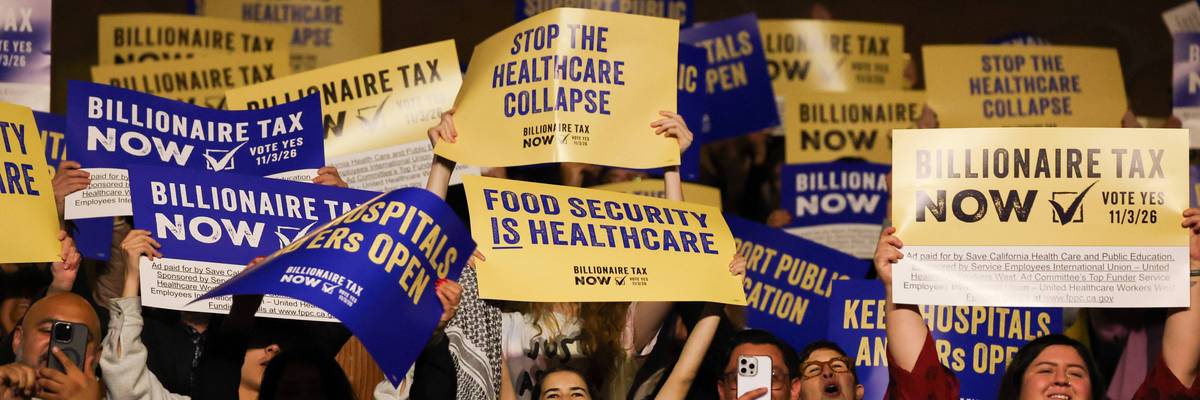
Attendees cheer during an event supporting the California Billionaire Tax Act in Los Angeles on February 18, 2026.
"The fact that the ultra-wealthy and billionaire-backed politicians like Gov. Newsom nearly succeeded in killing it is the single best argument for why we need to tax billionaires in the first place."
Organizers said late Thursday that a proposed one-time wealth tax on California billionaires has been certified to appear on state ballots in November, advancing despite efforts by Democratic Gov. Gavin Newsom and billionaire-funded groups to tank the measure ahead of the June 25 deadline.
"Today we’re making it clear that we aren’t backing down–the billionaire tax will be on the ballot this November, and we intend to win,” said Debru Carthan, a radiologic technologist and spokesperson for Billionaire Tax Now, the healthcare union-led coalition leading the ballot initiative.
If approved by California voters, the proposal would tax billionaires' wealth at a rate of 5%, raising an estimated $100 billion to shore up the state's healthcare system amid devastating federal cuts to Medicaid. Revenue from the tax would also be used for food aid and education, according to the initiative's text.
Last week, organizers offered to withdraw their proposal if Newsom agreed to push a 2% tax on billionaire wealth in California's Legislature. Newsom, who is widely seen as a 2028 presidential hopeful, rejected the compromise and privately told a major Democratic donor that he was confident the billionaire tax would not appear on California's ballot in November.
Organizers emphasized Thursday that despite Newsom's opposition and fearmongering from billionaires and other opponents, the proposed tax is popular among California voters, who are facing an affordability crisis as the wealthiest see their fortunes soar. From 2023 to 2025, the wealth of California billionaires surged by 144%, according to a recent paper co-authored by leading economists.
"Voters consistently support the billionaire tax by large, double-digit margins, and the growing campaign has brought on thousands of volunteers," organizers said in a statement. "Supporters of the measure submitted over 1.6 million signatures, more than double the number needed to secure a spot on the general election ballot."
To succeed, proponents of the billionaire tax must secure enough votes to pass their initiative while also defeating separate ballot measures that would effectively cancel out the wealth levy. One of the competing initiatives was pushed by a group bankrolled by Google co-founder Sergey Brin, who has spent tens of millions of dollars trying to defeat the billionaire tax and who left California in late 2025 to avoid the potential levy.
The competing ballot measures—the Retirement and Personal Savings Protection Act of 2026 and the Improving Transparency, Effectiveness, and Efficiency in California Government Act of 2026—are titled in ways that could lead some voters to support both the wealth tax and proposals that would counteract it.
Igor Volsky, director of the Tax the Greedy Billionaires campaign, said in a statement that "when billionaires can erase democratic initiatives that threaten their fortunes, they have too much power."
"The fact that the ultra-wealthy and billionaire-backed politicians like Gov. Newsom nearly succeeded in killing it is the single best argument for why we need to tax billionaires in the first place," Volsky added.
US Rep. Ro Khanna (D-Calif.), a vocal supporter of the proposed billionaire wealth tax, said Thursday that "this issue couldn’t be more simple."
"There are 250 billionaires in a state of 40 million people," said Khanna. "What we’re saying is, tax these 250 billionaires so that millions of Californians can have healthcare."
Dear Common Dreams reader, It’s been nearly 30 years since I co-founded Common Dreams with my late wife, Lina Newhouser. We had the radical notion that journalism should serve the public good, not corporate profits. It was clear to us from the outset what it would take to build such a project. No paid advertisements. No corporate sponsors. No millionaire publisher telling us what to think or do. Many people said we wouldn't last a year, but we proved those doubters wrong. Together with a tremendous team of journalists and dedicated staff, we built an independent media outlet free from the constraints of profits and corporate control. Our mission has always been simple: To inform. To inspire. To ignite change for the common good. Building Common Dreams was not easy. Our survival was never guaranteed. When you take on the most powerful forces—Wall Street greed, fossil fuel industry destruction, Big Tech lobbyists, and uber-rich oligarchs who have spent billions upon billions rigging the economy and democracy in their favor—the only bulwark you have is supporters who believe in your work. But here’s the urgent message from me today. It's never been this bad out there. And it's never been this hard to keep us going. At the very moment Common Dreams is most needed, the threats we face are intensifying. We need your support now more than ever. We don't accept corporate advertising and never will. We don't have a paywall because we don't think people should be blocked from critical news based on their ability to pay. Everything we do is funded by the donations of readers like you. When everyone does the little they can afford, we are strong. But if that support retreats or dries up, so do we. Will you donate now to make sure Common Dreams not only survives but thrives? —Craig Brown, Co-founder |
Organizers said late Thursday that a proposed one-time wealth tax on California billionaires has been certified to appear on state ballots in November, advancing despite efforts by Democratic Gov. Gavin Newsom and billionaire-funded groups to tank the measure ahead of the June 25 deadline.
"Today we’re making it clear that we aren’t backing down–the billionaire tax will be on the ballot this November, and we intend to win,” said Debru Carthan, a radiologic technologist and spokesperson for Billionaire Tax Now, the healthcare union-led coalition leading the ballot initiative.
If approved by California voters, the proposal would tax billionaires' wealth at a rate of 5%, raising an estimated $100 billion to shore up the state's healthcare system amid devastating federal cuts to Medicaid. Revenue from the tax would also be used for food aid and education, according to the initiative's text.
Last week, organizers offered to withdraw their proposal if Newsom agreed to push a 2% tax on billionaire wealth in California's Legislature. Newsom, who is widely seen as a 2028 presidential hopeful, rejected the compromise and privately told a major Democratic donor that he was confident the billionaire tax would not appear on California's ballot in November.
Organizers emphasized Thursday that despite Newsom's opposition and fearmongering from billionaires and other opponents, the proposed tax is popular among California voters, who are facing an affordability crisis as the wealthiest see their fortunes soar. From 2023 to 2025, the wealth of California billionaires surged by 144%, according to a recent paper co-authored by leading economists.
"Voters consistently support the billionaire tax by large, double-digit margins, and the growing campaign has brought on thousands of volunteers," organizers said in a statement. "Supporters of the measure submitted over 1.6 million signatures, more than double the number needed to secure a spot on the general election ballot."
To succeed, proponents of the billionaire tax must secure enough votes to pass their initiative while also defeating separate ballot measures that would effectively cancel out the wealth levy. One of the competing initiatives was pushed by a group bankrolled by Google co-founder Sergey Brin, who has spent tens of millions of dollars trying to defeat the billionaire tax and who left California in late 2025 to avoid the potential levy.
The competing ballot measures—the Retirement and Personal Savings Protection Act of 2026 and the Improving Transparency, Effectiveness, and Efficiency in California Government Act of 2026—are titled in ways that could lead some voters to support both the wealth tax and proposals that would counteract it.
Igor Volsky, director of the Tax the Greedy Billionaires campaign, said in a statement that "when billionaires can erase democratic initiatives that threaten their fortunes, they have too much power."
"The fact that the ultra-wealthy and billionaire-backed politicians like Gov. Newsom nearly succeeded in killing it is the single best argument for why we need to tax billionaires in the first place," Volsky added.
US Rep. Ro Khanna (D-Calif.), a vocal supporter of the proposed billionaire wealth tax, said Thursday that "this issue couldn’t be more simple."
"There are 250 billionaires in a state of 40 million people," said Khanna. "What we’re saying is, tax these 250 billionaires so that millions of Californians can have healthcare."
Organizers said late Thursday that a proposed one-time wealth tax on California billionaires has been certified to appear on state ballots in November, advancing despite efforts by Democratic Gov. Gavin Newsom and billionaire-funded groups to tank the measure ahead of the June 25 deadline.
"Today we’re making it clear that we aren’t backing down–the billionaire tax will be on the ballot this November, and we intend to win,” said Debru Carthan, a radiologic technologist and spokesperson for Billionaire Tax Now, the healthcare union-led coalition leading the ballot initiative.
If approved by California voters, the proposal would tax billionaires' wealth at a rate of 5%, raising an estimated $100 billion to shore up the state's healthcare system amid devastating federal cuts to Medicaid. Revenue from the tax would also be used for food aid and education, according to the initiative's text.
Last week, organizers offered to withdraw their proposal if Newsom agreed to push a 2% tax on billionaire wealth in California's Legislature. Newsom, who is widely seen as a 2028 presidential hopeful, rejected the compromise and privately told a major Democratic donor that he was confident the billionaire tax would not appear on California's ballot in November.
Organizers emphasized Thursday that despite Newsom's opposition and fearmongering from billionaires and other opponents, the proposed tax is popular among California voters, who are facing an affordability crisis as the wealthiest see their fortunes soar. From 2023 to 2025, the wealth of California billionaires surged by 144%, according to a recent paper co-authored by leading economists.
"Voters consistently support the billionaire tax by large, double-digit margins, and the growing campaign has brought on thousands of volunteers," organizers said in a statement. "Supporters of the measure submitted over 1.6 million signatures, more than double the number needed to secure a spot on the general election ballot."
To succeed, proponents of the billionaire tax must secure enough votes to pass their initiative while also defeating separate ballot measures that would effectively cancel out the wealth levy. One of the competing initiatives was pushed by a group bankrolled by Google co-founder Sergey Brin, who has spent tens of millions of dollars trying to defeat the billionaire tax and who left California in late 2025 to avoid the potential levy.
The competing ballot measures—the Retirement and Personal Savings Protection Act of 2026 and the Improving Transparency, Effectiveness, and Efficiency in California Government Act of 2026—are titled in ways that could lead some voters to support both the wealth tax and proposals that would counteract it.
Igor Volsky, director of the Tax the Greedy Billionaires campaign, said in a statement that "when billionaires can erase democratic initiatives that threaten their fortunes, they have too much power."
"The fact that the ultra-wealthy and billionaire-backed politicians like Gov. Newsom nearly succeeded in killing it is the single best argument for why we need to tax billionaires in the first place," Volsky added.
US Rep. Ro Khanna (D-Calif.), a vocal supporter of the proposed billionaire wealth tax, said Thursday that "this issue couldn’t be more simple."
"There are 250 billionaires in a state of 40 million people," said Khanna. "What we’re saying is, tax these 250 billionaires so that millions of Californians can have healthcare."