SUBSCRIBE TO OUR FREE NEWSLETTER
Daily news & progressive opinion—funded by the people, not the corporations—delivered straight to your inbox.
5
#000000
#FFFFFF
To donate by check, phone, or other method, see our More Ways to Give page.
Daily news & progressive opinion—funded by the people, not the corporations—delivered straight to your inbox.
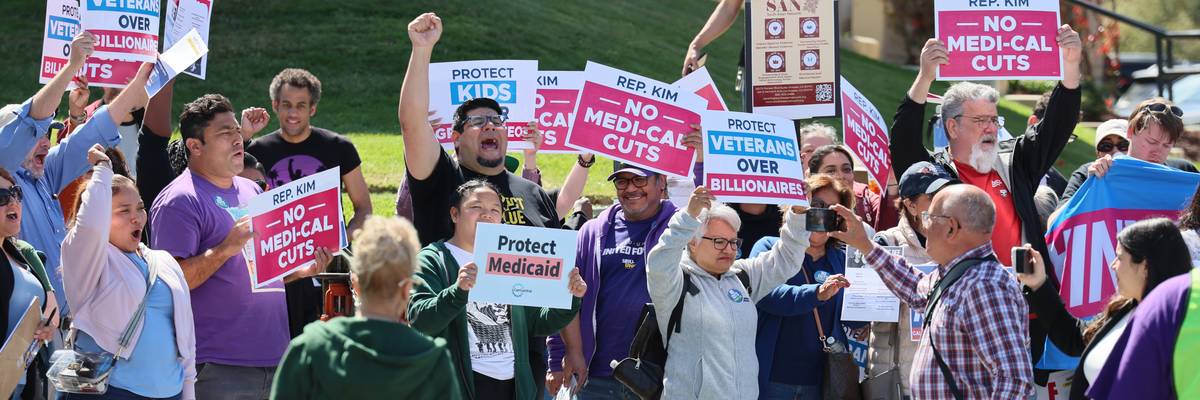
Demonstrators protest Medicaid cuts in Anaheim Hills, California on March 18, 2025.
"If these cuts take effect without replacement funding, it won't just mean longer lines—it means people won't be able to get care when they need it," said one healthcare worker.
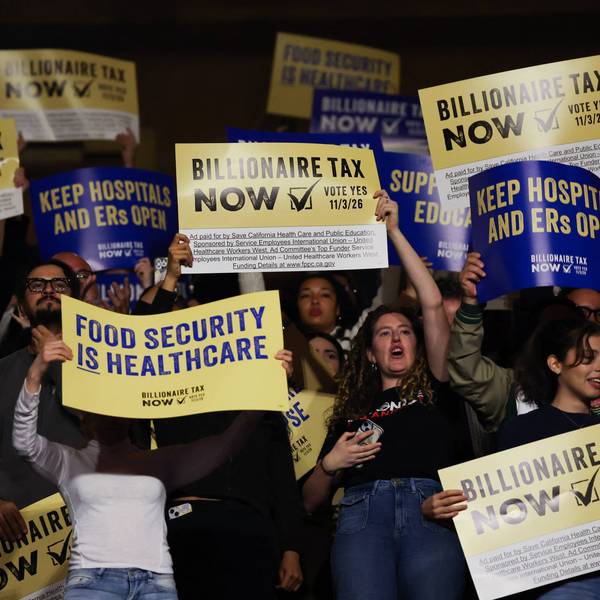
A coalition of frontline healthcare workers, unions, and economists launched an effort Thursday to build support for a proposed ballot measure in California that would impose a one-time tax on the state's billionaires to avert a looming crisis spurred by national Republicans' unprecedented Medicaid cuts.
The proposed ballot initiative, titled "The 2026 Billionaire Tax Act," would levy a single 5% tax on the wealth of California's roughly 200 billionaires to offset healthcare funding shortfalls caused by the roughly $1 trillion in Medicaid cuts that US President Donald Trump and congressional Republicans approved over the summer.
Service Employees International Union–United Healthcare Workers West (SEIU-UHW), one of the largest healthcare worker unions in the country, is spearheading the organizing push to get the proposal on the California ballot in November 2026. The union expects support for the measure to grow quickly in the coming weeks, and organizers said they hope the effort can serve as a "playbook" for other states working to mitigate the increasingly devastating impacts of the GOP assault on Medicaid.
Dave Regan, the president of SEIU-UHW, said during a press call Thursday that "it is a 100% certainty that we have the ability to put this on the ballot in 2026, and we intend to do so."
"We know what's going to happen if we don't do this," Regan added, alluding to the hospital closures, healthcare job cuts, and other havoc the Trump-GOP Medicaid cuts are already causing across the nation.
Supporters of the new initiative warn that if Medicaid funding cuts aren't offset with new revenue, California could lose around 145,000 healthcare jobs and see hospital closures across the state, a disaster for vulnerable families.
"We are already short-staffed, and every week more patients walk through our doors with fewer places to go," said Mayra Castanada, an ultrasound technologist in Lynwood, California. "If these cuts take effect without replacement funding, it won't just mean longer lines—it means people won't be able to get care when they need it."
"The tax is small relative to the massive gains billionaires have made, yet large enough to preserve programs that are crucial for California's economy and its continued success."
Experts estimate that the one-time tax would raise $100 billion—a fraction of the staggering $2 trillion in combined wealth controlled by the 200 wealthiest Californians. Billionaires impacted by the tax would include Meta CEO Mark Zuckerberg and Nvidia chief executive Jensen Huang, two of the richest men in the world.
Emmanuel Saez, an economics professor at the University of California, Berkeley and a leading expert on wealth inequality, voiced support for the initiative, saying that "the wealth of California billionaires has exploded in recent years while health and education in California are getting defunded by the Trump administration."
"The tax is small relative to the massive gains billionaires have made, yet large enough to preserve programs that are crucial for California's economy and its continued success," said Saez.
Former US Labor Secretary Robert Reich also backed the initiative, saying the GOP Medicaid cuts have sparked a "manufactured crisis."
"These federal cuts didn't happen by accident—they were designed to shield billionaires from contributing while pushing the consequences onto patients and workers," said Reich. "A time-limited emergency tax on the ultra-wealthy is a practical way to keep the healthcare system functioning."
Dear Common Dreams reader, It’s been nearly 30 years since I co-founded Common Dreams with my late wife, Lina Newhouser. We had the radical notion that journalism should serve the public good, not corporate profits. It was clear to us from the outset what it would take to build such a project. No paid advertisements. No corporate sponsors. No millionaire publisher telling us what to think or do. Many people said we wouldn't last a year, but we proved those doubters wrong. Together with a tremendous team of journalists and dedicated staff, we built an independent media outlet free from the constraints of profits and corporate control. Our mission has always been simple: To inform. To inspire. To ignite change for the common good. Building Common Dreams was not easy. Our survival was never guaranteed. When you take on the most powerful forces—Wall Street greed, fossil fuel industry destruction, Big Tech lobbyists, and uber-rich oligarchs who have spent billions upon billions rigging the economy and democracy in their favor—the only bulwark you have is supporters who believe in your work. But here’s the urgent message from me today. It's never been this bad out there. And it's never been this hard to keep us going. At the very moment Common Dreams is most needed, the threats we face are intensifying. We need your support now more than ever. We don't accept corporate advertising and never will. We don't have a paywall because we don't think people should be blocked from critical news based on their ability to pay. Everything we do is funded by the donations of readers like you. When everyone does the little they can afford, we are strong. But if that support retreats or dries up, so do we. Will you donate now to make sure Common Dreams not only survives but thrives? —Craig Brown, Co-founder |
A coalition of frontline healthcare workers, unions, and economists launched an effort Thursday to build support for a proposed ballot measure in California that would impose a one-time tax on the state's billionaires to avert a looming crisis spurred by national Republicans' unprecedented Medicaid cuts.
The proposed ballot initiative, titled "The 2026 Billionaire Tax Act," would levy a single 5% tax on the wealth of California's roughly 200 billionaires to offset healthcare funding shortfalls caused by the roughly $1 trillion in Medicaid cuts that US President Donald Trump and congressional Republicans approved over the summer.
Service Employees International Union–United Healthcare Workers West (SEIU-UHW), one of the largest healthcare worker unions in the country, is spearheading the organizing push to get the proposal on the California ballot in November 2026. The union expects support for the measure to grow quickly in the coming weeks, and organizers said they hope the effort can serve as a "playbook" for other states working to mitigate the increasingly devastating impacts of the GOP assault on Medicaid.
Dave Regan, the president of SEIU-UHW, said during a press call Thursday that "it is a 100% certainty that we have the ability to put this on the ballot in 2026, and we intend to do so."
"We know what's going to happen if we don't do this," Regan added, alluding to the hospital closures, healthcare job cuts, and other havoc the Trump-GOP Medicaid cuts are already causing across the nation.
Supporters of the new initiative warn that if Medicaid funding cuts aren't offset with new revenue, California could lose around 145,000 healthcare jobs and see hospital closures across the state, a disaster for vulnerable families.
"We are already short-staffed, and every week more patients walk through our doors with fewer places to go," said Mayra Castanada, an ultrasound technologist in Lynwood, California. "If these cuts take effect without replacement funding, it won't just mean longer lines—it means people won't be able to get care when they need it."
"The tax is small relative to the massive gains billionaires have made, yet large enough to preserve programs that are crucial for California's economy and its continued success."
Experts estimate that the one-time tax would raise $100 billion—a fraction of the staggering $2 trillion in combined wealth controlled by the 200 wealthiest Californians. Billionaires impacted by the tax would include Meta CEO Mark Zuckerberg and Nvidia chief executive Jensen Huang, two of the richest men in the world.
Emmanuel Saez, an economics professor at the University of California, Berkeley and a leading expert on wealth inequality, voiced support for the initiative, saying that "the wealth of California billionaires has exploded in recent years while health and education in California are getting defunded by the Trump administration."
"The tax is small relative to the massive gains billionaires have made, yet large enough to preserve programs that are crucial for California's economy and its continued success," said Saez.
Former US Labor Secretary Robert Reich also backed the initiative, saying the GOP Medicaid cuts have sparked a "manufactured crisis."
"These federal cuts didn't happen by accident—they were designed to shield billionaires from contributing while pushing the consequences onto patients and workers," said Reich. "A time-limited emergency tax on the ultra-wealthy is a practical way to keep the healthcare system functioning."
A coalition of frontline healthcare workers, unions, and economists launched an effort Thursday to build support for a proposed ballot measure in California that would impose a one-time tax on the state's billionaires to avert a looming crisis spurred by national Republicans' unprecedented Medicaid cuts.
The proposed ballot initiative, titled "The 2026 Billionaire Tax Act," would levy a single 5% tax on the wealth of California's roughly 200 billionaires to offset healthcare funding shortfalls caused by the roughly $1 trillion in Medicaid cuts that US President Donald Trump and congressional Republicans approved over the summer.
Service Employees International Union–United Healthcare Workers West (SEIU-UHW), one of the largest healthcare worker unions in the country, is spearheading the organizing push to get the proposal on the California ballot in November 2026. The union expects support for the measure to grow quickly in the coming weeks, and organizers said they hope the effort can serve as a "playbook" for other states working to mitigate the increasingly devastating impacts of the GOP assault on Medicaid.
Dave Regan, the president of SEIU-UHW, said during a press call Thursday that "it is a 100% certainty that we have the ability to put this on the ballot in 2026, and we intend to do so."
"We know what's going to happen if we don't do this," Regan added, alluding to the hospital closures, healthcare job cuts, and other havoc the Trump-GOP Medicaid cuts are already causing across the nation.
Supporters of the new initiative warn that if Medicaid funding cuts aren't offset with new revenue, California could lose around 145,000 healthcare jobs and see hospital closures across the state, a disaster for vulnerable families.
"We are already short-staffed, and every week more patients walk through our doors with fewer places to go," said Mayra Castanada, an ultrasound technologist in Lynwood, California. "If these cuts take effect without replacement funding, it won't just mean longer lines—it means people won't be able to get care when they need it."
"The tax is small relative to the massive gains billionaires have made, yet large enough to preserve programs that are crucial for California's economy and its continued success."
Experts estimate that the one-time tax would raise $100 billion—a fraction of the staggering $2 trillion in combined wealth controlled by the 200 wealthiest Californians. Billionaires impacted by the tax would include Meta CEO Mark Zuckerberg and Nvidia chief executive Jensen Huang, two of the richest men in the world.
Emmanuel Saez, an economics professor at the University of California, Berkeley and a leading expert on wealth inequality, voiced support for the initiative, saying that "the wealth of California billionaires has exploded in recent years while health and education in California are getting defunded by the Trump administration."
"The tax is small relative to the massive gains billionaires have made, yet large enough to preserve programs that are crucial for California's economy and its continued success," said Saez.
Former US Labor Secretary Robert Reich also backed the initiative, saying the GOP Medicaid cuts have sparked a "manufactured crisis."
"These federal cuts didn't happen by accident—they were designed to shield billionaires from contributing while pushing the consequences onto patients and workers," said Reich. "A time-limited emergency tax on the ultra-wealthy is a practical way to keep the healthcare system functioning."