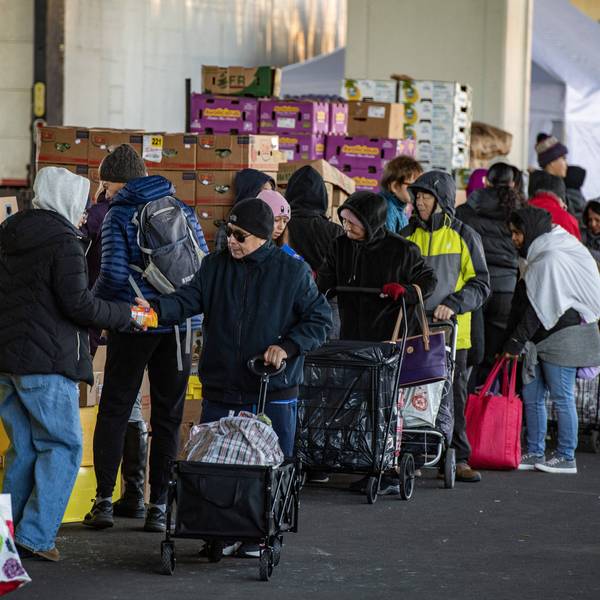


People including senior citizens receive food and other items from volunteers with Pasadena Community Job Center at the Mano a Mano Pantry food distribution program on July 10, 2026 in Pasadena, California.
House Dems Press Trump USDA Over Aid Cuts as Seniors 'Struggle to Put Food on the Table'
"No senior should have to choose between putting food on the table, paying rent, or affording lifesaving medication."
A group of almost 20 Democratic lawmakers on Tuesday pressed US Agriculture Secretary Brooke Rollins to explain the adverse effects of President Donald Trump's so-called One Big Beautiful Bill Act on older Americans, including the administration's plan to eliminate a program serving nearly 700,000 low-income seniors and expanded food stamp work requirements.
"At a time when Americans continue to face elevated grocery costs, Washington Republicans enacted the One Big Beautiful Bill Act (OBBBA), which the Congressional Budget Office (CBO) estimates will reduce federal [Supplemental Nutrition Assistance Program] spending by approximately $187 billion through 2034," 18 House Democrats led by Rep. Analilia Mejia (D-NJ) wrote in a letter to Rollins.
"The law expanded SNAP’s three-month time limit and associated work requirements to certain adults ages 55 through 64, restricted states’ ability to obtain geographic waivers from those requirements, and made additional changes to state cost-sharing requirements expected to reduce SNAP participation and benefits," the letter continues.
"These cuts come as the same law provides substantial tax benefits that will help disproportionately benefit the rich, with CBO finding that the law will decrease resources available to households towards the bottom of the income distribution while increasing resources for households toward the top," the lawmakers noted.
The letter decries Trump's stated goal of eliminating the Commodity Supplemental Food Program (CSFP), which the lawmakers described as "the most extensive hunger-relief federal program for seniors and services to nearly 700,000 low-income seniors across the nation."
"The administration justified the elimination of this crucial program by focusing 'on supporting seniors through the SNAP program' as they passed a law to make SNAP more inaccessible for seniors," the letter laments. "Congress has been responsible for keeping the CSFP fully funded and maintained while the administration continues to threaten this critical federal food assistance program."
"Even so, as Americans—particularly seniors—struggle to put food on the table, you have failed to meet the urgency of this affordability crisis, even as the department you lead reports that food prices have climbed another 3% in the past year," the Democrats added.
The letter requests state-by-state figures showing how many adults ages 55 to 64 have lost or suffered reductions in SNAP benefits because of expanded work requirements, as well as how many have received exemptions. The lawmakers are also seeking data regarding the health and financial consequences of eliminating the CSFP and how the administration would ensure seniors retain access to nutritious food. The legislators requested a written response from Rollins' office by November 6.
"You have failed to meet the urgency of this affordability crisis."
According to the Center on Budget and Policy Priorities (CBPP), approximately 5.5 million people, including roughly 2 million children, have lost SNAP assistance since Trump signed the OBBBA in July 2025. This, despite more than 47 million Americans—including 1 in 5 children—living in food-insecure households.
Seniors are experiencing their own unique set of hardships, given that many of them have limited resources.
"Many seniors rely heavily on fixed or limited incomes from Social Security, retirement savings, and pensions, leaving them particularly vulnerable as the cost of living continues to rise," the letter states, adding that "rather than protect older and low-income Americans from rising costs, you and the Trump administration continue to pursue policies that threaten to make it harder for them to afford basic necessities."
We are at a crossroads
This country and this world are at a monumental crossroads. In a few short weeks, US voters will have an opportunity to beat back the forces of fascism and confront the billionaires who are rigging the economy, our media system, and our democracy, making it increasingly impossible for ordinary people to get by. We’re not just talking about the election. We’re talking about what must be done once these fascist elements are vanquished from power. We need a bolder set of solutions than what either major party has so far been willing to offer and a working-class movement ready to fight like hell for it. Trump didn't emerge from nowhere. The conditions that fueled MAGA authoritarianism were created by decades of radical neoliberal economic policies and a corrupt political system dominated by corporate interests. They slashed taxes on the super-rich, promising that the benefits would trickle down. They said giveaways to the corporate titans would make life more affordable for the rest of us. It was all bullshit. And when a bitter, betrayed populace searches for someone to blame, right-wing demagogues have little trouble finding scapegoats. People know when they're being lied to, but you won't hear any of this from the corporate media. Only independent journalism—powered and funded by people who believe in building a better world—can deliver truly trustworthy daily news. Our Fall Campaign is underway, and we need your help. To power our newsroom through the rest of the year, we need to raise $125,000 by midnight on October 31. So if you share our vision, please contribute whatever you can to sustain our work. |
A group of almost 20 Democratic lawmakers on Tuesday pressed US Agriculture Secretary Brooke Rollins to explain the adverse effects of President Donald Trump's so-called One Big Beautiful Bill Act on older Americans, including the administration's plan to eliminate a program serving nearly 700,000 low-income seniors and expanded food stamp work requirements.
"At a time when Americans continue to face elevated grocery costs, Washington Republicans enacted the One Big Beautiful Bill Act (OBBBA), which the Congressional Budget Office (CBO) estimates will reduce federal [Supplemental Nutrition Assistance Program] spending by approximately $187 billion through 2034," 18 House Democrats led by Rep. Analilia Mejia (D-NJ) wrote in a letter to Rollins.
"The law expanded SNAP’s three-month time limit and associated work requirements to certain adults ages 55 through 64, restricted states’ ability to obtain geographic waivers from those requirements, and made additional changes to state cost-sharing requirements expected to reduce SNAP participation and benefits," the letter continues.
"These cuts come as the same law provides substantial tax benefits that will help disproportionately benefit the rich, with CBO finding that the law will decrease resources available to households towards the bottom of the income distribution while increasing resources for households toward the top," the lawmakers noted.
The letter decries Trump's stated goal of eliminating the Commodity Supplemental Food Program (CSFP), which the lawmakers described as "the most extensive hunger-relief federal program for seniors and services to nearly 700,000 low-income seniors across the nation."
"The administration justified the elimination of this crucial program by focusing 'on supporting seniors through the SNAP program' as they passed a law to make SNAP more inaccessible for seniors," the letter laments. "Congress has been responsible for keeping the CSFP fully funded and maintained while the administration continues to threaten this critical federal food assistance program."
"Even so, as Americans—particularly seniors—struggle to put food on the table, you have failed to meet the urgency of this affordability crisis, even as the department you lead reports that food prices have climbed another 3% in the past year," the Democrats added.
The letter requests state-by-state figures showing how many adults ages 55 to 64 have lost or suffered reductions in SNAP benefits because of expanded work requirements, as well as how many have received exemptions. The lawmakers are also seeking data regarding the health and financial consequences of eliminating the CSFP and how the administration would ensure seniors retain access to nutritious food. The legislators requested a written response from Rollins' office by November 6.
"You have failed to meet the urgency of this affordability crisis."
According to the Center on Budget and Policy Priorities (CBPP), approximately 5.5 million people, including roughly 2 million children, have lost SNAP assistance since Trump signed the OBBBA in July 2025. This, despite more than 47 million Americans—including 1 in 5 children—living in food-insecure households.
Seniors are experiencing their own unique set of hardships, given that many of them have limited resources.
"Many seniors rely heavily on fixed or limited incomes from Social Security, retirement savings, and pensions, leaving them particularly vulnerable as the cost of living continues to rise," the letter states, adding that "rather than protect older and low-income Americans from rising costs, you and the Trump administration continue to pursue policies that threaten to make it harder for them to afford basic necessities."