As Biodiversity Summit Begins, 'Systems That Sustain Life on Earth Are Under Threat'
Governments can't keep "promising to protect nature while supporting its destruction through harmful subsidies and incoherent policies," said one campaigner. "Any more delay is a threat to our survival on the planet."
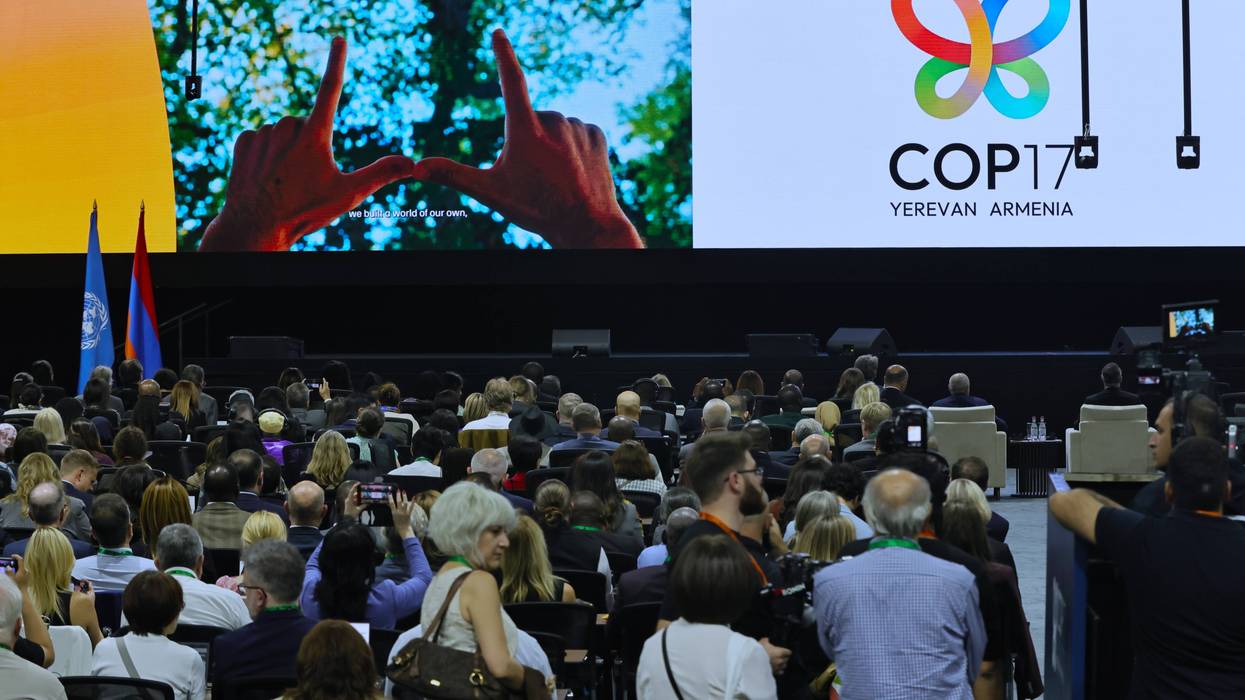
Four years after world leaders agreed to the Kunming-Montreal Global Biodiversity Framework, representatives from nearly 200 nations gathered in the Armenian capital on Monday for a summit to review progress on the agreement and discuss future actions to protect nature.
In the lead-up to the 17th Conference of the Parties to the Convention on Biological Diversity (COP17) in Yerevan, the United Nations Environment Program released a "State of Biodiversity Action" report. UN Secretary-General António Guterres said that the framework "has inspired action across the globe," with nearly 90% of parties establishing national targets, but "progress is uneven, and far too slow."
The framework—sometimes called the "Paris Agreement for Nature"—features 23 targets for 2030 and four for 2050. The world isn't on track to meet any of them, including its key goal to protect 30% of all land and water by the end of this decade. Guterres noted that "even if current national commitments are met, only 26% of terrestrial and 12% of marine ecosystems would be protected" on that timeline.
The Guardian pointed out that "the last biodiversity summit, COP16 in Cali, Colombia, ended in disarray with no clear agreement on key topics after negotiations ran out of time. Another round of talks were needed in Rome to finish the meeting."
Agence France-Presse reported Monday that "only a handful of world leaders, including UN chief Antonio Guterres but mostly heads of state from nearby Central Asian nations, turned up for a high-level session on Friday ahead of the formal negotiations."
Armenian Environment Minister Hambardzum Matevosyan, who is presiding over the summit, told AFP that success "will not be measured simply by the number of participants, high-level statements, or decisions adopted," but whether nations actually take action. He added at the opening session that "over the next two weeks, our task will be to bridge the differences, build consensus, and ensure that COP17... deliver[s] results commensurate with the urgency of the challenges before us."
Those who are participating in the summit and parties to the convention face pressure from conservation leaders, including Jeffrey Parrish, the Nature Conservancy's global managing director for nature protection, who declared that "our planet is in peril. The biodiversity that sustains us is being lost faster than ever, and ecosystems that fuel our health and economies are fraying."
Parrish called on those in Yerevan to turn the review process "into an acceleration agenda" to boost progress on the 2030 goals, "transform our financial systems" to mobilize investment at the necessary scale, "integrate biodiversity into infrastructure and development decision-making," and "strengthen policy frameworks to deliver durable, area-based conservation outcomes."
Nature COP17 starts today, with governments gathering to assess progress towards restoring nature The target to protect 30% of land for nature by 2030 seems within reach, but ‘paper parks’ won’t cut it - eg just 7% of England is *properly* protected for naturewww.theguardian.com/environment/...
[image or embed]
— Guy Shrubsole (@guyshrubsole.bsky.social) October 19, 2026 at 3:34 AM
An Lambrechts, head of advocacy group Greenpeace's delegation to the summit, said in a statement that "we're halfway to 2030 and the evidence is clear: We are far off track to reach the 30×30 targets. The systems that sustain life on Earth are under threat, and decisions made at COP17 must deliver a clear course correction to protect our planet's ecosystems."
"This COP can't become a mere entry in a vast log of destruction," she argued. "Governments need to agree on concrete actions that tackle the drivers of biodiversity loss, increase finance, and redirect money flows to where they are needed. But decisions in Yerevan will only matter if governments follow through at home. They cannot continue promising to protect nature while supporting its destruction through harmful subsidies and incoherent policies. Any more delay is a threat to our survival on the planet."
Nichanan Tanthanawit, global project lead for Greenpeace's Ocean Justice Campaign, stressed that "protecting 30% of the planet by 2030 is not just a numerical target. Our ambition must be centered around justice, equity, and those who protect nature. Indigenous Peoples and local communities have cared for these lands and waters for generations, yet their knowledge, rights, and leadership are still too often overlooked."
Camila Jardim, an international political expert at Greenpeace Brazil, highlighted how biodiversity concerns connect to the fossil fuel-driven climate crisis—which world leaders have also failed to adequately address, despite scientists' warnings.
"The world is moving towards a looming 1.5ºC overshoot and the sixth mass extinction, with the human-caused climate and biodiversity crises already severely impacting people all over the world," Jardim said, referring to the Paris Agreement's temperature rise target for this century. "Those are not separate issues, but pieces of the same puzzle, and action is more urgent than ever."
"Governments can make the most impact with aligned policies to address both crises... together, with clear actions for the short, medium and long term," she continued. "This is especially critical for primary forests, which are essential for both climate stability and biodiversity protection, and the Brazil-led roadmap to halt and reverse deforestation and forest degradation by 2030 offers a real opportunity for strengthening synergies between conventions. Protection means tackling not only deforestation but also degradation, and ensuring that climate and biodiversity commitments reinforce each other rather than pull in different directions."
Europe can’t lead on nature at COP17 while cutting biodiversity cash at home
[image or embed]
— euobserver — EU news that matters (@euobserver.com) October 18, 2026 at 3:08 PM
Also attentive to the talks in Armenia on Monday, the International Union for Conservation of Nature (IUCN) released recommendations and guidance on how to incorporate ecological integrity—or "how closely an ecosystem’s species, structure, functions, and ecological processes remain within their natural range of variation"—into relevant policies and practices.
"The world has made ambitious commitments to halt and reverse biodiversity loss, but success cannot be measured by simply counting the number of conservation areas established, the species protected, or the amount of land and water conserved," said John G. Robinson, a Wildlife Conservation Society scientist who co-chairs the IUCN Task Force on Ecological Integrity.
"The real test is whether natural ecosystems—forests, grasslands, freshwater systems, and oceans—are maintaining or recovering the ecological integrity needed to sustain life," Robinson explained. "Do these places continue to support healthy wildlife populations, functioning ecosystems, and the natural processes that make life possible? By focusing on ecological integrity, we can make conservation more effective, and governments can be more accountable for results."