SUBSCRIBE TO OUR FREE NEWSLETTER
Daily news & progressive opinion—funded by the people, not the corporations—delivered straight to your inbox.
5
#000000
#FFFFFF
To donate by check, phone, or other method, see our More Ways to Give page.


Daily news & progressive opinion—funded by the people, not the corporations—delivered straight to your inbox.
"Today's EPA rule to ban the use of chrysotile asbestos is a groundbreaking, landmark protection," said AFL-CIO president Liz Shuler. "Unions have been sounding the alarm on this dangerous substance for decades."
Labor and environmental advocates on Monday applauded the Environmental Protection Agency for finalizing a ban on the last remaining type of asbestos used in the United States eight years after Congress amended the nation's chemical safety law to accelerate the phaseout of the carcinogenic substance.
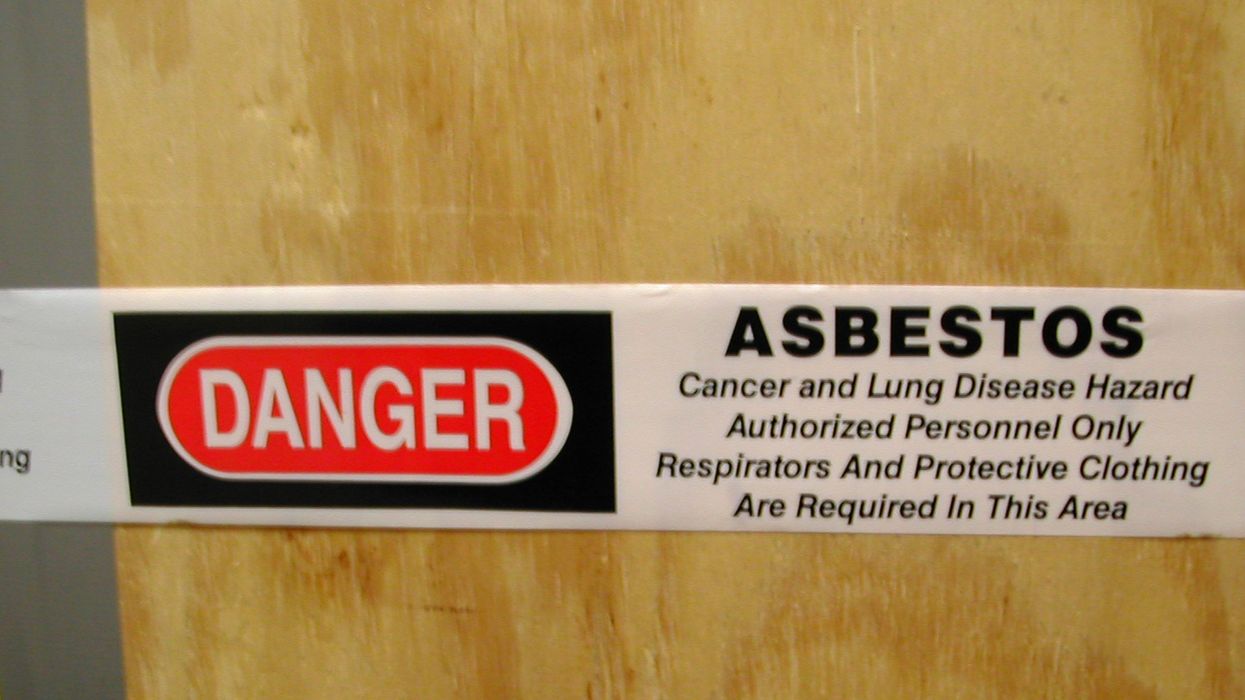
The EPA announced a final rule to prohibit ongoing uses of chrysotile asbestos, which is found in a wide range of products including asbestos diaphragms, sheet gaskets, brake blocks, and aftermarket automotive brakes and linings. In a rare display of election-year bipartisanship, Congress voted nearly unanimously in 2016 to amend the Toxic Substances Control Act to update and strengthen the nation's chemical safety laws.
"Today's rule is a positive first step to give all Americans a future free of exposure to asbestos—a carcinogen that has killed far too many."
Asbestos exposure can cause mesothelioma as well as laryngeal, lung, and ovarian cancer. Banned in more than 50 countries, the substance is linked to more than 40,000 U.S. deaths each year.
"The science is clear—asbestos is a known carcinogen that has severe impacts on public health," said EPA Administrator Michael Regan. "President [Joe] Biden understands that this concern has spanned generations and impacted the lives of countless people. That's why EPA is so proud to finalize this long-needed ban on ongoing uses of asbestos."
The Congressional Progressive Caucus said on social media that "this new asbestos ban is long-overdue and will save thousands of lives."
U.S. Sen. Jeff Merkley (D-Ore.) said in a statement that "today's rule is a positive first step to give all Americans a future free of exposure to asbestos—a carcinogen that has killed far too many."
"An immediate ban on the import of chrysotile asbestos for the chlor-alkali industry is a long-overdue step forward for public health," he added.
Liz Shuler, president of the AFL-CIO union, hailed the EPA's "groundbreaking, landmark protection," adding that "unions have been sounding the alarm on this dangerous substance for decades."
Green groups echoed labor unions in welcoming the EPA move. Environmental Working Group senior vice president Scott Faber said that "it's been more than 50 years since EPA first sought to ban some uses of asbestos and we're closer than ever to finishing the job."
"For too long, polluters have been allowed to make, use, and release toxins like asbestos and PFAS without regard for our health," Faber added, referring to per- and polyfluoroalkyl substances, commonly called forever chemicals. "Thanks to the leadership of the Biden EPA, those days are finally over."
"Biden is on thin ice with young people," said the Sunrise Movement. "He can't throw a bone to us on Monday, let us down on Tuesday, and expect our generation to turn out in the numbers he needs us to in order to win."
The youth-led Sunrise Movement on Friday panned the Biden administration's decision to delay a regulatory crackdown on existing gas-fired power plants by exempting the major polluters from a forthcoming rule aimed at curbing planet-warming greenhouse gas emissions.
E&E News, which first reported the Environmental Protection Agency's (EPA) move, noted that the delay "could push a major part of the president's fight against global warming until after the November election."
"Under the new approach, EPA is still expected to complete a rule in April that would cut greenhouse gas pollution limits for existing coal-fired and future natural gas plants," E&E News reported. "But the rule coming out in April will no longer include limits for existing gas-fired plants—the country's top generator of electricity."
EPA Administrator Michael Regan said in a statement that splitting the rules would allow the agency to take "a new, comprehensive approach to cover the entire fleet of natural gas-fired turbines, as well as cover more pollutants including climate, toxic, and criteria air pollution."
But that rationale didn't satisfy some climate advocates. The Sunrise Movement said it was "disappointed" in the decision and accused the administration of "caving to pressure" from industry lobbyists.
"Biden is on thin ice with young people," Sunrise added. "He can't throw a bone to us on Monday, let us down on Tuesday, and expect our generation to turn out in the numbers he needs us to in order to win."
"Don't get us wrong, we applaud the EPA for finalizing the rules regulating harmful local pollutants from these power plants," the group added. "These rules are a huge win for environmental justice and will protect frontline communities from toxic air pollution. But, we need more from Biden."
"EPA promises that some future proposed rule will address these emissions, but time is not on our side, and the agency's generally lethargic rulemaking pace does not leave one optimistic."
Sen. Sheldon Whitehouse (D-R.I.), chair of the Senate Budget Committee and a member of the chamber's Environment and Public Works Committee, also slammed the decision to—at least temporarily—exempt gas-fired plants from tougher regulations.
"EPA's new power plant rule omits a massive emissions source: existing gas power plants. Making a rule that applies only to coal, which is dying out on its own, and to new gas power plants that are not yet built, is not how we are going to reach climate safety," said Whitehouse. "Failing to cover the plants responsible for the vast majority of future carbon pollution from the power sector makes no sense."
"It is inexplicable that EPA, knowing of these emissions, did not focus this rulemaking on existing gas-fired plants from its inception," the senator continued. "EPA promises that some future proposed rule will address these emissions, but time is not on our side, and the agency's generally lethargic rulemaking pace does not leave one optimistic. With temperature records being broken daily and a spiraling cascade of climate-driven extreme weather events affecting families across America and the world, the planet cannot afford action at EPA's pace. The agency must complete a robust rule covering the existing gas fleet by the end of this year."
The EPA's original proposal to strengthen pollution standards for new and existing power plants drew criticism from environmentalists who said it would cover just a small percentage of existing gas plants and rely far too heavily on ineffective carbon capture technology. The utility industry, meanwhile, lobbied aggressively against the proposal.
Abigail Dillen, president of Earthjustice, defended the EPA's new approach, arguing that its decision to separately pursue more ambitious regulations for existing gas-fired plants would allow the agency "to consider technologies that were not considered in its initial proposal and ensure that new standards do not shift pollution to dirty, uncontrolled plants and the communities they pollute."
But Sunrise warned Friday that putting off any new rules targeting existing gas plants could leave the fate of any broader regulatory effort "up to the results of the 2024 election."
"That's not how a climate president acts," the group said.
Donald Trump, the former president and presumptive 2024 GOP nominee, aggressively rolled back environmental regulations during his first four years in office and appears poised to do the same—potentially on an even larger scale—if he wins in November.
"Trump and his advisers have made campaign promises to toss crucial environmental regulations and boost the planet-heating fossil fuel sector," The Guardian reported last month. "Those plans include systemically dismantling the Environmental Protection Agency."
"Even with these new protections in place, too many people's health will still be at risk from dangerous exposures to PM2.5," one expert said.
The U.S. Environmental Protection Agency announced on Wednesday that it had finalized tougher standards on soot, or fine particulate matter pollution, one of the deadliest types of air pollution.
In a move largely applauded by environmental and public health groups and protested by industry, the EPA said it was strengthening the national ambient air quality standard for soot from an annual limit of 12 micrograms per cubic meter to nine micrograms per cubic meter, which—according to the agency—would prevent as many as 4,500 early deaths each year.
"This final air quality standard will save lives and make all people healthier, especially within America's most vulnerable and overburdened communities," EPA Administrator Michael S. Regan
said in a statement. "Cleaner air means that our children have brighter futures, and people can live more productive and active lives, improving our ability to grow and develop as a nation."
Fine particulate matter (PM 2.5) kills almost 50,000 people in the U.S. every year and led to 4.2 million early deaths worldwide in 2019. It is released primarily by the burning of fossil fuels by factories, power plants, and vehicles and causes health problems like respiratory ailments, cardiovascular disease, and cancer. It is also a major environmental justice issue, as low-income communities of color tend to experience a higher pollution burden.
"Particulate matter pollution is deadly, especially for children and older Americans. The Biden administration's new air quality standards will save thousands of lives and help address unjust disparities in air quality for communities of color and low-income communities," Patrice Simms, Earthjustice's vice president of litigation for healthy communities, said in a statement. "We applaud EPA for issuing a rule that will help reduce heart disease, asthma, and other serious illnesses. We look forward to EPA's implementation efforts, which must include robust enforcement and rigorous monitoring."
The World Health Organization has set its annual target for PM2.5 to five micrograms per cubic meter and its 24-hour target to 15. It calculates that 99% of people on Earth breath air that exceeds its health limit for several pollutants including PM2.5. Despite this, the EPA has not updated its PM2.5 standards since 2012.
"It's shameful that, in the face of such clear and compelling evidence of the public health and economic benefits of stronger soot standards, big polluters and their allies in Washington do everything in their power to undermine these commonsense air pollution standards."
The Clean Air Act requires the agency to review the science and decide whether or not to update the standard every five years. However, while the EPA under former President Donald Trump did complete an assessment, it chose not to strengthen the standards in December 2020. Its own scientists concluded that lowering the safety limit from 12 to nine micrograms would decrease yearly deaths by 12,150, but various industry groups urged the administration not to make any changes, according to The New York Times. Trump EPA Administrator Andrew Wheeler also dismissed an outside group of expert scientists who were consulting on the measure. In response, the Union of Concerned Scientists (UCS) reassembled the panel in 2019. The experts concluded that the EPA should raise its standards to protect public health.
"The delays in updating this standard come at a steep cost, and lingering pollution impacts are too often borne by communities of color and low-income communities already facing disproportionate cumulative pollution burdens," Chitra Kumar, managing director of the UCS' Climate & Energy Program, said in a statement. "Those delays are due in large part to the previous administration dismissing a key science advisory board and ignoring the overwhelming evidence that the PM2.5 standard was insufficient."
While the UCS applauded the new standards, it argued the agency could have gone even further.
"New rules are long overdue, and today's final rule is a step toward cleaner air and healthier communities," Kumar said. "However, even with these new protections in place, too many people's health will still be at risk from dangerous exposures to PM2.5."
One gap in EPA regulations is that there are no standards in place to protect people from ultrafine particulate matter.
"The science is clear—ultra-fine particles make their way into the bloodstream contributing to premature death," said Beto Lugo Martinez, an environmental and climate justice leader who is part of the group Coming Clean.
American Lung Association president Harold Wimmer told the Times that the EPA should have set the limit at eight instead of nine, which was the safest standard in the 8 to 10 micrograms range recommended by the EPA's Clean Air Scientific Advisory Committee. while the Sierra Club pointed out that the agency did not tighten the limit on 24-hour exposure, which remains at 35 micrograms. Lowering this number was also a committee recommendation.
However, the EPA under Regan and President Joe Biden has resisted industry pressure by strengthening the standards at all. In October 2023, representatives from sectors including fossil fuels, manufacturing, and mining sent a letter to Chief of Staff Jeffrey Zients arguing that a nine-microgram standard would "risk jobs and livelihoods by making it even more difficult to obtain permits for new factories, facilities, and infrastructure to power economic growth" as well as hamper Biden administration efforts like the implementation of the Inflation Reduction Act.
In responding to journalists Tuesday, EPA officials pushed back against the economic arguments, according to The Guardian. They said that the country would in fact see up to $77 in health benefits in 2032 for every $1 spent on complying with the update, and that 99% of U.S. counties were already on track to meet the new standard by that date, which is most likely the date by which states would face fines for not complying with the new standard.
"It's shameful that, in the face of such clear and compelling evidence of the public health and economic benefits of stronger soot standards, big polluters and their allies in Washington do everything in their power to undermine these commonsense air pollution standards," Sierra Club executive director Ben Jealous said in a statement. "Their resistance is a stark reminder that the fight for clean air and a healthier future is far from over, and we will continue working to ensure the benefits of these stronger air pollution standards reach the communities that need them most."
The next step is for the EPA to spend the coming two years determining which areas do not meet the revised standards. After that point, the states that do not meet them would have 18 months to draft a plan to lower pollution levels.
Environmental advocates see the new standards as a chance to improve air quality and health in frontline communities such as the nation's ports.
"We're elated by the EPA's decision to finalize a significantly stronger air quality standard that will better protect all Americans, especially port communities," Terrance Bankston, Friends of the Earth's senior ports and freights campaigner, said in a statement. "Many Americans have been subjected to disproportionate health risks from air pollution via port operations for decades. The biggest offender has and continues to be soot pollution from port emissions. For LatinX residents, the exposure to soot pollution is 75% higher. For Black Americans, the risk of dying from soot pollution is the highest, with a rate of over triple that of white Americans."
Ports now have an opportunity to use the $3 billion from the EPA's Clean Port Program to switch to zero-emissions technology.
"We encourage port stakeholders to use the EPA's announcement as an opportunity to be on the right side of history," Bankston said.
The rule, and the science behind it, is also a reminder that fossil fuels harm human health even beyond driving the climate crisis, and that both regulating their pollution and transitioning away from them can have multiple benefits.
"Air pollution used to be the price we had to pay to heat our homes, commute, or produce goods by burning coal, oil, and gas. Thankfully, in the rapidly accelerating renewable energy era, that's no longer the case," Lisa Frank, executive director of Environment America Research & Policy Center's Washington Office, said in a statement. "These soot standards will save lives, clear our skies, and alleviate the burden of asthma and other illnesses. That's something all Americans should celebrate."
Across the nation, the success of the new rule will also depend on the degree to which the EPA holds violators to account.
"EPA must support the new standard with strong enforcement on polluters," Martinez said. "The continued influence of polluters on EPA does not align or meet with the administration's claimed priorities on environmental justice. Weak standards and weak enforcement give a green light to polluters and the government to continue business as usual."
"We're challenging the EPA's failure to protect us. The air we breathe has become a casualty of their opposition."
As the United Nations climate talks cast a spotlight on the fossil fuel-driven climate emergency, the U.S. law firm Our Children's Trust on Sunday launched a constitutional lawsuit against the Biden administration on behalf of 18 California children "growing up with polluted air and a government-imposed and -sanctioned climate crisis."
Filed in the U.S. District Court in the Central District of California, the complaint takes aim at the federal government, the Environmental Protection Agency, and its administrator, Michael Regan, arguing that the "EPA's conduct in controlling the pollution that enters the nation's air actively discriminates against children, and these plaintiffs, knowingly causing them disproportionate harm compared to similarly situated adults and burdening them with a lifetime of hardship."
Avroh, a 14-year-old plaintiff, said in a statement Monday that "we are experiencing what no one should have to experience. We're facing constitutional negligence. We're challenging the EPA's failure to protect us. The air we breathe has become a casualty of their opposition."
Another plaintiff, 8-year-old Neela, said that "I believe kids can make a difference and the Earth needs our help. I want to help protect the people and places I love. I'm excited to be a part of this case and be a voice for all kids who deserve a healthy environment."
"We feel a constant worry about the future, and all around us no one is moving fast enough."
Catherine Smith, of counsel to Our Children's Trust—which secured a landmark victory while representing Montana youth in state court earlier this year—argued that "in times like this, when the legislative and executive branches have breached their obligation to young people by intentionally allowing climate pollution and explicitly discounting children's lives in some political or economic calculus fully aware of its consequences to youth, courts must serve as a constitutional backstop to end it."
The plaintiffs—who are ages 8-17—are seeking "a declaratory judgment that as children they are entitled to a heightened level of
judicial review over government conduct that burdens them with lifetimes of hardship, that they are members of a constitutionally protected class, and that defendants have violated their constitutional rights," according to the complaint.
"They also seek declaratory relief that defendants have infringed their fundamental rights to life, including their personal security and happiness, and in so doing have also acted outside the scope of their delegated authority," the filing adds. "Plaintiffs seek further relief as deemed necessary and proper to enforce a declaratory judgment after the facts are found and the legal conclusions of the district court are rendered on a full evidentiary record."
Noah, a 15-year-old plaintiff, warned that "time is slipping away, and the impact of the climate crisis is already hitting us directly. We are running from wildfires, being displaced by floods, panicking in hot classrooms during another heatwave."
"We feel a constant worry about the future, and all around us no one is moving fast enough," Noah noted. "The Constitution guarantees every American the rights to life, liberty, and the pursuit of happiness including and especially children."
Our Children’s Trust chief legal counsel Julia Olson declared that "these children are rising up from fire, smoke, heat, and flood to share their stories of physical harm and despair, along with their clarion call to adults—'our equal rights to life matter as much as yours.'"
"There is one federal agency explicitly tasked with keeping the air clean and controlling pollution to protect the health of every child and the welfare of a nation—the EPA," she continued. "The agency has done the opposite when it comes to climate pollution and it's time the EPA is held accountable by our courts for violating the U.S. Constitution and misappropriating its congressionally delegated authority."
In addition to representing youth plaintiffs in Held v. State of Montana—which the state is now appealing—Our Children's Trust is the group behind Juliana v. United States, the constitutional climate lawsuit first filed on behalf of 21 young people in 2015. While a June ruling put Juliana on track to proceed to trial, the Biden administration continues its battle to quash the case.
E&E News reported Monday that "while Juliana targets a swath of government agencies," the new case, Genesis B. v. EPA, singles out one agency. Our Children's Trust senior staff attorney Andrea Rodgers explained that the firm hopes the focus will mean that the EPA "won't fight this case" in the way that the Obama, Trump, and Biden administrations have targeted Juliana.
"Congress and local elected officials must now step in and do more to protect clean water through durable legislation and state-based action," said one advocate.
Under a U.S. Supreme Court ruling condemned by clean water advocates earlier this year, the Environmental Protection Agency on Tuesday announced a revised rule that could clear the way for up to 63% of the country's wetlands to lose protections that have been in place nearly half a century under the Clean Water Act.
EPA Administrator Michael Regan said he had been "disappointed" by the 5-4 decision handed down in Sackett v. Environmental Protection Agency in May, but he was obligated under the ruling to issue a final rule changing the agency's definition of "waters on the United States."
As Common Dreams reported, the high court ruled in May that the Clean Water Act protects waters and wetlands that have a "continuous surface connection to bodies that are waters of the United States in their own rights," such as major rivers and coastlines.
Prior to the ruling, the Clean Water Act protected wetlands as long as they had a "significant nexus" to regulated waters, but the EPA rule removes that test from consideration when determining if a waterway should be protected. The rule will leave streams and tributaries—and the communities adjacent to them—without protections from pollution that can be caused by housing and business development, mining, pipeline construction, and a number of industries.
The ruling and resulting EPA rule reflected "the Supreme Court's disturbing pattern of striking down environmental regulations to serve industry interests," said environmental law group Earthjustice on Tuesday.
An EPA official told The Washington Post that an estimated 1.2 million to 4.9 million miles of ephemeral streams across the U.S. would immediately lose protections now that the final rule has been issued.
Julian Gonzalez, a water policy lobbyist with Earthjustice, told the Post that changing the rule is "not necessarily what they want to do" at the EPA, while Patrice Simms, the group's vice president of litigation for healthy communities, called the court's ruling a "politically motivated decision" that "ignores science and flies in the face of what almost everyone knows: that we all need clean water."
"The Supreme Court's right-wing supermajority's disastrous ruling in Sackett v. EPA reduced EPA's ability to protect our wetlands and waters from destruction and contamination," said Simms. "The new rule from EPA adjusts its existing regulations to comport with Sackett and reflects our dangerous new reality—one where mining companies, Big Ag fossil fuel developers, and other polluting industries can bulldoze and fill wetlands indiscriminately, harming our public health and ecosystems."
With state regulatory agencies and legislatures now empowered to determine how wetlands are protected, Earthjustice said waterways in states including Texas, Kentucky, Oklahoma, and Colorado are the most vulnerable to industrial pollution. States including Vermont, New York, and Minnesota currently have some of the strongest protections in place.
Marc Yaggi, CEO of Waterkeeper Alliance, said that with the climate and pollution crises becoming increasingly destructive, "there could not be a worse time to weaken the Clean Water Act."
"Intensifying droughts are wreaking havoc on agriculture, pollution and toxins are increasingly threatening water sources nationwide, and millions of people are contending with dangerously contaminated drinking water," said Yaggi. "Congress and local elected officials must now step in and do more to protect clean water through durable legislation and state-based action."
Close inspection of the historic arguments used by the fossil fuel industry and its partners reveals the same delay-based messaging each time they have faced the prospect of regulation.
The U.S. Environmental Protection Agency, or EPA, is considering proposals aimed at reducing climate-warming carbon dioxide emissions from existing coal and gas-fueled power plants. Power plants are the second-largest source of greenhouse gases in the United States, and the pollution standards, which are open for public comment until August 8, will mark a new milestone in climate action. But the United States’ biggest polluters and their political allies are pushing back—just as they have resisted every other landmark shift in the 60-year history of federal air pollution control.
“This administration is determined to advance its radical climate agenda and has made it clear they are hellbent on doing everything in their power to regulate coal and gas-fueled power plants out of existence, no matter the cost to energy security and reliability,” declared Sen. Joe Manchin III (D-W.Va.) in a May 10 statement.
The National Mining Association (NMA) echoed Manchin’s fiery rhetoric, warning of “premature coal plant retirements,” alleging that these would pose “serious risks” and calling for “an energy policy reset to avoid an uneasy and potentially failing energy situation.”
“National policy must avoid imprudent attempts to make ‘great leaps forward.’”
“It’s truly an onslaught,” NMA’s President and CEO Rich Nolan told the AP, “designed to shut down the coal fleet prematurely.”
These arguments were reiterated August 1 in a letter to EPA Administrator Michael Regan signed by 39 Senate Republicans who warned that the proposed rule will “negatively impact electric reliability across the country,” describing it as “rushed decision-making.”
This not-so-fast rhetoric is nothing new. Close inspection of the historic arguments used by the fossil fuel industry and its partners to justify their ongoing pollution of the earth’s atmosphere—whether it be by sulfur oxides, CO2, or methane—reveals the same delay-based messaging each time they have faced the prospect of regulation.
In the 1960s, as the American public grew increasingly concerned about coal-based air pollution, a spokesman for the United States’ most powerful coal lobby told senate lawmakers that the elimination of pollution could “be brought about only gradually” without “impairing the viability of any of our energy industries.”
“National policy must avoid imprudent attempts to make ‘great leaps forward,’” declared Philip Sporn in 1967. Sporn was the vice-chairman of the National Coal Policy Conference (NCPC), an alliance of coal interests that included the American Mining Congress and the National Coal Association (historic forebears of today’s National Mining Association).
Instead, Sporn (who was also the former president of utilities giant American Electric Power), urged that policy should focus on “continuing research” aimed at alleviating “fossil fuel pollution” while expanding the “fullest possible use” of all energy industries, predominantly “coal, gas and oil.”
“Time,” he argued, “must be permitted for research to find solutions.”
This call for more time—and more research into technological fixes that allow for the continued use of fossil fuels—is one of the arguments that the coal industry and a wider coalition of fossil fuel allies has used for 60 years to delay change and prevent regulation. Other tactics, some evident in Manchin’s and Nolan’s recent comments, include denying or doubting that a pollution problem exists and calling for further research; warning that regulations will hurt the economy or threaten living standards; playing to fears that regulations will limit energy supply, causing blackouts and shortages; stating that industry is already making great progress in fixing the problem voluntarily; and arguing that local and state governments, rather than the federal government, should manage pollution.
“From coal to chemicals and pesticides to petroleum, these tactics have been around for decades,” says Melissa Aronczyk, professor at the School of Communication & Information at Rutgers University and co-author of A Strategic Nature: Public Relations and the Politics of American Environmentalism.
“There are reasons you see the same tired rhetoric across so many polluting industries,” Aronczyk explains. In her view, trade associations like the National Mining Association work behind the scenes to protect industry at all costs. “Even if a company is breaking the rules,” she states, “they’ll push back against the rule-makers rather than acknowledge their polluting ways.”
In 1963, after “black rain” fell in his hometown of Boston, President John F. Kennedy made an initial attempt to bring the nationwide problem of air pollution under federal control in what would become the first Clean Air Act. This move, aimed specifically at tackling “interstate air pollution,” was strongly opposed by American Mining Congress (AMC), whose spokesman, J. Allen Overton, told the Senate Subcommittee on Air and Water Pollution that, “provisions giving the Federal Government broad authority to enforce air pollution abatement should not be enacted.”
As a member of the National Coal Policy Conference (NCPC), the AMC stood alongside a range of coal-related industries (including oil, chemicals, steel, electrical utilities, and railroads) that aimed to use their collective power for mutual benefit.
Like many of its coalition partners, the AMC argued that air pollution should be the responsibility of state and local governments alone.
Exactly 60 years later, the National Mining Association, which succeeded the American Mining Congress, is once again demanding that the EPA should “respect states’ authority to set performance standards” in response to the current efforts to set new regulations.
“The very nature of air pollution is local in character and can be most effectively met at the local level,” Overton insisted in his statement to the Senate subcommittee, before emphasizing the AMC’s belief that it was “undesirable for the Federal Government to be a policeman in these activities.”
Instead of developing and enforcing national emissions standards, the AMC stated that the federal government’s role should be limited to providing “leadership through research and technical assistance.”
During the hearings, Sen. Maurine B Neuberger (D-Ore.) challenged this common industry preference for state and local regulation, suggesting that it was predicated on the belief that polluters could exert greater influence with “municipal or State government” than “with the vast Federal Government that represents all the people.”
Exactly 60 years later, the National Mining Association, which succeeded the American Mining Congress, is once again demanding that the EPA should “respect states’ authority to set performance standards” in response to the current efforts to set new regulations. The industry group is also arguing that the federal government should focus on providing “dedicated leadership” in making “technologies broadly commercially and economically viable and globally replicable.”
In early 1963, the powerful trade group the National Association of Manufacturers (NAM) also threw its weight against air pollution regulation. Samuel S. Johnson, chairman of NAM’s self-described Conservation Committee wrote a letter to Sen. Abraham Ribicoff (D-Conn.), the original sponsor of the first Clean Air Act, stating that federal regulation was unnecessary. According to NAM, “American industry” was already “spending hundreds of millions of dollars on air pollution control” with the result that there had been “visible improvement in conditions.” Consequently, there was “no necessity for the type of federal enforcement legislation” that Ribicoff was proposing. Amplifying this message, NAM also issued a national press release quoting directly from Johnson’s letter.
Similarly, a 2023 NAM press release issued in response to the EPA’s proposed new power plant emissions rule also implies that regulation is unnecessary because the industry is already responsibly controlling pollution.
“Manufacturing in America is cleaner and more sustainable than ever” NAM proclaimed on May 11, declaring that “the power generation sector has been making historic strides in bringing zero-emission sources online.”
In late 1963 a report titled “Study of Pollution–Air” was entered into the Congressional Record by Sen. Edmund Muskie (D-Maine). It outlined evidence of “a gradual increase” in atmospheric CO2 from burning fossil fuels and the resulting potential temperature and climate impacts, including “more destructive storms.”
In December 1963 the Clean Air Act was signed into law, barely a month after President Kennedy’s assassination. However, partly as a result of industry pressure, authority rested largely with the states and the new law failed to solve what multiple witnesses in Congress had described as the “grave” and “serious”problem of air pollution.
That problem was not only confined to sulfur dioxide emissions from burning coal. Senators were also concerned about evidence of increasing carbon dioxide (CO2) emissions and the impact these might be having on the earth’s climate.
In late 1963 a report titled “Study of Pollution–Air” was entered into the Congressional Record by Sen. Edmund Muskie (D-Maine). It outlined evidence of “a gradual increase” in atmospheric CO2 from burning fossil fuels and the resulting potential temperature and climate impacts, including “more destructive storms.”
Two years later, a report by the President’s Science Advisory Committee—made public by President Lyndon B. Johnson on the grounds of the universal significance of its findings—further stated that “carbon dioxide is being added to the earth’s atmosphere by the burning of coal, oil, and natural gas” at such a rate that “by the year 2000 the increase” may produce “marked changes in climate.“
The coal industry was aware of the climate science of the time as well as discussions about the need for limits on carbon dioxide emissions. In August 1966, the Mining Congress Journal featured an article titled “Air Pollution and the Coal Industry” by James Garvey, a vice president of the National Coal Association (NCA). It discussed “serious studies” being conducted “to determine whether more restrictions should be placed on the emission of carbon dioxide in the atmosphere.”
Garvey reported on evidence indicating that the amount of CO2 in the earth’s atmosphere was increasing “as a result of the combustion of fossil fuels” and could drive temperature increases and “vast changes in the climates of the earth” such as “melting of the polar icecaps” and the “inundation of many coastal cities, including New York and London.”
Despite this knowledge, the industry continued to fight tooth-and-nail against regulations.
The following year, in 1967, the Senate Committee on Public Works (the parent committee of the Air and Water Pollution Subcommittee) would emphasize the “immediate need” to control air pollution, including CO2.
“The problem of air pollution is neither local nor temporary. It is a universal problem, and, so long as our standard of living continues to increase, it will be a permanent threat to human well-being,” Muskie reported on behalf of the committee. “No one has the right to use the atmosphere as a garbage dump.”
In January 1967, frustrated by lack of progress, lawmakers tried again to tighten control over the nation’s biggest polluters.
Once more, however, the coal industry and its allies were prepared. During the 11 days of public hearings on what would become the Air Quality Act, America’s foremost coal lobbyist and founder of the NCPC, Joseph Moody, organized testimony from across the fossil fuel industry, orchestrating a coordinated portfolio of views from the NCPC and its partners.
Moody’s coalition included the country’s largest coal mining companies, Peabody and Consolidation Coal; electric utility American Electric Power; and the United Mine Workers of America. Echoing these positions, were the American Petroleum Institute; Humble Oil (now ExxonMobil); the Edison Electric Institute; the Pennsylvania Railroad; the National Steel Corp, which represented 41 other steel companies; NAM; the U.S. Chamber of Commerce; and the Automobile Manufacturers Association, with representatives from Chrysler and General Motors.
Spoiler Alert: When the Clean Air Act of 1970 eventually introduced firm restrictions on sulfur emissions from existing power plants, the lights did not go out.
Like their modern counterparts, the coal industry cohorts sought to delay a transition to cleaner fuels, pleading for time and emphasizing the current economic centrality of fossil fuels in the hope of maintaining the status quo and securing coal’s place in America’s future energy supply. Witnesses frequently reinforced each other’s positions, warning of the dangers of moving “too fast,” predicting “power shortages” as a consequence of regulation, advocating investment in research and technological fixes as the best methods for tackling pollution, while almost uniformly opposing national emissions standards and any prohibition of even the most toxic agents (including lead in gasoline). Often, they seemed to be speaking from the same script.
For example, C. Howard Hardesty Jr., executive vice president of Consolidation Coal, declared that “our primary concern with this legislation and with the entire air pollution program is that we are trying to do too much too fast.” Moving “too hastily” could create “a serious fuels and power shortage.”
This message was repeated by James Garvey of the NCA and the author of its 1966 article on the predicted dangers of CO2-induced temperature rises. Now in front of the Senate Subcommittee on Air and Water Pollution, faced with imminent regulation of sulfur oxides, Garvey declared that the “primary concern” of the NCA was that the nation was perhaps “moving too fast in the imposition of control measures.” He also conjured visions of power shortages, warning that alternatives to high-sulfur coal would not be sufficient “for meeting the power demand of the United States.”
Moody himself testified in front of the subcommittee, urging lawmakers to prioritize “economic realities” and criticizing what he described as “regulatory standards written in total disregard of technological feasibility… regardless of the economic disruption that inevitably will result.”
Instead, Moody suggested “a program of sound and orderly air pollution abatement,” based on “research to close the technology gap.” If not, Moody warned there would be “fuel shortages.”
Spoiler Alert: When the Clean Air Act of 1970 eventually introduced firm restrictions on sulfur emissions from existing power plants, the lights did not go out. Instead, the industry switched its fuel source, shifting from high-sulfur coal to low-sulfur coal.
And yet, in 2023, the National Mining Association is once again similarly resisting any suggestion of fuel-switching, playing on fears around energy supply as a way of delaying limits on air pollution, and arguing that the EPA recognize “real-world constraints” to decarbonization. If not, the NMA warns that the agency’s “power sector strategy” will make it impossible to meet the energy demands of the U.S.”
Today, the NMA and the wider fossil fuel industry have a powerful ally in Manchin, the chairman of the Senate’s Energy and Natural Resources Committee. Manchin, who has a personal financial interest in coal-fired electricity generation, has vowed to oppose every EPA nominee if the agency’s power plant emission regulations are approved and has previously been described as a “kingmaker” by a lobbyist for ExxonMobil on account of his influence over environmental legislation.
Similarly, throughout the 1960s, the fossil fuel industry also possessed a “potent weapon” in the form of Sen. Jennings Randolph (D-W.Va.), the influential chairman of the Public Works Committee which held overall responsibility for air pollution legislation. Like Manchin, Randolph was a senate Democrat from West Virginia who had close relationships with his home state’s coal and chemical industries.
On Randolph’s request, a number of amendments beneficial to the coal industry and its fossil fuel allies were inserted into the 1967 Air Quality Act. As documented by multiple scholars, these “Randolph Amendments” focused federal air pollution policy squarely on technological fixes aimed at reducing pollution from existing fuels rather than encouraging a transition to less-polluting alternatives. Essentially, they delivered exactly what the coal industry had demanded when Philip Sporn of the NCPC urged lawmakers to focus on “improved techniques” for the “use of fossil fuels” and called for “continuing research” to promote solutions that would not preclude the “fullest possible use” of all America’s “energy industries,” meaning primarily fossil fuels.
Despite CCS’s lack of proven success at scale, the industry has repeatedly championed it in public, promising reduced greenhouse gas emissions without the necessity of cutting consumption of coal, gas, or oil.
This emphasis on technological solutions that allow for prolonged use of fossil fuels has dominated federal air pollution policy ever since.
For example, while the EPA’s new proposals incentivize potential fuel-source-switching to alternative technologies such as green hydrogen or renewables, they also open the door to the broader adoption of carbon capture and storage (CCS) technology, which many argue is an unproven and potentially dangerous false solution.
Despite CCS’s lack of proven success at scale, the industry has repeatedly championed it in public, promising reduced greenhouse gas emissions without the necessity of cutting consumption of coal, gas, or oil. For example, in May 2023 the NMA called for a “carbon capture moonshot,” claiming that emissions reductions cannot be achieved without its “deployment for all fossil fuels.”
This same emphasis is also evident in international climate diplomacy. In May, COP28 President, Sultan Ahmed Al Jaber (who heads the Abu Dhabi National Oil Company), announced that climate diplomacy should focus on a “phase out” of emissions from “all sectors” while leaving open the possibility of continued use of fossil fuels via the expansion of as-yet-unproven carbon capture technology.
In 1970, the Clean Air Act Amendments prioritized “health and welfare” over “considerations of technology and economic feasibility.” Predictably, these provisions elicited outcry from all corners of the fossil fuel industry. The NCPC criticized “the rush to new legislation,” warning that “hasty, unrealistic solutions today may adversely affect both energy and pollution control requirements of tomorrow.” The AMC argued that provisions for considering “economic feasibility” should be re-instated. Standard Oil of Indiana (later BP) described the subcommittee’s decisions as “hasty,” urging that standards of performance for “all new stationary emission sources” (including power plants) be “modified” to recognize “commercial feasibility.” Ashland Oil called for “an orderly program to accomplish control goals, giving full consideration to economic impact.”
Fears of economic disruption were played upon most intensely by Lee Iacocca, the executive vice president of the Ford Motor Company and later CEO of Chrysler, who issued a 20-page statement calling the bill “a threat to the entire American economy and to every person in America.”
Conferring with his fellow lawmakers, Sen. Muskie refused to “dilute” the bill by allowing economic considerations to take precedence, declaring that “What may seem economically prohibitive today may with the benefit of hindsight… look like a very cheap answer that we should have insisted upon at that time if only we had known.”
“What may seem economically prohibitive today may with the benefit of hindsight… look like a very cheap answer that we should have insisted upon at that time if only we had known.”
In the event, the Clean Air Act did not threaten the entire American economy or every person in America.
But despite this, the same fear-mongering tactics are evident today. Responding to the EPA proposals in May of this year, NAM declared that “the U.S. cannot afford to shut down more than half of our power generation and grind our economy to a halt.” According to NAM, the EPA’s power plant rule presents “a grave risk” to the “economy and families.”
Mark Z. Jacobson, professor of civil and environmental engineering at Stanford University and author of No Miracles Needed: How Today’s Technology Can Save Our Climate and Clean Our Air, says the direct opposite is true. “The longer we keep coal, the higher the cost we will pay, not only for energy, but also for health and climate damage.”
According to Jacobson, we already have “95% of what we need” to solve problems around the energy transition, but action is being stymied by the fossil fuel industry’s continued “lobbying against renewables, sowing confusion, and greenwashing.” Instead, Jacobson argues that what’s needed now is better “education about what is possible” and “the political will to implement useful solutions rapidly.”
Although there are certainly valid concerns around today’s energy transition, revisiting the fossil fuel industry’s arguments over the past six decades highlights the emptiness of its rhetoric and the long-term predatory nature of its delay-based arguments.
However, while history sharply reveals the forces of obstruction, it also reveals other forces capable of dynamic change.
In January 1963 political will was needed just as much as it is now.
In his reply to the National Association of Manufacturers, Sen. Ribicoff emphasized that he would not be swayed by its arguments. Rebutting NAM’s assertion that air pollution regulation was unnecessary, Ribicoff noted that the facts of air pollution were “well documented,” that he regretted NAM’s opposition to “needed legislation,” and promised that he would “continue this fight undismayed.”
Announcing the new power plant proposals in May 2023, EPA Administrator Michael Regan echoed Ribicoff’s determination. “It’s clear that we’ve reached a pivotal point in human history and that we must act now to protect our future,” declared Regan. “We have a once-in-a-generation opportunity for real climate action. Failure is not an option. Indifference is not an option. Inaction is not an option… We must get this right; we only have one planet.”
"This is a win for workers, our economy, and our fight to confront the climate crisis," said Democratic Sen. Chris Van Hollen.
U.S. President Joe Biden's administration on Friday opened a pair of grant competitions with a combined $20 billion in public funding designed to "mobilize private capital into clean technology projects."
The initiative aims to "create good-paying jobs and lower energy costs for American families, especially in low-income and disadvantaged communities, while cutting harmful pollution to protect people's health and tackle the climate crisis," the U.S. Environmental Protection Agency (EPA) explained in a statement.
The $14 billion National Clean Investment Fund (NCIF) seeks to expand the deployment of green technologies nationally while the goal of the $6 billion Clean Communities Investment Accelerator (CCIA) is to increase local green financing capacity via community lenders.
"Today, communities around the country are getting a green light for a new historic era of green financing."
Both programs are part of the $27 billion Greenhouse Gas Reduction Fund (GGRF) established last year when congressional Democrats passed the Inflation Reduction Act. The final $7 billion component of the GGRF, the "Solar for All" program, was unveiled last month.
EPA Administrator Michael Regan announced the NCIF and CCIA grant competitions at an event at Coppin State University in Baltimore. He was joined by Vice President Kamala Harris, Democratic Sens. Tom Carper (Del.), Ed Markey (Mass.), and Chris Van Hollen (Md.), and Democratic Reps. Frank Pallone (N.J.) and David Trone (Md.).
"Communities on the frontlines of the climate crisis will be the first to reap the benefits of President Biden's historic investments in the clean economy," said Regan. "The Greenhouse Gas Reduction Fund will spur private investment into clean technology projects and expand economic opportunity for communities that have been left behind, for families that want lower energy costs, and for workers who need good-paying jobs."
According to the EPA, the NCIF "will provide grants to support two to three national clean financing institutions, enabling them to partner with the private sector to provide accessible, affordable financing for tens of thousands of clean technology projects nationwide."
"By mobilizing significant amounts of private capital, these national nonprofits will ensure that every dollar of public funds generates several times more in private investment," the agency said. "At least 40% of the funds from the National Clean Investment Fund will be dedicated to low-income and disadvantaged communities."
Meanwhile, the CCIA "will provide grants to support two to seven hub nonprofit organizations, enabling them to provide funding and technical assistance to public, quasi-public, not-for-profit, and nonprofit community lenders working in low-income and disadvantaged communities—supporting the goal that every community in the country has access to the capital they need to deploy clean technology projects," the EPA continued.
"These hub nonprofits will enable hundreds of community lenders—such as community development financial institutions (including Native CDFIs), credit unions, green banks, housing finance agencies, and minority depository institutions—to finance clean technology projects in low-income and disadvantaged communities while also mobilizing private capital and building the enduring capacity of community lenders to finance these projects for years to come," the agency added. "100% of the funds from the Clean Communities Investment Accelerator will be dedicated to low-income and disadvantaged communities."
Applicants have until October 12 to request grants.
"This program will bring life-changing projects to environmental justice and frontline communities around the country, delivering on the promise of a livable future for all."
The nationwide green investment strategy elicited praise from progressive members of Congress.
"It's been over a decade since we first put the idea of creating a national climate bank on paper," said Van Hollen, who introduced legislation to create a federal green bank 14 years ago. "Today, that idea is becoming a reality. With the launch of the Greenhouse Gas Reduction Fund, we are deploying powerful tools to help us address climate change through innovative new solutions while creating jobs and growing our economy."
"These funds will serve as a force multiplier for private investment in clean energy projects to cut emissions and promote environmental justice in underserved communities across the country," he added. "This is a win for workers, our economy, and our fight to confront the climate crisis."
Markey, the lead sponsor of the National Climate Bank Act that inspired the creation of the GGRF, concurred.
"Today, communities around the country are getting a green light for a new historic era of green financing," said Markey, chair of the Senate Environment and Public Works Subcommittee on Clean Air, Climate, and Nuclear Safety.
"I am thrilled to celebrate the hard work of Administrator Regan and the Biden-Harris administration and herald the start of a national clean financing network, funded by the landmark investments of the Inflation Reduction Act," the lawmaker added. "From clean transit to healthy housing, applicants to this program will bring life-changing projects to environmental justice and frontline communities around the country, delivering on the promise of a livable future for all."
"At a time when people are struggling to make ends meet, all while dealing with the existential threat of climate change, we must make residential rooftop solar a reality for low-income and working families that need it most," said Sen. Bernie Sanders.
President Joe Biden's administration on Wednesday opened a $7 billion grant competition aimed at increasing access to residential solar power for millions of low-income households across the United States.
The initiative was announced by U.S. Environmental Protection Agency (EPA) Administrator Michael Regan in Waterbury, Vermont. Regan was joined by U.S. Sen. Bernie Sanders (I-Vt.) and other members of the state's congressional delegation, who touted how local rooftop solar installations are lowering energy bills while improving public and planetary health.
Regan emphasized that the Biden administration's "Solar for All" program will replicate those benefits in disadvantaged neighborhoods nationwide, simultaneously alleviating the cost-of-living crisis, rampant air pollution, and the climate emergency—all of which are driven to varying degrees by the country's reliance on fossil fuels.
"Solar for All will accelerate the deployment of residential solar in communities that for too long have lacked access to the cost-saving benefits of clean energy generation at home."
"For too long, overburdened communities on the frontlines of the climate crisis have been left behind and locked out of clean energy investments and climate solutions," Regan said in a statement. "This historic boost in solar investments will advance millions of residential solar projects nationwide, protect people and the planet, deliver environmental justice, save families money, and create good-paying jobs."
The grants are part of the $27 billion Greenhouse Gas Reduction Fund (GGRF) established by the Inflation Reduction Act (IRA). The EPA said that it will award "up to 60 grants to states, territories, tribal governments, municipalities, and eligible nonprofits to create and expand low-income solar programs that provide financing and technical assistance, such as workforce development, to enable low-income and disadvantaged communities to deploy and benefit from residential solar."
Applicants have until September 26 to request grants in amounts ranging from $25 million to $400 million.
"All communities deserve to participate in America's growing clean energy economy," said Regan. "Under this competition, we will bring more communities along, working together to build a healthier and cleaner future for all."
A long-term study published in November showed that rooftop solar is becoming more accessible to low- and moderate-income households, but not quickly enough to stave off the worst consequences of the climate crisis.
Sanders sponsored the inclusion of the Solar for All program in the IRA and has long advocated for its swift implementation.
As The Hill reported Wednesday:
In December, at a meeting of the Senate Environment and Public Works Committee, the Vermont senator voted to advance the nomination of Joe Goffman, President Biden's nomination to lead the EPA's air office, but said he would not back him in the full Senate without a written commitment that the full $7 billion would go toward installation of residential solar.
The panel advanced Goffman's nomination this April, but it has yet to receive a full Senate vote.
"At a time when people are struggling to make ends meet, all while dealing with the existential threat of climate change, we must make residential rooftop solar a reality for low-income and working families that need it most," Sanders said Wednesday.
"This $7 billion residential solar program that I introduced and the EPA is administering is a major step in the right direction," he added. "I look forward to working with the EPA on this program to make it more affordable for low-income and working-class families to install solar on their homes and save money on their electricity bills, as well as help create millions of good jobs in Vermont and across the country."
According to the EPA:
The new grant competition will provide funds to expand existing low-income solar programs as well as develop and implement new Solar for All programs nationwide. Solar for All programs ensure low-income households have equitable access to residential rooftop and residential community solar power, often by providing financial support and incentives to communities that were previously locked out of investments. In addition, these programs guarantee low-income households receive the benefits of distributed solar including household savings, community ownership, energy resiliency, and other benefits.
"Solar for All will accelerate the deployment of residential solar in communities that for too long have lacked access to the cost-saving benefits of clean energy generation at home," said GGRF acting director Jahi Wise. "The Solar for All program strengthens low-income and disadvantaged community-focused solar programs across the country, bringing long-needed cost savings and pollution reduction to American communities."
In addition to unveiling the $7 billion Solar for All initiative, the EPA announced that it plans to launch two other GGRF programs in the coming weeks: A $14 billion National Clean Investment Fund (NCIF) grant competition to expand the deployment of clean technologies at the national scale and a $6 billion Clean Communities Investment Accelerator (CCIA) grant competition to increase local clean financing capacity via community lenders.
"As plastic pollution saturates our planet and our bodies, the Biden administration should take every reasonable step to protect our environment and public health," said Rep. Lloyd Doggett.
Citing extensive research which has shown recently that microplastics are ubiquitous in the environment, more than 70 U.S. House members on Friday wrote to the Environmental Protection Agency to demand stronger regulation of the microscopic particles that are used in everyday household items and have been linked to respiratory diseases and cancers.
Rep. Lloyd Doggett (D-Texas) led lawmakers including Reps. Pramila Jayapal (D-Wash.), Mark Pocan (D-Wis.), and Barbara Lee (D-Calif.) in writing the letter, which notes that under the Clean Water Act, the EPA can and should "use its existing statutory authorities to address the growing prevalence of microplastic pollution" across the country.
Currently, the lawmakers said, it is largely being left up to individual states to decide whether to regulate microplastics, leading to "troubling disparities... regarding basic protections."
In Doggett's home state, the Texas Commission on Environmental Quality last year "quickly abandoned" a proposal to require "chemical companies to have internal processes restricting accidental releases of plastic pollution," while California residents are benefiting from a statewide effort led by the California Ocean Protection Council to reduce microplastics in marine environments.
"Federal action should encourage high standards to mitigate microplastics in natural environments, which can ultimately make their way into the food we eat, the water we drink, and the air we breathe," wrote the lawmakers.
The letter points to a 2020 study which found that scientists discovered microplastic pollution in some of the world's most remote places, including Mount Everest, and research from 2021 which suggested the average adult ingests 320,000 microplastics each year.
As Common Dreams reported last year, a team of researchers in the U.K. found tiny microplastic particles lodged in the lungs of 11 out of 13 patients at a hospital, with the most common microplastic found being polypropylene—commonly used in plastic packaging, textiles, and kitchen utensils.
A draft report on microfiber pollution from the EPA and the National Oceanic and Atmospheric Administration (NOAA) found that microplastics "have the potential to impact human reproductive, respiratory, digestive, nervous, and urinary systems," noted Doggett and the other lawmakers on Friday.
"Plastic pollution is not just affecting our oceans and marine life—it's flowing in our bloodstreams and lingering on nearly every object we touch," said Doggett in a statement. "Regulating microplastics as hazardous waste will protect our health and our environment."
The lawmakers wrote that they are "encouraged" by the EPA and NOAA's draft report and accompanying federal plan for preventing microfiber pollution, but called on the agency to take steps under the Clean Water Act—whose "whole purpose is to eliminate the discharge of pollutants into our waters"—to mitigate microplastics in the environment.
The letter calls on EPA Administrator Michael Regan to:
"These are actions that the EPA can and must take now," said Brandon, "to address this growing threat."
"This is Biden's chance to take the biggest single step of any nation to confront the climate crisis, but the EPA's proposal stalls out when it comes to new gas-guzzlers," said Dan Becker of the Center for Biological Diversity.
The Biden Environmental Protection Agency garnered widespread, often effusive, praise on Wednesday for unveiling what it described as the "strongest-ever pollution standards for cars and trucks."
But the Center for Biological Diversity (CBD) argued that, in their current form, the proposed rules "fail to address carbon pollution from new gas-powered cars and trucks" because they don't require automakers to adopt technologies to reduce the amount of CO2 that such gas-guzzling vehicles will spew into the atmosphere for decades to come.
"This is Biden's chance to take the biggest single step of any nation to confront the climate crisis, but the EPA's proposal stalls out when it comes to new gas-guzzlers," Dan Becker, the director of CBD's Safe Climate Transport Campaign, said in a statement. "The draft rule fails to require any improvement in the tens of millions of new gas-guzzlers, and even the strongest option falls well short of the 75% pollution cut necessary to protect our planet."
As The Washington Post reported Wednesday, EPA officials acknowledged that the new federal emission standards "won't mandate any particular technology" to slash vehicle pollution because the agency "wants to find flexible ways for the industry to comply."
"These rules are limits on the emissions each auto company's fleet of sold vehicles will produce," the Post explained. "So while the rule changes wouldn't order or require auto companies to sell a certain number of electric vehicles, it would set emissions limits so tightly that the only way to comply would be to sell large percentages of EVs—or some other type of zero-emissions vehicle."
During a Wednesday event touting the new rules, EPA Administrator Michael Regan confirmed that the administration is not "prescribing any mandates" or "driving any particular technology out of business," referring to gas-powered vehicles.
"We're giving the markets and the automobile industry and the private sector the options to choose on how we best move forward to reach the very, very, very ambitious climate goals that we must reach if we are to protect this planet," Regan continued.
Becker said it is "unfathomable" that the EPA crafted rules that do nothing to force car companies to implement specific pollution-cutting changes to new gas-powered vehicles.
"This is auto mechanics, not rocket science," he added.
The EPA projects that under the strongest version of its proposed rules—which, if finalized, would take effect in 2027—electric vehicles could account for 67% of all new light-duty vehicle sales by model year 2032. Last year, just 6% of new vehicles sold in the U.S. were electric.
In a phone interview with Common Dreams, Becker said the 67% EV figure would represent "a lot of progress" but stressed that it's far from certain the administration will ultimately finalize the most aggressive option—meaning the best-case scenario highlighted by the EPA may be overly optimistic.
"If the auto companies continue to churn out tens of millions of new gas-guzzlers, which they will, and those have to make no improvements, then it's like squeezing a balloon," Becker argued. "You're getting improvements from the switch to EVs, but not everything's going to be an EV. So a lot of these vehicles will continue to guzzle and pollute until the middle of the century."
The International Energy Agency has said that automakers around the world must stop selling new gas-guzzling vehicles by 2035 in order to keep critical warming targets within reach.
"We're in a climate emergency," Becker said. "The president needs to act like it and strengthen this draft rule to require 67% EVs by 2030 and 3.5% annual improvement for new gas cars and trucks. Together those moves would slash auto pollution 75%."
"Automakers talk out of both sides of their tailpipes, promising electric vehicles while delivering mostly the same old gas-guzzlers and lobbying for weak, loophole-riddled rules."
CBD, which said the new rules "fail to meet" the climate emergency, emphasized in its statement Wednesday that automakers "already have cost-effective technologies to dramatically cut pollution from gas-powered cars, such as improved engines, transmissions, and aerodynamics."
"Instead of installing these technologies in new vehicles," the group said, "car companies successfully lobbied for loopholes that will allow them to keep making polluting cars, SUVs, and pickups."
As Becker put it: "Automakers talk out of both sides of their tailpipes, promising electric vehicles while delivering mostly the same old gas-guzzlers and lobbying for weak, loophole-riddled rules. A strong standard will make them keep their word."
Other climate organizations were far less critical of the proposal, with Environment America calling it "among the most significant actions on climate by the Biden administration to date" and echoing projections laid out by the EPA, which says its proposed rules would "avoid nearly 10 billion tons of CO2 emissions" through 2055.
Matt Casale, director of U.S. PIRG's environment campaigns, thanked the Biden administration for "embracing the promise of clean cars."
"These new vehicle pollution standards will pay off in cleaner air and a healthier future for all Americans," Casale said.
But some of the groups that celebrated the new rules as a vast improvement over the untenable status quo said more ambition is necessary, specifically when it comes to regulating pollution from heavy-duty vehicles such as buses and freight trucks.
"Heavy-duty trucks only make up 10% of the vehicles on the road but create 28% of the global warming emissions from transportation, as well as 45% of nitrogen oxide emissions and 57% of particulate matter emissions," said Dave Cooke, senior vehicles analyst with the Union of Concerned Scientists.
"The proposed heavy-duty rules are significant," Cooke added, "but the market for electric trucks is moving quickly and there is both an urgent need and an opportunity to go even further to facilitate the transition to electric trucks with no tailpipe pollution."