SUBSCRIBE TO OUR FREE NEWSLETTER
Daily news & progressive opinion—funded by the people, not the corporations—delivered straight to your inbox.
5
#000000
#FFFFFF
To donate by check, phone, or other method, see our More Ways to Give page.


Daily news & progressive opinion—funded by the people, not the corporations—delivered straight to your inbox.
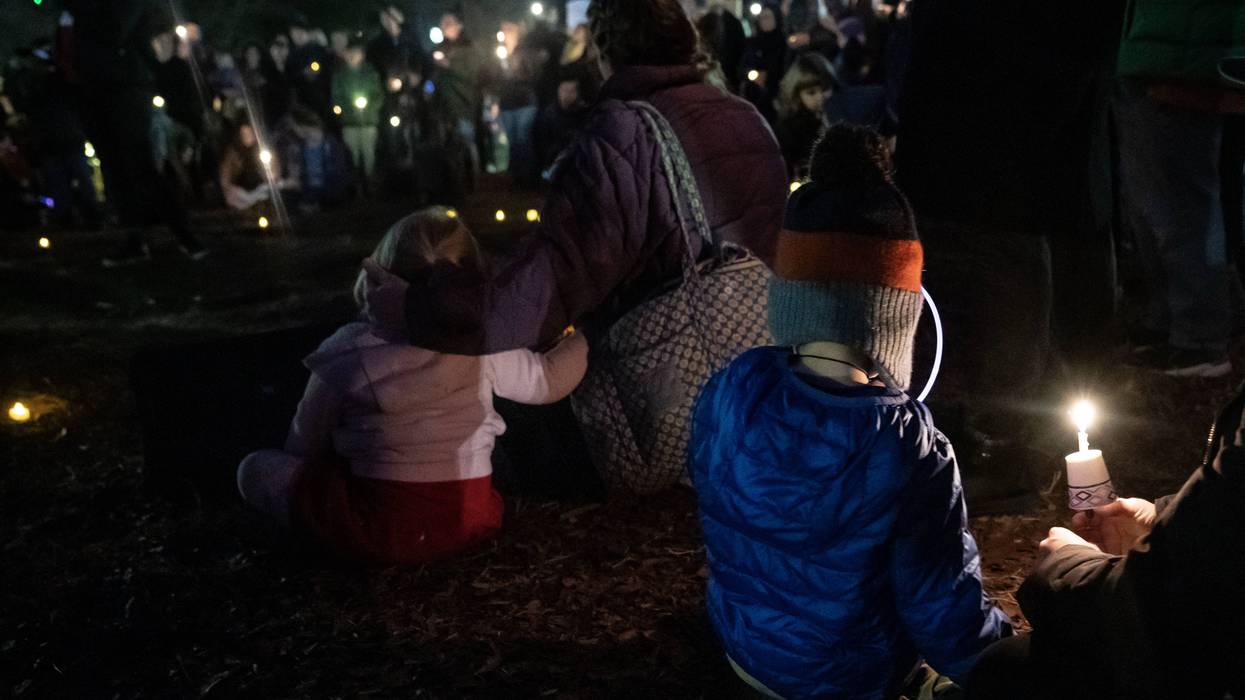
Recent violent and fatal encounters involving US Immigration and Customs Enforcement have forced families across lines of race, ethnicity, and immigration status to confront the reality of their precarious existence in America—and start talking to their children about how to stay safe.
It is 1955 and the hot Mississippi sun is blazing overhead. Miles away in Chicago a Black mother is having a conversation with her 14-year-old son. She tries to impress upon him the often subtle but dangerous realities of what it means to be Black in America, and how one misinterpretation, one lie, could result in his death. That boy is Emmett Till, and in her memoir, Death of Innocence, Mamie Till-Mobley reflects on “The Talk” she delivered to her son before his historically tragic trip to Mississippi.
This version of The Talk dates back to American chattel slavery and has been passed down for generations in Black families, shaped by ongoing racial violence and unequal treatment. But recent violent and fatal encounters involving US Immigration and Customs Enforcement (ICE) have forced families across lines of race, ethnicity, and immigration status to confront the reality of their precarious existence in America—and start talking to their children about how to stay safe. Black families’ experience on how to have these conversations is now, tragically, something many families can learn from.
The Talk has always carried more than one meaning. For many families, it refers to the conversation about the birds and the bees, the discussion parents have with their children about dating, puberty, and sex in an effort to prevent teen pregnancy or sexually transmitted infections. That version of The Talk is often framed as universal.
But for Black families, The Talk has long meant something entirely different. In addition to conversations about puberty, Black parents have used The Talk to prepare their children for the realities of race and how to stay safe in a society shaped by racism.
In this modern era The Talk is undergoing another round of evolution. It is no longer just a Black conversation. It is fast becoming an American conversation.
Both conversations typically happen around the onset of puberty, but only some families have had the privilege of needing just one version of The Talk. In a 2024 study conducted by Dr. Conial Caldwell, Black fathers reflected on whether other communities also have The Talk. The consensus was clear: Some groups have long had the luxury of avoiding it, while others have their own versions shaped by identity, history, and perceived vulnerability. However, that distinction is beginning to blur.
Because of recent ICE actions, many immigrant and mixed-status families are foregoing everyday liberties out of fear, like grocery shopping and going to work. In Connecticut, Minneapolis, and other locations school attendance stymied by ICE-related anxiety is widespread. Recent deaths linked to encounters with federal immigration enforcement, including those of Keith Porter Jr., Renee Nicole Good, and Alex Preti in Minnesota, have sparked national outrage and renewed scrutiny of ICE’s training practices, accountability, and use of force, including against white Americans. These incidents follow the detention of 5-year-old Liam Conejo Ramos by ICE agents, showing that not even young children are safe.
Families who once felt insulated from normalized and state sanctioned violence against Black Americans, are now asking the same questions Black parents have asked for generations: How do we keep our children safe? How do we prepare them for interactions with law enforcement? What do we say and when?
The fathers in Caldwell’s study offered simple but powerful guidance.
Parents should have The Talk early and revisit it often, adjusting the conversation as children grow. As children grow and become part of new environments outside of the home, so too do the risks of danger increase. Parents’ protective conversations should reflect their children’s developmental stage and level of maturity. At the same time, they should be mindful of social media and television, recognizing that children are exposed to images and narratives that shape their understanding of safety and belonging. Social media has become of one the major spaces of youth interactions; thus, the risk of exposure is not only heighted but as consistent as their internet access. Beyond one’s immediate family, communities must work together to protect all children, not just their own. And children must be consistently reminded that their lives have value, regardless of how they look or where they come from.
From chattel slavery to emancipation, from reconstruction and the civil rights period to post civil rights, The Talk has had to respond to harsh prevailing societal realities for Black Americans. In this modern era The Talk is undergoing another round of evolution. It is no longer just a Black conversation. It is fast becoming an American conversation. So, just as Mamie Till-Mobley may have agonized over her words as she gave her son some of her final attempts at guidance and protection, parents across the USA are weighing their words and conversations in their attempts to safeguard their children.
The painful history of Emmett Till’s lynching and his mother’s remarkable courage is seared into the fabric of this country.
Emmett Till would have turned 82 on July 25. But he was murdered at 14, on August 28, 1955, dragged from his great-uncle’s home in Money, Mississippi, by two white men for allegedly whistling at a white woman. They beat, tortured, and shot Emmett, tied a heavy cotton gin fan to him with barbed wire, and threw his body into the Tallahatchie River. His bloated, disfigured corpse was discovered several days later.
His mother, Mamie Till-Mobley, had his body returned to Chicago for his funeral. She insisted on an open casket so the world would see the brutality of bigotry, the ravages of racism. Jet Magazine and other publications carried photos of Emmett Till’s beaten, distended face in his coffin, shocking the world and galvanizing the civil rights movement to defeat Jim Crow.
“I believe that the whole United States is mourning with me,” Mamie Till-Mobley said of her decision. “And if the death of my son can mean something to the other unfortunate people all over the world, then for him to have died a hero would mean more to me than for him just to have died.”
The suggestion that the millions of enslaved people in this country somehow benefited from their enslavement is simply grotesque.
Sixty-eight years later, President Joe Biden formally established the Emmett Till and Mamie Till-Mobley National Monument, signing the proclamation on Emmett Till’s birthday.
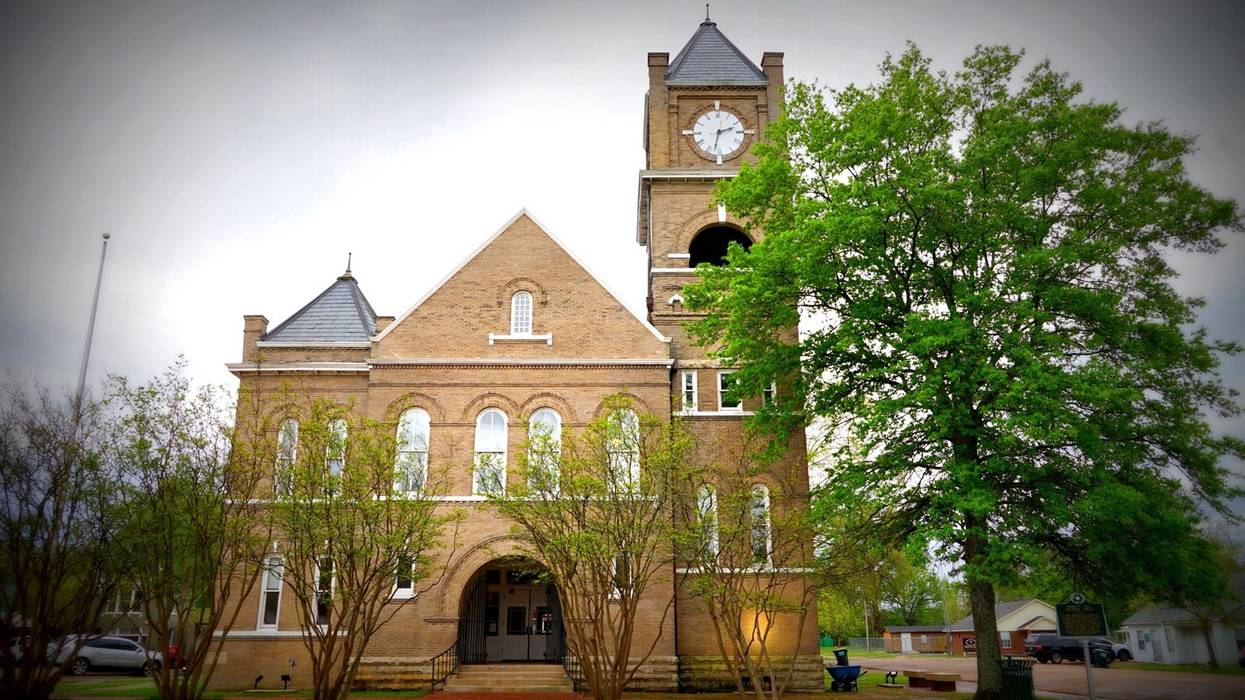
Three sites make up the monument: the Roberts Temple Church of God in Christ on Chicago’s South Side, where Emmett’s funeral was held; the Tallahatchie County Second District Courthouse in Sumner, Mississippi, where Emmett’s two murderers were acquitted by an all-white jury; and the Graball Landing site along the Tallahatchie River, believed to be where Emmett Till’s body was found. The memorial sign at Graball Landing was made bulletproof to withstand the attempts to destroy it. It’s been shot at and vandalized countless times.
The painful history of Emmett Till’s lynching and his mother’s remarkable courage is seared into the fabric of this country. Less than three months later, sickened by the photos of Emmett, Rosa Parks refused to give up her seat to a white passenger on December 1, 1955, sparking the Montgomery Bus Boycott. The March on Washington in 1963 was held on August 28, the anniversary of Emmett Till’s murder.
Yet there are people now attempting to suppress history and whitewash the systemic racism so central to our nation. Leading the pack of these revisionists is Florida Governor Ron DeSantis, a Republican presidential candidate. DeSantis first forced the revision of the state’s AP African American Studies curriculum, purging key Black writers, feminists, and references to Black Lives Matter.
Then, last week, the Florida Department of Education released its social studies standards for this school year. The 216-page document states, “Instruction includes how slaves developed skills which, in some instances, could be applied for their personal benefit.”
Gov. DeSantis was asked to explain this shocking rewrite of the brutal, bloody history of slavery in the United States, while at a campaign stop in Utah:
“They’re probably going to show some of the folks that eventually parlayed, you know, being a blacksmith into doing things later in life.”
Renowned civil rights attorney and Florida resident Ben Crump responded on the Democracy Now! news hour. “It is sickening. It is astonishing that in 2023 we can have a person who is the second in contention for the Republican nomination telling his supporters and his state that he governs that it is going to be mandated now that students in Florida, starting from middle school on, will have to be taught that slavery had positive benefits… It has the potential to cause serious psychological trauma to African American students. We will not stand for it. We will explore every possible legal remedy in the court of law.”
The catalog of atrocities during the centuries-long practice of legal enslavement in the U.S. is long: forced labor, beatings, whipping, torture, rape, murder, the separation of families, the denial and criminalization of education, and more. The suggestion that the millions of enslaved people in this country somehow benefited from their enslavement is simply grotesque.
Of course, many enslaved Africans and their enslaved descendants did learn skills that served them later in life–but these were the skills born of resistance. Harriett Tubman escaped north from Maryland to Philadelphia, and used that hard-earned experience to lead between 11 and 30 dangerous missions to rescue more enslaved people, guiding them to freedom, mostly at night, navigating by the stars.
Legal slavery ended in the United States on December 5, 1865, with the ratification of the 13th Amendment, but its echoes painfully persist to this day. Monuments and memorials are important checks on the whitewashing of history, but strong social movements are the best bulwark against those who would rollback progress.
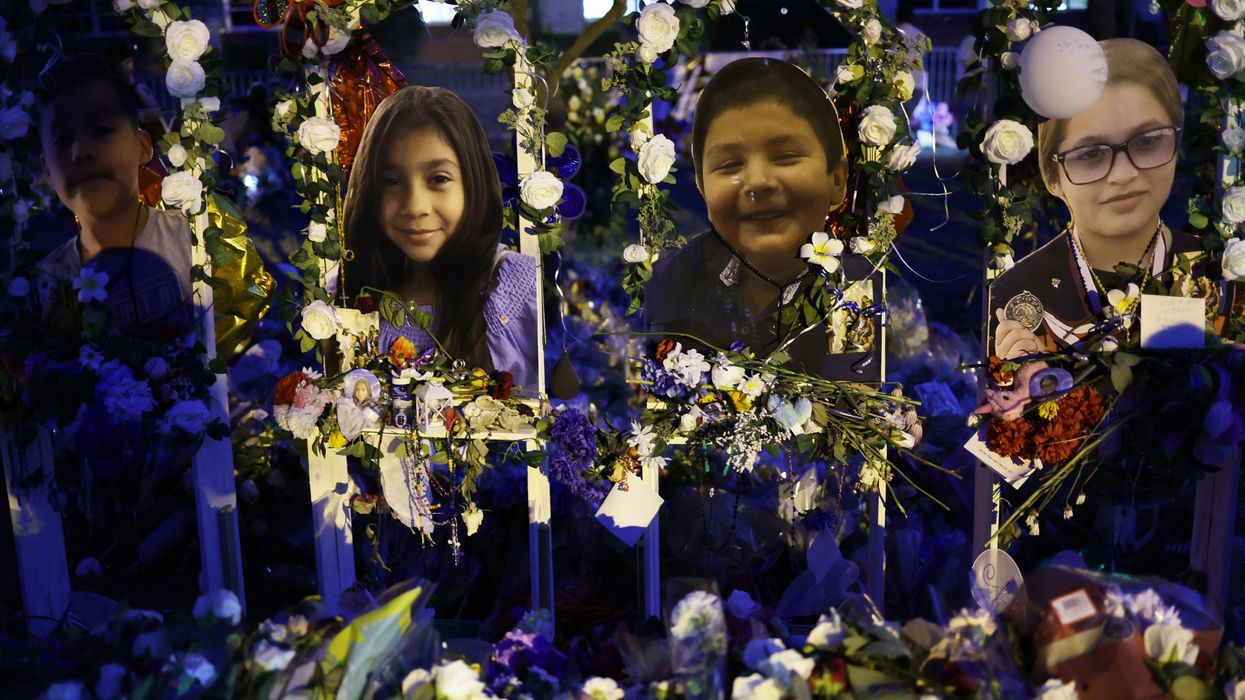
Amid the desperation, pain, and frustration in the wake of last month's massacre of 19 children and two teachers at a Texas elementary school, there is renewed debate about whether making public post-mortem images of those killed by AR-15s and other assault weapons would help move the public or lawmakers in the U.S. towards taking real action on gun violence and mass shootings.
"I just cannot believe that Americans in this country would see what these weapons do to our children, our teachers, our community, and that they would stand by and do nothing."
In a society that often averts confronting the bloody and graphic consequences of its domestic and foreign policy choices, many people argue the images of children and others who suffer unimaginbale violence--like Emmett Till's pulverized body, Phan Thi Kim Phuc running naked and napalm-scorched down a South Vietnamese road, or Derek Chauvin's knee slowly choking the life out of George Floyd--have the power to change minds and potentially upend horrific norms.
Trauma surgeon Amy Goldberg believes Americans wouldn't be so numb to gun violence--which claims tens of thousands of U.S. lives each year and is so frequent that only the most horrific mass shootings make national headlines--if they saw what she has seen so many times.
"I think the citizens need to see the destruction of what these military-style weapons do, and that would be pictures," Goldberg told NPR earlier this week. "And I don't say that lightly. I don't say that with any disrespect, but I'm desperate. All the trauma surgeons need this to stop."
"I just cannot believe that Americans in this country would see what these weapons do to our children, our teachers, our community, and that they would stand by and do nothing," she continued.
"Emmett Till's mom had an open casket, and I'm sure that had some impact on the civil rights movement," Goldberg added. "The napalm girl--you know, those images, brought into our homes during the Vietnam War, I think significantly made change."
In an op-ed published by Common Dreams on Wednesday, attorney and social justice activist Mitchell Zimmerman contended that "there is no Second Amendment right to protection from reality."
Noting that "a number of states force women exercising their constitutional right to abortion to look at fetal sonograms before ending their pregnancy," Zimmerman asks, "What if states required anyone who wants to buy an assault rifle, or other semi-automatic weapons, to first see photos or films that show what such weapons do to human bodies?"
"Perhaps some would reconsider whether they really need this kind of weapon to hunt or engage in target shooting," he said.
The debate is not a new one. After 26 students and staff were murdered at Sandy Hook Elementary School in Newtown, Connecticut in 2012, Academy Award-winning documentary filmmaker Michael Moore asserted that the entire country was complicit in the slaughter due to gun control inaction.
"That is why we must look at the pictures of the 20 dead children laying with what's left of their bodies on the classroom floor," the Bowling for Columbine director said. "Then nothing about guns in this country will ever be the same again."
Moore's remarks sparked widespread outrage.
"There is no Second Amendment right to protection from reality."
"We want to remember the little angels as they were, with their happy expressions and faces and you want to think of the teachers trying to hold them safe and not to see the pictures of their bodies," said the leader of a Newtown parents group who called Moore's idea "a horrendous offense to the families."
Lenny Pozner told The New York Times that after his six-year-old son Noah died at Sandy Hook, he considered showing the world photos of what a 5.56mm x 45mm NATO-spec bullet--the type fired by an AR-15--does to a child's body. Made for use in war, such bullets can decapitate a person or leave a body looking "like a grenade went off" inside it, according to trauma surgeon Peter Rhee.
Pozner's first thought was, "It would move some people, change some minds." His next thought, however, was, "Not my kid."
Others believe that those puhsing for making such images public are mistaken and that many people--especially those so steeped in their sacrosanct right to bear arms that no number of dead children would move them--would "stand by and do nothing," as MSNBC opinion columnist Michael A. Cohen wrote on Thursday.
"To be an advocate of near-unfettered access to firearms means shutting out all the evidence that one's selfish demand for practically limitless gun rights is responsible for so much needless suffering," he continued. "It means looking at Robb Elementary, Sandy Hook, Marjory Stoneman Douglas High School, the 2017 mass shooting at the Route 91 Harvest country music festival in Las Vegas, or countless other tragedies and deciding that the fetishization of steel and bullets plays no role whatsoever."
"Making public the pictures of the children slaughtered at Uvalde's Robb Elementary School would likely do little to change minds or seriously reshape the debate about guns in America," Cohen conluded. "But allowing people to see such pictures would increase the national trauma around gun violence."
"It's something you never want to see and it's something you don't, you cannot, prepare for. It's a picture that's going to stay in my head forever, and that's where I'd like for it to stay."
Some proponents of showing photos argue that it could come down to the way in which the images are displayed.
"I can imagine some pictures that could be made without dehumanizing the victims that speak to the story of the AR-15, which is a story that has not been seen or fully told," Nina Berman, a documentary photographer, filmmaker, and Columbia journalism professor, told the Times.
"For a culture so steeped in violence, we spend a lot of time preventing anyone from actually seeing that violence," she said. "Something else is going on here, and I'm not sure it's just that we're trying to be sensitive."
There is also the very real possibility that ordinary people viewing images of extraordinary carnage could be traumatized, perhaps even forever. Uvalde coroner Eulalio "Lalo" Diaz, Jr. had the grisly task of idenfitying victims of the Robb Elementary School massacre.
"It's something you never want to see and it's something you don't, you cannot, prepare for," he said of the crime scene. "It's a picture that's going to stay in my head forever, and that's where I'd like for it to stay."
In the days since the Uvalde shooting, media outlets have shared heartbreaking images of the small victims as they were cherished in life. As Americans, we're forced to look into their young, innocent eyes and accept our shame that we failed to protect them.
These disturbing images could ignite the public conscience. They could also be put before gun buyers themselves.
What we haven't seen is what they looked like after their lives were ripped away by AR-15 bullets. Many of the children were reportedly so mutilated they could only be identified by DNA.
It is understandable that a newspaper would be loath to publish such photographs. Most human beings would be loath to look at them.
But in the past, such disturbing images have been used to galvanize action--by forcing us to examine painful realities. When I was a civil rights organizer in the South back in the 1960s, one episode still loomed large in the minds of those who took part in the freedom struggle.
On an August night in 1955, two white men forced their way into a house in rural Mississippi, and abducted a 14-year-old Black child from Chicago named Emmett Till. Emmett had been visiting his Mississippi relatives for the summer.
Earlier that same day, in response to a "dare," Emmett allegedly committed the "crime" of whistling at a white woman in a local grocery store.
The two men kidnapped Emmett and brutally beat and mutilated him before shooting him in the head. Using barbed wire, they tied the dead teenager to a heavy metal fan and dumped his body in the Tallahatchie River. His body wasn't taken from the river for another week.
His mother insisted on an open casket funeral. "Everybody needs to know what happened to Emmett Till," she said.
Tens of thousands viewed the body as it was, and Jet magazine and the Chicago Defender ran photographs of the brutalized child. The resulting anger and grief stiffened the determination of the civil rights movement.
Just as children in America today face the reality that a deranged or racist person with an assault rifle can invade their school and take their lives, in 1955 young Black children in the South bore the knowledge that any white man who chose to could pull them out of their home in the night and murder them--and that their society would grant the killer complete impunity.
That bitter knowledge helped mobilize a generation of African Americans and their white allies to fight against segregation and white supremacy. Could the horrific images of the unrecognizable bodies of murdered schoolchildren move more Americans toward confronting our gun problem?
The families of the Uvalde victims will make their own painful decisions regarding the remains of their children. They owe us nothing--it is we who owe them our shamed apologies for failing to protect their children from the now well-known danger of mass murder.
No one can demand the right to use photographs of the victims.
But children aren't the only ones whose bodies have been torn apart and rendered unrecognizable by modern assault weapons. Photographs from both wartime and the home front can doubtless be found to illustrate the costs of so-called "gun rights."
These disturbing images could ignite the public conscience. They could also be put before gun buyers themselves.
A number of states force women exercising their constitutional right to abortion to look at fetal sonograms before ending their pregnancy. What if states required anyone who wants to buy an assault rifle, or other semi-automatic weapon, to first see photos or films that show what such weapons do to human bodies?
Some buyers would no doubt harden their hearts and persuade themselves they must have a weapon of war to defend their homes from an attack by imaginary hordes or other fictitious threats -- or to overthrow a government so tyrannical as to consider regulating firearms.
But perhaps some would reconsider whether they really need this kind of weapon to hunt or engage in target shooting.
There is no Second Amendment right to protection from reality.
American novelist Toni Morrison--winner of the Pulitzer Prize (1988), the Nobel Prize for Literature (1993), and many other awards--has died at the age 88.
"Toni Morrison was a towering intellect, a brilliant scribe of our nation's complex stories, a heartbreaking journalist of our deepest desires, and a groundbreaking author who destroyed precepts, walls and those who dared underestimate her capacity. Rest well and in peace." --Stacey Abrams"It is with profound sadness we share that, following a short illness, our adored mother and grandmother, Toni Morrison, passed away peacefully last night surrounded by family and friends," the Morrison family said in a statement released Tuesday morning. "She was an extremely devoted mother, grandmother and aunt who reveled in being with her family and friends. The consummate writer who treasured the written word, whether her own, her students or others, she read voraciously and was most at home when writing. Although her passing represents a tremendous loss, we are grateful she had a long, well lived life."
Author of a number of famous nonfiction books as well as novels, including "Song of Solomon", "The Bluest Eye", and "Beloved", Morrison was renowned for career as an editor and teacher of African American studies, humanities, and creative writing at Princeton University, where she was professor emeritus.
According to the New York Times:
In awarding her the Nobel, the Swedish Academy cited her "novels characterized by visionary force and poetic import," through which she "gives life to an essential aspect of American reality."
Ms. Morrison animated that reality in a style resembling that of no other writer in English. Her prose, often luminous and incantatory, rings with the cadences of black oral tradition. Her plots are dreamlike and nonlinear, spooling backward and forward in time as though characters bring the entire weight of history to bear on their every act.
Her narratives mingle the voices of men, women, children and even ghosts in layered polyphony. Myth, magic and superstition are inextricably intertwined with everyday verities, a technique that caused Ms. Morrison's novels to be likened often to those of Latin American magic realist writers like Gabriel Garcia Marquez.
Following the announcement, Derrick Johnson, president and CEO of the NAACP, remarked: "Rest in power to #ToniMorrison, one of the most prolific writers of our time."
News of her death resulted in streams of condolences and remembrances online from progressive lawmakers, fans, and others:
Writing for The New Yorker in 2003, Hilton Als explored how Morrison not only changed the U.S. literary landscape overall, but "fostered a generation of black writers" with her editing career, novels, and teaching. Offering an overview of her career, Als wrote:
When "The Bluest Eye" was published, in 1970, Morrison was unknown and thirty-nine years old. The initial print run was modest: two thousand copies in hardcover. Now a first edition can fetch upward of six thousand dollars. In 2000, when "The Bluest Eye" became a selection for Oprah's Book Club, Plume sold more than eight hundred thousand paperback copies. By then, Toni Morrison had become Toni Morrison--the first African-American to win the Nobel Prize in Literature, in 1993. Following "The Bluest Eye," Morrison published seven more novels: "Sula" (1973), "Song of Solomon" (1977), "Tar Baby" (1981), "Beloved" (1987), "Jazz" (1992), "Paradise" (1998), and now "Love." Morrison also wrote a critical study, "Playing in the Dark: Whiteness and the Literary Imagination" (1992), which, like all her novels since "Song of Solomon," became a best-seller. She has edited several anthologies--about O.J., about the Clarence Thomas hearings--as well as collections of the writings of Huey P. Newton and James Baldwin. With her son Slade, she has co-authored a number of books for children. She wrote the book for a musical, "New Orleans" (1983); a play, "Dreaming Emmett" (1986), which reimagined the life and death of Emmett Till, the fourteen-year-old black boy who was murdered in Mississippi in 1955; a song cycle with the composer Andre Previn; and, most recently, an opera based on the life of Margaret Garner, the slave whose story inspired "Beloved."" She was an editor at Random House for nineteen years--she still reads the Times with pencil in hand, copy-editing as she goes--and has been the Robert F. Goheen Professor in the Council of the Humanities at Princeton since 1989.
"I know it seems like a lot," Morrison said. "But I really only do one thing. I read books. I teach books. I write books. I think about books. It's one job."
From Princeton, university president Christopher L. Eisgruber said, "Morrison's brilliant vision, inspired creativity, and unique voice have reshaped American culture and the world's literary tradition. Her magnificent works will continue to light a path forward for generations of readers and authors."
The world lost a visionary activist this week, with the death of Chokwe Lumumba, the newly elected mayor of Jackson, Miss. Lumumba died unexpectedly at the age of 66 of an apparent heart attack. Last June, he won the mayoral race in this capital of Mississippi, a city steeped in the history of racism and violence. He was a champion of human rights, a pioneering radical attorney, a proud Black Nationalist and a dedicated public servant. While his friends, family and allies mourn his death, there is much in his life to celebrate.
First, take a step back, and look at the history of Jackson, Miss. As my "Democracy Now!" news hour co-host, Juan Gonzalez, pointed out when we interviewed Lumumba the day after he was elected, Jackson was "a center of racism and racial oppression over centuries. The city was named after Andrew Jackson by the white settlers when Jackson, in 1820, was able, as Indian commissioner, to pressure the Choctaw Indians to give up 13 million acres of land ... in the Treaty of Doak's Stand. That's why the white settlers named the city after Jackson, because of his success at ethnic cleansing." Jackson, Miss., where the NAACP's first field secretary for Mississippi, Medgar Evers, was assassinated on the evening of June 12, 1963. This city is just 80 miles from Philadelphia, Miss., where Freedom Summer activists Andrew Goodman, James Chaney and Michael Schwerner were murdered, and 95 miles from Money, Miss., where 14-year-old Emmett Till was kidnapped, tortured and murdered in 1955, for allegedly "wolf-whistling" at a white woman. Jackson, Miss., is the political, economic and historic center of so much violence and racial hatred, which is why Lumumba's victory in the mayoral race held such import.
Lumumba told me last June, "I attribute the victory that we had this last week to the people, the people of Jackson, who were more than ready to have leadership that was forward-looking and ready to raise Jackson to a different level of development, ready to embrace the ideas that all government should do the most to protect the human rights of the people." He was dedicated to human rights, and was embarking on a progressive agenda for the city. His slogan read "One City, One Aim, One Destiny."
Lumumba was born Edwin Finley Taliaferro, in Detroit. His parents involved him with civil-rights organizing at an early age. Lumumba's explanation to the Jackson Free Press on how he changed his name is worth repeating. He said: "I picked the name Chokwe because in my African history class I learned that the Chokwe tribe, which is a tribe that still exists, was one of the last tribes to resist the slave trade successfully in northeast Angola. The name literally means 'hunter.' The second name, Lumumba, was the name of a great African leader who began to lead Africa to decolonize, to independence. He was from the Congo. Lumumba means 'gifted.' So literally, it means 'gifted hunter.'"
He became a lawyer, and represented people like the activist Assata Shakur and the rap artist Tupac Shakur. He successfully appealed to the governor the life sentences of two sisters, Gladys and Jamie Scott, imprisoned for the robbery of 11 dollars. They were released after serving 16 years in prison. In 2009, he ran for and won a seat on the Jackson City Council. Four years later, he became mayor, with an ambitious agenda and strong public support. Just this past month, on Jan. 14, the voters of Jackson approved an increase in the local sales tax of 1 percent. Along with increases in the water and sewer rates, Lumumba was going to raise $700 million to improve the city's infrastructure, and leverage that for more funding through bonds. He told me: "We are a population here now in the need of a lot of development. Development is one of the tracks or one of the roads to human rights and to the recognition of human rights, especially our economic human rights."
Lumumba's sudden death has left his broad community reeling. A close ally of Lumumba's, Bill Chandler, executive director of the Mississippi Immigrants Rights Alliance, told me, "We look forward to continuing his vision for the city of Jackson." The new, publicly approved sales tax goes into effect March 1. On the first weekend in May, a conference that Lumumba helped organize, Jackson Rising, will take place, promoting economic alternatives like cooperative business ownership. The inspired vision of Chokwe Lumumba continues.
Denis Moynihan contributed research to this column.

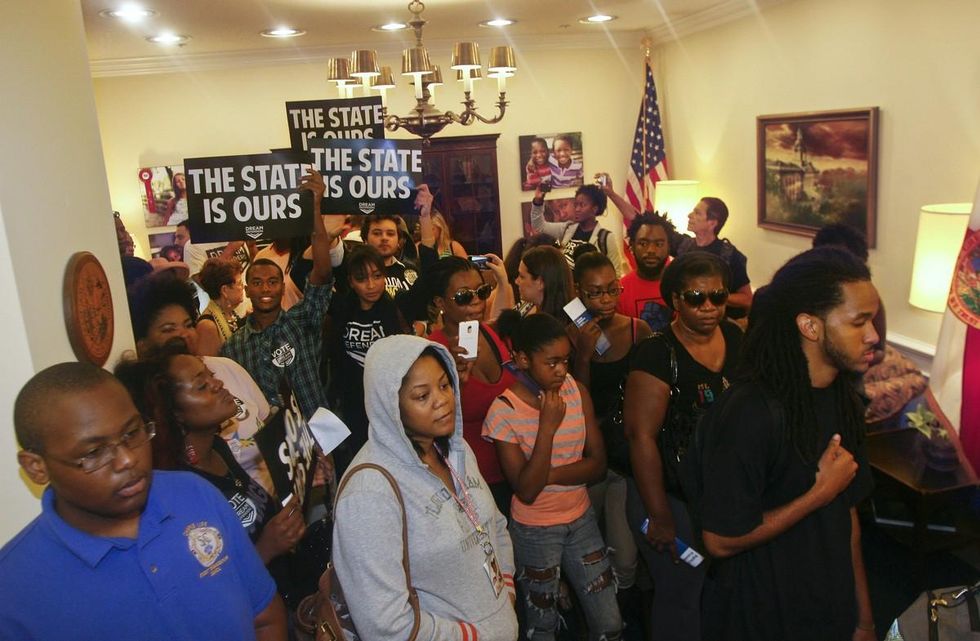
Hundreds entered their third day of a round-the-clock sit-in at Florida Governor Rick Scott's office Thursday to honor Trayvon Martin's life and demand overhaul of the state's controversial 'Stand Your Ground' law and the racism that underlies it.
Organizers say their numbers have doubled since they launched the sit-in on "Takeover Tuesday."
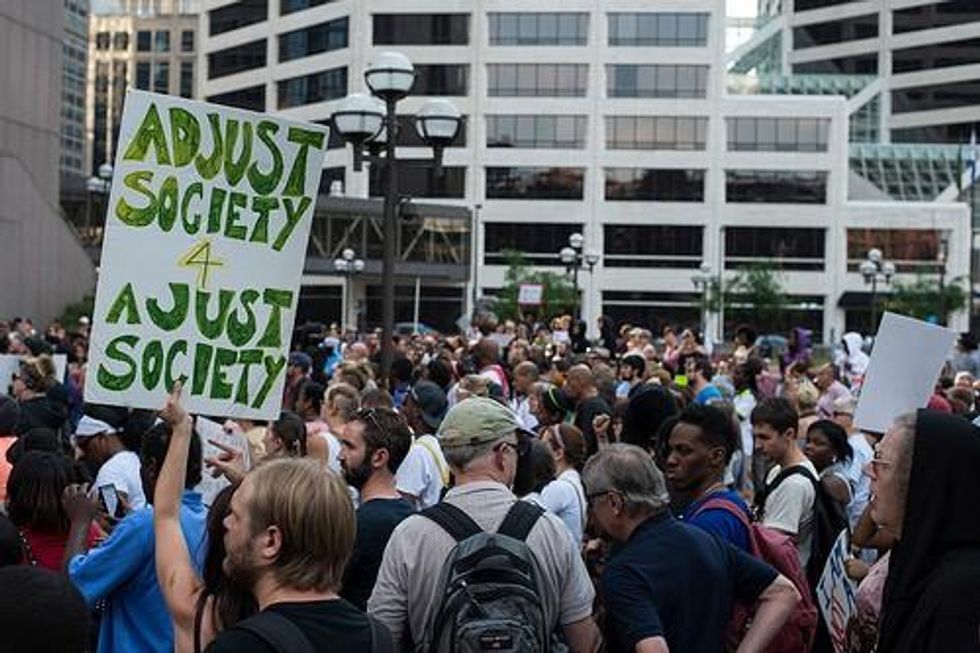
The protesters, who are with the Dream Defenders--an organization of African American and Latino youth working to transform system-wide inequality--are peacefully occupying the governor's office waving signs that read "I am human" and "3/5 No More" and wearing shirts declaring "The Next Emmett Till."
Colorlines reports:
Hundreds of students, some as young as nine years old, are gathered to convince state lawmakers to pass the "Trayvon Martin Act." The bill would address racial profiling, "Stand Your Ground" laws and school-to-prison pipeline issues -- "the three pillars that led to George Zimmerman getting away with killing Trayvon Martin," said Dream Defender Philip Agnew on a media call.
Despite the ongoing occupation of his office--one of numerous passionate protests for racial justice across the US in the wake of the George Zimmerman trial--the Florida governor has somehow found a way to avoid these protesters, responding with a flat "no" to their demands that he meet with them.
"The governor has not yet arrived so apparently this isn't a priority of his," Steven Pargett told the AP Wednesday. "This is a huge priority of ours. This is the largest priority that we have and it's not just us ... So we're here and we'll wait and we'll wait."
"We are here to honor the memory of Trayvon Martin and pay respects to his family," reads a group statement about the office occupation. "This tragedy serves as a vivid reminder of the pain felt by our communities, in which we are profiled, criminalized and targeted."
"We are here because Trayvon can't be."
Dream Defenders #takeoverfl Governor Rick Scott's Office to Demand #justicefortrayvonThe Dream Defenders have taken over Florida Capitol to demand the #TrayvonMartinAct. Sign the petition here: ...
_____________________
Did the ghosts of our slave-holding and Jim Crow past high-five each other in the Florida courtroom on Saturday? George Zimmerman was acquitted, but does that mean that American history was, too?

Hmm . . . wasn't that the case anyway?
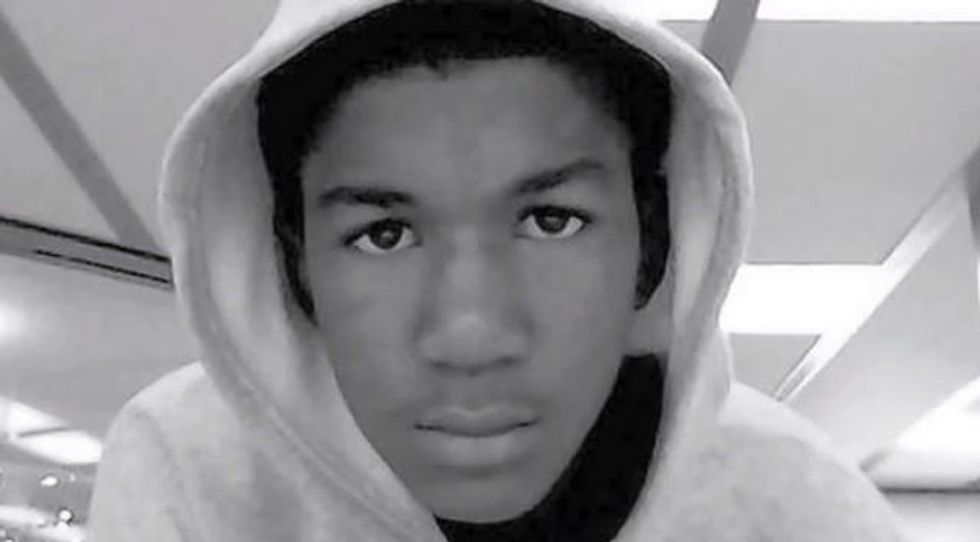
The incident blew into a national outrage because, initially, the boy's killing was nothing at all in the eyes of the law. He was walking through a white, gated community, wearing a hoodie. Stand your ground! The police held the killer for a few hours, then let him go without charges.
"The police initially did not have evidence to disprove Zimmerman's self-defense claim," USA Today reported, quoting former Sanford, Fla. police chief Bill Lee, Jr. It hardly mattered that the victim was unarmed. Right from the start, it was obvious the state had no interest in actual justice from Trayvon Martin's point of view - any more than the state has ever evinced interest in justice or, good Lord, healing in relation to its own past.
Our present legal system has evolved from legal and social structures that regarded certain categories of human beings as chattel. That immorality has never been officially disowned. It has never been fully and courageously addressed with any depth of remorse, either socially or legally. We've never had our moment of national atonement for slavery. We've never started over.
"Trayvon Martin's death is an American tragedy, but it will mainly be understood as an African-American one," Jelani Cobb wrote for the New Yorker.
Where is the court of justice big enough to try this case as the American tragedy that it is, and to put the whole context of Trayvon's killing on the stand? The glaring prejudices built into our legal system, even if they've been erased from the letter of the law, permeate its collective will and heart. Slavery is eradicated, but racism regroups. How in God's name do we stop this once and for all?
The glaring prejudices built into our legal system, even if they've been erased from the letter of the law, permeate its collective will and heart. It's no secret that the police in most American communities focus on young black males, going out of their way to harass and intimidate them, for the ultimate purpose of corralling them into the prison system and permanent second-class citizenship. The rest of the legal system, berobed and tradition-bound, pushes that process along in a pretense of impartiality that is seldom questioned or challenged. Why is our prison population so disproportionately black and brown? The experts shrug.
Trayvon was shot and killed because he was a black person out of place, walking through a white neighborhood. In this case, the "cop" was only a neighborhood-watch guy and cop wannabe, but that didn't particularly matter. Afterward Zimmerman was treated like a cop - debriefed and allowed to walk, no harm done.
This changed only because Trayvon's parents, in their grief and outrage, petitioned for Zimmerman's arrest and filed suit to get the public records of the case. The incident began getting media attention and, three weeks after it occurred, went national. Ka-wham! Suddenly the system was outflanked by public outrage and had no choice but to reverse itself, arrest Zimmerman and charge him with second-degree murder.
That's a victory of sorts for human decency and the latter-day civil rights movement, but not enough of one. The fact that Zimmerman was acquitted may well have an upside, in that it guarantees that public outrage over this iconic injustice will not end. The push to put American history and its legal system on trial will and must continue, in Trayvon's name and Emmett Till's name and for the nameless millions who have suffered and continue to suffer because of it. The time has come - I hope - to challenge our legal system all the way to its racist roots, and to demand that the state find an interest in healing the harm it has caused.
Talking about Zimmerman's search for anyone who didn't belong in his whitish 'hood, Thom Hartmann noted, on The Daily Take, that "The South has a long history of this sort of thing. Today they're called Neighborhood Watches. They used to be called Slave Patrols."
Hartmann quotes the Slave Patrol Regulations from Rowan County, N.C., circa 1825. Here's regulation no. 4: "One patroller shall have power to seize any negro slave who behaves insolently to a patroller, or otherwise unlawfully or suspiciously; and hold such slave in custody until he can bring together a requisite number of Patrollers to act in the business."
Yeah, we've buried this history. The time has come to exhume it. Racism is alive and well and embedded in our legal system. It's the soul of retributive justice, which has an interest in punishment and the culling out of human chaff. Let's find the courage to build a new system based on healing and inclusion - and justice for the ones we've always excluded from it.
George Zimmerman will go on trial today for the murder of Trayvon Martin. But let's be clear, within the defense's opening arguments, for many who follow the trial--which will be televised!--it will be Trayvon Martin who will be on trial.

New evidence in Zimmerman case: Trayvon texted about fighting, smoking marijuana about a week before he was killed.
The evidence that George Zimmerman's attorneys have uncovered on Trayvon Martin's cell phone paints a troubling picture of the Miami Gardens teenager: He sent text messages about being a fighter, smoking marijuana and being ordered to move out of his home by his mother.
And photos from that phone offer more of the same: healthy green plants--what appear to be marijuana--growing in pots and a .40-caliber Smith & Wesson handgun.
So here we go again with a script deep in the white American psyche: the impossibility of Black innocence.
My first experience with the horror of racism was the murder of Emmett Till in 1955; he was only a year older than me when he died. It was alleged that Till, a 14-year-old Chicago black boy visiting Mississippi for the summer, did not know his place and whistled at a white woman in a store. That evening the husband of the woman and his friend came to the house of Emmett's grandfather, kidnapped Emmett, beat him beyond recognition, and then drowned his body. When his mutilated body was found, Emmett's Mother, Mamie Till, insisted that his casket be left open because, in her words, "I wanted the world to see what they did to my baby." The images shocked the black community and attracted great anger and sympathy from anti-racist people all over the world.
And yet, for some, the debate focused on whether Emmett had or hadn't made any flirtatious advances toward a southern white woman--with many believing that if so, he had brought his murder on himself.
When I worked in the Newark Community Union Project in 1966-1968 in the city's black south and central wards, we worked on many community issues including police brutality. In each case we worked to identify the facts of the story and document the specifics of the brutality. I still remember George Richardson, a militant black political figure explaining to us his views on the realities of police brutality cases as if it was yesterday:
You know, Eric, in these police brutality cases, we are always looking for the perfect black victim, the completely "innocent" black man, but he doesn't exist. In our ideal case, a white cop beats or shoots a black man and it turns out it was a black doctor walking down the street doing absolutely nothing when a white cop comes up to him and beats him badly. But that is never the way it is. The guy usually is poor or working class, has a criminal record, he was drinking, he talked back to the cop, he ran a traffic sign, he shoplifted, he 'resisted arrest', he yelled at the cop, he raised his hand whether in self-defense or even to fight back. But that has nothing to do with the fact that he was beaten half to death for being black. In every case, the black man is on trial, guilty until proven innocent and you what, for most of these folks, even our hypothetical black doctor could never been innocent enough.
Trayvon Martin, an unarmed black manchild leaving a gated community and shot down in cold blood was as close in reality to that hypothetcal black doctor as one can imagine, but it did not save him from an early grave.
So now, in this important test case, it's essential that the civil rights movement and organizers in communities of color put the system on trial--for this trial is not about George Zimmerman alone, but also about how a system that sanctioned the murder of an un-armed black teenager until mass national and international pressure forced a trial. We have to win the argument that there are no extenuating circumstances in the stalking and murder of unarmed black men, and while we are there, we have to win the argument that a pen, or a knife, or a shopping cart, or a parked car or "something that looked like a gun" are not lethal weapons at 15 feet, and that lethal force is not an option.
Every time someone raises any questions about Trayvon, and we can be assured that as the trial goes on, the character assassination of Trayvon Martin will escalate, we have to counter with the most radical and structural demands on the system possible, to shift the therms of the debate and put the system on trial. This tactic--what's been called "counter-hegemonic demand development"--was the great contribution of the civil rights movement and is rooted in Frederick Douglass' advice: Power acceeds to nothing without a demand.
We have to roll back all the stop and frisk laws, all the "hold your ground laws," all the "war on drugs" laws, the endless web of laws that have put one million black people in prison and millions more in probation and parole. We have to demand President Obama enforce the 1964 Civil Rights Act and use his statutory power to withhold federal funds from any agency using those funds in a racially discriminatory manner--from Los Angeles to Chicago, from New York to Houston and everywhere else in between. We need to demand the social welfare state, not the police state--1,000 more buses, 1,000 more teachers, 1,000 more nurses, 1,000 fewer police. When we say Trayvon Martin did not die in vain, we have to fight for the maximum program that his life and his death and his innocence deserve.

There is, however, a pattern of violence against women that's broad and deep and horrific and incessantly overlooked. Occasionally, a case involving a celebrity or lurid details in a particular case get a lot of attention in the media, but such cases are treated as anomalies, while the abundance of incidental news items about violence against women in this country, in other countries, on every continent including Antarctica, constitute a kind of background wallpaper for the news.
If you'd rather talk about bus rapes than gang rapes, there's the rape of a developmentally disabled woman on a Los Angeles bus in November and the kidnapping of an autistic 16-year-old on the regional transit train system in Oakland, California -- she was raped repeatedly by her abductor over two days this winter -- and there was a gang rape of multiple women on a bus in Mexico City recently, too. While I was writing this, I read that another female bus-rider was kidnapped in India and gang-raped all night by the bus driver and five of his friends who must have thought what happened in New Delhi was awesome.
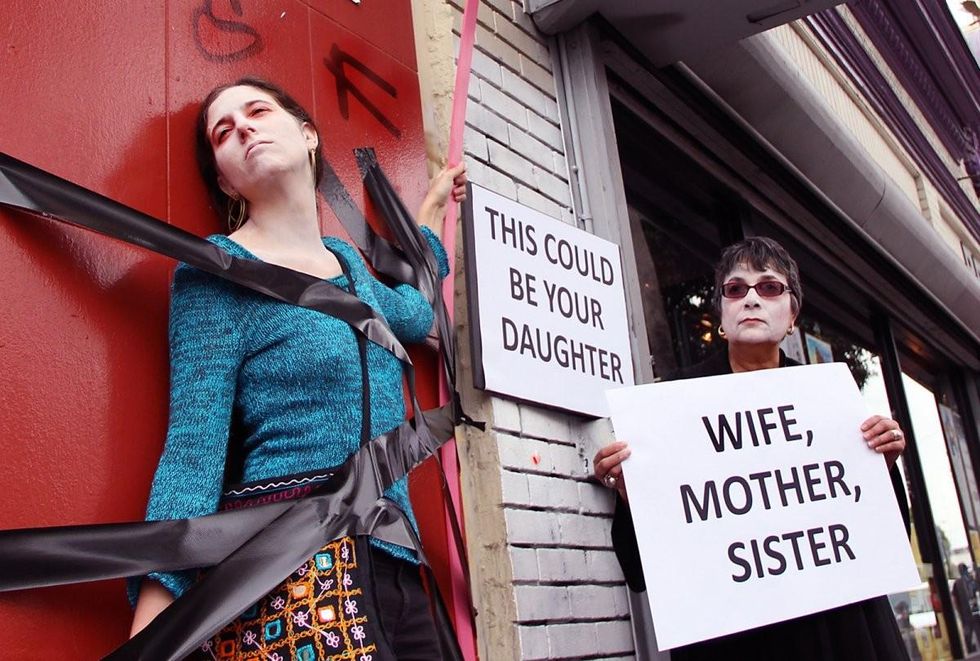
We have an abundance of rape and violence against women in this country and on this Earth, though it's almost never treated as a civil rights or human rights issue, or a crisis, or even a pattern. Violence doesn't have a race, a class, a religion, or a nationality, but it does have a gender.
Here I want to say one thing: though virtually all the perpetrators of such crimes are men, that doesn't mean all men are violent. Most are not. In addition, men obviously also suffer violence, largely at the hands of other men, and every violent death, every assault is terrible. But the subject here is the pandemic of violence by men against women, both intimate violence and stranger violence.
What We Don't Talk About When We Don't Talk About Gender
There's so much of it. We could talk about the assault and rape of a 73-year-old in Manhattan's Central Park last September, or the recent rape of a four-year-old and an 83-year-old in Louisiana, or the New York City policeman who was arrested in October for what appeared to be serious plans to kidnap, rape, cook, and eat a woman, any woman, because the hate wasn't personal (though maybe it was for the San Diego man who actually killed and cooked his wife in November and the man from New Orleans who killed, dismembered, and cooked his girlfriend in 2005).
Those are all exceptional crimes, but we could also talk about quotidian assaults, because though a rape is reported only every 6.2 minutes in this country, the estimated total is perhaps five times as high. Which means that there may be very nearly a rape a minute in the U.S. It all adds up to tens of millions of rape victims.
We could talk about high-school- and college-athlete rapes, or campus rapes, to which university authorities have been appallingly uninterested in responding in many cases, including that high school in Steubenville, Notre Dame University, Amherst College, and many others. We could talk about the escalating pandemic of rape, sexual assault, and sexual harassment in the U.S. military, where Secretary of Defense Leon Panetta estimated that there were 19,000 sexual assaults on fellow soldiers in 2010 alone and that the great majority of assailants got away with it, though four-star general Jeffrey Sinclair was indicted in September for "a slew of sex crimes against women."
Never mind workplace violence, let's go home. So many men murder their partners and former partners that we have well over 1,000 homicides of that kind a year -- meaning that every three years the death toll tops 9/11's casualties, though no one declares a war on this particular terror. (Another way to put it: the more than 11,766 corpses from domestic-violence homicides since 9/11 exceed the number of deaths of victims on that day and all American soldiers killed in the "war on terror.") If we talked about crimes like these and why they are so common, we'd have to talk about what kinds of profound change this society, or this nation, or nearly every nation needs. If we talked about it, we'd be talking about masculinity, or male roles, or maybe patriarchy, and we don't talk much about that.
If we talked about crimes like these...we'd have to talk about what kinds of profound change this society, or this nation, or nearly every nation needs. If we talked about it, we'd be talking about masculinity, or maybe patriarchy, and we don't talk much about that.
Instead, we hear that American men commit murder-suicides -- at the rate of about 12 a week -- because the economy is bad, though they also do it when the economy is good; or that those men in India murdered the bus-rider because the poor resent the rich, while other rapes in India are explained by how the rich exploit the poor; and then there are those ever-popular explanations: mental problems and intoxicants -- and for jocks, head injuries. The latest spin is that lead exposure was responsible for a lot of our violence, except that both genders are exposed and one commits most of the violence. The pandemic of violence always gets explained as anything but gender, anything but what would seem to be the broadest explanatory pattern of all.
Someone wrote a piece about how white men seem to be the ones who commit mass murders in the U.S. and the (mostly hostile) commenters only seemed to notice the white part. It's rare that anyone says what this medical study does, even if in the driest way possible: "Being male has been identified as a risk factor for violent criminal behavior in several studies, as have exposure to tobacco smoke before birth, having antisocial parents, and belonging to a poor family."
Still, the pattern is plain as day. We could talk about this as a global problem, looking at the epidemic of assault, harassment, and rape of women in Cairo's Tahrir Square that has taken away the freedom they celebrated during the Arab Spring -- and led some men there to form defense teams to help counter it -- or the persecution of women in public and private in India from "Eve-teasing" to bride-burning, or "honor killings" in South Asia and the Middle East, or the way that South Africa has become a global rape capital, with an estimated 600,000 rapes last year, or how rape has been used as a tactic and "weapon" of war in Mali, Sudan, and the Congo, as it was in the former Yugoslavia, or the pervasiveness of rape and harassment in Mexico and the femicide in Juarez, or the denial of basic rights for women in Saudi Arabia and the myriad sexual assaults on immigrant domestic workers there, or the way that the Dominique Strauss-Kahn case in the United States revealed what impunity he and others had in France, and it's only for lack of space I'm leaving out Britain and Canada and Italy (with its ex-prime minister known for his orgies with the underaged), Argentina and Australia and so many other countries.
Who Has the Right to Kill You?
But maybe you're tired of statistics, so let's just talk about a single incident that happened in my city a couple of weeks ago, one of many local incidents in which men assaulted women that made the local papers this month:
"A woman was stabbed after she rebuffed a man's sexual advances while she walked in San Francisco's Tenderloin neighborhood late Monday night, a police spokesman said today. The 33-year-old victim was walking down the street when a stranger approached her and propositioned her, police spokesman Officer Albie Esparza said. When she rejected him, the man became very upset and slashed the victim in the face and stabbed her in the arm, Esparza said."
The man, in other words, framed the situation as one in which his chosen victim had no rights and liberties, while he had the right to control and punish her. This should remind us that violence is first of all authoritarian. It begins with this premise: I have the right to control you.
Murder is the extreme version of that authoritarianism, where the murderer asserts he has the right to decide whether you live or die, the ultimate means of controlling someone. This may be true even if you are "obedient," because the desire to control comes out of a rage that obedience can't assuage. Whatever fears, whatever sense of vulnerability may underlie such behavior, it also comes out of entitlement, the entitlement to inflict suffering and even death on other people. It breeds misery in the perpetrator and the victims.
As for that incident in my city, similar things happen all the time. Many versions of it happened to me when I was younger, sometimes involving death threats and often involving torrents of obscenities: a man approaches a woman with both desire and the furious expectation that the desire will likely be rebuffed. The fury and desire come in a package, all twisted together into something that always threatens to turn eros into thanatos, love into death, sometimes literally.
It's a system of control. It's why so many intimate-partner murders are of women who dared to break up with those partners. As a result, it imprisons a lot of women, and though you could say that the attacker on January 7th, or a brutal would-be-rapist near my own neighborhood on January 5th, or another rapist here on January 12th, or the San Franciscan who on January 6th set his girlfriend on fire for refusing to do his laundry, or the guy who was just sentenced to 370 years for some particularly violent rapes in San Francisco in late 2011, were marginal characters, rich, famous, and privileged guys do it, too.
The Japanese vice-consul in San Francisco was charged with 12 felony counts of spousal abuse and assault with a deadly weapon last September, the same month that, in the same town, the ex-girlfriend of Mason Mayer (brother of Yahoo CEO Marissa Mayer) testified in court: "He ripped out my earrings, tore my eyelashes off, while spitting in my face and telling me how unlovable I am... I was on the ground in the fetal position, and when I tried to move, he squeezed both knees tighter into my sides to restrain me and slapped me." According to the newspaper, she also testified that "Mayer slammed her head onto the floor repeatedly and pulled out clumps of her hair, telling her that the only way she was leaving the apartment alive was if he drove her to the Golden Gate Bridge 'where you can jump off or I will push you off.'" Mason Mayer got probation.
This summer, an estranged husband violated his wife's restraining order against him, shooting her -- and six other women -- at her spa job in suburban Milwaukee, but since there were only four corpses the crime was largely overlooked in the media in a year with so many more spectacular mass murders in this country (and we still haven't really talked about the fact that, of 62 mass shootings in the U.S. in three decades, only one was by a woman, because when you say lone gunman, everyone talks about loners and guns but not about men -- and by the way, nearly two thirds of all women killed by guns are killed by their partner or ex-partner).
What's love got to do with it, asked Tina Turner, whose ex-husband Ike once said, "Yeah I hit her, but I didn't hit her more than the average guy beats his wife." A woman is beaten every nine seconds in this country. Just to be clear: not nine minutes, but nine seconds. It's the number-one cause of injury to American women; of the two million injured annually, more than half a million of those injuries require medical attention while about 145,000 require overnight hospitalizations, according to the Center for Disease Control, and you don't want to know about the dentistry needed afterwards. Spouses are also the leading cause of death for pregnant women in the U.S.
'Women worldwide ages 15 through 44 are more likely to die or be maimed because of male violence than because of cancer, malaria, war and traffic accidents combined.' "Women worldwide ages 15 through 44 are more likely to die or be maimed because of male violence than because of cancer, malaria, war and traffic accidents combined," writes Nicholas D. Kristof, one of the few prominent figures to address the issue regularly.
The Chasm Between Our Worlds
Rape and other acts of violence, up to and including murder, as well as threats of violence, constitute the barrage some men lay down as they attempt to control some women, and fear of that violence limits most women in ways they've gotten so used to they hardly notice -- and we hardly address. There are exceptions: last summer someone wrote to me to describe a college class in which the students were asked what they do to stay safe from rape. The young women described the intricate ways they stayed alert, limited their access to the world, took precautions, and essentially thought about rape all the time (while the young men in the class, he added, gaped in astonishment). The chasm between their worlds had briefly and suddenly become visible.
Mostly, however, we don't talk about it -- though a graphic has been circulating on the Internet called Ten Top Tips to End Rape, the kind of thing young women get often enough, but this one had a subversive twist. It offered advice like this: "Carry a whistle! If you are worried you might assault someone 'by accident' you can hand it to the person you are with, so they can call for help." While funny, the piece points out something terrible: the usual guidelines in such situations put the full burden of prevention on potential victims, treating the violence as a given. You explain to me why colleges spend more time telling women how to survive predators than telling the other half of their students not to be predators.
Threats of sexual assault now seem to take place online regularly. In late 2011, British columnist Laurie Penny wrote, "An opinion, it seems, is the short skirt of the Internet. Having one and flaunting it is somehow asking an amorphous mass of almost-entirely male keyboard-bashers to tell you how they'd like to rape, kill, and urinate on you. This week, after a particularly ugly slew of threats, I decided to make just a few of those messages public on Twitter, and the response I received was overwhelming. Many could not believe the hate I received, and many more began to share their own stories of harassment, intimidation, and abuse."
Women in the online gaming community have been harassed, threatened, and driven out. Anita Sarkeesian, a feminist media critic who documented such incidents, received support for her work, but also, in the words of a journalist, "another wave of really aggressive, you know, violent personal threats, her accounts attempted to be hacked. And one man in Ontario took the step of making an online video game where you could punch Anita's image on the screen. And if you punched it multiple times, bruises and cuts would appear on her image." The difference between these online gamers and the Taliban men who, last October, tried to murder 14-year-old Malala Yousafzai for speaking out about the right of Pakistani women to education is one of degree. Both are trying to silence and punish women for claiming voice, power, and the right to participate. Welcome to Manistan.
The Party for the Protection of the Rights of Rapists
It's not just public, or private, or online either. It's also embedded in our political system, and our legal system, which before feminists fought for us didn't recognize most domestic violence, or sexual harassment and stalking, or date rape, or acquaintance rape, or marital rape, and in cases of rape still often tries the victim rather than the rapist, as though only perfect maidens could be assaulted -- or believed.
As we learned in the 2012 election campaign, it's also embedded in the minds and mouths of our politicians. Remember that spate of crazy pro-rape things Republican men said last summer and fall, starting with Todd Akin's notorious claim that a woman has ways of preventing pregnancy in cases of rape, a statement he made in order to deny women control over their own bodies. After that, of course, Senate candidate Richard Mourdock claimed that rape pregnancies were "a gift from God," and just this month, another Republican politician piped up to defend Akin's comment.
Happily the five publicly pro-rape Republicans in the 2012 campaign all lost their election bids. (Stephen Colbert tried to warn them that women had gotten the vote in 1920.) But it's not just a matter of the garbage they say (and the price they now pay). Earlier this month, congressional Republicans refused to reauthorize the Violence Against Women Act, because they objected to the protection it gave immigrants, transgendered women, and Native American women. (Speaking of epidemics, one of three Native American women will be raped, and on the reservations 88% of those rapes are by non-Native men who know tribal governments can't prosecute them.)
And they're out to gut reproductive rights -- birth control as well as abortion, as they've pretty effectively done in many states over the last dozen years. What's meant by "reproductive rights," of course, is the right of women to control their own bodies. Didn't I mention earlier that violence against women is a control issue?
And though rapes are often investigated lackadaisically -- there is a backlog of about 400,000 untested rape kits in this country-- rapists who impregnate their victims have parental rights in 31 states. Oh, and former vice-presidential candidate and current congressman Paul Ryan (R-Manistan) is reintroducing a bill that would give states the right to ban abortions and might even conceivably allow a rapist to sue his victim for having one.
All the Things That Aren't to Blame
Of course, women are capable of all sorts of major unpleasantness, and there are violent crimes by women, but the so-called war of the sexes is extraordinarily lopsided when it comes to actual violence. Unlike the last (male) head of the International Monetary Fund, the current (female) head is not going to assault an employee at a luxury hotel; top-ranking female officers in the U.S. military, unlike their male counterparts, are not accused of any sexual assaults; and young female athletes, unlike those male football players in Steubenville, aren't likely to urinate on unconscious boys, let alone violate them and boast about it in YouTube videos and Twitter feeds.
No female bus riders in India have ganged up to sexually assault a man so badly he dies of his injuries, nor are marauding packs of women terrorizing men in Cairo's Tahrir Square, and there's just no maternal equivalent to the 11% of rapes that are by fathers or stepfathers. Of the people in prison in the U.S., 93.5% are not women, and though quite a lot of them should not be there in the first place, maybe some of them should because of violence, until we think of a better way to deal with it, and them.
No major female pop star has blown the head off a young man she took home with her, as did Phil Spector. (He is now part of that 93.5% for the shotgun slaying of Lana Clarkson, apparently for refusing his advances.) No female action-movie star has been charged with domestic violence, because Angelina Jolie just isn't doing what Mel Gibson and Steve McQueen did, and there aren't any celebrated female movie directors who gave a 13-year-old drugs before sexually assaulting that child, while she kept saying "no," as did Roman Polanski.
In Memory of Jyoti Singh Pandey
What's the matter with manhood? There's something about how masculinity is imagined, about what's praised and encouraged, about the way violence is passed on to boys that needs to be addressed. There are lovely and wonderful men out there, and one of the things that's encouraging in this round of the war against women is how many men I've seen who get it, who think it's their issue too, who stand up for us and with us in everyday life, online and in the marches from New Delhi to San Francisco this winter.
There's something about how masculinity is imagined, about what's praised and encouraged, about the way violence is passed on to boys that needs to be addressed.
Increasingly men are becoming good allies -- and there always have been some. Kindness and gentleness never had a gender, and neither did empathy. Domestic violence statistics are down significantly from earlier decades (even though they're still shockingly high), and a lot of men are at work crafting new ideas and ideals about masculinity and power.
Gay men have been good allies of mine for almost four decades. (Apparently same-sex marriage horrifies conservatives because it's marriage between equals with no inevitable roles.) Women's liberation has often been portrayed as a movement intent on encroaching upon or taking power and privilege away from men, as though in some dismal zero-sum game, only one gender at a time could be free and powerful. But we are free together or slaves together.
There are other things I'd rather write about, but this affects everything else. The lives of half of humanity are still dogged by, drained by, and sometimes ended by this pervasive variety of violence. Think of how much more time and energy we would have to focus on other things that matter if we weren't so busy surviving. Look at it this way: one of the best journalists I know is afraid to walk home at night in our neighborhood. Should she stop working late? How many women have had to stop doing their work, or been stopped from doing it, for similar reasons?
One of the most exciting new political movements on Earth is the Native Canadian indigenous rights movement, with feminist and environmental overtones, called Idle No More. On December 27th, shortly after the movement took off, a Native woman was kidnapped, raped, beaten, and left for dead in Thunder Bay, Ontario, by men whose remarks framed the crime as retaliation against Idle No More. Afterward, she walked four hours through the bitter cold and survived to tell her tale. Her assailants, who have threatened to do it again, are still at large.
The New Delhi rape and murder of Jyoti Singh Pandey, the 23-year-old who was studying physiotherapy so that she could better herself while helping others, and the assault on her male companion (who survived) seem to have triggered the reaction that we have needed for 100, or 1,000, or 5,000 years. May she be to women -- and men -- worldwide what Emmett Till, murdered by white supremacists in 1955, was to African-Americans and the then-nascent U.S. civil rights movement.
We have far more than 87,000 rapes in this country every year, but each of them is invariably portrayed as an isolated incident. We have dots so close they're splatters melting into a stain, but hardly anyone connects them, or names that stain. In India they did. They said that this is a civil rights issue, it's a human rights issue, it's everyone's problem, it's not isolated, and it's never going to be acceptable again. It has to change. It's your job to change it, and mine, and ours.