SUBSCRIBE TO OUR FREE NEWSLETTER
Daily news & progressive opinion—funded by the people, not the corporations—delivered straight to your inbox.
5
#000000
#FFFFFF
To donate by check, phone, or other method, see our More Ways to Give page.


Daily news & progressive opinion—funded by the people, not the corporations—delivered straight to your inbox.
"If implemented, Project 2025 would lead to a multibillion-dollar annual giveaway to corporations at the expense of Medicare enrollees and taxpayers," warns a new Center for American Progress report.
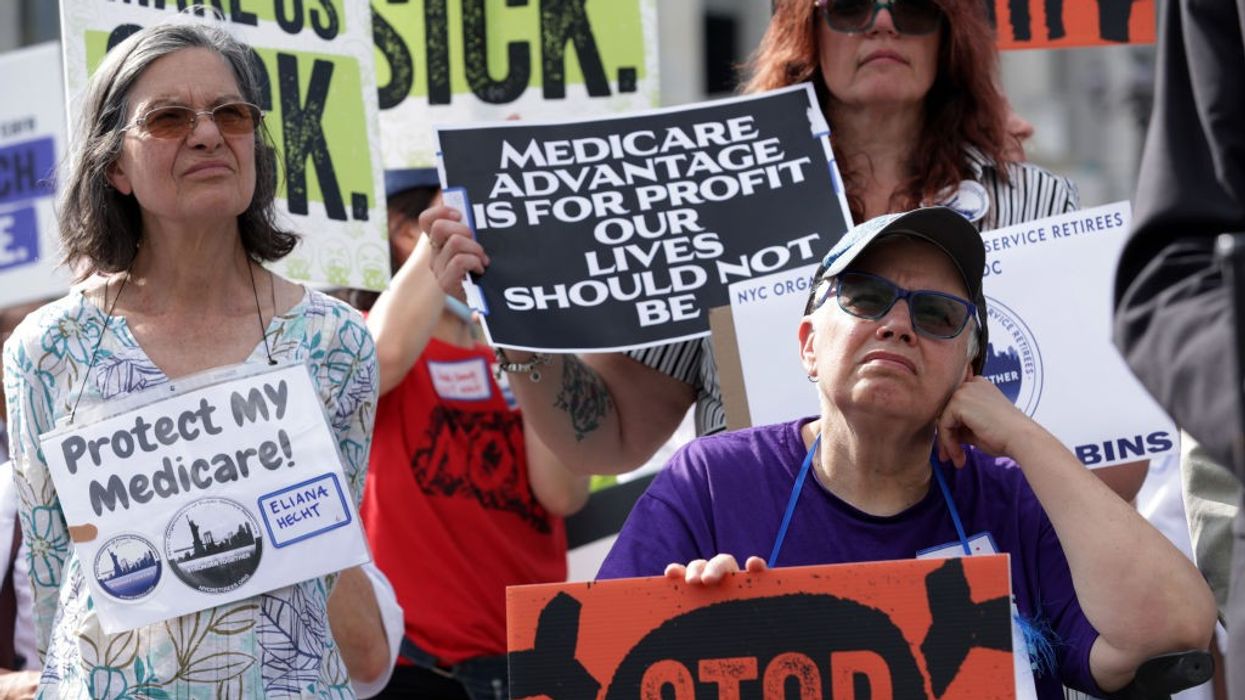
Project 2025—the far-right initiative to expand U.S. presidential power and purge the federal civil service—poses a dire threat to the government-run healthcare coverage enjoyed by tens of millions of senior citizens by making private, for-profit Medicare Advantage plans the default option for all Medicare enrollees, a report published Thursday warned.
The Center for American Progress (CAP) report said the goal of the Heritage Foundation and other right-wing groups behind Project 2025 involves "pushing the United States toward a future of fully privatized Medicare."
"If implemented, Project 2025 would lead to a multibillion-dollar annual giveaway to corporations at the expense of Medicare enrollees and taxpayers, and at the expense of Medicare's financial sustainability," CAP said, noting that "Medicare Advantage costs the Medicare program 22% more per enrollee than traditional Medicare."
"If Project 2025's plan to make MA the default option were to expand the proportion of Medicare beneficiaries in MA to 75%—up from its current enrollment level of 51%—CAP estimates that wasteful spending could approach an eye-popping $2 trillion over 10 years," the publication states.
Furthermore, the report says that "making Medicare Advantage the default option would restrict more Medicare enrollees' options over which doctors and hospitals they can receive care from."
Report co-author and CAP research associate for health policy Brian Keyser said in a statement that "Project 2025's plan to make Medicare Advantage the default option would give corporations even more power and strip doctors and patients of the freedom to make decisions about what care enrollees can or cannot receive."
"Project 2025's plan makes it clear—its priority is to help boost profit-driven corporations' bottom lines at the expense of Medicare enrollees' access to care and the future solvency of Medicare," Keyser added.
Often derided as "Medicare Disadvantage" by critics, MA was created by a GOP-controlled Congress and signed into law in 2003 by then-President George W. Bush "as a way of routing hundreds of billions of taxpayer dollars into the pockets of for-profit insurance companies," according to frequent Common Dreams opinion contributor Thom Hartmann.
A report published last year by Physicians for a National Health Program revealed that MA plans are overcharging U.S. taxpayers by up to $140 billion per year, enough to completely eliminate Medicare Part B premiums or fully fund Medicare's prescription drug program.
The MA report is part of a CAP series on Project 2025—which also includes an analysis from last week showing how the initiative "would make it easier for big corporations to dump dangerous toxins that poison Americans."
According to the report, the initiative's plan to dismantle environmental regulations—as former President Donald Trump, the 2024 GOP nominee, did during his first term—threatens to reverse progress in protecting Americans from toxins like lead, soot, and other poisons including per- and polyfluoroalkyl substances (PFAS), also known as "forever chemicals" because they don't break down easily over time.
In an attempt to distance himself from the extremist agenda, Trump has claimed that he "knows nothing about" Project 2025 or who is behind it.
However, at least 140 people who worked in the first Trump administration have been involved with Project 2025, and last week The Washington Post published an article revealing that Trump took a private jet flight with Heritage Foundation president Kevin Roberts to a conference where the GOP nominee said that the conservative think tank is "going to lay the groundwork and detail plans for exactly what our movement will do."
"Insurers using AI to deny needed care to seniors and people with disabilities means sacrificing patient needs on the altar of corporate greed," said one campaigner.
Dozens of Democratic U.S. lawmakers joined consumer and patient advocates on Tuesday in sounding the alarm over the use of artificial intelligence by companies providing Medicare Advantage plans to deny healthcare to their senior customers.
Fifty-one Democratic members of Congress and Independent Sen. Bernie Sanders of Vermontwrote to Centers for Medicare and Medicaid Services (CMS) Administrator Chiquita Books LaSure on Tuesday expressing their concern over Medicare Advantage (MA) providers' increasing use of algorithmic systems to deny patient care.
"Plans continue to use AI tool to erroneously deny care and contradict provider assessment findings," the letter notes. "Last year, a class action lawsuit was filed alleging that UnitedHealth Group unlawfully used an AI algorithm, nH Predict, to deny rehabilitative care to sick Medicare Advantage patients."
"The lawsuit cites an investigation suggesting that UnitedHealth Group pressured employees to use the algorithm to issue payment denials to Medicare Advantage beneficiaries and set a goal for employees to keep patient rehabilitation stays within 1% of the length of stay predicted by nH Predict," the lawmakers continued.
MA plans are not part of Medicare. They are a private health insurance "scam" created by a Republican-controlled Congress and signed into law by then-President George W. Bush "as a way of routing hundreds of billions of taxpayer dollars into the pockets of for-profit insurance companies," according to frequent Common Dreams opinion contributor Thom Hartmann.
Advocates have warned about the use of AI in MA denials since at least last year, while imploring congressional and regulator action to protect seniors and people with disabilities from being preyed upon by what critics have called "Medicare disadvantage" companies.
In February, CMS "clarified that Medicare Advantage organizations may use algorithms, artificial intelligence, and related technologies to assist in making coverage determinations, but these technologies may not override standards related to medical necessity and other applicable rules for how coverage determinations by Medicare Advantage organizations are made."
Rights groups echoed the lawmakers' concerns about the use of AI for MA denials.
"Medicare Advantage insurers using AI to deny needed care to seniors and people with disabilities means sacrificing patient needs on the altar of corporate greed," Public Citizen executive vice president Lisa Gilbert said. "CMS must expand upon the steps it has already taken to improve oversight of companies using AI to deny care that would be covered by traditional Medicare."
"It is time to protect enrollees by cracking down on Medicare Advantage insurers using AI to deny needed care through additional reporting requirements and increased enforcement actions against bad actors," Gilbert added.
David Lipschutz, associate director of the Center for Medicare Advocacy, said in a statement that "in our experience, MA plans' use of AI or algorithmic software has led to more inappropriate denials and premature terminations of care—this must end."
A report published earlier this month revealed that MA plans have overcharged the federal government by $612 billion since 2007—and $82 billion last year alone. Another report published last year by Physicians for a National Health Program found that MA plans are also overcharging U.S. taxpayers by up to $140 billion per year, enough to erase all Medicare Part B premiums or fully fund Medicare's prescription drug program.
A 2022 U.S. Senate Finance Committee investigation found that insurance companies and other brokers are "running amok" with "fraudsters and scam artists" making false or misleading claims to dupe seniors into buying MA plans. In February 2023, Reps. Mark Pocan (D-Wis.), Ro Khanna (D-Calif.), and Jan Schakowsky (D-Ill.) reintroduced legislation to change the official name of MA to "alternative private health plan" to make clear that such coverage is offered by for-profit companies.
"They're using AI to predict when to cut off payment for treatments," said one watchdog group. "We repeat, AI. Not a doctor."
As Medicare Advantage plans rely increasingly upon artificial intelligence to determine—and often deny—payment for patient care, a group of Democratic U.S. lawmakers on Friday urged Medicare's top official to strengthen oversight of AI and algorithmic tools used to make coverage determinations.
"In recent years, problems posed by prior authorization have been exacerbated by MA plans' increasing use of AI or algorithmic software to assist in their coverage determinations in certain care settings, including inpatient hospitals, skilled nursing facilities, and home health," 32 House Democrats led by Rep. Judy Chu (D-Calif.) wrote in a letter to Centers for Medicare & Medicaid Services (CMS) Administrator Chiquita Books LaSure.
"Advocates and the media report that the use of such software has led to coverage decisions that are more restrictive than allowed under traditional Medicare rules, as well as more frequent and repeated denials of care," the lawmakers wrote. "Absent prohibiting the use of AI/algorithmic tools outright, it is unclear how CMS is monitoring and evaluating MA plans' use of such tools in order ensure that plans comply with Medicare's rules and do not inappropriately create barriers to care."
The lawmakers are calling on CMS to take steps including, but not limited to:
MA plans are not part of Medicare. They are a private health insurance "scam" created by a GOP-controlled Congress and signed into law 20 years ago by then-President George W. Bush "as a way of routing hundreds of billions of taxpayer dollars into the pockets of for-profit insurance companies," according to frequent Common Dreams opinion contributor Thom Hartmann.
A report published last month by Physicians for a National Health Program revealed that MA plans are overcharging U.S. taxpayers by up to $140 billion per year, enough to completely eliminate Medicare Part B premiums or fully fund Medicare's prescription drug program.
The lawmakers' letter is endorsed by advocacy groups including the Center for Medicare Advocacy, Public Citizen, Social Security Works, Center for Health and Democracy, and Business Leaders for Health Care Transformation.
"The use of AI by Medicare Advantage insurers to deny needed care to seniors and people with disabilities represents the most recent and dangerous step by greedy companies focused on profit instead of patients," Public Citizen executive vice president Lisa Gilbert said in a statement.
"Now is the time for CMS to crack down on companies that are using AI and other mechanisms to deny care that would be covered if the enrollee were covered by traditional Medicare," Gilbert added. "Understanding how Medicare Advantage insurers are using AI to deny needed care and holding bad actors accountable are crucial steps to protecting seniors and the Medicare program."
Last year, a U.S. Senate probe found that insurance companies and other brokers are "running amok" with "fraudsters and scam artists" making false or misleading claims to dupe senior citizens into purchasing MA plans.
Progressive lawmakers have also criticized President Joe Biden for delaying promised curbs on Medicare Advantage plans amid heavy insurance industry lobbying.
Earlier this year, Reps. Mark Pocan (D-Wis.)—one of the 32 lawmakers who signed the letter to Brooks LaSure—Ro Khanna (D-Calif.), and Jan Schakowsky reintroduced a bill to change the official name of MA to "alternative private health plan" to make clear that such coverage is offered by for-profit companies.
"The scheme is called Medicare Advantage," Pocan and Khanna explained. "But in reality, so-called 'Medicare Advantage' is neither Medicare nor an advantage."
It's simple: "Republicans drove up the national debt by giving huge tax breaks to the rich and major corporations—now they're trying to make the rest of us pay for it."
As negotiators for the White House and congressional Republicans continue their will-they-or-won't-they game with the global economy at risk, critics are calling out corporate media coverage of efforts to prevent a devastating U.S. default by raising the debt ceiling.
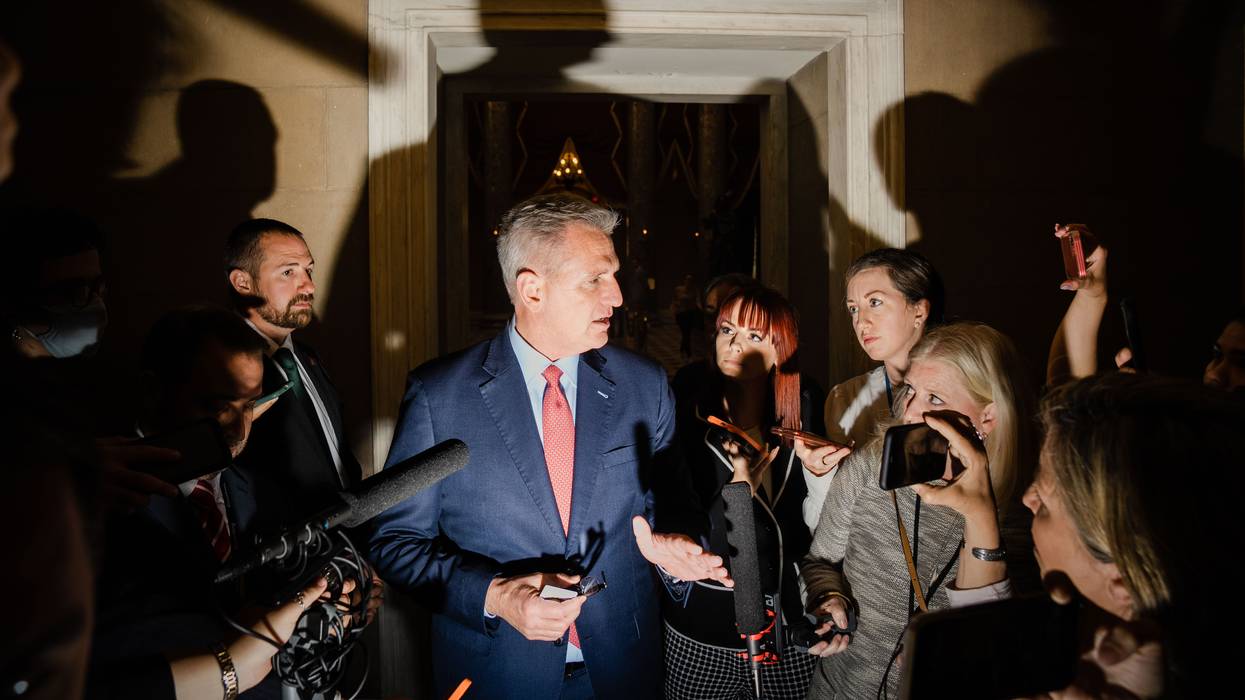
"There are three aspects to the substance and coverage of this debate that have been infuriating," said Revolving Door Project executive director Jeff Hauser in a statement Friday. "First, the notion that 'modest cuts' to spending are inconsequential."
"Second is the role of inflation," Hauser continued, charging that the brewing potential deal between President Joe Biden and House Speaker Kevin McCarthy (R-Calif.) "would be a catastrophe for government capacity, and coverage that ignores the role of inflation (hardly a low profile issue in 2023!) is wildly and indefensibly misguided."
"The notion that the president was trapped under the gun of McCarthy is ridiculous."
"Third, the notion that the president was trapped under the gun of McCarthy is ridiculous," he added. "Because the debt ceiling is an unconstitutional, incoherent excuse for a law and because there is an active lawsuit from the National Association of Government Employees [NAGE], Biden's status as a hostage merely reflects an advanced case of Stockholm Syndrome."
Given arguments that the president "has a wide number of ways out from the debt ceiling and no legal way to implement it," Hauser asserted, "the media needs to quit deferring to the debt ceiling's political theater and engage more with the essentially uncontroverted legal experts pointing out that it cannot be implemented in a constitutional manner."
The NAGE case has a hearing set for May 31, just days before the so-called X-date, or when Treasury Secretary Janet Yellen warns the government could run out of money absent a debt limit hike. The union's suit and subsequent request for emergency action by the court this month initially sparked some hope that Biden might act unilaterally to avoid a default based on the 14th Amendment to the U.S. Constitution, which says that "the validity of the public debt of the United States... shall not be questioned."
However, as
Common Dreams reported earlier Friday, Deputy Treasury Secretary Wally Adeyemo told CNN's Poppy Harlow that the president won't invoke the 14th Amendment and "we don't have a Plan B that allows us to meet the commitments that we've made to our creditors, to our seniors, to our veterans, to the American people."
By taking the 14th Amendment off the table, "Biden might inexplicably be cornering himself,"
The Washington Post's Paul Waldman and Greg Sargent wrote in a Tuesday opinion piece. "Biden should not make it harder for himself to follow the Constitution in defense of the country if and when it's the only option left."
Even if the White House and McCarthy do strike a debt ceiling deal by the X-date, now June 5, there are potential long-term consequences from the president—and the press—normalizing the GOP's economic hostage-taking. Waldman and Sargent wrote:
As Georgetown law professor Anna Gelpern notes, there's danger in not being fully prepared to honor the country's obligations and in allowing the integrity of U.S. credit to remain under threat of future extortion efforts. "There's downside risk to telling the world Congress can keep doing this," Gelpern said, adding that the standoff is already undermining confidence in the U.S. government.
Paradoxically, the more Biden expresses reluctance about the 14th Amendment, the more it encourages the public to perceive the standoff as a conventional budget negotiation. By contrast, if Biden flatly declared he will not allow extreme demands to interfere with his constitutional duty, Gelpern argues, the debate would be about "whether threatening to tank existing U.S. obligations is a legitimate tool."
CNN political analyst and Princeton University history and public affairs professor Julian Zelizer wrote in a Thursday opinion piece that "regardless of the outcome, Republicans have already won this political war. Once again, the GOP has weaponized a routine process. In doing so, it has normalized an extreme tactic that should not be considered a legitimate tool of partisan combat."
"Although former President Barack Obama hoped to have quashed this tactic in 2013 when he stood firm against the Tea Party Republicans during another round of debt ceiling threats (the GOP managed to extract significant concessions in 2011 using a similar approach)," Zelizer added, "an extreme cohort of Republican legislators has shown that this high-risk maneuver is not going away."
That's thanks to not only Biden's willingness to negotiate with GOP hostage-takers rather than challenge the constitutionality of the debt ceiling statute, but also media coverage that has helped to "normalize Republican legislative terrorism," as The American Prospect's Ryan Cooper put it earlier this month, specifically calling out Axios, CNBC, and Punchbowl News.
In a Friday opinion piece for Common Dreams, University of California, Berkeley professor and former Labor Secretary Robert Reichtook aim at "inexcusable" reporting from few other outlets:
I heard ABC News attribute the standoff on the debt ceiling to "polarization" in Congress. NPR blames the fight on "hyper-partisanship" in American politics. Reuters blames the stalemate on lawmakers "digging in on partisan positions."
"Partisan standoff" is the way most of the media is now characterizing the fight.
"Enough with the 'both sides' reporting on the debt ceiling," Reich demanded. "Republicans alone manufactured this looming disaster... The 'both sides' reporting is misleading the public and giving a free pass to McCarthy and his extremists."
Members of the Congressional Progressive Caucus (CPC) expressed similar frustration with the media during a Wednesday press conference. Caucus Whip Greg Casar (D-Texas) told journalists that "if the hostage gets hurt, you all should be asking the hostage-takers, 'Why did you do that?' not asking the hostage, 'Why didn't you pick the lock faster?'"
Some reporters refuse to blame Republicans for the current crisis, even though they are willing to tank the economy for a potential electoral advantage in 2024, noted CPC Chair Pramila Jayapal (D-Wash.), echoing an off-hand remark from Biden a few days earlier.
In a Friday opinion piece for Common Dreams, radio show host and author Thom Hartmann explained how the ongoing fight fits into a trend that began decades ago—and "it all started with a guy named Jude Wanniski, who literally transformed American politics with a plan that the American mainstream media, astonishingly, continues to ignore."
The GOP strategist's plan was that during Republican presidencies, policymakers should pursue huge tax cuts and uncontrolled spending that stimulate the economy and raise the national debt—then, "when a Democrat is in the White House, Republicans must scream about the national debt as loudly and frantically as possible," he summarized.
"Following Wanniski's script, Republicans are again squealing about the national debt and saying they will refuse to raise the debt ceiling, possibly crashing the U.S. economy," Hartmann wrote. "And, once again, the media is preparing to cover it as a 'Debt Ceiling Crisis!' rather than what it really is: a cynical political and media strategy devised by Republicans in the 1970s, fine-tuned in the 1980s, and since then rolled out every time a Democrat is in the White House."
Under the most recent GOP president—Donald Trump, who is seeking reelection in 2024—Republicans in Congress supported multiple debt limit hikes "while providing trillions in tax cuts for the rich," Reich stressed Friday, declaring that "McCarthy and his band of MAGA crazies don't give a fig about the national debt."
As
Common Dreams reported Wednesday, while congressional Republicans continue to hold the economy hostage, they are crafting a soon-to-be-revealed tax cuts package that would further benefit wealthy individuals and corporations and add trillions to the deficit.
The Supreme Court appears hell-bent on making America bigoted again. Step-by-step, they're undoing every bit of progressive legislation from the past 80 years that they can find.
Now they're going after the right of gays and lesbians who want to get married to shop for a website, or pretty much anything else that requires "creative" effort.
There was a time in America when any retail business could, as the old sign said, "reserve the right to refuse service to anyone for any reason." Often such proclamations were just slightly more subtle than the "No Negros," "No Jews," or "No Irishmen" signs they replaced, although they still pepper retail establishments across the nation.
And it's true that if you run a "public accommodation," you're welcome to toss out drunk, belligerent, naked, high, or otherwise offensive customers. Bars and airlines--clearly public accommodations--do it daily.
But, particularly since passage of the 1964 Civil Rights Act, there are boundaries around who you can and can't refuse to serve. Under federal law, you can toss out somebody because they're wearing a tee-shirt that has offensive language printed on it, but you can't toss out somebody because they're Black or wearing a yarmulke.
Title II of the Civil Rights Act specifically says a company doing business with the public can't discriminate based on "race, color, religion, or national origin."
And in 23 states plus Washington, DC you can't refuse service to somebody because of sexual orientation. (The Equality Act, which would put that protection into federal law, has passed the House twice, last year and in 2019, but died both times in the Senate because of Republican filibusters.)
Now the Supreme Court has those state laws protecting gay people in its cross-hairs in the 303 Creative LLC v. Elenis case they heard argued yesterday: specifically Colorado's law that bans discrimination based on "disability, race, creed, color, sex, sexual orientation, marital status, national origin, or ancestry."
In a twist, the Republicans on the Court chose not to hear Lorie Smith's original argument that, through her company 303 Creative, she shouldn't have to make a website for a gay wedding because it offends her "deeply held Christian faith."
(Although no gay couple has ever asked her to make a wedding website--in fact, no couple of any sort has ever asked her to make any website for their wedding--she's apparently worried that it may happen and so, with big bucks from rightwingers behind her, took her case to the Supreme Court.)
Instead, Republicans on the Court used their majority status to decide, from among her various arguments, to shift the frame toward "creative expression," choosing to decide:
"Whether applying a public-accommodation law to compel an artist to speak or stay silent violates the Free Speech Clause of the First Amendment."
In this context, the answer is a slam-dunk. Of course, no law (outside of contract law) should or could compel an artist to speak or stay silent unless their "artistic expression" violates other laws like inciting to violence, etc.
But Ms. Smith isn't just an artist: she and her company are doing business with the public, just like bars and lunch counters do. And, while federal law doesn't protect LGBTQ+ people the way it does racial and religious minorities, Colorado law does.
Tearing down Colorado's law in the name of "creative expression" is the new strategy for "Christian" fundamentalists to attack public accommodation laws; this is in large part a repeat of their failed effort to strike down Colorado's public accommodation law in the infamous 2018 Masterpiece Cakeshop gay wedding cake case.
When baker Jack Phillips' case was decided that year, the Court ordered he take a class offered by the State of Colorado in how to comply with public accommodation laws. This is not unusual and is a lot less punishment than sending somebody to jail: when all three Trump children were convicted of nonprofit fraud the State of New York similarly ordered them to attend nonprofit law classes instead of going to jail.
But yesterday Neil Gorsuch freaked out at the very idea, comparing Phillips' having to attend the class with Mao's and Stalin's "re-education programs." These are some very serious yet very hysterical rightwing justices, and it appears at least some are committed to ending these protections for minorities.
Bigots using religion as their excuse have chafed at these laws ever since Bobby Kennedy used them to forcefully integrate lunch counters in the South and his federal prosecutors used them to end racial and religious discrimination in hotels, theaters, and bars.
Now they're switching to "creative expression" instead of religion as the club they'll use to beat down public accommodation laws.
But doing business with the public is not an absolute right in America. You must form the company, apply for a business license, and then figure out how best to offer your goods or services. You must operate, under the laws of most states, "in the public interest" or at least in a way that doesn't harm the public interest.
Lorie Smith is arguing that she should be able to run a business that serves the public, but that she should also be able to legally discriminate against gay customers because she's "creative."
Is the guy painting my gay friend's house "creative" because he's helping choose colors and paint the house? How about a barber? Or the chef who owns his own restaurant or lunch counter? A bartender who custom-mixes cocktails?
If this decision is handed down in Smith's favor and knocks down the Colorado law (and 22 other states'), expect a whole spectrum of businesses run by bigots and religious freaks to begin discriminating against people not protected by the federal Civil Rights Act, with queer people at the top of that list.
If SCOTUS goes the whole distance and guts the Civil Rights Act--like Republicans on the Court did with the Voting Rights Act in 2013--discrimination against women, Blacks, Jews, Muslims, and the disabled will again become part of the American landscape.
Is there no bottom for the six Republicans on this Court? We'll soon find out.
Years ago, a caller named "Jeff from Denver" used to call my show complaining of a lack of progressive action and sold-out Dems in Colorado. One day I challenged him to show up at his local Democratic Party and do something about it instead of just complaining. He stopped calling, which made me think I'd offended him and he'd stopped listening.
Instead, about six months later, he called back in to say that he'd joined first his county and then his state Democratic Party and not only helped get a good progressive candidate on the ticket but participated in writing the national Democratic Party platform.
They all saw this as a fatal flaw in the republic they'd birthed: there could only be two political parties of any consequence because of the way the election system worked.
Activism works, but it requires more than just words. Nowadays numerous callers brag on the air that they've become precinct committee persons (more on that in a minute) and are actively influencing their local Democratic Parties.
If we wanted to take over NBC, for example, to promote progressive change, it would take billions of dollars. The Democratic Party, on the other hand, is a nonprofit corporation with, in most states, a "Come on in!" sign on the front door that, with hard work, we can (and, in many parts of the country already have) take(en) over.
Just look, for example, at the impact of Bernie's two Democratic presidential primary candidacies on grassroots support for progressive values and issues and how the conversation within the Party has changed since the days of the Clinton presidency.
President Biden is, in many cases today, taking positions that Bill Clinton's Democrats claimed were "too far left" to be considered, and Bernie is chair of the powerful Budget Committee in the Senate. Build Back Better, while betrayed by two sold-out "Corporate Dems," was championed by our Democratic President and nearly passed; it was arguably the most progressive legislation since the 1960s.
A friend recently dropped me a note asking why I don't go after "corporate Dems" as often as I do Reagan, Trump and the Republicans who're following in their footsteps.
"This is something I don't quite get," he wrote. "All your examples are of Reagan and deservedly bashing the Repugs. But little mention of the corporate Democrats."
He (and others) correctly pointed out that it was Democratic President Obama, for example, who chose not to prosecute any of the banksters (many contributors to Obama's campaigns) who crashed our economy in 2008.
He (and others) noted that Obama's Affordable Care Act, while expanding healthcare options for all Americans until five conservatives on the Supreme Court gutted its Medicaid expansion, was also one of the largest windfalls for the insurance industry in history.
It's very true that "corporate Dems" have let us down repeatedly.
When George W. Bush and his buddies pushed through the "Medicare Advantage" scam to privatize Medicare--consigning millions of Americans to terrible insurance coverage while draining the coffers of Medicare far more rapidly than "real" Medicare--neither Obama nor Biden (so far) did a thing to stop it, and most Democrats in Congress are equally complacent even today.
And then there's Bill Clinton's bear-hug embrace of Reagan and Bush's neoliberal plan to destroy American unions by shipping over 60,000 factories and tens of millions of good-paying manufacturing jobs overseas.
It's not like Democrats don't have a lot to answer for.
(And, truth be told, I've written about every one of the examples above, both in Op-Eds over the years, on these pages, and in my books, particularly the Hidden History series on Monopolies, Oligarchy, Healthcare, and Neoliberalism.)
But the unfortunate truth is that, in America, there is one and only one way for us to accomplish the progressive goals we've worked and fought for all these years, and that's through getting inside and seizing control of the Democratic Party.
That's because America is a two-party state. It's built into our Constitution because of the way we do elections in nearly every state in the union, and it's why we've had two parties and two parties only controlling our politics since 1789.
During the Washington and Adams administrations, they were the Federalists and the Democratic Republicans. After Jefferson was elected in 1800, the Democrats dropped "Republican" from their name and the Federalists were replaced by the Whigs. By the time of the Civil War, the Whigs were replaced by the Republican Party, and it's been Republicans and Democrats ever since.
Of course, it doesn't say in the Constitution, "There shall only be two political parties."
But it may as well, because when our nation was conceived as the first modern democracy in nearly 3000 years, the Founders and Framers didn't have the benefit we do of looking back on a 200-year experiment in how to make space for multiple political parties.
They knew that democracy meant "majority rule," and set things up so that whoever won the majority of the vote in an election ended up with the whole thing. Winner take all. Which always produces a 2-party polar system.
People will call into my show and ask, "Why can't we have a dozen effective political parties like France or Israel?" The simple answer is that our system isn't organized like theirs. And it would require amending the Constitution or universal state-by-state adoption of Instant Runoff Voting (and getting rid of the electoral college) to get us close to being there.
It wasn't until the year the Civil War started, 1861, that British philosopher John Stuart Mill published a how-to manual for multi-party parliamentary democracies in his Considerations On Representative Government.
It was so widely distributed and read that nearly all of the world's democracies today--all countries that became democracies after the late 1860s--use variations on his "proportional representation" parliamentary system.
In Mill's system, if a political party gets, say, 12 percent of the vote then they also get 12 percent of the seats in that country's congress or parliament. The result is a plethora of parties representing the broad range of perspectives and priorities, all able to participate in the daily governance of their nation.
Governing becomes an exercise in coalition building, and nobody is excluded. Most European countries, for example, have political parties represented in their parliaments that range from the far left to the extreme right, with many across the spectrum of the middle. The result is typically an honest and wide-ranging discussion across society about the topics of the day, rather than a stilted debate among only two parties.
It's how the Greens became part of today's governing coalition in Germany, for example, and are able to influence the energy future of that nation. And because of that political diversity in the debates, the decisions made tend to be reasonably progressive: look at the politics and lifestyles in most European states.
In our system, though, if a party gets 12 percent of the vote--or anything short of 50 percent plus one--they get nothing. Whoever gets 50 percent plus one wins everything and everybody else in aggregate gets nothing, so we end up with two parties always battling for the higher end of that 50/50 teeter-totter.
Another factor that maintains our system is that with two parties, at least the winner typically has support from half or more of the voters. That increases the chance the government is viewed as legitimate, keeping the system somewhat stable.
But with three major parties in a system like ours, a winner could seize the entire office with only 34 percent of the vote; with 4 parties the winner could carry only 26 percent of the vote. With such weak popular support, a minority-run non-coalition government like that would be in constant crisis.
When James Madison and Alexander Hamilton took on the job of trying to sell our new democracy in October 1787 with a yearlong series of newspaper articles we now call "The Federalist Papers," they knew they had to confront this terrible problem.
They were haunted by what's called "first-past-the-post winner-take-all" elections--majority rule--meaning that, in practical terms, there could only be two political parties.
They were so horrified by this realization that Madison devoted the entirety of Federalist 10 to begging Americans not to empower factions or embrace political parties, as I quoted at length in my March 21, 2022 rant Is America Facing the "Doom Loop" of Democracy? and Dan Sisson and I devote several chapters to in The American Revolution of 1800.
In the first of their series, Federalist 1, Hamilton writes:
"Ambition, avarice, personal animosity, party opposition, and many other motives not more laudable than these" are typical of the "intolerant spirit which has, at all times, characterized political parties."
Thomas Paine, writing from Paris in 1795, laid it out clearly six years after our Constitution was adopted and modern America was birthed:
"[F]or it is the nature and intention of a constitution to prevent governing by party, by establishing a common principle that shall limit ... the power and impulse of party, and that says to all parties, thus far shalt thou go and no further." [emphasis Paine's]
They all saw this as a fatal flaw in the republic they'd birthed: there could only be two political parties of any consequence because of the way the election system worked.
Any third party might have an influence for a cycle or two, but ultimately would always pull votes away from one of those two primary parties and increase the chances that the one closest-aligned to the third party would lose.
This is why the Republican Party and partisans aligned with them have repeatedly been busted for funding the Green Party, and Democrats sometimes have tried to boost the fortunes of the Libertarian Party.
Similarly, Republicans have overtly used third-party participation on the left to their advantage in the past. In a Washington Post story titled GOP Figure Behind Greens Offer, N.M. Official Says, Post writer Thomas B. Edsall noted that: "The chairman of the Republican Party of New Mexico said yesterday he was approached by a GOP figure who asked him to offer the state Green Party at least $100,000 to run candidates in two contested congressional districts in an effort to divide the Democratic vote."
It's how Ralph Nader's winning 90,000 votes in Florida in 2000--even if most of those people wouldn't have voted at all if he hadn't been on the ballot that year, as he asserts to this day (and is, I believe, right)--helped George W. Bush "win" that state, and thus the presidency, by 537 votes. (And why David Cobb, the Green's presidential candidate who followed Nader, didn't campaign in swing states.)
David Koch figured this out when he ran for Vice President on the Libertarian ticket in 1980, pulling about a million votes away from Republicans (Reagan won anyway). His Libertarian efforts helped push Reagan to the right, but he quickly abandoned both the effort and the Party.
It's presumably why he and his brother, after that electoral failure, committed themselves to help build a 50-state infrastructure to build their influence within the Republican Party.
It's what progressives need to do, too, only within the Democratic Party.
But we have a challenge, because criticism isn't enough.
What I've discovered after doing progressive talk radio for nearly 20 years, is that most people who want to gratuitously trash the Democratic Party falsely believe that there's an easy alternative.
But there isn't.
Most think the Greens or some other third-party can someday win and thus elevate progressive values. While they can be a significant and positive force at the local level and have brought instant runoff voting to over 300 municipalities, at the congressional and presidential level they generally pull votes away from Democrats and overall reduce the power of the left.
Some think if they can just "tear down the system" by breaking windows, setting fires, or engaging in massive strikes (that never happen), a thousand flowers of democracy will bloom. Sometimes such things are triggers for change--witness the Boston Tea Party--but more often they simply alienate locals and give conservatives a handy villain to complain about.
Others are convinced we just need to loudly criticize any Democrat (or ally) who's not sufficiently pure, and they'll all fall right into line. That "yelling on social media" can be satisfying (and sometimes slightly alters politicians' behavior on specific issues), but most often just provides an excuse to avoid the hard work of infiltrating and taking over a party and/or running for political office.
This is not to say I'm not a big fan of public accountability. Locally, for two election cycles in a row (for example), I've tried to help rid Oregon of a "corporate problem solver" Democrat, Kurt Schrader, who regularly tries to sabotage progressive programs as simple and elementary as letting Medicare negotiate drug prices.
Some of my colleagues have made holding Democrats accountable a regular part of their beat. I salute and often quote their efforts, like The Lever critique of Biden continuing Trump's support for corrupt and predatory for-profit colleges.
And sometimes it makes a difference: Schrader announced this week that he's no longer going to take contributions from Koch.
I still prefer his progressive primary challenger Jamie McLeod-Skinner. As do FOUR local Oregon Democratic county Parties where progressives have done the hard work to get inside and now have actual political power.
Democrats can and do change when enough progressives get involved.
But what, some say, of the "bad Democrats" like Manchin and Sinema? Shouldn't the Democratic Party purge itself of them right away?
Years ago, a political consultant here in Portland gave me a much-needed lesson in politics 101.
"The single most important vote a member of the House or Senate casts," Kari Chisholm told me, "is their first vote. The vote for who's going to lead the legislature."
In other words, if we were to purge Sinema or Manchin from the Party today, leadership of the Senate would shift from Democrat Chuck Schumer to Republican Mitch McConnell. And, while Schumer's no progressive superstar, that wouldn't be good for anybody except the billionaires and Russian oligarchs who own McConnell and the GOP.
So what do we do?
When Obama was president, a conservative group that called themselves the Concord Project, presumably preparing for the 2010 elections, put together a series of videos about how movement conservatives could seize control of the Republican Party.
Their message was simple: get inside the Party and take it over.
Even simpler, they noted, party precinct committee members are, in aggregate, the single most powerful political force in America.
Here's one of their clips, running just two minutes and well worth your taking a moment to watch:
This strategy, now being openly advocated by Steve Bannon, worked for the conservatives who wanted to take over the GOP and evict the "weak" Republicans they saw as standing in the way of rolling back Roe v Wade, reversing decades of racial and gender progress, and rigging election laws to create a permanent Republican majority.
Today, because of these very same types of efforts by Bannon and people like him on the right, Trump-aligned neofascists have seized considerable control over the Republican Party in almost every state in the nation.
Successful nations with power distributed over multiple parties are:
using government to improve the lives of their citizens with national healthcare systems
maintaining high quality public schools and colleges
keeping big money out of their politics
and building a green infrastructure for the future.
But to do that here takes political change within one of our two parties. A political revolution, to paraphrase Bernie.
Changing American politics and creating a progressive future requires large numbers of us working from the bottom up, getting directly involved in the daily, messy work of the Democratic Party.
Revolutions never happen from the top down, even when they look that way, as Thomas Paine pointed out at length in The Crisis. Without popular support they fail right away or their foundation is so weak they don't last.
Instead, changing American politics and creating a progressive future requires large numbers of us working from the bottom up, getting directly involved in the daily, messy work of the Democratic Party.
When, in 2016, Senator Bernie Sanders ran for president on the Democratic ticket, Alexandria Ocasio-Cortez volunteered as an organizer for his campaign.
She got inside the system. And two years later she took down the ultimate "corporate Dem" (and Chair of the Democratic House Caucus), Joe Crowley.
Today, she and other progressives within the Democratic Party have become major forces in our nation. We need more like her.
When Bernie first started doing his "Brunch With Bernie" hour every Friday on my program back in 2003, he'd recently started the Congressional Progressive Caucus.
I remember doing a fundraising event back then for them; it was a small affair with a half-dozen politicians (including its then-chair, Rep. Raul Grijalva) and fewer than 100 activists. The CPC only had a few dozen congressional members; it was new.
Today, because more and more Democrats are waking up to and rejecting widespread corporate-funded grifts with names like "Corporate Problem Solvers" and "No Labels," the Progressive Caucus has grown into one of the largest and most vibrant caucuses in DC.
And the most powerful.
Look at what progressives have helped to get through already in less than two years. The list is exhaustive.
While much of it is attributed to Biden, the political reality is that he could not have done much or even most of it if the Progressive Caucus wasn't with him. That is true political power.
Progressives are gaining political power by the day, and America needs us to continue pushing back against the corporate bribery and graft that's infected both parties. While the Republican Party has turned to outright white supremacy and neofascism, the Democratic Party has rapidly moved in a more progressive direction. But there are still stragglers.
We can help. Reach out to your local Democrats and show up at the Party meetings. Make friends, pitch in, help out. It's satisfying, meaningful, and important work. God's work, some would say (those who take Jesus' words about feeding the hungry, housing the homeless, and healing the sick literally).
As in so many meaningful efforts in life and even in work, when you go into political battle you often don't necessarily like or even fully agree with the people who stand by your side.
Nonetheless, it's important to remember who's the real opponent, versus who shares some or hopefully most (but not necessarily all) of your values.
Whether you're volunteering to canvas or campaign, running for precinct committee-person, or just helping out, if you really want to see progressive change in America the single most effective way to do it is to infiltrate join the Democratic Party and transform it from the inside.
Just yelling about the evils of "corporate Dems" may be satisfying, particularly for those of us in the media, but it's often just the political equivalent of masturbation. Instead of just complaining, get inside the Party and evict those corporate Dems, replacing them with good progressives, so we can create genuine and lasting progressive change!
This article was first published on The Hartmann Report.
Do we stand on the edge of a grand new progressive era, with good wages for all, racial and gender equality and justice, and a reduction of the political power of reactionary forces in America? Or will the next president gleefully overthrow American democracy, shutter the free press, and imprison those who object?
The question is whether the forces arrayed against such change, from corporate media (and social media) to packed courts to cranky billionaires, can be overcome.
When Mussolini put Antonio Gramsci, the founder of Italy's Communist Party, in prison in 1927, Gramsci wrote from his prison cell that, "[T]he old is dying and the new cannot be born; in this interregnum a great variety of morbid symptoms appear."
Two forces in American politics are similarly on a collision course today: neoliberalism and progressivism. In the friction zone between the two, the "morbid symptom" of Trump's white-power neofascism is claiming territory and has largely seized the power structures of the GOP.
Whether American history goes in cycles, as Strauss and Howe posit in The Fourth Turning, or merely "rhymes" as in the apocryphal quote from Twain, we can identify periods when a particular political and economic philosophy holds court--and the periods when philosophies or regimes begin to collapse.
The Fourth Turning posits roughly 80-year cycles in American history, each ending with an economic crash and a war, then each rebooting into a new progressive era: the Depression of the early 1770s and the American Revolution, the Panic of 1856 and the Civil War, the 1930s Republican Great Depression and World War II.
It's been about 80 years since the end of that war, indicating, if this theory is right, that a crash and war may be around the corner.
Another way of looking at the cycles of American history is through the lens of "regimes," as articulated by Stephen Skowronek in his 1993 book The Politics Presidents Make and recently revived in The New York Times by Professor Corey Robin.
"The Jeffersonian regime lasted from 1800 to 1828," Robin writes, "the Jacksonian regime, from 1828 to 1860; the Republican regime, from 1860 to 1932; the New Deal order, from 1932 to 1980."
The Reagan order is thus now almost certainly in its calcification stage, becoming brittle, more fragile, and less vigorous as inevitably happens with every turn of regimes.
In my opinion, the progressive movement--for example the unionization effort where Kellogg's fired their workers and irate young people crashed their job-application server--is the ascendant group that will soon take power and hold the country for another turn of history.
Unless, of course, Trump's neofascists succeed in closing off that option by utterly destroying our system of government.
Evidence abounds that the Reagan era or regime is rapidly disintegrating; that the Trump neofascist movement isn't strong or broad-based enough to replace it (although they can cause considerable violence and distress); and, like in the 1930s and 1960s, that a young progressive movement is rapidly acquiring and consolidating political power.
If I'm right and that's what's happening, it's almost certainly because Americans are realizing that Reagan's neoliberalism regime (which was carried on by the following five presidents) was largely a scam designed to disempower the working class while enriching the already well-off.
All its vaunted rhetoric about "fiscal responsibility" and "conservative values" was just a smokescreen to hide naked theft, racism and misogyny.
In overthrowing FDR's New Deal politics and economics, Reagan's era:
Destroyed most of the American labor movement
Shifted trillions in both income and wealth from the middle class to the top 1 percent
Consolidated business and the wealth it creates into the hands of monopolies in every sector of our economy
Moved over 60,000 factories and tens of millions of good-paying jobs to low-wage countries
All while fattening the money bins of the morbidly rich with the Reagan, Bush and Trump tax cuts.
Reagan, of course, had what he thought was a good rationale: he was holding back a growing tide of social change that intimidated wealthy older white men like himself and, he believed, threatened "The American Way."
It started back in 1951, when Russell Kirk electrified a small coterie of conservatives like William F. Buckley and Barry Goldwater with his prediction that the middle class was growing too rich, and the inevitable result would be massive and widespread social upheaval in this country.
This little band of conservatives predicted that if the middle class continued to gain income and wealth faster than the top 1% (which was the case in 1951), soon "the rabble" of working class people would be so wealthy that they'd feel safe challenge the institutions and social norms of America.
Racial minorities would demand parity with white people, these conservatives warned us, women would disobey their husbands and leap into competition in the nation's workplaces, and young people would openly defy their elders.
The result, they predicted, would be social chaos and out of that chaos would come a new and perhaps even communist--certainly more socialist--America, unrecognizable to the John Wayne-loving white men of America.
Few in America took Kirk's warnings seriously at the time, as I laid out in detail in The Hidden History of American Oligarchy. Buckley was sidelined to public broadcasting and Goldwater lost the 1964 election in an historic landslide.
But then came Jane Fonda, Tim Leary and the Beatles:
By 1968 the birth control pill was in widespread use and the women's movement was well underway.
Martin Luther King was leading marches across America even as cities kept erupting in violence in response to white police beating and murdering unarmed Black people (which triggered literally every single one of the "race riots" of the '60s and '70s).
And young people were smoking pot, exploring spirituality, joining SDS, and refusing to go to Vietnam.
Suddenly, every conservative in America was reading Russell Kirk, as rightwing foundations and billionaires were rushing to fund "conservative think tanks" and groups to influence the media and the courts.
Richard Nixon rode the white fear of this change into office that year and set the stage for the 1971 Powell Memo and the rise of Reagan ten years later. Reagan then brought to a screeching halt much of the forward motion of those three movements, along with the gay rights movement, by stripping working class people of wealth and political power while demonizing gays around AIDS.
But nothing stays the same. Circumstances change, failures are exposed, new generations acquire power as old generations pass away. If there's a constant to politics it is this: every new cycle is eventually rejected and replaced as time moves forward.
When Mussolini used state violence to imprison the progressive workers' movement that was then sweeping both America and Europe, Gramsci wondered out loud: "Will the interregnum, the crisis whose historically normal solution is blocked in this way, necessarily be resolved in favor of a restoration of the old?" Or, will this "lead in the long run to widespread skepticism and a new 'arrangement'"?
After all, Gramsci noted, that "new arrangement" would require "a reduction of the highest superstructures" of politics and society, "in other words, the possibility and necessity of creating a new culture."
And, indeed, it appears that's just what's happening today in America.
Starbucks just got their first unionized American store in their 50 years of existence. Kellogg's is engaging in extreme union-busting, firing and replacing striking workers, while Amazon is facing a renewed effort to unionize their warehouses.
Much like with Mussolini's state violence, the only reason there's not been a widespread and successful wave of unionization efforts in America is because multiple Supreme Court decisions since the 1960s have eroded union rights in this country so severely, tilting state power against workers.
While last-gasp-reactionary states like Texas are fighting to put women back into the bedroom and kitchen, progressive states like California are preparing for a post-Roe America by expanding and institutionalizing women's rights to healthcare, contraception and abortion.
Progressive states like Oregon have decriminalized all drugs and provide terminally ill people with a "right to die with dignity," while reactionary Red states are doubling down on their death penalties and Nixon-era anti-drug laws.
Bifurcation, a splitting apart, appears to be the current state of America, but significant social change always happens just as "opposite" forces like these battle for the approval of the larger culture and its media, to soon be followed by its voters.
Corey Robin points out in The New York Times how "regimes grow brittle" and, much like the way the Reagan regime replaced FDR's New Deal regime, we may be at the end of our generation's 40-year neoliberal experiment (my phrase, not his).
For this to actually happen, though, is going to take not just a cultural shift but an actual change in the political and legal structures Reagan's neoliberalism and its reactionary predecessors erected.
It will require, as Robin notes, ending the filibuster, overcoming the resistance of a small handful of sold-out Democrats in Congress (from Sinema/Manchin in the Senate to the "corporate problem solvers" in the House), expanding voting rights while ending partisan gerrymanders, and returning to an explicit right to unionize. I'd add overturning Citizens United and breaking up corporate monopolies to Robin's list.
All of these are within our grasp and, for the first time in over 50 years, are supported by the administration in power and the Democratic Party overall.
The question is whether the forces arrayed against such change, from corporate media (and social media) to packed courts to cranky billionaires, can be overcome.
In a brilliant little (63 page) book (The Old is Dying and the New Cannot Be Born) whose title came from Gramsci's famous quote, Nancy Fraser argues that progressive populism is today on the verge of replacing neoliberalism in its several forms.
She makes a strong argument, although notes candidly that it will take all of us, particularly requiring a widespread mobilization of the young people, if we are to succeed. They are the ones who will face the worst outcomes, from the ravages of climate change to the rise of neofascist bullies, if we fail.
We stand on the verge of major social and political change.
The GOP has embraced the oligarchic strong-man police-state values that reigned in the South between 1830 and 1865.
The Democratic Party is returning to its progressive and populist roots more rapidly than anybody would have thought possible just five years ago.
As the old cliche goes, we face a moment of great danger, but also one of great opportunity.
This article was first published on The Hartmann Report.
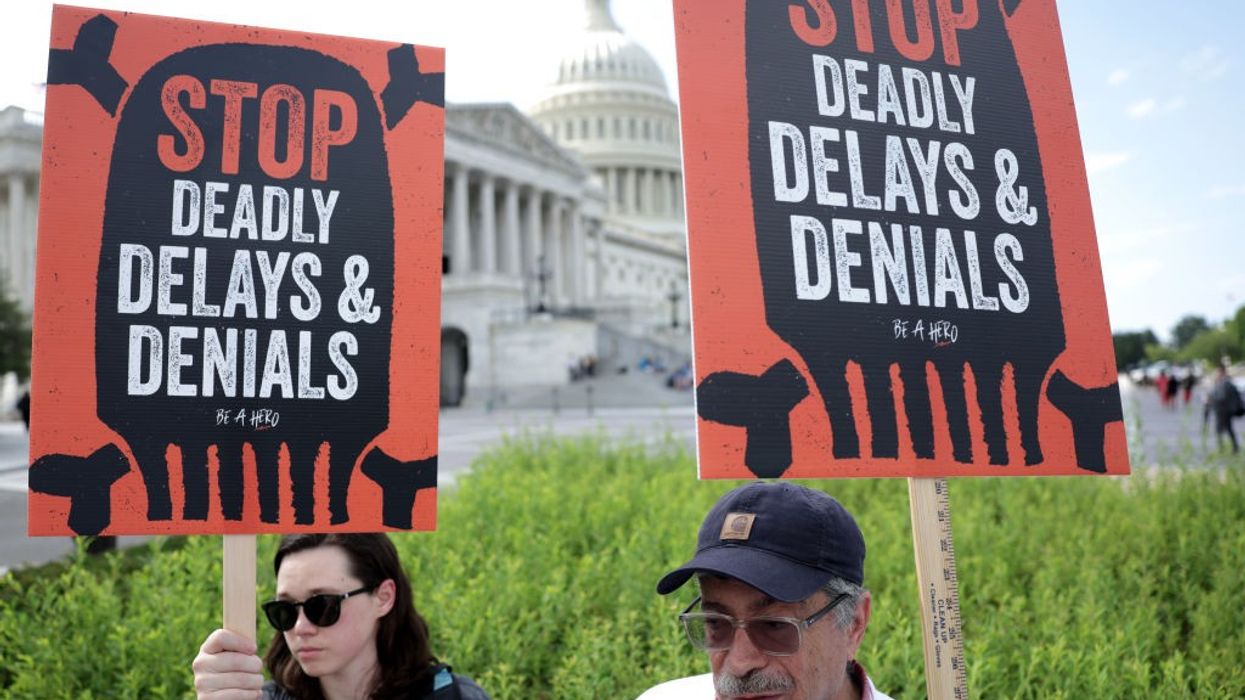
In 2003, George W Bush set up the destruction and privatization of Medicare. The end of "real Medicare" is getting closer every day, and Congress and Medicare's administrators are doing nothing.
Last Friday the Centers for Medicare Services (CMS) announced a 14.5% increase in Medicare Part B premiums, raising the monthly payments by the lowest-income Medicare recipients from $148.50 a month to $170.10 a month next year.
Congress must stop these for-profit parasites who are steadily draining "real" Medicare of funds and resources while producing billions in profits and often outright stolen funds for the insurance industry.
If you're trying to live on the bottom rung of Social Security (about $365/month), that's consequential. People with Medigap policies are also seeing their policy price rises announced this month.
Two months ago I wrote about the Medicare Advantage Scam and how it can screw consumers. This price hike, though, raises the larger issue of what's happening to Medicare itself and whether the entire system may be out of business in a few years, in part because our government is being robbed blind by all these so-called "Advantage" plans.
It all began with George W. Bush, who'd spent most of his life openly and proudly campaigning to privatize Medicare and Social Security.
In 2003 Congress and the Bush administration rolled out a privatization option, allowing private for-profit insurance companies to sell policies branded as "Medicare Advantage" to gullible seniors who think they're buying the actual Medicare Parts A and B. As a result, today companies eager to rip off seniors are flooding the market, particularly with TV advertising.
As I note in considerable detail in The Hidden History of American Healthcare: Why Sickness Bankrupts You and Makes Others Insanely Rich, Medicare Advantage is hurting traditional Medicare, because that system is paying the insurance companies, in most cases, far more than it would be paying to simply cover the costs of its regular Medicare recipients.
Medicare Advantage is also one of the most effective ways that insurance companies can kill a real "Medicare for All" system, since so many people who think they're on Medicare are actually on these privatized plans instead.
Nearly from its beginning, Medicare allowed private companies to offer plans that essentially compete with it, but they were an obscure corner of the market and didn't really take off until the Bush administration and Congress rolled out the Medicare Modernization Act of 2003.
This was the GOP's (and a few corporate-owned Democrats') big chance to finally privatize Medicare, albeit one customer at a time.
That law legalized a brand known as "Medicare Advantage" under the Medicare Part C provision and a year later it phased in what are known as risk-adjusted large-batch payments to insurance companies offering Advantage plans.
Medicare Advantage plans are not government-provided Medicare. They're private health insurance most often offered by the big for-profit insurance companies (although some nonprofits participate, particularly the larger HMOs), and the rules they must live by are considerably looser than those for Medicare.
Even more consequential, they don't get reimbursed directly on a person-by-person, procedure-by-procedure basis. Instead, every year, Advantage providers submit a bill to the federal government based on the aggregate risk score of all their customers and, practically speaking, are paid in a massive lump sum for all of their customers.
The higher their risk score, the larger the payment. Profit-seeking insurance companies, being the predators that they are, have found a number of ways to raise their risk scores without raising their expenses.
For example, many Medicare Advantage plans promote an "annual home visit" by a nurse or physician's assistant as a "benefit" of the plan. What the companies are doing, though, is trying to upcode (raise their payments from Medicare) customers to make them seem sicker than they are.
"Heart failure," for example, can be a severe and expensive condition to treat . . . or a barely perceptible tic on an EKG that represents little or no threat to a person for years or even decades. Depression is similarly variable; if it lasts less than two weeks, there's no reimbursement; if it lasts longer than two weeks, it's called a "major depressive episode" and rapidly jacks up a risk score -- and thus the payments to the insurance company, even if it provides no services.
The home health visits are so profitable that an entire industry has sprung up of companies that send nurses out on behalf of the smaller insurance companies.
In summer 2014, the Center for Public Integrity (CPI) published an in-depth investigative report titled Why Medicare Advantage Costs Taxpayers Billions More Than It Should.
They found, among other things, that one of the most common scams companies were running involved that very scoring of their customers as being sicker than they actually were, so that their reimbursements were way above the cost of caring for those people.
Here are a few quotes and summaries (in my words) from the report:
Companies are almost never nailed for these overcharges, and when they are, they usually pay back pennies on the dollar.
For example, when the Office of Inspector General, Health and Human Services (which oversees Medicare), audited six out of the hundreds of plans on the market in 2007, they found that just those six companies "had been overpaid by an estimated $650 million" for that one year. As the Center for Public Integrity states, "CMS settled five of the six audits for a total repayment of just over $1.3 million."
The Centers for Medicare and Medicaid Services also, in 2012, decided to audit only 30 plans a year going forward. As CPI noted, "At that rate, it would take CMS more than 15 years to review the hundreds of Medicare Advantage contracts now in force." And that's 15 years to audit just one year's activity!
Things haven't improved since that 2014 investigative report from CPI. In September 2019, Senator Sherrod Brown of Ohio and five Democratic colleagues sent a letter to President Donald Trump's CMS Administrator, Seema Verma.
"The recent HHS Payment Accuracy Report exposes that taxpayers have overpaid Medicare Advantage plans more than $30 billion dollars over the last three years," Brown wrote, wanting to know if the government was going to try to recover any of that essentially stolen money.
Meanwhile, during the four years of the Trump administration, CMS went out of their way to illegally promote Medicare Advantage plans.
A February 2020 report in the New York Times stated, "Under President Trump, some critics contend, the Centers for Medicare and Medicaid Services, which administers Medicare, has become a cheerleader for Advantage plans at the expense of original Medicare."
The National Bureau of Economic Research (NBER) compared Medicare Advantage with traditional Medicare and found the Advantage programs to be mind-bogglingly profitable: "MA insurer revenues are 30 percent higher than their healthcare spending. Healthcare spending for enrollees in MA is 25 percent lower than for enrollees in [traditional Medicare] in the same county and [with the same] risk score."
In other words, they are paid more and deliver less, keeping the balance as their profit. And it is hundreds of billions of dollars.
At the same time, Medicare Advantage often screws its customers. According to the NBER study, people with Medicare Advantage got 15 percent fewer colon cancer screening tests, 24 percent fewer diagnostic tests, and 38 percent fewer flu shots.
Today the industry is so entrenched and massively profitable it can buy off members of Congress with the loose change it finds in the couch.
Meanwhile, changes CMS made to the Medicare website during the Trump administration now direct people who want to sign up for Medicare, instead, to a page to sign up for private Medicare Advantage plans.
If they can move more than half of Americans off traditional Medicare and onto these corporate plans, it'll provide the political cover to kill off Medicare altogether--and they're nearly there right now.
While much of the media focus on Medicare's price increase has been around a single Alzheimer's drug, the simple reality is that without the Medicare Advantage scam the Medicare system would be in great shape right now.
Congress must stop these for-profit parasites who are steadily draining "real" Medicare of funds and resources while producing billions in profits and often outright stolen funds for the insurance industry.
As U.S. President Joe Biden on Tuesday implored Congress to pass two landmark pro-democracy bills--the For the People Act and John Lewis Voting Rights Act--scores of advocacy groups joined progressive lawmakers in urging Senate Democratic leadership to abolish the filibuster, which time and again has been used to thwart progressive legislation.
"Passing the For the People Act is indeed a national imperative, but the only way to do so is to repeal the filibuster."
--Rep. Mondaire Jones
In an impassioned Tuesday afternoon speech in Philadelphia, Biden excoriated efforts by Republicans and the previous administration to overturn the results of the 2020 general election and disenfranchise millions of voters, calling GOP voter suppression bills a "21st-century Jim Crow assault" on democracy.
Biden called passing broad voting rights legislation a "national imperative." But he dodged the filibuster issue, failing to mention it in his address. When asked about it by reporters afterward he said, "I'm not filibustering now."
Progressive lawmakers and advocates, however, argued that ending the filibuster is an indispensable step to ensure passage of voting rights and other pro-democracy legislation that otherwise would not garner the requisite support from 60 senators to hold a vote. They pointed to GOP senators' recent blocking debate of the For the People Act--which passed the House--via the filibuster to underscore the need to end the racist-rooted obstruction vehicle.
"Passing the For the People Act is indeed a national imperative, but the only way to do so is to repeal the filibuster," tweeted Rep. Mondaire Jones (D-N.Y.) after Biden's speech. "Anyone who says otherwise is missing the point."
In a call to end the filibuster, Rep. Alexandria Ocasio-Cortez (D-N.Y.) said that "the White House must use every piece of leverage it has to protect the right to vote. Our democracy is at stake. The last thing we want to see is wonderful speeches and public-facing statements, but no actual legislative movement on voting rights."
Fix Our Senate, Battle Born Collective, Citizens for Responsibility and Ethics in Washington (CREW), Common Cause, Demand Justice, Indivisible, People for the American Way, Public Citizen, Stand Up America, and over 80 other advocacy groups sent a letter (pdf) to Senate Majority Leader Chuck Schumer on Tuesday calling on him to move to abolish the "outdated and abused" filibuster.
"Protecting Americans' voting rights and strengthening the fundamentals of our democracy should not be partisan issues," the letter states. "However, the unfortunate reality is that [Senate Minority Leader Mitch] McConnell [R-Ky.] and his colleagues think voter suppression and gerrymandering are good for their political party. They want to continue to use the filibuster as their preferred weapon to silence voters."
The letter continues:
Republicans' insistence on obstructing the majority's will in the U.S. Senate is matched by their effort to suppress the people's vote in state legislatures. As the Brennan Center for Justice notes, 14 states have enacted more than 20 laws this year that will make it harder for Americans to vote. The burden will disproportionately impact Black and brown voters. Together, it creates a dangerous moment for American democracy and Americans' basic rights, one from which we may not return.
We agree with your repeated promise that "failure is not an option" when it comes to voting rights. To ensure progress in the face of partisan obstruction, we... urge you to hold another vote on voting rights legislation like the For The People Act before the August recess. Further delay risks a decade of Republican-controlled gerrymandering and Republican-controlled state voter suppression laws taking effect.
"If, as expected, Sen. McConnell and his Republican caucus again filibuster voting rights legislation--or once again filibuster simply allowing debate to begin--we urge you to move quickly to protect our democracy by eliminating the filibuster as a weapon that Sen. McConnell can use to block voting rights legislation and other urgent reforms," the letter concludes. "The filibuster cannot be allowed to stand in the way of Americans' voting rights and our democracy."
Common Cause president Karen Hobart Flynn said in a separate statement that "the For the People Act has already passed the House. Republicans filibustered it last month. If the Senate can bypass the filibuster to send core elements of the American Jobs Plan and American Families Plan to President Biden's desk, it ought to be able to do the same for anti-corruption legislation that protects the freedom to vote, breaks the grip of big money in politics, and ends gerrymandering."
All it would take to end the filibuster is the political will to do so and the support of conservative Democrats including Sens. Joe Manchin (W.Va.) and Kyrsten Sinema (Ariz.), both of whom oppose abolition.
As progressive talk show host Thom Hartmann noted on Tuesday, "because the filibuster is built into Senate rules and not a 'law,' it can be changed with a simple majority of Senate votes: 50 plus one," meaning Vice President Kamala Harris. "It needs to be changed now."
Inequality is literally killing us, both individually and as a society, and its two main drivers are monopolistic business behavior, and greedy CEOs and politicians. Both are a result of psychopaths taking over politics and business.
Decades ago, when I was doing international relief work, I visited a school for Aboriginal children way up northeast near Cairns, Australia in a little town called Lockhart River.
One of the teachers there, a white guy who'd grown up in Sydney and was my guide around the place, told me the story of an "amazing, life-changing" revelation he had the first week he was teaching at the school.
He was supervising after-school activities, and a large group of the kids formed into two teams and were playing soccer. The game's score went back-and-forth, back-and-forth with the two teams, fairly evenly matched, taking turns with who was ahead.
"They played for about an hour," he told me, as I recall. "And then they stopped. They said the game was over, and I couldn't figure out why."
The revelation for him came when they told him that, by their rules, the game was over when both teams had achieved the same number of points. When things were even.
This is how things were across much of humanity before the psychopaths took over.
Humans are wired for cooperation and empathy; these are among the highest values in societies the predate the Agricultural Revolution and in cultures today who still remember their roots in such ancient societies.
The advent of agriculture 7,000 years ago, however, produced seasonal bursts of food from harvests, often followed by long, hungry winters. This gave some people--the psychopaths--the ability to (as Daniel Quinn wrote so eloquently in his book Ishmael) "lock up the food." It was the original sin of greed, the forbidden fruit of the garden, something that's considered a crime or a mental illness in Older Cultures.
Those greedy few who controlled the food had the power of life and death over everybody else, eventually coming to be known as kings, robber barons and CEOs as humanity moved into the modern era.
Multiple studies show that as many as 20% of American CEOs are psychopaths, accounting for a brutal business culture and a winner-takes-all economy.
Although humans are wired for empathy, collaboration and cooperation, there is a small percentage--most estimates run between .5% to 2%--of people among us who are psychopaths; these people rarely feel empathy and view cooperation as a sign of weakness rather than strength.
And, tragically, these psychopaths have mostly come to dominate the worlds of politics and business.
Most stunning, multiple studies show that as many as 20% of American CEOs are psychopaths, accounting for a brutal business culture and a winner-takes-all economy.
Depending on party affiliation, those numbers probably hold true in politics, as well; if psychopaths are over-represented in the Republican Party (Trump is the latest and most visible example), that would account for their brutal style of politics.
If psychopaths are under-represented in the Democratic Party, that would account for why Dems constantly want to compromise and work things out. Such behavior is, after all, the baseline norm for humans who are not psychopaths.
While psychopathic CEOs and politicians battling it out in their own realms may seem remote for the average person, the reality is their psychopathic, greedy behavior accounts for much of the massive inequality we see in the world today.
And that psychopath/greed-driven inequality is making us, as a society, sick.
Richard Wilkinson and Kate Pickett of the Equality Trust in the UK have spent years documenting how the more unequal a society is the greater will be their rates of crime, mental illness, violence, homicide, suicide, drug addiction, obesity, unwanted pregnancy and a whole host of other medical, psychological and social ills.
On the other hand, the more egalitarian or equal a society is the less frequently these societal ills present themselves. They've shown this is true from country to country, and even did an extraordinary break-down state-by-state in the US showing the exact same effect.
And now we're finding that just playing games that are based on psychopathic behavior like trying to wipe out your competitors and take all their assets triggers similar reactions in people to societal inequality itself. And some games are worse than others at this.
And the game that's the worst is Monopoly.
Back in 1903 Lizzy Magie, a British feminist and socialist, patented the board game that we know today as Monopoly. She invented the game as a warning about the dangers of unrestrained, unregulated capitalism, although over the past hundred years that has been almost completely forgotten.
As Chris Melore reports, "Monopoly stands out as the most debated--and most forbidden--board game of all time. In a recent survey of 2,000 U.S. residents, 20 percent say that their game nights with friends or family members are often or always disrupted by competitive or unfriendly behavior."
Perhaps the "good" news is that "only 11% of respondents said they witnessed a physical fight break out," but Monopoly--a game that is based on the prime psychopathic value of taking everything for yourself and thus increasing inequality--seems to trigger the worst in us.
Nobody's calling for a ban on the game of Monopoly, but as the Aboriginal kids taught their "westernized" teacher--and the extraordinary scientific research of the Equality Trust clearly shows--we will all be better off if we can reform our political and business cultures to be less greed-driven (psychopath-friendly) and more collaborative and fair (humanity-friendly).
Those psychopath-proofing reforms range from tackling actual business monopolies, to getting corporate and billionaire money out of politics, to strengthening our democracy by establishing an absolute right for all Americans to easily and comfortably vote like in other democracies (see: HR1).
It's a big lift, but if we all work together we can still make it happen.
This article was first published on The Hartmann Report.