SUBSCRIBE TO OUR FREE NEWSLETTER
Daily news & progressive opinion—funded by the people, not the corporations—delivered straight to your inbox.
5
#000000
#FFFFFF
To donate by check, phone, or other method, see our More Ways to Give page.

Daily news & progressive opinion—funded by the people, not the corporations—delivered straight to your inbox.
This year's nationwide protests demanding racial justice and an end to police brutality--sparked by the killings of George Floyd, Breonna Taylor, Ahmaud Arbery, and other Black Americans--inspired a proposal from Republican Gov. Ron DeSantis that critics worry will lead to more bloodshed: expanding the state's controversial "stand your ground" law with his drafted "anti-mob" legislation.
The Miami Herald reported Tuesday on the draft, which traces back to promises DeSantis made earlier this year "as he tried to deliver Florida" to President Donald Trump. The president--who ultimately won the state but lost the election, though is still refusing to concede to President-elect Joe Biden--has come under fire for his own forceful response to the protests.
DeSantis' administration has circulated an "anti-mob legislation draft" among Florida lawmakers since his public statements in September, but no related measures have been filed in the state legislature. However, local attorneys are already raising alarm that the proposal "allows for vigilantes to justify their actions," in the words of Denise Georges.
Georges, a former Miami-Dade County prosecutor who handled "stand your ground" cases, told the Herald that "it also allows for death to be the punishment for a property crime--and that is cruel and unusual punishment. We cannot live in a lawless society where taking a life is done so casually and recklessly."
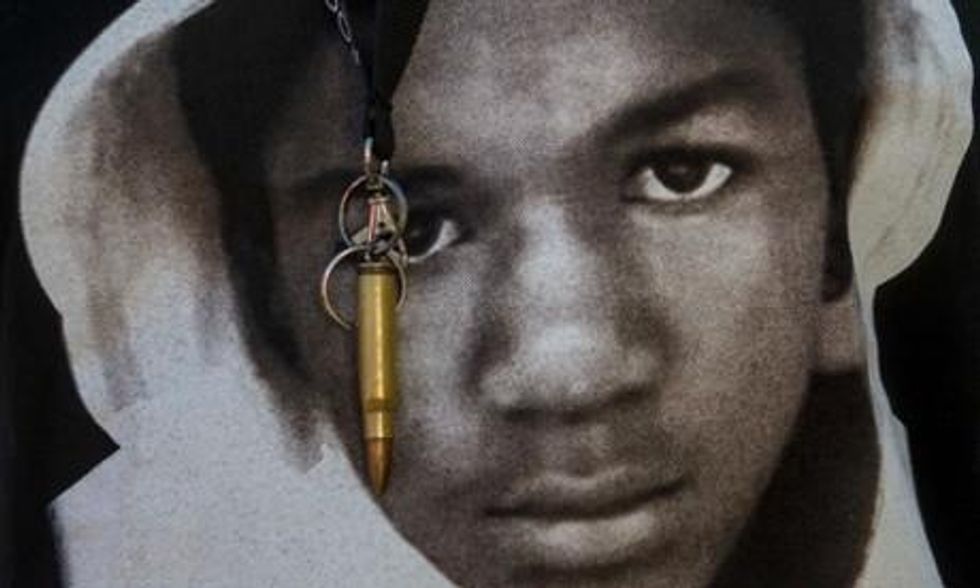
Florida passed its "stand your ground" law in 2005--and other states, encouraged by the National Rifle Association, followed suit, enacting measures that effectively say people have no duty to retreat before using deadly force to defend themselves. The Florida measure garnered national attention in 2012, after George Zimmerman, a neighborhood watch volunteer, killed Trayvon Martin, an unarmed Black teenager, in a gated community. Zimmerman's acquittal the next year sparked the Black Lives Matter movement.
"Zimmerman's attorney did not raise a 'stand your ground' defense at the trial," the Washington Post noted in 2014. "But after the trial a juror acknowledged that jurors had discussed the self-defense law before finding Zimmerman not guilty. The law also changed the standard instructions to jurors in homicide cases, so that the judge said that Zimmerman had no duty to retreat and could stand his ground if he felt threatened. (The law may have also played a role in the initial failure of the local police to prosecute Zimmerman.)"
DeSantis' proposal goes even further than 2017 changes to the law that make prosecutors prove by "clear and convincing evidence" that a defendant wasn't acting in self-defense. As the Herald detailed Tuesday:
The proposal would expand the list of "forcible felonies" under Florida's self-defense law to justify the use of force against people who engage in criminal mischief that results in the "interruption or impairment" of a business, and looting, which the draft defines as a burglary within 500 feet of a "violent or disorderly assembly."
Other key elements of DeSantis' proposal would enhance criminal penalties for people involved in "violent or disorderly assemblies," make it a third-degree felony to block traffic during a protest, offer immunity to drivers who claim to have unintentionally killed or injured protesters who block traffic, and withhold state funds from local governments that cut law enforcement budgets.
Former Miami-Dade prosecutor Aubrey Webb told the newspaper that "the Boston Tea Party members would have been lawfully shot under Florida's law by the British East India Tea Company."
"It dangerously gives armed private citizens power to kill as they subjectively determine what constitutes 'criminal mischief' that interferes with a business," Webb said. "Someone graffiti-ing 'Black Lives Matter' on a wall? Urinating behind a dumpster? Blocking an entrance?"
Webb and Georges were far from alone in criticizing the GOP governor's proposal. Critics warned it could lead to more violence by vigilantes like the white teenager charged with killing racial justice protesters in Kenosha, Wisconsin in August and urged DeSantis to instead focus on the coronavirus pandemic that continues to ravage his state.
Miami Beach Mayor Dan Gelber, retired Miami-Dade homicide prosecutor Reid Rubin, Miami defense lawyer Phil Reizenstein, and Melba Pearson, a civil rights attorney and former deputy director of Florida's American Civil Liberties Union, all shared concerns about the proposal with the Herald, while others on social media described the draft legislation as "legalizing lynching" and "legalizing murder."
As digital rights activist Evan Greer put it: "This is basically just a license for white people to kill protesters."
The greatest athletes in America are standing up for justice at a critical time.
Despite unprecedented, multiracial demonstrations across the country protesting police violence against African Americans, the horrors keep on coming.
Last week, Jacob Blake was shot seven times in the back by a policeman in Kenosha, Wisconsin. As the anger has grown, some of the protests have been marred by vandalism and looting. Now armed right-wing militia groups are escalating the tensions. In Kenosha, two demonstrators were murdered and one wounded by a 17-year-old Trump supporter illegally wielding an assault weapon.
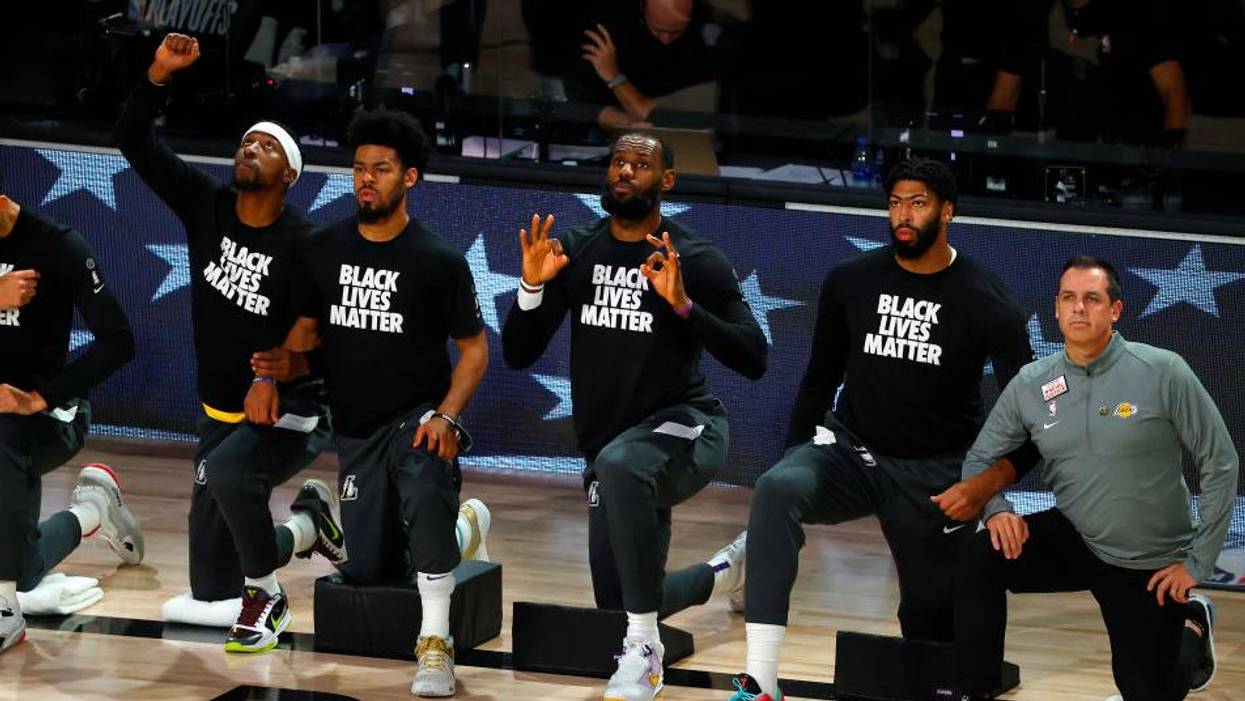
It is into this cauldron that the professional basketball players of the NBA stood up, forcing a suspension of the playoffs, to support the call for justice. Their example was picked up by others--the WNBA, baseball players, tennis champions like Naomi Osaka and more.
This takes courage. Great athletes are taught to focus on their sport and to ignore their power in the culture. Owners, agents, managers and fans see them as entertainment, not as citizens or leaders.
Yet the very God-given gifts, discipline and skills that make a great athlete contribute to their capacity for leadership. In the Old Testament, little David honed his skill with a sling. When an oppressive horde led by a giant named Goliath threatened the Hebrew people, David stepped up, hurling the stone that slew the giant and saved his people.
Now America's greatest athletes are standing up, calling this country to change. They know that they will face criticism and abuse. They know that they could be risking their careers and livelihood.
When LeBron James, Dwayne Wade, Chris Bosh and the Miami Heat players stood up in response to the death of Trayvon Martin, Americans across the country took notice. The same is true now as the current athletes focus on Breonna Taylor, George Floyd, Jacob Blake and the others they name.
They know the risks, but they also know that when they leave the court or playing field and return to their families, they are just another Black person to the police, and must worry about how to protect their sons and daughters, sisters and brothers, or even themselves. Both Sterling Brown of the Milwaukee Bucks and Thabo Sefolosha of the Houston Rockets were victims of police lawlessness.
Here the example and leadership of LeBron James has been critical. Athletes across the world look up to him. When LeBron uses his platform to speak out--even in the face of insults from the president and others--he sets a tone and an example for others. In my opinion, he uses his gifts and platform so responsibly because it is his way of thanking God by serving others.
Dr. Martin Luther King Jr. used his gifts and platform to change the culture. Today, athletes are using their commitment to call this country to its senses.
Great athletes have often been pacesetters. When Heavyweight Champion Jack Johnson stood up to racially biased and arbitrary social mores, he impacted the culture. When Joe Lewis defeated Max Schmeling, he pummeled the entire Nazi theory and racist ideology. When Jesse Owens became the world's fastest man at the Berlin Olympics, Adolf Hitler wouldn't shake his hand, but when Owens came home, he told me President Roosevelt wouldn't shake his hand either. Jackie Robinson broke the racial barrier in baseball and bore the physical and psychological scars from doing it.
At the height of his career, Muhammad Ali, became a conscientious objector to the Vietnam War, and paid the price of years stolen from his career. Every athlete should be grateful to Curt Flood for ending the reserve clause and gaining athletes the right to free agency to negotiate the best deal they could. Colin Kaepernick launched his nonviolent campaign against police killing of Black people four years ago that has cost him his career.
The athletes had to stop business as usual to gain attention. They have been in intense meetings figuring out how they can most be effective. They understand that the murders can't go on; the system must change. They are calling on others to join them. They are putting their time and their resources on the line. They've now convinced NBA owners to turn their arenas into polling places where people might vote safely.
Their actions have already had effect. It is too easy for cynical politicians and entrenched interests to turn attention from the injustice to the excesses that mar those protesting it. The players have forced our attention back to the injustice and to the core demand that Black Lives Matter. For that, they deserve our respect and our support.
When the brutal murder of George Floyd occurred on May 25 in Minneapolis, Minnesota, few people could have imagined that it would have such far-reaching repercussions. Following the equally egregious killings of Ahmaud Arbery and Breonna Taylor, some of us assumed that Floyd's name would join the miserable rollcall of names of black Americans such as Trayvon Martin, Michael Brown, and Eric Garner, slain at the hands of racist police and their civilian counterparts.
But Floyd's murder has ignited a breadth of protests seldom seen in the United States, and the current tension-filled climate has aspects that are still unfolding, and implications that are not yet fully appreciated.
One of the most unexpected and remarkable aspects of the nationwide protests is how these demonstrations have spread to other parts of the world, including continental Europe and the United Kingdom. Protests are occurring
not just in British cities with sizable communities of black people--such as London, Birmingham, and Manchester--but also in cities north of the English border, like Glasgow and Edinburgh. The rallies that have taken place across the United Kingdom have reflected the outrage of people of many different ethnicities.Like the United States, Britain has a protracted and shameful history of black deaths in police custody. A significant number of the placards held by British protesters have drawn attention to the abuse of black people in Britain, even as these signs also demanded an end to the transatlantic pandemic of racism--a pandemic which, like Covid-19, has claimed a grotesquely disproportionate number of black lives.
As could be expected, Black Lives Matter protests took place in Bristol, a city in the west of England with a long history of activism and protest emanating from its black communities. But few could have predicted that in the aftermath of the rally, activists would seek, in particularly dramatic fashion, to right a specific wrong and an injustice that had been well over a century in the making.
In Bristol's city center there has stood, from the late-nineteenth century onward, a statue of a merchant who shipped captured African men, women, and children, as part of what historians refer to as the Atlantic Slave Trade, or the Triangular Slave Trade. The merchant, Edward Colston, amassed considerable wealth from his trading activities and in doing so became an important philanthropist within the city, the benefits of his largesse still being enjoyed by modern-day Bristolians.
But just as there's a long history of activism in the United States around the removal of confederate monuments, people have spoken out against Colson's statue since it was erected in the late 19th century. In more recent years, those voices became more animated. Some sought a compromise by asking that a plaque be appended to the monument, drawing attention to how Colston amassed his fortune, and the price paid by hundreds of thousands of African people in this endeavor.
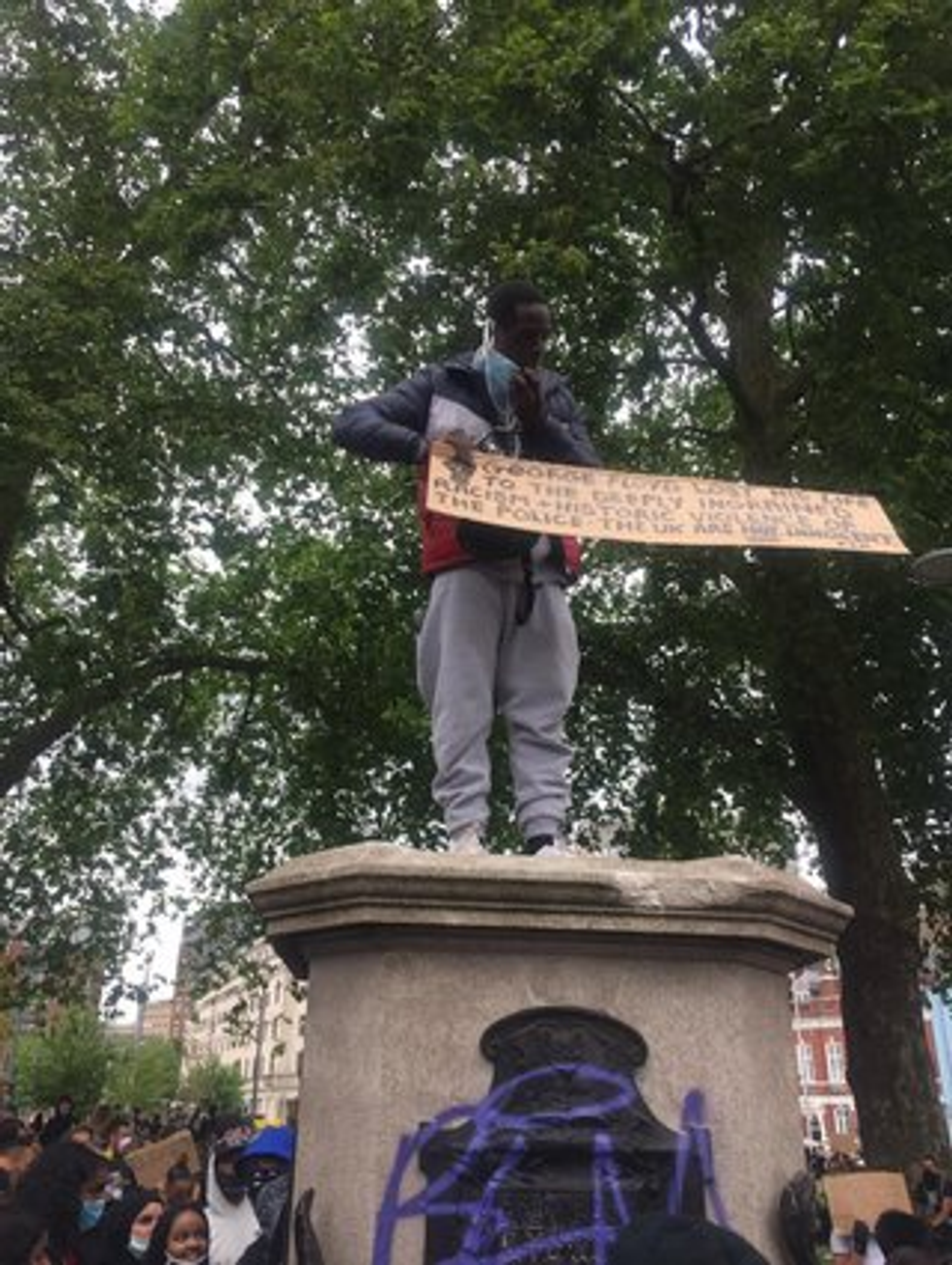
On June 7, matters came to a dramatic head when a number of Black Lives Matter protesters tore down the statue of Colston. For good measure, the damaged statue was rolled to the nearby docks in Bristol city center and dumped into the water of Bristol's harbor--the same harbor from which vessels set sail on their murderous voyages.
Prime Minister Boris Johnson and senior government figures such as Home Secretary Priti Patel were quick to condemn what they declared to be acts of "thuggery," a racially loaded term if ever there was one.
Ironically, just as Johnson, Patel, and others have demanded the vigorous prosecution of those allegedly responsible for the toppling of the statue of Colston, politicians across the U.K. and throughout Europe began, at long last, to take preemptive action to remove statues of equally offensive figures.
These include a statue of the infamous King Leopold II of Belgium, who presided over unspeakable horrors inflicted on the people of the Congo. He was a monarch who ruthlessly and mercilessly exploited both the land and the people of a vast expanse of central Africa. One of his preferred methods to induce harder labor in the Congo, and punish those he believed to be slackers, was to amputate the hands, feet, and limbs of men, women, and children.
What started in Minnesota has the potential to do more than address systemic problems in the United States; people on the other side of the Atlantic have taken these protests into remarkable, extraordinary, and wholly unforeseen directions.
There are numerous statues of him across Belgium, and one of them, in a supposed gesture of retribution, had a hand severed some years ago; another was unceremoniously removed. But one Leopold II statue that's still standing bears a particularly deplorable inscription: "I have undertaken the work in the Congo in the interest of civilization and for the good of Belgium."
In London, Mayor Sadiq Khan, in response to the toppling of the Colson statue, announced a review of the many statues and street names with explicit links to Britain's involvement in the slave trade. A statue of the notorious slaveholder Robert Milligan was already being removed from outside the Museum of London Docklands. Milligan owned several sugar plantations and hundreds of enslaved people in the British colony of Jamaica--He was just one of the many slaveholders and imperialists that were honored in public spaces in Britain.
Parallels can--and should--be drawn between the belated removal of Confederate statues and monuments throughout the South, and the similarly belated removal of statues of brutes such as Colston and Milligan.
What started in Minnesota has the potential to do more than address systemic problems in the United States; people on the other side of the Atlantic have taken these protests into remarkable, extraordinary, and wholly unforeseen directions.
Names of some of those taken by police brutality in the United Kingdom (as seen on placard above): Mark Duggan, Sean Rigg, Sheki Bayoh, Leon Briggs, Christopher Aider, Joy Gardner, Cynthia Jarrett, Cherry Groce, Smiley Culture, Michael Powell, Ricky Bishop, Brian Douglas, Leon Patterson, Derek Bennett, Sarah Reed, Roger Sylvester, Azelle Rodney, Mzee Mohammed, Edson Da Costa, Rashan Charles, Kevin Clarke, Luigi Basile, Leroy Junior Medford, Shane Bryant, Oghene Abboh, Demetre Fraser.
George Zimmerman, the former Florida neighborhood watch volunteer who shot and killed unarmed teenager Trayvon Martin in 2012, is suing the victim's family, prosecutors, and the media for $100 million in damages.
Zimmerman was acquitted of murdering Martin in 2013.
"Imagine killing an unarmed child and then suing his parents," tweeted Center for Policing Equity president Phillip Atiba Goff.
The lawsuit, which Zimmerman's lawyer Larry Klayman--a right-wing legal advocate--filed in Polk County Circuit Court in Florida Wednesday names Martin's mother, Sybrina Fulton, as the lead defendant. Fulton is running for Congress in Florida's District 1.
According to the Miami Herald:
The suit in Polk County Circuit Court cites information in a documentary about the case that accuses the Martin family of engineering false testimony, and the director has scheduled a press conference this week in Coral Gables to coincide with a film screening there. The suit seeks $100 million in civil damages, alleging defamation, abuse of civil process and conspiracy. A copy of the suit was distributed to media Wednesday by the movies' director, Joe Gilbert. The case does not yet appear on the online docket of the Polk court system.
Zimmerman, Klayman, and Gilbert will host a press conference Thursday afternoon at the Coral Gables Art Cinema.
Documentary filmmaker Billy Corben said in a tweet he was outraged at the cinema's involvement in what he called a "disgraceful sham."
New York State Assembly member Yuh-Line Niou couldn't believe what she was reading.
"This killer wants to do what?!" said Niou.
Last week, the Florida-based Dream Defenders announced a six week "social media sabbatical" from their personal and organizational Facebook, Twitter and Instagram accounts, promising to digitally resurface in November "with a fresh voice; one that emanates from the grassroots and is a complement to movement work, not just characters."
Founded in the wake of Trayvon Martin's murder in 2012, the Dream Defenders' first major action was a three-day, 40-mile march from Daytona to Sanford, where they held a sit-in at the town's police headquarters to demand the long-awaited arrest of Martin's killer, George Zimmerman. The group soared into the national spotlight just over a year later, staging a 31-day occupation of the Florida statehouse following Zimmerman's acquittal by a grand jury. Having been organizing on the ground in Florida ever since, the Dream Defenders have emerged in the last year as a leading voice in the movement for black lives, boasting iconic branding, nearly 53,000 Twitter followers and a steady stream of interview requests from national media outlets. Explaining the blackout on their site, they wrote: "Our culture rewards folks for RTs and posting the same information, articles and snarky comments. Our profiles get more attention for talking about tragedies than they do for highlighting the work that our membership is doing day in and day out."
To learn more, I sat down via Google Hangout with Elijah Armstrong and Rachel Gilmer. Armstrong, Dream Defenders' Central Florida representative and a member of the group's advisory board, grew up in Bartow, Florida. He has organized with Dream Defenders since its inception, working on campaigns against the school-to-prison pipeline and private prisons. Gilmer joined the Dream Defenders this July as chief of strategy. A long-time community organizer, she has worked extensively on issues of equity and racial justice both in her home state of Oregon and in New York City, where she previously served as associate director of the African American Policy Forum.
What has the relationship been like so far between Dream Defenders' on-the-ground organizing and its social media presence?
Elijah: Everything from the ground has influenced our social media work. After the Capitol takeover, our social media really boomed. Out of nowhere, we had a lot of followers. That was a real undertaking. Folks came out saying we were a new voice. It was weird to go to different spaces, and the first thing people would mention would be our social media presence. After a while, it seems like social media can overshadow the work that's being done on the ground because it's not uplifted in the same light or held in the same regard. The on-the-ground work is the most important work we do, and we got caught up a little bit in social media. For the most part, though, I think we've done a good job of connecting the work that we do on social media to our base, and we make sure that it's staying in line with that.
Rachel: As a young organizer seeing the Dream Defenders take over the Capitol was deeply inspiring and in many ways, changed my life. It was reinvigorating to see other young people out there who believe in the same things I do, who weren't interested in accepting the status quo, who were fighting in new ways and who were building real power. It's been a real experience coming down here and working for the Dream Defenders because most of my understanding of who they were was shaped by social media. It's been really amazing to see on-the-ground work, which -- to some extent -- can be expressed over social media, but only to some extent. Sometimes we have this idea in our head that we are our social media, but it is in no way a substitute for really knowing someone, and really experiencing something.
Why a blackout?
Elijah: Right now we're at a crucial point in our movement. A lot of folks have been using social media in a very negative manner within the movement, to make personal attacks and critiques. The way social media is going, I think that the big media is doing a good job of controlling our narrative, and we aren't really controlling it -- whether they're taking sound bites from us, or just misrepresenting us or misquoting us. With different folks beefing on social media, it's gotten to a point where the platform isn't being used in the most positive light, like for political education or as a way to bond and work. It's just being used as a way to say "You don't do this" or "You don't do that" or "I've done this" and "I've done that." All these arguments that you see on social media ... people have each other's numbers, and won't even pick up the phone to call or even text. Whole conversations will play out on social media in 140 characters, so there's no way that you're going to actually have a real conversation. It just further disconnects us. It's almost become a circus, in a way, that's really being run by big media. I think this is, first, a time to really shift people's focus away from big media, and two, to regroup the work that we're doing on the ground to make sure that we aren't getting caught up in that nonsense of the back-and-forth. We really just want to take the time to continue to build with our base.
Rachel: I totally agree. Personally, I don't have a big social media following and, to be honest, it's not really my thing. But ever since the movement really erupted, I have started to, subconsciously, equate my worth as an organizer with my presence online. Because of this, I've devalued myself and told myself I'm unimportant because I don't have a strong social media presence. I've actually thought of my own community organizing as less important because I don't know how to package it and present it online. It feels like lesser work. When you look at all these lists that are generated, like "The Top 10 Youth Organizers" from our generation, they're largely people with a strong social media presence. And that's not to say that that's not important, or that I don't value that type of work. But it seems that work has been uplifted over other types of organizing. And then I have to question why I even care about those top 10 lists in the first place. Social media has completely skewed my perspective of what's important -- both fueling and draining my ego, making me feel like the center of the universe and making me feel like an absolute nobody at the same time. It's a really sick and viscous cycle.
Not only does social media cause trauma in this way, but it can also be an incredibly damaging way to receive information. If you look at the Sandra Bland case, for instance, all the details of her death came out one little piece of information at a time. It would flood your feed for a day, and then the next piece of the story would come out and it would flood your feed for a day. I think digesting information in this way is a form of psychological warfare: It's traumatizing and re-traumatizing and re-traumatizing. I don't think that people actually realize how much damage this is doing to us psychologically, especially to our young people who don't necessarily have the tools to understand why people like them are being killed with impunity by the police.
I think being off social media is an opportunity for us to really understand how social media is impacting us, how it's being used to manipulate us by our oppressor and how we can be intentional in understanding its limitations and what the opportunities are.
Lastly, to Elijah's point, I think social media has created this illusion of deep relationships within the movement. You can say, "Hey fam!" on Twitter, acting like we all know each other really well. That's not to say that we haven't built real relationships on social media, but I also think that all the fighting that happens over social media is indicative of the fact that people really don't know each other. Social media provides the illusion of deep relationships. So long as people don't really know each other, the work is never going to go that far. This is doing the work of COINTELPRO in the sense that you see people calling each other out online, and you see all these rifts being created. Social media is doing that to us. Stepping back from all that is really important right now. We're in a really critical time where all of this could actually kill the movement.
What are your plans for base-building, and the deep relationship-building work you hope to feed by stepping back from social media?
Elijah: Right now, we're going through a process of revamping who we are, what we do and how we do it -- to really get more in touch with our base because we are a membership-based organization, and membership should lead from the bottom-up, not the top-down. It's really just about trying to rebuild and deepen relationships with our members. We've been doing work in these communities for a long time and we know some of the needs, but we don't know all of them. We want to make sure that we're adequately representing the folks that we work with. We are a part of these communities, not just random folks coming in to say that we live there. We breathe in these communities, so this work affects us as well.
As someone who's been off social media for the last couple of days, I've actually had to try to remember my friends' birthdays because that's what Facebook does. I've texted and called more of my friends instead of talking to them via Facebook. It feels like I'm in 2004 again, where there's no Myspace, and that's cool. It's really been helpful to me, in the sense of relationships and just with my productivity. It's so routine to constantly check your social media. I didn't realize how much I was depending on it. It's only been a couple days and it's been weird, but really liberating and awesome. It's funny: The more connected you are on social media, the less connected it feels like you are offline. Right now, we're just focused on being offline. I think we're so used to being online that we're not used to thinking about what it's like to be fully offline and fully engaged with folks, not having anything standing in the way of that.
Rachel: A couple studies came out last year on how Facebook can literally mess with your emotions by changing what comes on your feed. It's scary to think about the impact that could have on a movement, not only in terms of your emotional health but also in terms of strategy and how that could manipulate your understanding of issues. Social media is so much about spectacle. As a movement, we've been really caught up in it. We've done a lot of amazing tactical work.
We've shut stuff down, and it's changed the world. But one of the things that we're thinking about is how we can move beyond tactical level organizing that forces us to react to what's been given to us, and instead, be visionary and build a strategy for how we build power and the world we want to see in the long run.
We're preparing to launch a new initiative, called the Free Campaign, where we're having all of our [chapters] go door-to-door and do street canvassing to talk to folks about what freedom means, and to really build relationships with the community around the basic concept of what it would look like to be free. They're also doing intensive research projects to gain a deeper understanding of the local political and community landscape, and the history of revolutionary organizations and movements around the world and how we can embody this as the Dream Defenders. All of this will help us build a vision for Florida and a strategy for building power here, with the hopes that it will have a reverberating effect across the country.
What would an ideal, mutually reinforcing relationship between social media and on-the-ground organizing look like?
Elijah: Social media sees organizing on a very surface level, which is also, I think, a part of social media wanting you to see it on a very surface level. It helps being able to share movies and stories and actions. But that's only a window; it's not the whole house. I think we've got to be more realistic about that. Social media is not the end all be all, but it definitely does help. Like Rachel said, folks seeing us take over the Capitol was something that inspired them to continue to do more work. But social media also makes you think that if you're not there where the social media is then you're not doing the same amount of work. That is a huge fatal flaw. Rachel shouldn't have seen what we did out there in Florida and wanted to come join us, which -- don't get me wrong -- is cool. But she should have been more inspired to continue to do the work where she was. Last summer, everybody shouldn't have rushed to Ferguson when Mike Brown died. There were organizers already there on the ground. Social media is the thing that showed people "doing the work" in Ferguson, but really they were just doing interviews and talking about the trauma that the police were causing. They don't ever show the stuff that you need. A prime example is #BlackLivesMatter. Social media only takes soundbites; social media doesn't cover your strategy meetings. It doesn't cover all the different work that goes into the whole totality that is organizing. As organizers, we have to be mindful of that and constantly try to let folks know that they're only seeing 10 percent of the iceberg, if that.
Rachel: The next month and a half for us organizationally and as individuals, is an opportunity to come back in November with an intentional strategy for how we will use social media: recognizing what it is, recognizing what it isn't, and understanding how it can amplify, but not substitute the on-the-ground organizing being led by our members. It's a time to process. When you're on social media, your'e submersed in thousands of other people's lives, thoughts and perspectives. What does that do for your own thinking, and your own ability to process, assesses what you believe in, and strategize for yourself and your people? Given the way that social media uplifts this idea of celebrity activism, I think it's really important for us to step back and understand the way that it has manipulated people's understanding of who the Dream Defenders are. How do we, organizationally, navigate this structure, understanding both its strengths for building connections and its limitations in order to really change the course for our people?
What do you think about the long-term role of social media in movement organizing?
Elijah: I've been thinking a lot about this song by Gil Scott Heron, "The Revolution Will Not be Televised." In other words, television is an institution used to support the powers that be, so you're not going to get the revolution through that medium. Now I see people saying the revolution won't be televised, but it'll be digitalized. I don't know if that's true. There's a potential that it could be, but the way we're doing it now I don't think we're going to get there. With the Internet being so big, if we were able to craft it and control our own narrative then maybe we could, using our own platforms. But relying on Twitter, Facebook and Instagram, to me, is no different than relying on CNN, MSNBC and FOX to tell our story. Having more direct contact with these platforms doesn't mean we have more control.
Rachel: I'd agree with everything Elijah said. I think the Internet might also be creating a sense of rugged individualism. How is it that I can Google something and Elijah can Google something and we can both get totally different results? The fact that Google can control the way information goes out creates deep discrepancies in our understanding of the way the world works. I think there's an illusion that we control our social media because we are choosing what we put out into the world. But we must understand the way this is being manipulated so that the oppressor can't continue to control the narrative.
Police are investigating the shooting of nine African Americans at Emanuel AME Church in Charleston as a hate crime committed by a white man. Unfortunately, it's not a unique event in American history. Black churches have long been a target of white supremacists who burned and bombed them in an effort to terrorize the black communities that those churches anchored. One of the most egregious terrorist acts in U.S. history was committed against a black church in Birmingham, Ala., in 1963. Four girls were killed when members of the KKK bombed the 16th Street Baptist Church, a tragedy that ignited the Civil Rights Movement.
But listen to major media outlets and you won't hear the word "terrorism" used in coverage of Wednesday's shooting. You won't hear the white male shooter, identified as 21-year-old Dylann Roof, described as "a possible terrorist." And if coverage of recent shootings by white suspects is any indication, he never will be. Instead, the go-to explanation for his actions will be mental illness. He will be humanized and called sick, a victim of mistreatment or inadequate mental health resources. Activist Deray McKesson noted this morning that, while discussing Roof's motivations, an MSNBC anchor said "we don't know his mental condition." That is the power of whiteness in America.
U.S. media practice a different policy when covering crimes involving African Americans and Muslims. As suspects, they are quickly characterized as terrorists and thugs, motivated by evil intent instead of external injustices. While white suspects are lone wolfs -- Mayor Joseph Riley of Charleston already emphasized this shooting was an act of just "one hateful person" -- violence by black and Muslim people is systemic, demanding response and action from all who share their race or religion. Even black victims are vilified. Their lives are combed for any infraction or hint of justification for the murders or attacks that befall them: Trayvon Martin was wearing a hoodie. Michael Brown stole cigars. Eric Garner sold loosie cigarettes. When a black teenager who committed no crime was tackled and held down by a police officer at a pool party in McKinney, Tex., Fox News host Megyn Kelly described her as "No saint either."
Early news reports on the Charleston church shooting followed a similar pattern. Cable news coverage of State Sen. and Rev. Clementa Pinckney, pastor of Emanuel AME who we now know is among the victims, characterized his advocacy work as something that could ruffle feathers. The habit of characterizing black victims as somehow complicit in their own murders continues.
It will be difficult to hold to this corrosive, racist media narrative when reporting on the shooting at Emanuel AME Church. All those who were killed were simply participating in a Wednesday night Bible study. And the shooter's choice of Emanuel AME was most likely deliberate, given its storied history. It was the first African Methodist Episcopal church in the South, founded in 1818 by a group of men including Morris Brown, a prominent pastor, and Denmark Vesey, the leader of a large, yet failed, slave revolt in Charleston. The church itself was targeted early on by fearful whites because it was built with funds from anti-slavery societies in the North. In 1822, church members were investigated for involvement in planning Vesey's slave revolt, and the church was burned to the ground in retribution.
With that context, it's clear that killing the pastor and members of this church was a deliberate act of hate. Mayor Riley noted that "The only reason that someone could walk into a church and shoot people praying is out of hate." But we need to take it a step further. There was a message of intimidation behind this shooting, an act that mirrors a history of terrorism against black institutions involved in promoting civil and human rights. The hesitation on the part of some of the media to label the white male killer a terrorist is telling.
In the rapidly forming news narrative, the fact that black churches and mosques historically have been the targets of racial violence in America should not be overlooked. While the 1963 Birmingham church is the most historic, there also was a series of church burnings during the 1990s. Recognition of the terror those and similar acts impose on communities seems to have been forgotten post-Sept. 11. The subsequent Islamophobia that has gripped sectors of media and politics suggests that "terrorism" only applies in cases where the suspects are darker skinned.
This time, I hope that reporters and newscasters will ask the questions that get to the root of acts of racially motivated violence in America. Where did this man, who killed parishioners in their church during Bible study, learn to hate black people so much? Did he have an allegiance to the Confederate flag that continues to fly over the state house of South Carolina? Was he influenced by right-wing media's endless portrayals of black Americans as lazy and violent?
I hope the media coverage won't fall back on the typical narrative ascribed to white male shooters: a lone, disturbed or mentally ill young man failed by society. This is not an act of just "one hateful person." It is a manifestation of the racial hatred and white supremacy that continues to pervade our society, 50 years after the Birmingham church bombing galvanized the Civil Rights Movement. It should be covered as such. And now that authorities have found their suspect, we should be calling him what he is: a terrorist.

Some of the state legislators were at least aware of the attention stand-your-ground laws have drawn. As Democratic Rep. Mia Jones explained to her colleagues: "The world is looking at Florida and ... we don't look good right now." This is not, perhaps, a persuasive argument in a state that leads the nation in both incidents of human cannibalism and "zombie foreclosures". The so-called "warning-shot" bill passed 93-24.
Shamelessness aside, the renewed passion of Florida politicians for the expansion and protection of this type of loophole - the very kind that let George Zimmerman run free, even if he got off on self-defense - at least raises a different question: Why are those local legislatures passing such embarrassing laws in the first place?
As the nation's statehouses have splintered off from the on-year electorate, states such as Florida (really, especially Florida) serve up the best examples for how our "laboratories of democracy" have become playgrounds for mad scientists - particularly, the right-wing American Legislative Exchange Council. Almost all of Florida's legislative antics (including some off-the-clock holiday jaunts) can be traced back to ALEC, including its original stand-your-ground law. ALEC designs the legislation, compliant legislators cut-and-paste it into law - literally, in the instance of Florida Rep. Rachel Burgin, who forgot to remove ALEC's mission statement from the text of an anti-tax bill she submitted in 2012.
Anyone with even a casual interest in the escapades of "Florida man" and "Florida woman" knows that the state's gun crazy extends beyond the crazy stand-your-ground law to which the death of Trayvon Martin introduced us all. The state has some of the most permissive open-carry and concealed-carry laws in the country (with the added bonus of not running mental health background checks on individuals who apply for the permits!). A bill currently before the Florida Senate (with the backing of the governor and the National Rifle Association) would extend conceal carry privileges to all gun owners "during a mandatory evacuation in a state of emergency". Because we know how even-keeled and slow-to-anger people are during those types of situations. Last fall, Florida Attorney General Pam Bondi joined the NRA in a bid to allow 18- and 19-year-olds to purchase handguns. Justin Bieber with a Glock - exactly what Florida needs.
But the gun laws themselves are just the collateral damage of a spun-out legislature that has become one of the most successful case studies for ALEC's push to enact pro-business, pro-conservative legislation across the country. Florida's stand-your-ground law, shepherded by ALEC protege and then-state senator Marco Rubio, was the first of its kind in the nation. The process became a model not just for the expansion of the so-called "Castle Principle" legislation but for how to pass ALEC-scripted laws in general.
There are 13 ALEC-ordered bills in consideration in Florida right now, one of which would exempt companies from revealing the chemicals used in oil and gas extraction. Last June, Gov Rick Scott signed into law an ALEC bill that blocks local governments from implementing paid sick leave.
Florida is also the epicenter of many of ALEC's other, broader legislative aims, from privatizing prisons and profiting from prison labor (Florida is home to the nation's second-largest private prison firm) to, significantly, legislation sold as "vote fraud protection".
Via voter ID legislation, ALEC insures that the democracy lab experiments are rigged. Jekyll shows up one day, Hyde the next. If we had consistent voter turnout, the government might more closely resembled the governed. Jekyll and Hyde might still both show up, but at least they'd be forced to work together.
Well, that's not quite right, because as it stands, once one of them gets in the lab, he does everything he can to keep the other out. And the Republican Hydes are much, much better at this than the Democrat Jekylls. Indeed, ALEC's minions spend much of their time establishing ways to preserve their control over the lab, rather than making any particular forward progress on other issues: of the 62 "voter ID" bills introduced in state legislatures in 2011 and 2012, over half were written or sponsored by ALEC-associated politicians.
It is telling that of all the measures the Florida House attached to its expanded stand-your-ground law, the most subversive amendment had to do with the power of the pen and not the sword - or gat, as the case may be. Because despite all the damage that guns have done to Florida (and, oh boy: gun injuries in the state are double the national average), it is the pens of Floridian legislators that have made it a model for the worst American democracy has to offer.
In the wake of mass protests following the acquittal of George Zimmerman for the killing of unarmed teenager Trayvon Martin and an ongoing sit-in at the Florida state capital building by a group called the Dream Defenders, Florida House Speaker Will Weatherford announced on Friday that he has ordered a hearing this fall to review the state's "stand your ground" law at the center of the case.
Following the announcement, Phillip Agnew, executive director of the Dream Defenders, expressed cautious optimism about the hearing, which has been one of the group's key demands, but warned that it is only a small victory among a slew of issues the group has set out to tackle.
Asked if he was happy with the announcement, Agnew responded, "We are always happy with small victories...but we know that this is a marathon, not a sprint." He added that the Dream Defenders are not just fighting to end 'stand your ground' but also to tackle issues of racial profiling and the school-to-prison pipeline. "So we celebrated for a short time but we know there is a lot more work to do," Agnew said.
Agnew added the Defenders plan to continue their sit-in at the capital. "We are 19 days in...a few of us were joking saying we'd like to see what 30 or 40 days looks like," he said. "We've got a few more issues that we've got to discuss. We came here presenting a total package for our lawmakers."
"It's a critical first step," Agnew told reporters. "We've been here for three weeks. We know Democracy takes time. Progress takes time."
Weatherford assigned the task of chairing the hearings to a supporter of the stand your ground law, Rep. Matt Gaetz, R-Fort Walton Beach.

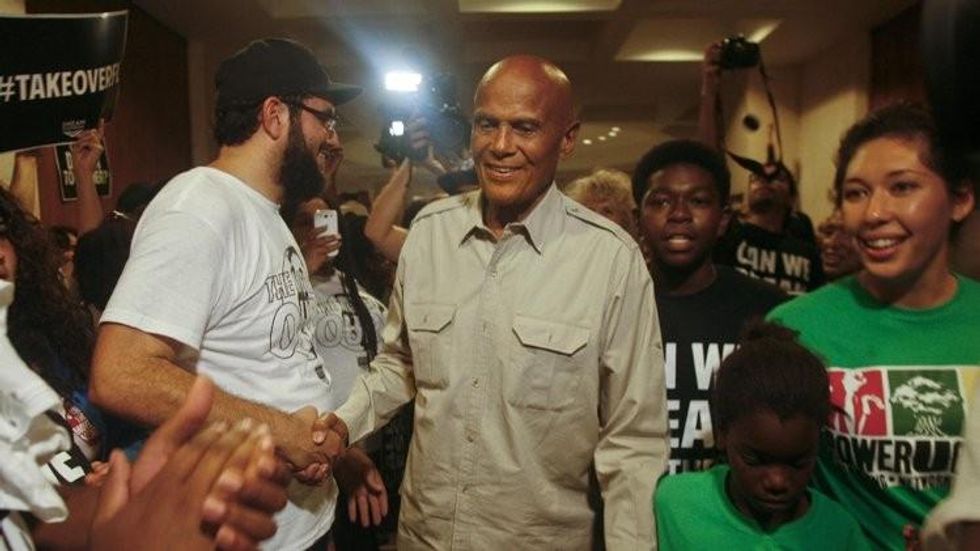
"I'm here because you called. I'm here because I am a part of your history," notable civil rights activist and musical icon Harry Belafonte declared Friday to a crowd of hundreds of demonstrators inside the main rotunda of the Florida capitol building.
The rally, billed as #theTakeover, was one of a number of demonstrations staged by the Dream Defenders since the group took residence in the capitol on July 16 in an ongoing sit-in to call attention to what they are saying is the 'systemic criminalization of black and brown youth.'
#THETAKEOVER ft. Harry BelafonteThe Dream Defenders have taken over Florida Capitol to demand the #TrayvonMartinAct. "We fired up!" "We fired up, we can't ...
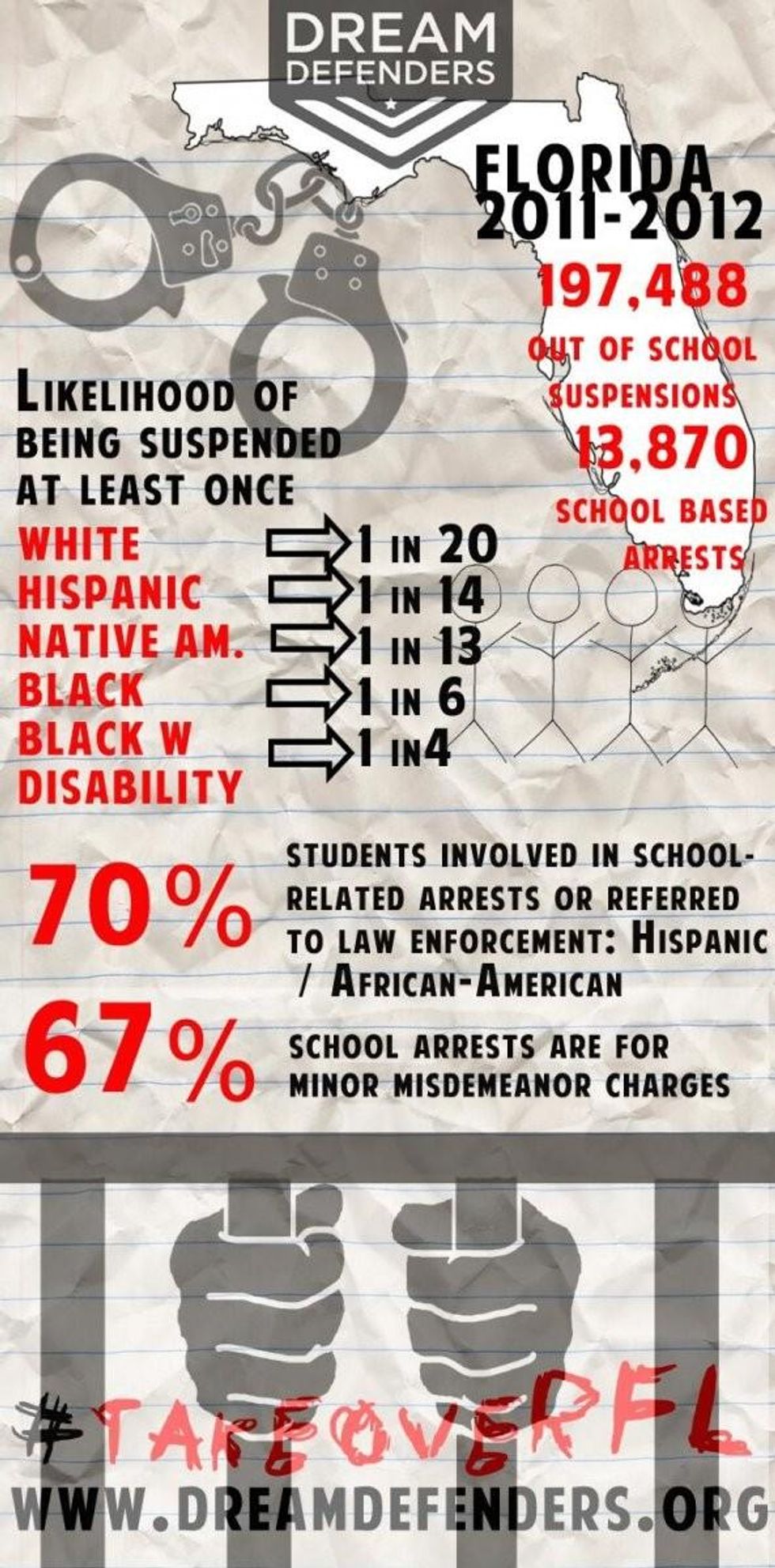
The protesters are calling on Florida Governor Rick Scott to hold a special session of the legislature to repeal the controversial Stand Your Ground law, address the dangerous and ongoing practice of racial profiling, and amend the "war on youth that paints us as criminals and funnels us out of schools and into jails."
"We understand that we have to go right to the source of power and we have to fight with them in order to make real change," protester Daniel Agnew recently told YES! Magazine. "That's why we're at the state capitol, because that's where things change."
Over the weekend, the Defenders' camp was buoyed by a number of faith-based organizations and students from up and down the east coast. Since occupying the capitol building, the sit-in demonstrators--whose numbers fluctuate from 15 or 16 to over 100, depending on time of day--have been busy building and organizing for upcoming demonstrations.
"I'm doing this because I believe that Florida has been shown that they don't really value the lives of our youth, with the school-to-prison pipeline and forcing our kids out of school and into drug programs or into house arrest," said protest organizer Jabari Mickles. "Social injustice is going on in the state of Florida and black and brown young people are disproportionally penalized. We need change if we actually say we care about the future of Florida, and not just the future of people who have money."
"[W]hen you're talking about racial profiling and the school-to-prison pipeline in general, you're talking about disenfranchising a whole class of citizens and making them second-class citizens," added outreach organizer Melanie Andrade. Andrade points out that--though the Stand Your Ground rule has become a central rallying theme--these conversations have been occurring since before the trial and that the problem goes far beyond that legislation.
"Stand Your Ground isn't what put the bullet in Trayvon. The culture that Zimmerman was brought up in--this whole environment of safety first, everybody is scared of people, people profile each other and don't even realize it--that whole culture is what we're talking about."
_____________________
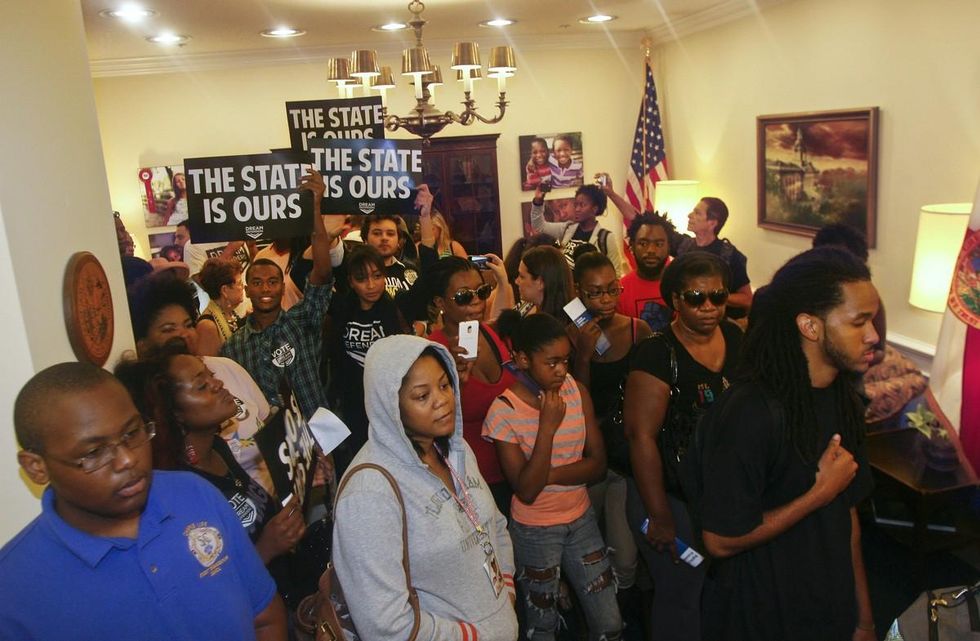
Hundreds entered their third day of a round-the-clock sit-in at Florida Governor Rick Scott's office Thursday to honor Trayvon Martin's life and demand overhaul of the state's controversial 'Stand Your Ground' law and the racism that underlies it.
Organizers say their numbers have doubled since they launched the sit-in on "Takeover Tuesday."
The protesters, who are with the Dream Defenders--an organization of African American and Latino youth working to transform system-wide inequality--are peacefully occupying the governor's office waving signs that read "I am human" and "3/5 No More" and wearing shirts declaring "The Next Emmett Till."
Colorlines reports:
Hundreds of students, some as young as nine years old, are gathered to convince state lawmakers to pass the "Trayvon Martin Act." The bill would address racial profiling, "Stand Your Ground" laws and school-to-prison pipeline issues -- "the three pillars that led to George Zimmerman getting away with killing Trayvon Martin," said Dream Defender Philip Agnew on a media call.
Despite the ongoing occupation of his office--one of numerous passionate protests for racial justice across the US in the wake of the George Zimmerman trial--the Florida governor has somehow found a way to avoid these protesters, responding with a flat "no" to their demands that he meet with them.
"The governor has not yet arrived so apparently this isn't a priority of his," Steven Pargett told the AP Wednesday. "This is a huge priority of ours. This is the largest priority that we have and it's not just us ... So we're here and we'll wait and we'll wait."
"We are here to honor the memory of Trayvon Martin and pay respects to his family," reads a group statement about the office occupation. "This tragedy serves as a vivid reminder of the pain felt by our communities, in which we are profiled, criminalized and targeted."
"We are here because Trayvon can't be."
Dream Defenders #takeoverfl Governor Rick Scott's Office to Demand #justicefortrayvonThe Dream Defenders have taken over Florida Capitol to demand the #TrayvonMartinAct. Sign the petition here: ...
_____________________