

SUBSCRIBE TO OUR FREE NEWSLETTER
Daily news & progressive opinion—funded by the people, not the corporations—delivered straight to your inbox.
5
#000000
#FFFFFF
To donate by check, phone, or other method, see our More Ways to Give page.
Daily news & progressive opinion—funded by the people, not the corporations—delivered straight to your inbox.
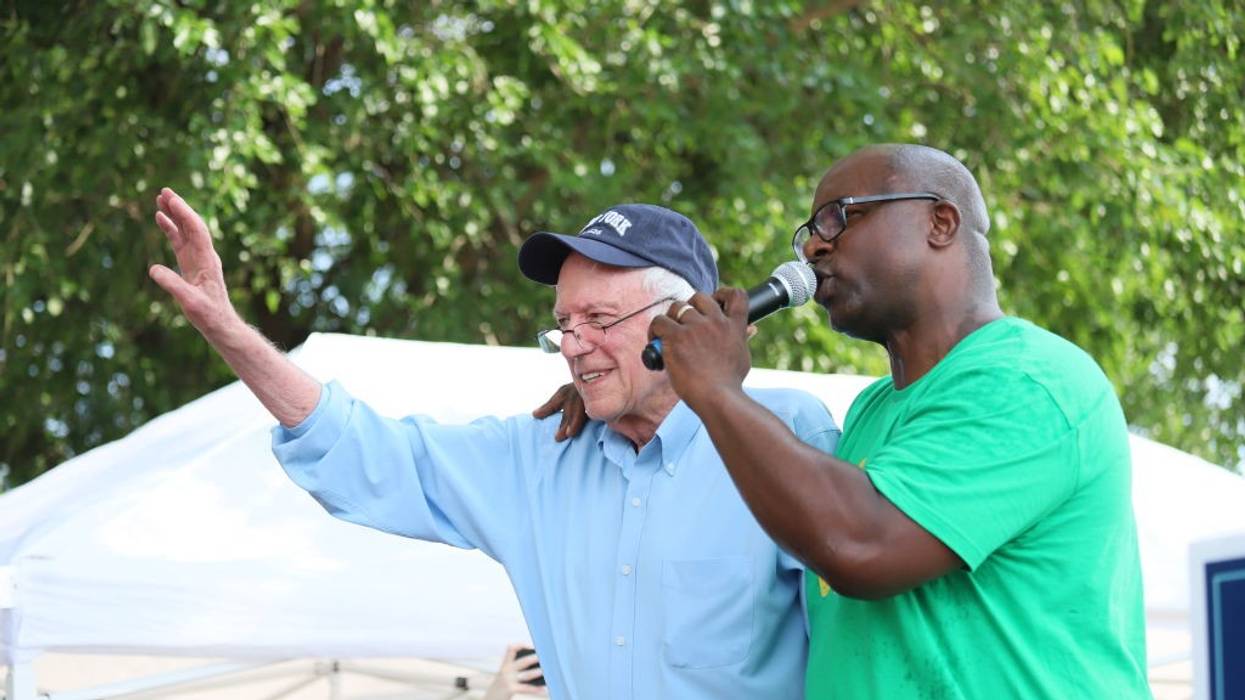
Flanked by progressive heavyweights, Rep. Jamaal Bowman called for "the many" to defeat "the money" of AIPAC, which has set funding records in its effort to help defeat the pro-Palestine Congressman.
Congressman Jamaal Bowman, a prominent critic of Israel's war on Gaza, called on Saturday for voters to defeat the influence of the American Israel Public Affairs Committee, which has poured millions of dollars into defeating him, as he made his final campaign push before the Democratic primary in New York's 16th Congressional District on Tuesday.
The contest has seen one of the largest influxes of money of any U.S. House of Representatives primary race in history, mainly because of AIPAC's super PAC, the United Democracy Project (UDP), which has spent more than any interest group has ever spent on a House race—more than $14 million, according to The New York Times.
"AIPAC is scared to death," Bowman (D-N.Y.) said at an animated rally in the Bronx in which Sen. Bernie Sander (I-Vt.) and Rep. Alexandria Ocasio-Cortez (D-N.Y.) also spoke. "They are afraid they have already lost," he said, citing public opposition to AIPAC's agenda.
"They are in this race because we called for a permanent cease-fire in Gaza," Bowman said of AIPAC. "And we’re going to keep calling for a permanent cease-fire."
Progressive standard-bearers Sanders and Ocasio-Cortez came to the rally, where placards read "for the many, not the money," to help stave off a possible Bowman defeat to challenger George Latimer, a pro-Israel Democrat who leads in the polls. An Emerson College poll from early June showed Latimer up 17 points, 48% to 31%. The race has been seen as a bellwether for the fate of other pro-Palestine progressives such as Rep. Cori Bush (D-Mo.), who faces a primary challenge in August.
It is TWO million degrees but we are happy to be alive folks @JamaalBowmanNY @AOC @BernieSanders take The Bronx pic.twitter.com/Q0KArxNOWm
— Anna Bahr (@anna_bahr) June 22, 2024
Latimer has not just the backing of AIPAC but also some local support and connections. He is the Westchester County Executive and has political clout there—Politico called him "the Cher of suburban New York." The 16th district includes the southern part of the county and a slice of the northern Bronx, giving it a wide mix of demographics.
Latimer was accused by Bowman and others of using an Islamophobic dog whistle in a recent debate, when Latimer said that Bowman's constituency was Dearborn, Michigan—a majority Arab-American city.
In a blow to Bowman, who has described himself as an "outspoken Black man," Jewish voters in the county recently formed Westchester Unites, a group that has mobilized votes for Latimer, including a substantial proportion of the early and mail-in voting that's already underway.
The race has been "nationalized," or "Israelized," as The Nation's Richard Lingeman wrote, with the two candidates' positions on Gaza dictating their fundraising hauls.
The Times reported that UDP was spending up to "$17,000 an hour" and "filling television screens, stuffing mailboxes, and clogging phone lines with caustic attacks." Other pro-Israel groups have also given money.
UDP's ads and messages "almost never" mention Israel, the Times noted. This is in keeping with AIPAC's strategy in races across the country as support for Israel's war on Gaza wanes.
Yet the groups attacking Bowman plan to put forward a different message if the race goes they way they want.
"Assuming the outcome is as we expect it, the message is going to be that being pro-Israel is not just wise policy, it's smart politics," said Mark Mellman, founder of the Democratic Majority for Israel, an advocacy group that spent $1 million against Bowman, told the Times.
Marshall Wittmann, an AIPAC spokesman, told the Times that Latimer was "pro-Israel" while "Jamaal Bowman has refused to support the Jewish state as it fights a moral and just war against Iranian terrorist proxies."
The pro-Israel lobby's all-out attack on Bowman for his opposition to the war led Karen Attiah, columnist at The Washington Post, to label its strategy as "shut up or else"—a way of using money to silence public criticism of Israel.
Sanders, who campaigned with Bowman both Friday and Saturday, emphasized the same disturbing dimension to AIPAC's efforts. "This is the message of this campaign: You stand up to powerful interests, they will try to bring you down,” he told the Times.
"Are we a democracy or an oligarchy?" Sanders wrote on social media Thursday, pointing to AIPAC's spending in the Bowman race.
People in New York have also expressed opposition to AIPAC's attempt to influence a local race.
"The funding toward Latimer from AIPAC has definitely turned me off a lot," Sasha Fuller, a 23-year old who attended a Bowman rally on Friday, told the Times. "He’s kind of a more traditional corporate Democrat, so I don’t really support his politics."
Just as Bowman argued that AIPAC was scared, some of his supporters have found a silver lining in the group's blitz of attack ads. Jeremy Cohan, spokesperson for the New York chapter of the Democratic Socialists of America, said the spending was a sign of change, as public opinion moves further from the positions of groups like AIPAC.
"I do see it as, to some degree, a sign of desperation," Cohan told Al Jazeera.
“They are doing that because they see where the tides are moving," he added. "They see where history is moving.”
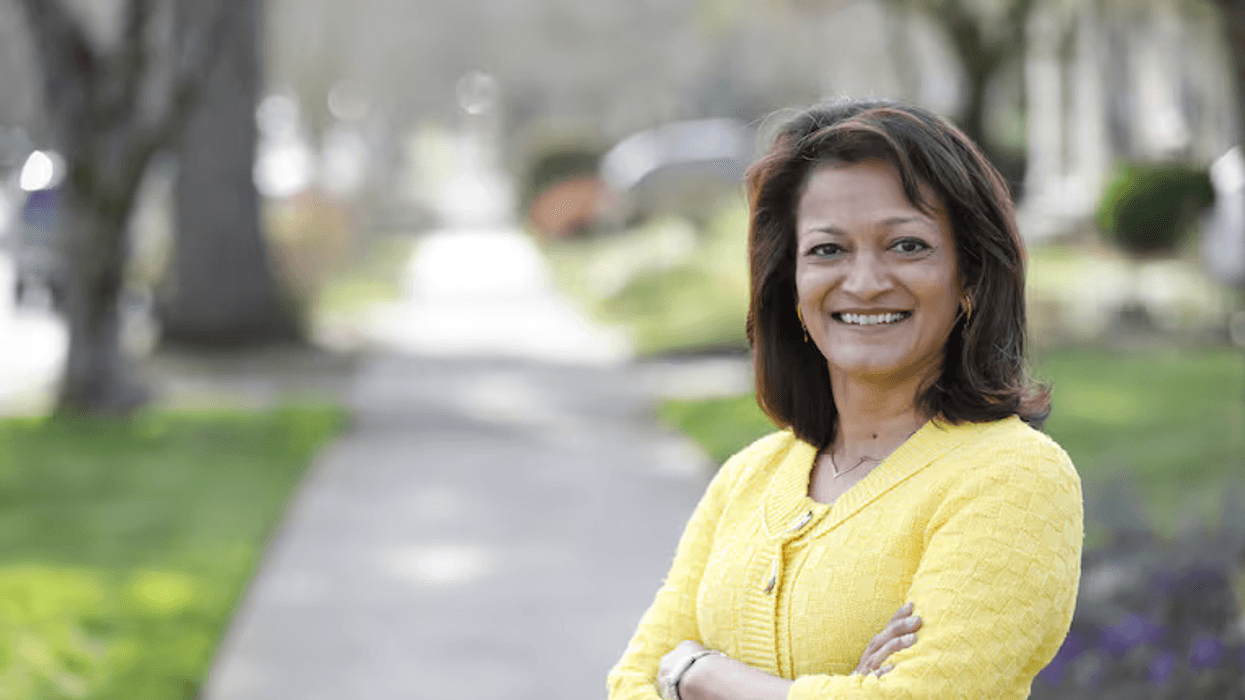
"This race showed so clearly why we need to have real campaign finance reform," said Susheela Jayapal, who lost after being outspent 30-to-1.
Progressives lost two Democratic primary races in Oregon on Tuesday following heavy spending by outside groups, including at least one tied to the American Israel Public Affairs Committee, which has spent heavily to oppose left-wing and pro-Palestinian candidates in races across the U.S. in recent months.
In Oregon's 3rd Congressional District, Maxine Dexter defeated Susheela Jayapal, taking 51.1% of the vote to just 28.6% for Jayapal as of Wednesday morning. Jayapal—the elder sister of Pramila Jayapal (D-Wash.), who chairs the Congressional Progressive Caucus and has been critical of Israel—was seen as the most progressive candidate in the race and a potential new member of her sister's caucus. The Portland-area seat is solidly blue and Dexter is expected to win easily in the general election.
Dexter, a member of the state House, received an enormous boost from outside groups, which spent roughly $7 million in supporting her and opposing Jayapal. Pro-Israeli donors funneled $2.2 million through 314 Action Fund, a political action committee (PAC) that served as a vehicle for AIPAC donors, according to The Intercept. Another PAC attacking Jayapal called Voters for Responsive Government, newly formed for this race, has not yet had to release its donor list. Ultimately, Dexter's supporters outspent Jayapal's 30-to-1, HuffPost reported.
"This race showed so clearly why we need to have real campaign finance reform that allows for public financing," Susheela Jayapal wrote on social media Wednesday, criticizing the role of outside super PACs, which she said timed their contributions so they wouldn't have to reveal their donors until after the primary.
The outside group spending gap was, by my calculation, 30 to 1 in favor of Dexter.
And we still don't know who was funding "Voters for Responsive Government," the mysterious super PAC that sprang up to attack Jayapal. pic.twitter.com/Vac6YVTwjL
— Daniel Marans (@danielmarans) May 22, 2024
AIPAC didn't formally endorse Dexter during the primary race but did congratulate her on Tuesday night in a social media post.
AIPAC congratulates @doctormaxine on her Democratic primary win!
AIPAC members were proud to support Maxine Dexter in her race against an anti-Israel opponent endorsed by @BernieSanders, @AOC, and @jstreetdotorg.
Being pro-Israel is good policy and good politics! https://t.co/74h3TFdusd
— AIPAC (@AIPAC) May 22, 2024
Another state representative, Janelle Bynum, won the Democratic primary in Oregon's 5th Congressional District with 68.9% of the vote, defeating progressive candidate Jamie McLeod-Skinner in a race in which outside spending was also somewhat lopsided, according to OpenSecrets data. 314 Action Fund poured nearly $500,000 into the race. The Intercept's Ryan Grim argued that the PAC's involvement in this race revealed the hollowness of its claim to support scientists and pro-science candidates—Bynum is a McDonald's franchise owner.
Unlike Oregon's 3rd District, its 5th District will likely have a competitive race in November, with Bynum seeking to unseat incumbent Rep. Lori Chavez-DeRemer (R-Ore.), who narrowly defeated McLeod-Skinner in 2022. National Democrats have their eyes on the seat, which is seen as highly winnable, with President Joe Biden having won the district handily in 2020. The Democratic Congressional Campaign Committee supported Bynum with more than $1 million in the primary, according to CNN.
As elsewhere, pro-Israel groups funded ads in Oregon that had nothing to do with Israel or Palestine. This a strategic decision by AIPAC and its super PAC, United Democracy Project (UDP), thanks to growing support for the Palestinian cause, according to Politico.
AIPAC chooses races carefully, sometimes focusing on preventing progressives such as Susheela Jayapal from entering office rather than on dislodging existing members. After spending millions against Rep. Summer Lee (D-Pa.) in 2022, UDP stayed out of this year's primary, in which the "Squad" member faced a pro-Israeli Democrat. Lee won the primary handily last month, even though her opponent was backed by a billionaire megadonor.
Yet UDP does take on Squad members when it sees opportunity: It's pouring big resources into primary challenges to Reps. Jamaal Bowman (D-N.Y.) and Cori Bush (D-Mo.). Bowman faces a pro-Israel Democrat on June 25, Bush on August 6.
"Jamaal Bowman has his own agenda and refuses to compromise—even with President Biden," a UDP attack ad says, criticizing him for not supporting legislation backed by most congressional Democrats.
Commentators have pointed out that the resources that progressive groups must use to defend the seats of Bowman and Bush limits their ability to help newcomers such as Susheela Jayapal.
"In a different cycle, Justice Democrats and the Working Families Party might have been able to help Susheela Jayapal, but they have their hands full—and their wallets committed—as they seek to defend Reps. Jamaal Bowman and Cori Bush," Daniel Marans, a politics reporter at HuffPost, wrote on social media Wednesday.
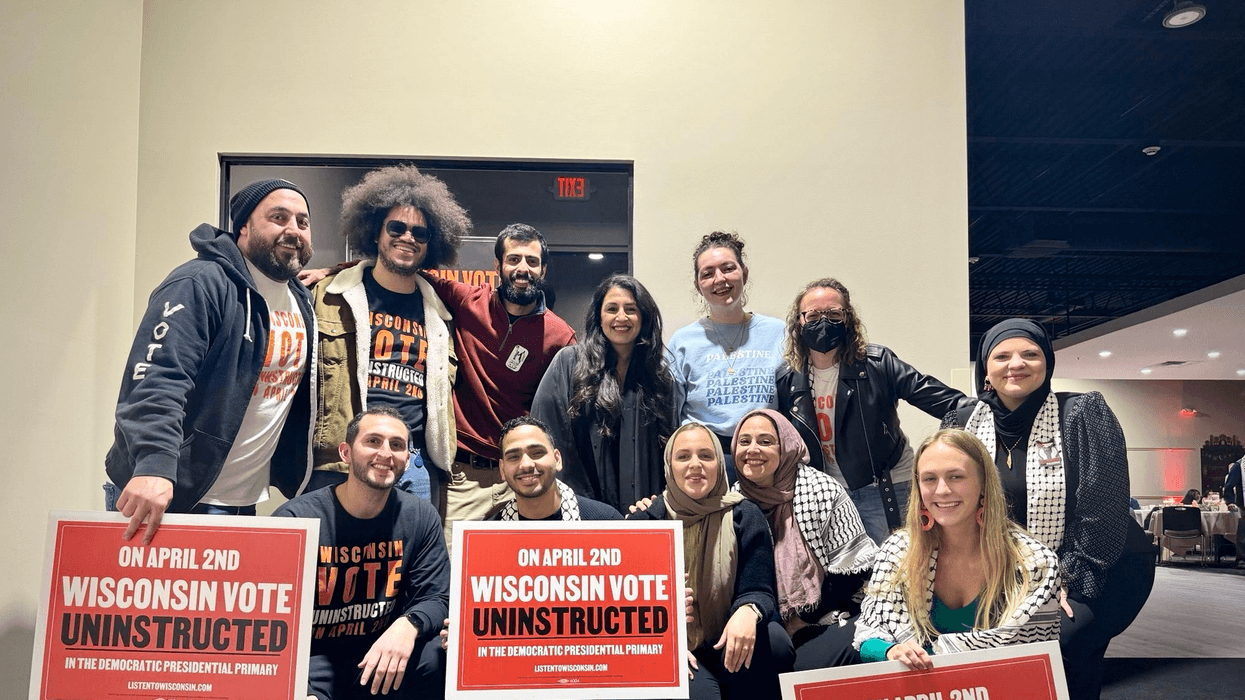
"Rather than dismissing the wave of votes being made to stand in support of Palestine, listen to the demands the movement is making and shift policies," said one campaigner. "Stop sending weapons to Israel."
Campaigners with Listen to Wisconsin had hoped they could convince 20,000 Democratic primary voters on Tuesday to select "uninstructed delegate" on their ballots to send the message to President Joe Biden that he can't yet count on their votes in the November general election due to his support for Israel's bombardment of Gaza.
After organizing for less than a month, the campaign far surpassed its goal, with more than 47,800 people voting for the uninstructed option.
The results show "how serious of a problem Biden will have in the general election" if he does not change his policy regarding Israel and the occupied Palestinian territories," said Abed Ayoub, national executive director of the American-Arab Anti-Discrimination Committee.
About 8.4% of voters in the primary voted for "uninstructed delegate" over the president, in a state where Biden beat former President Donald Trump by less than 1%—just 20,682 votes—in 2020
The primary came just over a month after the Listen to Michigan campaign started the nationwide push for Democratic primary voters to vote "uncommitted" in order to pressure Biden to change his policy in Israel, whose U.S.-backed military has killed at least 32,975 Palestinian people in Gaza.
Wisconsin voters went to the polls a day after a Israeli shelling killed seven aid workers with World Central Kitchen, including one U.S.-Canadian citizen. An Al Jazeera investigation found the attack was intentional.
Nearly 20% of Minnesota Democratic primary voters last month voted "uncommitted," as well as 13% of Michigan voters. On Tuesday, 15% and 12% of voters in Rhode Island and Connecticut, respectively, marked "uncommitted" on their ballots.
Iman Abid, director of advocacy and organizing at the U.S. Campaign for Palestinian Rights, said the results, particularly in crucial swing states like Michigan and Wisconsin, must not be ignored by the Biden administration.
"Rather than dismissing the wave of votes being made to stand in support of Palestine, listen to the demands the movement is making and shift policies," said Abid. "Stop sending weapons to Israel."
A poll released Monday by Poll Progressive Strategies showed that voters under the age of 29 in Wisconsin are among those pushing most strongly for Biden to demand a permanent cease-fire, to halt military aid to Israel, and to ensure humanitarian aid reaches Gazans. One hundred percent of voters in the age bracket said they strongly or somewhat approved of an immediate and permanent cease-fire.
"This president must decide if loyalty to [Israeli Prime Minister Benjamin] Netanyahu is worth delivering Trump the election in November," said former Ohio state Sen. Nina Turner. "He must decide."

"AIPAC is an essential link in the chain that holds in place the unbearable tragedy of Israel/Palestine."
More than 100 prominent Jewish Americans signed a statement released Wednesday condemning the American Israel Public Affairs Committee's increasingly aggressive interventions in U.S. elections, particularly Democratic Party primaries in which the powerful lobbying group is spending big to unseat progressives.
The statement's list of signatories includes well-known scholars, rabbis, anti-war activists, journalists, and filmmakers who have "agreed to come together to highlight and oppose the unprecedented and damaging role of AIPAC" and its allied organizations in the American electoral process. The statement calls on Democratic candidates to reject all funding from AIPAC's political network.
AIPAC's political entities, including its United Democracy Project super PAC, are expected to spend $100 million this election cycle targeting candidates who have backed a cease-fire in Gaza or have otherwise been deemed inadequately pro-Israel.
"We recognize the purpose of AIPAC's interventions in electoral politics is to defeat any critics of Israeli government policy and to support candidates who vow unwavering loyalty to Israel, thereby ensuring the United States' continuing support for all that Israel does, regardless of its violence and illegality," reads the new statement from Jewish Americans, which can be read in full below.
"Given that Israel is so isolated internationally that it could not continue its inhumane treatment of the Palestinians without U.S. political and military support, AIPAC is an essential link in the chain that holds in place the unbearable tragedy of Israel/Palestine," the statement continues. "In the coming U.S. elections, we need to break that chain in order to help free the people of Israel/Palestine to pursue peaceful coexistence."
"In contrast to AIPAC, we are American Jews who believe that U.S. support for foreign governments should only be extended to those that respect the full human and civil rights, and right to self-determination, of all people."
The statement comes days after more than 20 progressive advocacy organizations—including Jewish Voice for Peace Action and the Jewish-led IfNotNow Movement—formed a coalition aimed at countering AIPAC's influence in the 2024 elections after the lobbying group had a significant impact on the 2022 midterms.
According to OpenSecrets, most of the candidates AIPAC supported in the 2022 cycle won their races after the group's super PAC raised more than $30 million.
In the current cycle, AIPAC's top targets are members of the progressive Squad who have called for a cease-fire and end to weapons exports to Israel. As The Intercept reported earlier this month, AIPAC recruited and is funding Rep. Jamaal Bowman's (D-N.Y.) primary challenger and is expected to spend heavily to unseat Rep. Summer Lee (D-Pa.), who overcame AIPAC money to win her seat in Pennsylvania's 12th Congressional District in 2022.
On top of working to sink progressives, AIPAC has also previously "endorsed Republican extremists and dozens of Congress members who'd voted against certifying" President Joe Biden's 2020 victory over former President Donald Trump, the Jewish Americans noted in their new statement.
"In contrast to AIPAC, we are American Jews who believe that U.S. support for foreign governments should only be extended to those that respect the full human and civil rights, and right to self-determination, of all people," the statement reads. "We oppose all forms of racism and bigotry, including antisemitism—and we support the historic alliance in our country of Jewish Americans with African Americans and other people of color in the cause of civil rights and equal justice."
"Therefore, we strongly oppose AIPAC's attempts to dominate Democratic primary elections," the statement adds. "We will support candidates who are opposed by AIPAC, and who are advocates for peace and a new, just U.S. policy toward Israel/Palestine."
Read the full statement and list of signatories:
We are Jewish Americans who have varying perspectives. We’ve agreed to come together to highlight and oppose the unprecedented and damaging role of AIPAC (American Israel Public Affairs Committee) and allied groups in U.S. elections, especially within Democratic Party primaries. We recognize the purpose of AIPAC's interventions in electoral politics is to defeat any critics of Israeli Government policy and to support candidates who vow unwavering loyalty to Israel, thereby ensuring the United States' continuing support for all that Israel does, regardless of its violence and illegality.
Given that Israel is so isolated internationally that it could not continue its inhumane treatment of the Palestinians without U.S. political and military support, AIPAC is an essential link in the chain that holds in place the unbearable tragedy of Israel/Palestine. In the coming U.S. elections, we need to break that chain in order to help free the people of Israel/Palestine to pursue peaceful coexistence.
In the same 2021-22 election cycle in which AIPAC endorsed Republican extremists and dozens of Congress members who’d voted against certifying Biden's victory over Trump, the AIPAC network raised millions from Trump donors and spent the money inside Democratic primaries against progressives, mostly candidates of color. AIPAC is now vowing to spend even more millions in the 2024 Democratic primaries, targeting specific Democrats in Congress—initially all legislators of color—who’ve advocated for a Gaza cease-fire, a position supported by the vast majority of Democratic voters. AIPAC’s election spending increasingly works to defeat candidates who criticize the racist policies of Israel.
In contrast to AIPAC, we are American Jews who believe that U.S. support for foreign governments should only be extended to those that respect the full human and civil rights, and right to self-determination, of all people. We oppose all forms of racism and bigotry, including antisemitism—and we support the historic alliance in our country of Jewish Americans with African Americans and other people of color in the cause of civil rights and equal justice.
Therefore, we strongly oppose AIPAC's attempts to dominate Democratic primary elections. We call on Democratic candidates to not accept AIPAC network funding, and demand that the Democratic leadership not allow Republican funders to use that network to deform Democratic primary elections. We will support candidates who are opposed by AIPAC, and who are advocates for peace and a new, just U.S. policy toward Israel/Palestine.
Signed by: (Organizational Affiliations For Identification Purposes Only)
Adam Gold, Senior Strategist, Working Families Party
Adam Shatz, London Review of Books
Alan Levine, Civil rights lawyer
Alan Minsky, Executive Director, Progressive Democrats of America
Alicia T. Singham Goodwin, Political Director at Jews For Racial & Economic Justice
Rabbi Alissa Wise, Lead Organizer, Rabbis for Ceasefire
Alisse Waterson, Presidential Scholar and Professor, John Jay College, CUNY
Anna Baltzer, Author, “Witness in Palestine: A Jewish American Woman in the Occupied Territories”
Anthony Karefa Rogers-Wright, M4BL Black Hive/Black Alliance for Peace
Ariel Dorfman, Novelist, playwright, essayist, human rights activist
Ariel Gold, Executive Director, Fellowship of Reconciliation
Ariela Gross, Distinguished Professor, UCLA School of Law
Rabbi Dr. Aryeh Cohen, Professor, American Jewish University
Aurora Levins Morales, Writer
Aviva Chomsky, Professor of History, Salem State University
Aviva Orenstein, Professor, Maurer School of Law, Indiana University
Ben Cohen, Co-founder, Ben & Jerry’s, philanthropist
Ben Ehrenreich, Author, winner of American Book Award
Beth Miller, Political Director, Jewish Voice for Peace
Rabbi Brant Rosen
Rabbi Brian Walt
Caroline Levine, Professor of the Humanities, Cornell University
Dan Segal, Professor Emeritus, Anthropology and History, Pitzer College
Dan Simon, Professor of Law and Psychology, University of Southern California
Daniel Stolzenberg, Associate Professor of History, University of California, Davis
Danny Goldberg, Music executive, author
Dave Zirin, Sports editor at The Nation, author
David Vine, Professor of Anthropology, American University
Deborah Eisenberg, Writer and actress
Deena Metzger, Poet, novelist, and essayist
Dennis Bernstein, Poet, human rights reporter, and host of Flashpoints
Donna Nevel, Educator
Eliot Katz, Poet, author “The Poetry and Politics of Allen Ginsberg”
Elliott Gould
Eric Drooker, Graphic novelist and artist
Estee Chandler, Board Chair, Jewish Voice for Peace Action
Eva Borgwardt, National Spokesperson, If Not Now
Ira Shor, Professor Emeritus, Graduate Center, CUNY
Gabriel Winant, Assistant Professor of History, University of Chicago
Gail Hershatter, Professor Emeritus of History, University of California, Santa Cruz
Gene Bruskin, Labor leader and playwright
Hadar Cohen, Scholar, mystic, and artist
Hollie Ainbinder, Program Director, Institute for Public Accuracy
Howard Horowitz, Board President, WESPAC Foundation
Howard A. Rodman, Screenwriter, novelist, and educator
Ivan Handler, J Street Chicago
James Schamus, Filmmaker, Professor, Columbia University
Jay Levin, Founder of LA Weekly
Jeff Cohen, Media critic, retired Ithaca College journalism professor
Jeff Gottlieb, Pulitzer Prize-winning journalist
Jennifer Spitzer, Associate Professor, Literatures in English, Ithaca College
Rabbi Jessica Rosenberg, Organizer, founding member, Radical Jewish Calendar
Joel Beinin, Emeritus Professor of History, Stanford University
Judith Butler, Professor, University of California, Berkeley
Judith Gurewich, Publisher, Other Press
Kenneth Pomeranz, Professor, University of Chicago, Yuen Campus in Hong Kong
Larry Cohen, Former President of Communications Workers of America
Laura Dittmar, Professor Emerita, author of “Tracing Homelands”
Leora Auslander, Professor, University of Chicago
Lesley Williams, Librarian, Board Member, Jewish Voice for Peace Action
Lisa Sternlieb, Associate Professor of English and Jewish Studies, Penn State University
Marcy Winograd, Co-founder, Progressive Caucus, California Democratic Party
Marjorie Cohn, Professor Emerita of Law, past president of National Lawyers Guild
Mark Dimondstein, President of the American Postal Workers Union
Mark Weisbrot, Co-Director, Center for Economic and Policy Research
Martin A. Lee, Author, “The Beast Reawakens”
Maya Schenwar, Director, Truthout Center for Grassroots Journalism
Medea Benjamin, CODEPINK Co-founder
Michael Greenberg, Founder and Executive Director, Climate Defiance
Mike Hersh, Communications Director, Progressive Democrats of America
Mitchell Plitnick, President, ReThinking Foreign Policy
Molly Crabapple, Artist and writer
Morgan Spector, Actor
Naomi Dann, Chief of Staff, Housing Justice for All
Nomi Stolzenberg, Professor, USC Gould School of Law
Norman Solomon, National Director, RootsAction
Dr. Paul Zeitz, Author and activist
Penny Rosenwasser, Author, Center for Jewish Nonviolence
Peter Beinart, Editor-at-Large, Jewish Currents, author, and journalism professor
Phyllis Bennis, Fellow, Institute for Policy Studies
Rafael Shimunov, Radio host and co-founder, The Jewish Vote
Rebecca Vilkomerson, Organizer and author
Richard Bauman, Professor Emeritus, Indiana University
Richard Handler, Professor of Anthropology, University of Virginia
Rick Goldsmith, Documentary filmmaker
Robert Brenner, Professor Emeritus of History, UCLA
Robert Greenwald, Filmmaker, President of Brave New Films
Robert Herbst, Esq., Board Co-Chair, Israeli Committee Against House Demolitions (ICAHD)
Robert Naiman, Former Policy Director, Just Foreign Policy
Robert Scheer, Author, journalist, publisher of ScheerPost
Sam Rosenthal, Political Director, RootsAction
Samuel Moyn, Chancellor Kent Professor of Law and History, Yale University
Sarah Jaffe, Journalist, author of “Work Won’t Love You Back”
Sarah Schulman, Writer
Seth Ackerman, Editor-at-Large, Jacobin
Sheldon Pollock, Professor Emeritus, Columbia University
Simone Zimmerman, Co-founder, IfNotNow
Sarah Sophie Flicker, Artist, actress, and activist
Spencer Ackerman, Journalist and author
Stefanie Fox, Executive Director, Jewish Voice for Peace
Susan Adelman, Feminist, activist, and philanthropist
Suzanne Gordon, Journalist and author
Suzi Weissman, Professor of Politics, St. Mary’s College
Tony Kushner, Writer
Victor Wallis, Professor of Liberal Arts, Berklee College of Music
Wallace Shawn, Actor & Playwright
Zillah Eisenstein, Professor Emerita of Politics, Ithaca College
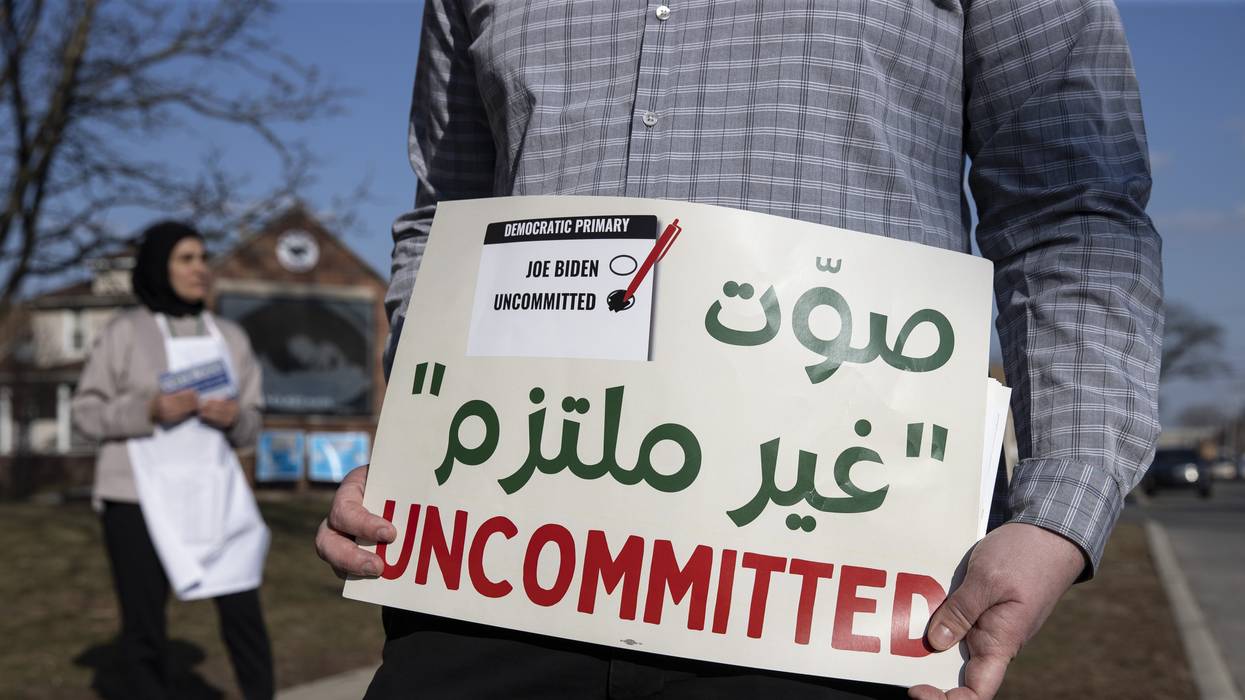
"This issue of Gaza is not just a Michigan issue, it is an issue across the United States," said one organizer.
With more than 100,000 Michigan voters having cast primary ballots letting U.S. President Joe Biden know they are "uncommitted" to supporting him in the general election due to his continued support for Israel's genocidal violence in Gaza, organizers of the effort said Wednesday that the Listen to Michigan campaign is spreading to other states.
Voters in Colorado, Minnesota, and North Carolina are among the Americans whose primary votes will be tallied next week on Super Tuesday, and all three states have "uncommitted" or similar language as an option on their ballots.
The Listen to Michigan campaign started organizing less than a month in advance, gathering support from leaders including Dearborn Mayor Abdullah Hammoud, Rep. Rashida Tlaib (D-Mich.), and former congressman Andy Levin in hopes that it could convince at least 10,000 voters to mark "uncommitted" on their primary ballots to warn Biden that he must end military funding for Israel and push the country to agree to a permanent cease-fire.
With more than three-quarters of Democrats in the U.S. backing a cease-fire, the campaign drew more than 10 times the amount of support it expected, with more than 13% of Michigan Democrats who took part in Tuesday's primary voting "uncommitted."
"We are going to be talking to other states that are looking for a unifying vehicle to send the same message to Joe Biden," Layla Elabed, campaign manager for Listen to Michigan, told reporters on Wednesday. "This issue of Gaza is not just a Michigan issue, it is an issue across the United States. So our plan is to work with other coalitions like Listen to Michigan."
According to Hammoud, organizers in other states with upcoming primaries have reached out to Listen to Michigan "to follow their strategy."
As Common Dreams reported last week, campaigners in Washington state are urging voters to write "cease-fire" on their primary ballots ahead of the March 12 election.
In Colorado, concerns about Biden's support for Israel, which has now killed more than 30,000 people in Gaza and decimated civilian infrastructure across the enclave even as it claims to be targeting Hamas fighters, helped push the state Democratic Party's executive committee to vote unanimously in December in favor of including a "noncommitted" line on primary ballots.
Abed Ayoub, national executive director of the American-Arab Anti-Discrimination Committee, said Thursday that Armenian-American campaigners in key states including Wisconsin, Arizona, and Pennsylvania are leading efforts to push people to vote "uncommitted."
More than 206,000 Armenian-Americans in swing states "are perfectly positioned to play a high-impact role," said the Armenian National Committee of America.
"Over 100,000 sent Biden a clear message in Michigan," said Yonah Lieberman, co-founder of the Jewish-led Palestinian rights group IfNotNow. "Now the fight moves on."
"Instead of capitulating, progressives should" build a "network of anti-occupation donors, operatives, and local community members on the ground—precisely mirroring the ideologically driven electoral infrastructure that the AIPAC network has already built."
To defeat the anti-Palestinian lobbying network that spends millions of dollars to help corporate Democrats beat left-leaning congressional candidates, progressives in the United States need not temper their criticism of Israel's brutal occupation nor Washington's role in subsidizing it, a pair of organizers wrote Monday in The Nation.
Alexandra Rojas and Waleed Shahid—respectively the executive director and communications director of Justice Democrats—argued that U.S. Rep. Summer Lee's (D-Pa.) recent victory provides "a road map for how progressive Democrats can unite to build infrastructure to elect candidates whose values will be consistent both at home and abroad."
Since the American Israel Public Affairs Committee (AIPAC) launched its super PAC, the United Democracy Project (UDP), in December 2021 as a way to legally contribute unlimited amounts of money to directly influence elections and counter mounting opposition to Israeli apartheid within the Democratic Party, the powerful anti-Palestinian lobbying group has not been shy about what journalist David Dayen calls its "perversion of the primary process."
Last year, for instance, AIPAC boasted that its Republican billionaire-funded attack ads helped topple nearly 10 left-leaning Democrats in primary races, including Jewish Rep. Andy Levin (D-Mich.), former Rep. Donna Edwards (D-Md.), and progressive champions Nida Allam in North Carolina, Nina Turner in Ohio, and Jessica Cisneros in Texas.
"The AIPAC network is spending millions of dollars precisely because it is losing the generational and partisan battle to progressive Democrats."
Despite AIPAC's best efforts to beat Lee—UDP dropped more than $2.3 million to support her corporate-friendly opponent in last May's Democratic primary and then invested substantial sums to help her Republican adversary Mike Doyle in November's midterm—the pro-working-class advocate from Pittsburgh won both contests.
"The importance of Lee's victory cannot be overstated," Rojas and Shahid wrote Monday. "It is a recent and concrete example of how a strong candidate with a well-run, community-driven campaign and large progressive coalition can overcome AIPAC’s multimillion-dollar machine."
But "as we head into another cycle of competitive Democratic primaries," the pair warned that "some Democratic operatives are suggesting that prospective candidates just get 'AIPAC's target off their back' by conceding to the anti-Palestinian spending network (made up of not just AIPAC but also Democratic Majority for Israel, Pro-Israel America, NORPAC, and others) through vague or overly conciliatory positions regarding the billions in largely unrestricted military aid that American taxpayers provide the Israeli military."
According to Rojas and Shahid:
This view was summarized in one conference call last year in which a consultant suggested to a progressive candidate: "Why don't you just tweet something about how you support Israel if you want to avoid $5 million in attack ads?” Missing from these short-term, tactical discussions about appeasing AIPAC are ideological, moral, and strategic questions regarding the Democratic Party's position on a military occupation that leading Israeli and international human rights organizations like B'tselem, Amnesty International, and Human Rights Watch all call apartheid.
"Instead of capitulating," the pair continued, "progressives should continue building off Lee’s victory by coordinating our own network of anti-occupation donors, operatives, and local community members on the ground—precisely mirroring the ideologically driven electoral infrastructure that the AIPAC network has already built."
Rojas and Shahid argued that "the AIPAC network is spending millions of dollars precisely because it is losing the generational and partisan battle to progressive Democrats."
"The AIPAC network's multimillion-dollar spending operation to punish Democrats who stray even one step away from unconditional support for the Israeli occupation makes sense considering how politically untenable such stances would be otherwise," Rojas and Shahid wrote. They pointed to a recent Gallup poll showing that for the first time, a majority of Democratic voters now sympathize with Palestinians more than with Israelis.
In addition, "as of 2019, 56% of Americans and 71% of Democrats said the United States should not 'give unconditional financial and military assistance to Israel if the Israeli government continues to violate American policy on settlement expansion or West Bank annexation,'" the pair continued.
In February, far-right Israeli Prime Minister Benjamin Netanyahu's administration retroactively authorized nine illegal settlements built without government approval in the occupied West Bank and East Jerusalem and announced its plans to erect even more. This elicited a rare rebuke from the United Nations Security Council, which said that "continuing Israeli settlement activities are dangerously imperiling the viability of the two-state solution based on the 1967 lines."
Roughly 700,000 Israelis live in illegal settlements that have been built in the occupied West Bank and East Jerusalem since Israel violently seized those Palestinian territories, along with Gaza, in 1967. Because international law prohibits occupying forces from transferring their civilian population into occupied territories, a top U.N.-appointed expert has characterized Israeli settlements as a "war crime."
"However, because of the massive political and financial power of the anti-Palestinian lobby, only 14% of Democrats in the House of Representatives have signed legislation to condition aid to Israel on ending the expansion of settlements," Rojas and Shahid lamented. "If the AIPAC network can spend unlimited money to ensure that U.S. politicians don't represent the generational shift in the Democratic Party and the evolving views of the American people, it will have nothing to worry about."
Since Netanyahu returned to power at the end of last year, his increasingly exterminationist government has killed more than 80 Palestinians and is currently trying to overhaul the judiciary to give itself even more power. Nevertheless, the Biden administration has shown no interest in making Washington's provision of $3.8 billion in annual military aid to Israel contingent on ending the unlawful annexation of Palestinian land as well as assaults on Palestinian residents.
"We must organize to align the preferences of Democratic legislators with the voters who elected them."
According to Rojas and Shahid, "AIPAC's aggressive entry into Democratic primaries signals the increasingly partisan track that the anti-Palestinian lobby is taking, mirroring Israel's rightward shift and the Democratic disavowal of groups like the NRA and more recently, Big Oil."
The pair continued:
In the last cycle, AIPAC backed over 100 insurrectionist-aligned Republicans, opposed Democrats in general elections and primaries, spent zero dollars against Republican candidates—and were largely funded by pro-Trump Republican donors Robert Kraft, Bernard Marcus, and Paul Singer. Given the generational shift taking place in the Democratic Party—led by Justice Democrats like Rashida Tlaib, Alexandria Ocasio-Cortez, Cori Bush, Jamaal Bowman, Summer Lee, and many others—it is clear that the extreme anti-Palestinian sentiment championed by AIPAC will increasingly fall along party lines, which is exactly what AIPAC's multimillion-dollar spending seeks to avoid.
Just as with Medicare for All, the Green New Deal, or criminal justice reform, we must organize to align the preferences of Democratic legislators with the voters who elected them. It is through Congress, after all, that we have the power to ensure that American taxpayers are not funding the violation of human rights and subsidizing the endless occupation of the Palestinian people. AIPAC and its largely Republican donors know that Democrats who speak out about the occupation also make the party more progressive on a range of other issues.
As political observers pointed out at the time, UDP's intervention against Lee in the general election marked the first time the super PAC spent money to boost a Republican candidate over a Democratic one, giving the lie to AIPAC's ostensible concerns about Lee and other progressives' presumed lack of loyalty to the Democratic Party. Notably, AIPAC's single-minded focus on suppressing criticism of Israeli colonialism led the group to endorse dozens of GOP extremists running for Congress last year, including election deniers, proponents of the racist "great replacement theory," and QAnon adherents.
Rojas and Shahid's argument echoed points made previously by Jewish democratic socialist Sen. Bernie Sanders (I-Vt.), who has been a vocal critic of AIPAC.
Last year, Sanders accused the group of bankrolling super PACs such as UDP "to buy elections and control this democracy."
"Why would an organization go around criticizing someone like Summer Lee for not being a strong enough Democrat when they themselves have endorsed extreme right-wing Republicans?" Sanders asked. "They are doing everything they can to destroy the progressive movement in this country."
In the words of Rojas and Shahid: "A progressive movement, and a Democratic Party that sells out Palestinians for an easy reelection, is not a movement that can be counted on to fight back for any community when they need us most. Our end goal is not winning for the sake of winning. It's winning to bring about fundamental change."
Progressive criticism of President Joe Biden's move to make South Carolina the first-in-the-nation Democratic presidential primary was given a boost Wednesday when More Perfect Union launched a petition imploring the Democratic National Committee to pick a diverse swing state instead.
"If we really want to pick a diverse primary electorate, look to South Carolina's neighbor to the north--an actual battleground state."
Biden's proposal to raise South Carolina to the first spot on the party's presidential primary calendar was approved by the DNC's Rules and Bylaws Committee last Friday but is still months away from receiving a green light from the entire panel. If Biden's plan is rubber-stamped by the full DNC, voters in New Hampshire--currently home to the nation's first primary contest following the Iowa caucuses--would be second in line, casting ballots on the same day as their counterparts in Nevada.
In its petition, More Perfect Union applauded other changes sought by Biden, including his proposed elevation of Nevada, Georgia, and Michigan--three general election battleground states that were among the 10 closest races in his 2020 victory over then-President Donald Trump.
The biggest flaw in the president's plan is that he "chose South Carolina to go first and ahead of all those battleground states," said the progressive media outlet. "Biden's proposal to elevate South Carolina to the front gives it incredible power to shape the race."
Doing so would be problematic, More Perfect Union contended, because:
South Carolina is not a battleground state: Donald Trump carried it by double digits in 2020. It is way more ideologically and culturally conservative than the Democratic Party and the rest of the nation. It's also one of the fiercest anti-union, anti-labor states in the country. In fact, South Carolina is already first in the nation with the terrible distinction of being the lowest-density union state in America.
If Democrats are serious about winning the working-class vote, South Carolina isn't the state to get it done.
While Biden has portrayed his preferred reshuffling of the Democratic Party's presidential primary calendar as an attempt to foreground voters of color, the progressive advocacy group RootsAction recently characterized the president's move as "an inappropriate, self-serving intervention dressed up in noble rhetoric."
Sen. Bernie Sanders' (I-Vt.) 2016 presidential campaign manager Jeff Weaver, meanwhile, warned Thursday in The Nation that "the schedule put forward by the White House empirically and dramatically diminishes the influence of Latinos on the Democratic presidential nominating process."
"In doing so, this proposed gerrymander will give Republicans more fodder for convincing Latino voters that the Democratic Party is not a home for them," Weaver argued. "Given the erosion of Democratic Party support among the fastest-growing segment of the American population, that's a problem."
Sanders' 2020 presidential campaign manager and current adviser Faiz Shakir--the founder of More Perfect Union and a DNC delegate--has vowed to reject Biden's effort to promote South Carolina, which he sees as a transparent attempt by the White House to reward Rep. Jim Clyburn (D-S.C.) for his influential endorsement in the last presidential contest.
While Shakir agrees that Iowa should no longer go first, he argued in a New York Times opinion piece published Monday that pushing South Carolina, a GOP stronghold, to the front of the line "would be comical if it weren't tragic."
"We all know why South Carolina got the nod," wrote Shakir. "President Biden, Rep. Jim Clyburn, and many of his top supporters were buoyed by their campaign's comeback in February 2020 when the state delivered Mr. Biden his first victory of the season--and a big one at that."
"The media attention from that victory, and the consolidation of the Democratic field that it yielded, helped catapult him to winning a majority of the following Super Tuesday states," Shakir continued. "And when Covid spread through the nation shortly after, the rest of the primary contests were effectively quarantined, and Mr. Biden iced his victory. None of that story is a reason to put South Carolina first, however."
Soon after the piece was published, DNC Chair Jamie Harrison appeared to baselessly accuse Shakir of disrespecting Black voters. In an ensuing interview with Politico, Shakir said that "it's a very insulting approach to suggest that somehow we don't care about Black voters because we think South Carolina shouldn't go first."
In his essay, Shakir wrote that "if we really want to pick a diverse primary electorate, look to South Carolina's neighbor to the north--an actual battleground state."
More Perfect Union's petition also advocates for prioritizing racially diverse swing states: "As one of the strongest voting blocks in the Democratic coalition, it is essential Black voters get their say early and often throughout the nominating process. Yet Georgia has significantly more Black voters than South Carolina. So do Florida and North Carolina, two more battleground states. In fact, 14 states have larger Black populations than South Carolina."
"Our first priority must be to select states early in the process that help produce the strongest Democratic nominee consistent with our working-class values and agenda," says the petition. "South Carolina isn't even trending in any way toward the Democratic Party."
"Just two years ago, Jaime Harrison--now the chair of the Democratic National Committee--spent the eye-popping sum of $130 million to try to defeat [Republican] Sen. Lindsey Graham. After out-raising and outspending Mr. Graham, Mr. Harrison still lost the 2020 Senate race decisively," the petition adds. "Let's not compel all other Democratic campaigns to waste more money that could be better spent building coalitions in states Democrats need to win."
Adolph Reed Jr., professor emeritus of political science at the University of Pennsylvania and an organizer with the Debs-Jones-Douglass Institute's Medicare for All campaign in South Carolina, told Common Dreams that the notion that the South Carolina primary serves as corporate Democrats' so-called "firewall" has "only worked that way because Democratic elites have interpreted it that way when it's been in their interest to do so and because the news media have colluded with them in that view."
"It's just as important to note that South Carolina is a state no Democrat is going to win in November," said Reed, "and that Black voters in South Carolina are not identical to Black voters in Michigan, Illinois, or New York, that there's no such thing as 'the Black vote,' and that South Carolina Black voters' inclinations are shaped significantly by political dynamics within the state as are those of those voters in other states."
Shakir, for his part, called it a "special honor" to go first. "The state chosen for the task is rewarded in myriad ways. Iowa's economy has benefited greatly over the years from the high level of campaign spending and travel. Aware of the process' economic power, many of our Democratic campaigns employed union-friendly hotels, restaurants, and vendors when we were active in Iowa. Good luck finding that in South Carolina."
As RootsAction's Don't Run Joe campaign--an effort to dissuade the incumbent from seeking reelection in 2024--noted last week in a statement:
Biden received a mere 8% of the vote in the 2020 Democratic primary in New Hampshire, finishing fifth. Now he wants to dislodge New Hampshire from its long-standing first-in-the-nation primary role. On the other hand, Biden was the big winner of the South Carolina primary in 2020. Now he wants that state to go first.
Biden's decision to intrude into the Democratic National Committee's painstaking process for setting the 2024 presidential primary schedule appears to be a sign of anxiety in the White House about potential obstacles to his winning renomination. The president has indicated repeatedly that he plans to run again, so how ethical would it be for the DNC to allow a contestant to determine key rules of the game before the race begins?
South Carolina is a state that Biden obviously sees as vital to a renomination bid, but--unlike all other states under consideration for early primaries--it is not a battleground state. Everyone knows that the Democratic ticket will not win the deep-red state of South Carolina in 2024. Georgia, on the other hand, is one of the most important battleground states, and is more racially diverse than South Carolina. If Biden's proposal to supplant the New Hampshire primary as first-in-the-nation were truly about diversity and not about improving his own prospects for renomination, he would be promoting a state other than South Carolina to be first.
The group called on Biden to stop trying "to manipulate the Democratic primary schedule for his own narrow political purposes."
That message is echoed in More Perfect Union's petition, which tells Biden and the DNC: "Don't make South Carolina the first state to vote in the 2024 Democratic primary. Make diverse, battleground states that Democrats need to win in the general election, like Georgia, Nevada, and Michigan, first instead."
The race is far from over, Bernie Sanders told his supporters on Saturday night after news outlets projected a big win for Hillary Clinton in the South Carolina Democratic primary.
"Let me be clear on one thing tonight," Sanders said in a statement just after 7 pm EST. "This campaign is just beginning. We won a decisive victory in New Hampshire. She won a decisive victory in South Carolina. Now it's on to Super Tuesday. In just three days, Democrats in 11 states will pick 10 times more pledged delegates on one day than were selected in the four early states so far in this campaign. Our grassroots political revolution is growing state by state, and we won't stop now."
As of 7:30 pm, according to CBS News:
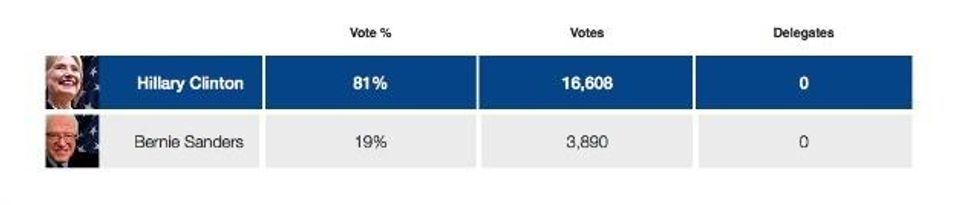
CBS reported a high turnout among African Americans, who overwhelmingly backed Clinton. According to CBS exit polling, "more than 86 percent of black women and 79 percent of black men supported her over Sanders."
Jane Sanders, Bernie Sanders' wife, told the Guardian about that particular margin of victory: "I think we're getting a lot better [at reaching African American voters]. It's just that they didn't know us. They didn't know us in the South generally."
However, the Associated Press pointed out that this "bodes well for Clinton headed into Super Tuesday contests across the South, where several states have large populations of black voters."
Eleven states hold Democratic primaries or caucuses on Tuesday, March 1, and the stakes are high for Sanders. The U.S. senator from Vermont "needs something to change because frankly, he's losing," Harry Enten wrote at FiveThirtyEight on Saturday.
Among those states is Texas, where Sanders spoke to a "mega-rally" of 10,000 people on Saturday and highlighted his ability to beat GOP frontrunner Donald Trump in the general election.
"I believe that Donald Trump's idea of dividing us up is a horrific un-American idea," Sanders told the outdoor rally in Austin. "I believe that not only can we win this Democratic nominating process, but we can defeat Trump and defeat him soundly."
After Saturday's debate drew the lowest TV ratings so far this primary season, the Democratic National Committee (DNC) is under fire--yet again--for setting a schedule that rival candidates say was designed deliberately to "protect" frontrunner Hillary Clinton.
According to Nielsen data out on Sunday, roughly 6.71 million viewers tuned in to the third 2016 Democratic debate, which aired during prime time the Saturday before Christmas. In comparison, the first and second Democratic debates drew 15.3 million and 8.5 million viewers, respectively, while the three most viewed Republican debates saw 25 million, 23 million, and 18 million viewers.
When asked following Saturday's match-up if he thought the DNC scheduled the debate deliberately to minimize viewership, Sen. Bernie Sanders stated, "Yes, I do."
"I hope a lot of people watched the debate tonight," the Vermont senator told New Hampshire's ABC affiliate WMUR. "I think it was a good debate, but I think there is a desire on the part of the DNC to protect Secretary Clinton."
Sanders also pointed to the October 13 debate in Iowa, which he noted was scheduled the same evening as a big Iowa football game. "Do you think that's a coincidence?" he asked.
"I think everybody understands that Hillary Clinton, who I have a lot of respect for, is the establishment candidate," he added. "Virtually the entire establishment is supporting her--including the leadership of the DNC."
That opinion was shared by Sanders' other rival, former Maryland governor Martin O'Malley, who on Sunday said he believed that the party had scheduled the debates intentionally to shield Clinton. "In fact," O'Malley continued, "that's also why, for the first time ever, they have limited the number of debates to just four."
The next Democratic face-off will be held in Charleston, South Carolina on January 17, the Sunday of Martin Luther King Jr. holiday weekend.
Ironically, as The Nation's John Nichols pointed out on Sunday, the DNC's impulse to insulate the frontrunner candidate will only damage the party as a whole.
Nichols writes:
The constrained debate schedule that the DNC has proposed is bad for candidates such as O'Malley, who needs strong debate performances--which he is capable of delivering--to expand his appeal. It's bad for Sanders, who needs strong debate performances--which he is capable of delivering--in order to narrow the gap on Clinton.
But a restricted debate schedule is also bad for Clinton. She has repeatedly delivered strong debate performances. In fact, a case can be made that those strong performances have cemented her front-runner status in the Democratic race.
"The problem is that most Americans are not seeing Clinton, Sanders, or O'Malley do well in the debates," he adds. "That's ridiculous, and potentially damaging to all three contenders and to the party's long-term prospects."
DNC chair Rep. Debbie Wasserman Schultz (Fl.) has faced mounting criticisms this primary season, first for the debate schedule and, most recently, for her controversial decision to temporarily suspend Sanders' campaign access to voter information in response to a software malfunction and alleged data breach.
In an interview with Democracy Now! on Monday, Salon columnist and former White House counselor to President Clinton, Bill Curry, described the DNC as a "dead carcass" of its former self and called for Wasserman Schultz's resignation.
"This is supposed to be a political party. In a healthy society, there would be a democratic process in the Democratic Party by which elected people would oversee these issues by ensuring there wasn't just nepotism and insider dealing," Curry said.
He continued: "That the political party itself--which is supposed to be the progressive party--has become mortgaged to a small group of Washington insiders who raise money from large corporate PACs, [and] has become just a dead carcass of what it once was, is the most important piece of information that this contretemps over the data files has emphasized. It is time for progressives in this country to stand up and demand a genuinely democratic process."
Though the Democratic National Committee (DNC) reversed its controversial decision late Friday to prevent the Bernie Sanders campaign from accessing important voter information, the skirmish raised questions about the organization's neutrality in the presidential contest.
Hours after the Sanders campaign filed (pdf) a lawsuit against the party, chair Rep. Debbie Wasserman Schultz (Fl.) issued a statement saying that the DNC will restore campaign access to the voter file. At the same time, the group continues to investigate the alleged data breach.
"Clearly, they were very concerned about their prospects in court," said Sanders' campaign manager Jeff Weaver. The suit charges that the campaign would suffer "sustaining irreparable injury and financial losses" exceeding $600,000 each day if unable to retrieve essential voter information.
Further, organizers argue that the security lapse was the DNC's fault. "Now what we need to restore confidence in the DNC's ability to secure data is an independent audit that encompasses the DNC's record this entire campaign," Weaver added. "Transparency at the DNC is essential. We trust they have nothing to hide."
After the DNC leaked the news to the press, the national party was barraged with messages from supporters of Sanders accusing the group of placing "its thumb on the scales in support of Hillary Clinton's campaign," as Weaver wrote in a campaign email.
Over 214,800 people signed an online petition to the DNC circulated by Sanders' campaign. MoveOn.org collected another 250,000 signatures, while Democracy for America, which announced it was endorsing the Vermont Senator's presidential bid just Thursday, collected 100,000.
DFA executive director Charles Chamberlain issued a strong statement against the DNC, saying its "decision to attack the campaign that figured out the problem, rather than go after the vendor that made the mistake, is profoundly damaging to the party's Democratic process."
Sanders' campaign maintains that the employee accused of penetrating the confidential files gathered by Hillary Clinton's rival campaign was trying to understand the extent of the software error.
Further, Chamberlain alluded to the mounting critique of the national party, saying it must restore equity "before the committee does even more to bring its neutrality in the race for President into question."
The controversy erupted as Democratic candidates geared up for their third debate, which will be held in New Hampshire on Saturday evening and aired on ABC News. The DNC has also faced criticism over the number and timing of the primary debates, including this latest one, which is expected to have a low viewer turnout due to its scheduling on Saturday before Christmas. Critics argue that this is a boost to frontrunner Clinton.
Indeed, Weaver also said it was "disconcerting" that the move to limit the campaign's actions came on the same day it "reached two million individual contributions and received two of our most prominent endorsements."
Sanders' campaign and supporters will comment on the debate live under the hashtag #DebateWithBernie.