

SUBSCRIBE TO OUR FREE NEWSLETTER
Daily news & progressive opinion—funded by the people, not the corporations—delivered straight to your inbox.
5
#000000
#FFFFFF
To donate by check, phone, or other method, see our More Ways to Give page.
Daily news & progressive opinion—funded by the people, not the corporations—delivered straight to your inbox.

Expert contacts:
Dana Perls, (510) 978-4425, dperls@foe.org
Tim Schwab, (202) 683-2517, tschwab@fwwatch.org
Jaydee Hanson, (202) 547-9359, JHanson@CenterforFoodSafety.org
Communications contacts:
Kate Colwell, (202) 222-0744, kcolwell@foe.org
Rich Bindell, 202-683-2457, Rbindell@fwwatch.org
Abigail Seiler, 443-854-4368, aseiler@centerforfoodsafety.org
A never-before-seen draft environmental review of AquaBounty Technologies' (ABTX) genetically engineered (GE) salmon reveals that Canadian government scientists disagree with the U.S. Food and Drug Administration (FDA) on key questions related to the safety and performance of what may be the first GE animal approved for human consumption. In light of these findings, Food & Water Watch, Center for Food Safety, Friends of the Earth and Consumers Union today called on the FDA to terminate its ongoing review of GE salmon.
The partially redacted, 400-page draft risk assessment from the Canadian Department of Fisheries and Oceans makes startling findings about the welfare and performance of GE salmon, including that GE salmon:
-- are more susceptible to Aeromonas salmonicida, a type of disease-causing bacteria, than non-GE domesticated salmon, which indicates unique animal health problems and raises environmental and public health concerns that the FDA has never considered.
-- are exhibiting dramatically diminished growth rates in AquaBounty's commercial facilities, casting more doubt on the widely disputed claims about the accelerated growth rates of GE salmon.
-- are displaying widely varied performance, including inconsistent growth rates, suggesting that the growth-hormone gene construct inserted in the fish is not operating in a predictable manner, raising questions about the durability, safety and commercial viability of GE salmon.
"The findings from the Canadian risk assessment show that FDA has based its assessment of this totally unnecessary technology on blind trust," said Wenonah Hauter. "It's clear that there are unique safety issues that FDA has failed to consider, which is why we are calling on the agency to terminate its review of GMO salmon."
The contradictions found in the Canadian risk assessment follow a series of embarrassing missteps in the FDA's ongoing regulatory review of GE salmon, including the FDA's failure to document two major biosecurity lapses at AquaBounty, including a storm-related mechanical failure that involved "lost" salmon. Additionally, in 2014, it was discovered that AquaBounty's production facility in Panama has been operating without legally required permits related to environmental safety.
"The modus operandi at FDA is to rubber stamp AquaBounty's flawed and biased studies and then call its review process 'science-based,'" said Jaydee Hanson, Senior Policy Analyst at the Center for Food Safety. "FDA's inadequate risk assessment is at odds with reality, with science and with the public, which has long called on the agency to put consumers' health and environmental safety ahead of the corporate interests of the biotechnology industry."
The 2013 Canadian draft risk assessment recently became public through a legal battle over Canadian regulators' approval of commercial GE salmon production, which several public-interests groups are challenging. No government anywhere in the world has ever approved GE salmon for consumption or declared it safe to eat, and commercial production has not yet begun. The FDA's regulatory approval is still pending.
"Major grocery chains, consumers and salmon producers are all rejecting genetically engineered salmon," said Dana Perls, food and technology campaigner for Friends of the Earth. "This new assessment adds to the body of science showing that this genetically engineered fish doesn't offer any benefit to aquaculture, has unique health problems and presents environmental risks. Why is the FDA continuing to spend scarce tax-payer dollars reviewing this fish that offers all risk and no reward?"
The commercial salmon industry has long disputed AquaBounty's claims that GE salmon can reach market weight in half the time as conventional salmon. A variety of sources, including new data found in the Canadian risk assessment, indicate that GE salmon probably grow slower than the highly domesticated Atlantic salmon currently in commercial production. The only benefit claim that AquaBounty submitted to the FDA for regulatory approval is fast growth.
MATERIALS
Canadian Draft Risk Assessment: https://fwwat.ch/1JUxPdr
Letter to US FDA: https://fwwat.ch/1LIYrN0
Friends of the Earth fights for a more healthy and just world. Together we speak truth to power and expose those who endanger the health of people and the planet for corporate profit. We organize to build long-term political power and campaign to change the rules of our economic and political systems that create injustice and destroy nature.
(202) 783-7400
"The very purpose of this biased and politically motivated text, which was pushed by the Israeli regime and the United States, is clear: to reverse the roles of victim and aggressor," said Iran's ambassador to the UN.
The United Nations Security Council on Wednesday adopted a resolution condemning Iran's retaliatory attacks on Gulf nations without denouncing—or even mentioning—the illegal US and Israeli bombing campaign that started the war, which has hurled the region into conflict and destabilized the global economy.
The resolution, sponsored by council member and US ally Bahrain, "condemns in the strongest terms the egregious attacks by the Islamic Republic of Iran against the territories of Bahrain, Kuwait, Oman, Qatar, Saudi Arabia, the United Arab Emirates, and Jordan," nations that host US military bases. The text calls Iranian strikes "a breach of international law and a serious threat to international peace and security," but contains no mention of the US or Israel, nations that have been accused of grave war crimes.
The council adopted Bahrain's measure by a vote of 13-0, with two abstentions—China and Russia. Both nations have veto power but declined to use it. Neither Iran nor Israel is currently a member of the Security Council.
The UN body also voted on a competing resolution, sponsored by Russia, that would have implored "all parties"—without naming any of them—to stop their military operations and avoid escalating the conflict. The resolution did not receive the nine votes necessary for adoption, with the US and Latvia voting against it and Bahrain, Colombia, the Democratic Republic of the Congo, Denmark, France, Greece, Liberia, Panama, and the United Kingdom abstaining.
Amir Saeid Iravani, Iran's ambassador to the UN, said the body's adoption of Bahrain's resolution marks "a serious setback to the council’s credibility and leaves a lasting stain on its record."
"Today’s action represents a blatant misuse of the Security Council’s mandate in pursuit of the political agendas of certain members," said Iravani. "The very state responsible for this brutal war of aggression against my country—the regime of the United States—sits on the other side of this chamber as president of the council, abusing its position while obstructing every effort to bring an end to this barbaric war against the Iranian people and preventing the Council from fulfilling its Charter-based responsibilities."
"This resolution is a manifest injustice against my country, the main victim of a clear act of aggression. It distorts the realities on the ground and deliberately ignores the root causes of the current crisis," he continued. "The very purpose of this biased and politically motivated text, which was pushed by the Israeli regime and the United States, is clear: to reverse the roles of victim and aggressor. It rewards the regimes of the United States and Israel, which have violated the UN Charter and committed acts of aggression. In doing so, it establishes impunity and sends a wrong message to the international community—emboldening the aggressors to commit further crimes."
"The UN and International Criminal Court were created for moments like this, when the most powerful decide the rules do not apply to them."
Ahead of the vote on Bahrain's resolution, which accuses Iran of "deliberate targeting of civilians and civilian objects," Iravani said US-Israeli bombing has killed more than 1,300 civilians in Iran and destroyed nearly 10,000 civilian structures across the country, including around 8,000 homes and dozens of schools and healthcare facilities.
Earlier on Wednesday, the New York Times reported that the Pentagon has reached the preliminary conclusion that US forces were responsible for the February 28 bombing of an Iranian elementary school, an attack that killed around 175 people—mostly young children.
DAWN, a nonprofit that supports human rights and democracy in the Middle East, said Wednesday that "mounting evidence" shows US and Israeli forces "have committed multiple war crimes" in Iran and Lebanon—which is facing a rapidly worsening humanitarian disaster due to Israeli attacks.
"In mere days, US and Israel forces have launched a war of choice, killed hundreds of civilians, displaced hundreds of thousands, bombed scores of schools, health facilities, and fuel depots, and dropped white phosphorus on civilian communities," Omar Shakir, DAWN's executive director, said in a statement. "The international community's failure to act when the most fundamental norms of international law are being challenged risks plunging the world further into a lawless era in which civilians across the globe are at risk."
"The UN and International Criminal Court were created for moments like this, when the most powerful decide the rules do not apply to them," said Shakir. "Governments unwilling to invoke international law when their allies commit crimes have no credibility when they invoke it against rivals."

"In less than two weeks, Israel has killed 570 people and displaced 750,000—over 10% of the entire country," the senator said of Lebanon. "Residential buildings are being bombed with no warning."
Just a day after tearing into US President Donald Trump and Israeli Prime Minister Benjamin Netanyahu for "unraveling international law, the Geneva Conventions, and the legitimacy of the United Nations" with their illegal war on Iran, Sen. Bernie Sanders stressed that "it's not just Iran."
"It's Lebanon," Sanders (I-Vt.) said on social media Wednesday. Since Trump and Netanyahu began bombing Iran a dozen days ago, Israel has also ramped up attacks against its northern neighbor—claiming to target the Lebanese political and paramilitary group Hezbollah—despite a November 2024 ceasefire deal.
That agreement to protect the Lebanese people was struck just over a year into Israel's retaliation for the October 2023 Hamas-led attack, which has also left the Gaza Strip in ruins. Despite the Lebanon truce, and another for Gaza reached this past October, Israeli forces have continued to slaughter civilians in both places.
In Lebanon, Sanders noted Wednesday, "in less than two weeks, Israel has killed 570 people and displaced 750,000—over 10% of the entire country. Residential buildings are being bombed with no warning."
"The US cannot continue to be complicit in Netanyahu's wars," declared the senator. His comments came after the White House tried to walk back Secretary of State Marco Rubio's suggestion last week that Trump followed the Israeli prime minister's lead on Iran.
Sanders has also criticized and even attempted to curb US complicity in Netanyahu's genocidal assault on Palestinians in Gaza—under the Biden and Trump administrations—by forcing unsuccessful votes to cut off some weapons to Israel.
The Israeli government has used the operation against Iran—which experts argue violates the US Constitution and UN Charter—to again cut off necessary humanitarian aid to Gaza, claiming last week that "the existing stock is expected to suffice for an extended period."
Philippe Lazzarini, commissioner-general of the United Nations Relief and Works Agency for Palestine Refugees in the Near East, called the move "a new chokehold on Gaza," adding that "after more than two years of unspeakable suffering and a spreading man-made famine, people still lack the most basic supplies, despite increases in aid since the ceasefire.
As for Lebanon, Axios reported Monday that "the Lebanese government proposed direct negotiations with Israel—through the Trump administration—aimed at ending the war and reaching a peace agreement."
However, the Financial Times reported Tuesday that "Israel has rejected diplomatic overtures by Lebanon," with one unnamed source saying that the Lebanese "are ready to talk to Israel, but under the condition of a cessation of fire. Not a ceasefire, but a cessation... so talks can get going in Cyprus."
"Israel has so far refused and says it will only negotiate 'under fire,'" according to that unnamed source.
Trump's ambassador to the United Nations, Mike Waltz, made US support for Israel's bombing of Lebanon clear in his Wednesday remarks to the UN Security Council.
"The United States condemns the attacks that Hezbollah, a long-time proxy of the Iranian regime, has launched against Israel. Hezbollah has yet again made it clear that it does not represent nor does it defend the people of Lebanon. It defends the interests of the Iranian regime," Waltz said, stressing Israel's "right to defend itself."
Waltz also welcomed the Lebanese Council of Ministers' recent decision "to immediately prohibit Hezbollah’s military and security activities," and declared that "now is the time for the government of Lebanon to take back control of the entirety of its country."
Meanwhile, Tom Fletcher, United Nations under-secretary-general for humanitarian affairs and emergency relief coordinator, noted to the Security Council that UN Secretary-General António Guterres "has insisted... we need the protection of civilians, de-escalation, an immediate cessation of hostilities, and genuine dialogue and negotiations towards a peaceful settlement, in line with the charter."
Fletcher concluded his comments at the briefing on Lebanon with calls for the protection of "all civilians throughout the region," "generous funding for a principled, scaled-up humanitarian response," and "a revival of strategic, calm, rational, hopeful diplomacy."
"Lebanon is exhausted by other people's wars," he said. "It is not asking for help, but for oxygen. Its people can defy the history, the geography, even the politics. They can be stronger than the forces pulling them apart. But they can only do that if Iran and Israel stop fighting their war in Lebanon."
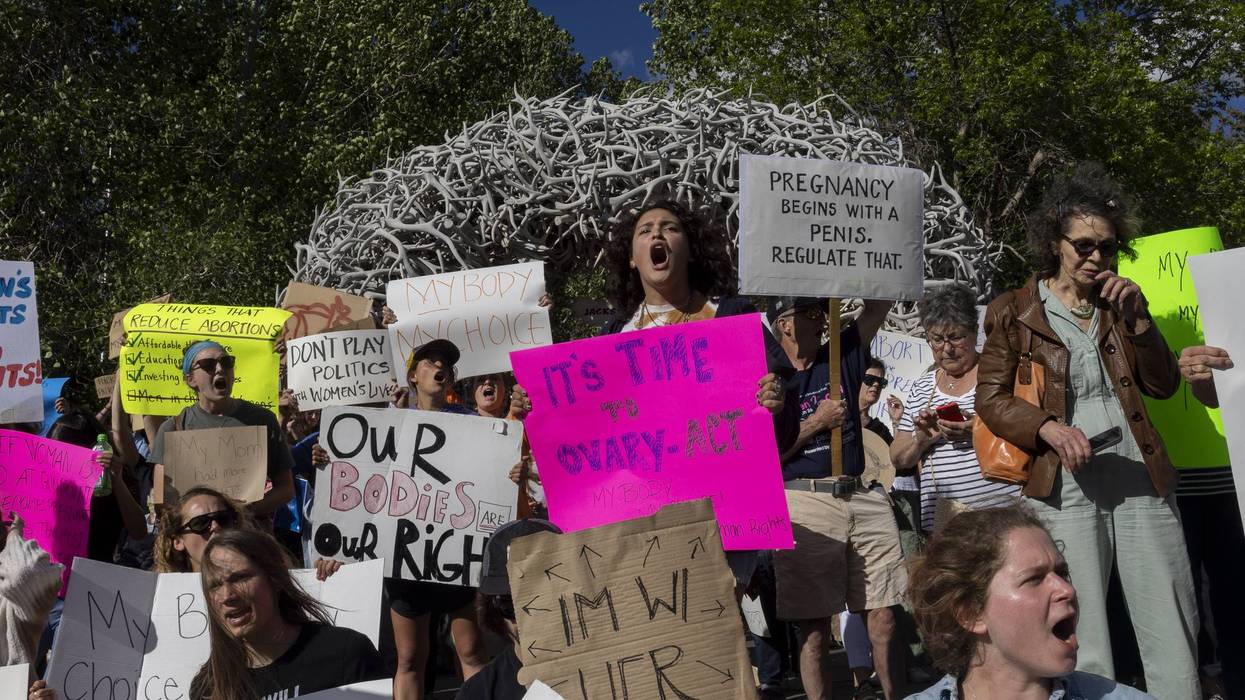
"This new law is part of a relentless campaign by anti-abortion extremists who continue to push restrictions regardless of settled law, patient safety, or basic compassion," said one critic.
A reproductive rights group coalition that recently got two anti-abortion laws overturned in Wyoming's Supreme Court filed a legal challenge on Tuesday against the insidiously named "fetal heartbeat" legislation signed earlier this week by the state's Republican governor.
The advocacy groups Chelsea's Fund and Just the Pill; Wellspring Health Access, Wyoming's only abortion clinic; and three physicians filed a motion seeking to block HB 0126, the so-called Human Heartbeat Act, which was signed Monday by Gov. Mark Gordon.
The law bans abortion when there is a "detectable fetal heartbeat." Critics note that the term "fetal heartbeat" is medically inaccurate and misleading, as what can be detected with a transvaginal ultrasound at around six weeks of gestation is not an actual heartbeat, but rather electrical activity in fetal tissue that later develops into a heart.
The legislation contains an exception to “preserve the woman from an imminent peril that substantially endangers her life or health, according to appropriate medical judgment," but forces victims of rape and incest to carry their abusers' fetus to term.
The “uNfOrTuNaTe fLaW” he's referring to is that the state's abortion ban has no rape or incest exception. 🤬But this is no accident; these policies are DESIGNED to violate our basic human rights. For the extremists who champion these violent laws, this is a feature, not a bug.
[image or embed]
— Center for Reproductive Rights (@reprorights.org) March 11, 2026 at 7:51 AM
Gordon called the glaring lack of exceptions for rape or incest "an unfortunate flaw."
Wyoming's Republican-dominated Legislature passed the law after the state Supreme Court struck down two other pieces of forced-birth legislation in January.
One of the overturned laws outlawed abortion in nearly all cases, except when the pregnant patient’s life is in danger or for victims of rape or incest. The other banned abortion pills. Both laws were passed after the US Supreme Court overturned Roe v. Wade, reversing half a century of federal abortion rights.
In striking down the laws, the state's high court ruled that they violated residents' ability to make their own healthcare decisions—a right enshrined in the Wyoming Constitution.
The groups challenging the new law echoed the ruling in their motion, arguing the legislation "transgresses the constitutional guarantee of plaintiffs’ and individuals’ to make healthcare decisions without interference from the government."
Chelsea's Fund executive director Janean Forsyth expressed dismay over state lawmakers' relentless attacks on healthcare.
“I'm thinking about everyone from the 15-year-old that we supported, whose grandmother actually reached out, a victim of sexual assault,” Forsyth told Wyoming Public Radio on Wednesday. “I'm thinking about a family with a very wanted pregnancy that we supported in eventually seeking an abortion for a severe fetal anomaly.”
"It's not only affecting access to abortion care, it's affecting reproductive healthcare access generally for parents and children, which is really unfortunate,” she added, referring to medical professionals who are leaving the state for fear of prosecution.
On Wednesday, Brittany Fonteno, president and CEO of the National Abortion Federation (NAF), said in a statement:
A mere two months after two abortion bans were struck down by the state’s Supreme Court, Wyoming’s anti-abortion leaders have enacted yet another ban despite clear judicial rulings and public support for the constitutional right to make personal healthcare decisions. This new law is part of a relentless campaign by anti-abortion extremists who continue to push restrictions regardless of settled law, patient safety, or basic compassion.
“But as they have before, providers are standing firm and fighting back," Fonteno added. "NAF is proud to support Wellspring Health Access and the advocates challenging this ban, and we remain committed to ensuring abortion care is not only legal, but accessible and protected for every person, in every state.”
Abortion access has been tenuous in Wyoming in recent years, with bans and a 2022 arson attack on the Wellspring Health Access clinic in Casper—the state's only full-service abortion facility—causing uncertainty and delays.
Lawmakers in Wyoming considered putting the issue before voters in a referendum but decided against doing so, as such ballot measures have repeatedly resulted in the protection of abortion rights—even in deep "red" and conservative-leaning states including Arizona, Kansas, Michigan, Missouri, Montana, and Ohio.
Wyoming is the fifth state to ban abortion at around six weeks, joining Florida, Georgia, Iowa, and South Carolina.
According to the Guttmacher Institute, 13 states currently have near-total abortion bans, while 28 other states restrict the procedure. Numerous forced-birth bills are pending across the nation, and—while unlikely to pass—the most severe proposals including punishing the medical procedure with lengthy imprisonment and even the death penalty for healthcare providers and patients.
Wyoming’s governor signed into law a so-called “fetal heartbeat” ban. Abortion is now banned in the state when “cardiac activity” is detected, around 6 wks of pregnancy. WY now shifts from “Restrictive” to “Very Restrictive” on our interactive map. Learn more: https://gu.tt/4985P4S#AbortionAccess
[image or embed]
— Guttmacher (@guttmacher.org) March 11, 2026 at 6:00 AM
On Monday, the Center for Reproductive Rights published a report examining the human and economic toll of abortion bans, which a separate study last year by the Population Reference Bureau has linked to 478 excess infant deaths and 59 excess deaths of pregnant people since Roe was struck down nearly four years ago.
It's not only state-level bans that harm patients. Republicans' so-called One Big Beautiful Bill Act, signed into law by President Donald Trump last year, contains the biggest cuts to Medicaid in the program's 60-year history. Dramatically decreased Medicaid funding has resulted in the closure of at least 50 Planned Parenthood clinics nationwide, and the reduction of services at many others.