SUBSCRIBE TO OUR FREE NEWSLETTER
Daily news & progressive opinion—funded by the people, not the corporations—delivered straight to your inbox.
5
#000000
#FFFFFF
To donate by check, phone, or other method, see our More Ways to Give page.
Daily news & progressive opinion—funded by the people, not the corporations—delivered straight to your inbox.
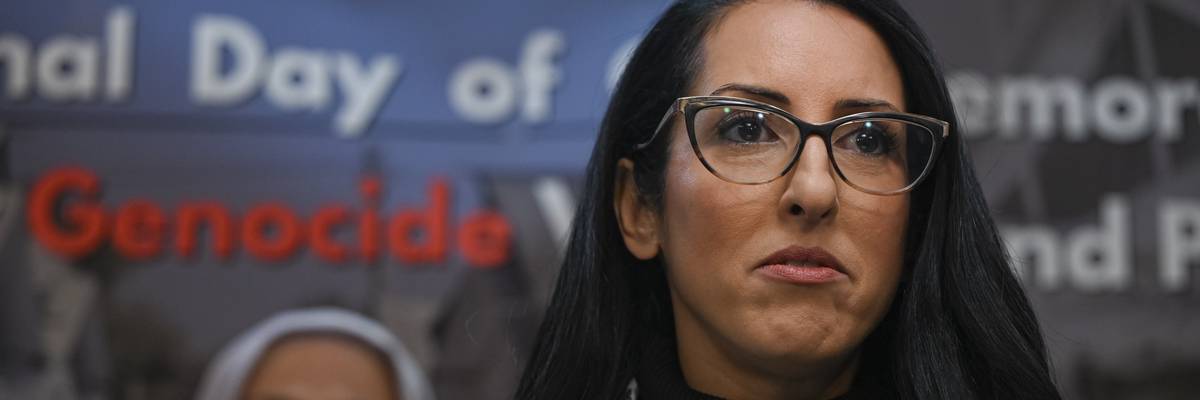
Former State Department official Hala Rharrit speaks during the press conference held by doctors who returned from Gaza at the Council on American-Islamic Relations headquarters in Washington, DC on December 9, 2024.
"They actually had the power to stop unconditional arms assistance to Israel," said Hala Rharrit. "They enabled it 100%."
Recent expressions of regret by top Biden administration officials who vehemently defended the United States' billions of dollars in military aid to Israel as it was bombarding Gaza have not gone far with former diplomat Hala Rharrit, who was retaliated against for speaking out about the US policy before she ultimately resigned, and who condemned her former colleagues recent "PR game" this week.
In an interview with Middle East Eye, Rharrit said the former officials who have mused that they would now support withholding weapons from Israel, or that they should have backed such a move while serving under President Joe Biden, are "just so despicable."
"They're so disgusting," Rharrit said. "Those individuals, particularly [National Security Adviser] Jake Sullivan and a handful of others, actually had the power to save human lives. They actually had the power to stop unconditional arms assistance to Israel, right? The Israelis were not killing the Palestinians by themselves. The Israelis were killing the Palestinians with American bombs, with American jets, with American everything. We enabled it 100%. They enabled it 100%."
"They’re so disgusting."
Former US diplomat Hala Rharrit, who resigned in 2024 over Gaza, responds to the Biden officials who’ve recently claimed they should have done more on Gaza.
Watch early by joining MEE's YouTube membership ➡ https://t.co/kSRg1sVXCo pic.twitter.com/szijxYjczk
— Middle East Eye (@MiddleEastEye) August 27, 2026
Rharrit, who resigned as the Arabic language spokesperson for the US State Department in April 2024, six months into Israel's US-backed assault—which has been called a genocide by leading human rights organizations and Holocaust experts—spoke to MEE months after former Secretary of State Antony Blinken said the US should have called for a ceasefire earlier than it did, "such that the suffering the people endured, the loss of the children, so many others, could have been averted.”
Sullivan last year said—weeks before a ceasefire was finally agreed to—that he'd had a change of heart regarding providing Israel with weapons, and that he would no longer support the policy.
In November, Sullivan added in an interview with The Dartmouth that "it’s fair to say that there were a lot of objections from a lot of parts of the international community about the US continuing to support Israel over the course of last year—2024—and over the course of this year in 2025. I think a lot about what we could have done differently."
Rharrit told MEE that "it's despicable that now they're trying to make themselves look like, 'Oh we should have done better and we're so sorry.'"
The former diplomat emphasized that the apology tour has taken place as it's become increasingly clear that "America has changed" in terms of its views on Israel, Palestine, and the United States' decadeslong, unconditional support for the Israeli military—despite US statutes like the Foreign Assistance Act of 1961 and Leahy Laws, which bar the government from providing military aid to countries that block humanitarian assistance and that are accused of human rights abuses.
A poll released this week showed that large majorities of Democratic voters in the first six states that will vote in the 2028 presidential primaries support cutting off weapons aid to Israel, and another survey by Hart Research Associates and Public Opinion Strategies in March found that just 32% of Americans viewed Israel positively, compared with 47% in 2023.
"America is forever changed," said Rharrit. "Americans no longer support these forever wars, they no longer support unconditional arms assistance to Israel. They no longer agree with US policy in the Middle East. And so now... they're doing a PR game. This is just pure PR."
Rharrit and other officials who resigned over the US policy on Israel and Gaza "were vindicated," she said. "Of course we were right the whole time, because it's international law. It's US law. I abided by my oath to the Constitution... That is exactly what I did. That is exactly why I resigned."
Francesca Albanese, the United Nations special rapporteur on the occupied Palestinian territories, said Rharrit is one of "a rare breed" of diplomats.
"During this genocide I've met courageous diplomats and officials who denounced it at real personal cost," said Albanese, whom the Trump administration targeted with sanctions earlier this year. "Imagine foreign policy built by more of them. Because the problem is never one unfit minister/head of state: It's whole spineless cohorts around them."
Dear Common Dreams reader, It’s been nearly 30 years since I co-founded Common Dreams with my late wife, Lina Newhouser. We had the radical notion that journalism should serve the public good, not corporate profits. It was clear to us from the outset what it would take to build such a project. No paid advertisements. No corporate sponsors. No millionaire publisher telling us what to think or do. Many people said we wouldn't last a year, but we proved those doubters wrong. Together with a tremendous team of journalists and dedicated staff, we built an independent media outlet free from the constraints of profits and corporate control. Our mission has always been simple: To inform. To inspire. To ignite change for the common good. Building Common Dreams was not easy. Our survival was never guaranteed. When you take on the most powerful forces—Wall Street greed, fossil fuel industry destruction, Big Tech lobbyists, and uber-rich oligarchs who have spent billions upon billions rigging the economy and democracy in their favor—the only bulwark you have is supporters who believe in your work. But here’s the urgent message from me today. It's never been this bad out there. And it's never been this hard to keep us going. At the very moment Common Dreams is most needed, the threats we face are intensifying. We need your support now more than ever. We don't accept corporate advertising and never will. We don't have a paywall because we don't think people should be blocked from critical news based on their ability to pay. Everything we do is funded by the donations of readers like you. When everyone does the little they can afford, we are strong. But if that support retreats or dries up, so do we. Will you donate now to make sure Common Dreams not only survives but thrives? —Craig Brown, Co-founder |
Recent expressions of regret by top Biden administration officials who vehemently defended the United States' billions of dollars in military aid to Israel as it was bombarding Gaza have not gone far with former diplomat Hala Rharrit, who was retaliated against for speaking out about the US policy before she ultimately resigned, and who condemned her former colleagues recent "PR game" this week.
In an interview with Middle East Eye, Rharrit said the former officials who have mused that they would now support withholding weapons from Israel, or that they should have backed such a move while serving under President Joe Biden, are "just so despicable."
"They're so disgusting," Rharrit said. "Those individuals, particularly [National Security Adviser] Jake Sullivan and a handful of others, actually had the power to save human lives. They actually had the power to stop unconditional arms assistance to Israel, right? The Israelis were not killing the Palestinians by themselves. The Israelis were killing the Palestinians with American bombs, with American jets, with American everything. We enabled it 100%. They enabled it 100%."
"They’re so disgusting."
Former US diplomat Hala Rharrit, who resigned in 2024 over Gaza, responds to the Biden officials who’ve recently claimed they should have done more on Gaza.
Watch early by joining MEE's YouTube membership ➡ https://t.co/kSRg1sVXCo pic.twitter.com/szijxYjczk
— Middle East Eye (@MiddleEastEye) August 27, 2026
Rharrit, who resigned as the Arabic language spokesperson for the US State Department in April 2024, six months into Israel's US-backed assault—which has been called a genocide by leading human rights organizations and Holocaust experts—spoke to MEE months after former Secretary of State Antony Blinken said the US should have called for a ceasefire earlier than it did, "such that the suffering the people endured, the loss of the children, so many others, could have been averted.”
Sullivan last year said—weeks before a ceasefire was finally agreed to—that he'd had a change of heart regarding providing Israel with weapons, and that he would no longer support the policy.
In November, Sullivan added in an interview with The Dartmouth that "it’s fair to say that there were a lot of objections from a lot of parts of the international community about the US continuing to support Israel over the course of last year—2024—and over the course of this year in 2025. I think a lot about what we could have done differently."
Rharrit told MEE that "it's despicable that now they're trying to make themselves look like, 'Oh we should have done better and we're so sorry.'"
The former diplomat emphasized that the apology tour has taken place as it's become increasingly clear that "America has changed" in terms of its views on Israel, Palestine, and the United States' decadeslong, unconditional support for the Israeli military—despite US statutes like the Foreign Assistance Act of 1961 and Leahy Laws, which bar the government from providing military aid to countries that block humanitarian assistance and that are accused of human rights abuses.
A poll released this week showed that large majorities of Democratic voters in the first six states that will vote in the 2028 presidential primaries support cutting off weapons aid to Israel, and another survey by Hart Research Associates and Public Opinion Strategies in March found that just 32% of Americans viewed Israel positively, compared with 47% in 2023.
"America is forever changed," said Rharrit. "Americans no longer support these forever wars, they no longer support unconditional arms assistance to Israel. They no longer agree with US policy in the Middle East. And so now... they're doing a PR game. This is just pure PR."
Rharrit and other officials who resigned over the US policy on Israel and Gaza "were vindicated," she said. "Of course we were right the whole time, because it's international law. It's US law. I abided by my oath to the Constitution... That is exactly what I did. That is exactly why I resigned."
Francesca Albanese, the United Nations special rapporteur on the occupied Palestinian territories, said Rharrit is one of "a rare breed" of diplomats.
"During this genocide I've met courageous diplomats and officials who denounced it at real personal cost," said Albanese, whom the Trump administration targeted with sanctions earlier this year. "Imagine foreign policy built by more of them. Because the problem is never one unfit minister/head of state: It's whole spineless cohorts around them."
Recent expressions of regret by top Biden administration officials who vehemently defended the United States' billions of dollars in military aid to Israel as it was bombarding Gaza have not gone far with former diplomat Hala Rharrit, who was retaliated against for speaking out about the US policy before she ultimately resigned, and who condemned her former colleagues recent "PR game" this week.
In an interview with Middle East Eye, Rharrit said the former officials who have mused that they would now support withholding weapons from Israel, or that they should have backed such a move while serving under President Joe Biden, are "just so despicable."
"They're so disgusting," Rharrit said. "Those individuals, particularly [National Security Adviser] Jake Sullivan and a handful of others, actually had the power to save human lives. They actually had the power to stop unconditional arms assistance to Israel, right? The Israelis were not killing the Palestinians by themselves. The Israelis were killing the Palestinians with American bombs, with American jets, with American everything. We enabled it 100%. They enabled it 100%."
"They’re so disgusting."
Former US diplomat Hala Rharrit, who resigned in 2024 over Gaza, responds to the Biden officials who’ve recently claimed they should have done more on Gaza.
Watch early by joining MEE's YouTube membership ➡ https://t.co/kSRg1sVXCo pic.twitter.com/szijxYjczk
— Middle East Eye (@MiddleEastEye) August 27, 2026
Rharrit, who resigned as the Arabic language spokesperson for the US State Department in April 2024, six months into Israel's US-backed assault—which has been called a genocide by leading human rights organizations and Holocaust experts—spoke to MEE months after former Secretary of State Antony Blinken said the US should have called for a ceasefire earlier than it did, "such that the suffering the people endured, the loss of the children, so many others, could have been averted.”
Sullivan last year said—weeks before a ceasefire was finally agreed to—that he'd had a change of heart regarding providing Israel with weapons, and that he would no longer support the policy.
In November, Sullivan added in an interview with The Dartmouth that "it’s fair to say that there were a lot of objections from a lot of parts of the international community about the US continuing to support Israel over the course of last year—2024—and over the course of this year in 2025. I think a lot about what we could have done differently."
Rharrit told MEE that "it's despicable that now they're trying to make themselves look like, 'Oh we should have done better and we're so sorry.'"
The former diplomat emphasized that the apology tour has taken place as it's become increasingly clear that "America has changed" in terms of its views on Israel, Palestine, and the United States' decadeslong, unconditional support for the Israeli military—despite US statutes like the Foreign Assistance Act of 1961 and Leahy Laws, which bar the government from providing military aid to countries that block humanitarian assistance and that are accused of human rights abuses.
A poll released this week showed that large majorities of Democratic voters in the first six states that will vote in the 2028 presidential primaries support cutting off weapons aid to Israel, and another survey by Hart Research Associates and Public Opinion Strategies in March found that just 32% of Americans viewed Israel positively, compared with 47% in 2023.
"America is forever changed," said Rharrit. "Americans no longer support these forever wars, they no longer support unconditional arms assistance to Israel. They no longer agree with US policy in the Middle East. And so now... they're doing a PR game. This is just pure PR."
Rharrit and other officials who resigned over the US policy on Israel and Gaza "were vindicated," she said. "Of course we were right the whole time, because it's international law. It's US law. I abided by my oath to the Constitution... That is exactly what I did. That is exactly why I resigned."
Francesca Albanese, the United Nations special rapporteur on the occupied Palestinian territories, said Rharrit is one of "a rare breed" of diplomats.
"During this genocide I've met courageous diplomats and officials who denounced it at real personal cost," said Albanese, whom the Trump administration targeted with sanctions earlier this year. "Imagine foreign policy built by more of them. Because the problem is never one unfit minister/head of state: It's whole spineless cohorts around them."